
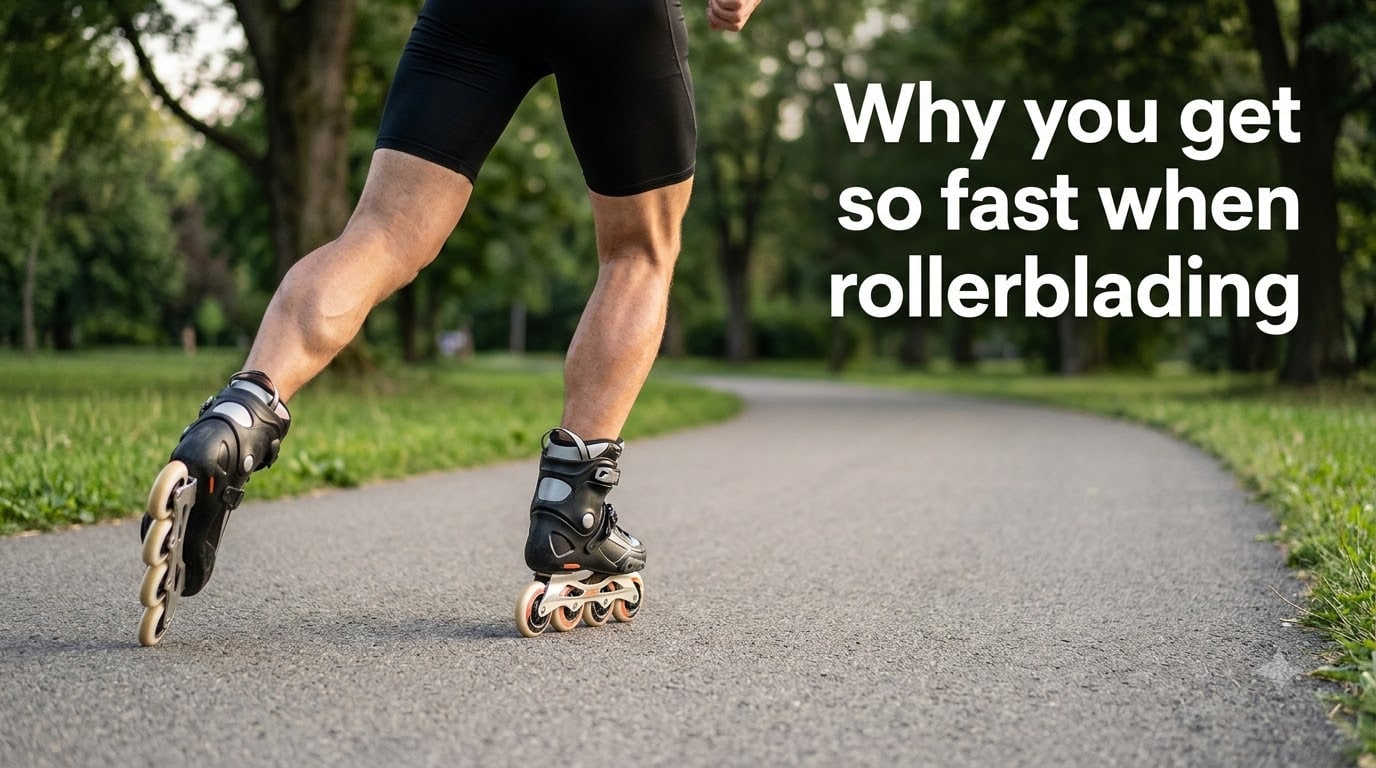
You get tired so fast when rollerblading because the activity recruits your glutes, quads, hamstrings, calves, and core all at the same time while you fight to stay balanced on wheels. Unlike walking or running, every stride demands constant stabilizer muscle engagement and subtle balance corrections, which burns through energy at a surprising rate, especially for beginners.
I remember my first real skate session, a sunny loop through a park that should have been easy. After about 20 minutes my calves were burning, my lower back ached, and I had to stop three times before I even finished one mile. I thought something was wrong with me. Nothing was wrong. My body just had not learned the movement yet, and that learning curve is the main reason rollerblading exhausts people so quickly.
In this guide I will walk you through the exact reasons rollerblading fatigue hits so hard. We will cover the muscles involved, the physics of the V-stance, the beginner mistakes that drain your tank, and the training tricks that build real rollerblading endurance. By the end you will know whether your tiredness is normal, what to fix in your technique, and how to keep rolling longer.
Table of Contents
How Tiring Is Rollerblading Compared to Other Exercises
Rollerblading is genuinely more demanding than most beginners expect. The American Council on Exercise lists inline skating at about 8.5 to 9 METs (metabolic equivalents) at a moderate pace, putting it in the same intensity zone as running a 6 minute mile. Walking scores only 3.5 to 5 METs and casual cycling scores around 6 METs.
That means an average 160 pound person burns roughly 600 to 700 calories per hour of moderate rollerblading. The same person burns only 280 to 350 calories walking at 3.5 mph. Cyclists cover more ground per calorie, while runners burn similar calories but recruit fewer stabilizer muscles because their feet leave the ground on each stride.
The high metabolic cost explains why you gasp for air after short sessions. Your cardiovascular system has to deliver oxygen fast enough to feed muscles that are working much harder than the speed of your skating suggests.
What Muscles Does Rollerblading Work the Most?
Rollerblading lights up nearly every major muscle group in your lower body, plus your core. Healthline’s analysis of skating biomechanics highlights four primary movers and a network of stabilizers that keep you upright on four narrow wheels.
The primary muscles worked include:
Glutes (gluteus maximus and gluteus medius) power every push and stabilize your hips.
Quadriceps extend your knee during the glide phase and hold you in a slightly squatting stance.
Hamstrings assist hip extension and stabilize the back of the knee.
Calves (gastrocnemius and soleus) handle ankle stability and absorb the constant micro-corrections.
Core muscles, including the abdominals, spinal erectors, and obliques, keep your torso from twisting.
What surprises beginners is the role of stabilizer muscles. The gluteus medius, hip abductors, and deep ankle stabilizers rarely get challenged in everyday walking. On skates they fire thousands of times per minute, and they have very little endurance when you first start. That is why your legs give out long before your heart rate does.
Why Rollerblading Feels So Hard for Beginners?
If you have been skating for under three months, your fatigue is mostly a training issue, not a fitness issue. Beginners fatigue quickly because the movement pattern is new and your body has not yet built efficient neural pathways for it. Reddit users on r/Rollerskating describe this exact pattern: skating 15 to 30 minutes at a moderate pace before needing a break, even when they can run or bike much longer.
Three factors make the first weeks feel brutal:
Untrained muscle fibers. Slow twitch fibers used for walking do most of the work. Fast twitch fibers take over during balance corrections and tire quickly.
Mental concentration. Every wobble demands attention. Holding that focus uses real energy, almost like solving math problems while jogging.
Tension and clenching. New skaters grip the inside of their boots with their toes and lock their ankles, multiplying the workload on small muscles.
I experienced all three. The day everything clicked, around week four, was the day my legs stopped screaming at 20 minutes. Before that, my body simply did not know how to coordinate the motion without strain.
The V-Stance and Forward Motion: How Skating Physics Drains You
Inline skating propulsion is unlike any other land sport. You push from a V-stance, gliding each leg outward and back, which means your adductors (inner thigh) and gluteus medius work through ranges of motion they rarely use in walking or running. These muscles fatigue fast because they are smaller and have less endurance capacity than the big quadriceps.
Once you finish a push, you glide on one foot. That single-leg balance phase activates every stabilizer from your foot to your hip. Runners get a brief flight phase between steps. Cyclists stay planted on a wide saddle. Rollerbladers have to keep the skate perfectly aligned or risk a sideways slip, so the stabilization never stops.
The combined effect: you use big muscles for power and small muscles for stability, all at the same time. Your body has two jobs in parallel, and it pays for both in energy.
Technique Mistakes That Accelerate Fatigue
Bad form multiplies the work your body has to do. Skatefresh’s coaching resources point out three technique errors that quietly exhaust beginners. Fix them and you can often double your session length without training.
Standing too upright. Locked knees put all the shock into your joints and require constant micro-adjustments from your quads. A slight knee bend lowers your center of gravity and lets your muscles absorb impact elastically.
Toe-gripping and ankle tension. When the boot feels unstable, beginners curl their toes inside the skate. This shortens the calf muscles and pumps them up until they cramp. Relaxed ankles let the boot do the work.
Overstriding and braking with the feet. Reaching far forward on each push loads the hamstrings heavily. Dragging the back foot to slow down wastes the energy of every stride. Push out at a comfortable angle, and use a heel brake or scissor stop instead of friction.
These mistakes share a common root: tension. The more you fight your skates, the harder every muscle has to work.
How to Build Rollerblading Stamina and Last Longer?
Building real rollerblading endurance is a mix of better technique, smart training, and off-skate conditioning. Here is what actually moves the needle based on my own experience and what experienced skaters recommend on forums.
Bend the knees and relax the ankles. Aim for about a 20 to 30 degree knee bend. Let the boot hug your foot instead of gripping it back. You should be able to wiggle your toes inside the boot at all times.
Push from the heels. Power comes from your heel rolling outward, not your toe. Heel pushes engage the glutes and hamstrings, the muscles built for endurance, and save your calves for stability.
Use interval training. Skate hard for 2 minutes, easy for 1 minute, repeat for 20 minutes. Intervals build anaerobic capacity faster than steady cruising because they recruit more muscle fibers.
Strengthen off-skate. Bodyweight squats, side-lying leg lifts, and single-leg balance drills on a couch cushion all train the same muscles skating demands. Three 20 minute sessions a week cuts adaptation time roughly in half.
Hydrate and breathe rhythmically. Aim for one sip of water every 10 minutes and breathe in for two strides, out for two. A steady breathing cadence keeps oxygen flowing and delays the burning sensation in your legs.
Most skaters I have coached feel a noticeable difference in two to three weeks once these habits click.
How Long Until Rollerblading Stops Feeling So Tiring?
For most beginners, rollerblading fatigue peaks in the first two weeks and then drops sharply between weeks three and six. By week eight, a 45 minute session at moderate pace should feel comfortable. Your body adapts in three overlapping phases.
First, your nervous system learns the V-stance and balance corrections become automatic. Second, your stabilizer muscles grow stronger and tolerate longer contractions. Third, your cardiovascular system catches up to the 8 to 9 MET demand.
Consistency matters more than distance. Three short sessions a week build endurance faster than one long weekly grind. If you can only manage 15 minutes today, do that three times this week. Next week you will likely manage 20.
Frequently Asked Questions
How tiring is rollerblading?
Rollerblading rates about 8.5 to 9 METs, which puts it in the same intensity zone as running a 6 minute mile. A 160 pound person burns roughly 600 to 700 calories per hour at a moderate pace, which is more than double the calories burned walking at 3.5 mph. The high metabolic cost is why new skaters feel exhausted after short sessions.
What muscles does rollerblading work the most?
Rollerblading primarily works the glutes (maximus and medius), quadriceps, hamstrings, calves, and core. The gluteus medius and hip abductors act as stabilizers during the V-stance push, while the core and spinal erectors keep your torso upright during single-leg glides.
Is rollerblading hard for beginners?
Yes, rollerblading is hard for beginners because the movement pattern is new and requires constant balance correction on wheels. Most beginners fatigue after 15 to 30 minutes at moderate pace, even if they can run or bike much longer. The learning curve typically lasts 4 to 8 weeks of consistent practice.
Why do my legs hurt after rollerblading?
Your legs hurt after rollerblading because the activity recruits muscles that are rarely used in everyday walking, especially the gluteus medius, hip abductors, calves, and deep core stabilizers. These muscles fatigue quickly when they are untrained, which causes the burning sensation in your lower legs and the deep ache in your hips after a session.
How long does it usually take to learn how to rollerblade?
Most people learn basic rollerblading within 4 to 8 weeks of consistent practice, three sessions per week. Comfort on skates typically arrives around week three, while endurance for 45 minute sessions usually develops by week six. Falling frequency drops sharply after the first month.
What are two major causes of muscle fatigue?
The two major causes of muscle fatigue are metabolic buildup and neural deconditioning. Metabolic buildup happens when lactate, hydrogen ions, and inorganic phosphate accumulate faster than blood can clear them. Neural deconditioning happens when untrained stabilizer muscles run out of efficient motor unit recruitment, which is why beginners fatigue fast even at low effort.
Final Thoughts on Rollerblading Fatigue
Why you get tired so fast when rollerblading comes down to one simple truth: inline skating asks a lot of your body at once. The V-stance pushes from muscles that walking barely uses, the single-leg glides demand constant stabilizer work, and the 8 to 9 MET intensity taxes your heart and lungs harder than the casual speed suggests.
The good news is that all of this is trainable. Bend your knees, relax your ankles, push from the heels, breathe rhythmically, and skate three short sessions a week. In about six weeks, the same loop that wrecked you on day one will feel like a warm up.
Stick with it. The first month is the hardest, and then rollerblading becomes one of the most rewarding low-impact workouts you can do.