
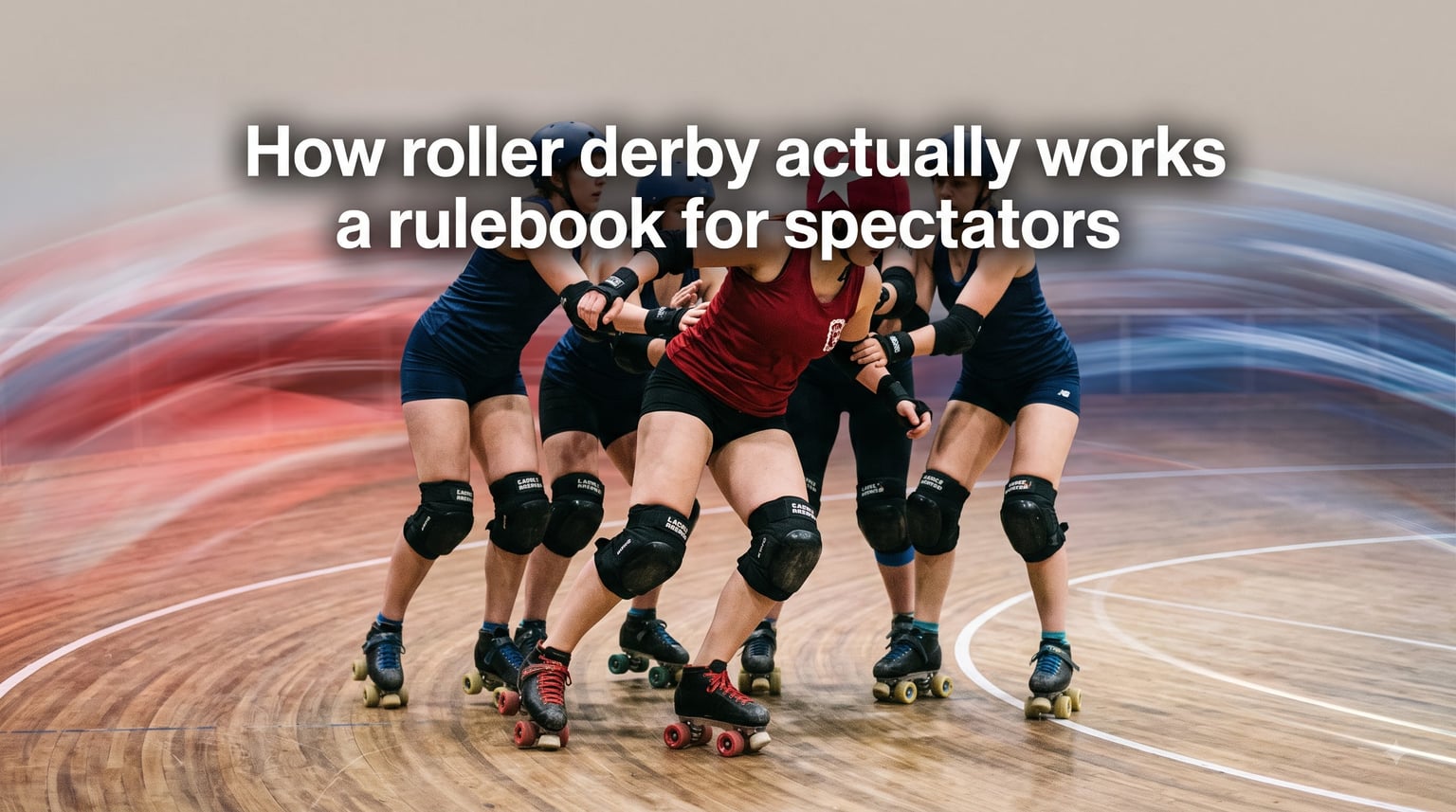
I went to my first flat track roller derby match expecting chaos and elbows. Two hours later, I was hooked on the strategy. If you are searching for how roller derby works and what the rules actually are, this spectator rulebook walks you through everything happening on the track in 2026.
Roller derby is a full-contact sport played on quad roller skates where two teams of five skaters compete on a flat oval track. The whole game comes down to one thing: a designated point-scorer called the jammer racing through the pack of opposing blockers to earn a point for every opponent they lap. Everything else – the penalties, the pivots, the lead jammer calls – exists to make that scoring race work.
Table of Contents
How Roller Derby Works in 60 Seconds?
Every roller derby game is split into two 30-minute periods, and each period is broken into short plays called jams that last up to two minutes. Both teams line up on the track, the jammers start behind the pack, the whistle blows, and the jammers fight through a wall of blockers while the rest of the team defends or clears a path.
The first jammer to legally pass every opposing blocker becomes the lead jammer and earns the right to end the jam early by tapping their hips. Points are scored only on the jammer’s second trip through the pack – one point for each opposing blocker passed. That is the whole sport in two sentences. The rest of this guide unpacks what that actually looks like when you are sitting in the stands.
Game Format: How Roller Derby Is Structured?
A flat track roller derby game is played on a flat, oval track that is typically marked off on a flat surface like a basketball court or hockey rink. The track is flat – not banked like older banked-track versions of the sport – which is why the modern game is officially called flat track roller derby.
Each game has two 30-minute periods, with a halftime break between them. Inside each period, the gameplay is broken into short units called jams. A jam can last up to two minutes but can end sooner if the lead jammer calls it off. Between jams there is a 30-second break where teams regroup, set up their blockers, and position the jammers for the next play.
Each team puts five skaters on the track for every jam. One skater is the jammer (the point-scorer), one skater wears a special striped helmet cover and acts as the pivot (a defensive captain who can become the jammer), and the remaining three skaters are blockers. Together, the blockers and pivot from both teams form what is called the pack.
The Three Skater Roles: Jammer, Pivot, and Blocker
Every player on the track has a defined role, and you can spot which is which by the helmet cover they wear. The jammer wears a cover with a star on each side, the pivot wears a striped cover, and blockers wear no cover at all.
The Jammer
The jammer is the point-scorer for the team. There is one jammer per team per jam, and they start each jam behind the pack. Their job is to skate through the opposing blockers, lap them, and then keep skating to score a point for each opposing blocker they pass on the second and subsequent trips through the pack.
Jammers also need to be tough. They get hit, blocked, and knocked down constantly, but they can also use their hips and shoulders to push back through blockers. This is the position that scores, so the team usually puts their best all-around athlete here.
The Pivot
The pivot wears the striped helmet cover and starts each jam at the front of the pack. They are a defensive captain who controls the team’s formation, calls blocking plays, and acts as the last line of defense before the jammer can break through.
The pivot has a special power: they can receive the star helmet cover from the jammer during a jam and instantly become the new jammer. This play is called a star pass, and it lets teams swap scorers mid-jam if the original jammer is stuck behind the pack or in the penalty box.
The Blockers
Blockers are the muscle of the team. They use their bodies – shoulders, hips, torsos – to block opposing jammers from getting through the pack, while also trying to clear a path for their own jammer. Blocking is legal when done with the front of the body above the mid-thigh and using established contact zones on the opponent.
Every team fields three blockers per jam. Working with the pivot, the four non-jammer skaters form the team’s blocking formation.
How a Jam Actually Works, Step by Step
If you have watched one jam and felt completely lost, you are not alone. Most spectators need three or four jams before things click. Here is a step-by-step walkthrough of what happens from the first whistle to the end of a jam.
The referees line up the pack: four blockers from each team skate slowly counterclockwise around the track until the pack is formed at the start line.
Jammers take their position: each jammer lines up behind the pack, on the inside line of the track, ready to sprint.
The first whistle blows: the pack starts skating, and the jammers explode forward to fight through the blockers in front of them.
Jammers try to break out: each jammer tries to legally pass every opposing blocker to escape the pack on their first trip.
Lead jammer is declared: the first jammer to exit the pack legally becomes the lead jammer, signaled by two short referee whistles.
Scoring begins: as the lead jammer comes back through the pack for a second lap, they start scoring one point for each opposing blocker they pass.
The jam ends: the lead jammer taps their hips twice to call off the jam, or the 2-minute jam clock runs out.
Once you can see those seven steps happening live, the entire sport starts to make sense. Everything else – penalties, the pack, hand signals – is layered on top of that simple flow.
Lead Jammer and the Power of Calling It Off
The lead jammer is one of the most important concepts in roller derby, and it gives one team enormous strategic control during every jam. Lead jammer status goes to the first jammer who legally passes every opposing blocker on the pack.
Once a jammer is declared lead jammer, they earn a huge tactical advantage: they can end the jam at any time by tapping their hips with both hands. This is called calling off the jam. If the lead jammer’s team is losing the score battle on that jam, they call it off immediately to stop the bleeding.
If the lead jammer’s team is winning the jam, they let the clock run as long as possible to keep racking up points. This trade-off between ending jams early versus scoring more points is where most of roller derby strategy lives. It also means the first jammer out of the pack often dictates the entire pace of a game.
Scoring: How Points Are Earned in Roller Derby
Scoring in roller derby only happens when the jammer is on their second or later trip through the pack. The first trip is for lead jammer status only – no points are scored no matter how many opponents the jammer passes.
After the jammer has cleared the pack the first time, every opposing blocker they then pass – on the hips, torso, or rear – earns the jammer exactly one point. Penalties, blockers in the penalty box, and skaters off the track all count as passable opponents.
A single jam can theoretically produce a lot of points if a strong jammer makes multiple scoring passes. In practice, most jams see between zero and ten points scored per team, and the lead jammer’s decision to call it off early is what usually keeps scores in that range.
Penalties and the Penalty Box Explained
Penalties are the main way referees keep roller derby safe and legal. Skaters who break the rules sit in the penalty box for 30 seconds, leaving their team short-handed during that jam.
Here are the most common penalties you will see called at a roller derby game.
Back block: hitting an opponent from behind, which is illegal because they cannot see it coming.
High block: contacting an opponent above the shoulders, including with the head, elbows, or forearms.
Low block: hitting an opponent below the mid-thigh, like kicking out a skate or tripping.
Forearms: using forearms or elbows to push or hit instead of legal body contact.
Cutting the track: leaving the track in front of an opponent to gain a positional advantage.
Multi-player block: two teammates blocking together in a way that creates an illegal wall.
Skaters who pick up seven penalties during a game foul out and must sit in the penalty box for the rest of the match. When that happens, their team plays the remaining jams down a skater, which is a huge disadvantage.
What the Pack Is and Why It Matters
The pack is the largest group of blockers from both teams skating together as a unit. It includes all in-play blockers and pivots from both teams and is the cluster of skaters that defines the game’s geometry.
The pack must stay together during a jam. If one team gets too far ahead or behind, the referees will signal to reform the pack, and the jammers effectively get a do-over on their scoring pass. This is why teams fight so hard to keep their blockers bunched up with the opposing blockers – if the opposing jammer has nothing to pass, no points get scored.
The pack is also the legal blocking zone. Skaters cannot block opponents who are more than 20 feet in front of or behind the pack. This 20-foot window is where every jammer’s battle takes place.
Referee Hand Signals Every Spectator Should Know
One thing almost no roller derby guide covers well is what the referees are signaling during a jam. Knowing a few key hand signals makes watching the game dramatically easier.
Lead jammer: two short blasts of the whistle, followed by referees pointing at the lead jammer.
Jammer penalty: one arm raised straight up with the opposite hand pointing at the penalized jammer.
Blocker penalty: one arm bent across the chest with the hand pointing at the offending blocker.
Pack is split: one arm extended sideways and swept back and forth, telling skaters to reform the pack.
Lead jammer status lost: after a jammer passes the pivot illegally, refs cross forearms in front of the chest to indicate lead status is revoked.
Jam called off: four short whistle blasts, with refs tapping their hips to signal the lead jammer called it.
Once you know these six signals, you can often tell what just happened in a jam before the announcer explains it.
Spectator Etiquette and Strategy Basics
If this is your first roller derby game, a few tips will make it more fun. Pick a jammer to follow visually – usually the one wearing a star helmet cover – and just track them around the track. You will see the whole story of the jam unfold through their eyes.
Cheering loud is welcomed. Roller derby crowds are famously loud and supportive, and many teams encourage fans to name their own signs or chants. The only real etiquette rule is to stay clear of the track and penalty box areas during play.
Two strategies to watch for: if a team’s jammer is stuck behind the pack, look for the star pass where the pivot takes over scoring. If a team sends all three blockers to the front of the pack to stop the jammer, that is called a wall and is one of the most dramatic blocking plays in the sport.
The sport’s official rulebook is published by the WFTDA (Women’s Flat Track Derby Association), and it has been the standard since the early 2000s. Almost every league in the world plays by these rules or a very close variant.
Frequently Asked Questions
Is roller derby real or scripted?
Yes, modern flat track roller derby is a real, full-contact sport with no predetermined outcomes. Referees enforce the WFTDA rulebook, skaters are penalized and sent to the penalty box for illegal contact, and the lead jammer makes real-time strategic decisions that determine the score.
What are the basic roller derby rules?
Each team fields one jammer and four blockers. The jammer scores one point for every opposing blocker they pass on each trip through the pack. The first jammer to legally exit the pack becomes lead jammer and can end the jam early by tapping their hips. Games are two 30-minute periods broken into up to 2-minute jams.
What does ‘eat the baby’ mean in roller derby?
Eat the baby is a slang term for a power jam – a situation where one jammer removes the opposing jammer from play by sending them to the penalty box. The remaining jammer then scores points uncontested on multiple passes through the pack.
Why do they tap their hips in roller derby?
Skaters tap their hips to signal that they are calling off the current jam. Only the lead jammer has the authority to do this, and tapping the hips twice ends the jam immediately, regardless of how much time is left on the 2-minute jam clock.
How long is a roller derby game?
A regulation flat track roller derby game lasts 60 minutes of play, split into two 30-minute periods with a halftime break. Each period is broken into multiple jams of up to 2 minutes each, with 30-second breaks between jams.
Final Whistle: Your First Roller Derby Game
If you have read this far, you now know more about how roller derby works than most first-time spectators. Pick a jammer, follow them around the track, and listen for the lead jammer signal. Within three or four jams, the speed, hits, and strategy will start clicking together. If you want the official WFTDA rulebook for deeper reading, it is published online and free for anyone curious about the sport.