
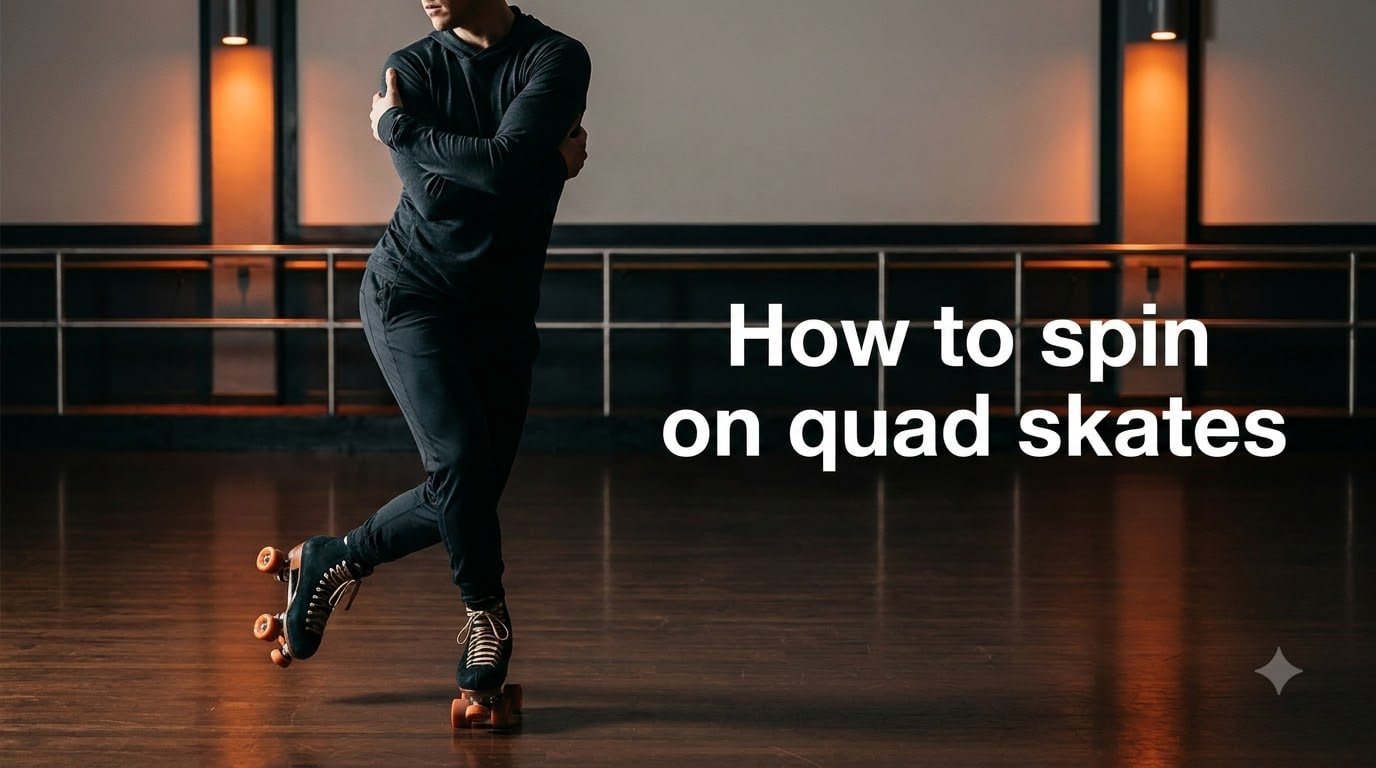
Learning how to spin on quad skates is one of those skills that looks effortless when someone else does it. Then you try it yourself and end up wobbling half a rotation before grabbing the nearest wall. I have been there, and so has pretty much every skater I know.
The good news is that spinning is not about talent or luck. It is about understanding a few core principles around balance, arm control, and edge work, then practicing them in the right order. Once those pieces click, your spins start coming together faster than you might expect.
This guide breaks down everything you need to learn how to spin on quad skates, from finding your natural spin direction to managing dizziness, fixing common mistakes, and building a progressive practice routine. Whether you are working on your very first rotation or trying to string multiple spins together, you will find specific, actionable steps here.
One thing I want to flag right away: most tutorials online treat quad skates and inline skates the same way. They are not. Quad skates have a wider wheelbase and two trucks that behave differently than the single-line blade of an inline skate. I wrote this guide specifically for quad skates, so every technique here accounts for how your trucks, wheels, and plate actually work.
Table of Contents
How Spinning Actually Works: The Physics Made Simple
Spinning on quad skates comes down to one concept: angular momentum. That sounds intimidating, but the idea is simple once you break it down.
Angular momentum is the rotational equivalent of regular momentum. When you move in a straight line, your momentum keeps you going forward. When you rotate, angular momentum keeps you turning. The faster your mass is concentrated toward your center, the faster you spin.
Think of a figure skater pulling their arms in during a spin. When their arms are extended, they rotate slowly. When they pull their arms tight to their body, they suddenly whip around much faster. That is angular momentum in action, and it works the exact same way on quad skates.
Your center of gravity is the other piece of the puzzle. To spin without falling, your weight needs to stay stacked directly over the narrowest part of your wheelbase. If your center of gravity shifts too far forward, back, or to either side, you lose the spin. Every technique in this guide ultimately serves one goal: keeping your center of gravity stable while you rotate.
Find Your Natural Spin Direction
Before you attempt any spin, you need to figure out which direction feels natural for you: clockwise or counterclockwise. Most skaters have a clear preference, and fighting against your natural direction makes learning twice as hard.
Here is a quick test you can do right now. Stand with your feet shoulder-width apart on flat ground (no skates needed). Close your eyes and imagine spinning in place. Notice which way your body wants to turn first. For most people, this matches their natural spin direction on skates.
Another method is to think about which foot you naturally push off with when skating forward. If you push with your right foot, you likely prefer spinning counterclockwise (rotating to the left). If you push with your left, clockwise rotation (to the right) may feel more natural.
Some skaters on the r/Rollerskating community suggest it relates to brain hemisphere dominance, similar to being right-handed or left-handed. There is no right or wrong direction. Pick whichever feels easier and stick with it until you build confidence. You can always learn the other direction later.
How to Spin on Quad Skates: Step-by-Step Technique
This is the core of what you came here for. I am going to walk you through the exact sequence for initiating, maintaining, and exiting a basic two-foot spin on quad skates. Follow these steps in order and practice each one individually before combining them.
Step 1: Set Your Stance and Posture
Start from a standstill with your feet about hip-width apart. Bend your knees slightly, not deeply, just enough to feel grounded and athletic. Your back should be straight, not hunched forward.
Engage your core muscles by pulling your belly button slightly inward. This creates a stable center that keeps your upper body from wobbling during rotation. Think of your core as the axis your body spins around.
Keep your weight centered evenly between both skates at this point. Look straight ahead, not down at your feet. Looking down shifts your center of gravity forward and throws off your balance before you even start.
Step 2: Position Your Arms at 90 Degrees
Extend both arms out to your sides at shoulder height, forming a 90-degree angle at your shoulders. Your elbows should be slightly bent, not locked straight. This is your starting arm position.
Imagine you are holding a large beach ball against your chest with your arms. That rounded, slightly bent shape is what you want. Straight, stiff arms make it harder to control your rotation speed later.
Keep your shoulders relaxed and down. Tension in your shoulders travels down through your core and makes the spin jerky and uncontrolled. Take a breath and let your shoulders drop before you initiate.
Step 3: Create Initial Momentum
To start the spin, wind up slightly by rotating your upper body in the opposite direction of your spin. If you spin counterclockwise, twist your shoulders gently to the right first. This creates a small counter-rotation that generates momentum when you release.
Now, unwind your upper body in your spin direction while simultaneously sweeping both arms horizontally in that same direction. Your arms act like pendulums, dragging your body into rotation. The movement should feel smooth, not forceful.
As your body begins to rotate, let your hips follow your shoulders naturally. Do not try to twist your lower body independently. The rotation should flow from top to bottom in one connected movement.
Step 4: Pull In to Accelerate
Once you feel the rotation begin, pull your arms in toward your chest. Bring them close to your body, keeping that rounded beach-ball shape. This is where the angular momentum principle kicks in, and your rotation speed increases.
The tighter you pull your arms, the faster you spin. But do not yank them in suddenly. A smooth, controlled pull gives you a clean acceleration. Jerking your arms inward causes your balance to shift and often kills the spin.
Keep your elbows close to your ribs and your hands near your chest. Your core should still be engaged. If your core goes slack here, your upper body starts to lean and you will lose the spin within a rotation or two.
Step 5: Spot and Control the Exit
As you rotate, try to spot a fixed point in the room. Each time you come around, snap your eyes back to that same point. Spotting helps your brain track your position and reduces dizziness significantly.
To exit the spin, extend your arms back out to your sides. This slows your rotation using the same angular momentum principle in reverse. As you decelerate, let your skates settle into a stable position and bend your knees slightly to absorb the remaining momentum.
Practice exiting slowly and with control. A sloppy exit where you stumble or grab for balance can become a bad habit that undermines your confidence. Even if the spin was short, nail the exit cleanly every time.
Types of Spins You Can Learn on Quad Skates
Once you have the basic two-foot spin working, there are several spin variations to explore. Each one builds on the same core principles but adds new challenges. Here is a progression path from beginner to advanced.
Two-Foot Spin (Beginner)
This is where everyone starts. Both skates stay on the ground with weight distributed roughly evenly between them. Some skaters prefer a 70-30 weight distribution, with slightly more weight on their dominant spin-side foot, but even weight works fine for learning.
The two-foot spin teaches you the fundamentals: arm control, core engagement, spotting, and balance. Do not rush past this stage. Skaters on Reddit consistently report that mastering clean two-foot rotations makes every subsequent spin easier to learn.
One-Foot Spin (Intermediate)
In a one-foot spin, you lift one skate and balance entirely on the other. This requires significantly more ankle strength and edge control than the two-foot version. Most skaters balance on their spin-side foot and lift the other.
Start by shifting your weight gradually during a two-foot spin rather than lifting your foot abruptly. As you feel stable on one foot, pull your lifted knee up toward your chest. This keeps your center of gravity compact and helps maintain the spin.
Toe Spin (Intermediate to Advanced)
A toe spin uses your toe stop as a pivot point. You plant one toe stop on the ground and spin around it, balancing on the toe stop and the wheels of your other skate. This produces a fast, tight spin that looks impressive.
Toe spins require strong ankle stability and precise weight placement. Too much weight on the toe stop and you tip forward. Too little and you lose the pivot. Start by practicing the balance position while stationary before adding rotation.
How to Manage Dizziness When Spinning?
If there is one complaint I hear more than any other from new skaters, it is the dizziness. Your inner ear fluid swirls during rotation, and your brain struggles to process the conflicting visual input. The result is that nauseous, off-balance feeling that can last minutes after you stop.
Dizziness is completely normal and does get better with practice. Your brain gradually adapts to rotational movement, a process skaters call building your spin tolerance. But there are specific techniques you can use to reduce dizziness right now.
The most effective technique is spotting. Before you spin, pick a fixed point at eye level, a sign on the wall, a door handle, a piece of tape. As you rotate, keep your eyes locked on that point as long as possible. When you can no longer see it, snap your head around quickly to find it again on the next pass.
Spotting works because it gives your brain a stable visual reference. Instead of seeing a continuous blur, your eyes register a series of still images with brief gaps. This is the same technique dancers and figure skaters use, and it makes an enormous difference.
Another strategy is to limit your repetitions early on. Do one rotation, stop, breathe, and reset. Trying to push through three or four rotations when you are already dizzy only reinforces the discomfort. Short, clean single rotations build tolerance faster than grinding through multiple spins while nauseous.
Finally, practice spinning regularly but in short sessions. Five to ten minutes of spin practice per skating session is enough to build tolerance without overwhelming your system. Consistency matters more than duration.
Common Mistakes When Learning to Spin (and How to Fix Them)
Forum discussions are full of skaters stuck at the same roadblocks. I have compiled the most common mistakes here, along with specific fixes for each one. If your spins feel stuck, one of these is likely the culprit.
Mistake 1: Looking down at your feet. This is the single most common issue. Looking down shifts your center of gravity forward, which makes you fall out of the spin almost immediately. Fix it by picking a spot at eye level on the wall before you start and keeping your eyes there throughout.
Mistake 2: Arms flailing when pulling in. If your arms swing outward or upward when you try to pull them in, you lose angular momentum and destabilize your spin. Fix it by practicing the arm pull while standing still, off skates. Bring your arms in smoothly along the same horizontal plane they started on, no upward or downward deviation.
Mistake 3: Spinning too fast initially. Many beginners try to whip into a fast spin right away, which makes control impossible. Fix it by starting with slow, controlled rotations. Speed comes naturally when you pull your arms in. You do not need to generate it at the start.
Mistake 4: Weak or disengaged core. Without core engagement, your upper body sways during rotation and kills the spin within one rotation. Fix it by consciously pulling your abdominal muscles tight before you initiate. If you feel your torso wobbling mid-spin, your core is not engaged enough.
Mistake 5: Uneven weight distribution. Leaning too far forward, back, or to one side throws off your center of gravity. Fix it by recording yourself from the side and from behind. Video is the fastest way to spot balance issues you cannot feel from inside the spin.
Mistake 6: Rushing past the two-foot spin. Skaters want to jump to one-foot or toe spins before their two-foot rotation is stable. Fix it by committing to clean, controlled two-foot spins until you can consistently complete two to three full rotations without losing balance.
Off-Skate Exercises to Build Spin Skills Faster
You do not need skates to improve your spinning. In fact, some of the most effective exercises happen off-skates, and they can dramatically speed up your progress. Here are the ones I recommend based on what experienced skaters and coaches emphasize.
Single-leg balance holds. Stand on one foot for 30 seconds at a time, then switch. This builds the ankle stability and proprioception you need for one-foot spins. Make it harder by closing your eyes or standing on an unstable surface like a cushion.
Plank holds. A strong core is non-negotiable for spinning. Hold a forearm plank for 30 to 60 seconds, three times. This builds the deep abdominal strength that keeps your torso stable during rotation. Add side planks to target the oblique muscles that control rotational movement.
Russian twists. Sit on the floor with your knees bent, lean back slightly, and rotate your torso side to side. Hold a weight or water bottle for added resistance. This exercise directly trains the rotational muscles you use to initiate and control spins.
Standing spot turns. Practice the spotting technique without skates. Stand in socks on a smooth floor, pick a focal point, and do slow rotation steps while keeping your eyes on that point. This trains the neck and eye coordination that makes on-skate spotting feel natural.
Pistol squat progressions. A pistol squat (single-leg squat) builds tremendous ankle and leg strength. You do not need to do a full one. Start by standing on one foot and lowering yourself a few inches while holding onto a wall. This strength translates directly to one-foot spin stability.
Quad Skate Setup for Better Spinning
Your equipment affects how easily you can spin. This is one area where quad skates differ significantly from inline skates, and most guides gloss over it. Here is what matters for spinning specifically.
Truck tension. Looser trucks make it easier to find your inside edges, which you need for spinning. Tight trucks keep you locked in a straight line and resist rotational movement. If your trucks are very tight, loosening the kingpin nut by a quarter to half turn can make spins feel more accessible. Just do not loosen them so much that you lose stability.
Wheel durometer (hardness). Softer wheels (78A to 85A) grip the floor more, which can make sliding into a spin harder. Harder wheels (95A and above) slide more easily and are preferred by skaters who do a lot of spinning and jam skating. If you skate primarily outdoors on rough surfaces, you may need softer wheels and will have to work a bit harder on spinning technique.
Wheel profile. Narrower wheels with a more rounded profile (like artistic skate wheels) create a smaller contact patch with the floor. This reduces friction and makes rotational movement smoother. Wider wheels give more stability but create more drag during spins.
Plate material and design. Aluminum plates are stiffer and transfer energy more directly, which some skaters prefer for spins. Nylon plates flex slightly more, which can absorb some of the energy you put into a spin. Neither is strictly better, but if you are upgrading skates with spinning in mind, an aluminum plate with a standard 16-degree action gives you solid rotational response.
Toe stop type. If you plan to learn toe spins, a larger adjustable toe stop gives you more surface area to balance on. Smaller jam plugs are fine for forward skating but are harder to balance on for toe spin work.
Progressive Drill Sequence: From First Spin to Multiple Rotations
One of the biggest gaps I found in existing tutorials is a clear practice progression. Skaters know they need to practice, but they do not know what to practice at each stage. Here is a drill sequence that takes you from absolute beginner to multiple rotations.
Phase 1: Stationary Balance (Week 1-2). Practice standing on both skates in your spin stance for 30 seconds at a time. Focus on core engagement, knee bend, and arm position. Add slow upper-body rotations while keeping your feet planted. This trains your body to rotate while balanced before you add wheel movement.
Phase 2: Half and Single Rotations (Week 2-4). Initiate the spin using the steps above but aim for just a half rotation at first. Build to one full rotation with a clean exit. Do not try for more. The goal is a controlled spin that starts and ends with balance. Repeat this 10 to 15 times per session.
Phase 3: Controlled Doubles (Week 4-8). Once single rotations feel stable, aim for two rotations. Focus on pulling your arms in smoothly to generate speed for the second rotation. Record yourself to check that your arms stay controlled and your core stays engaged through both rotations.
Phase 4: Multiple Rotations and Speed Control (Week 8+). At this stage, work on extending to three or more rotations. Experiment with arm position to control speed, pulling in tighter for more rotations or extending slightly to maintain a steady pace. This is also when you can start exploring one-foot and toe spin variations.
Keep in mind that these timelines are rough estimates. Some skaters progress faster, others slower. The Reddit rollerskating community consistently reports that most people need weeks to months of regular practice before spins feel consistent. That is normal. What matters is practicing with intention, not just repeating the same failed attempt over and over.
Frequently Asked Questions
How do you spin on quad skates for beginners?
Start with a two-foot spin from a standstill. Bend your knees slightly, engage your core, extend your arms at shoulder height in a rounded shape, and create momentum by sweeping your arms in your spin direction. Once rotating, pull your arms in toward your chest to accelerate. Practice one clean rotation with a controlled exit before attempting multiple spins.
What are the best exercises to improve balance for spinning?
Single-leg balance holds (30 seconds per foot), forearm planks for core strength, Russian twists for rotational muscle control, and standing spot turns to train your spotting technique. These off-skate exercises build the ankle stability, core strength, and rotational coordination that make on-skate spinning easier.
What type of wheels should I use for spinning?
Harder wheels (95A durometer and above) slide more easily and are preferred for spinning. Narrower wheels with a rounded profile reduce floor contact and create less friction during rotation. Softer wheels (78A-85A) grip more and make sliding into spins harder, though they are necessary for outdoor skating on rough surfaces.
What mistakes should beginners avoid when learning to spin?
Avoid looking down at your feet (shifts your center of gravity forward), letting arms flail when pulling in, trying to spin too fast initially, neglecting core engagement, rushing past the basic two-foot spin, and practicing with uneven weight distribution. Recording yourself is the fastest way to identify and fix these issues.
How can I stop feeling dizzy when spinning?
Use the spotting technique: pick a fixed point at eye level before spinning and snap your eyes back to it on each rotation. Limit your practice to one rotation at a time when starting out. Keep spin sessions short (5 to 10 minutes per skating session) and practice consistently so your brain builds tolerance to rotational movement over time.
Conclusion
Learning how to spin on quad skates takes patience, but the path is straightforward. Master your stance and posture, learn to control your arms, find your natural spin direction, and practice in a structured progression rather than randomly attempting full spins. Spot a fixed point to manage dizziness, build your core strength off-skates, and set up your trucks and wheels in a way that supports rotational movement.
Every skater struggles with spins at first. The people who eventually nail clean, controlled rotations are the ones who practice intentionally, record themselves to spot issues, and do not skip past the fundamentals. Start with one clean rotation and build from there. Your first successful spin is closer than you think.