
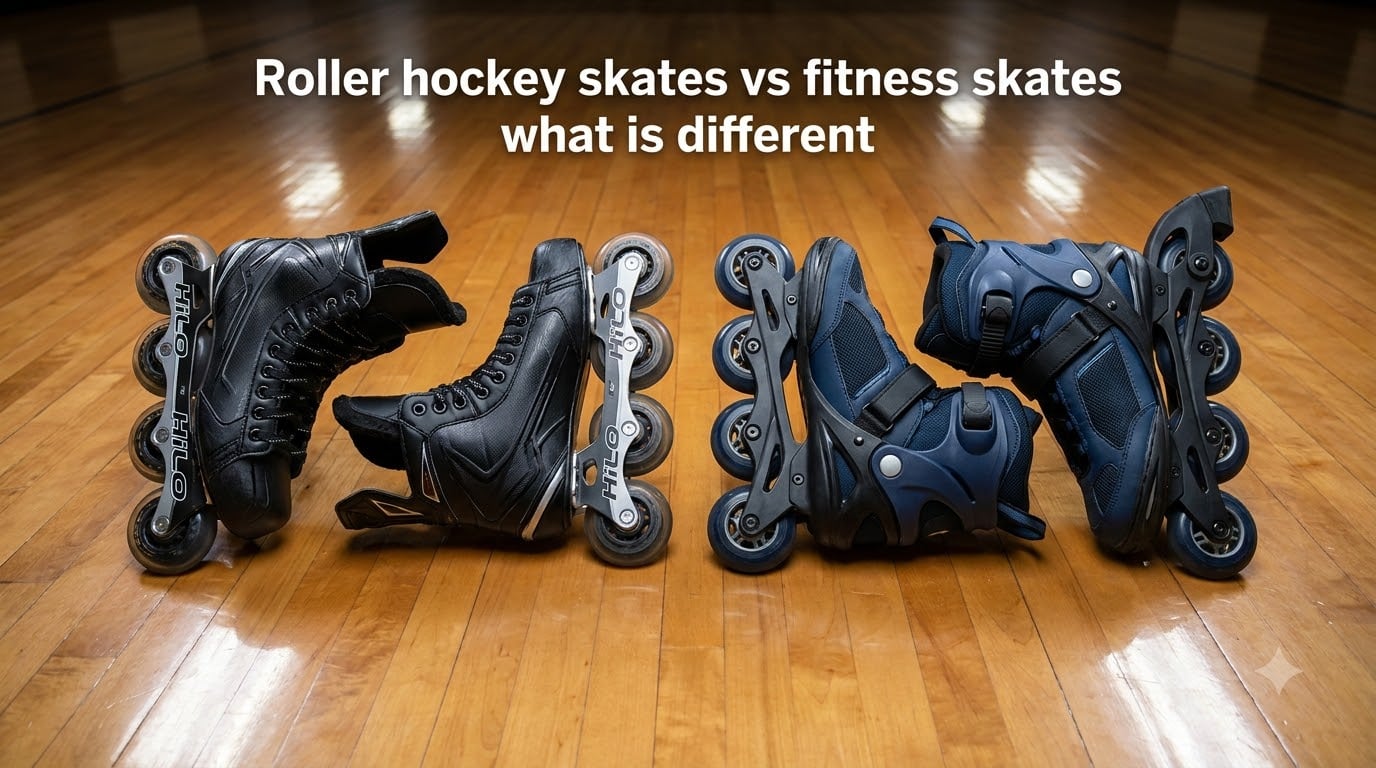
If you have ever stood in a skate shop wondering whether to grab roller hockey skates or fitness skates, you are not alone. The roller hockey skates vs fitness skates question comes up constantly in skating communities, and the answer matters more than most people realize. Each type is built for a completely different purpose, and choosing the wrong one can turn a great skating session into a frustrating one.
Our team has spent years testing both styles across rinks, trails, and neighborhood streets. We have talked to hockey players who switched to fitness skating and recreational skaters who tried to join casual hockey leagues. The differences go far beyond looks — they affect everything from how you stop to how tired your ankles feel after an hour.
In this guide, we break down every key difference between roller hockey skates and fitness skates. You will learn about boot design, frame geometry, wheel setups, braking systems, sizing quirks, and which type fits your skating style. Whether you are a beginner or a seasoned skater, this comparison will help you make the right call.
Table of Contents
What Are Roller Hockey Skates?
Roller hockey skates are purpose-built inline skates designed for the fast-paced, stop-and-go nature of hockey. They feature a stiff, low-profile boot that mimics the construction of ice hockey skates. This design gives players maximum ankle mobility while still providing lateral support for sharp cuts and quick direction changes.
The defining feature of roller hockey skates is the HiLo rocker frame. Instead of all four wheels sitting flat on the ground, the front two wheels are smaller (typically 76mm) and the back two are larger (typically 80mm). This creates a rocked profile that mimics the blade of an ice skate, making it easier to pivot, turn, and accelerate explosively.
Hockey skates almost never come with a brake attached. Players rely on hockey stops, T-stops, and tight turns to control their speed — the same techniques used on ice. This makes them less forgiving for beginners but incredibly responsive for experienced skaters who need split-second maneuverability.
What Are Fitness Skates?
Fitness skates (also called recreational inline skates) are designed for comfortable, stable skating over longer distances. They feature a soft-boot or hybrid construction with generous padding, breathable mesh panels, and a higher cuff for ankle support. The focus here is comfort, not aggressive performance.
The frame on fitness skates is longer than on hockey skates, and all wheels are the same size — usually 80mm to 90mm, sometimes up to 100mm on higher-end models. This longer wheelbase and consistent wheel diameter create a smooth, stable ride that tracks straight and glides efficiently. That makes fitness skates ideal for cardio workouts, bike-path cruising, and commuting.
Unlike hockey skates, fitness skates almost always come with a heel brake attached to the right skate. This gives newer skaters a reliable, easy-to-learn stopping method. The combination of a stable frame, comfortable boot, and included brake makes fitness skates the go-to choice for recreational and fitness-focused skaters.
Roller Hockey Skates vs Fitness Skates: Boot Design
The boot is where the roller hockey skates vs fitness skates difference becomes most obvious. Hockey skate boots are built from stiff composite materials — sometimes carbon fiber on premium models — with a low-cut profile that sits below the ankle bone. This design allows the ankle to flex forward for powerful strides while keeping lateral stiffness for edge control.
Fitness skate boots take the opposite approach. They use softer materials like nylon mesh, reinforced plastic, and thick foam padding. The cuff rises higher up the ankle, providing wraparound support that helps prevent ankle fatigue during long sessions. Ventilation is also a priority, with breathable panels that keep your feet cool during summer skating.
Power transfer is another key distinction. The stiff shell of a hockey boot sends energy directly from your leg to the frame with minimal loss, which is why hockey players can accelerate so quickly. Fitness boots absorb some of that energy in exchange for comfort. You get a smoother feel underfoot, but explosive acceleration takes more effort.
For skaters coming from an ice hockey background, the hockey boot feels natural and familiar. The lace-up system, the forward flex, and the snug heel lock all mirror what you experience on the ice. Fitness boots feel more like wearing a padded hiking shoe on wheels — comfortable and forgiving, but less responsive when you push hard.
Frame and Wheel Setup Differences
The frame and wheel setup is where performance characteristics really diverge. Roller hockey skates use the HiLo rocker configuration, which is the single most important technical difference between the two types. Let us break down exactly what this means.
HiLo Rocker Technology Explained
The HiLo setup places smaller wheels in the front and larger wheels in the back. A typical configuration is two 76mm wheels up front and two 80mm wheels in the rear. Because the front wheels are smaller, the front of the frame sits closer to the ground. This creates a slight forward tilt — a rocker — that mirrors the curved profile of an ice skate blade.
That rocker is what gives hockey skates their signature agility. With less wheel surface in contact with the ground at any given moment, you can pivot and turn with minimal resistance. The trade-off is stability: the smaller contact patch means less grip and a less planted feel when cruising in a straight line at speed.
Fitness skates use a flat frame where all wheels are the same diameter. This puts the maximum amount of urethane in contact with the pavement, creating a smooth, stable glide. You give up the ability to pivot on a dime, but you gain confidence and control at higher speeds and over rougher surfaces.
Wheel Size and Durometer
Hockey skate wheels typically range from 72mm to 80mm, with durometer ratings between 76A and 84A. The softer end of that range grips better on smooth indoor surfaces (sport court), while harder wheels handle rough outdoor asphalt better. Hockey players often swap wheels depending on where they play.
Fitness skate wheels range from 80mm to 100mm. Larger wheels hold momentum better and roll over cracks and debris more easily, which is why they dominate fitness and distance skating. Durometer ratings for fitness wheels tend to sit around 82A to 85A — a middle ground that balances grip and durability for varied outdoor surfaces.
Frame Materials
Both skate types use either aluminum or composite (nylon) frames, but the priorities differ. Hockey frames are shorter and stiffer, prioritizing responsiveness. Aluminum is preferred for its rigidity and power transfer. Fitness frames are longer and sometimes slightly more forgiving, with composite frames appearing on entry-level models to keep weight and cost down.
Braking Systems and Maneuverability
Braking is a fundamental difference that catches many skaters off guard. Roller hockey skates do not include a brake — not as an option, but as a design philosophy. Hockey players stop by turning sharply and sliding sideways, just like on ice. This requires skill and confidence, and it eats through wheels faster than a brake pad does.
Fitness skates come with a standard heel brake on the right boot. You lean forward, lift the right toe, and drag the brake pad against the ground. It is simple, reliable, and works at any speed. For beginners, this built-in safety feature is a major reason to choose fitness skates over hockey models.
Maneuverability follows the same pattern. Hockey skates excel at quick directional changes, tight turns, and rapid acceleration from a standstill. Fitness skates track straight and true, making them better for distance skating where you want to maintain a rhythm without fighting the skates’ tendency to wander.
One thing to note: you can technically bolt a brake onto some hockey skates using aftermarket adapters, but the short frame makes the braking angle awkward. Most experienced skaters agree that if you need a brake, fitness skates are the better choice from the start.
Sizing and Fit Differences
Sizing is one of the most confusing aspects of the roller hockey skates vs fitness skates comparison. The two types fit very differently, and getting this wrong can ruin your skating experience.
Roller hockey skates are sized like ice hockey skates, which means they run about 1 to 1.5 sizes smaller than your regular shoe size. A skater who wears a size 10 sneaker might need a size 8.5 hockey skate. The boot is designed to fit snugly — almost tight — because any heel lift or foot movement inside the boot translates directly to lost performance and blisters.
Fitness skates are sized much closer to your everyday shoe size. Some brands run a half-size small, but the general rule is to order your normal shoe size and adjust based on fit. The softer boot construction is more forgiving of slight sizing mismatches, which is another reason fitness skates are friendlier for beginners.
Width also matters differently. Hockey boots come in standard and wide widths, with the same snug heel lock that ice players expect. Fitness boots accommodate a wider range of foot shapes thanks to their padded, forgiving construction. If you have wide feet, fitness skates will likely feel more comfortable out of the box.
The break-in period differs too. Hockey skates can take several sessions to mold to your feet, especially if they use heat-moldable materials. Fitness skates are typically comfortable from the first wear, with minimal break-in needed.
Can You Use Fitness Skates for Roller Hockey
This is one of the most common questions in skating forums, and the answer depends on how seriously you plan to play. If you are talking about a casual, no-contact roller hockey league with friends, fitness skates can work — with some important caveats.
Forum users from the r/rollerblading community have shared their experiences extensively. One user with Rollerblade Twister urban skates asked whether they could join a casual roller hockey league, and the consensus was: yes, but expect limitations. The longer frame makes quick pivots harder, the higher cuff restricts the ankle flex needed for powerful strides, and the lack of a HiLo rocker means turns feel sluggish compared to dedicated hockey skates.
For competitive or league play, dedicated hockey skates are strongly recommended. The performance gap becomes obvious the moment you try to execute a sharp crossover turn or a quick direction change. Fitness skates simply are not built for that kind of lateral stress.
The reverse question — using hockey skates for fitness cruising — also comes up frequently. Hockey players with decades of ice experience often try roller hockey skates for neighborhood cruising. The common complaint is that the stiff boot feels uncomfortable over long distances, and the HiLo rocker makes straight-line skating less stable at cruising speeds. For anything beyond short, casual rides, fitness skates win on comfort.
Weight Capacity and Support Considerations
Weight capacity is an overlooked factor that surfaces regularly in forum discussions. Heavier skaters — particularly those over 250 pounds — need to think carefully about which skate type can support them safely.
One forum user weighing 315 pounds asked whether fitness skates could handle their weight for casual hockey use. The community response highlighted several concerns. Fitness skate frames, especially composite ones on entry-level models, can flex under heavier loads. That flex reduces power transfer and, in extreme cases, can lead to frame failure. Stiffer aluminum frames — found on both higher-end fitness skates and most hockey skates — handle heavier loads much better.
Boot support is the other factor. The higher cuff on fitness skates provides more ankle support, which can help heavier skaters who need extra stability. Hockey boots sit lower, which means your ankles do more of the stabilization work. For heavier skaters without strong ankles from hockey experience, a fitness boot with a stiff aluminum frame is often the safest combination.
Wheel choice also matters for heavier skaters. Softer wheels (lower durometer) compress more under weight, which increases grip but wears faster. Harder wheels last longer but can feel slippery. Most heavier skaters find success with wheels in the 82A to 84A range on a quality aluminum frame.
Which Skates Should You Choose
The roller hockey skates vs fitness skates decision comes down to one question: what do you actually plan to do on skates? Here is our straightforward framework for making the right choice.
Choose roller hockey skates if you play roller hockey, want to practice hockey-specific skills off-ice, or prioritize agility and quick acceleration over straight-line comfort. Hockey skates are also the natural choice for anyone with an ice hockey background who wants a familiar feel on wheels. Just be prepared for a boot that demands strong ankles and a frame with no brake.
Choose fitness skates if your primary goal is exercise, trail skating, commuting, or casual cruising with friends. The comfortable boot, stable frame, included brake, and larger wheels make fitness skates the best all-around choice for the majority of recreational skaters. They are also the better starting point for beginners who are still learning to balance and stop.
If you want to do both — some casual hockey and some fitness skating — we recommend starting with fitness skates. They are more versatile, more comfortable, and more forgiving while you build fundamental skills. You can always add a dedicated pair of hockey skates later once you know the sport is a regular part of your routine.
For beginners with no skating experience, fitness skates are the clear winner. The learning curve is gentler, the brake gives you a safety net, and the stable frame builds confidence. Once you have mastered basics like stopping, turning, and maintaining balance, you will have a much better sense of whether hockey skates are worth the investment.
Frequently Asked Questions
What are fitness skates?
Fitness skates (also called recreational inline skates) are designed for casual cruising, cardio workouts, and distance skating. They feature a soft-boot construction with generous padding, a longer frame with same-sized wheels (typically 80mm to 100mm), and a built-in heel brake for easy stopping. The focus is on comfort, stability, and smooth gliding rather than aggressive maneuverability.
What are the two types of roller skates?
The two main types are quad roller skates (four wheels arranged in a two-by-two pattern) and inline roller skates (wheels arranged in a single line). Within inline skates, the most common subtypes are fitness skates for recreation and exercise, and roller hockey skates designed for the speed and agility demands of hockey.
Do roller hockey skates fit like ice hockey skates?
Yes, roller hockey skates fit very similarly to ice hockey skates. Both are sized about 1 to 1.5 sizes smaller than your regular shoe size, and both feature a snug, low-profile fit designed to minimize foot movement inside the boot. Skaters transitioning from ice to roller hockey will find the sizing and fit feel natural and familiar.
Are roller blades or skates better for exercise?
Inline skates (roller blades) are generally better for cardio-focused exercise because they build momentum faster and glide more efficiently over distance. Fitness inline skates with larger wheels are ideal for workouts. Quad roller skates work well for dance-style fitness and lower-body strengthening but are less efficient for distance cardio. For pure fitness training, fitness inline skates are the top choice.
Can I use fitness skates for hockey?
You can use fitness skates for very casual, non-competitive roller hockey, but they have significant limitations. The longer frame and lack of a HiLo rocker make quick pivots and direction changes harder, and the softer boot does not provide the same power transfer as a hockey boot. For any league or competitive play, dedicated roller hockey skates are strongly recommended.
Conclusion
The roller hockey skates vs fitness skates comparison ultimately comes down to purpose. Hockey skates deliver explosive agility and a familiar feel for ice hockey players. Fitness skates deliver comfort, stability, and versatility for the majority of recreational skaters. Match the skate to your activity, and you will enjoy every session on wheels.