
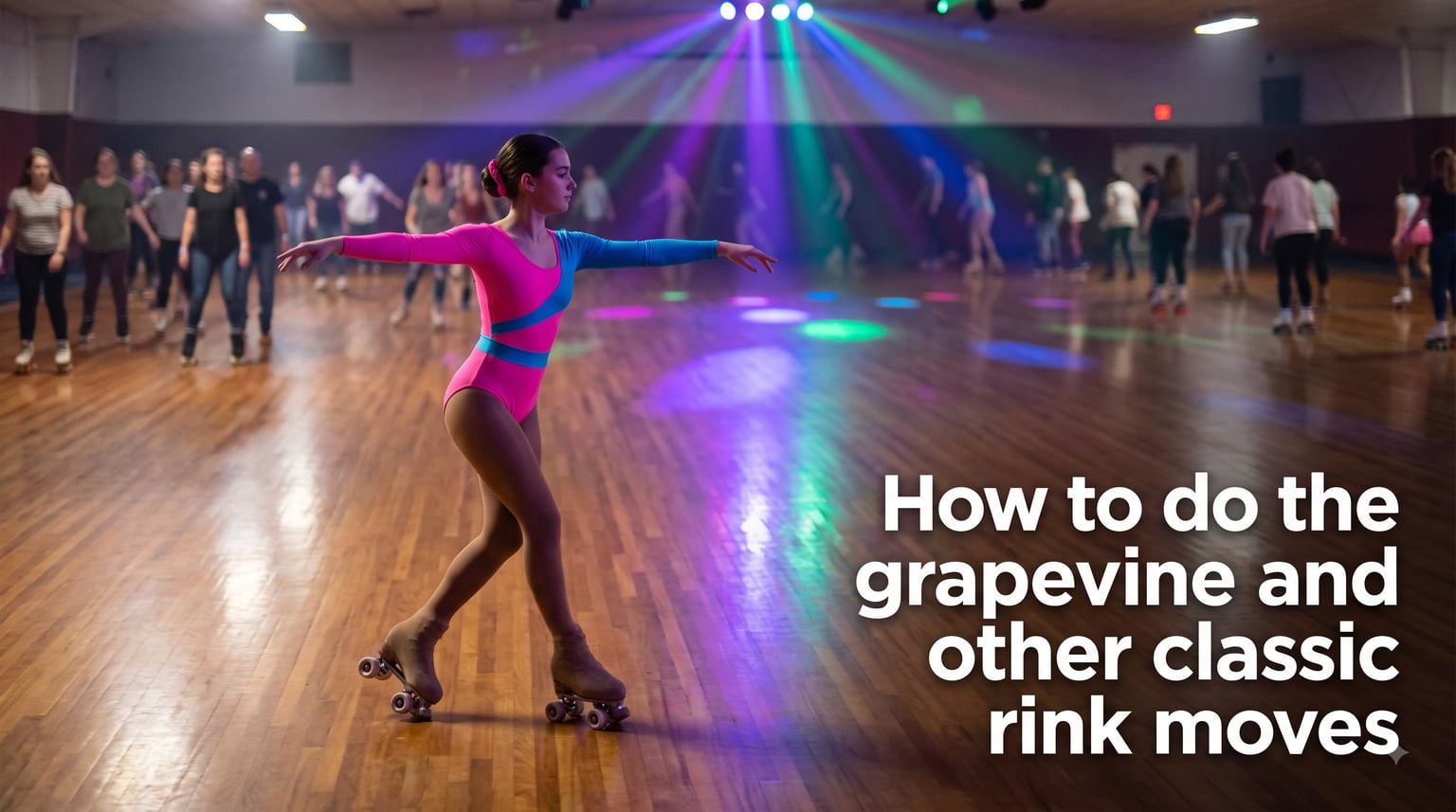
I still remember the first time I watched someone cruise past me at the rink doing the grapevine like it was nothing. Eight wheels, a smirk, and a perfectly smooth side-to-side glide while everyone else was just trying to stay upright. I went home that night and started learning how to do the grapevine and other classic rink moves the long, slow way.
This guide is everything I wish someone had handed me before that first session. We will break down the grapevine step by step, fix the mistakes that stall most beginners, and cover the other classic rink moves every skater should know. By the end, you will have a mini-routine you can actually dance to a song.
Table of Contents
What Is the Grapevine and Why Skaters Love It
The grapevine is a lateral roller skating rink move where your feet weave over and under each other while you travel sideways across the floor. It uses exclusively outside edges, which means you are constantly balancing on the outer wheels of each skate as you shift weight from foot to foot.
The Anatomy of the Grapevine Move
At its core, the grapevine is a cross, step, cross, step pattern. Your feet never leave the floor in a true grapevine. Instead, they trace a tight figure-eight shape beneath you as your body glides across the rink. The rhythm looks like this:
Toes turn out (rolling on the outside edge of the front foot)
Back foot crosses in front
Toes turn in (rolling on the outside edge of the other foot)
Back foot crosses behind
That repeated cross is what creates the sideways drift that defines classic rink skating moves.
Why the Grapevine Builds Core Skating Skills
Even if you never dance at a rink, the grapevine teaches you three skills that make every other move easier. First, it forces honest outside edge control, which is the foundation of jam skating footwork. Second, it trains weight transfer between your feet without losing momentum. Third, it teaches your upper body to stay quiet while your lower body does something complicated.
Once those skills click, every other rink dance move starts to feel less mysterious.
How to Do the Grapevine Step by Step
This is the part of the guide I am most excited to share, because most tutorials skip the mechanics. I learned the grapevine the wrong way three times before I understood what my feet were actually doing. The breakdown below is the version that finally made it click.
Step 1: Find Your Starting Stance
Start with your skates parallel, about shoulder width apart, rolling slowly forward. Bend your knees, keep your chest up, and put your weight slightly on your heels. This staggered, balanced position is your reset point between grapevine reps.
Step 2: The First Cross
Shift your weight to your right foot. Lift your left foot just enough to clear the right skate, then step your left foot across and in front of the right foot. Land on the outside edge of your left wheel. Your toes should be pointing slightly toward the right wall.
Step 3: The Lateral Shift
Now push off the right outside edge and transfer your weight onto the left foot. As you do, turn your left toes out so you roll on the inside of that foot’s outside edge. Your shoulders and hips should slide one full skate length to the left.
Step 4: The Second Cross
Cross your right foot behind your left foot this time, landing on the outside edge of the right skate. Keep your knees soft and your head facing the same direction your hips are traveling. The community-validated cue here is “toes in, cross, toes out, cross” and that phrase is worth memorizing.
Step 5: Build the Rhythm
Repeat the cross in front, shift, cross behind, shift pattern. Use your head and shoulders to lead the direction change instead of forcing your feet. Every push should generate forward momentum, not just a hop in place. Within ten minutes of practice, the move should feel less like work and more like a sway.
Common Grapevine Mistakes and How to Fix Them
If you have tried to learn the grapevine from a video and felt worse after watching it, you are not alone. These are the same struggles I see on every roller skating forum thread.
Mistake 1: Losing Speed Mid-Move
The most common complaint I hear is that skaters drift to a halt halfway through the grapevine. The fix is to push out of every cross, not just step into it. Think of each outside edge as a small jump that launches you into the next cross. If you can keep one foot rolling on its edge at all times, your speed stays constant.
Mistake 2: Spinning in Circles Instead of Moving Sideways
This usually happens when skaters try to force the move with their hips. Instead, let your head and shoulders lead the rotation. Look over the shoulder in the direction you want to travel before your feet follow. Your hips will track naturally and the move will move laterally across the floor.
Mistake 3: Falling Forward on the Cross
If your chest tips forward during the cross, you are probably trying to look at your feet. Lift your chin, pick a spot on the wall, and trust the edge work. I spent an embarrassing amount of time watching my wheels before I realized my balance was fine and my eyes were the problem.
Other Classic Rink Moves Every Skaters Should Know
The grapevine is the gateway move, but the rink has a whole library of classic rink dance moves waiting. These are the ones I teach to anyone who asks me for the basics.
The Criss-Cross
The criss-cross is the grapevine’s simpler cousin. You cross your feet in front and behind alternately while rolling forward, but you stay moving in a straight line instead of drifting sideways. It is perfect for building confidence before adding lateral travel. Most beginners can land a clean criss-cross within their first session.
The Bounce
The bounce is a small, controlled hop on both feet in time with the beat. Bend your knees deeply, push up through your toe stops (or wheels if you are advanced), and land soft. Done well, it is the move that makes the rest of your footwork look like it has rhythm. Done badly, it is just a clatter.
The Moonwalk on Skates
The moonwalk on roller skates looks intimidating but is mostly about weight transfer. Skate forward slowly, plant your dominant foot flat, then drag your back foot backward so it looks like the floor is moving under you. The illusion works because your front foot holds still while your back foot rolls in reverse.
The Knee Slide
The knee slide is one of the most photogenic classic rink skating moves. Build up a little speed, drop one knee to the floor with your shin parallel to the wood, and let momentum carry you forward. Always wear knee pads for this one. The slide ends with both feet returning under you before you stand.
The Two-Foot Spin
Plant your feet in a staggered stance, cross your arms, and push off with one skate while pulling your arms in tight to your chest. The faster you pull in, the faster you spin. The trick to controlling it is spotting a fixed point on the wall so you do not get dizzy.
How to Connect Moves Into a Mini-Routine?
Once you can do three or four of these moves cleanly, the next step is stringing them together. This is the part nobody teaches, so I will give you the framework I use at the rink.
Pick a Steady Beat
Choose a song around 100 to 120 BPM. Anything faster and you will rush the transitions. Anything slower and the moves will feel disconnected. Classic disco and modern funk work great because the beats are consistent and easy to count.
Use Transitions That Flow
Every move should end in a stance that the next move can start from. The grapevine ends facing sideways. The criss-cross ends facing forward. Linking them means turning your hips 90 degrees during the bounce. Build your routine around those natural pivot points and it will look like choreography, not a list of tricks.
Practice in Both Directions
Most rink moves favor your dominant side, but real rink dancers can do everything in both directions. Spend half of every practice session on your weak side. By the end of a month, your weak side will be your stronger technical side because you have actually drilled it.
Practice Tips and Progression for Rink Moves
Learning how to do the grapevine and other classic rink moves is mostly a matter of how you practice, not how long you practice.
Start on Carpet or Smooth Sidewalk
You do not need a rink to drill the footwork. A flat patch of carpet or a smooth sidewalk lets you focus on the cross-step rhythm without the pressure of an audience. Once the pattern is muscle memory, take it to the rink and let momentum do the rest.
Use Music at the Right Tempo
Slowing the song down by half speed on your phone is a great trick. You can find the beat, lock in your timing, and then play the real version once the move feels natural. This is how I taught myself to bounce on beat without overthinking it.
Drill Outside Edges Separately
If the grapevine feels impossible, the problem is usually not the cross. It is that your outside edges are not stable yet. Stand in a staggered stance, roll forward on the outside edge of one foot, and hold the line for as long as you can. Once you can balance on each outside edge for five seconds, the grapevine almost builds itself.
Safety and Etiquette Tips for Rink Dancing
Looking good at the rink and staying safe are not opposites. A few habits will keep both intact.
Wrist Guards and Helmet Basics
You do not need full pads for classic rink dancing, but wrist guards save you from the worst beginner falls. A helmet is optional for adults but worth it while you are still learning transitions. Knee pads are non-negotiable if you plan to try the knee slide.
Rink Floor Awareness
Always look before you launch into a move. Rinks are full of kids, beginners, and reverse skaters who cannot stop fast. Pick a clear lane before you commit to a grapevine or spin. A move performed safely is more impressive than one performed recklessly.
Social Skating Etiquette
If the rink has a designated dance floor or session, that is your stage. Outside of those times, stick to the outer lane and save the footwork for when space is open. Yield to skaters who are moving faster than you, and never cut across the middle of a pack.
Frequently Asked Questions
How to grapevine on roller skates?
Start in a parallel stance, shift your weight to one foot, cross the other foot in front, push out on the outside edge, cross behind, and repeat. The full pattern is cross in front, lateral shift, cross behind, lateral shift, all while rolling on outside edges.
How to do the grapevine step by step?
Step 1: Stand with feet parallel. Step 2: Shift weight to right foot. Step 3: Cross left foot in front and land on outside edge. Step 4: Push off right foot and shift weight to left. Step 5: Cross right foot behind and land on outside edge. Step 6: Repeat the cross in front, shift, cross behind pattern. The rhythm is toes in, cross, toes out, cross.
What are some popular roller skating moves?
Popular roller skating moves include the grapevine, criss-cross, bounce, moonwalk, knee slide, two-foot spin, and the basic forward crossovers. These moves form the foundation of jam skating footwork and classic rink dance styles.
What are the basic roller skating moves?
The basic roller skating moves every beginner should learn are forward skating, stopping with toe stops, forward crossovers, the criss-cross, the bounce, and the grapevine. Mastering these six moves opens the door to roller disco and jam skating.
How do you do the moonwalk on roller skates?
To do the moonwalk on roller skates, skate forward slowly, plant your front foot flat to hold position, then drag your back foot backward so it looks like the floor is rolling forward. The illusion works because your front foot stays still while your back foot rolls in reverse.
Final Thoughts on Learning Classic Rink Moves
Learning how to do the grapevine and other classic rink moves is one of the most rewarding things you can do on eight wheels. The grapevine alone will change how your body understands balance, and the rest of the moves compound on that foundation. Give yourself a few sessions to feel awkward, a few more to feel capable, and by the end of the month you will be the one cruising past beginners with a smirk.
Pick one move, drill it until it is boring, then add the next. Before long, you will have a routine, a song, and a story to tell at the rink.