
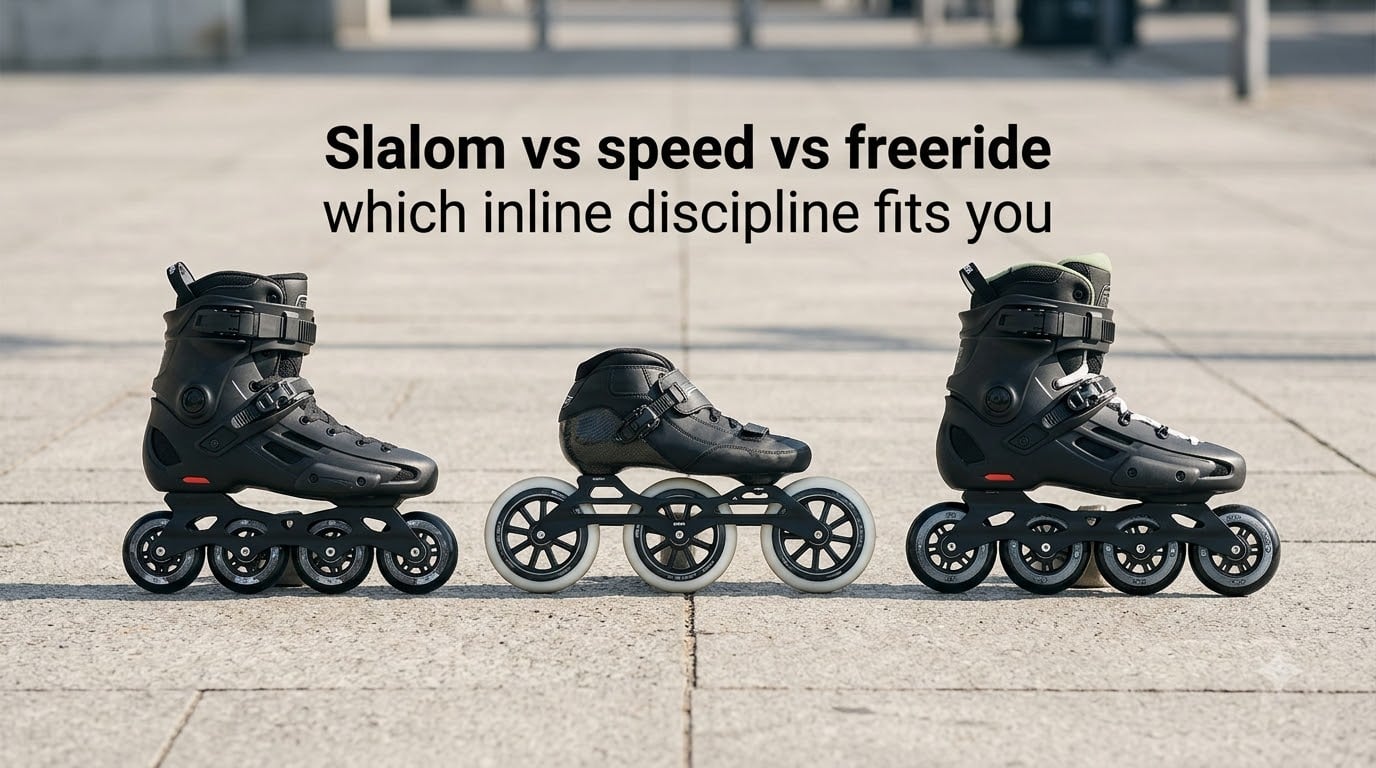
Inline skating is not one sport. It is a family of disciplines, each with its own gear, its own rhythm, and its own crowd. Picking the right one early saves you from buying skates you will outgrow in three months.
At Patin Carr Era, our team has been skating the three main styles long enough to know what each one really asks of you. In this guide we break down slalom, speed, and freeride inline skating side by side. You will see what gear each needs, what skills they demand, and which one matches your goals in 2026.
Table of Contents
What Are the Main Inline Skating Disciplines?
The three most popular modern inline skating disciplines are freestyle slalom, speed skating, and freeride (also called freeskate). Each one uses a different frame geometry, wheel size, and boot construction, and each rewards a different kind of movement.
Slalom is about precision and rhythm through cones. Speed is about straight-line efficiency and endurance. Freeride is about versatility and movement through urban space. The skates you buy lock you into one of these worlds more than most beginners expect.
Freestyle Slalom Skating Explained
Freestyle slalom is the most technical of the three disciplines. Skaters weave through a line of cones set about 80 centimeters apart, performing tricks, spins, and footwork. The discipline traces back to aggressive street skating in the 1990s, but evolved into its own competitive scene in France and Korea.
What Slalom Skating Is
Slalom skating is freestyle movement on a tight line. Skaters push the front wheels left and right in quick succession, using the rocker (a banana-shaped wheel curve) to pivot sharply. Tricks include one-foot spins, heel-toe switches, and full crossovers.
Competitions run in cities like Lyon, Seoul, and Paris. The world record for most cones in a row sits at 65 without touching one. It is a discipline that looks effortless on Instagram but rewards thousands of hours of practice.
Slalom Skating Equipment
Slalom skates have a hard shell with no liner, a short wheelbase (around 230 millimeters), and four small rockered wheels, typically 76 to 80 millimeters in diameter. Hard polyurethane wheels around 85A durometer give the grip needed for tight turns. Frames are usually flat aluminum or carbon, mounted very close to the ground to lower the center of gravity.
Common slalom brands include Seba, FR Skates, and Powerslide. A complete setup runs from about 250 to 600 dollars depending on frame and wheel quality.
Who Should Choose Slalom Skating
Slalom is the right fit if you love rhythm, want to master footwork, and do not mind slow progress. It rewards patience more than athletic talent. If you are drawn to short bursts of intense practice and visual tricks you can show your friends, slalom will keep you motivated for years.
It is harder on your ankles than other disciplines. Beginners often spend their first three months falling on their wrists. If you want quick wins, this is not the place.
Speed Inline Skating Explained
Speed inline skating is the oldest and most structured of the three disciplines. It traces directly back to ice speed skating, which dates to the 17th century in the Netherlands. Inline racers compete on road courses, banked tracks, and marathons. The Berlin Marathon and the Eleven City Tour in the Netherlands both host thousands of speed skaters each year.
What Speed Inline Skating Is
Speed skating is about covering distance as fast as possible. Skaters use long, efficient strides and a deep tuck position to reduce wind drag. Races range from 200-meter sprints on ovals to 200-kilometer road events.
Inline speed skating is an official sport under World Skate, with world championships and continental cups. It is also the closest analog to ice speed skating, so many ice athletes cross-train on wheels in summer.
Speed Skating Equipment
Speed skates feature a low-cut carbon shell with a tall cuff and a long frame, typically 280 to 325 millimeters. Wheels are large, 100 to 125 millimeters, with high rebound polyurethane (85A to 90A) for efficiency. Inline skates for speed use three- or four-wheel setups, with elite racers sometimes running five-wheel frames on long courses.
Bearings matter more in speed than in any other discipline. ABEC 9 or higher is standard, and many racers upgrade to ceramic bearings. A full race setup runs from 400 to 1500 dollars depending on frame length and wheel quality.
Who Should Choose Speed Skating
Speed skating fits skaters who want measurable progress, strong cardio workouts, and competitive structure. If you are a runner, cyclist, or triathlete looking for a low-impact alternative, inline speed skating will feel familiar. It also suits anyone training for a marathon or ultramarathon who wants a fresh challenge.
It demands patience with technique. Beginners often waste energy with short choppy strides until they learn to push from the hip. If you want to spin and turn within your first session, look elsewhere.
Freeride and Freeskate Skating Explained
Freeride inline skating, also called freeskating, is the most versatile of the three disciplines. Skaters cruise through cities, slide down rails, jump stairs, and explore anything paved. The term comes from skiing, where freeride means riding anywhere you want rather than staying on marked runs.
What Freeride Skating Is
Freeride is movement through urban space with no fixed course. Skaters treat curbs, handrails, ledges, and hills as features to ride. The discipline absorbed urban skating in the 2000s, when rollerbladers began skating spots that skateboarders had ignored. Today, cities like Barcelona, New York, and Berlin have thriving freeride scenes.
The defining move is the slide, where a skater turns the skate sideways and drifts to a stop or to change direction. Slides open up hills, traffic, and tight corners in ways no other inline discipline matches.
Freeride Skating Equipment
Freeride skates have a soft or hard shell with a removable liner, a mid-length frame (around 250 to 280 millimeters), and four wheels in the 80 to 110 millimeter range. The most popular setup in 2026 is four 90 millimeter wheels with a flat or slightly rockered frame. Hard wheels around 86A to 88A durometer slide well without sacrificing too much grip.
The liner sets freeride apart from freestyle slalom. Freeride skates come with thick, padded liners that absorb road vibration and let you skate for hours. FR Skates, Rollerblade, and Adapt dominate this segment. A solid freeride setup runs from 300 to 700 dollars.
Who Should Choose Freeride Skating
Freeride is the best starting point for most adult beginners. It is forgiving, comfortable, and lets you try tricks, slides, and jumps as you progress. If you want to use skates for commuting, fitness, weekend exploration, and tricks without switching gear, freeride is the right call.
It is also the best fit for skaters who live in cities. The versatility means you can roll to work, hit a skate park after, and grab dinner, all on the same setup.
Slalom vs Speed vs Freeride Side by Side
This table lines up the three disciplines across the points that matter when you choose your first serious setup.
| Feature | Freestyle Slalom | Speed | Freeride / Freeskate |
|---|---|---|---|
| Primary focus | Tricks, precision footwork | Maximum speed and endurance | Versatility, urban exploration |
| Typical wheel size | 76 to 80 mm | 100 to 125 mm | 80 to 110 mm |
| Frame length | Short (around 230 mm) | Long (280 to 325 mm) | Mid (250 to 280 mm) |
| Boot type | Hard shell, no liner | Low-cut carbon shell, tall cuff | Soft or hard shell with padded liner |
| Wheel setup | Rockered (banana curve) | Flat | Flat or slight rocker |
| Skill level | Intermediate to advanced | Intermediate to advanced | Beginner to advanced |
| Main use | Cones, tricks, competitions | Racing, marathons, fitness | Commuting, urban tricks, slides |
| Entry cost | About 250 to 600 dollars | About 400 to 1500 dollars | About 300 to 700 dollars |
| Best for | Trick-focused skaters | Endurance and speed athletes | Versatile urban skaters |
How to Choose the Right Discipline for Your Goals?
The fastest way to pick a discipline is to start with what you actually want to do on skates. Then check whether your body and budget line up.
Match by Activity Goal
If your main goal is tricks, slalom is the obvious choice. If your goal is covering long distances fast, go with speed. If you want one setup that handles commuting, fitness, and tricks, freeride wins. Trying to pick based on what looks cool online usually backfires. Pick based on the surface you have access to and the time you can dedicate.
Match by Skill Level
Most true beginners do best on freeride or recreational skates for their first six months. Slalom rewards patience but punishes impatience. Speed demands a baseline of edge control and balance that takes time to build. Freeride meets you where you are, then grows with you.
Match by Fitness and Physical Demand
Speed skating has the highest cardio demand. A one-hour speed session burns 600 to 800 calories for most adult skaters. Slalom is more anaerobic, with short bursts of intense effort. Freeride lands in the middle and is the easiest on the joints because the wider frame and softer wheels absorb vibration.
If you are returning from an injury or want a low-impact cardio option, freeride is the safest starting point. Speed and slalom both load the ankles heavily.
Skill Level and Fitness Requirements by Discipline
Each discipline has its own minimum baseline. Slalom requires strong ankles and the patience to drill cone sequences for weeks before any visible progress. Speed requires solid balance and the hip mobility to push from a low stance. Freeride requires the least but still rewards skaters who commit to learning how to fall safely.
For physical fitness, speed skating builds aerobic capacity faster than any other inline discipline. Slalom builds proprioception and ankle strength. Freeride builds general athleticism, balance, and the ability to read terrain. If your goal is weight loss or endurance training, speed has the edge. If your goal is becoming a more agile athlete overall, slalom and freeride both deliver.
Can You Transition Between Disciplines
Yes, but each transition has friction. Skaters often start in freeride, then specialize. Going from freeride to slalom means buying a hard-shell skate without a liner and learning to balance on rockered wheels. Going from freeride to speed means a longer frame, larger wheels, and a much deeper skating stance.
Urban or freeride skates can do light slalom, but the rockered wheel setup feels different and the boot is less precise. Many skaters keep two setups once they specialize. The most common combination among our readers is a freeride skate for daily use and a slalom skate for cone sessions.
If you are buying your first pair and unsure where you will land, freeride is the safest bet. You can later add a specialty setup without throwing out your commuter gear.
Frequently Asked Questions
What is the easiest type of inline skating for beginners?
Freeride inline skating is the easiest discipline for beginners. The mid-length frame, padded liner, and four-wheel flat setup give you the stability and comfort needed to learn balance, stopping, and basic tricks. Slalom and speed both demand more specialized technique before they feel comfortable.
What is the difference between freeride and freestyle skating?
Freeride and freestyle are two different disciplines. Freestyle slalom uses a hard shell, no liner, short frame, and rockered 76 to 80 millimeter wheels for cone tricks. Freeride uses a padded liner, mid-length frame, and 80 to 110 millimeter flat wheels for versatile urban skating. Freestyle is more precise but less comfortable. Freeride is more durable and forgiving.
Can you use freeride skates for slalom tricks?
Urban or freeride skates can perform basic slalom moves but with clear limits. The boot is less precise, the frame is longer, and the wheels are not rockered, so tight cone work feels loose compared to a true slalom setup. For serious slalom progression, you need a hard-shell skate with no liner and a rockered wheel setup.
Which inline skating discipline is right for me?
Pick slalom if you love rhythm and want to master tricks. Pick speed if you want measurable fitness gains, long-distance training, or competitive racing. Pick freeride if you want one setup for commuting, fitness, slides, and urban tricks. For most adult beginners, freeride is the right starting discipline.
What is the hardest inline skating discipline?
Speed inline skating at elite levels is the most physically demanding discipline, demanding deep lunges, sustained power, and endurance over long distances. Freestyle slalom at elite levels is the most technically demanding, with cone runs requiring flawless footwork and balance under time pressure. Both take years of focused practice to reach competitive form.
Is inline speed skating good for fitness and weight loss?
Yes. Inline speed skating burns 600 to 800 calories per hour for most adult skaters and builds aerobic capacity faster than most low-impact cardio. Speed skating engages the quads, glutes, hamstrings, and core more deeply than recreational skating because of the deeper stride and sustained pace. It is also gentler on joints than running.
Final Verdict: Picking the Inline Discipline That Fits You
There is no single best inline skating discipline. There is only the one that fits your goals, your surface, and your patience level. Slalom rewards skaters who want to master footwork and are willing to fall. Speed rewards skaters who want measurable fitness and competitive races. Freeride rewards skaters who want versatility and the freedom to skate anything paved.
Our team’s recommendation: if this is your first pair of serious skates, start with freeride. You will learn faster, skate longer, and decide within six months whether you want to specialize. Once you specialize, you will know which discipline fits you because your body will tell you.
Inline skating is alive and growing in 2026. Pick the discipline that excites you most, buy the right gear for it, and commit to twelve weeks of consistent practice. The rest takes care of itself.