
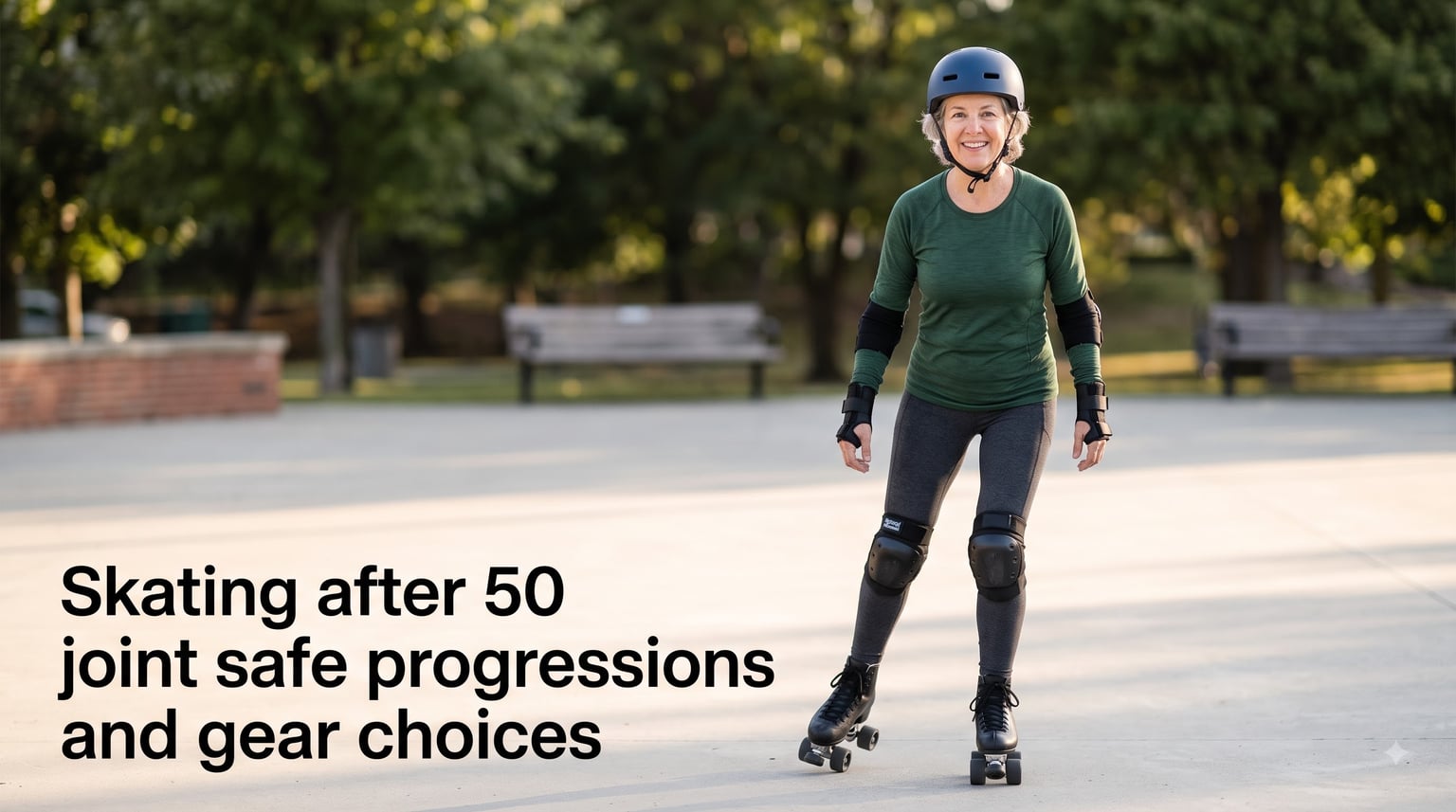
I hear the same question from readers almost every week: “I’m past 50, and I used to love skating. Can my body still handle it?” My answer is always yes, with a plan. Skating after 50 is one of the best low-impact exercises you can pick up, and after two decades of coaching older beginners, I’ve watched hundreds of 50-, 60-, and 70-somethings find their balance and confidence again.
This guide pulls together the progressions, gear, and mental shifts that actually work for adult learners. None of it requires athletic talent, just the right approach and patience with your joints.
Table of Contents
Safe Progression Techniques for Older Beginners
The fastest way to hurt yourself (or quit in frustration) is to rush the basics. Skating after 50 demands a different timeline than it did at 15. Here is the framework I use with my adult students.
Week 1 to 2: Floor Drills Only
Keep the skates on but stay on grass or carpet. Practice standing with feet parallel, then shoulder-width apart, getting comfortable with the rolling sensation underfoot. No movement yet, just balance work for 10 to 15 minutes per session.
Week 3 to 4: Forward Marching
Move to a smooth, flat surface (an empty rink or parking lot is ideal). Take small, controlled marching steps forward while wearing full protective gear. Your goal is rhythm, not speed. Aim for 20 minutes per session, three times a week.
Week 5 to 6: Gliding and Stopping
Once you can march comfortably, work on gentle forward glides by pushing off one foot and letting the other roll. Learn the “T-stop” early, dragging one skate perpendicular behind the other. Stopping is your friend at 50+.
Week 7 to 12: Turning and Building Endurance
Introduce wide turns using the “crossover-free” scissors technique. Build session length to 45 minutes. By three months in, most of my older students report steady forward skating, controlled stops, and the confidence to skate in public settings.
Speed and tricks can wait. Consistent, joint-friendly progress beats heroic one-off sessions every time.
Essential Protective Gear for Skaters Over 50
I rank gear by joint protection level rather than brand. At 50+, your wrists, knees, and tailbone are statistically the most vulnerable, and these are the pieces that matter most.
Wrist Guards (Non-Negotiable)
The single most important piece of equipment for skaters over 50. Wrist fractures in older adults heal slowly and can end a skating journey permanently. Look for guards with hard plastic splints on both the palm and top of the wrist.
Helmet With Proper Fit
Choose a multi-impact skate-specific helmet, not a bike helmet. Bike helmets are rated for single impacts and sit differently on the head. Replace any helmet after a major fall.
Knee Pads With Side Coverage
Older knees need protection from both direct impact and lateral stress. Look for pads with hard caps that wrap slightly around the sides. Soft foam-only pads compress too easily under adult weight.
Elbow Pads
Often overlooked, but elbows hit the ground more often than people expect during falls. Get hard-cap elbow pads that stay in place rather than sliding down.
Padded Shorts (Optional but Recommended)
For skaters with hip replacements, osteoporosis history, or simply cautious personalities, padded shorts protect the tailbone and hips from those inevitable backward slides. Worth the small extra cost.
One forum user in her 60s put it simply: “I never step onto wheels without wrist guards. It’s just habit now.” That habit has kept her skating for eight years.
Joint-Friendly Skating Techniques
The mechanics of how you move on skates matter more than how hard you push. These adjustments reduce joint stress while keeping you moving forward.
Bend the Knees, Not the Hips
Many older beginners instinctively bend at the waist, which throws weight forward onto the knees. Instead, keep your torso upright and lower your center of gravity by bending the knees. This distributes load across the quads and glutes instead of dumping it into the knee joint.
Keep Weight Over the Wheels
Lean slightly forward so weight sits over the front of the skate, not the heel. Heel-leaning creates braking forces that jar the knees and lower back on every stride.
Short Strokes, Not Long Pushes
Long, powerful pushes look great on younger skaters but generate high impact forces. Use shorter, more frequent strokes under your center of gravity. You will cover less distance per push but save your joints over hours of skating.
Stay Relaxed
Tense muscles absorb shock poorly. Consciously relax your shoulders, jaw, and grip. A relaxed skater has a softer landing and a smoother recovery.
Mental Approach and Patience in Learning Skating After 50
The biggest advantage older learners have is something they do not usually recognize. After teaching skating for 21 years, I have watched it become one of my favorite things about adult students.
Older skaters are not in a hurry. They tend to commit to the process rather than chase a quick result. That patience translates into better technique because they are willing to drill the boring basics until they stick.
Older skaters have less ego driving them. They do not feel pressure to land a hard trick at the rink. They skate for the joy of movement, and that freedom shows in their faces.
Older skaters get more pleasure from small improvements. A clean crossovers attempt three weeks in feels like a win. Younger skaters take that same skill for granted.
If you approach skating after 50 with curiosity instead of urgency, you will learn faster and hurt less. The timeline matters less than the consistency.
Physical Benefits of Skating for Older Adults
Roller skating and ice skating deliver cardio without the pounding. The motion is smooth, low-impact, and engages stabilizer muscles that other exercises miss.
Balance and Proprioception
Every stride on skates trains the small muscles around your ankles, knees, and hips to make constant micro-adjustments. After weeks of practice, that improved proprioception carries over into everyday life, reducing your fall risk on stairs, sidewalks, and wet floors.
Cardiovascular Fitness
A moderate skating session elevates heart rate into the cardio zone without the joint stress of running. For skaters with arthritis, this is often the only cardio that does not flare their symptoms.
Bone Density
Weight-bearing exercise, including skating, sends signals to bones to maintain density. For post-menopausal women specifically, this is a meaningful benefit that pairs well with strength training.
Mood and Mental Health
Movement, music, and social connection combine into something genuinely uplifting. Many of my older students say skating is the only exercise they actually look forward to.
Fall Prevention and Safe Falling Techniques
The fear of falling holds more older adults back than any physical limitation. Learning how to fall correctly changes everything.
The Knee-Drop Fall
When you feel yourself losing balance backward, intentionally drop to your knees rather than bracing with locked arms. Knee pads absorb the impact, and you can roll forward onto your hands to dissipate momentum. This is the safest fall for adults over 50.
The Side-Slide Fall
If you are falling sideways, tuck your chin and slide on the padded hip and outer thigh. Avoid sticking out your hands to catch yourself, as that causes the wrist fractures we have discussed.
Build the Falling Reflex
Practice falling on a soft surface while wearing your gear. Crouch, then let yourself tip over sideways and slide. Repeat until the motion feels familiar. Knowing how to fall reduces panic during real slips.
Skate in Well-Lit, Smooth Areas
Avoid cracked sidewalks, gravel, and dim lighting. The safest skating happens at dedicated rinks with maintained surfaces and good visibility.
One student described her breakthrough this way: “Once I learned to fall on purpose, the fear dropped by half. Now I just trust the gear and the technique.”
Off-Ice Preparation and Strengthening Exercises
The skaters who progress fastest (and hurt least) almost always do off-ice work. Five to ten minutes a day is enough for most adults.
Single-Leg Balance
Stand on one foot while brushing your teeth, waiting for coffee, or talking on the phone. Aim for 30 seconds per side. This directly translates to better skate balance.
Wall Sit With Knees Over Toes
Hold a 30-second wall sit, keeping knees aligned over toes (not caving inward). This builds the quad endurance for longer skating sessions.
Glute Bridges
Two sets of 15 reps. Strong glutes protect the lower back and knees by absorbing force during falls and turns.
Calf Raises
Three sets of 15. Strong calves stabilize the ankle joint on every skating stroke and reduce the risk of ankle rolls on uneven surfaces.
Hip Openers and Ankle Circles
Gentle stretches before each session warm up the joints that take the most stress. Spend two minutes each on hip circles and ankle rotations.
Doing these consistently for a month before your first real skate session gives your body a head start and noticeably reduces post-skating soreness.
After sessions, apply ice to any joints that feel warm or achy, and stay hydrated. Recovery happens during the hours off the skates, not during the skating itself.
FAQ: Common Questions About Skating After 50
Is 50 too old to roller skate?
No, 50 is not too old to roller skate. Most adults in their 50s, 60s, and even 70s can learn to skate safely with proper gear, gradual progressions, and joint-friendly techniques. Many adult skating communities report their fastest-growing age group is 50+.
Can you learn to skate in your 50s?
Yes, you can absolutely learn to skate in your 50s. Adult learners often progress faster than teenagers because of better focus, patience, and life experience with motor skills. Expect three to six months to reach comfortable forward skating with controlled stops.
What is the most important safety gear to wear when skating?
The most important safety gear for skaters over 50 is a properly fitted skate-specific helmet, hard-splint wrist guards, and hard-cap knee pads with side coverage. Wrist guards are critical because wrist fractures heal slowly in older adults and can end a skating journey.
Is roller skating good for older adults?
Roller skating is excellent for older adults because it provides low-impact cardio, improves balance and proprioception, supports bone density through weight-bearing movement, and offers social connection. It is generally easier on joints than running and can be adapted for arthritis.
What are good tips for roller skating over 50?
Key tips for roller skating over 50: always wear wrist guards, helmet, and knee pads; practice on grass or carpet before hard surfaces; bend your knees rather than your waist; take short strokes; learn to fall safely on your knees with pads; build off-ice balance and strength first; and progress gradually without rushing.
What age is a senior skater?
There is no universal definition, but most adult skating programs recognize senior skaters as those aged 50 and above, with masters categories for 40+ and veterans for 60+. Skating communities welcome adult beginners at any age, including beginners in their 70s and 80s.
Is 55 too old to roller skate?
No, 55 is not too old to roller skate. Many skaters start in their 50s and 60s and continue for decades. The key is matching your progression speed to your body, using proper protective gear, and choosing joint-friendly techniques over high-impact tricks.
How can I protect my knees while skating over 50?
Protect your knees while skating over 50 by bending at the knees instead of the waist, keeping weight over the balls of your feet, taking shorter strokes instead of long pushes, wearing hard-cap knee pads with side coverage, strengthening quads and glutes off the ice, and stopping immediately if you feel any sharp knee pain.
Conclusion: Your Joint-Safe Skating Journey Starts Now
Skating after 50 is not a stretch goal. It is a realistic, sustainable practice that can carry you for decades with the right foundation. The progressions in this guide are designed for joints that have logged a few decades of life, the gear recommendations come from skaters who have actually fallen and recovered, and the mental approach is built on the real strengths that older learners bring to the rink.
Start with floor drills this week. Add off-ice balance work tomorrow. Get properly fitted gear before your first session. Give yourself three months before judging your progress. That combination is what turns nervous first-timers into lifelong skaters, and it will work for you too.