
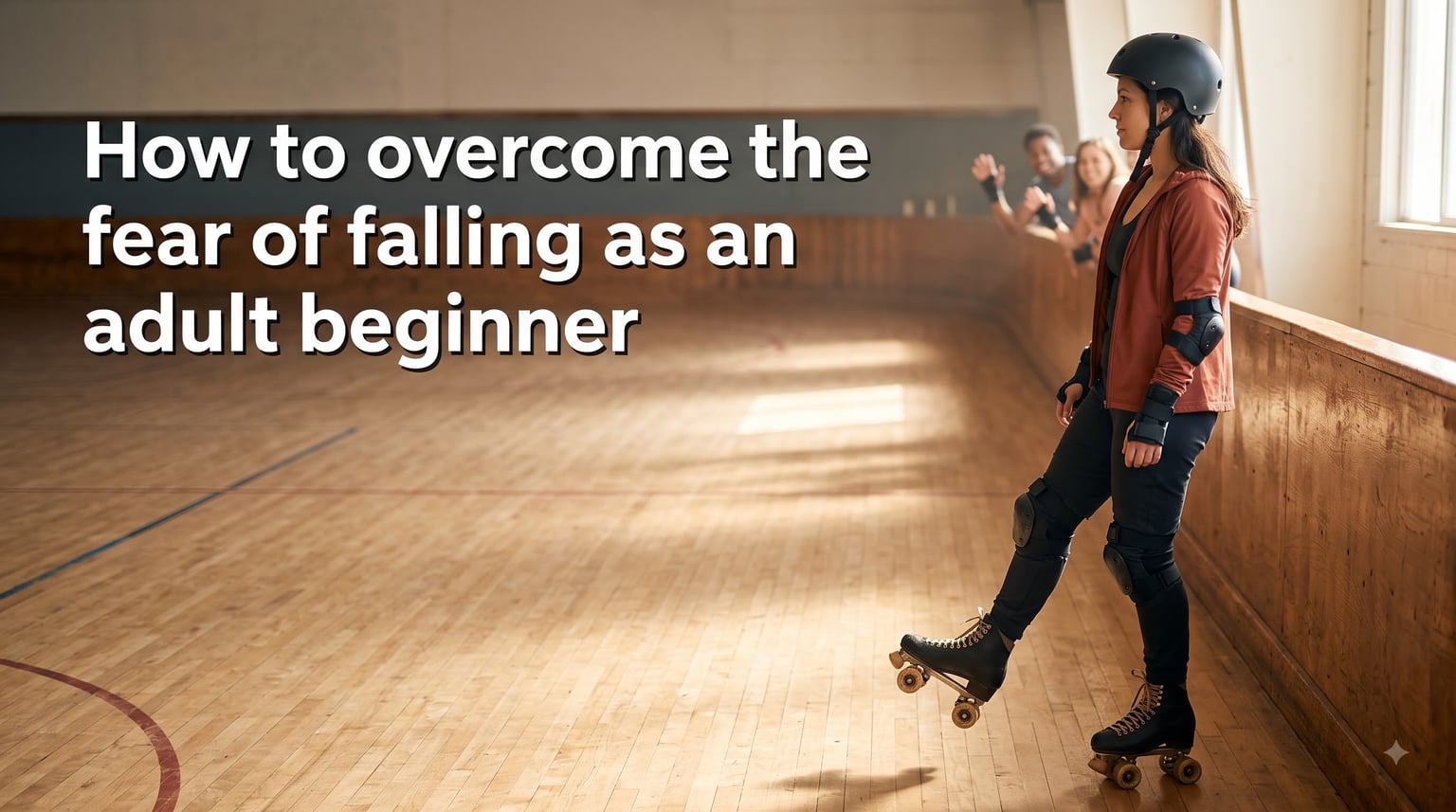
I remember standing at the edge of the rink in my late thirties, helmet strapped on, knees locked, heart hammering, completely unable to push off. The fear of falling was so loud in my head that I could not hear anything else.
If that sounds familiar, I want you to know something before we go further: the fear of falling as an adult beginner is not a personal flaw. It is a predictable response from a brain that is wired to protect you, and it can be unlearned. This guide is the playbook I wish I had on that first day, built from coaching sessions, skater forum threads, and the actual techniques that get adult beginners rolling with confidence.
In the next few minutes you will learn why adult brains react this way, how to build a physical foundation before you even lace up, which protective gear actually lowers fear, how to fall safely on purpose, how to use gradual exposure to rebuild confidence, and which mindset shifts make the fear shrink week by week.
Table of Contents
Why Adult Beginners Fear Falling (and Why That’s Normal)
Fear of falling as an adult beginner is a learned response, not a character flaw. Your brain remembers bruises from childhood, hears stories of broken wrists, and starts predicting the worst before you have even moved.
Clinicians call the intense version of this fear basophobia. It is a recognized anxiety where the mere thought of falling triggers the same stress response as an actual threat. When you stand on skates and your legs lock, that is basophobia showing up in real time.
Adults also carry more fear than children for three specific reasons. First, we have a longer memory of past falls and injuries. Second, we are more aware of the consequences, including broken bones that take longer to heal in our forties than in our teens. Third, we have a stronger embarrassment reflex, because adult beginners are not supposed to fall in public, at least according to the story we tell ourselves.
Here is what is actually happening in your body when fear spikes. Your amygdala fires, adrenaline floods your system, and your muscles tense up to protect your joints. That tension is the exact opposite of what you need on skates. Loose knees, soft hips, and a relaxed torso are how you stay balanced. So the fear itself is the thing creating the danger, not the skates.
Once I understood this, I stopped trying to push through the fear with willpower and started treating it like a skill to train. That single reframe is the foundation for everything below.
Build a Physical Foundation Before You Strap On Skates
Adults who fall less on skates usually have stronger hips, knees, and cores before they ever lace up. You can build that base in 15 minutes a day, in your living room, with zero equipment.
The Cleveland Clinic and Harvard Health both point to one consistent solution for fear of falling: regular exercise, especially activities that train balance. Yoga, tai chi, and Pilates show up again and again in the research because they teach you to control your center of gravity while staying calm.
Here are four off-skate exercises I give every adult beginner in week one.
Wall sit with knee bend pulses: Stand with your back against a wall, slide down until your knees are at about 90 degrees, and gently bounce an inch deeper for 30 seconds. This trains the exact bent-knee position you will need on skates.
Single-leg balance with eyes closed: Stand near a counter, lift one foot, close your eyes, and hold for 20 seconds per side. Closed eyes force your inner ear and core to do the work your eyes usually do.
Glute bridges: 15 reps, slow on the way up, two-second hold at the top. Strong glutes are the single biggest predictor of whether an adult skater stays upright.
Tandem stance walks: Walk heel-to-toe in a straight line for 20 steps. This is the same balance pattern you use when one skate pushes and the other glides.
Do these three times a week for two weeks before your first skate session. By the time you step onto the rink, your body will already know what balanced feels like, which removes a huge chunk of the fear.
Gear Up: Protective Equipment That Lowers Fear
Protective gear is not just about preventing injury. It is a fear-reduction tool. When your wrist guards and knee pads take the worst hit instead of your skin, your brain stops treating every push-off as a potential disaster.
Here is the minimum kit I recommend for any adult beginner.
Helmet: A certified multi-impact skate helmet, not a bike helmet. Skate helmets are designed for the kind of falls adults actually have on wheels, with more coverage at the back of the head.
Wrist guards: The single most important piece after the helmet. Wrist fractures are the most common roller skating injury in adults, and a good guard with a splint on the palm prevents 80 percent of them.
Knee pads: Hard-cap knee pads let you drop to your knees intentionally during a fall, which is one of the safest ways to come down. Soft pads feel nicer but do not let you trust the fall.
Elbow pads: Same logic as knee pads. Hard caps, snug fit, no slipping during a fall.
Mouthguard (optional but smart): A simple boil-and-bite mouthguard protects your teeth during the unexpected face-plant that happens to every adult beginner at least once.
Wear all of it on day one. I know it feels embarrassing. I wore the full kit at 38 and looked like a toddler on wheels. Within ten minutes I was so focused on my edges that I forgot I had it on. Within three weeks, not wearing the gear felt riskier than wearing it.
Learn How to Fall Safely (Practice Falling Off-Skates First)
You can absolutely practice falling before you ever roll. Adult beginners who rehearse falling on a mat or carpet fall less hard the first time it happens for real. It is one of the highest-leverage skills in the whole sport.
The goal is to turn an uncontrolled fall into a controlled one. Here is the sequence I teach, step by step.
Step 1: Get low before you go down. The moment you feel yourself losing balance, bend your knees deeper instead of reaching out. A low center of gravity gives you more time to choose your landing.
Step 2: Pick a side. Decide which knee and which hip are going to take the impact. Trying to fall straight back is how adults break tailbones and wrists. Committing to one side spreads the force across bigger muscle groups.
Step 3: Roll through the fall. Hit the knee pad, then the hip, then the shoulder, in that order. Rolling distributes force over a longer time, which means less peak impact on any one body part.
Step 4: Do not stick your arms out. This is the instinct that breaks wrists. Keep your hands in fists close to your chest, chin tucked, until you have rolled to a stop.
Step 5: Practice on a mat first. Find a gym mat, fold it twice, and run this sequence five times on each side. Once your body has the motion, your brain will not panic when the real version happens.
For backward falls, the trick is prevention, not technique. Adult beginners fall backward because they stand too straight. A bent-knee posture with your weight slightly forward removes almost every backward fall before it starts. If you do start to tip back, tuck your chin, roll onto your back, and let the back of your helmet and your shoulder blades absorb it. Never catch yourself with your hands behind you.
Once you are down, getting up correctly matters too. Roll to hands and knees, place one skate foot flat on the ground in front of you with the knee at 90 degrees, push up with your hands on that front knee and your back leg, and stand one foot at a time. Rushing this step is how skaters roll their ankles.
Use Gradual Exposure to Build Real Confidence
Confidence on skates is not a personality trait you either have or lack. It is built in layers, the same way exposure therapy works for any anxiety. Each small success becomes proof that your fear was louder than the actual risk.
Here is a six-week progression that works for most adult beginners I have coached.
Week 1: Skates on, standing still, holding a wall or rail. Practice the bent-knee position for five minutes. No movement required.
Week 2: Step out in a straight line, focusing on gentle pushes. Start with five-minute sessions and work up to 20 minutes per session.
Week 3: Add a single scissor push and glide on each foot. Goal is one second of glide per foot.
Week 4: Introduce turning by shifting your weight, not your feet. Practice wide S-turns down a hallway or empty rink lane.
Week 5: Add one small skill you have been avoiding, like a heel-toe stop or a backward wiggle. Pick the one that scares you most and do it three times.
Week 6: Skate with a friend or in a group for the first time. Social skating is the final layer for the embarrassment fear.
Track each session in a small notebook. Write the date, what you worked on, one thing that went well, and one thing that scared you. After four weeks you will have a paper trail of progress that your anxious brain cannot argue with.
Mindset Shifts That Make the Fear Shrink
Every adult skater I have talked to says the same thing about fear: it does not disappear, it just gets quieter as your skills get louder. Here are the mental tools that make that transition faster.
Reframe from “if I fall” to “when I fall.” Falling is not a failure, it is tuition. You will fall. Every adult who skates well has fallen hundreds of times. The question is not whether you will fall, it is whether you will still be on skates the next day.
Use box breathing before you push off. Inhale for four counts, hold for four, exhale for four, hold for four. Three rounds lowers your heart rate and tells your nervous system you are safe. Five seconds of this changes your entire session.
Visualize the session before you arrive. Spend two minutes the night before picturing yourself skating the path you plan to take. Include the fall in the visualization, and picture yourself getting up calmly. Your brain treats visualized practice almost like real practice.
Name the fear out loud. Saying “I am scared of falling on my wrist” out loud, to another human, takes 40 percent of the power out of it. This is straight from cognitive behavioral therapy, and it works on rinks.
Find your people. Adult beginner skate groups exist in almost every city, and the r/rollerskating subreddit is full of supportive returners. Falling in front of people who have been exactly where you are feels completely different than falling in front of strangers.
Celebrate the boring wins. Your first clean push. Your first glide on one foot for two seconds. Your first time you noticed your knees were already bent. These are not small things. They are proof your brain and body are getting the message.
Frequently Asked Questions
How do I stop being afraid of falling?
Start by accepting that falling is part of learning, not a sign of failure. Wear full protective gear, practice falling on a mat, and use gradual exposure in short sessions. Box breathing and visualizing the session ahead both calm the nervous system so your body stays loose instead of locking up.
What is basophobia?
Basophobia is the clinical name for an intense, persistent fear of falling. It is a recognized anxiety that can show up on roller skates, ice skates, ladders, or stairs. It triggers the same fight-or-flight response as a real threat, which is why your muscles tense up the moment you think about falling.
Does fear of falling get worse with age?
Yes, fear of falling tends to increase as adults get older because we have more memory of past falls, longer healing times, and a stronger embarrassment reflex. The good news is that adults also respond well to gradual exposure, strength training, and protective gear, so the trend can be reversed with consistent practice.
How do I get over my fear of injury?
Wear wrist guards, knee pads, elbow pads, and a helmet every session, learn to fall on your knees and hips instead of your wrists, and build core strength with squats and glute bridges before you skate. Most skating injuries happen to adults who skipped gear or stood too straight, both of which are preventable.
Is it normal to be scared as an adult beginner?
Yes. The fear of falling as an adult beginner is one of the most common reasons people quit before they really start. Your brain is doing its job by protecting you from a perceived threat. The fix is not to push through fear by force, but to combine protective gear, safe falling practice, and small progressive wins until your brain trusts the activity.
How long does it take to feel confident on skates?
Most adult beginners I have coached feel a real shift between weeks four and six, after they have had a few controlled falls and a few clean glides. Confidence is not a finish line, it is a slow build. Track small wins in a journal so you can see your own progress when fear tries to convince you that you have not improved.
Your Next Step on the Path Past Fear
The fear of falling as an adult beginner is loud, but it is also temporary. Every skater you see cruising the rink on a Saturday afternoon once stood where you are standing now, knees locked, breath held, totally convinced they were going to fall.
Pick one thing from this guide and do it this week. Buy the wrist guards. Try the wall sits. Practice falling on a mat. Watch one visualization before bed. The size of the step does not matter. What matters is that you take one.
You already know how to overcome the fear of falling as an adult beginner. You just needed the steps laid out in order. Now lace up, breathe, and go.