
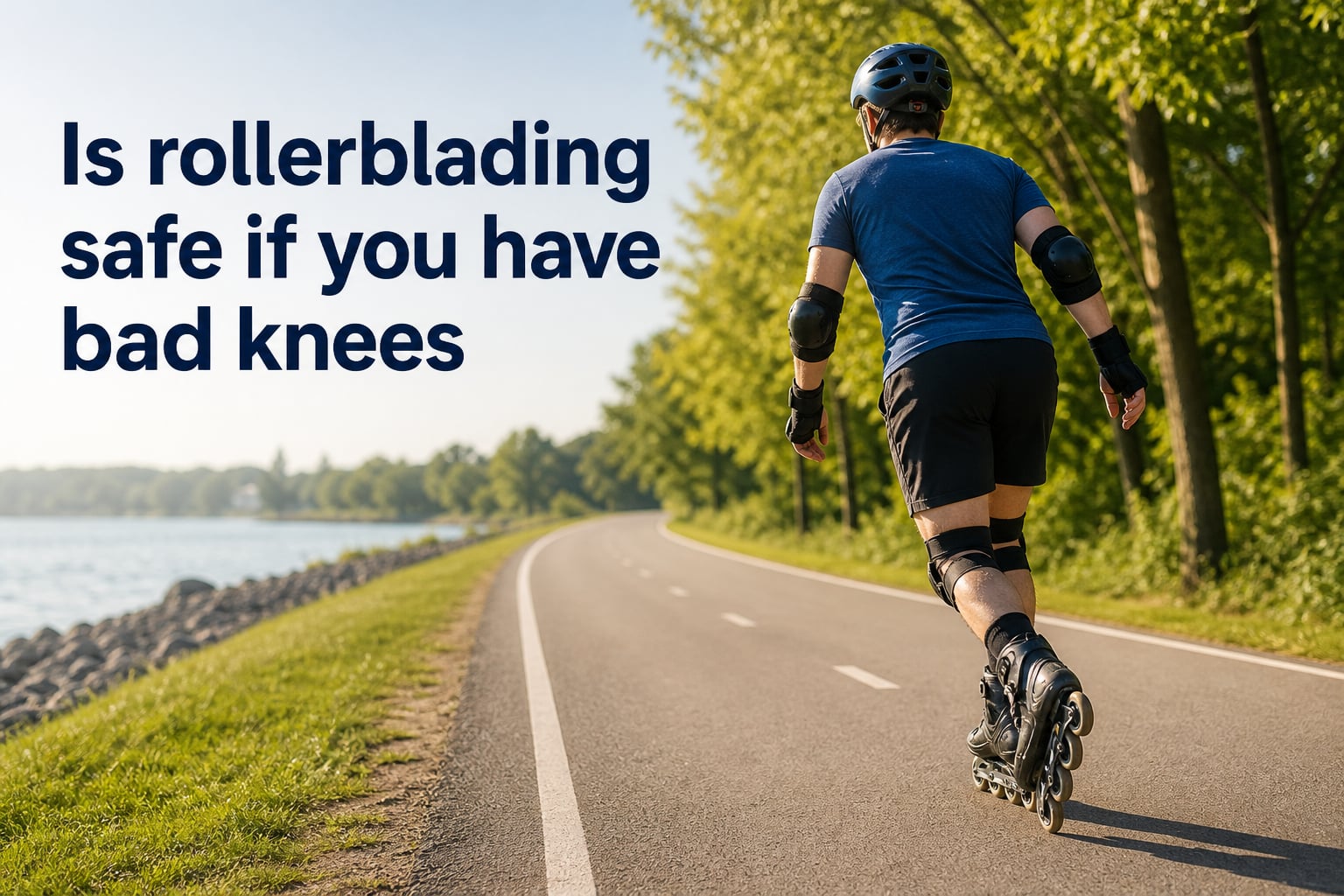
Yes, rollerblading is generally safe if you have bad knees. In fact, for many people dealing with chronic knee pain, inline skating offers a way to stay active without the punishing joint impact of running. I have spent years watching skaters with knee issues transform their fitness routines, and the results consistently surprise people who assumed their skating days were over.
The reason comes down to physics. Running sends a sharp downward force through your knee joint with every stride. Rollerblading distributes that force over a longer glide, producing roughly 50% less impact on the joint. That single difference explains why so many runners switch to skates when their knees start complaining.
But “generally safe” is not the same as “foolproof.” Technique matters. Equipment matters. And certain knee conditions need a more cautious approach than others. In this guide, I will walk through exactly when rollerblading helps bad knees, when it does not, and how to protect yourself if you decide to lace up.
Table of Contents
Is Rollerblading Safe If You Have Bad Knees? The Short Answer
Rollerblading is safe for most people with bad knees because the gliding motion produces about half the impact force of running, and the sideways stress pattern differs from the downward pounding that damages cartilage over time.
According to the Hospital for Special Surgery (HSS), low-impact activities like skating rank among the best exercises for sore knees because they keep the joint mobile without overloading it. The key word is “low-impact,” not “no-impact.” Your knees still work during skating. They just work differently.
I have talked with skaters who spent decades on wheels without knee problems and others who developed pain from poor form. The difference almost always comes down to how they skate, what they wear, and how well they prepared their leg muscles before pushing hard. That preparation is where most beginners with bad knees go wrong.
How Rollerblading Affects Your Knees Differently Than Running
To understand why rollerblading gets the green light for bad knees, you need to look at what happens inside the joint during each activity.
Running is a series of small jumps. Every time your foot lands, your body absorbs a force equal to two-and-a-half to three times your body weight. That force travels up through your ankle, into your knee, and up the kinetic chain to your hip. The meniscus, the rubbery cartilage that cushions your knee joint, takes the brunt of that repeated compression.
Rollerblading works on a completely different mechanic. Instead of landing, you glide. Instead of pushing downward against the ground, you push sideways to generate momentum. The wheels absorb vibration, and the smooth rolling motion spreads the workload over a longer time window. Your quadriceps, calves, and stabilizing muscles do most of the work, not your knee cartilage.
An osteopath featured in Stylist magazine explained it well: the sideways stress of skating is gentler on the knee joint because it recruits stabilizing muscles rather than relying on the joint as a shock absorber. Your muscles take the load that running dumps directly onto cartilage.
That said, the push-off motion in rollerblading is not zero-impact. One Reddit user with 25 years of skating experience reported bilateral meniscus damage he traced specifically to aggressive push-off technique over time. So while the impact is lower, poor form can still catch up with you.
Running vs Rollerblading: Knee Impact Comparison
Here is a side-by-side look at how the two activities compare on knee stress.
Impact force: Running transmits 2.5 to 3 times body weight per stride. Rollerblading transmits roughly 50% less, hovering around 1 to 1.5 times body weight depending on speed and terrain.
Force direction: Running creates downward compression through the knee. Rollerblading creates lateral push forces handled by muscles rather than cartilage.
Joint wear pattern: Running wears the meniscus through repeated compression. Rollerblading can strain the knee if push-off form is poor, but the wear pattern is muscular rather than compressive.
Fall risk: This is where rollerblading loses ground. Studies show 80 to 90% of rollerblading injuries come from falls, and most of those hit the upper body (wrists, elbows, shoulders) rather than knees. But a bad fall can still tweak a knee, so protective gear matters.
Muscle benefit: Rollerblading builds the quadriceps, calves, glutes, and core stabilizers that support knee health. Stronger muscles mean less load on the joint during everyday life, not just while skating.
Knee Conditions: Can You Skate With Arthritis, Meniscus Issues, or Chronic Pain?
Not all bad knees are the same. The right answer depends on what is actually going on inside your joint.
Osteoarthritis and Arthritic Knees
Yes, you can roller skate with arthritic knees, and many people find it helps. The low-impact gliding keeps the joint mobile, which is one of the best things you can do for arthritis. Movement circulates synovial fluid, the knee’s natural lubricant, and helps reduce stiffness.
The KC Wellness Center recommends skating as a joint-friendly cardio option for people managing arthritis, provided you start slow and listen to your body. Skaters on forums who switched from running to skating due to arthritis consistently report less day-to-day pain after a few weeks.
Meniscus Issues
This is the gray area. A torn or damaged meniscus needs careful management. The compressive forces of running are bad for meniscus damage, so the lower impact of skating is a point in its favor. However, the lateral push-off motion does stress the meniscus from a different angle.
If you have a meniscus injury, talk to a physical therapist before skating. Many people with meniscus issues skate comfortably once their leg muscles are strong enough to support the joint. The danger zone is skating before your stabilizing muscles are ready.
Ligament Injuries (ACL, MCL, PCL)
Ligament injuries require the most caution. If you are recovering from an ACL tear or repair, the twisting forces of skating could stress the repair. Get clearance from your orthopedic surgeon or physical therapist first. Many post-rehab patients do return to skating, but the timeline depends on your specific recovery.
Chronic Knee Pain Without a Specific Diagnosis
If your knees just ache and you have never gotten a clear diagnosis, rollerblading might actually help you figure out what is going on. Many people with vague knee pain discover that low-impact skating reduces their discomfort compared to running. The strengthening effect on quadriceps and glutes often relieves pain caused by muscle imbalance.
7 Safety Tips for Rollerblading With Bad Knees
These are the protocols I recommend to anyone with knee concerns who wants to start skating safely.
1. Wear full protective gear. Knee pads, wrist guards, elbow pads, and a helmet. Falls cause 80 to 90% of skating injuries, and a knee pad can turn a season-ending impact into a non-event. Do not skip this step.
2. Build leg strength first. Spend two to three weeks doing bodyweight squats, lunges, and glute bridges before you skate hard. Your quadriceps and glutes need to be strong enough to absorb the work your knee otherwise would.
3. Warm up before every session. Five minutes of dynamic stretching (leg swings, ankle circles, gentle squats) gets synovial fluid moving in your knee and primes your stabilizing muscles. Cold knees are injury-prone knees.
4. Choose smooth, flat surfaces. Rough asphalt and cracks send vibration straight through your wheels into your joints. Smooth bike paths, skate rinks, and paved trails are your friends. Avoid hills until your braking technique is solid.
5. Master your braking technique early. The heel brake or T-stop is the #1 skill to learn. Panicked stops lead to awkward body positions that torque the knee. Take a lesson if you can.
6. Skate within your limits. The most common cause of knee issues in newer skaters is ramping up distance and intensity before leg muscles are ready. Add no more than 10 to 15% to your skating time per week.
7. Stretch and recover after skating. Tight calves, hamstrings, and quads pull on the knee joint and cause pain that has nothing to do with the skating itself. Ten minutes of post-skate stretching prevents most “my knees hurt from skating” complaints.
When to Stop Skating: Warning Signs for Bad Knees
Some knee pain during exercise is normal. Some is a red flag. Here is how to tell the difference.
Stop skating and reassess if you feel sharp, stabbing pain in the knee joint. Dull muscle soreness is fine. Sharp joint pain is not. If the pain persists for more than 48 hours after a skating session, scale back and consult a professional.
Swelling around the knee after skating is another warning sign. Mild puffiness that resolves overnight is common when you are new. Visible swelling that lasts days or makes the knee feel warm indicates inflammation you should not ignore.
If your knee feels unstable, gives way, or locks during or after skating, stop immediately and see a doctor. These symptoms suggest a structural issue that skating could worsen.
Cross-Training to Protect Your Knees While Skating
The skaters I know with the healthiest knees all do one thing outside of skating: they cross-train. Strong supporting muscles are the real knee protection, not the skates themselves.
Yoga. Asha Kirkby of SkateFresh credits yoga with saving her skating career after a knee injury. Hot yoga and regular flow classes build the flexibility and core stability that keep your kneecap tracking properly. Even two sessions per week makes a measurable difference.
Glute and core work. Weak glutes force your knees to compensate. Glute bridges, single-leg deadlifts, and clamshells build the posterior chain that supports healthy knee mechanics during skating.
Strength training. Squats, lunges, and leg presses build the quadriceps strength that absorbs force before it reaches the knee joint. Aim for two strength sessions per week alongside your skating.
Forum skaters who combined skating with yoga and strength work consistently reported fewer knee issues than those who skated without cross-training. The pattern is too consistent to ignore.
Frequently Asked Questions
Is rollerblading hard on the knees?
No, rollerblading is not hard on the knees for most people. The gliding motion produces about 50% less impact than running because force is distributed over a longer stride and directed sideways rather than straight down through the joint. Poor push-off technique can cause strain over time, but proper form and strong leg muscles keep the knees safe.
What is the #1 mistake for bad knees?
The #1 mistake is increasing skating intensity and distance before your leg muscles are strong enough to support the knee joint. Skating with weak quadriceps and glutes forces the knee to absorb forces that strong muscles should handle. Build strength first, then skate.
What sport is best for bad knees?
Low-impact sports like rollerblading, swimming, cycling, and elliptical training are best for bad knees. Rollerblading stands out because it builds leg and core strength while delivering cardiovascular benefits, with roughly half the knee impact of running.
Can you roller skate with arthritic knees?
Yes, you can roller skate with arthritic knees, and it may help. The smooth gliding motion keeps the joint mobile and circulates synovial fluid, which lubricates the knee. Many arthritis patients report less stiffness after starting a skating routine, provided they start slowly and wear protective gear.
Are rollerblades bad for your knees?
Rollerblades are not inherently bad for your knees. The risk comes from poor technique, lack of protective gear, and skipping strength training. Falls cause 80 to 90% of skating injuries, and most affect the upper body rather than knees. With proper form and gear, rollerblading is gentler on knees than running.
Why does rollerblading hurt my knees?
Rollerblading can hurt your knees due to weak stabilizing muscles, poor push-off technique, skating on rough surfaces, tight muscles pulling on the joint, or skipping warm-ups. If your knees hurt during or after skating, address your strength, flexibility, and form before assuming the sport itself is the problem.
Is rollerblading hard on joints?
Rollerblading is considered a low-impact exercise that is gentle on joints compared to running. The gliding motion reduces stress on ankles, knees, and hips. However, the lateral push-off motion does engage the knees, so people with severe joint damage should get medical clearance before starting.
The Bottom Line on Rollerblading and Bad Knees
So, is rollerblading safe if you have bad knees? For the vast majority of people, the answer is yes. The 50% impact reduction, sideways force pattern, and muscle-building benefits make it one of the best low-impact cardio options for people who cannot run anymore.
The caveats are straightforward: wear your protective gear, build leg strength before pushing hard, warm up every time, and listen to your body when it sends warning signals. If you have a specific diagnosis like a meniscus tear or recent ligament surgery, check with your doctor first.
Your next step is simple. Grab a pair of skates, some knee pads, and a flat smooth surface. Start with 15-minute sessions and build from there. Your knees will likely thank you for choosing wheels over pavement.