
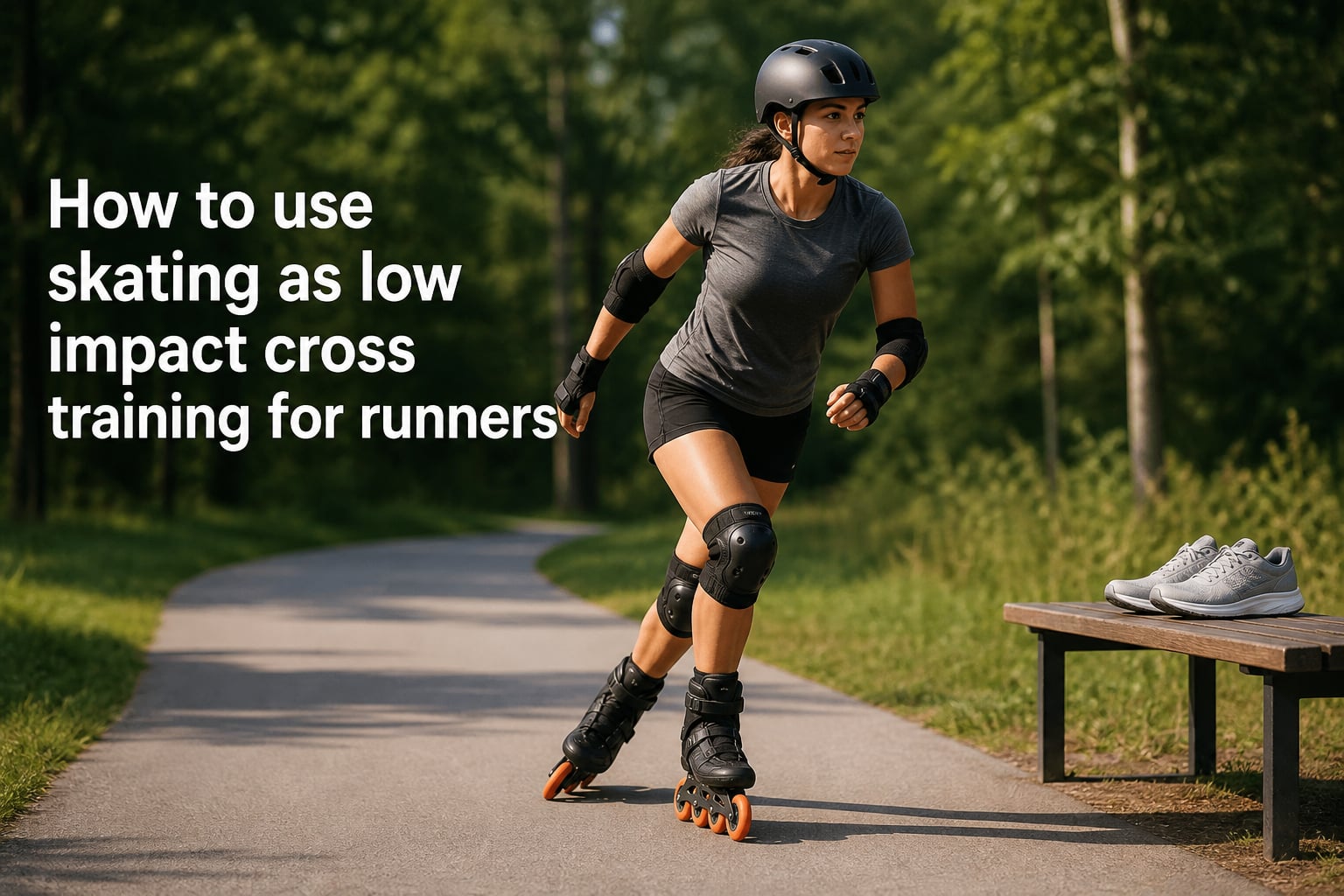
I first laced up inline skates after a stress fracture took me off the pavement for six weeks. I wanted to keep my cardio without the impact that broke me in the first place. What I discovered changed how I train for good.
Skating is one of the best-kept secrets in running circles. It keeps your heart rate up, builds muscles runners completely neglect, and stresses your joints at roughly half the impact of running. In this guide, I’ll show you how to use skating as low impact cross training for runners, the practical, evidence-informed way.
You’ll learn why skating works as cross-training, which muscles skating strengthens that running misses, how to pick between inline, ice, and roller, and how to build a weekly plan that fits around your running schedule.
Table of Contents
Why Skating Works as Cross-Training for Runners?
Skating works as cross-training for runners because it delivers real cardiovascular work while loading your joints at about 50% of the impact force that running produces. Every push engages muscles you barely touch during linear running, especially the gluteus medius, adductors, and core stabilizers. You get a workout that strengthens weak links, restores movement variety, and protects the very joints that running pounds on.
I have used inline skates as my off-day activity for three years. My IT band pain dropped dramatically after I built lateral strength through skating. My running friends who added skating to their training noticed the same thing: fewer knee issues, faster recovery days, and a longer season without injury.
Here’s the core logic. Running is a one-plane sport. You move forward, over and over, thousands of times per session. Your body adapts to that pattern, including its weaknesses. Skating forces you to push sideways, stabilize through your hips, and coordinate balance on a moving surface. That lateral work fills gaps that no amount of mileage can fix on its own.
The 50% less impact figure comes from biomechanical research cited by trainers and confirmed by my own perceived effort. A brisk skate session leaves my knees fresh while still elevating my heart rate into the aerobic zone. That’s the sweet spot for runners who want to keep fitness without breaking down.
The Three Biggest Skating Benefits for Runners
Low impact cardio that mirrors running’s aerobic demands. You can sustain 60 to 90 minutes on skates with far less joint stress per minute than the same time on pavement. It’s perfect for runners who need to keep their weekly mileage equivalents up during injury recovery or heavy race blocks.
Lateral movement that strengthens weak hips. Most runners are quad-dominant and have weak glutes, especially the gluteus medius, the small hip muscle that controls side-to-side stability. Skating recruits that muscle on every single push. The same motion lights up your adductors (inner thigh), abs, and lower back.
Injury prevention through movement variety. Patellofemoral pain, iliotibial band syndrome, shin splints, and Achilles tendon issues all share a common root: too much repeated forward stress. A sport that rotates the hips and ankles through different planes gives those overused tissues a break while still training the same energy systems.
What Muscles Does Skating Work That Running Doesn’t?
Skating works the gluteus medius, adductors, hip stabilizers, and core muscles that running leaves underused. Each push requires you to balance on one leg while driving the other outward, which fires stabilizers along your entire kinetic chain. Running, by contrast, emphasizes your quads, hamstrings, and calves in a straight line. Skating rounds out the muscle map.
I noticed the difference after about a month. My inner thighs were sore in a way they had never been from running. My hip control during single-leg drills improved. A coach pointed it out before I did. Runners who only run develop predictable imbalances; skaters develop balance.
Gluteus Medius and Hip Stabilizers
The gluteus medius is the small muscle on the side of your hip that keeps your pelvis level when one foot is off the ground. It’s chronically weak in most runners because running rarely challenges it side-on. Every skating stroke requires hip abduction against gravity. Strong gluteus medius means fewer fallen arches, less knee valgus, and better running economy.
Adductors (Inner Thigh)
Your adductors pull your leg back toward the midline. Running works them mainly for stabilization in a straight line. Skating makes them a primary mover. Strong adductors support your groin, protect your knees, and stabilize your pelvis during the single-leg stance phase of every running step.
Core and Postural Muscles
Balance on skates is hard. You constantly make micro-corrections with your abdominals, obliques, lower back, and even smaller stabilizer muscles along your spine. A 60-minute skate session is essentially an hour of dynamic core work. Runners gain trunk stability that translates directly to better form when fatigue sets in.
Why Lateral Movement Matters
Human gait evolved for travel in any direction. Modern runners use only one. Skating reintroduces frontal-plane and transverse-plane motion. That biomechanical variety keeps your tissues adaptable and resistant to the repetitive strain that ends seasons for dedicated runners.
Inline Skating vs Ice Skating vs Roller Skating: Which Type Is Best
Inline skating is the best type of skating for runners who want year-round, accessible training with the highest cardio transfer to running. Ice skating offers the deepest lateral engagement and core work but is seasonal. Quad roller skating is the gentlest option, ideal for beginners or recovery days. All three deliver the core benefits runners need.
I rotate between inline skates in summer and ice skates in winter, and I bring quad rollers out for very easy days when I want pure active recovery.
Comparison of Skating Types for Runners
Inline skating: Closest to running in feel. Forward motion, heel-toe push pattern, easy to vary intensity. Best for sustained cardio and speed work. Available year-round on roads, paths, and indoor rinks.
Ice skating: Deepest balance and lateral demands. Engages calves, glutes, adductors, and core harder per minute than inline. Limited to winter or indoor ice rinks. Best for off-season strength building.
Quad roller skating: Slower, more stable. Lower impact on knees and ankles. Excellent for learning balance and for true recovery sessions. Great cross-training choice for runners returning from injury.
Off-ice skate trainers: Sliders used on carpet that mimic skating strides at home. Convenient for technique drills when you can’t get to a rink or path.
Choose inline skating first if you want running-specific cardio transfer. Choose ice skating if you have access and want maximum lateral strength. Choose quad roller if balance, injury recovery, or pure low-intensity work is your goal.
How to Start Skating as Cross-Training: Beginner Guide
Start skating as cross-training by investing in proper protective gear, choosing a smooth practice surface, and beginning with 20 to 30 minute sessions two to three times per week. Beginners should use smaller wheels (76mm to 80mm) for better balance, master the ready position, and progress only when balance feels automatic.
I learned the hard way. My first session was on too-large wheels, on rough asphalt, without wrist guards. I fell twice and felt unstable the whole time. Lower your entry barrier: safe gear, smooth ground, and small wheels. The rest follows.
Essential Safety Gear
Wear a helmet, wrist guards, knee pads, and elbow pads every session. Falling is part of learning. Road rash on a kneecap will end your training block faster than the impact you’d avoid on the run. Spend the money on a real helmet designed for skating or cycling.
Choosing Your Setup
Inline skate beginners should pick a fitness skate with four wheels in the 76mm to 80mm range, a stiff cuff for ankle support, and a brake pad on the right skate. Hard-shell boots are more forgiving than carbon race boots. Comfort beats performance when you’re learning.
Where to Practice
Find a flat, smooth, low-traffic surface. Empty parking lots, closed bike paths, smooth boardwalks, and indoor rinks are ideal. Avoid hills, rough pavement, and traffic until your balance is automatic. A smooth tennis court or basketball court is a perfect training ground.
Sessions Start Short
Begin with 20 minutes per session, three times weekly. Add 5 to 10 minutes per week as your balance improves. Most runners feel comfortable for an hour within four to six weeks of consistent practice.
Beginner Skating Exercises for Runners
The four beginner exercises that build a solid skating foundation for runners are the ready position, basic two-foot glide, scissor glide, and one-foot glide with progression from wall support to free balance. Master each in order; rushing the sequence is how runners get injured and quit.
I work through these drills in my warm-up every session. They keep my form sharp and remind my hips which muscles to fire. Skip them and your skating will always feel sloppy.
Drill 1: Ready Position
Stand with feet shoulder-width apart, knees slightly bent, weight centered over the balls of your feet, arms relaxed in front for balance. Your shoulders should sit slightly forward of your hips. Hold this stance for one to two minutes, focusing on relaxed ankles and a low center of gravity. This is the default position you’ll return to between drills.
Drill 2: Basic Two-Foot Glide
From the ready position, push both feet outward to one side and glide on the other. Repeat to the opposite side. Each push should be small. The glide matters more than the push. Start against a wall for support, then move away as confidence builds. Goal: 10 glides each direction without touching a wall.
Drill 3: Scissor Glide
Push your right foot out to the side while keeping your left foot pointing forward. Glide on the left foot briefly, then bring the right foot back to center and switch. This is the foundational motion of all skating. Keep your knees soft and your weight slightly forward. Aim for smooth, controlled exchanges rather than speed.
Drill 4: One-Foot Glide
Start near a wall. Push off, glide on one foot for three to five seconds, then place the other foot down to stop. Switch sides. As balance improves, move farther from the wall until you can glide 10 to 15 meters on each foot. One-foot glides build the hip stability that translates directly to better running form.
Drill 5: Forward Swizzle
Point both toes inward in a slight V, knees bent, then push outward to form an upside-down V while gliding forward. You’ll travel slowly forward in a herringbone pattern. Forward swizzles teach balance, weight transfer, and the V-shaped push that powers efficient skating.
Sample Skating Cross-Training Plan for Runners
A good skating cross-training plan for runners includes one to two skate sessions per week on non-consecutive days, starting at 30 minutes each and progressing to 90 minutes over eight to twelve weeks. Use heart rate to keep effort in the aerobic zone (60 to 75% of max) for recovery sessions and the tempo zone (75 to 85%) for harder workouts that replace a run.
I built my current plan around three pillars: one easy recovery skate, one tempo skate, and optional weekend long-skate. Let me walk you through how I structure the week.
Weekly Schedule Template
Runners who train five days per week can swap one easy run and one medium run for one easy skate and one tempo skate. A simple plan looks like this.
Monday: Easy skate, 45 minutes, conversational pace
Tuesday: Run, easy
Wednesday: Run, tempo or intervals
Thursday: Off or core work
Friday: Easy run
Saturday: Tempo skate, 60 minutes, sustained effort
Sunday: Long run
Skating sessions replace runs because the cardio benefit is similar and the recovery cost is lower. You keep your training load up while giving your joints a break.
Heart Rate Zones for Skating
Use a chest strap or wrist-based monitor. Skating’s perceived effort often feels harder than your heart rate suggests because balance uses extra stabilizing muscle. Here’s how to translate effort.
Aerobic recovery: 60 to 70% of max heart rate. Easy conversational skate. Replace an easy run.
Aerobic base: 70 to 80% of max. Steady-state skate. Replace a mid-week medium run.
Tempo: 80 to 87% of max. Hard but sustainable. Replace a tempo run or hill repeat session.
Skill Progression Levels
Progress your skating skills on a four-tier system so you don’t overreach. Level 1 is balance and two-foot glides (first two weeks). Level 2 adds scissor glides and gentle forward motion (weeks three to four). Level 3 introduces one-foot glides and turns (weeks five to eight). Level 4 covers crossovers, stops, and sustained tempo skating (weeks eight and beyond).
The 3-3-3 Rule for Runners
The 3-3-3 running rule is a recovery principle: at least 3 hours of sleep in your regular window, 3 liters of water daily, and 3 grams of carbohydrate per kilogram of body weight on training days. Skating fits naturally into this framework because its lower impact lets you keep training while still recovering. Use a skate session as your “recovery hour” within the rule.
Frequently Asked Questions
Is skating good cross training for running?
Yes, skating is excellent cross-training for running because it builds cardiovascular fitness with about 50% less joint impact than running, strengthens hip stabilizers and adductors that running neglects, and improves balance and proprioception through constant single-leg work.
Is skating lower impact than running?
Yes, skating produces roughly 50% less impact force on joints than running at comparable cardiovascular intensity, which is why many runners use it as an injury-prevention tool or as their primary cross-training during recovery.
Is skating a low-impact exercise?
Skating is generally classified as a low-impact exercise because the rolling motion eliminates the repeated ground-strike force that makes running high impact, even though it still produces a cardiovascular and muscular training effect similar to moderate running.
How often should I skate for cross-training?
Most runners benefit from one to two skating sessions per week on non-consecutive days, starting at 30 minutes per session and progressing to 60 to 90 minutes as balance and endurance improve.
Will skating help me get better at running?
Skating improves running performance indirectly by strengthening the gluteus medius, adductors, and core stabilizers that running underuses, while allowing runners to maintain cardiovascular fitness during injury recovery or high-mileage race blocks.
Final Thoughts on Skating Cross Training for Runners
Skating cross training for runners delivers what almost no other cross-training activity can: real cardio load with real lateral strengthening and a fraction of the joint punishment that running dishes out. You build stabilizer muscles, restore movement variety, and keep your weekly training load intact without the overuse risk.
Start with one short, easy session this week. Grab a helmet, find a smooth surface, and spend 30 minutes working on balance and basic glides. Your hips, knees, and next race season will thank you. Skating isn’t a replacement for running. It’s the perfect partner for it.
1 thought on “How to Use Skating as Low Impact Cross Training for Runners (September 2026)”