
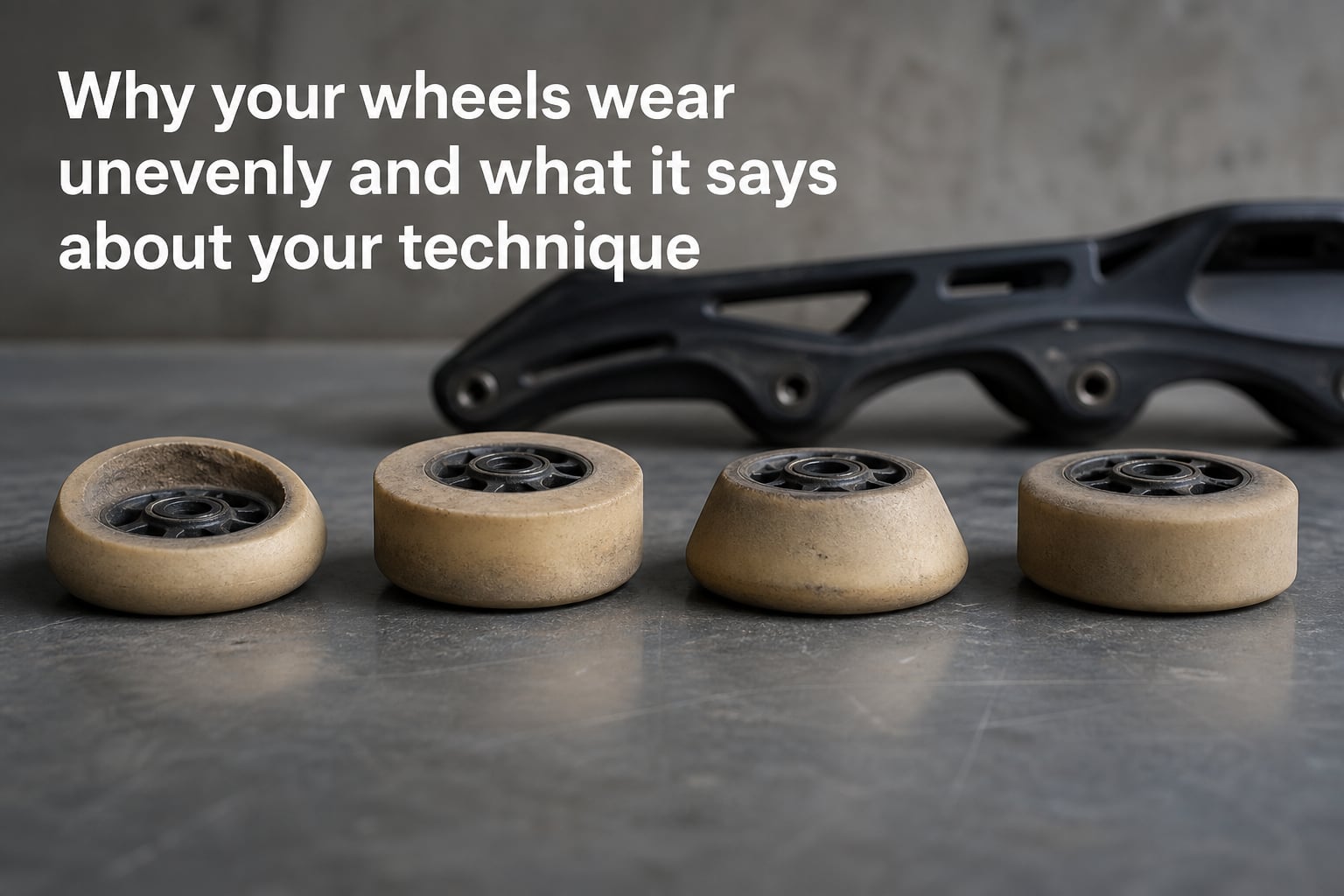
Your inline skates are quietly keeping score of every mistake you make on wheels. Look down at your wheels after a few sessions and they will tell you exactly where your technique breaks down, before any coach has to say a word. I have been skating for over a decade and I still check my wheels first when something feels off, because the wear pattern is more honest than my own perception.
Uneven wheel wear is not a defect in your equipment. It is a diagnostic readout. In this guide, I will walk you through the five main wear patterns I see on recreational and fitness skates, what each one says about your technique, and the exact drills our team uses to correct them. By the end, you will be able to read your wheels like a coach reads your posture.
Table of Contents
Understanding Wheel Wear Patterns: Your Skates Are Talking to You
Inline skate wheels are made from polyurethane, a material that wears predictably based on load, angle, and surface contact. When you skate with proper form, your weight travels down through the frame in a straight line, each wheel touches the ground evenly, and your wheels wear down into a uniform cylinder. This is the gold standard. Bill Begg, one of the most respected inline skating coaches in the world, has said for years that correctly positioned skaters on smooth surfaces will see their wheels wear evenly without scuffing at all.
Most of us are not skating with perfect form. The moment your ankle rolls, your weight shifts off-center, or your push goes through the toe instead of the side, the load redistributes across the wheel. That redistribution shows up as uneven wear, and the specific shape of that wear is a fingerprint of your specific mistake.
There are three properties to look at when you inspect your wheels. The first is which edge is wearing faster, the inside edge or the outside edge. The second is the contact patch shape, whether it is a flat band across the top, a cone, or a tapered point. The third is which wheel in the frame is wearing fastest, the front wheel, the middle, or the rear. Each of these properties maps to a different category of technique error.
If you only take one thing from this section, take this: every wear pattern has a meaning, and the meaning is almost always something you can fix with stance work and a few targeted drills.
Inside Edge Wear: The Pronation Problem
Inside edge wear is the most common pattern I see on beginner and intermediate skates. You will notice it when one side of the wheel, the side closest to your other foot, wears down faster than the other side. The wheel starts to look like a shallow cone leaning inward. If you run your finger across the contact patch, the high side is on the outside and the worn slope points toward the inside of the frame.
This pattern is the signature of pronation. Pronation is what happens when your ankle rolls inward during the push or glide phase. Instead of your weight traveling straight down through the bones of your leg, it collapses toward the arch, the knee drifts inward, and the inside edge of every wheel takes more load than it should.
Why does this happen? In my experience, three things cause it. First, weak glute medius muscles, the small muscles on the side of your hip that should keep your pelvis level. Second, stiff ankles that cannot dorsiflex properly, so the body finds range by rolling the foot instead. Third, fear. New skaters who are not confident in their balance tend to lean their ankles inward to create a wider base, which trains the pronation pattern over time.
How to confirm you pronate without any equipment. Stand on one foot and watch your ankle in a mirror. If the ankle visibly rolls inward and your arch drops, you pronate. Then look at the wear pattern on your skates. If the inside edges are lower than the outside edges, that is your second confirmation.
Three drills our team uses to fix pronation in inline skating. The first is lateral band walks, two sets of fifteen steps each direction with a resistance band above the knees. The second is single-leg glute bridges, three sets of twelve per side, focusing on driving the heel into the floor. The third is the wall sit with a ball between the knees, holding for thirty seconds across four rounds. After two to three weeks of consistent work, you will see the inside edge wear begin to even out.
Outside Edge Wear: When You Push Too Hard Outward
Outside edge wear is the mirror image of pronation and far less common, but it deserves its own section because most articles ignore it. You will see it when the outside edge of the wheel, the side facing away from your other foot, wears down faster than the inside edge. The cone shape tilts outward instead of inward.
This is called supination, and it happens when your weight rolls to the outer edge of your foot during the glide or push. Skating coaches sometimes call it the opposite mistake, but in our testing it tends to come from a different cause than pronation.
Common causes of supination. Stiff ankles that cannot pronate even a little, so the foot compensates by rolling the other way. Fear of falling inward, especially on downhills or rough surfaces. Old injuries to the lateral ankle ligaments that make the outside of the foot feel safer. Aggressive skaters coming from inline hockey who learned a wider stance.
How to tell supination apart from pronation. Run your finger across the contact patch. The high side will be on the inside and the worn slope points outward. If you pronate, the high side is on the outside and the worn slope points inward. The two patterns are opposites and the fix is different.
Fixes for supination focus on ankle mobility and trust. Calf stretches against a wall, three sets of forty-five seconds per side, restore range of motion to the ankle joint. Balance board work, two minutes per day, teaches the ankle that small lateral movements are safe. Heel-to-toe walks along a line force the foot to move through its full range. Within a month, outside edge wear typically moderates.
Flat Top and Cone Wear: Push Mechanics Issues
Flat top wear shows up as a wide, flat band across the top of the wheel instead of the typical narrow contact patch. The wheel almost looks like a tiny cylinder. Cone wear shows up as a tapered, cone-shaped contact patch that points inward or outward depending on the push direction.
Both of these patterns are push mechanics issues, and they happen because of how you transfer force into each stroke. Skating has two main push styles. There is the side push, where you push outward with the full edge of the wheel while your knee tracks over your toe. There is the toe push, where you finish the stroke by flicking the toe outward.
Beginners almost always toe push. The flat top on the wheel is the dead giveaway. When you push through your toe, the wheel contacts the ground on its leading edge instead of its full side, and the flat top forms because the contact patch never gets to taper naturally. Fitness skaters and speed skaters who push correctly from the side develop a gentle cone shape instead of a flat top, because the side push spreads wear across a wider patch.
Bill Begg’s coaching column on inline planet describes this in detail. He notes that recreational skaters who skate in an upright position tend to develop flat top wear from toe-pushing, while skaters who adopt the proper low, butt-down stance with knees above toes and hips above ankles develop a more even cone shape from side pushing. The difference is not subtle. It shows up in the wheels within weeks.
The proper butt-down side push technique. Bend your knees until your kneecaps sit directly above your laces. Keep your hips back like you are sitting in a chair. Push outward with the full side of the wheel, not with the toe. Let your trailing leg glide fully extended before recovering. Practice this in front of a mirror for ten minutes a day and your wheels will start to cone evenly instead of going flat.
If your wheels are already flat topped, you can still fix the pattern. It takes four to six weeks of focused side-push practice, and during that time you will be replacing wheels more often than usual because the flat top wears out faster than a cone does. Once your technique shifts, replacement intervals stretch back out.
Front vs Back Wheel Wear: Stance and Stride Problems
Front wheel wear shows up when the first wheel in each skate wears noticeably faster than the others. Back wheel wear shows up when the rearmost wheel takes the brunt of use. Both patterns are common and both have specific causes.
Front wheels wear faster on beginners for a clear reason. Beginners tend to lead with their toes, place their weight slightly forward, and put more pressure on the front wheel during every stride. The wheel takes the initial ground contact and bears more load per stroke. As technique improves and weight settles back into the heel, front wheel wear moderates.
Back wheels wear faster when the skater uses heavy braking, drag stops, or aggressive T-stopping. The rear wheel takes the friction load during every stop, and the pattern is especially pronounced on inline skates used for downhill or aggressive street riding. If you use your back wheel as a primary brake, expect it to wear out roughly twice as fast as the others.
One skate wearing faster than the other is also normal. Most skaters have a dominant foot that they push with more often and with more force. Right-foot dominant skaters typically see faster wear on the right skate, left-foot dominant skaters see faster wear on the left. This is not a defect. It is just how the body distributes force.
Stride corrections to balance wear across the frame. Practice pushing equally with both feet by counting your strokes out loud for the first five minutes of every session. Shift your weight slightly back during the glide phase. Use a heel brake if you tend to drag stop with the rear wheel, and you will save that wheel for actual skating instead of braking.
Self-Diagnosis: Reading Your Wheels Like a Coach
Reading your own wheels is a skill that takes five minutes to learn and a lifetime to refine. Here is the simple process I walk every new skater through.
Step one. Pull each wheel off the frame and lay them out in order from front to back on a flat surface. Step two. Look at each wheel from the side and identify which edge is lower, inside or outside. Step three. Look at the contact patch shape and decide if it is flat, gently cone-shaped, or steeply cone-shaped. Step four. Note which wheel in the frame is the smallest. Step five. Compare left and right skates to see if one side wears faster than the other.
Once you have those five pieces of data, the diagnosis is almost always obvious. Inside edge wear across all wheels on both skates points to pronation. Outside edge wear points to supination. Flat tops point to toe-pushing. Front wheels much smaller points to forward weight bias. Back wheels much smaller points to drag braking.
When to seek video analysis. If your wheels show a wear pattern that you cannot match to a known mistake, film yourself skating from the side and from behind. Slow it down frame by frame and look at your ankles during the glide phase. Most mystery patterns reveal themselves in the first ten seconds of footage.
Wheel Rotation Schedules and Patterns That Extend Wheel Life
Wheel rotation does not fix bad technique. What it does is spread the wear across all four wheels on each skate so that no single wheel becomes a weak point before the others. Combined with technique corrections, rotation extends the life of your wheel set by roughly two to three times.
Why wheel rotation matters. Polyurethane wheels wear at different rates depending on their position in the frame. Front wheels take more impact. Rear wheels take more braking. Outside wheels take more side push force. If you never rotate, you end up with one wheel worn to the core while three others have plenty of life left. Rotation evens this out.
How often to rotate inline skate wheels. For recreational skaters, every two to three weeks or every fifteen to twenty hours of skating. For fitness skaters who log more mileage, every week. For aggressive and downhill skaters, after every few sessions because the wear rates are much higher.
Three beginner rotation patterns. The first is front-to-back rotation, where the front wheel moves to the back, the back wheel moves to the front, and the middle two swap. The second is the X-pattern rotation, where front-left moves to back-right, back-right moves to front-left, and so on across the frame. The third is the full diagonal rotation, where every wheel moves one position clockwise. The X-pattern is the most common recommendation for recreational skaters.
Advanced setups include the HiLo and rockered configurations. HiLo means the front and rear wheels are a different size than the middle two, often used for speed skating. Rockered setups curve the wheel stack so the front and rear wheels are slightly smaller than the middle, giving the skate a more maneuverable feel. Both setups require specific rotation patterns that are beyond a beginner guide but worth exploring once your base technique is solid.
When to Rotate vs When to Replace Your Wheels
Rotation keeps wheels alive longer but it does not make them last forever. There are clear visual signs that a wheel needs replacement instead of another rotation. Visible core exposure is the biggest warning. The dark inner core showing through the polyurethane means the wheel is unsafe and must be replaced.
Other signs you need new wheels. Wobble during skating that did not exist before, even after checking bearings and axle tension. A flat spot you can feel as a rhythmic thump under your foot. Vibration through the frame at speed. Any wheel that has worn unevenly enough that rotation would create a tilt in the frame.
A practical rule from our team. If a wheel is more than sixty percent worn compared to a new wheel, replace it. Rotating heavily worn wheels into a position of higher load only delays the inevitable and can throw off your frame geometry.
Frequently Asked Questions About Inline Skating Wheel Wear
What does wheel wear say about skating technique?
Wheel wear is a direct readout of how your weight and force travel through the frame. Inside edge wear indicates pronation, outside edge wear indicates supination, flat top wear indicates toe-pushing instead of side-pushing, and front or back wheel wear indicates weight distribution or braking habits. Each pattern maps to a specific technique flaw.
How to fix pronation in inline skating?
Fixing pronation requires strengthening the glute medius, restoring ankle dorsiflexion, and retraining the push mechanics. Three effective drills are lateral band walks, single-leg glute bridges, and wall sits with a ball between the knees. Combined with consistent side-push technique, you should see improvement in inside edge wear within two to three weeks.
How often should you rotate inline skate wheels?
Rotate your inline skate wheels every two to three weeks or every fifteen to twenty hours of skating for recreational use. Fitness skaters should rotate weekly. Aggressive and downhill skaters should rotate after every few sessions. The X-pattern rotation is the most common approach for recreational skaters.
Why are my inline skate wheels wearing on the inside edge?
Inside edge wear happens when your ankles roll inward during the glide or push phase, a pattern called pronation. The inside edge of each wheel takes more load than the outside, and the wheels develop a cone shape leaning inward. Weak glute medius muscles, stiff ankles, and balance fear are the most common causes.
What causes flat spots on inline skate wheels?
Flat top wear or flat spots develop when you push primarily through the toe instead of the full side of the wheel. The contact patch never tapers naturally and the wheel wears into a flat band across the top instead of a gentle cone. This is most common in beginners who have not yet learned the butt-down side-push technique.
Is uneven wheel wear normal on inline skates?
Some unevenness is normal, especially one skate wearing faster than the other due to dominant foot pressure. Pronounced patterns like steep inside edge wear, flat tops, or one wheel much smaller than the rest are not normal and indicate technique issues that can be corrected with stance work and rotation.
Final Thoughts: Your Wheels Are Your Best Coach
Inline skating wheel wear is one of the few free coaching tools in any sport. Every session, your skates are telling you exactly what your body is doing, and they never lie about it. Once you learn to read the patterns, you have a feedback loop that no instructor can match.
Pull your wheels off tonight. Lay them out and look at them honestly. Identify the pattern, match it to the technique mistake, and pick one drill from this guide to focus on for the next two weeks. Combine that drill with a regular wheel rotation schedule, and you will see real changes in both your wheels and your skating. That is how our team has trained hundreds of skaters to diagnose their own form, and it works.