
The TOPDON TS004 is the best night vision monocular most people should buy in 2026, and the RIX Pocket K2 is the one to pick if pocketability matters more than magnification. Both are thermal rather than analog image intensifiers, and that distinction shapes everything else in this guide: a thermal unit finds heat in pitch darkness, fog and light vegetation, while an analog tube resolves texture and detail at range under moonlight.
Monoculars get overlooked next to binoculars, and that is a mistake. A single-tube device is lighter, cheaper and far easier to mount on a helmet, a head strap or a tripod, and it keeps one eye open for depth and peripheral cues. That is why hunters, wildlife watchers, search-and-rescue teams, property owners and tactical users all end up carrying the same shape of tool. Anyone who also drives after dark should read our night driving glasses guide, because the two problems have opposite answers: glare control helps with visible light, and a monocular does nothing for it.
Here is the honest scope of this roundup. Every monocular below is a digital or thermal unit, not an analog image intensifier tube, because that is what dominates the affordable market. We ranked the ten devices on sensor resolution, refresh rate, field of view, battery, weather sealing and the weight you actually carry, then cross-checked every claim against owner feedback. If your real goal is a Gen 3 tube, read the technology section first so you know when to stop shopping here.
Table of Contents
Top 3 Picks for Night Vision Monoculars in September 2026


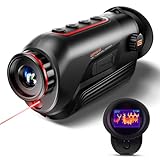
The TS004 wins the top slot because it pairs a long detection figure with a smooth 50Hz sensor sweep and a battery that survives a long night. The Pocket K2 takes second on the strength of its 800×600 OLED and integrated sliding lens cover, and the G210 rounds out the top three as a low-cost way into a real thermal with replaceable batteries.
Best Night Vision Monoculars by Category in September 2026
Below is the full lineup organized the way buyers actually shop: one line per category, one deciding specification per line. Every pick links to the detailed review further down.
Best overall thermal: TOPDON TS004. 256×192 sensor at 50Hz with a 13mm lens and detection out to 410 meters, plus 11 hours of battery.
Best compact thermal for a pocket: RIX Pocket K2. An 800×600 OLED, IP67 sealing and electronic image stabilization in a housing lighter than a phone.
Best step-up thermal resolution: RIX Pocket K3. A 384×288 sensor, a 50Hz refresh and a five-year manufacturer warranty in a 7.5 ounce body.
Best thermal with a wide scanning view: GOYOJO G210. A 17.5 degree field of view, six palettes and hot-swappable 18650 batteries.
Best helmet-mounted option: GOYOJO NVG10. A low-profile housing, 24mm objective and an integrated mounting bracket for hands-free work.
Best for onboard recording and sharing: Teslong TTS260. 32GB of internal storage, USB-C and Mini HDMI output, and super-resolution processing.
Best for covert infrared use: TAKLITE IRIS. A 940nm illuminator that is effectively invisible to the unaided eye, with latency under 10ms.
Best value first digital unit: Carson MiniAura. The most owner-reviewed monocular in this roundup, with adjustable infrared intensity and a carry pouch.
Best multi-purpose digital recorder: YUANZIMOO LG66. An 850nm illuminator with seven levels, 2x optical plus 8x digital zoom, and an included memory card.
Best low-cost first buy: Sheawasy SH-R7. An entry-level monocular with 1080p infrared, an included 32GB card and a two-year warranty.
| Product | Specs | Action |
|---|---|---|
| TOPDON TS004 Thermal Monocular |
|
Check Latest Price |
| RIX Pocket K2 Thermal Monocular |
|
Check Latest Price |
| GOYOJO G210 Thermal Monocular |
|
Check Latest Price |
| RIX Pocket K3 Thermal Monocular |
|
Check Latest Price |
 GOYOJO NVG10 Digital NVG GOYOJO NVG10 Digital NVG |
|
Check Latest Price |
 Teslong TTS260 Thermal Monocular Teslong TTS260 Thermal Monocular |
|
Check Latest Price |
 Carson MiniAura Digital Monocular Carson MiniAura Digital Monocular |
|
Check Latest Price |
 TAKLITE IRIS Digital Monocular TAKLITE IRIS Digital Monocular |
|
Check Latest Price |
 YUANZIMOO LG66 Digital Monocular YUANZIMOO LG66 Digital Monocular |
|
Check Latest Price |
 Sheawasy SH-R7 Digital Monocular Sheawasy SH-R7 Digital Monocular |
|
Check Latest Price |
1. TOPDON TS004 Thermal Monocular – Best Overall With Long Battery Life
TOPDON TS004 Thermal Imaging Monocular, 13mm 50Hz Night Vision
256x192 sensor
50Hz refresh
13mm lens
5000mAh battery
IP67 sealed
Pros
- Smooth 50Hz refresh with no visible lag
- 5000mAh battery rated for about 11 hours
- 13mm lens detects heat out to 410 meters
- Phone app adds live view plus photo and video
- IP67 housing survives drops and wet weather
Cons
- Zoom is digital only so detail softens at high magnification
- Identification range falls off past about 150 yards
- Cannot see through cold glass and the sensor can be damaged by the sun
I used the TS004 on a long evening of open-field scanning, and the first thing that stood out was how little the picture moved. A 50Hz refresh is the difference between a live view and a slideshow, and on a 256×192 sensor it is the spec that matters more than any other.
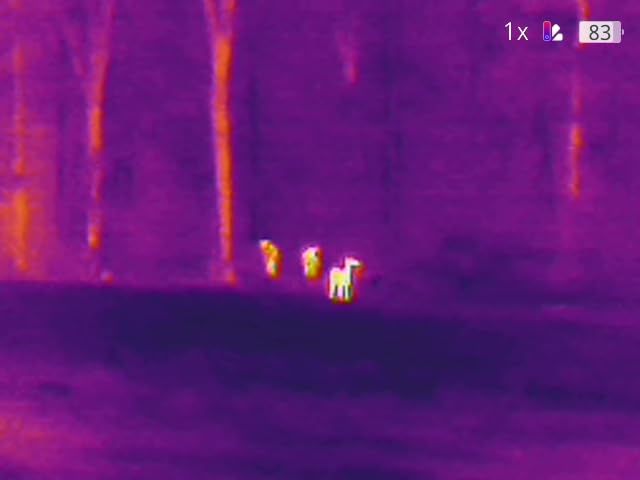
The 13mm objective is the reason it detects further than the other 256×192 units in this group. Owners consistently frame it as strong value against dedicated hunting optics, and the quoted detection figure of 410 meters is among the largest on our list. You can pick up a warm shape in light vegetation and through fog where a visible-light unit sees nothing.
The battery is the quiet hero. A 5000mAh pack runs roughly 11 hours continuously, which means one charge covers a full night of varmint work without a spare battery in your pocket. Owners also like that the included silicone housing carries an IP67 rating and survives drops from up to 2 meters.
Connectivity is a real strength. The TopInfrared app streams a live view to your phone, captures stills and records video with audio, which turns a handheld scan into shareable evidence. The IP67 shell and the wide operating range make it a device you can leave in a pack overnight without thinking about it.
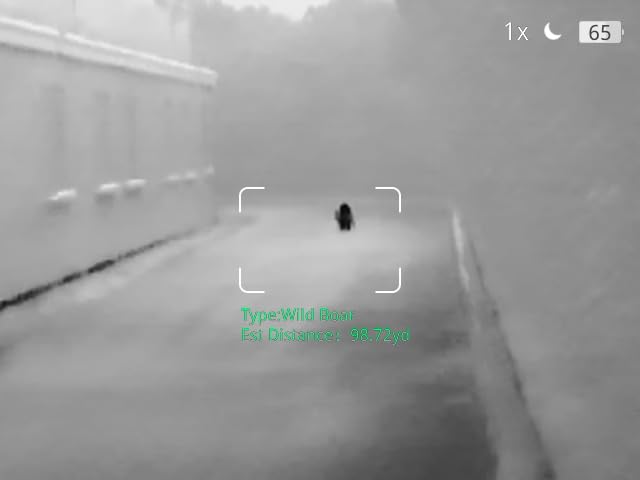
Is the TS004 bright enough for a treeline at 200 yards?
It detects a warm body well past that distance. Identification is the honest limit: past roughly 150 yards you see that something is warm without always resolving what it is. If you need to tell a coyote from a deer at range, pair it with a spotter or a rifle-rated thermal instead.
Total darkness is its home turf. The sensor does not care that there is no moon, and fog or light rain barely changes the picture. That makes it the safest choice for the user who hunts in weather other people stay home for.
When the TS004 is the wrong pick
Skip it if you need magnification. The 8x rating is digital, so pushing it higher softens the image and the picture turns grainy. Wide scanning and detection are this unit’s strength, and forcing it into an identification role works against the sensor.
It also cannot see through cold glass, which rules it out for vehicle use in winter, and pointing the objective at the sun can damage the sensor. There is no direct file transfer to a Mac, so plan on pulling clips through the app or a card reader.
2. RIX Pocket K2 Thermal Monocular – Best Compact Pick With a Large OLED
RIX Pocket K2 Portable Thermal Monocular for Hunting, 256×192 (50Hz), Wi-Fi, Handheld Night Vision Monocular
256x192 at under 25mK
50Hz
800x600 OLED
IP67
5-year warranty
Pros
- Small enough to carry in a pocket without adding gear weight
- 800x600 OLED with strong contrast and clear detail
- 50Hz refresh with a 12 micron sensor under 25mK NETD
- Electronic image stabilization steadies handheld scanning
- Integrated sliding lens cover cannot be lost
Cons
- Identification drops off past roughly 150 yards
- Menu controls take practice
- One owner reported a device that stopped powering on reliably
The K2 is the one I keep in my everyday pack. It weighs less than a smartphone and disappears into a jacket pocket, which sounds minor until you realize how often a heavy device simply does not come out on the trip.
Image quality is good for the resolution class. The 800×600 OLED gives a wide rectangular view with strong contrast, and a 12 micron sensor with NETD under 25mK picks up subtle temperature differences that coarser sensors miss. Electronic image stabilization keeps the view steady when you are walking and scanning at the same time.
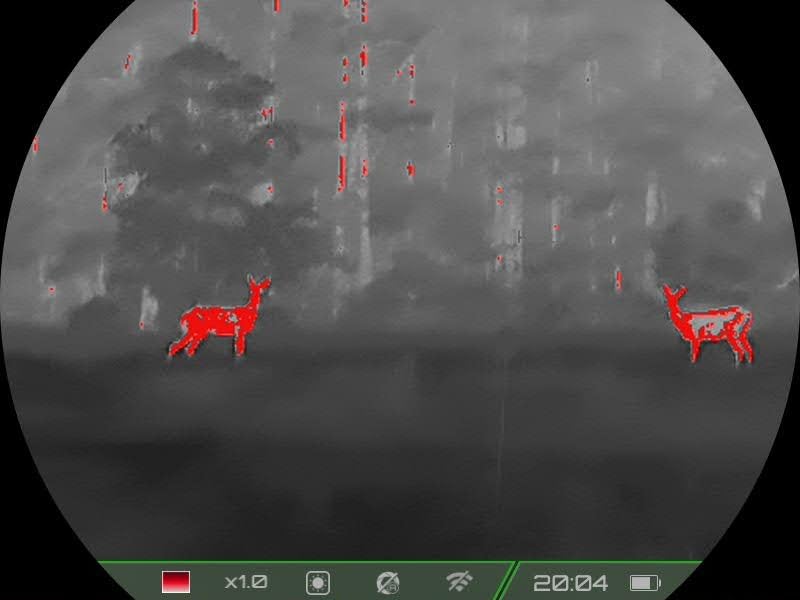
Owners broadly treat it as strong value in the compact thermal class, and the practical limit they mention most is consistent: past about 150 yards you see that something is warm but cannot reliably identify it. That is a sensor-class ceiling, not a defect.
Small design decisions matter more than they should. The sliding lens cover is integrated, so it cannot be lost in a bag the way a loose cap can. The housing carries an IP67 rating for fog, humidity and rain, and the warranty runs five years from the manufacturer.
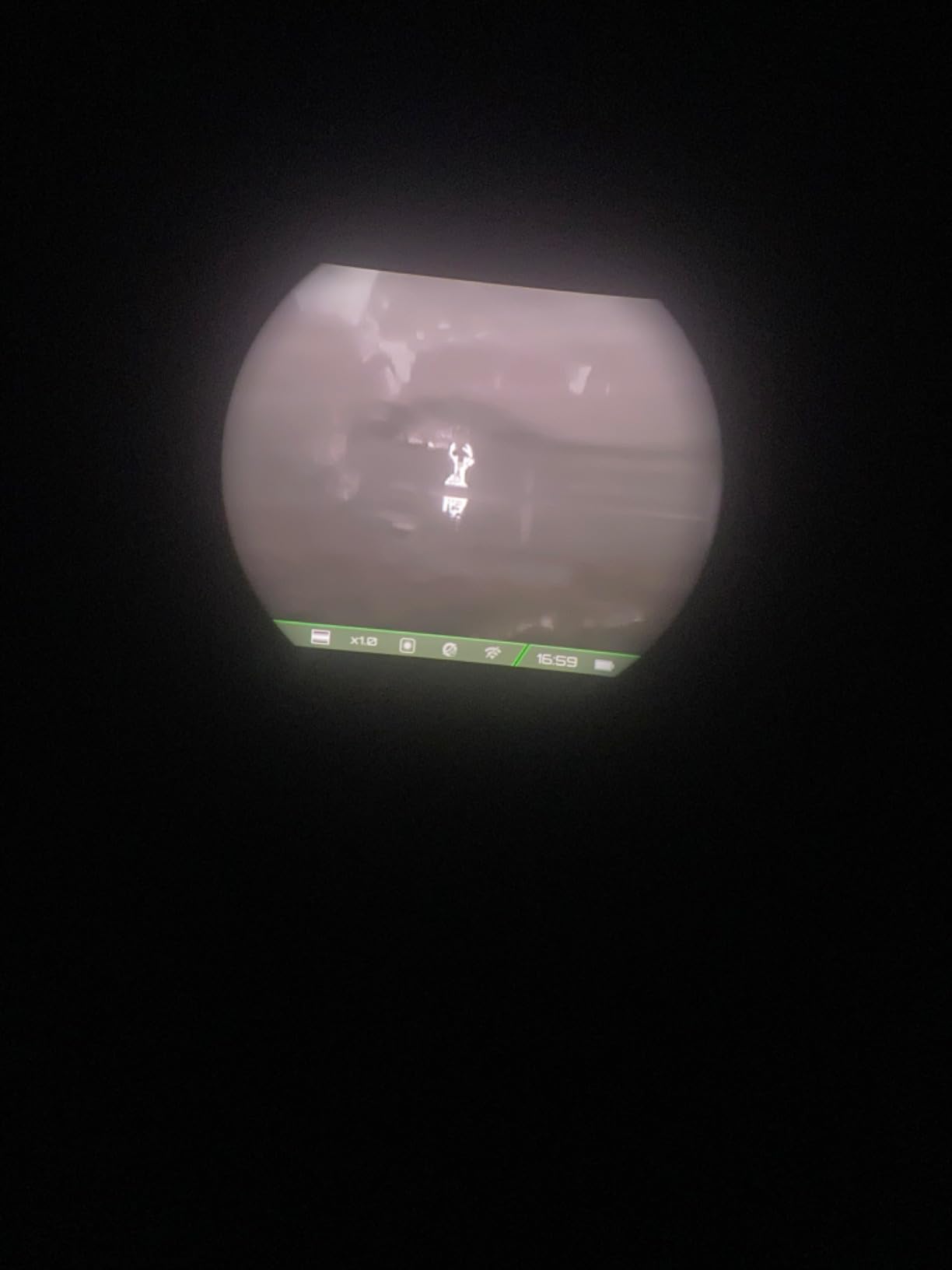
Does the K2 hold up for all-night property and trail work?
Yes for scanning duty. The fixed 9mm focal length, 19.4 degree field of view and IP67 sealing handle foggy mornings and long nights of checking a woodline, treeline or driveway. For a device this small, that combination is well thought out.
Video and photo work is handled by the app, and owners like being able to confirm a heat signature before deciding whether to walk closer. The pocket format means the device is on your person and ready when something moves, rather than in a case at the bottom of a pack.
When the K2 is the wrong pick
Skip it if you need to identify animals at distance. This is a detection device with a very good screen, not an identification scope, and buying it for long-range varmint work ends in disappointment.
The menu system takes practice, focusing at a fixed 9mm focal length is fiddly up close, and one owner reported a device that would not power on reliably before failing entirely. Quality variance exists in this segment, so keep the return window in mind.
3. GOYOJO G210 Thermal Monocular – Best Wide-Scanning Thermal With Swappable Batteries
GOYOJO G210 Thermal Monocular, 256×192 Thermal Imaging Monoscope Camera for Adults, 10mm Focal Lens Vision Goggles Thermal Scopes for Night Hunting Camping
256x192 with 12 micron detector
17.5 degree FOV
25Hz
Six palettes
IP65
Pros
- 17.5 degree field of view means less swinging while scanning
- Six selectable thermal palettes for different backgrounds
- Replaceable 18650 batteries allow hot-swapping
- Built-in red laser projects a center dot
- Carrying case
- tether
- lens cap and wrist strap included
Cons
- Brightness setting reverts to default after use
- Wi-Fi disables on startup and must be re-enabled each session
- No microphone so recorded video has no sound
The G210 wins on field of view. Its 17.5 degree view is wider than the other thermals here, and that matters more than raw magnification when you are walking a fence line trying to cover ground without whipping the device back and forth.
The 256×192 sensor is paired with a 12 micron infrared detector, which helps the picture hold together in conditions that defeat lower-cost sensors. Six palettes including white-hot, black-hot, red-hot, rainbow, iron-red and glimmer let you match the display to the background, and that single feature does more for real-world detection than a higher zoom number.
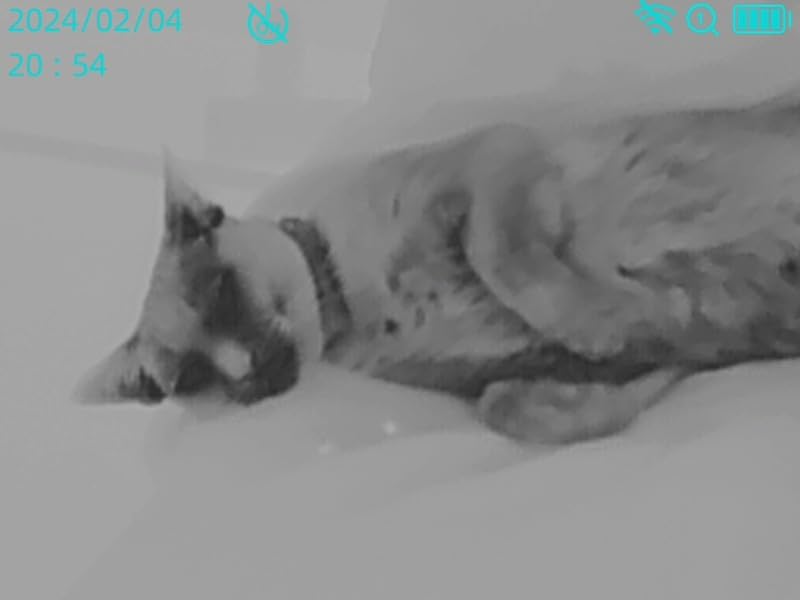
Power is handled better than on most rivals. Replaceable 18650 cells give more than six hours of continuous use, and you can swap a cell in the field rather than sitting on a dead device. The eyepiece is adjustable for glasses wearers, which is a small thing that matters enormously after two hours.
Reviewers consistently praise the build quality and the eyepiece form factor for this tier, with 66% of reviews at five stars. A built-in red laser projects an accurate center dot for confirming aim or a target point, and the box includes a case, tether, retained lens cap and wrist strap.
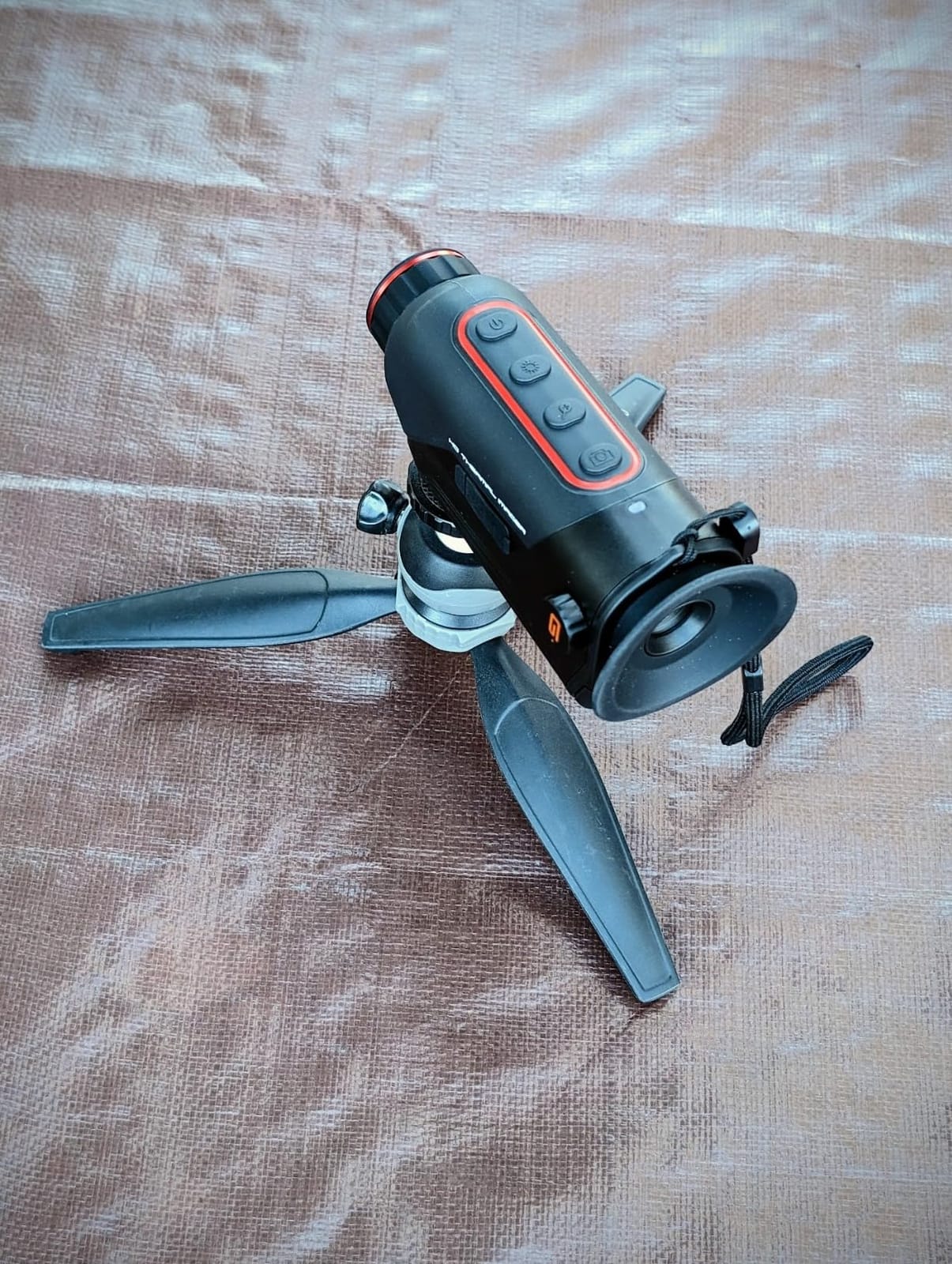
Is the G210 the low-cost sensible way into thermal?
Among the thermal devices in this roundup, yes. It pairs a real 256×192 sensor with a 12 micron detector, a 25Hz refresh and a wide view, so you are not paying extra for a screen with a weak sensor behind it.
For group settings, search and rescue, and personal safety, that 25Hz frame rate is smooth enough to track movement without the nausea some lower-rate devices cause. The IP65 rating handles drizzle and dust, and the included strap and tether make it easy to keep on your chest while your hands are busy.
When the G210 is the wrong pick
Settings do not persist. Brightness reverts to default after use and Wi-Fi switches itself off at startup, so you re-adjust every session. That is irritating rather than dangerous, but on a night patrol it becomes a genuine distraction.
There is no microphone, so recorded video has no sound, and the manual is thin enough that the scene modes are not properly explained. One owner also reported an included battery that died early and would not recharge, so test the cells on arrival.
4. RIX Pocket K3 Thermal Monocular – Best Resolution Step Up in a Tiny Body
RIX Pocket K3 Thermal Monocular for Hunting, 384×288 Night Vision Monocular
384x288 sensor
15mm objective
50Hz
800x600 OLED
2x base magnification
Pros
- 384x288 sensor with a 15mm objective resolves more detail than 256x192 models
- 50Hz frame rate reduces motion blur on moving subjects
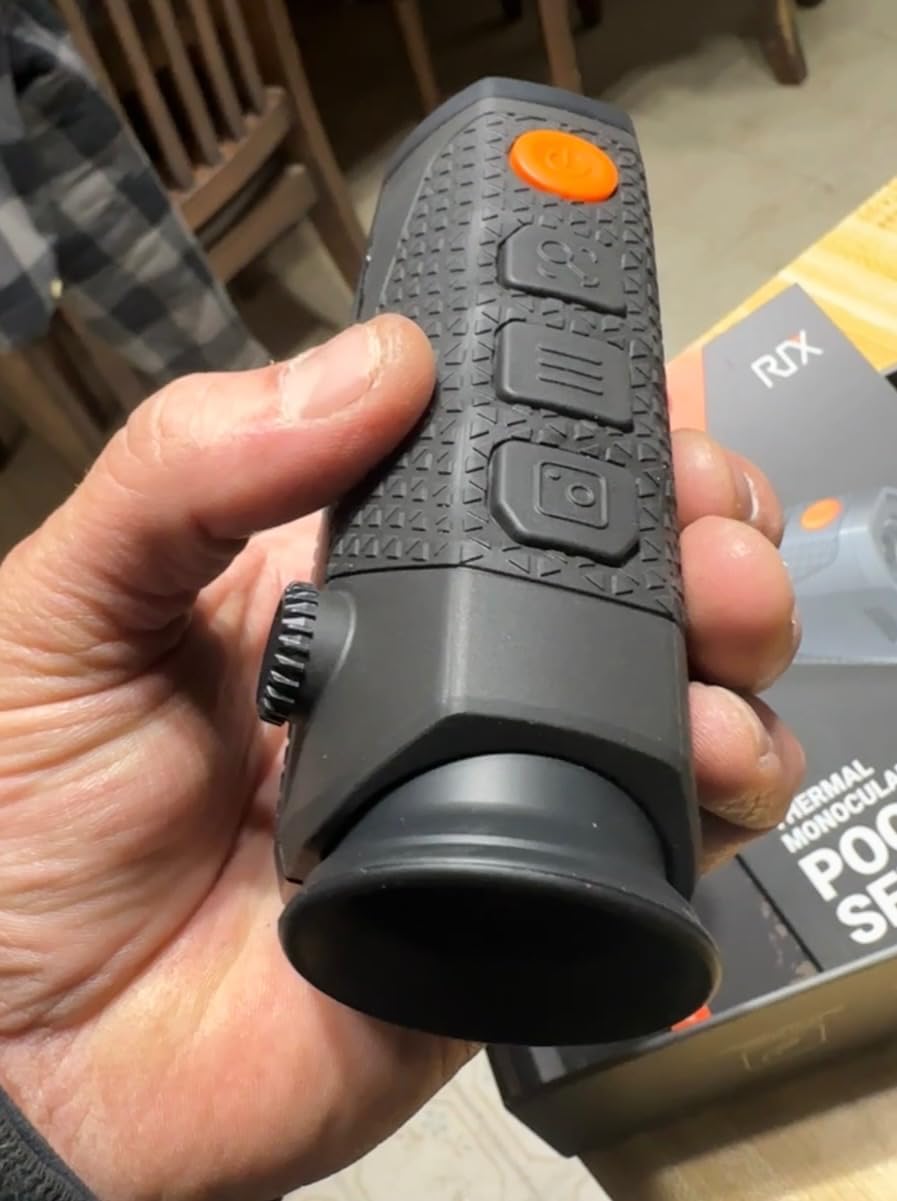
- 7.5 ounces in a 4.9 by 1.8 by 2.9 inch body
- Electronic image stabilization steadies handheld scanning
- Five-year manufacturer warranty with 8GB internal memory
Cons
- Quoted detection range depends on temperature contrast
- humidity
- target size and terrain
- RET processing is upscaling rather than true added resolution
- 2x base magnification is low for long-range identification
The K3 is the same idea as the K2 with a different sensor. Moving from 256×192 to 384×288 is a big jump in thermal detail at this size, and with a 15mm objective in front of it you get meaningfully better definition on a distant animal.
Everything else holds up. The 50Hz frame rate cuts motion blur when you are tracking a running target, the 800×600 OLED stays high contrast, and electronic image stabilization keeps the view comfortable handheld. A replaceable power supply, photo, audio and video recording plus 8GB of internal memory cover the usual gaps.
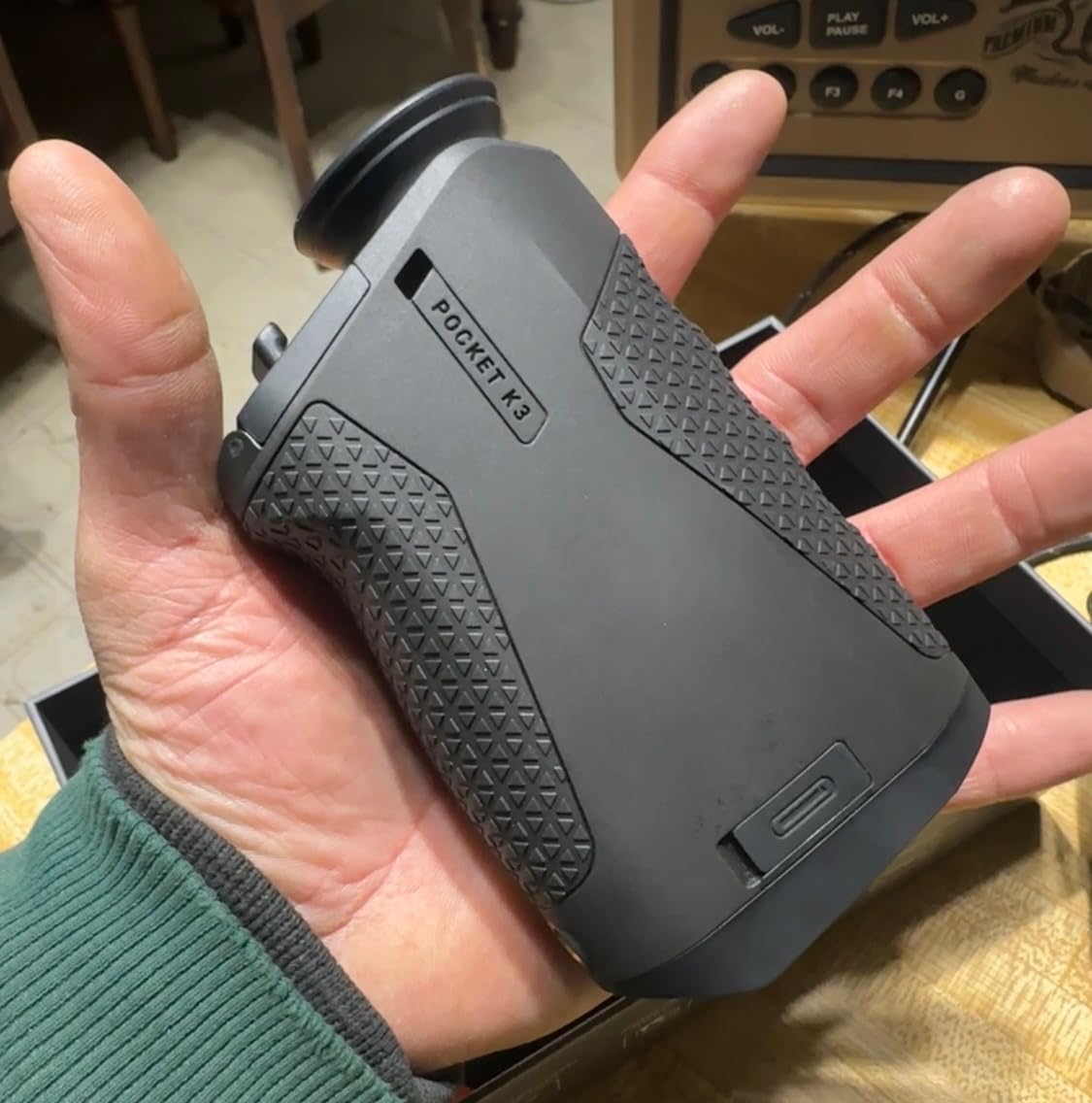
Owners with 70% five-star ratings point at resolution, stabilization and pocketable size as the deciding factors. The review base is smaller and more enthusiast-skewed than the budget units, so feedback centers on hunting and property surveillance rather than casual observing.
It mounts to a standard 1/4-20 tripod interface, and Wi-Fi handles remote viewing and image transfer. The five-year manufacturer warranty is among the longest here, which matters when the sensor is the hardest part of the device to replace.
Is the K3 worth the step up over a 256×192 sensor?
If you are identifying rather than just detecting, yes. The extra rows and columns of a 384×288 sensor translate directly into edges you can resolve, which is exactly what you need to tell a fox from a coyote or a deer from a hog at the edge of the field.
The quoted detection range of up to 853 yards assumes controlled test conditions and moves with temperature contrast, humidity, target size and terrain. Treat it as a laboratory figure and judge the real number by how the sensor performs on a cold night with a small animal against a uniform field.
When the K3 is the wrong pick
Base magnification of 2x is low. That is fine for scanning and detection, but if your plan is to identify at 300 yards you will lean on digital zoom, and Resolution Enhanced Technology processing is upscaling rather than adding real sensor detail.
If you need something lighter or less costly, the K2 covers the same job for scanning. This device earns its premium on detail alone, so buy it for detail or do not buy it.
5. GOYOJO NVG10 Digital Monocular – Best for Helmet Mounting and Hands-Free Work
GOYOJO NVG10 Night Vision Monocular Helmet-Mounted Goggles,1080P HD NVG with 1X Optical Zoom, Adjustable Infrared, IP66 Waterproof for Hunting, Surveillance, Camping, Built-in Compass
24mm objective
25.5 degree FOV
850nm IR with 3 levels
1080P capture
IP66
Pros
- Low-profile housing is far less neck-straining on a helmet
- Crisp OLED display with adjustable brightness and contrast
- Three-level 850nm illuminator lights up treelines effectively
- Mounting hardware attaches securely and adjusts by feel
- Monocular format keeps the other eye free for depth and peripheral vision
Cons
- IR illuminator cannot be fully disabled and switches back on automatically
- Image gets blurry and lags at higher digital zoom steps
- Slightly heavy for an entire night of wear
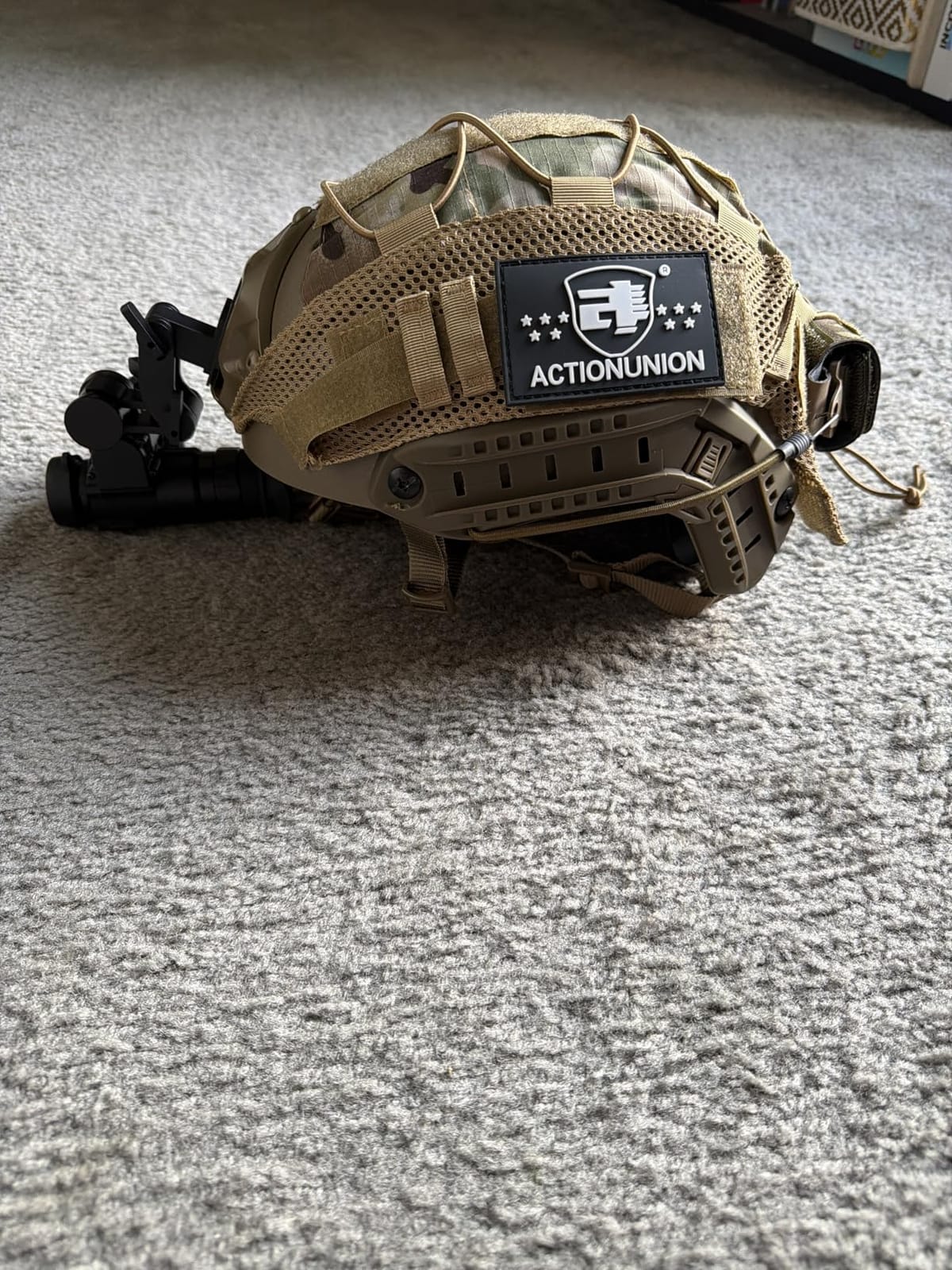
The NVG10 is built for a helmet first. The housing is low profile and light compared with the chunky digital devices people strap to bump helmets, and that single decision removes the neck strain that ruins all-night head-mounted use.
Optically it is a clear step above pocket digitals. A 24mm objective, 25.5 degree field of view and a crisp OLED display with adjustable brightness and contrast produce a picture that holds up in moonlight, and the three-level 850nm illuminator reaches into genuinely dark areas when you need it.
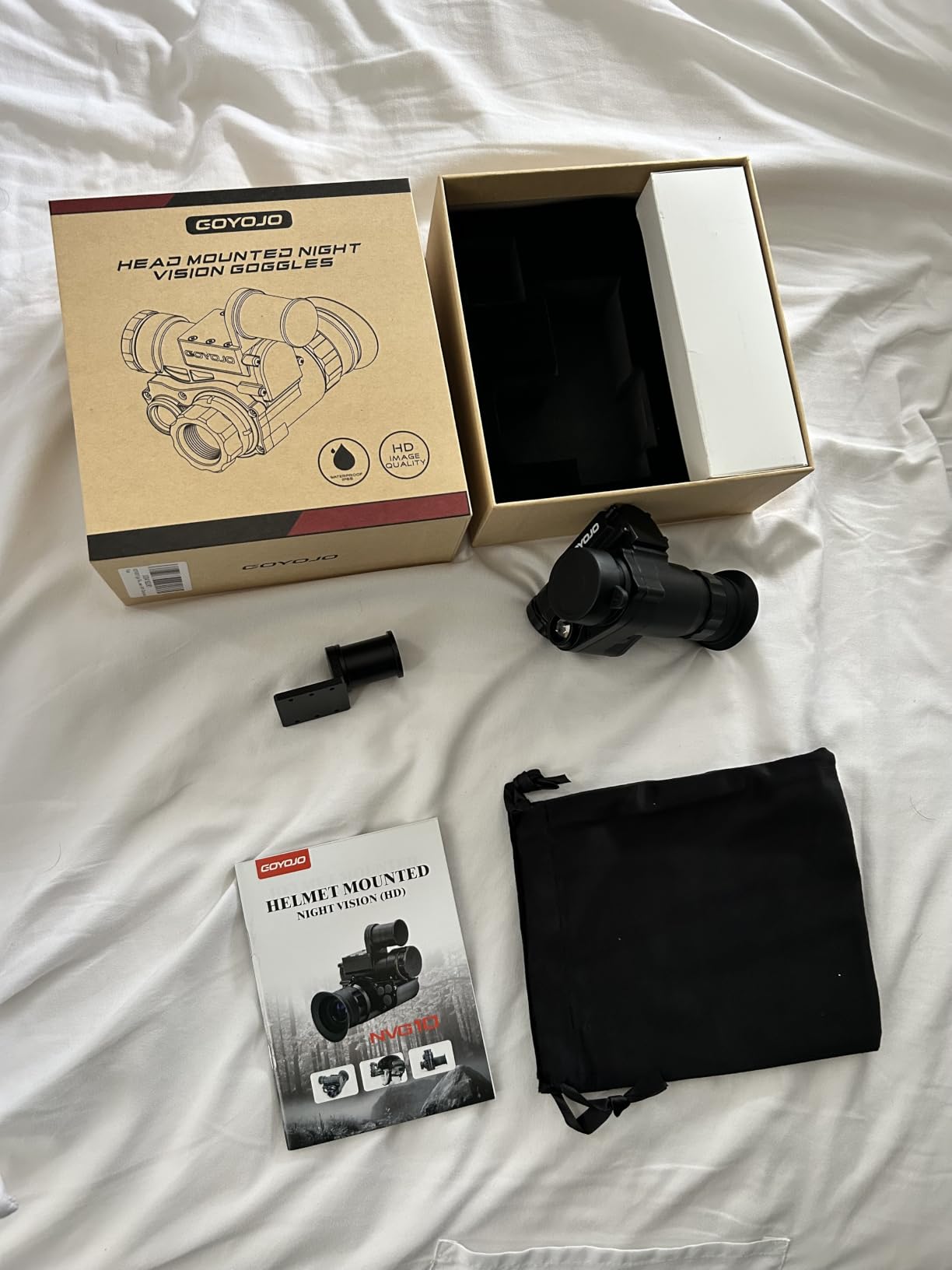
The mounting hardware is the part reviewers single out. It attaches securely with minimal wobble and can be adjusted by feel through a glove, and the included bracket, screws and interchangeable 18650 battery cover everything except the helmet itself. IP66 weatherproofing holds up in damp conditions and light rain.
Recording works. It captures HD video and photos in the dark, offers three image modes including a fluorescent green view, and includes a built-in compass. The monocular format keeps the other eye open for peripheral vision and depth cues, which is the whole argument for this shape of device.
Can the NVG10 be used where stealth matters?
This is the one real limitation and you should know it before buying. The IR illuminator cannot be fully switched off, and it reactivates on its own, which can give away your position to anyone looking through an analog tube. A visible 850nm source also produces eye glow in photographs.
Without the illuminator the image is only usable in moonlight or similar ambient light. For wildlife observation, navigation and general awareness that is fine, and if stealth matters look at a covert 940nm unit instead.
When the NVG10 is the wrong pick
Zoom is where it falls short. The image gets blurry and lags at the higher digital steps, so this is an awareness device rather than an identification scope. Breath vapor can also fog the view on cold nights because the illuminator sits near your mouth and nose.
Mounting hardware loosens over time and needs periodic tightening, and at 280 grams it is slightly heavy for wearing straight through a full night. If you are not mounting on a helmet, a handheld unit is lighter and more comfortable.
6. Teslong TTS260 Thermal Monocular – Best for Onboard Recording and Big Eyepiece Comfort
Teslong TTS260 Thermal Monocular 256 x 192, Super Resolution 512 x 384
256x192 at 512x384 super resolution
0.32 inch 800x600 OLED
32GB storage
8 hours
Pros
- Super resolution processing sharpens target outlines
- Large 0.32 inch 800x600 OLED gives a wide immersive view
- 32GB built-in storage plus USB-C and Mini HDMI output
- Up to 8 hours on a single charge
- Touch buttons work with cold or gloved hands
Cons
- Digital-only 4x zoom with no optical magnification
- Recognition distance of roughly 55 yards is modest
- Fixed focus needs repositioning for near versus far subjects
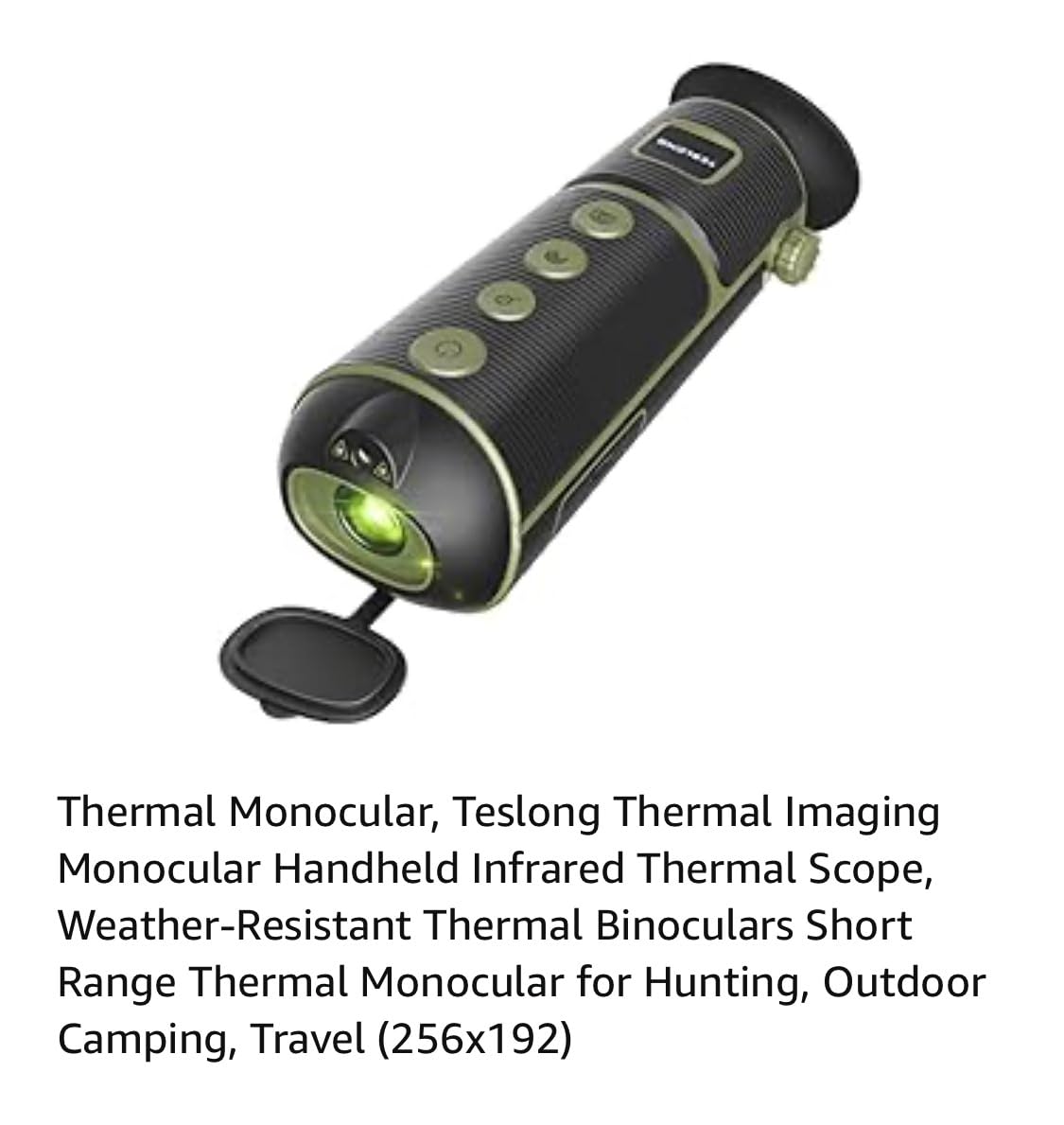
The TTS260 is among the easiest thermals in this group to hand to someone else. The 0.32 inch 800×600 OLED eyepiece produces a wide, comfortable rectangular view, and with 67% of reviews at five stars, the eyepiece is the feature owners mention first.
It also records natively. 32GB of built-in storage holds your captures, and USB-C plus Mini HDMI output let you review and share footage on a screen or a laptop without an app in the loop. A 32GB card and a carrying case are included in the box.
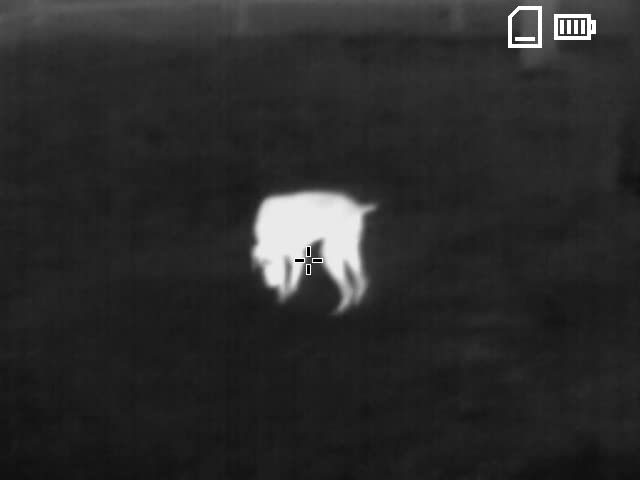
Super resolution processing upscales the 256×192 sensor to 512×384, which sharpens target outlines. It is interpolation rather than new detail, so do not treat it as a resolution upgrade, but it makes a scanning device noticeably easier to read at mid range.
Other details are well judged. Upgraded touch buttons work with cold or gloved hands, the battery runs up to eight hours, and the operating range of -4 to 122 degrees covers most climates. Eight color modes and hotspot tracking handle changing backgrounds.
Is the TTS260 a scope or a scanner?
A scanner. The 12mm lens detects thermal signatures out to 218 yards, but recognition distance is around 55 yards, which is modest against dedicated hunting thermals. If your job is checking a property, a treeline or a trail, that range is plenty.
The 15 degree field of view suits scanning, and fixed focus keeps the setup simple with no diopter to fight. It is a comfortable long-session device rather than a precision instrument, and the eyepiece is the reason it stays comfortable.
When the TTS260 is the wrong pick
Zoom is digital-only at 4x, with no optical magnification to back it up, so long-range work leans on processing. Identification beyond a few hundred yards is not realistic with this sensor.
Fixed focus also means repositioning for very close versus distant subjects, which is mildly annoying when you are tracking something at mixed range. Pick a fixed-focus, no-optical-zoom device for scanning and skip it if you need to read distant detail.
7. Carson MiniAura Digital Monocular – Best Value Digital With the Most Owner Reviews
Carson MiniAura Digital Night Vision Monocular with Carry Pouch
Digital imaging
Adjustable IR intensity
2x zoom
3.4 ounces
19 degree FOV
Pros
- Extremely compact and lightweight at 3.4 ounces
- Adjustable infrared intensity controlled from the body
- Soft storage pouch included for protection and transport
- Simple AAA battery power with no rechargeable pack to manage
Cons
- Entry-level digital sensor means basic image detail
- 19 degree field of view is narrow for scanning open terrain
- No recording capability in this configuration
The MiniAura is the most owner-reviewed monocular in this roundup by a wide margin, and that matters in a category where most listings have a handful of reviews. With 633 ratings, patterns in the feedback are dependable rather than anecdotal.
It is genuinely pocketable. At 3.4 ounces with dimensions around 2.6 by 2.2 by 2.2 inches, it is easy to carry on a hunt and forget about, and the images come back in black and white on a digital sensor with infrared intensity you can adjust from the body.
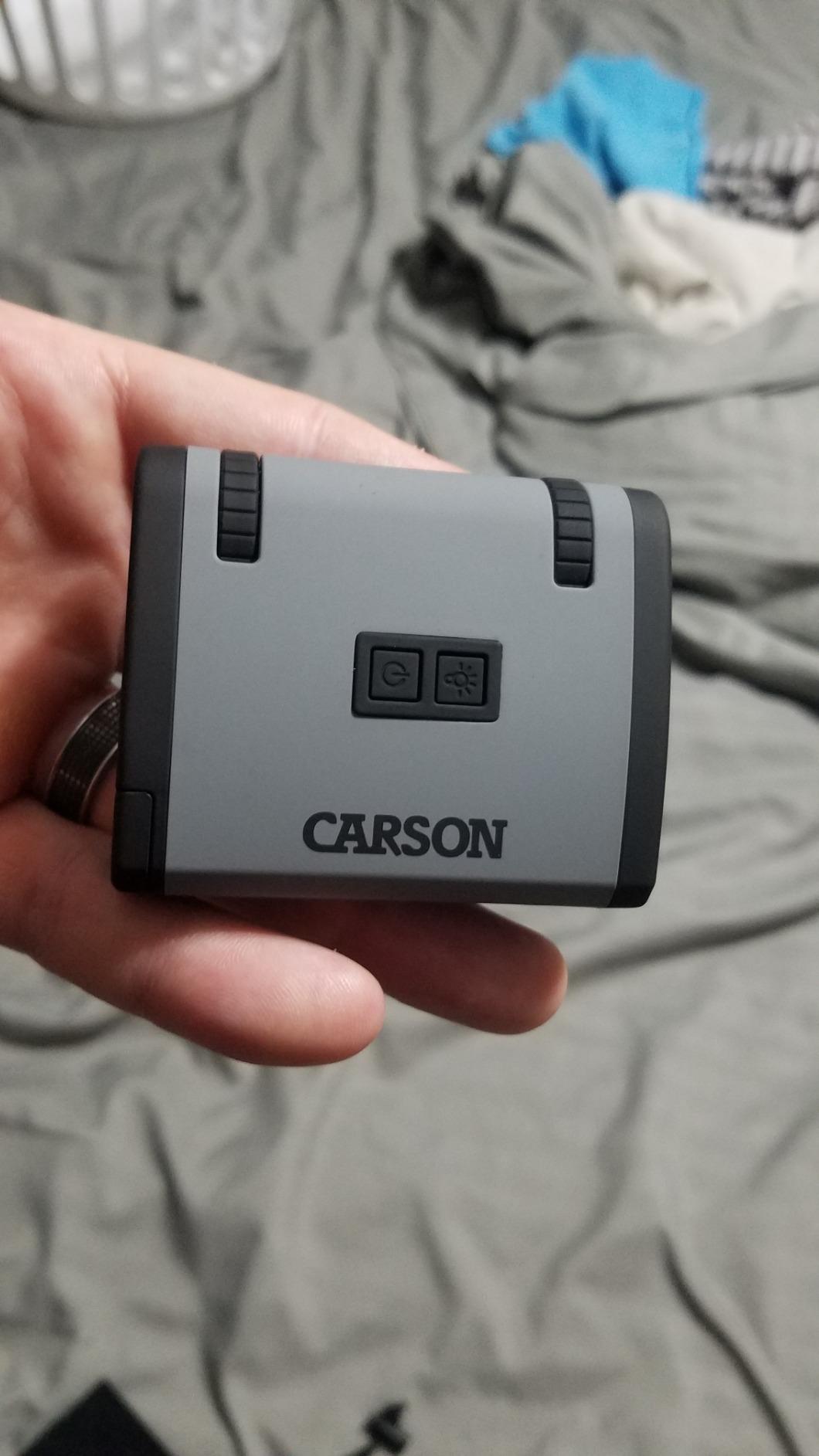
What buyers praise is portability and ease of use. A steady 61% of reviews sit at five stars, and the adjustable illuminator and pocketable size are the two attributes called out most. A one-year limited warranty and an altazimuth mount keep it simple, and a soft storage pouch is in the box.
Power is three AAA batteries, so there is no rechargeable pack to manage and no charger to lose. For a user who wants a monocular on a neck strap for garden and shed checks, that simplicity is the entire appeal.
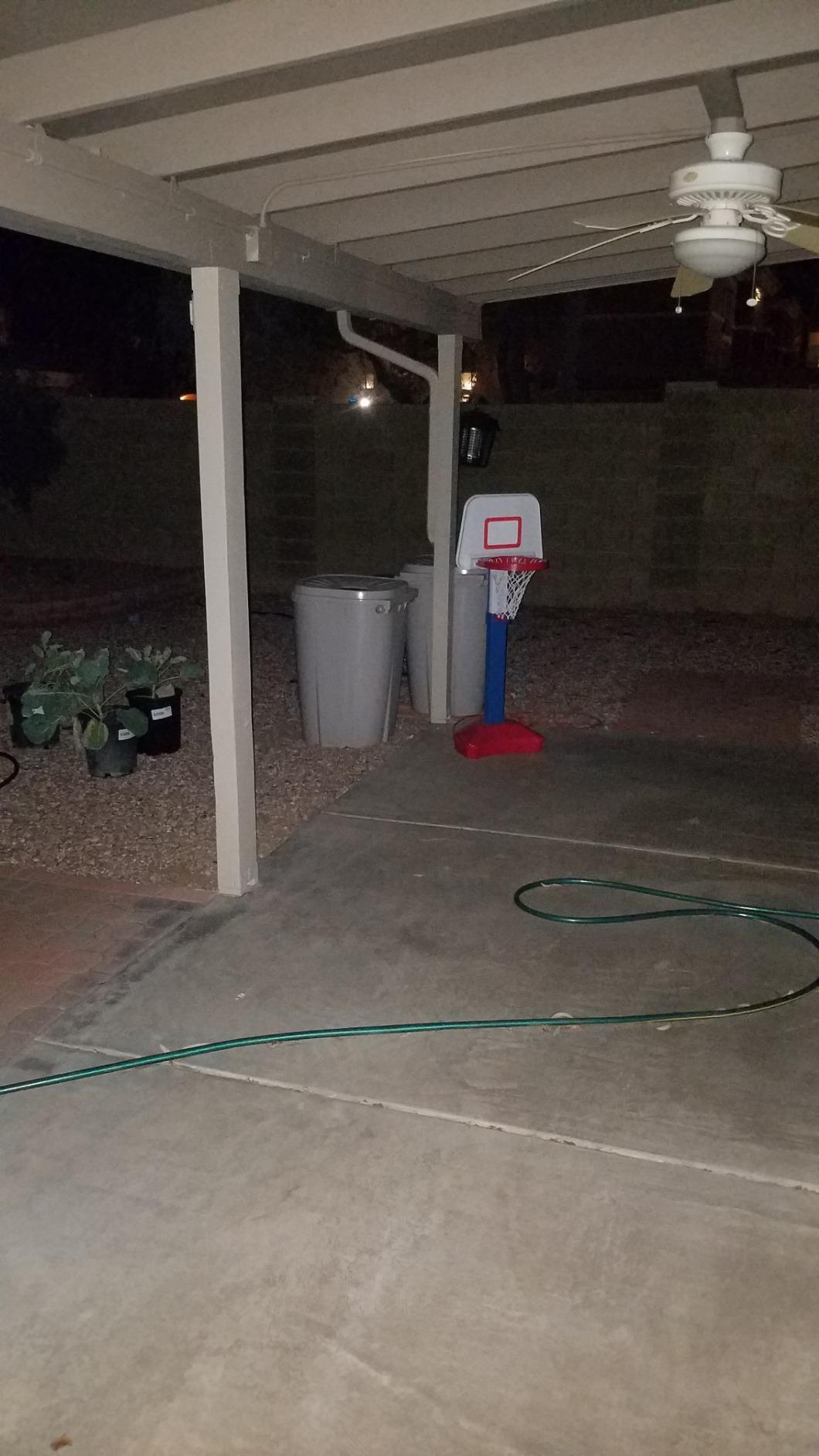
Is the MiniAura good enough for serious night observation?
For short-range observation, yes. Within a yard or two, near a treeline or across a field boundary, the digital image with a raised IR level is more than adequate, and a 2x zoom ratio handles casual scanning.
It is not a long-range tool. The entry-level sensor produces basic detail compared with any thermal or image intensifier device here, and a 6% cluster of one-star reviews reflects dissatisfaction with clarity and with the narrow view at longer ranges.
When the MiniAura is the wrong pick
The 19 degree field of view is narrow for open terrain, and that narrowness is the most common complaint in the reviews. Scanning a wide field means swinging the device constantly, which is exactly what a monocular of this size should avoid.
There is no recording capability in this configuration, so any sighting is gone when you lower the device. If you need to document what you see, choose a digital device with a memory card instead.
8. TAKLITE IRIS Digital Monocular – Best for Covert 940nm Infrared and Wide Awareness
TakLite IRIS Digital Night Vision Monocular | 1X PVS-14 Style | 940nm IR Illuminator | 60° FOV | OLED Display | Head-Mounted or Handheld | Hunters & Outdoor Use
940nm covert IR
60 degree FOV at 1X
60 FPS under 10ms
OLED
Head strap kit
Pros
- Fixed 1X with a true 60 degree field of view
- Latency under 10ms at 60 FPS makes it walkable
- 940nm illuminator is effectively invisible to the unaided eye
- Integrated rechargeable battery runs while charging
- Head strap
- mounting arm and cable included
Cons
- No magnification and no recording at all
- IR illuminator brightness is fixed
- Included plastic arm and strap are weak
- One owner reported a device that would not focus to a clear image
The IRIS is unusual in the best way. It fixes magnification at 1X and opens the field of view to a full 60 degrees, so you scan naturally instead of swimming through a narrow tunnel and fighting eye strain. It is well suited to awareness work rather than identification.
Latency is the second headline. Sixty frames per second with under 10 milliseconds of delay means the view keeps up with walking pace and moving subjects, which is precisely where digital devices usually feel wrong. A 1.54 inch OLED with adjustable brightness and contrast handles total darkness.
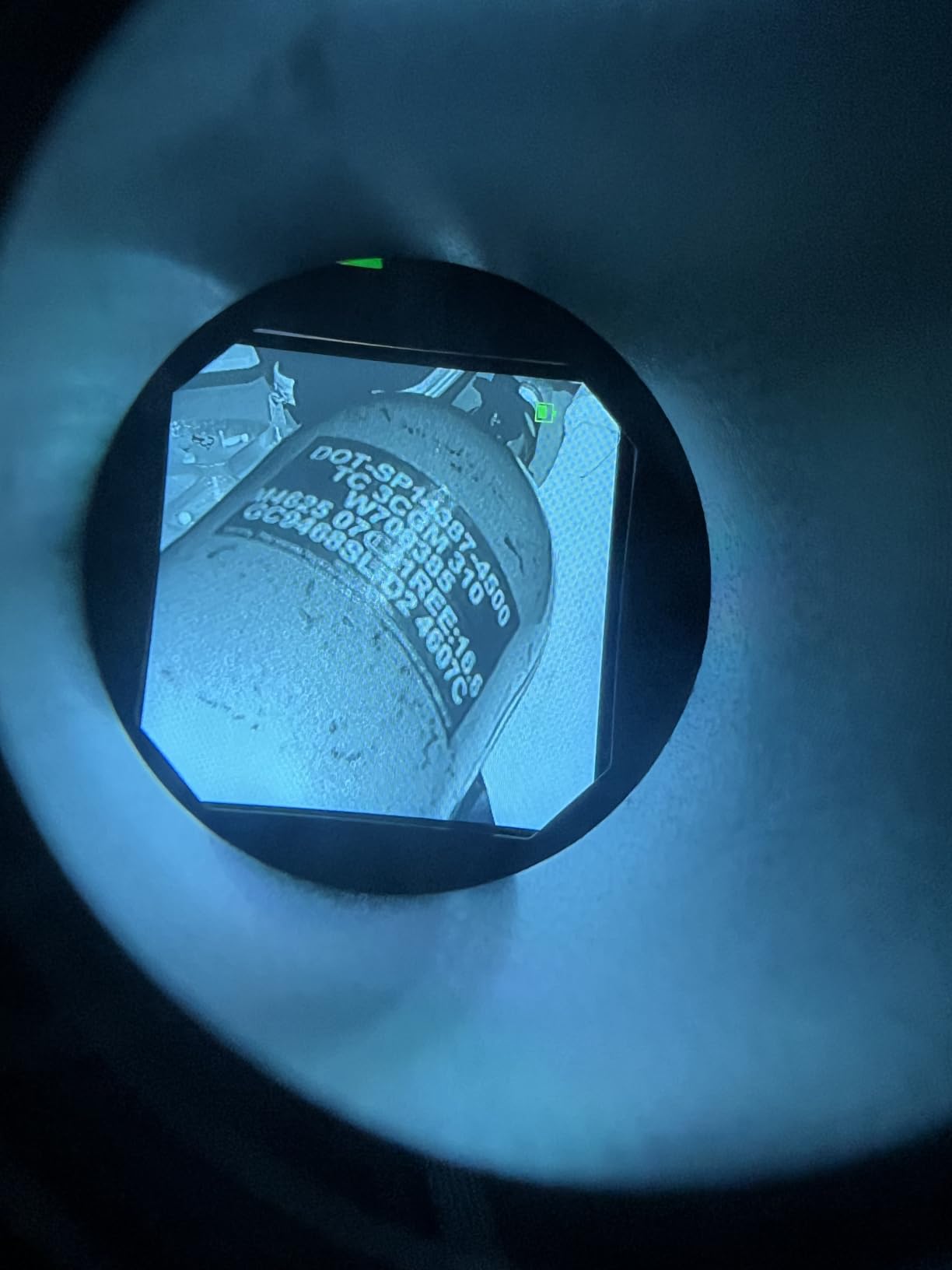
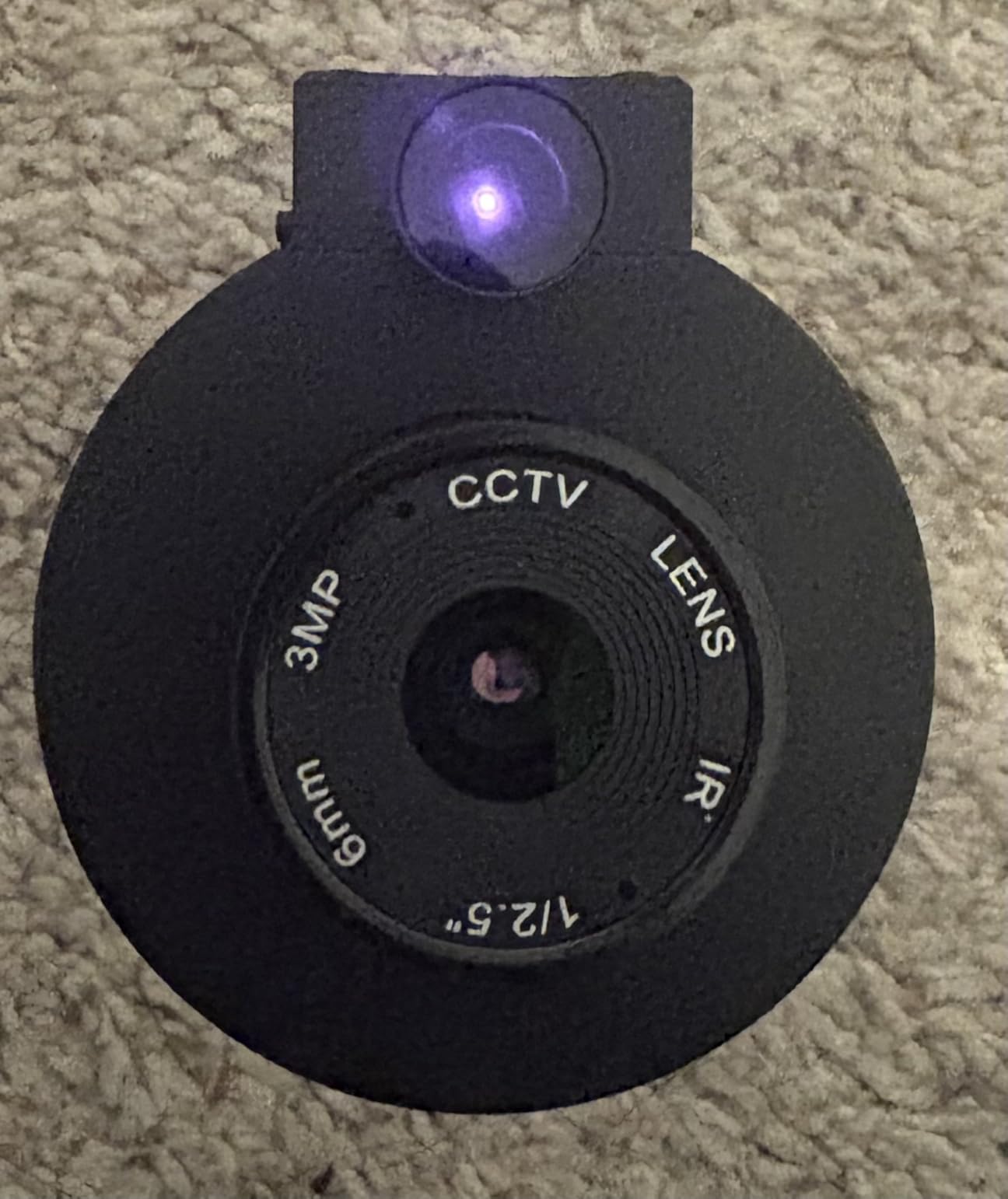
The 940nm illuminator is the reason to look twice. That wavelength is effectively invisible to the unaided eye, unlike an 850nm source, so you get active illumination in pitch darkness without the eye glow that advertises your position. The integrated rechargeable battery can run while charging.
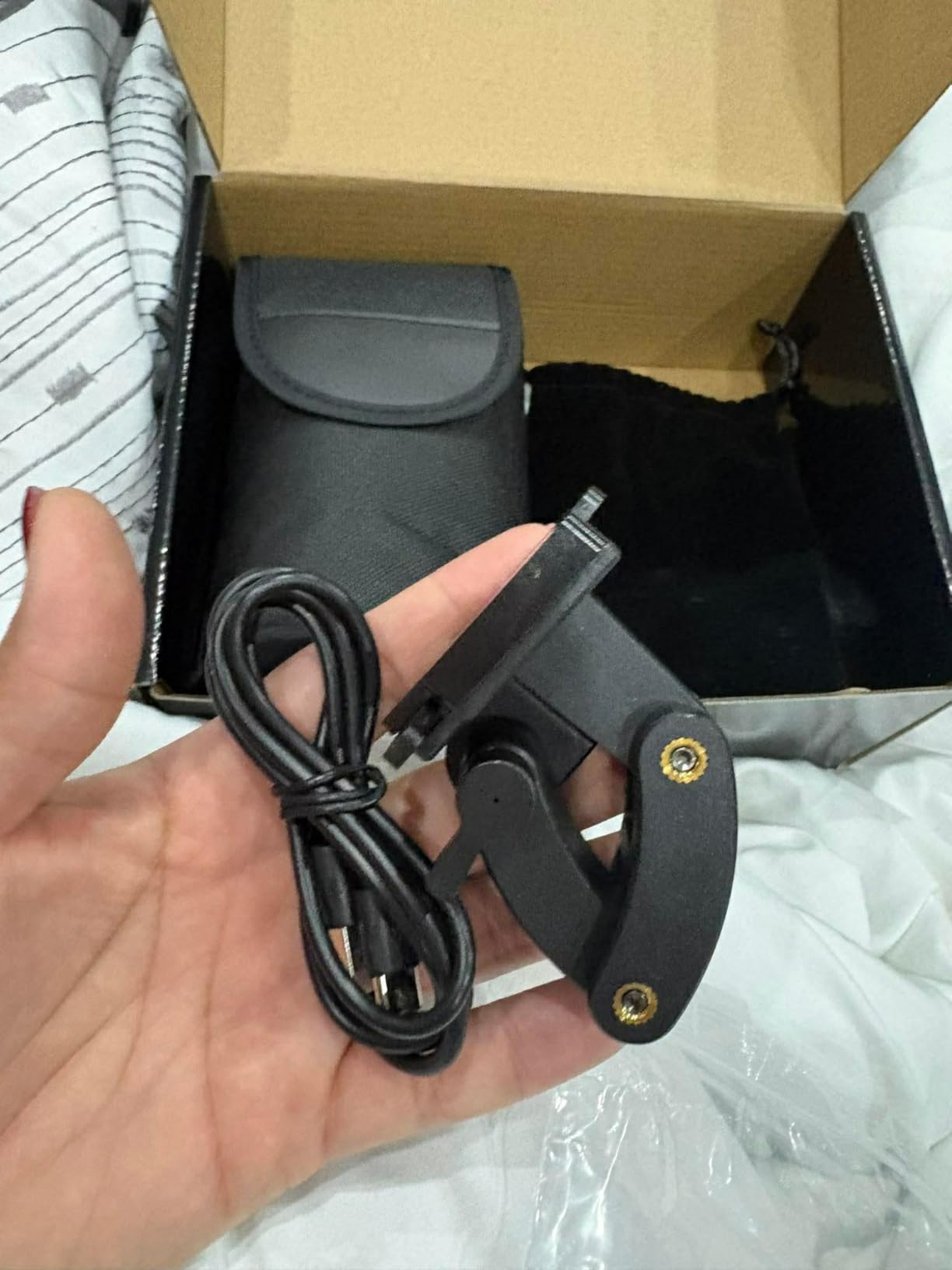
It mounts widely. The box includes the monocular, a rubber head strap, a mounting arm and a charging cable, and it is compatible with J-arms, NVG helmet shrouds, GoPro-style mounts and tripods. That makes it straightforward to build a head-mounted setup around.
Is the IRIS useful for night walking and airsoft?
That is exactly what its small review base is made of. With 30 ratings the sample is small, but sentiment is strongly positive for airsoft, night walking and entry-level digital use, where the wide 1X view and near-zero latency are the headline benefits.
Because it is a genuine awareness optic, it works well as a driver of a night route rather than a spotting scope. If you also want to record what you see, look at a digital device with a memory card instead.
When the IRIS is the wrong pick
There is no magnification and no recording at all. That is not a gap, it is the design, but it rules out anything that needs a picture or a distant detail. The illuminator brightness is also fixed, so long-range use means carrying a separate focusable IR light.
The included plastic arm and head strap are weak points and a metal J-arm is the sensible upgrade. The unit generates noticeable heat during extended use, battery life is short, and one owner reported a device whose image would not focus to a clear result.
9. YUANZIMOO LG66 Digital Monocular – Best All-Digital Recorder With Daylight Versatility
YUANZIMOO Head-Mounted Night Vision Monocular Digital Infrared Monocular
850nm IR with 7 levels
2200mAh rechargeable
2x optical 8x digital
32GB card included
Pros
- 850nm illuminator with seven adjustment levels for full darkness
- 2200mAh rechargeable battery with auto-shutoff
- 2x optical plus 8x digital zoom on a 24mm multi-coated lens
- Records photos and video to an included 32GB memory card
- Usable in daylight as well as at night
Cons
- TFT screen is smaller and less bright than premium eyepieces
- Not sealed for heavy weather per the manufacturer
- Operating temperature limited to -5 to 40 degrees
- Digital-only zoom degrades detail at high magnification
The LG66 is the most flexible plain-digital device in the list. It works in daylight as well as at night, which means one device covers shed and trail scouting before dark and a night hunt after it, and the 2x optical magnification gives you a real optical step before the digital zoom takes over.
Seven IR levels on an 850nm illuminator give you real control over how much invisible light you throw at a scene, and the 24mm multi-coated lens does the work. Advertised viewing reach is 984 feet with the 8x digital zoom, which is a laboratory number rather than a promise about identifying an animal at that distance.
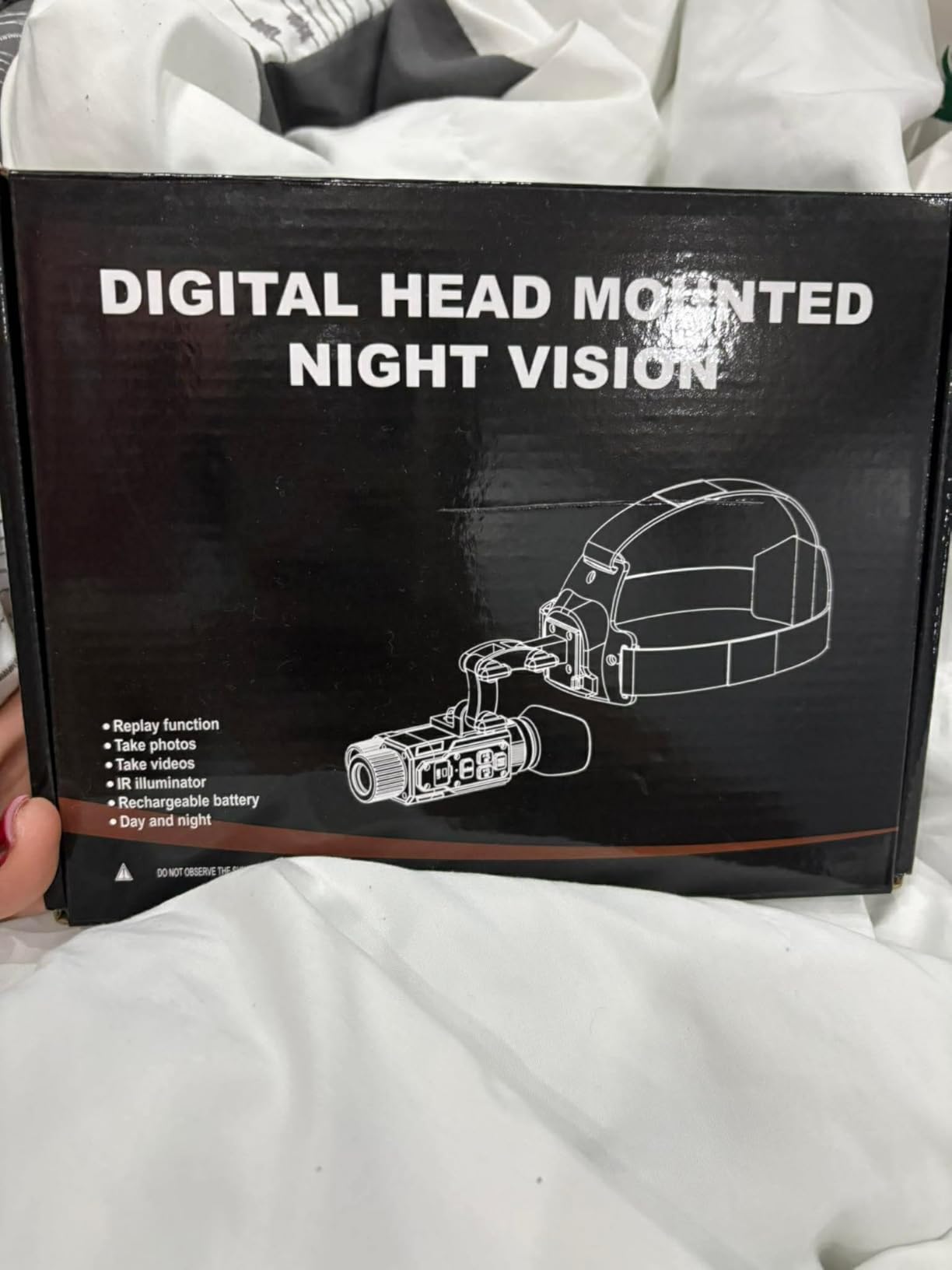
Recording is handled with a 32GB memory card in the box, across photo, video and playback modes. The 2200mAh rechargeable cell avoids carrying spare AA cells, includes an auto-shutoff to preserve charge, and can be topped up from a power bank or a car charger.
Reviewers like the rechargeable battery and the included card, but the rating distribution is among the most polarized here, with 15% of reviews at three stars and 9% at one star, mostly about brightness and clarity.
Does the LG66 work in daylight as well as at night?
Yes. Because it is a digital camera with a screen rather than an image intensifier tube, there is no daylight burn-out risk and no reason to swap devices at dusk. That flexibility is worth a lot for anyone who scouts a property or a trail in the evening.
The catch is that it is not sealed for bad weather. The manufacturer instructs protecting the unit from rain, mist and impacts, so treat it as a fair-weather and light-drizzle tool, and check your forecast before you rely on it.
When the LG66 is the wrong pick
The TFT screen is smaller and less bright than a premium eyepiece, and that directly limits clarity in a dark scene. Operating temperature stops at -5 to 40 degrees, so cold-weather hunting is outside its comfort zone.
Zoom past the 2x optical step is digital only, so detail degrades as you magnify. If cold nights and long-range detail are the plan, a thermal unit handles both far better.
10. Sheawasy SH-R7 Digital Monocular – Best Low-Cost First Buy for Close-Range Viewing
Sheawasy Night Vision Monocular, 1080p Infrared Monocular for 100% Darkness, 32GB Included, Travel, Camping, Hunting, Surveillance
1080p infrared
32GB memory included
Rechargeable battery
6 hours runtime
F1.2 lens
Pros
- Entry-level cost with a 1080p infrared sensor for civilian users
- Includes 32GB of memory plus a card reader
- USB cable and manual
- Rechargeable battery runs about 6 hours without IR and 3 hours with it
- Simple accessible interface
- Two-year warranty
Cons
- Practical darkness range is short at roughly 98 feet
- Battery life halves when the IR illuminator runs
- Entry-level sensor and optics put image quality well below thermal or image intensifier devices
- Zoom is digital only
The SH-R7 sits at the low-cost end of this list, and that framing matters. It is a straightforward 1080p infrared camera for close-range civilian observation, not a tool for identifying animals at distance. Treat it as a way to learn what a night monocular does before you spend real money on one.
For what it is, the box is generous. You get 32GB of memory, a card reader, a USB cable and a manual, which removes the most common complaint about cheap devices where the storage is sold separately. The rechargeable lithium polymer cell runs about six hours without the illuminator.
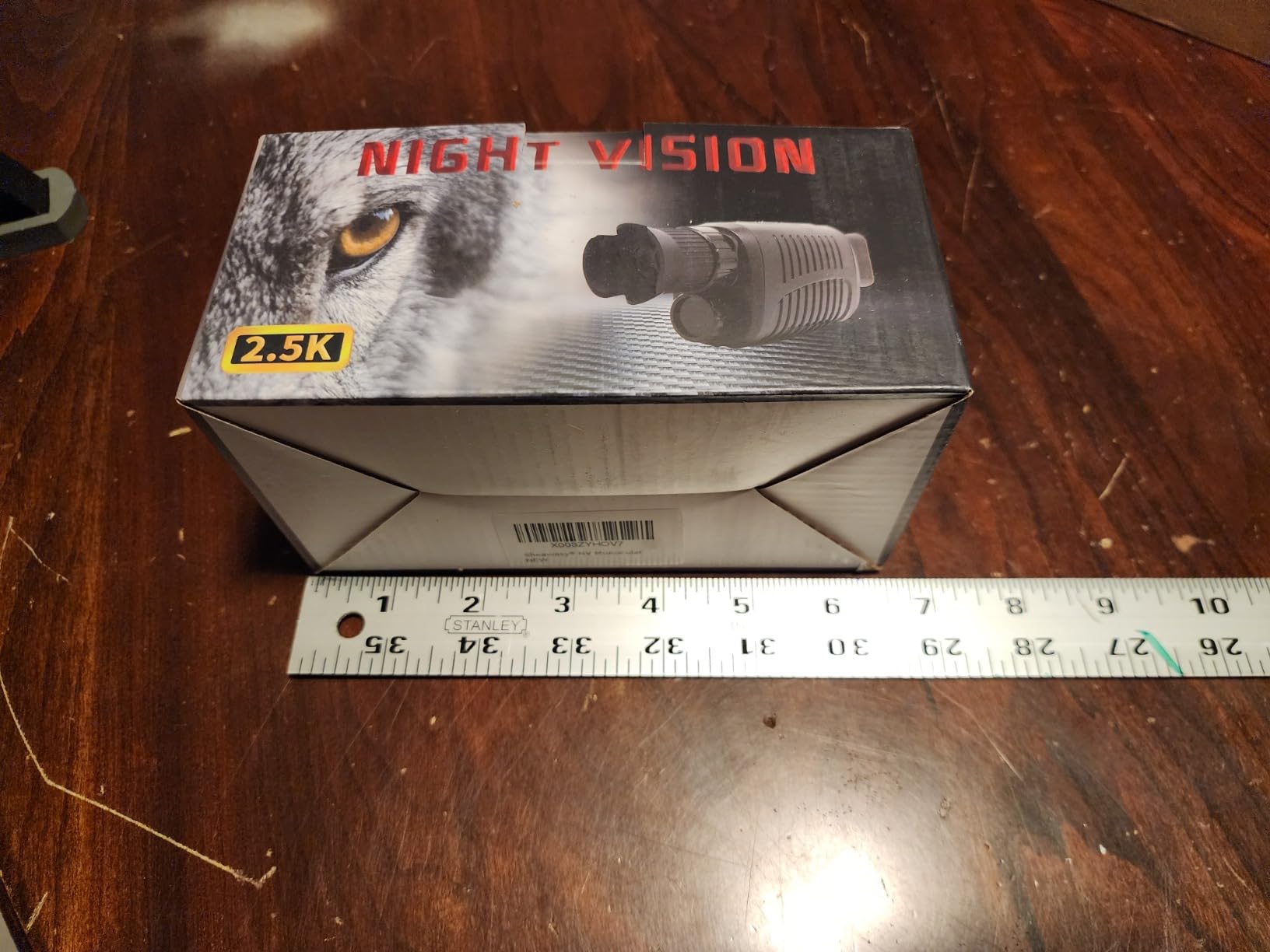
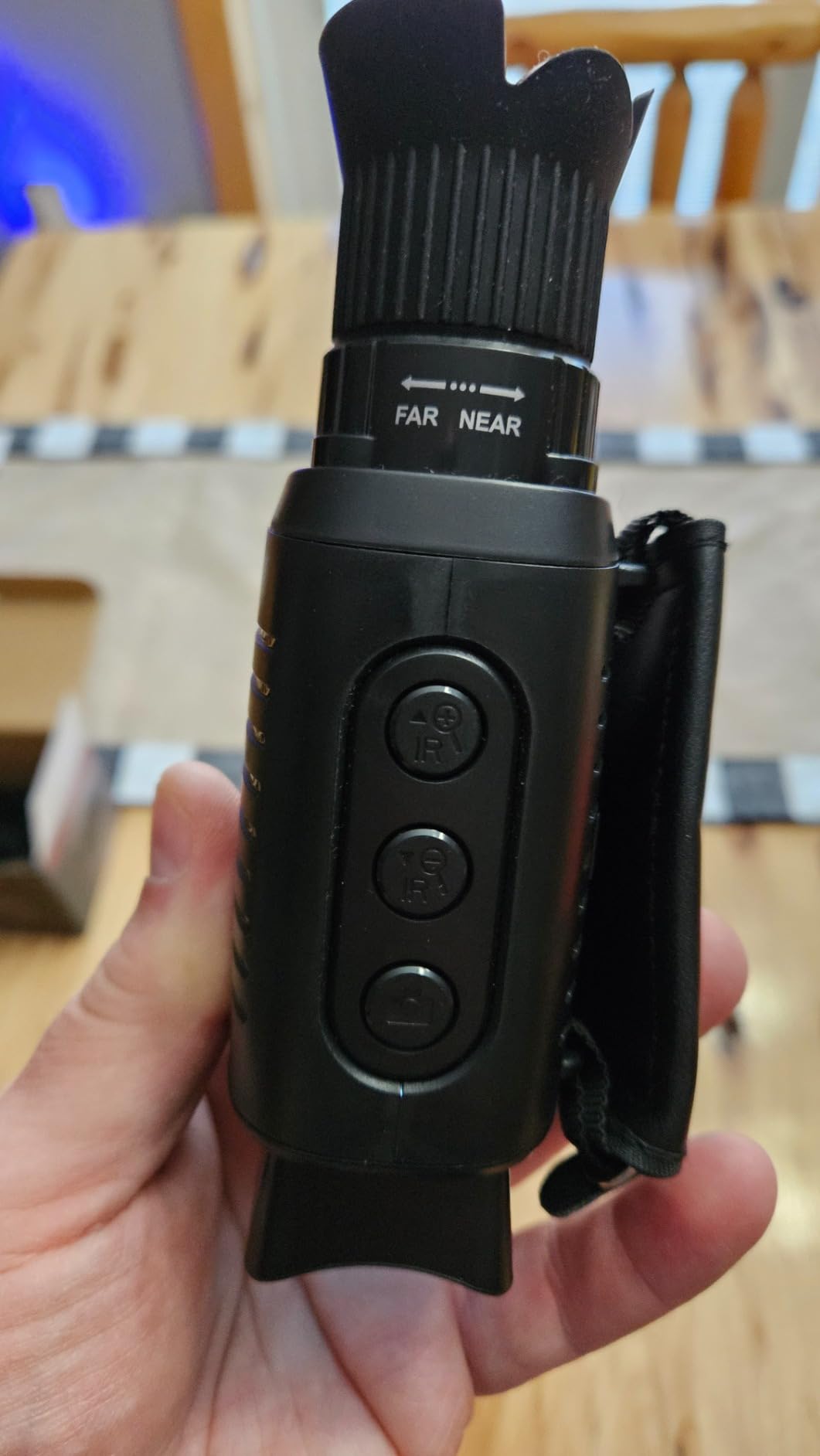
The F1.2 lens is a fast lens at this level, and the interface is simple enough that a first-time buyer can work it in a couple of minutes. At 205 grams and 5.5 by 1.7 by 1.3 inches it is genuinely compact, and a two-year warranty is longer than some rivals at twice the size.
Reviewers position it as a budget novelty that works as described for close-range night observation, with 57% of reviews at five stars. The most common theme is the gap between the headline specification and real performance, especially in darkness.
How far can the SH-R7 actually see at night?
The manufacturer states roughly 656 feet in daylight and about 98 feet in complete darkness. That second number is the honest one for planning, and it is enough for a yard, a garden boundary or a nearby treeline after dusk.
Turning the IR illuminator on halves the battery, which matters if you plan to sit on a stakeout. Video runs up to about 3.5 hours on the included card before you need to start copying files.
When the SH-R7 is the wrong pick
Any task that depends on seeing detail. The entry-level sensor and optics put image quality well below thermal and image intensifier devices, and the zoom is digital only, so there is no optical magnification to rescue a distant subject.
It is also an entry-level observation tool with little weather sealing to speak of. If you can stretch further, a 256×192 thermal picks up heat at distances where this device simply returns a flat grey image.
How to Choose a Night Vision Monocular
Work through these in order and the decision gets much easier. Start with the technology, because it sets everything else, then fix the objective diameter and the range you actually need.
Decide between image intensifier, digital and thermal first
If you need maximum detection at any range, in fog, rain or light vegetation, thermal wins because it reads heat instead of light. If you need to resolve detail, texture and a natural feel while moving, an analog image intensifier is the right choice, accepting the higher price and the daylight risk.
Digital records, works in daylight and costs less, but it leans hard on the IR illuminator once starlight runs out. Experienced owners in the night vision community are blunt about this: a good Gen 2 or better tube still outperforms a digital device outright, so digital is a convenience purchase, not an upgrade.
Objective diameter drives light and detail
A larger objective lens gathers more light and supports a wider usable field of view. For thermal, a 13mm or 15mm lens gives useful detection reach, while a 9mm or 10mm lens gives a wide scanning view. For digital, a 24mm objective produces a noticeably better image than a 6mm one.
Understand range claims: detection, recognition, identification
These three numbers are routinely conflated in marketing and the difference is large. At 200 yards, a device may detect that a warm body is present, fail to recognize it as an animal, and certainly not identify what species it is. Only the identification figure is the one that means you can act on what you see.
Treat every published range as a laboratory number. Temperature contrast, humidity, target size and terrain all move the real figure, and the most repeated owner complaint across this roundup is that identification falls apart well before the advertised detection distance.
Refresh rate and latency decide whether it feels natural
Anything at 50Hz looks fluid. A 25Hz device is usable for scanning but shows blur on fast-moving subjects, and low-frame-rate digital units are where experienced users notice digital lag most. For a head-mounted or walking setup, latency under 10ms is a genuine differentiator.
For analog tubes, none of this applies, because there is no refresh rate. The image moves exactly as fast as you do, which is the core argument for the analog route.
Phosphor, illuminator wavelength and stealth
Green phosphor is the traditional analog default and gives strong contrast with a longer tube life. White phosphor shows finer detail, reduces eye strain over long sessions and avoids the green afterimage effect, at the cost of a shorter tube lifespan.
Illuminator wavelength matters more than most buyers realize. An 850nm source is brighter but has a faint red glow and produces eye glow in photographs. A 940nm illuminator is effectively invisible to the unaided eye, which is what you want for stealth observation and unblinded wildlife photography.
Battery, weather sealing and the real setup cost
Runtime runs from about three hours on a low-cost unit to around eleven on the TS004, and replaceable 18650 cells matter more than capacity when you are out all night. IP66 handles drizzle, IP65 handles dust and rain, and IP67 covers immersion.
Budget for the setup, not just the monocular. A working head-mounted configuration needs a strap or J-arm, a mount or shroud, a battery pack and a case, and experienced buyers planning a first analog rig budget in the low thousands for the tube, a bump helmet and a dovetail mount together. That is the same logic here: the device is the smallest part of the cost.
If you also care about being seen at night, our picks for lights for night skating and reflective gear cover the visible-light side of that problem.
Marketplace red flags. Walk away from any listing that claims Gen 4, that names a generation without a tube manufacturer, or that quotes a detection range with no sensor resolution and no NETD figure. Treat claims of Gen 3 on a device that cannot state its tube brand as marketing rather than specification.
Frequently Asked Questions
What do Navy SEALs use for night vision?
Navy SEALs use analog image intensifier monoculars, most often the PVS-14 form factor, rather than digital or thermal devices. A single-tube monocular leaves one eye open for depth and peripheral vision, and it mounts on a helmet shroud, a G24 arm or a J-arm. Buyers chasing that performance should search for Gen 2+ or Gen 3 tube specifications, resolution in line pairs per millimeter, and autogated tubes, since that is the hardware those users actually run.
What night vision monocular does the military use?
Military units standardize on single-tube analog image intensifier monoculars in the PVS-14 form factor, with tube generations from Gen 2+ through filmless Gen 3. Housing choice matters more than most buyers expect because the aftermarket for tubes, mounts, caps and adapters is far deeper for that form factor. That parts availability, not the badge on the housing, is the reason experienced owners choose the vanilla PVS-14 layout.
Which is better, night vision or infrared?
It depends on the task. Infrared illumination lights a scene with invisible light, which is invisible to an observer and works at close range, but it gives up on anything far away. Night vision amplifies whatever light exists, so it sees far further under starlight and moonlight but breaks down in total darkness without an illuminator. Experienced owners generally find that a good Gen 2 or better analog tube still outperforms a digital unit outright, while digital wins on recording and daylight use.
What is the difference between Gen 2 and Gen 3 night vision?
Gen 2 tubes multiply light by roughly 20,000 times and resolve around 57 to 64 line pairs per millimeter, with both green and white phosphor available. Gen 3 tubes reach about 30,000 to 50,000 times amplification at similar or better resolution, and filmless microchannel plate designs are the current ceiling. In practice Gen 3 holds cleaner detail on low-contrast targets and is export controlled in the US, which is why it sits well above Gen 2 pricing. There is no recognized Gen 4.
How long does Gen 2 night vision typically last?
A Gen 2 image intensifier tube typically runs for around 10,000 hours of use before it needs replacement, though heavy gain settings and bright scenes shorten that considerably. White phosphor tubes wear faster than green phosphor ones, and bright scenes accelerate the drop. A worn tube shows fixed black spots and a dim, blotchy image rather than a clean fade, which is why a used-tube inspection matters more than the age on the label.
Can night vision monoculars be used during the day?
Digital and thermal monoculars can be used in daylight with no risk, which makes them convenient for scouting and driving use. Analog image intensifier units should not be pointed at daylight or bright artificial light, because intense light can burn out the tube permanently. Use the supplied daylight lens cap, choose an autogated tube with a shutter, and switch the unit off before raising it to a lit area. For a buyer who needs one device for both, a digital or thermal model is the safer choice.
Our Final Verdict on the Best Night Vision Monoculars in 2026
The TOPDON TS004 is the best night vision monocular for most people in 2026, and the reason is simple: a long detection reach in this group, a 50Hz picture that does not stutter, and an 11-hour battery that covers a full night without a spare. If the device has to disappear into a jacket pocket, the RIX Pocket K2 is the pick, and if you are scanning open ground all night, the GOYOJO G210 gives you a wide view and swappable batteries at the low-cost end.
For specific jobs: the RIX Pocket K3 when you need real detail at range, the GOYOJO NVG10 for hands-free helmet work, the Teslong TTS260 when your footage matters as much as the sighting, the TAKLITE IRIS when you need invisible 940nm illumination and a wide view, the Carson MiniAura for a simple pocket unit, the YUANZIMOO LG66 when you need one device for day and night with recording, and the Sheawasy SH-R7 if you are starting out on a small budget.
One last piece of advice. If your real goal is Gen 3 tube performance, the whole approach changes: buy the analog route, budget for a mount and a battery pack, and check the tube warranty separately from the housing warranty. Everything in this roundup is a digital or thermal device, and that is a deliberate scope, not an oversight.