
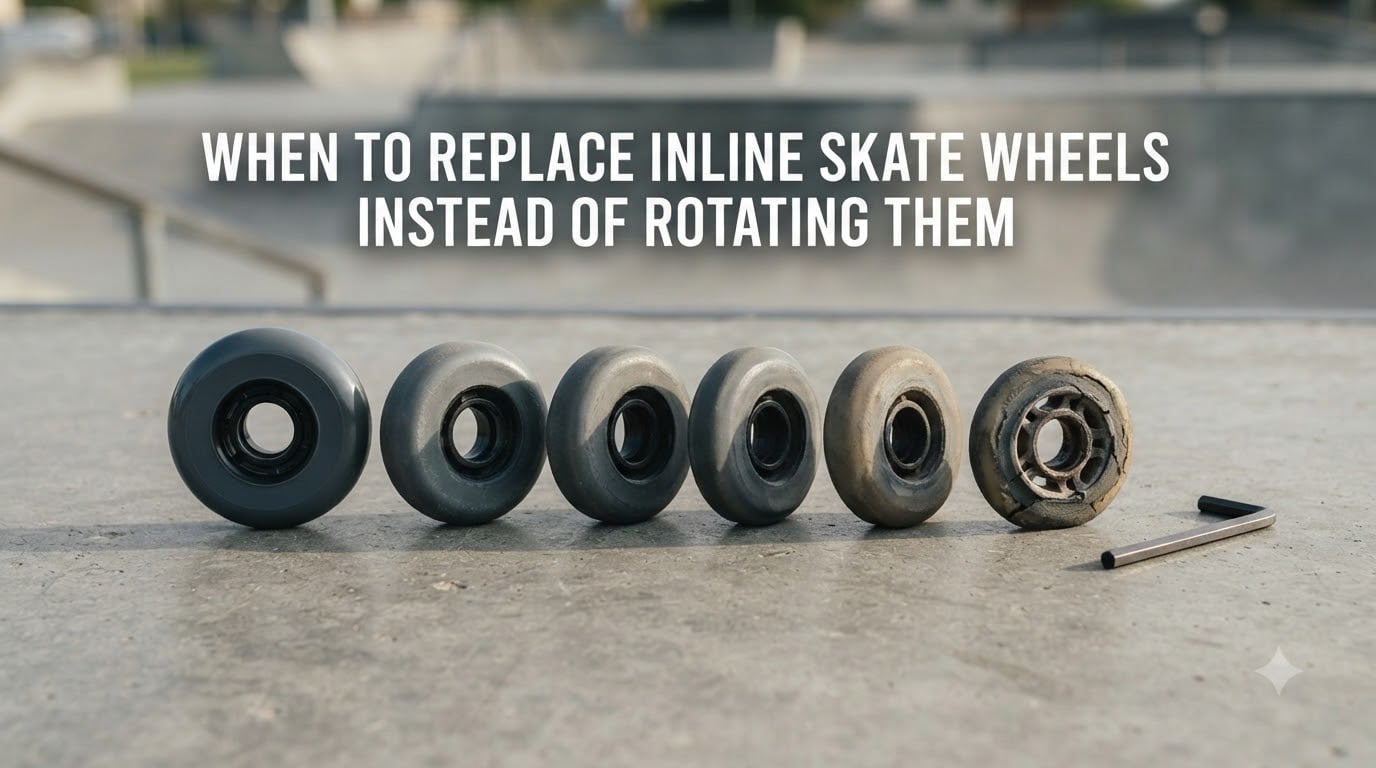
Replace your inline skate wheels instead of rotating them when you see chunks of urethane missing, cracks in the hub, coring (polyurethane separating from the core), or a sharp ridge forming at the center of the wheel. If the wheel is split, slick, or worn past the center ridge, rotation will not fix it — you need new wheels.
Knowing when to replace inline skate wheels instead of rotating them is one of the most overlooked skills in skating. I learned this the hard way after pushing a set of wheels way past their limit and having one split mid-skate on a downhill. That moment taught me there is a clear line between a wheel that needs rotating and one that needs replacing.
Our team has skated hundreds of hours across urban streets, bike paths, and indoor rinks. Along the way, we have tracked how wheels wear, when rotation actually helps, and when you are just delaying the inevitable. This guide breaks down everything you need to make that call with confidence.
Table of Contents
Why Wheel Rotation Matters?
Inline skate wheels do not wear evenly. Your weight distribution, braking habits, and turning patterns all put more pressure on certain wheels. Typically, the front and rear wheels wear faster on the inside edge, while middle wheels take a more balanced beating.
Rotation moves wheels from high-wear positions to lower-wear positions. This spreads the damage across all wheels so they degrade at a similar rate. Skaters on forums report that regular rotation extends wheel life by 2 to 4 times compared to never rotating.
But rotation only works when there is enough usable urethane left to redistribute. Once a wheel is too far gone, swapping its position just moves a broken wheel to a different slot. That is where replacement enters the conversation.
Signs You Need Replacement Instead of Rotation
Some types of damage cannot be fixed by repositioning a wheel. Here are the clear indicators that replacement is your only option.
Chunks of Urethane Are Missing
If pieces of the urethane have broken off the wheel, it is done. Missing chunks create an uneven rolling surface that causes vibration, unpredictable handling, and potential wheel failure at speed. No rotation pattern fixes a wheel that is literally falling apart.
The Wheel Is Coring
Coring happens when the polyurethane starts separating from the hard plastic core (hub) of the wheel. You will see a visible gap or peeling where the urethane meets the core. Once coring begins, the wheel will continue deteriorating rapidly and can fail without warning.
Cracks in the Hub or Spokes
Inspect the hard plastic core of each wheel. Cracks in the hub or broken spokes mean the structural integrity is compromised. A cracked hub can shatter under load, which is dangerous at any speed. Replace cracked wheels immediately.
A Sharp Ridge Has Formed at the Center
When wheels wear unevenly on both sides, a sharp ridge or point forms down the middle of the wheel. Slight coning is normal and can be addressed with rotation. But once that ridge becomes sharp and pronounced, the wheel has worn past the point where rotation helps — the shape is too distorted to recover.
The Wheel Splits Down the Middle
This is the most dangerous failure mode. A split wheel can lock up or disintegrate while you are skating. Forum users on r/rollerblading consistently warn that splitting wheels must be replaced immediately — no exceptions, no delays.
The Surface Is Slick or Bald
If the urethane has worn smooth and feels slick with no grip left, the wheel has reached the end of its usable life. A bald wheel slides unpredictably, especially on smooth or wet surfaces, and offers poor braking performance.
The Rotate vs Replace Decision Guide
Use this simple framework to decide whether your wheels need rotation or replacement.
Rotate when: The wheels show mild to moderate coning (one side wearing faster than the other), slight size differences between positions, or early signs of uneven edge wear. The urethane is still thick and intact with no cracks, chunks, or coring.
Replace when: Any wheel shows chunks missing, hub cracks, coring, splitting, a sharp center ridge, or a bald slick surface. Even if only one or two wheels show these signs, those specific wheels need replacing.
Replace all wheels when: The majority of your wheels are worn past recovery. Mixing brand-new wheels with heavily worn ones creates handling inconsistencies that can feel unpredictable, especially at speed.
A good rule of thumb from experienced skaters: if you are debating whether rotation will still help, it probably will not. When in doubt, inspect closely using the steps below.
How to Inspect Your Inline Skate Wheels?
A proper inspection takes about five minutes and can save you from a dangerous failure on the trail. Here is how I check my wheels every couple of weeks.
Step 1: Remove each wheel from the frame using an Allen wrench (typically 4mm). Pull out the axles and spacers, then slide the wheel out.
Step 2: Spin each wheel on its bearings. Listen for grinding or rough sounds, which indicate bearing issues rather than wheel problems. The wheel should spin freely and smoothly.
Step 3: Examine the urethane surface. Look for chunks missing, cracks, flat spots, and the sharp center ridge. Run your finger along the contact surface — it should feel consistent, not grooved or pitted.
Step 4: Check the hub and spokes. Look closely at the plastic core for any hairline cracks, especially around the bearing seats. Hold the wheel up to a light source to spot cracks more easily.
Step 5: Compare wheel diameters. Use a caliper or ruler to measure each wheel. A variation of 2-3mm between wheels on the same skate is normal after wear. Anything beyond that suggests rotation is overdue — or replacement if the smallest wheels are near the core.
Rotation Patterns for Different Skate Setups
Different skate configurations require different rotation patterns. Using the wrong pattern for your setup can actually make wear worse.
4-Wheel Flat Setup
The most common recreational setup uses four wheels of the same size per skate. The standard rotation pattern swaps the front and back wheels, and flips them so the worn inside edge becomes the outside edge.
Position 1 (front) goes to position 4 (rear) and flips. Position 2 goes to position 3 and flips. This ensures the most worn edges move to positions with less pressure and face the opposite direction.
3-Wheel Setup
Three-wheel skates (often called tri-skates) use larger wheels, typically 110mm or 125mm. Because there are fewer wheels, each one bears more load and wears faster. Rotate more frequently — about every 4 to 6 hours of skating.
The pattern is straightforward: swap the front and rear wheels and flip them. The middle wheel stays in place but should be flipped so the worn edge faces outward.
HiLo Setup
HiLo frames use smaller wheels in the front and larger wheels in the rear. You cannot swap wheels between front and rear positions because the sizes differ. Instead, swap left skate wheels with right skate wheels at the same positions, flipping each one.
For example, the front-left wheel of your left skate moves to the front-left position of your right skate, flipped. This counteracts the directional wear pattern without mixing wheel sizes.
Rockering
Rockering means setting the middle wheels slightly lower than the outer wheels to create a curved profile, similar to an ice blade. This setup is popular for slalom and aggressive skating because it improves maneuverability.
Rockered setups wear differently because weight distribution shifts toward the middle wheels. Pay extra attention to the two center wheels during inspection, as they will wear fastest and may need replacement sooner than the outer wheels.
Rotation Frequency Based on Your Skating Style
How often you rotate depends on how, where, and how much you skate. Rough surfaces, heavy braking, and aggressive turns all accelerate wear.
Casual recreational skating (smooth paths, light use): Rotate every 10 to 15 hours of skating. Inspect wheels every 5 hours.
Urban and commuter skating (mixed surfaces, frequent braking): Rotate every 6 to 8 hours. Rough asphalt and concrete break down urethane quickly.
Aggressive and slalom skating (sharp turns, jumps, slides): Rotate every 3 to 5 hours. The intense lateral forces in these styles cause rapid coning.
Speed and distance skating: Rotate every 8 to 10 hours. Long sessions at high speed generate heat that softens urethane and accelerates wear.
Forum users report that rough surfaces can destroy wheels in as few as two dozen hours without rotation. One skater on r/rollerblading noted their wheels lasted over two years with diligent rotation on smooth trails — but barely a season on rough city streets.
When in doubt, rotate sooner rather than later. Catching uneven wear early is the single biggest factor in extending wheel life.
Safety Risks of Delaying Replacement
Skating on wheels that should have been replaced is not just a performance issue — it is a genuine safety hazard. Worn wheels behave unpredictably and can fail catastrophically.
A wheel that splits while skating can lock up instantly, causing a sudden stop that throws you forward. Skaters on forums have shared stories of hard falls from wheel failures at speed, particularly on downhill sections.
Cracked hubs can shatter under the load of a hard turn or jump. When a hub breaks, the wheel can separate from the frame entirely. This is especially dangerous in traffic or on trails with obstacles.
Bald, slick wheels reduce your grip on the road. This means longer stopping distances, less control in turns, and a higher risk of sliding out on wet leaves, painted lines, or smooth pavement. If your wheels feel sketchy in turns, do not wait — inspect and replace as needed.
Cost Analysis: Rotation vs Replacement Over Time
Let us talk about the economics. A full set of quality inline skate wheels typically runs between $40 and $80 depending on size and brand. Bearings add another $15 to $50 if you need those too.
Regular rotation is free — it costs only your time and an Allen wrench. Skaters who rotate consistently report getting 2 to 4 times more life from each set of wheels. That means instead of buying new wheels twice a season, you might buy them once every season or two.
Over a few years, the savings add up. A skater who replaces wheels twice a year at $60 per set spends $120 annually. With proper rotation, that same skater might spend $60 every 18 months — cutting costs by more than half.
The cheapest approach is not avoiding replacement altogether. It is rotating diligently so you replace less often, and replacing promptly when wheels are genuinely worn out to avoid the cost of a crash.
Common Mistakes to Avoid
Waiting too long to rotate: The number one mistake. Once wheels are heavily coned or ridged, rotation cannot undo the damage. Rotate early and often.
Using the wrong rotation pattern: Applying a flat-setup pattern to a HiLo frame mixes wheel sizes and damages your frame. Always match the pattern to your setup.
Ignoring the bearings: When you have the wheels off for rotation, check your bearings. Spin them, listen for grinding, and clean or replace as needed. Worn bearings accelerate wheel wear by causing uneven rolling resistance.
Mixing new and badly worn wheels: Replacing one wheel while leaving three worn ones creates handling inconsistencies. Try to replace wheels in pairs at minimum, or do a full set when most are worn.
Frequently Asked Questions
When should I replace my inline skate wheels?
Replace your inline skate wheels when you see chunks of urethane missing, cracks in the hub, coring (polyurethane separating from the core), a sharp center ridge, splitting, or a slick bald surface. Any of these signs mean the wheel is beyond what rotation can fix.
Should you rotate inline skate wheels?
Yes. Rotating inline skate wheels evens out wear patterns and extends wheel life by 2 to 4 times. Move wheels from high-wear positions to lower-wear positions and flip them so the worn edge faces outward. Rotate regularly based on your skating style and surface conditions.
How do you tell if you need new skate wheels?
Inspect each wheel for missing chunks, hub cracks, coring (urethane peeling from the core), a sharp ridge down the center, splitting, or a smooth slick surface with no grip. If any of these are present, the wheel needs replacing rather than rotating.
How often should you rotate inline skate wheels?
Casual skaters should rotate every 10 to 15 hours of skating. Urban and commuter skaters every 6 to 8 hours. Aggressive and slalom skaters every 3 to 5 hours. Speed skaters every 8 to 10 hours. Always rotate sooner if you skate on rough surfaces.
Can I replace just one or two wheels instead of all of them?
You can replace individual wheels if only one or two show damage, but try to replace in pairs to maintain handling consistency. If the majority of your wheels are worn, replace the full set. Mixing new wheels with heavily worn ones creates unpredictable handling.
Conclusion
Knowing when to replace inline skate wheels instead of rotating them comes down to recognizing the point of no return. Mild coning and uneven edge wear respond well to rotation. Chunks, cracks, coring, sharp ridges, splitting, and slick surfaces all signal that replacement is the only safe option.
Make inspection a habit every few sessions, rotate on a schedule that matches your skating style, and replace promptly when you see the warning signs. Your wheels — and your safety — will thank you for it.