
I pulled into a rest stop last summer and a fellow RVer asked me why his trailer tires looked like they had been sanded down on one edge in a perfect cone shape. He had been driving for years without ever hearing the term wheel coning, and I realized most tire guides never explain it.
Your tires talk to you through the way they wear. If you know how to read the message, you can catch alignment, inflation, and suspension problems before they leave you stranded. In this guide, I will walk you through what wheel coning actually is, the most common wheel wear patterns, and a simple step by step way to read your own tires in under five minutes.
Table of Contents
What is wheel coning?
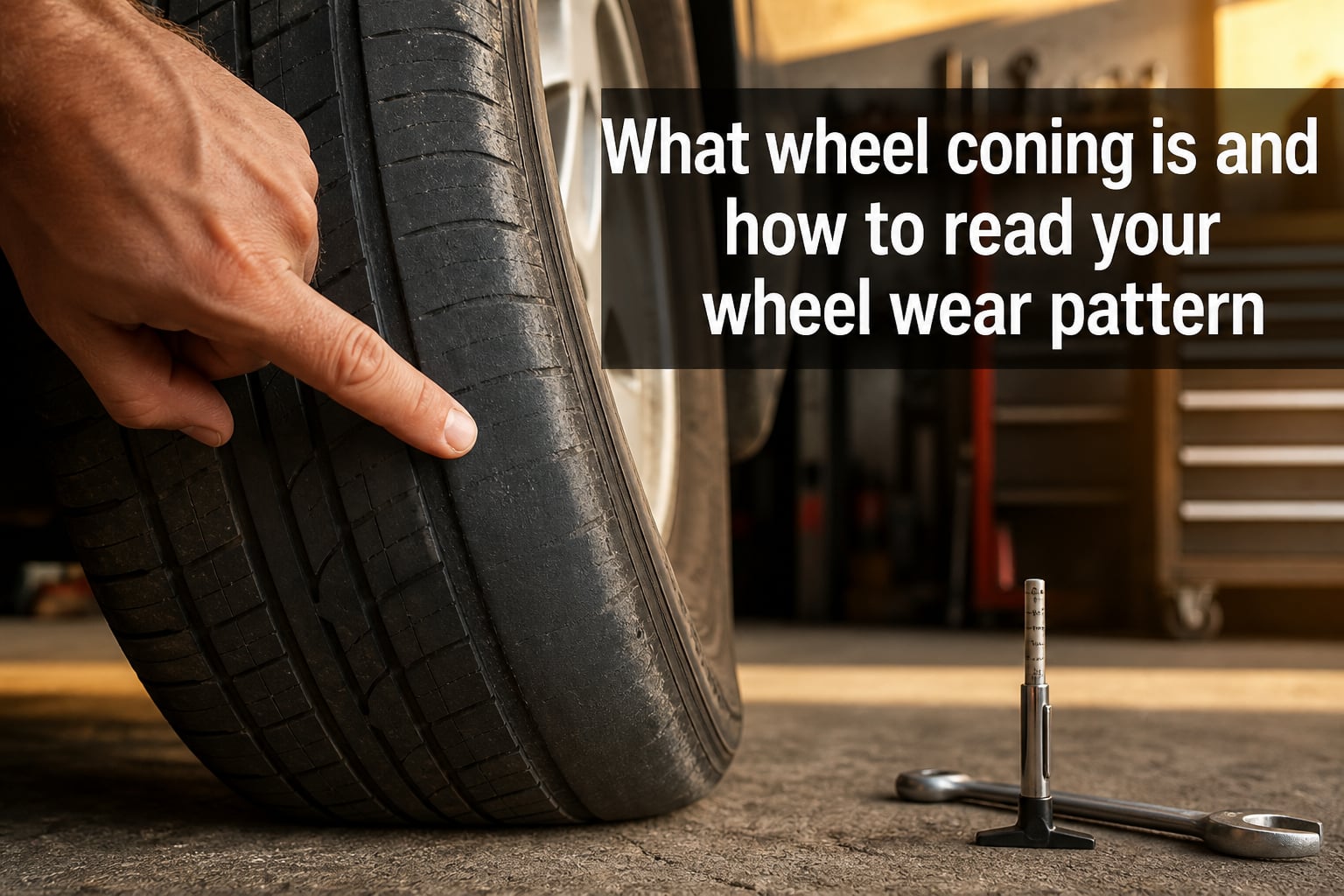
Wheel coning is a cone-shaped tire wear pattern where one side of the tread wears faster than the other, creating a tapered profile that resembles the slope of a cone. It most often appears on the inside edge of trailer, RV, and heavy load tires when the wheels are not tracking straight or the axle is out of alignment.
You will usually spot wheel coning by crouching beside the tire and looking across the tread from the side. A healthy tire looks roughly square across its width. A coned tire looks like the leading edge has been shaved, sloping from high in the middle to low on one shoulder.
How wheel coning differs from other wear patterns
Most tire wear patterns are caused by inflation or alignment geometry. Wheel coning is a more specific pattern linked to load imbalance, axle misalignment, and side to side tracking errors that are especially common on tandem axle trailers.
Unlike cupping, which creates scalloped dips around the circumference, coning produces a smooth but uneven slope across the tire width. Unlike feathering, which leaves a rough edge you can feel with your fingers, coning tends to feel smoother even though the wear is dramatic.
Why wheel coning matters for trailer and RV owners
On the RVLiving subreddit I see posts almost every week from owners asking why their trailer tires wear out after one season. In most cases the answer is wheel coning caused by an axle that has shifted from curb hits, worn bushings, or bearings that were never properly torqued.
Because trailers do not have a steering system correcting their path, even small alignment errors get amplified over thousands of miles. Catching the coning early can save you from replacing a full set of trailer tires every year.
Truck drivers on r/Truckers report similar patterns on dual wheel setups, where one tire in the pair takes most of the load and wears in a cone shape while the matching tire barely scuffs. Splitting the mileage and matching tires by tread depth helps slow the progression once the alignment is corrected.
Why reading your wheel wear pattern matters
A tire wear pattern is a free diagnostic tool. Every time you drive, the tread records how your suspension, alignment, and inflation are working. If you ignore the message, you end up replacing tires that were never the actual problem.
I learned this the hard way on my own truck. I burned through two front tires in 20,000 miles before I noticed the inside edge was shaved flat. A $90 alignment fixed what I assumed was a $400 tire problem.
Reading your wheel wear pattern also affects safety. Worn edges grip poorly in wet conditions, and cupped tires vibrate at highway speeds, which wears suspension components and can crack rims over time. According to the National Highway Traffic Safety Administration, tire related failures contribute to thousands of crashes each year, and most of them are preventable with a simple visual inspection.
Fleet managers rely on tire wear readings to schedule preventive maintenance. If you treat your personal vehicle like a one vehicle fleet, you can catch the same problems before they become roadside emergencies.
Common tire wear patterns and what they mean
Below is the chart I use when helping friends diagnose their tires. Each pattern points to a specific cause, and each cause has a specific fix.
| Wear Pattern | Looks Like | Likely Cause | Fix |
|---|---|---|---|
| Center wear | Tread is smooth in the middle, edges still have depth | Overinflation | Release air to spec pressure |
| Edge wear | Both shoulders are bald, center is fine | Underinflation | Add air and check for slow leaks |
| Inner or outer edge wear | Only one shoulder is bald | Camber misalignment or worn bushings | Get a four wheel alignment |
| Feathering | Tread blocks feel sharp in one direction, smooth in the other | Toe misalignment | Adjust toe angle to spec |
| Cupping or scalloping | Wavy dips around the tread | Worn shocks, struts, or unbalanced tires | Replace shocks, balance and rotate |
| Diagonal or patchy wear | Rough patches spaced around the tire | Tire out of balance or rotation overdue | Balance wheels, rotate on schedule |
| Wheel coning | Smooth tapered slope across width, usually one side | Trailer axle misalignment or bearing issue | Realign axle, check bearings |
Center wear (overinflation)
Center wear happens when your tires are overinflated. The middle of the tread bulges out and carries more of the vehicle weight, so it wears faster than the shoulders.
You will see a strip of smooth rubber running down the middle with normal tread remaining on both sides. The fix is simple: check the pressure on the door jamb sticker, not the tire sidewall, and let air out until you reach the recommended PSI.
Overinflation also makes the ride harsher and reduces the contact patch during cornering, which hurts grip on wet pavement. Do not assume the number on the sidewall is right for your vehicle, because that number is the maximum load pressure, not the recommended daily pressure.
Edge wear (underinflation)
Edge wear is the opposite problem. Underinflated tires sag in the middle and ride on their shoulders, scrubbing the tread off both outside edges.
This is one of the most dangerous wear patterns because it hurts wet traction right where you need it most. Add air to spec, inspect for slow leaks, and check the tire every couple of weeks until you are confident the pressure is holding.
Underinflation also builds heat inside the tire, which is the leading cause of sidewall blowouts on highway driven vehicles. If you find yourself adding air every month, the tire likely has a nail or a corroded bead that needs attention.
Inner or outer edge wear (camber issues)
When only one shoulder wears faster than the other, the problem is camber. Positive camber pushes the top of the tire outward, while negative camber tilts it inward, and either extreme wears the matching shoulder down quickly.
Common culprits include worn ball joints, collapsed springs, bent struts, and aftermarket modifications that lowered the suspension. The fix is a four wheel alignment combined with a suspension inspection.
On the r/DieselTechs forum, technicians note that even a brand new tire will wear out in 10,000 miles if the camber is off by more than one degree. That is why a fresh alignment is the first thing to check whenever you see one shouldered wear on a relatively new tire.
Feathering (toe misalignment)
Feathering feels like a comb running across the tread in one direction and velvet in the other. It happens when the toe angle is off and the tire is being dragged sideways instead of rolling straight.
You can diagnose feathering without gauges by sliding your hand across the tread. If the blocks feel like sharp knives one way and smooth the other way, you have a toe problem and need an alignment.
Toe settings are extremely sensitive. A change of just a few millimeters can produce visible feathering within a few thousand miles, which is why hitting a curb or a deep pothole often shows up first as feathering on the front tires.
Cupping and scalloping (suspension issues)
Cupping looks like a series of low spots scooped out around the circumference of the tire. Each dip is roughly the size of a quarter and they tend to repeat at regular intervals.
This pattern points to worn shocks or struts that let the tire bounce between the road and the wheel well several times per revolution. Replace the suspension parts, balance the tires, and the cupping will stop progressing.
Cupping is the wear pattern that drives me to recommend checking tire pressure more often than people expect. Low pressure changes the way the tire responds to bumps, and the bouncing heightens the cupping pattern until the tire is unusable.
Diagonal or patchy wear (balance and rotation)
Diagonal wear shows up as scuffed patches arranged diagonally across the tread. It usually means the wheel and tire assembly is out of balance or the tires have not been rotated on schedule.
Balance correction and a proper rotation interval (typically every 5,000 to 7,500 miles) usually clears this up before the patches get deep enough to require replacement.
If you commute on rough roads, shorten the rotation interval. Front tires on front wheel drive cars tend to wear faster, and rotating them to the rear before they reach 5/32 inch of tread keeps the wear even across the set.
How to read your wheel wear pattern step by step
You do not need any special tools to do a basic wheel wear check. Here is the routine I run through every time I rotate tires or check pressure.
Step 1: Inspect tires in good lighting
Pull into a garage or shaded area with bright, even light. Direct sunlight hides subtle wear, and a dirty tire can fool you into thinking you see cupping that is actually just brake dust.
Wipe each tire down with a microfiber cloth first. Surface grime can hide thin spots in the tread and make a smooth tire look deeply textured.
Step 2: Check both shoulders and center
Stand back a few feet and look at the tire from the front, the back, and directly above. Note whether the tread looks uniform or whether one zone is smoother than the rest.
Looking from above lets you see the contact patch shape, which is the quickest way to confirm camber and inflation issues. A rounded patch means overinflation, a wide flat patch means underinflation, and a teardrop patch means toe misalignment.
Step 3: Run your hand across the tread
Slowly slide your palm across the tread in both directions. Feathering and small scallops are easier to feel than see, especially on tires with deeper tread blocks.
Diabetics or anyone with reduced hand sensitivity should use a clean shop rag instead. The rag picks up the same directional roughness that your fingertips would catch.
Step 4: Measure tread depth
Use a tread depth gauge or a quarter. Insert a quarter with the head down into the tread groove. If you can see the top of the head, the tread is below 4/32 inch and you should start shopping for replacements.
Measure at the center, the inner shoulder, and the outer shoulder. The difference between the three readings tells you whether inflation or alignment is the faster progressing issue.
Step 5: Compare across all four tires
Uneven wear between tires tells you more than the wear on any single tire. A bald inside edge on the right front and a feathered pattern on the left rear is a completely different problem than the same pattern showing up symmetrically.
Write down what you find on each tire so you can show the technician during your next service visit. The notes turn a vague complaint into a specific diagnosis.
When to seek professional help for wheel wear
Some wear patterns can be corrected with a simple alignment, while others mean the tire is done. Knowing the difference saves you from paying for an alignment on a tire that needs to be replaced.
You can usually fix center wear, edge wear, feathering, and minor diagonal wear with the right adjustment. Once the wear is deeper than 2/32 inch, the tire will not hold alignment correctly and should be replaced.
Cupping that is severe, inner or outer edge wear that exposes the belt edge, and any wear showing cord or wire means the tire is unsafe and should be off the road immediately. For wheel coning on trailers, schedule an axle alignment as soon as you see the pattern, because the wear only accelerates with mileage.
If you see wear on one tire that is dramatically different from the matching tire on the other side, bring the vehicle in for a drivability inspection. Mismatched wear is one of the first signs of a failing differential, a bent axle, or a stuck brake caliper.
Frequently asked questions about wheel coning and tire wear
How do you read tire wear patterns?
Look at the tire from the front, back, and above in good lighting, then run your hand across the tread. Note whether the center, shoulders, or one specific side is smoother than the rest, and compare all four tires to see if the wear is even or directional.
What is wheel coning on a trailer?
Wheel coning on a trailer is a cone-shaped wear pattern that typically appears on the inside edge of the tires. It is caused by axle misalignment, worn bearings, or side to side tracking errors that get amplified because trailers do not have a steering system to correct their path.
Why is my tire wearing on the inside edge?
Inner edge wear usually means negative camber, which can come from a bent strut, collapsed spring, worn ball joint, or simply an alignment that has drifted out of spec. A four wheel alignment combined with a suspension inspection is the standard fix.
Why is my tire wearing wavy?
Wavy tire wear, also called cupping or scalloping, is caused by suspension components that let the tire bounce between the road and the wheel well. Worn shocks, struts, or unbalanced wheels are the most common culprits.
When should I replace tires based on wear pattern?
Replace tires when the tread drops below 2/32 inch, when you can see the wear indicators flush with the tread, or when the pattern exposes belt edges, cord, or wire. Severe cupping and any wear that makes the tire vibrate at highway speed also calls for replacement.
Final thoughts on reading wheel wear patterns
Wheel coning and the broader family of tire wear patterns are some of the most useful diagnostic signals your vehicle gives you for free. A five minute inspection once a month can tell you whether you need air, an alignment, new shocks, or just a rotation.
If you take one thing away from this guide, let it be this: do not replace a tire without first understanding why it wore the way it did. Otherwise the new tire will meet the same fate, and the underlying problem will keep draining your wallet until you read the message your tread is sending.
Bookmark this guide, share it with a friend who just bought new tires, and make tire wear inspection a habit. The few minutes you spend squatting next to your wheels each month will pay you back in longer tire life, safer drives, and fewer surprise repair bills.