
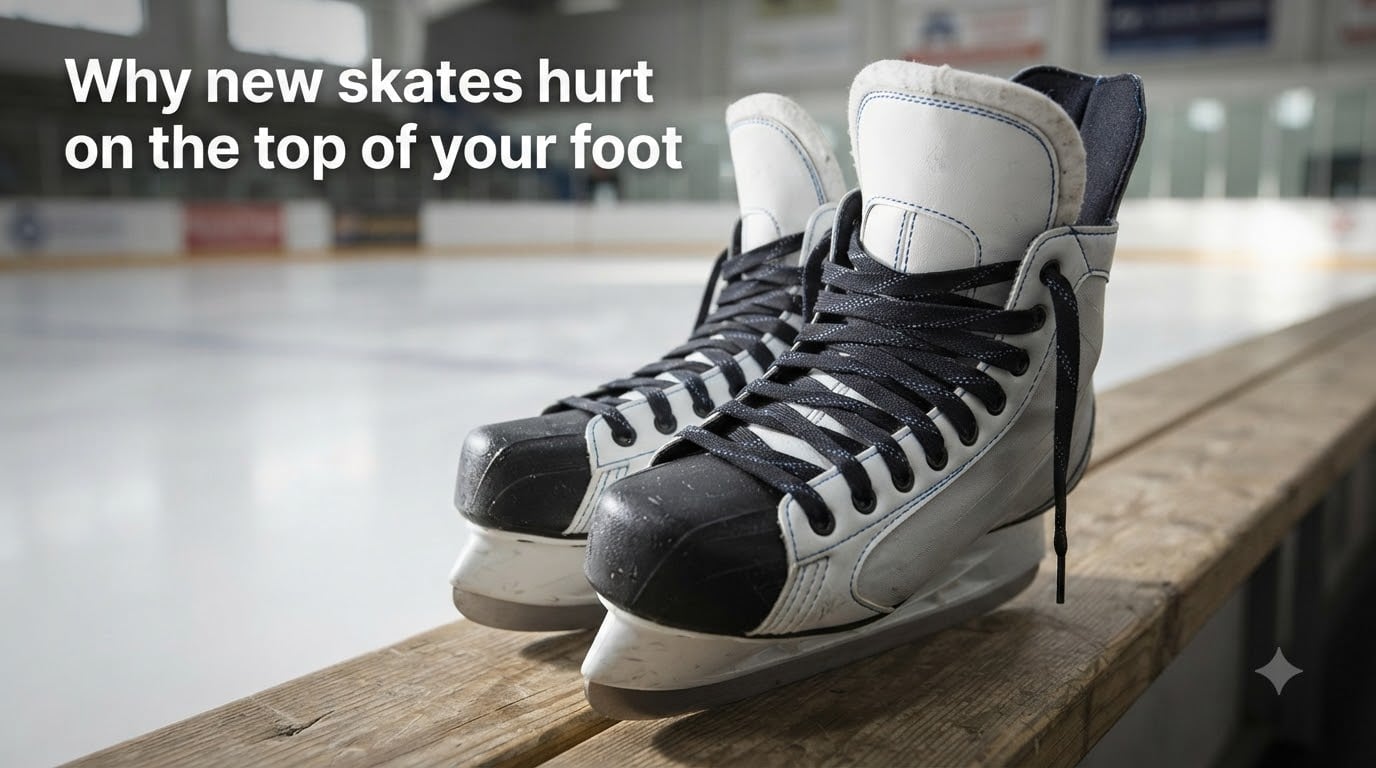
New skates hurt on the top of your foot because the stiff boot material presses against the instep before it has had time to soften and conform to your foot shape. When skates are laced too tightly, too loosely, or simply have not been broken in yet, the top of the foot absorbs the brunt of that pressure and the result is sharp, aching, or cramping pain after 20 to 30 minutes on the ice.
That uncomfortable, pinching sensation you feel is almost universal among skaters who are breaking in new boots. Our team has talked with hockey players, figure skaters, and recreational skaters who all describe the same nagging pressure across the instep, and the good news is that in the vast majority of cases it is completely fixable.
In this guide, I will break down exactly why new skates hurt on the top of your foot, how to tell whether you are dealing with a sizing problem, a lacing issue, or a technique problem, and what steps you can take today to relieve that pain. I will also cover how long the break-in period should last and when that discomfort crosses the line from normal to concerning.
One quick note: the solutions in this guide apply broadly to hockey skates, figure skates, and roller skates, because the mechanics of boot fit and foot pressure are largely the same across skate types.
Table of Contents
The Main Reasons New Skates Hurt the Top of Your Foot
Top-of-foot pain in new skates almost always traces back to one of four root causes: the boot is too tight, the boot is too loose, the laces are doing damage, or the boot is simply still stiff from the factory. Understanding which of these is affecting you is the first step toward solving it.
Skates That Are Too Tight
The most obvious cause of top-of-foot pressure is a boot that is simply too small for your foot. Skate boots are designed to fit far more snugly than street shoes, and many first-time buyers panic at how tight a properly fitted skate feels and mistake correct snugness for being too small. But there is a real difference between snug and crushing.
When a skate is genuinely too tight, it compresses the top of the foot against the boot tongue and the instep against the lacing area. You will feel this as a burning, numbing sensation that often starts around 15 to 20 minutes into a skate and does not let up. Toes that tingle or go numb are a clear signal that the boot is too narrow or too short.
A common mistake I see is going down a full size from your shoe size. While hockey and figure skates do run smaller than shoes, dropping too far creates the exact top-of-foot pain we are discussing. A proper skate fitting should leave your toes just brushing the toe cap when you are standing straight, and pulling back slightly when you bend your knees into skating position.
Skates That Are Too Loose
Here is the surprising one: skates that are too big can hurt just as much as skates that are too small. When a boot fits loosely, your foot slides forward and backward inside the shell with every stride. To compensate, most skaters crank the laces as tight as possible to lock the foot down, and that overtightening crushes the top of the foot against the laces.
This is a pattern I have seen repeatedly in forum discussions. A skater buys skates half a size too large, their heel lifts, so they pull the laces tighter and tighter, and then they wonder why the top of their foot throbs after 20 minutes. The pain is not from the fit itself, it is from the desperate overtightening the loose fit forces.
Signs your skates are too loose include heel lift when you push off, the need to retighten laces repeatedly during a session, and blisters forming on the heel or sides of the foot. In this case, the fix is not loosening the laces but addressing the underlying fit problem with thicker socks, an additional insole, or ultimately a smaller boot.
Improper Lacing and Overtightening
Even with the right skate size, how you lace your boots determines a huge amount of how the top of your foot feels. Most skaters lace their skates the way they would tie a running shoe: pull everything evenly and cinch the top as tight as possible. That approach is almost guaranteed to create top-of-foot pain.
The top of your foot is home to tendons, nerves, and blood vessels that sit close to the surface. When you pull the laces tight across the instep, you compress all of that against the hard boot tongue. The result is lace bite, restricted circulation, and that deep aching sensation that builds over the course of a skate.
Proper lacing actually varies the tension across different zones of the boot. The bottom portion around the toes should be snug but not crushing. The middle section across the instep should allow some give. The top section near the ankle should be the tightest point for support. This sounds counterintuitive, but most skaters benefit from leaving the instep area slightly looser than they think they need.
Boot Stiffness During the Break-In Period
New skate boots are intentionally stiff. That stiffness gives you support and power transfer, but it also means the boot has not yet shaped itself to the contours of your foot. A brand-new boot is essentially a rigid shell pressing against a soft, complex structure with arches, bumps, and tendon pathways.
Until the boot breaks in, the materials, whether leather in figure skates or composite in modern hockey skates, resist conforming to your instep. The top of the foot takes the most direct pressure because that is where the tongue and laces sit. As the boot softens over the first several sessions, the tongue molds to your foot and the pressure spreads out, which is why pain that is intense in week one often fades by week three.
How Lace Bite Causes Top-of-Foot Pain
Lace bite is the single most common cause of pain on the top of the foot in new skates, and it deserves its own deep look because it is both widely misunderstood and highly preventable.
What Is Lace Bite?
Lace bite is inflammation of the tendons on the top of the foot caused by repeated pressure from the skate laces and tongue. Every time you flex your ankle forward during a skating stride, the tendons on top of your foot slide under the tight laces. Over a full session, this friction and compression irritates the tendon sheath and creates a deep, aching pain that can linger for hours or even days after skating.
The hallmark of lace bite is tenderness right along the instep when you press on it after skating. You might also notice mild swelling or a burning sensation. If you press gently along the tendon paths on top of your foot and feel sharp tenderness, you are almost certainly dealing with lace bite rather than a pure fit issue.
How to Prevent Lace Bite
Preventing lace bite comes down to two things: reducing direct pressure on the tendons and giving the tongue time to mold to your foot. The fastest fix is a lace bite pad, sometimes called a Forsberg pad after the hockey player who popularized it. This is a thin foam or gel pad that sits between the tongue and the top of your foot, spreading lace pressure across a wider area.
You can also skip eyelets in the instep area, a technique called lace skipping. By leaving one or two eyelets unlaced across the most painful part of your foot, you remove the direct pressure on the tendon while still keeping the ankle locked in above that point. Many skaters use this trick during the break-in period and return to normal lacing once the boot has softened.
Finally, take a hard look at how tight you are pulling the instep laces. I have talked with skaters who solved years of foot pain simply by backing off the middle laces by 20 percent. The ankle support comes from the top eyelets, not from crushing your instep.
Lace Patterns to Try
If lace skipping feels too loose, try a parallel lacing pattern instead of the traditional crisscross. Parallel lacing pulls the boot tight from the sides rather than pressing down from the top, which dramatically reduces pressure on the instep tendons. You lose almost nothing in support and gain a great deal of comfort.
Another option is the double-cross method, where you cross the laces twice at the instep before continuing up. This anchors the foot without needing to pull the laces as tight, which again reduces downward pressure on the top of the foot.
Technique Mistakes That Cause Skate Foot Pain
Here is where this guide diverges from most others you will find. Not all foot pain comes from the skates themselves. A significant portion of top-of-foot pain, and especially the cramping and aching that skaters feel during a session, comes from how you are actually using your feet inside the boot.
Toe Gripping and Muscle Tension
If you are subconsciously gripping the bottom of the boot with your toes to stabilize yourself, you are loading the small muscles of the foot in ways they were never designed to handle. This gripping creates tension that radiates up through the arch and across the top of the foot, producing the exact cramping sensation so many skaters describe in forums.
Toe gripping usually happens for one of two reasons: the boot is too loose and the foot is searching for stability, or the skater is not confident in their edge control and is tensing up. Both are fixable. If the boot fits well and you still catch yourself gripping, the issue is technique and balance, not equipment.
The Ready Position Test
Here is a practical self-diagnosis test I picked up from experienced skating coaches. Stand in your skates and drop into a proper ready position: feet about hip-width apart, knees bent deeply so your shins press into the tongues of the boots, weight balanced over the middle of each foot, and back relatively upright.
Now notice what your feet are doing. If your toes are gripping, your arches are cramping, or the muscles on top of your feet feel tight, you have a technique problem that no amount of lace adjustment will fix. The fix is learning to trust the boot: press your shins into the tongues, let the boot hold you up, and consciously relax your toes.
This single correction resolves an enormous amount of foot pain. When you skate with bent knees and proper shin contact, the boot supports you and the foot can relax. When you skate too upright, the foot does all the stabilizing work and pain follows.
Posture and Knee Bend Corrections
Skating with insufficient knee bend is a silent cause of foot pain. When your legs are too straight, your weight shifts back toward your heels, your toes grip for balance, and the muscles across the top of your foot tense up to keep you stable. It feels like your skates are hurting you, but really your body is asking your feet to do a job the boot should be doing.
The correction is simple to describe and harder to execute: bend your knees more. Your shins should press forward into the boot tongues with noticeable pressure. If you can slide two fingers easily between the back of your calf and the boot, your knees are not bent enough. Get lower, lean slightly forward, and feel the difference in how much your feet relax.
Arch Pain and Foot Shape Considerations
Every foot is built differently, and a boot that fits one person perfectly may cause agony for someone with a different arch height, foot width, or ankle structure. Top-of-foot pain is often tangled up with arch pain and width issues, so it helps to understand your own foot anatomy.
Arch Height and Pronation
Skaters with high arches are particularly prone to top-of-foot pain because the boot tongue presses down on the raised instep. A high arch lifts the top of the foot closer to the laces, which means even moderate lace tension creates significant pressure. If you have visibly high arches, you will likely need to lace the instep area looser than other skaters do.
On the opposite end, flat feet and overpronation create a different set of problems. When the arch collapses, the foot spreads wider inside the boot, increasing pressure on the sides and top. Over-the-counter or custom orthotics can support the arch, reduce the spread, and relieve the corresponding top-of-foot pressure. Many skaters are surprised to find that their foot pain disappears entirely once they add proper arch support.
Wide Feet and Bone Spur Issues
Skaters with wide feet often experience pain across the top because the boot compresses the foot from the sides, squeezing the instep upward against the tongue. If your foot is wide, look for boots specifically built in wide or extra-wide fits rather than trying to force a standard-width boot to work. Forcing a narrow boot over a wide foot guarantees top-of-foot pain and eventually foot damage.
Bone spurs or bony bumps on the top of the foot are another factor. These create a hard pressure point against the boot tongue that no amount of break-in will soften. If you have a bony prominence on your instep, a boot fitter can punch out or stretch that specific area of the boot to create a pocket for the bone.
When Custom Orthotics Help
Custom orthotics are not just for medical conditions. They can correct the foot position inside the boot so that pressure distributes evenly rather than concentrating on the top of the foot. If you have tried everything else and the pain persists, a podiatrist or specialized skate fitter can assess whether orthotics would address an underlying alignment issue.
How to Break In New Skates Without Pain
The break-in process is where most of the pain lives, and accelerating or smoothing out that process is one of the most effective ways to reduce top-of-foot discomfort. Here is what actually works.
Heat Molding
Most modern hockey skates and many figure skates are heat moldable, meaning a skate shop can bake the boot in a special oven and then have you put it on while it is warm so it conforms to your foot. This is the single most effective thing you can do to shortcut the break-in process.
Heat molding softens the boot materials so they wrap around the contours of your foot, reducing the pressure points that cause top-of-foot pain. If you bought your skates from a reputable shop, ask whether they offer heat fitting. Many include it free with a purchase. If you bought online, call local hockey shops to see if they offer the service for skates you bring in.
Wearing and Skating Progression
Do not take brand-new skates straight into a two-hour game or practice. Break them in gradually by wearing them at home for 15 to 20 minutes at a time while watching TV or doing chores. This lets your feet and the boots get used to each other in a low-stakes environment.
For your first few on-ice sessions, plan for short skates of 20 to 30 minutes. Pay attention to where the pressure builds and adjust your lacing accordingly. Expect that the boots will feel dramatically better by the fifth or sixth session as the materials soften and the tongue molds to your instep.
Boot Punching for Hot Spots
If you have identified a specific spot on the top or side of your foot that hurts in the same place every time, a skate shop can punch out that area of the boot. Punching involves using a specialized tool to stretch a small section of the boot shell outward, creating a pocket that relieves pressure on a bony prominence or hot spot.
This is a permanent fix for a specific problem area and costs relatively little compared to buying new skates. If you have one nagging pressure point that will not go away after break-in, ask a fitter whether punching is an option for your boot model.
Normal Break-In Pain vs Concerning Pain
One of the most common questions in skating forums is some variation of how long is it normal for new skates to hurt. The honest answer is that some discomfort is expected during the first one to two weeks of regular skating, but certain types of pain signal a problem that needs attention.
Normal break-in pain is a general tightness or pressure that fades as you skate and disappears within an hour or two after you take the boots off. It gradually lessens with each session. Your feet may feel tired and slightly sore the next morning, but nothing is swollen, numb, or sharp.
Concerning pain is different. If you experience numbness or tingling in your toes that lasts beyond the skate, sharp stabbing pain in one specific spot, swelling that does not go down overnight, or pain that is getting worse rather than better after several sessions, something is wrong. These are signs of poor fit, nerve compression, or the early stages of an injury like a stress reaction, and you should stop skating in those boots until the problem is identified.
As one experienced hockey player put it in a forum thread: discomfort when skates are new is normal. Agony is not. If your skates hurt badly enough to make you dread putting them on, the fit or the lacing is wrong, and no amount of breaking in will fix a fundamentally mismatched boot.
Frequently Asked Questions
Why does the top of my foot hurt after skating?
The top of your foot hurts after skating because the stiff boot tongue and laces compress the tendons and nerves on your instep. This is caused by overtightened laces, a boot that is too tight or too loose, or lace bite from the boot not yet being broken in to your foot shape.
Is it normal for feet to hurt with new skates?
Yes, mild pressure and tightness are normal during the first one to two weeks as stiff boot materials soften and conform to your foot. However, sharp pain, numbness, or agony that makes you dread skating is not normal and usually points to a fit or lacing problem.
How do you fix pain on the top of your foot from skates?
Loosen the laces across the instep, use a lace bite pad or gel tongue pad, try lace skipping to remove pressure from the most painful eyelets, ensure the boot is the correct size, and get the skates heat molded. Adding arch support orthotics can also relieve top-of-foot pressure.
How long should new skates hurt?
New skates typically cause mild discomfort for the first five to six skating sessions, usually one to two weeks of regular use. After that, the boot should be largely broken in and pain should significantly decrease. If pain persists beyond two weeks, the fit or lacing likely needs adjustment.
How long does it take to break in new ice skates?
Most modern ice skates take about six to ten hours of skating time to fully break in. Heat molding at a skate shop can reduce this to two to four sessions by pre-shaping the boot to your foot before you ever step on the ice.
How do you buy ice skates that feel good on your feet?
Get professionally fitted at a skate shop, choose the correct width for your foot, size down from your shoe size by one to one and a half sizes only, ensure toes just brush the toe cap when standing straight, and consider heat moldable models so the boot can be shaped to your foot for a custom fit.
Conclusion
Understanding why new skates hurt on the top of your foot comes down to recognizing whether you are dealing with a fit problem, a lacing problem, or a technique problem. Address the root cause, loosen the instep laces, consider heat molding and lace bite pads, and pay attention to your knee bend and foot relaxation on the ice.
Some discomfort during the first week is completely normal. Agony that does not improve is not, and it means it is time to revisit your fit or visit a professional skate fitter. Your feet will tell you when something is wrong, so listen to them and make the adjustments that let you focus on skating instead of suffering.