
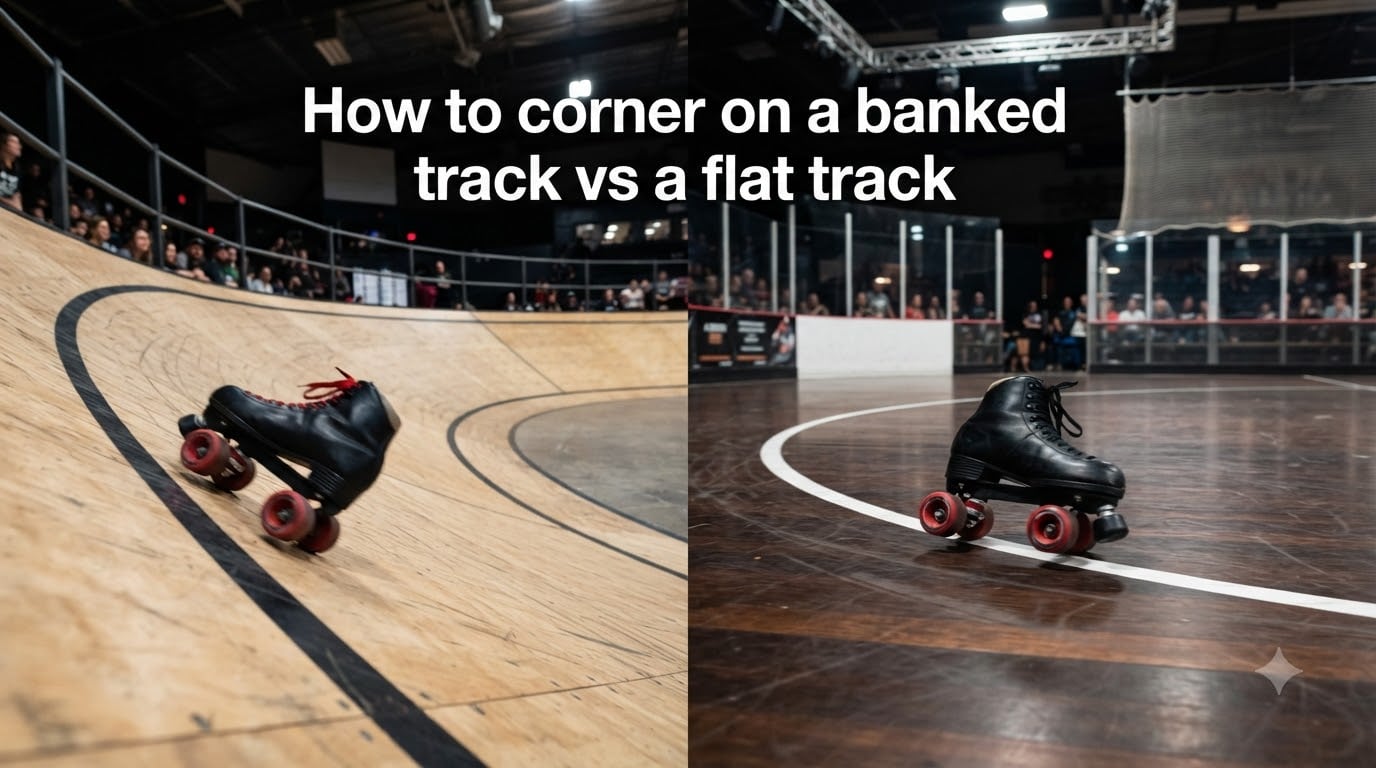
Learning how to corner on a banked track vs a flat track is one of the biggest technique shifts a roller derby skater will ever make. The two surfaces feel completely different under your wheels, and the same body position that wins on flat track will get you a face full of floor on a banked one. I have spent countless hours skating both, and I have crashed enough times to learn exactly where the differences start and where they really matter.
In this guide I will walk you through the body position, weight distribution, and entry speed you need for each track type. I will also share the drills our team uses to build the ankle strength and edge control that both tracks demand. Whether you are brand new to derby or you are transitioning between the two formats, this is the breakdown I wish someone had handed me on day one.
Table of Contents
What Are the Differences Between Banked and Flat Track Roller Derby?
A banked track is an oval with a sloped surface, usually at around 10 to 17 degrees of incline, and a raised inner edge called the coping. Flat track roller derby is played on a flat, level surface with no slope, only painted boundary lines. The bank gives you built-in gravitational pull through the corners, while a flat track leaves every bit of speed and edge control up to your skates.
The rules feel different too. Banked track requires continuous forward skating in derby direction only, with no stopping or going backwards during play. Flat track also requires continuous forward skating, but the layout is shorter and tighter, so cornering speed limits are very real. These rule differences change how you approach every single turn.
Here is the quick breakdown before we dive into the technique:
Banked track: Sloped oval, coping at the top, faster overall speeds, larger playing area.
Flat track: Flat oval, painted boundaries, tighter corners, smaller playing area.
Pack dynamics: Banked tracks let the slope do some of the work, while flat tracks demand more footwork and edge control.
Penalties: Falling on a banked track can be more dangerous, so wipeout penalties often carry heavier consequences.
How to Corner on a Banked Track: Step-by-Step Technique
Cornering on a banked track looks like running more than skating. The slope gives you extra grip, so your job is to stay tall, stay balanced, and let the bank do the work. Here is the step-by-step approach I teach every new skater.
Body Position on a Banked Track Corner
Step 1: Approach the corner tall and centered. Your head should be over your hips, not leaning into the turn. The natural instinct is to lean the way you would on flat ground, but the bank already tilts you. Leaning more just throws you off balance.
Step 2: Bend your knees deeply and keep your chest forward. Your knees absorb the slope, not your hips. If your hips drop on the bank, you are about to fall. I always tell skaters to imagine a string from their sternum pulling straight up to the ceiling.
Step 3: Keep your arms in a controlled position. Most skaters use one arm forward and one back, like a sprinter. This lets you check the pack without turning your whole body.
Weight Distribution and the Coping
Step 4: Distribute your weight evenly across both skates. Lean slightly toward the inside of the track only as much as the slope already pulls you. Over-leaning will send you down the bank; under-leaning will leave you scrambling up the slope.
Step 5: Run the corner. On a banked track you will often push straight across the curve rather than carving a long arc. Skating the coping (the raised lip at the top of the bank) is a skill that takes practice, but it lets you take the fastest line around the turn.
Step 6: Exit by pushing off the inside edge with your back foot. Keep your chest forward as you straighten out. The bank will help you accelerate onto the next straightaway, which is one of the reasons banked track derby feels so much faster.
How to Corner on a Flat Track: Step-by-Step Technique
Flat track cornering is all about edges, lean, and footwork. There is no slope to help you, so you have to generate every bit of grip with your wheels and your body. This is where most skaters build the technical foundation that transfers to banked skating later.
Body Position on a Flat Track Corner
Step 1: Approach the corner with controlled speed. Flat track does not forgive overspeed the way banked track does. I always tell skaters to enter at the speed they want to exit.
Step 2: Lean your whole body into the turn. On flat ground, your shoulders, hips, and knees should all point in the same direction along the curve. This is the opposite of what you do on a banked track.
Step 3: Keep your inside knee bent and your outside leg pushing. The inside leg carries your weight, the outside leg drives you through the corner with each push.
Weight Distribution and Edging
Step 4: Push your inside wheels down into the floor. This is what skaters call “edging” and it is what makes your turn grip rather than slide. The more you can roll onto the inside edge of your wheels, the sharper your turn will be.
Step 5: Use the apex. The apex is the geometric center of the curve. Cutting close to the apex on a flat track is the fastest line, but it requires the deepest lean and the best edge control. Touching the apex with your inside shoulder is the goal.
Step 6: Drive out of the corner with a strong crossover. Crossovers are the steps that keep your speed up while you turn. Each crossover step plants the outside skate and pushes the body through the arc. If you skip them, you will slow down every time.
Side-by-Side Comparison: Banked vs Flat Track Cornering
This is the comparison I wish I had when I first started skating both formats. The side-by-side view makes the technique differences obvious.
| Factor | Banked Track | Flat Track |
|---|---|---|
| Body lean | Stay tall, lean only with the slope | Lean into the turn with shoulders, hips, and knees |
| Weight distribution | Even across both skates | Inside edge carries weight, outside leg pushes |
| Footwork style | Run the curve, push straight across | Crossovers and gradual carve |
| Speed source | Gravity from the slope | Edge control and crossover power |
| Turning surface | Coping at the top, slope below | Painted boundary lines only |
| Entry speed | Higher entry speed tolerated | Lower entry speed required |
| Common error | Hips sinking down the bank | Too much lean with no edging |
| Best drill | Tall-man runs without skating | Ap-touch crossovers at low speed |
Common Mistakes Skater Make on Each Track Type
Most technical mistakes on a banked track come from forgetting you are not on flat ground. Skaters lean into the turn the way they would on flat track, and the slope adds another layer of lean on top. The result is a fast slide down the bank that ends in the floor. I have done this twice. Both times my own body position was the cause.
Hips dropping is the single most common banked track mistake. Beginners see the slope and let gravity pull their hips down the bank. The fix is to drive the knees forward and keep the chest lifted. If your hips feel like they are moving ahead of your head, slow down and reset.
On flat track, the most common mistake is leaning without edging. A skater can throw their whole body into a turn, but if their wheels are not rolling onto the inside edge, they will simply slide out. The other classic flat track error is scrubbing speed on every corner because the skater is afraid of the wall. Building crossover strength fixes both issues.
One mistake that crosses over both formats is arm position. Recoiling your arms toward your chest kills your balance on either track. I keep mine at about 90 degrees most of the time, ready to absorb contact from the pack.
Drills to Improve Your Cornering on Both Tracks
Drills are how you turn these techniques into muscle memory. I run these with skaters at every level, and the same three exercises always produce the fastest improvements. Pick a track, grab a friend, and try them at your next practice.
Banked Track Drills
Drill 1: Tall-man runs. Take your skates off and run the corners of the banked track. If you can run the curve at full speed without leaning or reaching for the floor, you will be able to skate it. This drill trains the body position without the variables of wheels.
Drill 2: One-foot coasting. Skate into the corner on one foot and hold the coast for three seconds. This builds the ankle strength that banked track demands. If your ankle wobbles, that is exactly what the bank is going to expose in a bout.
Drill 3: Coping laps. Skate one full lap with your front wheels just touching the coping. This trains the highest, fastest line and teaches you to trust the slope.
Flat Track Drills
Drill 1: Ap-touch crossovers. Set four cones in a tight diamond and crossover through them, touching the apex cone with your inside shoulder each time. Start at walking pace and build up. This is the single best drill for flat track cornering technique.
Drill 2: Edging figure-eights. Skate slow figure-eights while focused on rolling onto the inside edge of each skate. You should feel the wheels bite instead of slide.
Drill 3: Three-step stops exiting corners. Skate the corner, then stop within three steps using a toe stop or T-stop. This trains you to control entry speed, which is the difference between a clean turn and a slow one.
Equipment and Setup Considerations for Each Track Type
Your gear affects your cornering more than most skaters realize. On a banked track, I run slightly softer wheels for grip because the slope gives me extra momentum. On flat track, I run harder wheels that slide cleanly when I want to scrub speed. Plates and cushions also matter. A lower plate height gives you stability on a banked track, while a higher plate gives you the agility you want on flat track.
Helmet fit and lacing are worth mentioning on both. Loose laces cost you edge control on flat track, and a shifting helmet can throw your head position off on a banked track. I tighten my laces a half-notch more than feels comfortable before every practice.
If you skate both formats regularly, keep two setups if you can. Switching plates and wheels between tracks is faster than rebuilding the same setup every time.
How to Transition From Flat Track to Banked Track (and Back)?
Many skaters start on flat track and then try banked for the first time. The transition is mostly mental. Your flat track habits tell you to lean, but the bank punishes that. Spend your first banked sessions doing tall-man runs and slow cornering drills before adding any speed.
Going from banked back to flat track can feel slow at first. The slope has been doing work for you, and suddenly your edges have to do the same job. Plan for a few flat track practices to feel sluggish, then your footwork will catch up.
Build ankle strength in the off-season regardless of which track you play on. Squats, single-leg balances, and roller-specific plyometrics all transfer. The banked track skaters I trust most are the ones with the strongest ankles, and the flat track skaters who improve fastest are the ones who train their edging off-skates too.
Frequently Asked Questions
How do you corner on a banked track?
Approach tall with knees bent and weight even. Let the slope pull you through the turn, run the curve rather than carving, and exit by pushing off the inside edge near the coping.
What is the difference in turning on flat vs banked track?
On a flat track you lean into the turn and use edges and crossovers to generate grip. On a banked track you stay tall, run the corner, and let the slope do the work. Flat track requires more footwork; banked track requires more ankle strength.
How to stay low in banked track corners?
Stay low by bending your knees deeply while keeping your chest upright. Drop your hips and you will slide down the bank, but bend your knees and your center of gravity stays right where it needs to be.
Why is banked track faster than flat track?
The sloped surface adds gravitational pull through every corner, so skaters carry more speed into straightaways. The bigger playing area and longer straightaways also push overall pace higher than flat track.
How to transition from flat to banked track?
Start with tall-man runs without skates, then add slow cornering drills. Resist the urge to lean the way you do on flat track, and build ankle strength before adding full speed.
Final Thoughts: Picking Up Speed Without Losing Form
Cornering on a banked track vs a flat track comes down to one core idea: banked tracks give you the slope, flat tracks give you the work. Whichever surface you skate, the techniques I have covered here will keep you faster, safer, and out of the penalty box. The fastest skaters I know are the ones who can switch between the two formats without losing form, and that comes from drilling the basics until your body stops overthinking.
Take what you have learned, run a few laps at your next practice, and pay attention to where your hips and head end up. That is the real secret to mastering how to corner on a banked track vs a flat track.