
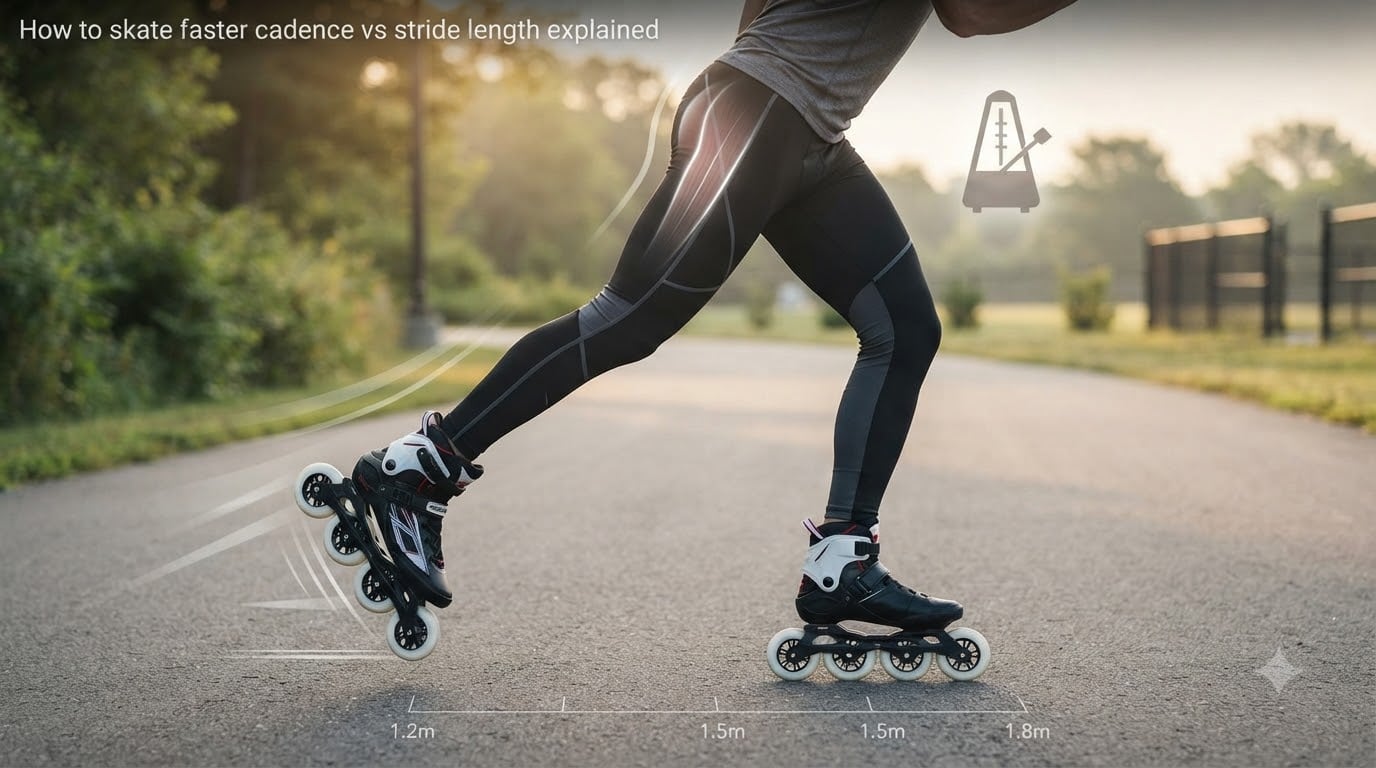
If you have ever asked yourself how to skate faster, you have probably heard two competing answers: take quicker steps, or push longer. Both are right, but only if you understand the relationship between cadence and stride length. I have spent years skating on inlines, ice, and quads, and the fastest skaters I know almost never reach top speed by doing one of those things in isolation.
Skating speed comes down to one simple formula: Speed = Cadence x Stride Length. Your cadence is how many strides you take per minute, and your stride length is the distance you cover with each push. Multiply them together, and you get your speed. Inside this guide, I will break down what each one really means, why elite skaters favor cadence, and the drills that helped our team gain real speed without burning extra energy.
Table of Contents
What Is Cadence and Stride Length in Skating?
Cadence is your stride frequency, or how many complete push-and-glide cycles you complete in one minute. In inline skating, recreational skaters average around 60 to 80 strides per minute (SPM), while fitness and speed skaters hit 90 to 110 SPM. Skaters can reach higher counts during short sprints, but sustainable cadence usually sits lower than the total count over time.
Stride length is the distance your body travels forward with each push, measured in meters or feet per stride. A long stride uses more of your leg power and covers more ground. A short stride costs less energy per step but forces you to step more often. Both have value, and the trick is finding the right mix for your body and goal.
Cadence and stride length cannot be fully separated, because one determines the other at a given speed. If your cadence slows but your speed stays the same, your stride length grows. Most skaters hit a natural ceiling on stride length based on hip mobility, leg length, and balance. Once you hit that ceiling, only cadence can keep pushing you faster.
The Speed Formula: How Cadence and Stride Length Create Speed
Speed equals cadence multiplied by stride length. If you take 80 strides per minute and each one covers 1.5 meters, you are skating at 120 meters per minute, or about 7.2 kilometers per hour. Bump your cadence to 90 SPM at the same stride length, and you are now at 9 km/h without changing your push at all.
This formula sounds obvious once you see it, but it changed how I train. Before I understood it, I focused on bigger pushes, which often left me gassed after 10 minutes. After I started measuring cadence, I could see that small improvements in stride frequency delivered more speed with less fatigue than stretching my stride to its limit.
The practical takeaway is simple: push your cadence up slightly and your speed rises for the same effort. Many skaters train running cadence targets between 170 and 190 SPM, but skating uses a different range because each stride is larger. Inline skating typically runs 70 to 110 SPM, while ice skating long strides run 60 to 80 SPM.
The Role of Cadence in Skating Speed
A higher cadence directly raises your speed as long as stride length stays constant, and it costs you less oxygen per meter than fighting for bigger pushes. This is the reason pro inline skaters and speed skaters run such smooth, fast rhythms. Their muscles recycle elastic energy between strides instead of fighting for raw power on every push.
There is a real ceiling to cadence, and it changes with style. Sprinters on ice reach very high SPMs during the acceleration phase, then settle into a lower count when they reach full speed. Long-distance fitness skaters stay in the 80 to 95 SPM window because they need efficiency over hours, not minutes.
If your cadence is low because you glide too long, your leg muscles will tighten and your balance on one foot becomes critical. If your cadence is high but each stride is tiny, you will spin your wheels without gaining speed. The sweet spot sits in the middle.
Understanding Stride Length in Skating
Stride length matters because longer strides cover more distance per push, which means fewer total pushes for the same distance. A skater with a 1.8 meter stride at 80 SPM covers 144 meters per minute, while a skater with a 1.4 meter stride at the same cadence only covers 112 meters per minute.
Pushing for a longer stride demands strong hip abduction and hip extension. Your skating leg has to push out to the side and fully extend before you glide. Most beginners cannot reach their full stride length because their hips are tight, their balance on one foot is shaky, or they are afraid to commit weight to the gliding leg.
There is a hard trade-off here. Push your stride past your body mechanics and you will over-push, which leads to inside-edge pronation and energy leaks. Most coaches tell you to build strength first, then length, then cadence. Skipping the strength step is the fastest way to injury.
Cadence vs Stride Length: Which Should You Focus On
Elite skaters favor higher cadence over excessive stride length, because cadence scales with less injury risk. A modest increase in SPM is usually safer than reaching for a much bigger stride, especially for skaters under 80 SPM. Once cadence is steady, any extra reach you can build into your stride stacks on top of it.
The balance looks different for each skating style. Inline fitness skaters do best around 85 to 95 SPM with moderate strides. Speed skaters sprint at 100+ SPM but with very wide, planted strides. Ice hockey players stay in the 80 to 95 SPM range but with shorter, sharper pushes because they need quick changes of direction.
If you are a beginner, focus first on cadence. Get your rhythm up to 75 SPM and your balance on one foot solid, then start pushing for longer strides. If you are an intermediate skater stuck at a certain speed, check whether your cadence has stalled. A jump from 70 to 80 SPM often unlocks more speed than another month of leg strength work.
How to Find Your Optimal Cadence and Stride Length
You can find your baseline in one short session. Mark a 100-meter straight path on flat ground. Skate at a comfortable, all-day pace, then have a friend count your right-foot pushes for 30 seconds. Multiply by two to get SPM, then divide 100 meters by your total strides to get stride length.
Once you have your numbers, set a target. Beginners typically sit at 60 to 70 SPM. Adding 5 to 10 SPM over 4 weeks is realistic and safe. For stride length, work on hip strength and balance first, then push for another 10 to 20 cm per stride over several months.
Use a metronome app or a song with 80 BPM to lock in cadence during practice. Many skaters find it easier to think in terms of matching a beat rather than counting pushes.
Body Positioning Fundamentals for Faster Skating
Speed starts with body position. Bend your knees slightly, keep your hips square to the direction you are traveling, and lower your center of mass about 5 cm compared to standing tall. This single adjustment makes balance on one foot much easier, which lets you commit more weight to the gliding leg.
Your push should always go out to the side, never straight down. Push diagonally out at about 30 degrees from straight ahead and let your hip do the work. The recovery phase, when your foot returns under your body, should be quick and relaxed. A tense recovery slows everything down.
Hip abduction is the muscle group that powers every push. Most beginners only use the quads, which is why they plateau. Add 2 to 3 weekly sets of side-lying leg raises, banded walks, or clamshells, and you will feel an immediate difference in your push power.
Drills to Increase Cadence and Stride Length
Drill 1: One-foot glide balance. Hold a one-foot glide for 3 seconds per side, building to 6 seconds. This locks in balance, which lets you commit more weight to the gliding leg. Without this drill, you cannot fully extend your stride because your body is afraid of falling.
Drill 2: Lateral push wall drill. Stand sideways next to a wall with one hand on it for balance. Push the inside leg out to the side as far as it will go, hold the extension for 1 second, then recover. Repeat 20 times per side. This builds the hip extension pattern that drives a longer stride.
Drill 3: Stride frequency ladder. Skate 50 meters at your normal cadence, then 50 meters at 10 SPM faster, then back to normal. Repeat 5 times. Train in this pattern twice a week to lift your baseline cadence without overstriding.
Drill 4: Lateral edge work. Skate on a wide oval, focusing each push toward the inside of the curve. This forces a clean lateral push and trains the hip muscles through their real range of motion. Most skaters find this drill increases their per-push distance by 15% within a month.
Common Mistakes That Kill Your Skating Speed
Mistake 1 is taking many small steps. New skaters often shuffle their feet instead of gliding, which burns huge energy for tiny gains. The fix is to commit to each push and let the glide happen, even if it feels slower at first.
Mistake 2 is over-pushing. Many skaters, in search of a longer stride, push so hard that their supporting leg pronates inward. This leaks energy and can hurt the knees over time. Strength work plus a more controlled push solves it.
Mistake 3 is excessive lateral movement of the upper body. Your shoulders should stay mostly quiet while your hips do the work. Side-to-side shoulder sway wastes the push energy and breaks your balance on the next glide. A quick video check, with someone filming from behind, will show you whether you are swaying.
Sport-Specific Adaptations: Inline vs Ice Skating
Inline and ice skating share the speed formula, but their cadence and stride ranges differ. Inline skating allows longer strides because of the wheel setup and braking options. Ice skating long strides favor longer and fewer pushes, while short-track sprints push higher cadence with tighter turns.
If you are a quad skater, your pushes tend to be shorter and more frequent because of the wheel base. Aim for 85 to 100 SPM and focus on smooth recovery. Quad skaters who chase long strides often roll their ankles, so shorter, snappier pushes are usually safer.
Frequently Asked Questions
Is it better to increase cadence or stride length?
For most skaters, increasing cadence is the safer and faster path to more speed. A modest rise in steps per minute costs less energy and reduces injury risk compared to reaching for a much larger stride. Build cadence first, then add stride length once your strength and balance catch up.
Does stride length make you faster?
Yes, a longer stride covers more distance per push, which raises your speed when cadence stays constant. The trade-off is that stride length is capped by hip mobility, balance on one foot, and leg strength. Pushing past your natural ceiling leads to injury and energy leaks.
Does faster cadence make you faster?
Yes, higher cadence directly raises speed when stride length stays the same. Faster cadence also tends to be more efficient because it lets your muscles recycle elastic energy between strides. This is why elite skaters train a smooth rhythm rather than chasing max reach.
What should my cadence and stride length be?
Inline skating typically runs 70 to 110 SPM with strides of 1.2 to 2 meters. Fitness skating favors 80 to 95 SPM. Speed skating sprint sessions reach 100+ SPM. Ice hockey sits between 80 and 95 SPM with shorter, sharper pushes. Your height, leg length, and strength all shift these numbers.
How to increase stride length and cadence?
Build hip strength first with abduction drills and banded walks. Practice one-foot glides to lock in balance. Then layer a stride frequency drill twice a week, raising your cadence by 5 SPM every 4 weeks. Finally, layer lateral push drills to grow your per-push distance.
How to lengthen your skate stride?
Lengthen your stride by training hip abduction and hip extension, by committing weight to the gliding leg, and by pushing out to the side rather than down. Glide drills and balance work unlock the length you already have in your hips.
Final Thoughts on Skating Faster Through Cadence and Stride Length
To learn how to skate faster, treat cadence and stride length as two dials on the same speedometer. Tune cadence first, since it scales with less injury risk and lower fatigue. Then bring in stride length work once your balance and hip strength support it. The skaters I have coached who followed this order gained 10 to 15% in speed within 8 weeks, without burning extra energy.
Pick one drill from the list above and run it twice this week. Measure your SPM after two weeks and you will see how to skate faster is less about raw power and more about rhythm, balance, and smart strength work. That is the whole cadence vs stride length story.