
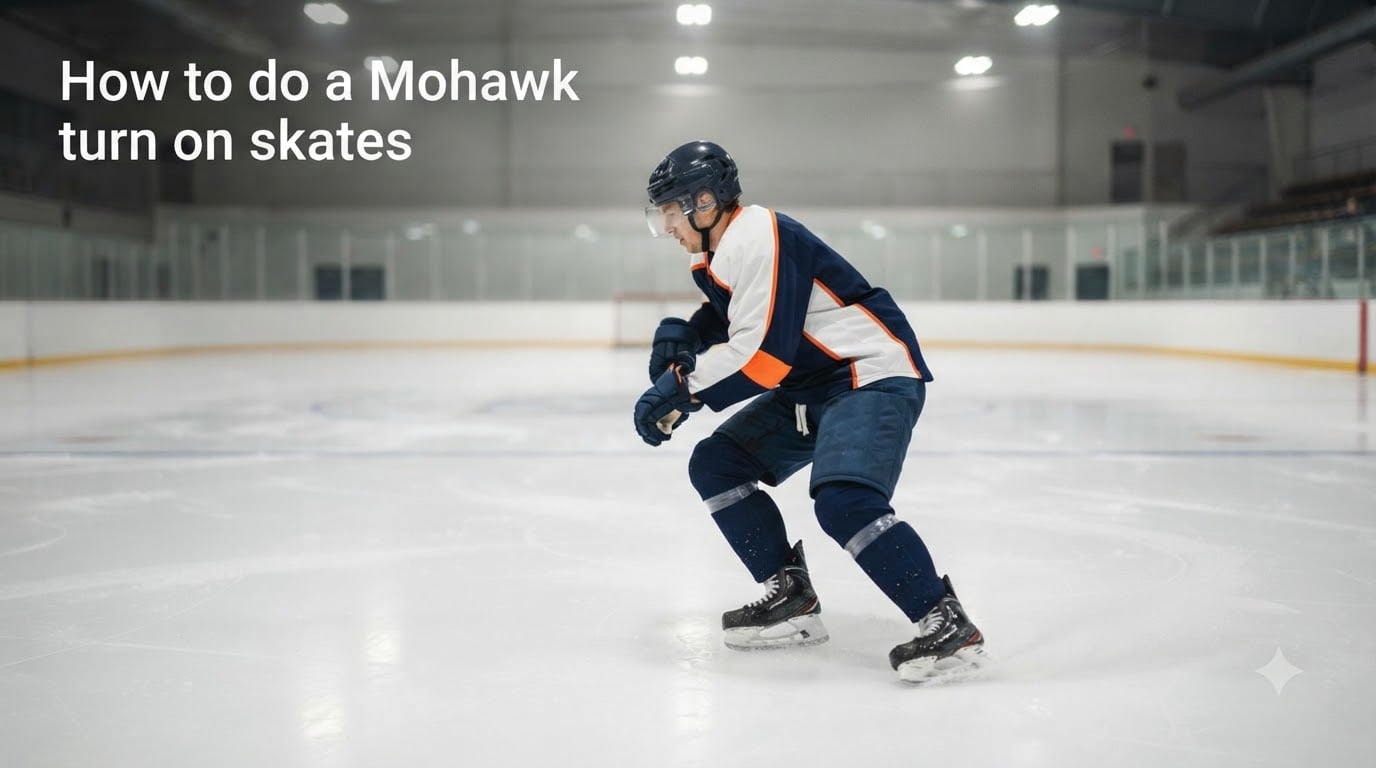
Learning how to do a Mohawk turn on skates is one of those skills that looks simple until you try it. Our coaching team has walked hundreds of hockey and figure skaters through this maneuver, and the same questions always pop up. This guide breaks down the Mohawk turn step by step, with off-ice stretches and drills you can start using today.
Table of Contents
What Is a Mohawk Turn on Skates?
A Mohawk turn is a skating maneuver where you change direction by rotating on the inside edges of both skates while keeping your heels together. It is the standard way to transition between forward and backward skating without lifting either foot off the ice.
You will hear it called the Eagle turn too. The name comes from the shape your legs make as you rotate. Hockey players use it to protect the puck on one-timers, and figure skaters use it for clean direction changes in patterns.
At its core, the Mohawk is two inside edges and a 180 degree hip rotation. Everything else, stance, knee bend, upper body posture, exists to make that simple mechanic work reliably at game speed.
Proper Stance and Positioning Before You Move
Before you attempt the turn, get your stance right. Most failed Mohawk attempts start with a poor setup, not a poor rotation.
Sink into an athletic stance with your knees bent past 90 degrees and your weight balanced over the balls of your feet. Your shoulders should sit directly over your knees. Keep your head up and eyes forward.
Bring your heels together and rotate your toes outward to form what coaches call a fat diamond. Your skates should point in opposite directions, around 180 degrees apart, with the inside edges lined up heel to heel. This is the position you hold the entire way through the turn.
Tip: Test this position off ice first. Stand on a flat surface, heels together, toes out, knees bent. If you cannot comfortably hold it for 30 seconds, your hip mobility needs work before you add the moving version.
How to Do a Mohawk Turn on Skates: Step by Step
Here is the exact sequence we teach on the ice. Practice each step slowly before stringing them together.
Step 1. Glide forward on two inside edges. Push once, then let both skates roll with a slight inside-edge pressure. Do not plow or stop. You want a calm, straight glide.
Step 2. Turn your hips, not your shoulders. Rotate your hips 180 degrees toward the new direction of travel. Keep your shoulders square and facing the same way until the hips complete the turn. This sequencing is what creates balance.
Step 3. Lift the heel of your leading skate just enough to free the blade, then set it back down on its inside edge in the new direction. Your back foot stays planted as a pivot.
Step 4. Shift your weight to the new leading inside edge. As your hips finish rotating, your weight transfers smoothly from the old edge to the new one.
Step 5. Push out on the new outside edge and continue gliding backward. Both skates should now be on inside edges, but traveling in the opposite direction. That is a clean Mohawk.
Step 6. Repeat in reverse to go from backward to forward. The mechanics are identical. Just flip the lead foot and rotate 180 the other way.
Quick checkpoint: If you can do it from forward to backward but not the other direction, that is normal. Reverse mohawk feels awkward for almost every skater their first month of practice.
Common Mistakes That Break the Mohawk
We see the same handful of errors over and over. Here is what to watch for.
Flipping the blade to an outside edge. The whole turn rides on inside edges. The moment pressure drifts to the outside edge, the blade slips and you fall backward. Keep a slight inside-edge lean through the rotation.
Standing up to make the turn. The lower you are, the more stable the turn. Skating upright raises your center of gravity and turns a controlled pivot into a wobble.
Turning the shoulders with the hips. Spinning your whole upper body throws off the counter-rotation that keeps you balanced. Shoulders stay facing forward until the hips finish their turn.
Not committing to the full 180. Half-rotations put your feet at a 90 degree angle, which has no stable position. You either rotate fully or you lose balance. Commit to the full motion.
Practice Drills to Build a Cleaner Mohawk
Drills matter more than reps. Here is the progression we use with our players.
Stationary fat diamond drill. Off the ice or at the boards, hold the fat diamond stance for 30 seconds, then slowly rotate your hips 180 degrees while keeping your heels as close together as possible. Repeat 10 times each direction.
Glide and stop drill. Glide forward on two feet, stop with both inside edges, perform the stationary Mohawk, then push backward. This separates the mechanics from momentum.
Figure eight drill. Skate a slow figure eight using only Mohawk turns at the crossover points instead of crossovers. It forces you to perform the turn while moving without giving you speed to lean on.
Two direction drill. After every successful Mohawk forward to backward, immediately perform one backward to forward. Train both directions in the same rep. Coaches call this the open-book drill.
Off-Ice Stretches for Mohawk Hip Flexibility
Forum users often ask why their skates only reach 90 degrees instead of 180. The honest answer is almost always hip mobility, not technique. Here is the routine our strength coach built for skaters who struggle with the position.
90/90 hip stretch. Sit on the floor with one leg bent 90 degrees in front and the other 90 degrees behind. Lean forward gently over the front leg for 30 seconds, then switch sides. Do 3 sets per side.
Pigeon pose. From hands and knees, bring one knee forward behind your wrist and extend the other leg back. Hold 45 seconds per side to open the external rotators.
Clamshells. Lie on your side with knees bent and stacked. Keep feet together and lift the top knee like a clamshell opening. Do 15 reps per side. This strengthens the glute medius, which stabilizes the position under load.
Standing heel-to-heel rotations. Stand with heels together, toes out, knees bent. Slowly rotate both feet 90 degrees one way, then 90 the other way, without lifting the heels. 10 slow rotations rebuilds the motor pattern.
When and Why to Use a Mohawk Turn?
The Mohawk is a transition tool. It shines in tight spaces where crossovers are too wide and pivots are too slow.
Hockey players use it behind the net to turn sharply without losing puck protection. It also opens up the ice on one-timers, since you can catch a pass and snap into a shot in one motion. Figure skaters use it in dance patterns where the rules require inside-edge turns.
Anywhere you need to change direction quickly while keeping both skates on the ice, the Mohawk is the answer.
Mohawk vs Eagle Turn and Other Variations
The Mohawk and the Eagle turn are the same thing. Different regions call it different names. If a coach says Eagle, they mean exactly this turn.
There are two main variations: the forward Mohawk (covered above) and the backward Mohawk. The backward version starts on back inside edges and rotates into forward gliding on inside edges. The hip mechanics are identical, just the direction of weight transfer changes.
For skaters comfortable on outside edges, the outside Mohawk exists too. Stick with the inside-edge version until your edges are confident. Outside Mohawks demand even deeper knee bend.
Frequently Asked Questions
How to do a Mohawk turn on roller skates?
The mechanics are the same as on ice. Glide on two inside edges, rotate your hips 180 degrees with heels together, then transfer weight to the new leading inside edge. The biggest difference is surface friction. Roller skates grip harder, so your weight transfer has to be smoother or the wheels will catch.
What is a Mohawk turn?
A Mohawk turn is a skating maneuver where you transition between forward and backward by rotating on the inside edges of both skates. Your heels stay together throughout the turn, and your toes point outward to form a fat diamond shape with your legs.
Why can I only do a Mohawk turn in one direction?
Most skaters find one direction easier because the hip rotation favors their dominant side. The fix is dedicated backward to forward practice using the two-direction drill. Rotating the non-dominant hip tighter usually evens out within 4 to 6 weeks of twice-weekly practice.
How can I practice Mohawk turns off ice?
Off-ice practice is mostly about hip mobility and muscle memory. Use the 90/90 stretch, pigeon pose, and clamshells to open up the hips. For movement patterns, hold the fat diamond stance and rotate your feet 90 degrees in each direction without lifting your heels.
What is the hardest skill to do in ice skating?
It depends on the skater, but common answers include the Biellmann spin, quadruple jumps, and the hydroblade. For most recreational and adult skaters, the Mohawk and one-foot spirals tend to be the hardest because they demand both hip mobility and edge control at the same time.
Final Thoughts on the Mohawk Turn
The Mohawk turn is two inside edges, a 180 hip rotation, and a clean weight shift. Nail the athletic stance, hold the fat diamond shape, and commit to the full rotation in both directions. Pair the on-ice drills with the off-ice hip routine and the turn stops feeling like a trick and starts feeling like a tool you reach for every shift.
Stick with it for a few sessions. Your hips will open up, both directions will click, and you will start spotting the Mohawk everywhere in the games you watch.