
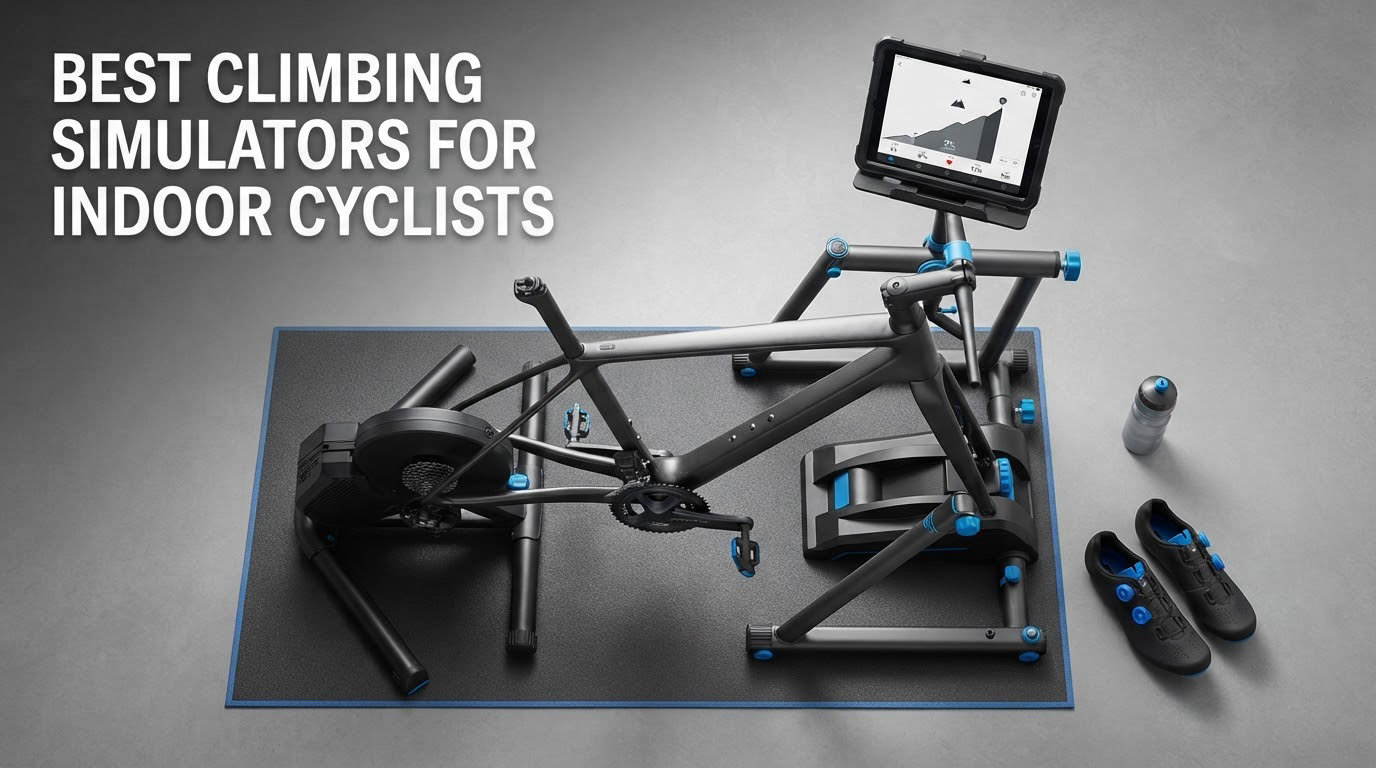
Riding a smart trainer on the flat is easy to accept and easy to regret. The fan is pointed at your face, the power numbers look respectable, and then ninety minutes later you realise you spent the whole session spinning your legs at a gradient the on-screen rider never touched. If you have ever finished a Zwift climb feeling like you sprinted up a shallow ramp, you already know the gap. Finding the best climbing simulators for indoor cyclists is how you close it, and the honest answer is more interesting than a shopping list.
A climbing simulator, also called a grade or gradient simulator, is a piece of hardware that physically raises the front of your bike so the machine under you pitches, the bar drops into your hands and the effort climbs with it. It sits between your fork and the floor, moves in sync with whatever app is running, and it changes the character of a session completely. In this guide we look at eight setups that either add real grade to a ride or solve the same problem more cheaply.
Two of them are the real dedicated devices everyone searches for, three are smart trainers that do a surprising amount of grade work on their own, and three are riser blocks that cost a fraction of any of the above. We also spend time on the case for buying nothing at all, because that is a legitimate answer for a lot of riders. If your winter training is more cross-training than racing, our off-season training guide for cyclists covers other ways to keep the engine honest while the roads are wet.
Table of Contents
Top 3 Picks for Indoor Climbing in October 2026
Our short list rewards the three setups that give you the most usable simulated grade per unit of fuss. The Tacx Neo 2T leads because it combines the highest verified rating of the smart trainers here with genuine downhill simulation, and it is the trainer the Tacx Alpine ecosystem is built around. The Wahoo KICKR V6 earns its place as the machine the KICKR CLIMB expects. The ThinkRider XXPRO takes the third slot on gradient capability alone.

Garmin Tacx Neo 2T Smart…
- Downhill and 20 percent grade simulation
- 32 neodymium magnets
- Quiet magnetic resistance
Wahoo KICKR V6 Smart Indoor…
- Over 2200 watts accurate to 1 percent
- AXIS feet for side-to-side movement
- Pairs with the KICKR CLIMB

ThinkRider XXPRO 2500W 25…
- 25 percent maximum analog slope
- 2500W direct drive
- Self-powered with no power adapter
The Best Climbing Simulators and Trainers at a Glance for October 2026
One row per product, ordered by how much simulated grade you actually get. Specifications are manufacturer-claimed and were checked against listings in October 2026, so treat numbers as claims rather than independent lab results.
| Product | Specs | Action |
|---|---|---|
| Garmin Tacx Neo 2T Smart Trainer |
|
Check Latest Price |
| Wahoo KICKR V6 Smart Indoor Trainer |
|
Check Latest Price |
| ThinkRider XXPRO 2500W 25 Percent Gradient |
|
Check Latest Price |
 Wahoo KICKR CLIMB Grade Simulator Wahoo KICKR CLIMB Grade Simulator |
|
Check Latest Price |
 ThinkRider X2Max 2000W 18 Percent Slope ThinkRider X2Max 2000W 18 Percent Slope |
|
Check Latest Price |
 KOM Cycling Riser Block KOM Cycling Riser Block |
|
Check Latest Price |
 Elite Su-Sta Adjustable Elevator Block Elite Su-Sta Adjustable Elevator Block |
|
Check Latest Price |
 Sunlite Forza Riser Block Sunlite Forza Riser Block |
|
Check Latest Price |
1. Garmin Tacx Neo 2T – The Best-Evidenced Way to Climb Indoors
Garmin TacX Neo 2T Smart Trainer
Downhill and 20 percent grade
32 neodymium magnets
47.4 lb foldable frame
Pros
- Highest review count and rating among the smart trainers here
- Accurate and responsive simulated gradient and downhill
- Quiet magnetic resistance
- Folds flat and includes a full thru-axle and QR adapter set
Cons
- Heavy at 47.4 pounds
- Only one month of Tacx Premium software included
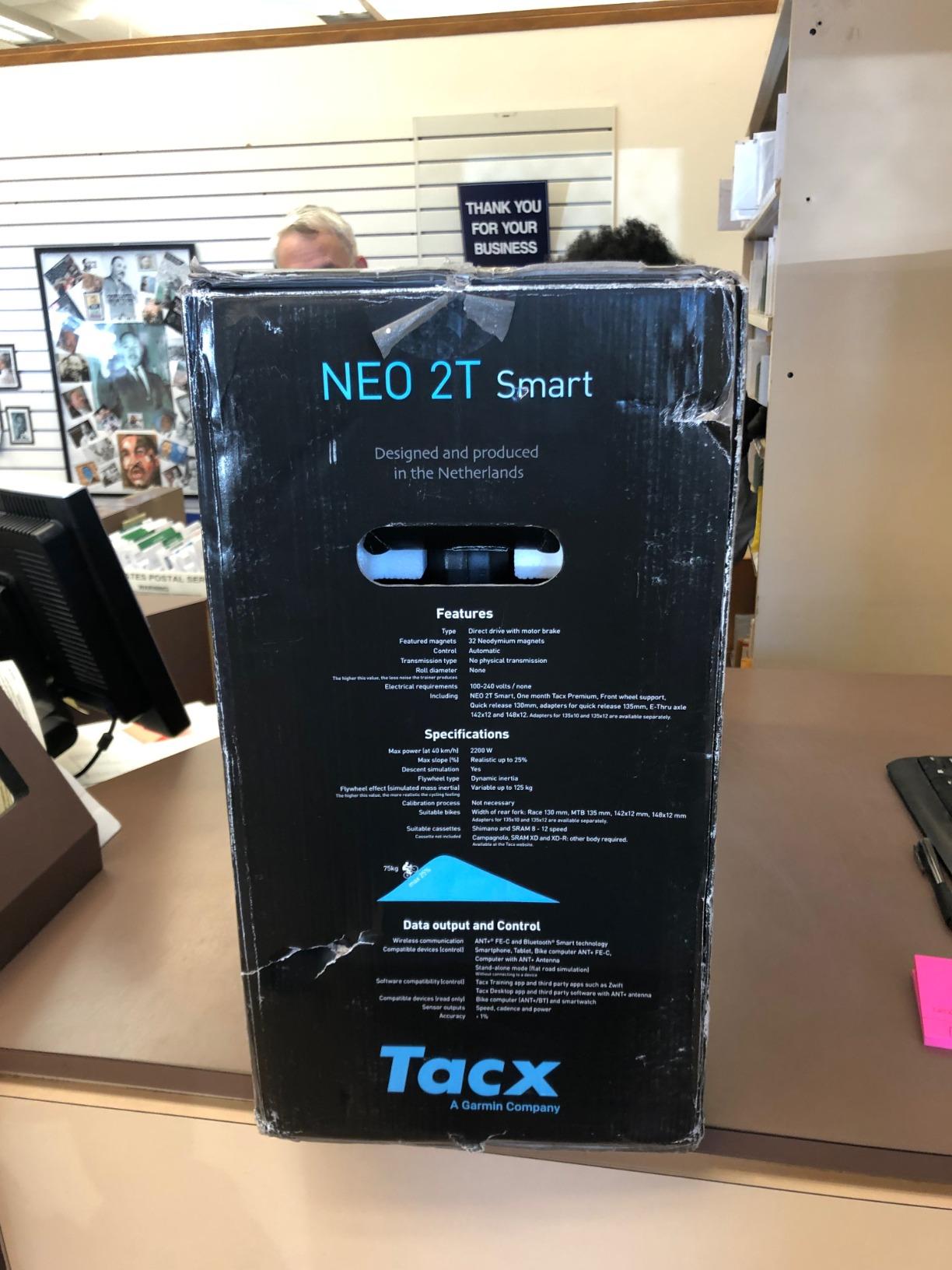
The Neo 2T is a smart trainer rather than a climbing simulator, but it changes this conversation because it simulates downhill and up to 20 percent grade through ANT+ and Bluetooth in connected apps without any extra hardware. For a lot of riders that is the entire problem solved. The rating and the volume of owner feedback behind it are the strongest of any trainer in this group, which is why it takes our top slot.
The mechanism is 32 neodymium magnets on a foldable frame, driven wirelessly over ANT+ and Bluetooth to iOS, Android, macOS and Windows. In a compatible app the gradient follows the map, and in ERG mode it holds a target power instead. That dual behaviour is what makes it useful for structured training rather than only for scenery riding.
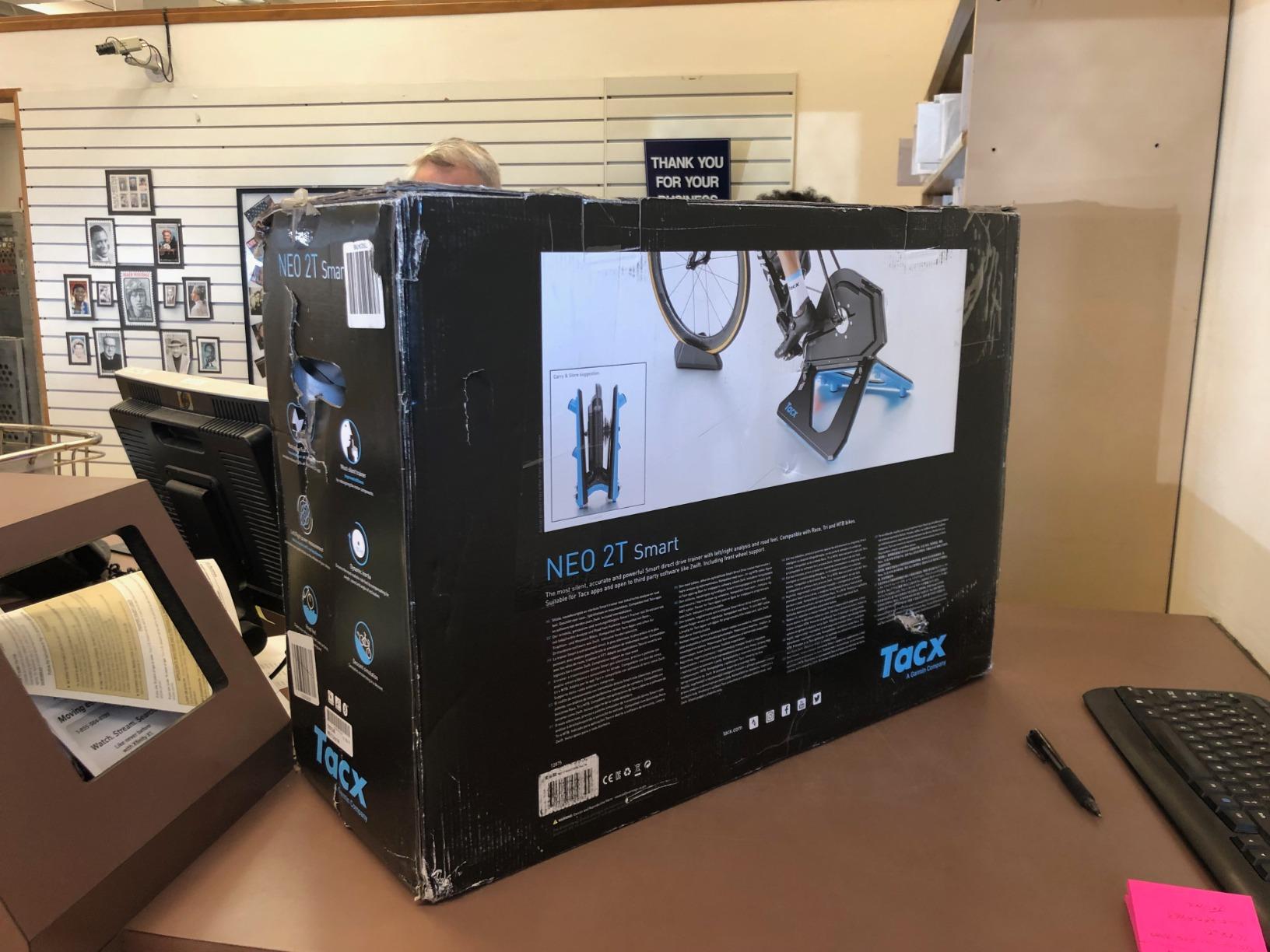
Owners repeatedly praise the gradient accuracy, the downhill response and how quiet the magnetic unit stays compared with a belt-driven wheel-on trainer. The box includes a front wheel block, a quick-release skewer, a thru-axle skewer and adapters for 130 mm QR, 135 mm QR, 12×142 mm thru-axle and 12×142 mm Boost, so axle compatibility is largely handled for you.
This is also the trainer the Tacx Alpine ecosystem is built around. If you are convinced you will eventually want the dedicated Alpine unit above your trainer, buying the Neo 2T now is the compatible path. It arrives with one month of Tacx Premium software included, which is the one part of the package owners complain about most.
What 20 percent on paper actually feels like on the Neo 2T
It feels like climbing, and it feels nothing like a simulator with a moving front end. The bike stays level while the resistance climbs, so your position does not change and the bar does not drop. Riders chasing that sensation need a riser or a simulator on top.
Riders chasing a reliable, quiet, accurate platform for structured sessions do not. At 4.7 stars across 472 ratings, this is the best-evidenced trainer we looked at, and the honest argument is that it covers most of the climbing use case without a second purchase.
Two practical warnings. At 47.4 pounds it is genuinely heavy to move between rooms or take upstairs, and the bundle includes only a month of the paid software tier.
Who the Tacx Neo 2T suits and who it does not
It suits riders who want one box that does climbs, descents and structured intervals, who care about quiet operation, and who want the widest axle support in the group. It also suits Tacx Alpine owners in the making, because that unit only works with Tacx trainers.
It does not suit riders chasing a moving front wheel, riders in small flats who have to carry equipment between rooms, or anyone who wants a quiet surface under the front tyre. A riser block handles that last point cheaply, and you can add one to this trainer at any time.
2. Wahoo KICKR CLIMB – The Only Dedicated Grade Simulator Here
Wahoo Fitness Kickr Climb Hill Climbing Simulator
20 percent incline and 10 percent decline
5 kg carbon steel unit
Wahoo KICKR trainers only
Pros
- Raises and lowers the front wheel to match the on-screen grade
- Handlebar remote makes manual grade changes simple mid-ride
- Works with Zwift TrainerRoad and Wahoo SYSTM
- Adapters included for 12x100 15x100 and 15x110 hubs
Cons
- Only compatible with Wahoo KICKR trainers
- Raised grade varies with bike size wheel size and trainer type
- 12 percent of reviews are 1-star
The KICKR CLIMB is the device most people mean when they search for a climbing simulator, and it is the only true grade simulator in this group. It is a 5 kg carbon steel unit that sits under the front wheel and travels through its range as your app commands it. Paired with a Wahoo KICKR trainer, the whole bike pitches rather than just getting harder to turn.
Manufacturer figures are 20 percent maximum incline and 10 percent maximum decline, and that two-way range is the thing that separates it from every riser block. Owners consistently single out the descent capability as the feature that justified the spend, because climbing is the part a flat trainer can half-do already.
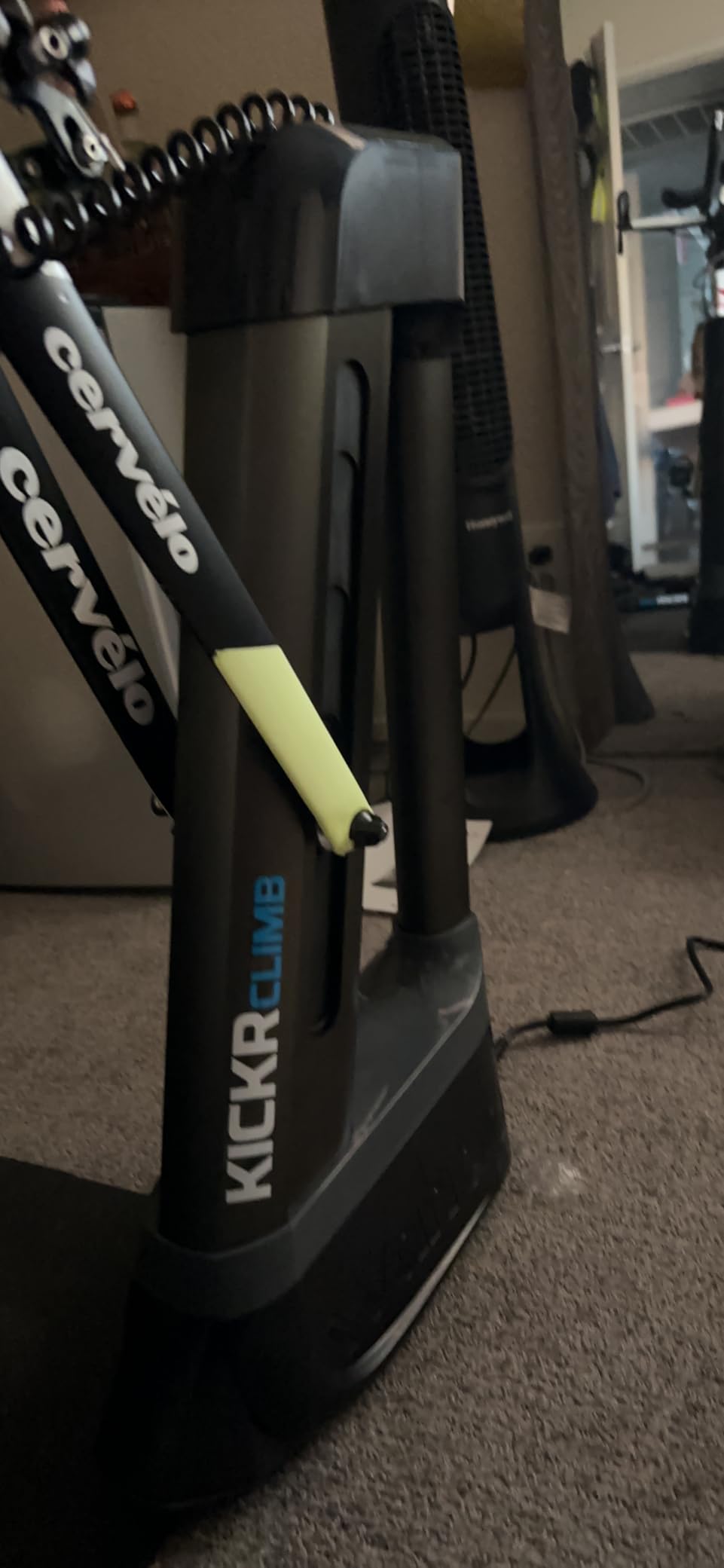
The control story is genuinely good. There is a handlebar remote for manual grade changes, the remote stores in the top of the unit so it does not vanish, and it pairs straight to the trainer with one button press. Locked and unlocked climbing modes let you ignore stray external grade commands, which matters if you share a bike or a trainer with another rider.
Set-up is the part that catches people. It is designed for Wahoo KICKR, KICKR CORE and KICKR SNAP trainers from the 2017 editions onward, and nothing else. Adapters for 12×100, 15×100 and 15×110 hubs are in the box, which is a genuine convenience, but if your trainer is from another brand this is a brick rather than a purchase.
Is the Wahoo KICKR CLIMB worth it?
It is the most credible dedicated entry point on the market, and it wastes money on anyone whose trainer is not a Wahoo KICKR. The 20 percent incline and 10 percent decline spec is real, and once you have ridden a descent in it you will struggle to go back to a fixed riser.
Three things to weigh before you commit. If you already own a Wahoo KICKR trainer, this is a straightforward add-on. If you own nothing, you are buying a trainer as well, and the trainer is the bigger decision. If you own a Tacx or Elite trainer, the answer is simply no.
One more caution from the review data: 12 percent of the 88 ratings here are 1-star, the highest share in this roundup, and owners point at variability in the grade actually achieved depending on wheel size and rider size. Treat the 20 percent as a ceiling rather than a promise.
Who the KICKR CLIMB suits and who it does not
It suits established Wahoo riders doing structured indoor work who want to practise long alpine climbs and the descents that follow them. Riders chasing a time trial, riders who cannot get to a mountain, and riders who like a handlebar remote will all feel the difference within a week.
It does not suit renters, anyone on a tight budget, or anyone whose trainer is not a KICKR. The 5 kg unit also raises the front of the bike high, so measure your ceiling clearance and the length of your trainer before you order.
3. Wahoo KICKR V6 – The Trainer the KICKR CLIMB Wants
Wahoo KICKR V6 Smart Indoor Trainer
Over 2200 watts within 1 percent
22 kg alloy steel frame
Automatic calibration
Wi-Fi ride data
Pros
- Automatic calibration keeps power accurate without manual zeroing
- Built-in 2.4 GHz Wi-Fi for a stable ride data feed
- AXIS feet add side-to-side movement
- 2200 watts handles hard sprinting
- Pairs with the Wahoo KICKR CLIMB
Cons
- Smallest review base among the smart trainers listed at 89 ratings
- Weighs 22 kg
- Heavier than direct-drive rivals that cost less
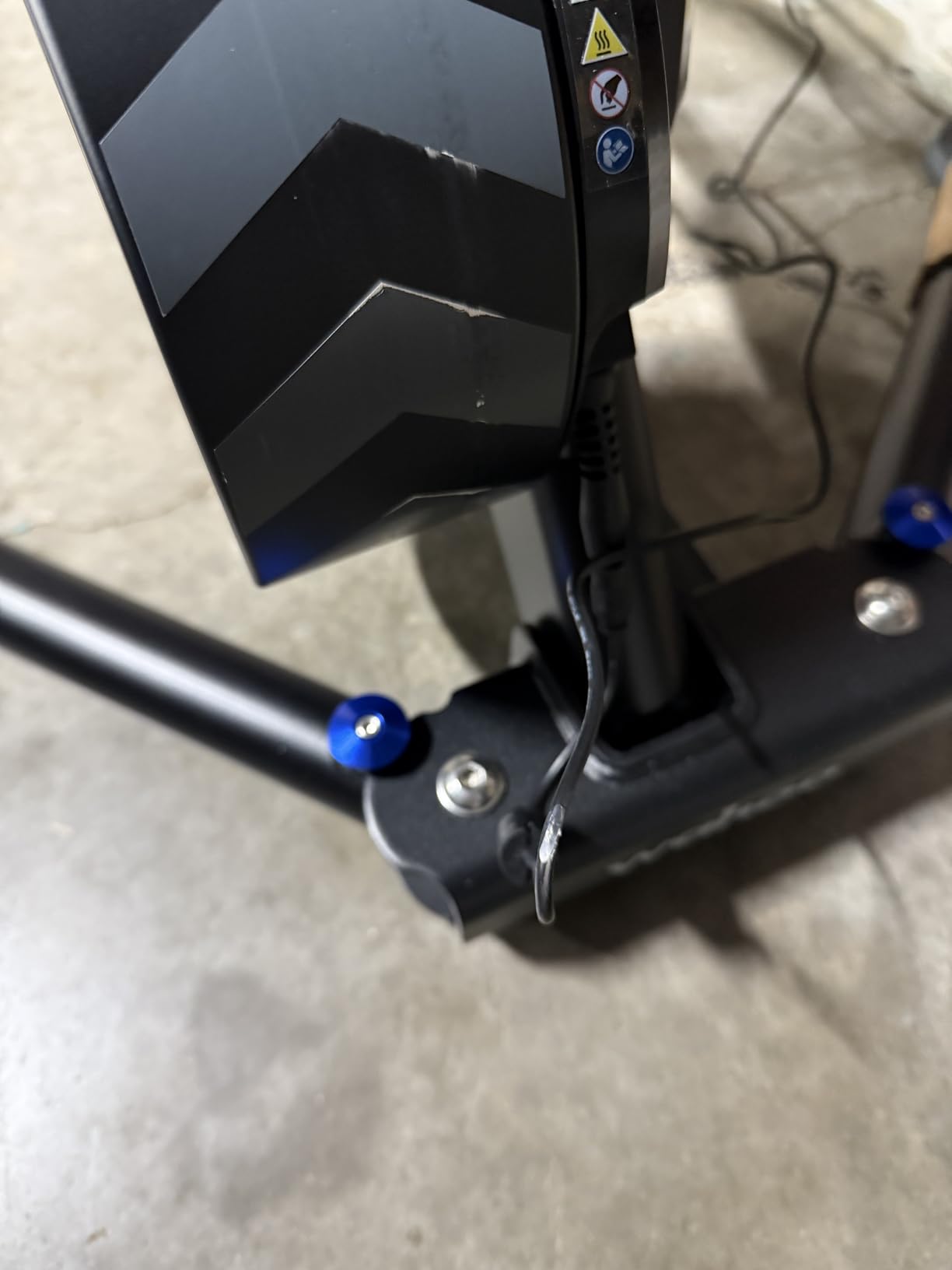
The KICKR V6 exists in this list because it is the machine that makes the dedicated simulator worth buying. It is an electromagnetic direct-drive unit rated at over 2,200 watts and accurate to within 1 percent, with automatic calibration, so you do not zero it between sessions. It is also the trainer we would pair with the KICKR CLIMB if we were building a full climbing setup.
The ride feel is the selling point. A high-inertia flywheel and the KICKR AXIS feet mimic the side-to-side movement of an outdoor bike, which matters more the steeper and slower the terrain gets. The AXIS movement is not a substitute for steering, but it takes the edge off a long climb at low power.
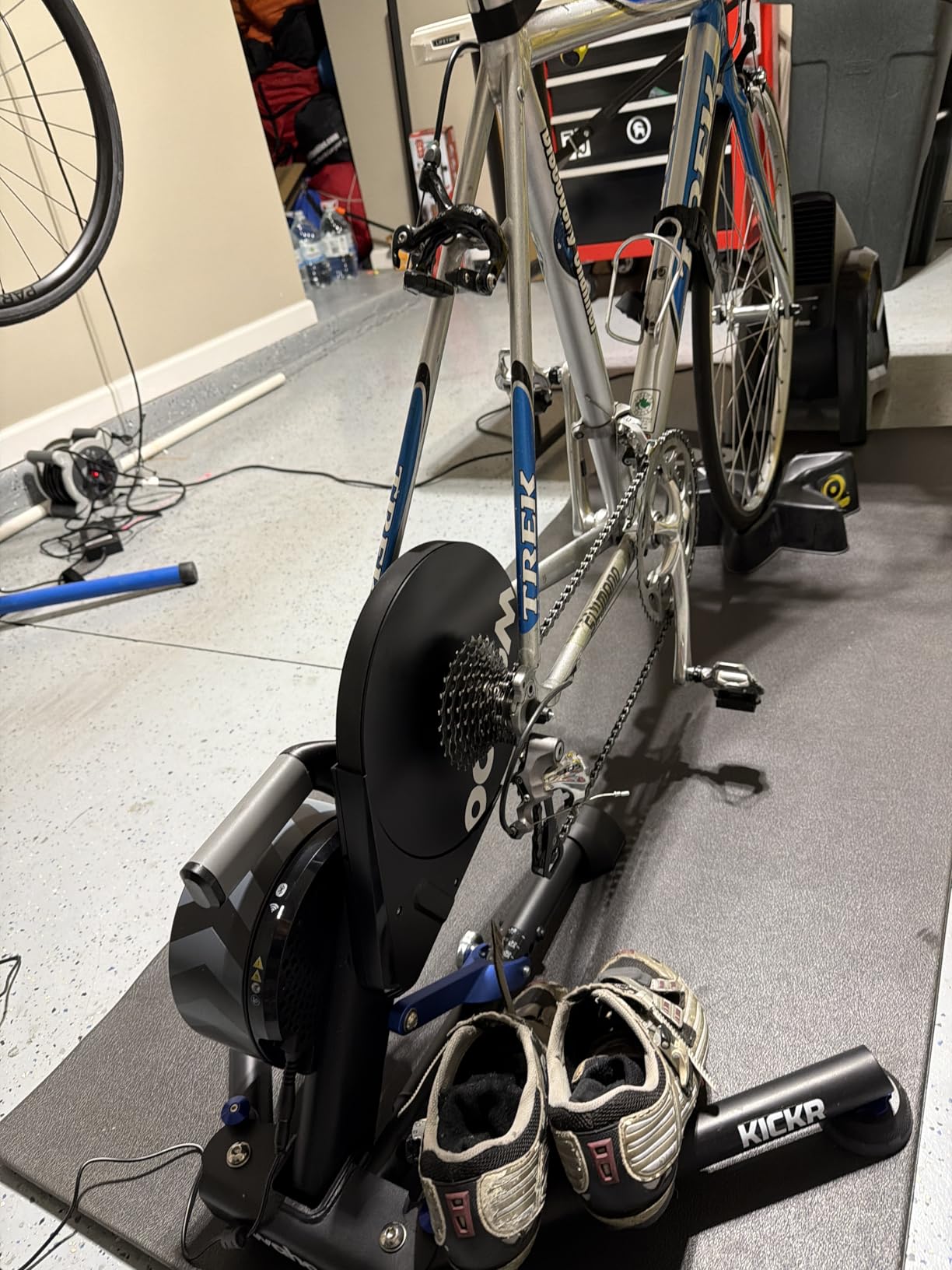
Connectivity is the quiet hero here. Built-in 2.4 GHz Wi-Fi moves ride data to a computer, tablet or phone with low latency and no dongle, which removes a whole category of dropouts in long sessions. Owners highlight the ride feel, the calibration-free accuracy and the stability of the feet most often.
The weight is the recurring complaint. At 22 kg it is a big object to move around, and the direct-drive competitors in this list do the same job for considerably less. The 89-rating review base is also the smallest among the trainers here, so long-term durability is less well documented than it should be.
Is the KICKR V6 the right base for a climbing simulator?
Yes, and it is the only trainer here that pairs with the dedicated Wahoo grade simulator out of the box. If your plan is to add the KICKR CLIMB later, buying this first is the sequence that makes sense and avoids buying the wrong accessory.
If your plan is to stay flat and train on power alone, the AXIS feet and the calibration-free accuracy still justify it on their own. The 2,200 watt ceiling and 1 percent accuracy are what structured programmes need.
The catch is physical. Check the floor space and the ceiling height you will have with a riser or simulator in front of the bike before committing, because 22 kg plus a front riser is a large installation.
Who the KICKR V6 suits and who it does not
It suits Wahoo ecosystem riders, anyone running long structured sessions where power accuracy matters more than grams, and riders who plan to add a grade simulator within a year or two. Wi-Fi alone removes enough small frustrations to justify it for plenty of people.
It does not suit riders on a hard budget, riders who move their setup between rooms regularly, or anyone whose floor cannot take a heavy direct-drive unit. If your budget is the deciding factor, the ThinkRider units later in this guide do the core job for a fraction of it.
4. ThinkRider XXPRO – The Most Simulated Grade in the List
ThinkRider XXPRO Smart Bike Trainer,2500W,25% Gradient,ANT + & BLE (White)
25 percent maximum analog slope
2500W direct drive
Iron frame
No calibration needed
Pros
- Highest simulated gradient of any unit here at 25 percent
- Self-generating power works with no outlet nearby
- No calibration needed and 1 percent power accuracy
- Automatic downhill simulation follows map slope
- Bluetooth ANT+ and Zwift all supported
Cons
- Only 109 reviews so long-term durability is not well documented
- Iron frame is heavy for its class
- Only a 1-year warranty
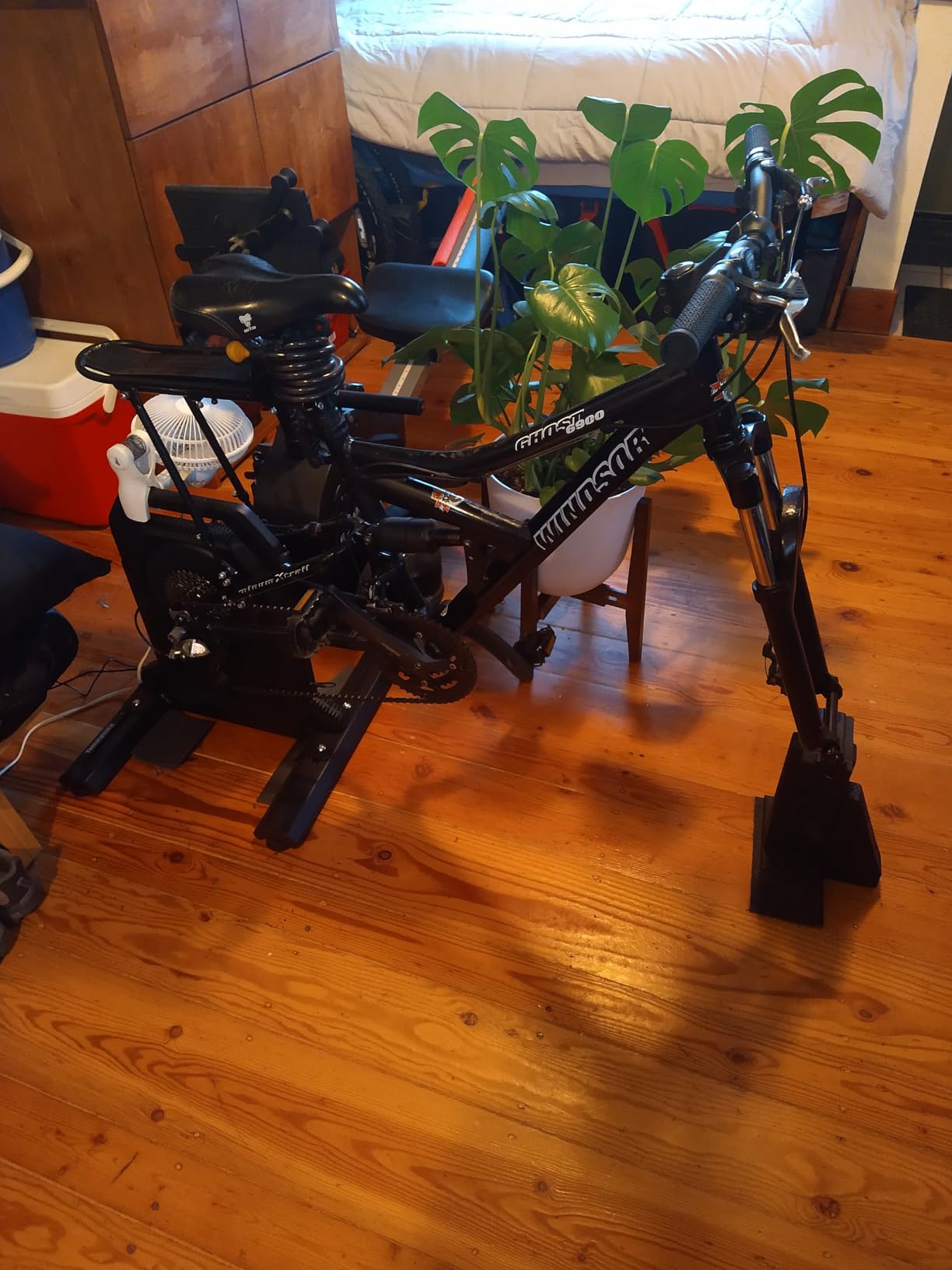
On paper the XXPRO is the most capable climbing machine here. It simulates up to a 25 percent maximum analog slope, has a 2500 watt ceiling, and its downhill simulation adjusts automatically to the slope of the map you are riding. Nothing else in this roundup can claim that gradient figure, and it does it without a riser, a subscription or a second purchase.
The direct motor drive reports power data accurate to 1 percent and needs no calibration at all, which removes the single most common indoor training annoyance. Connectivity covers Bluetooth, ANT+, a bike GPS head unit and Zwift, so it drops into almost any setup without adapters.
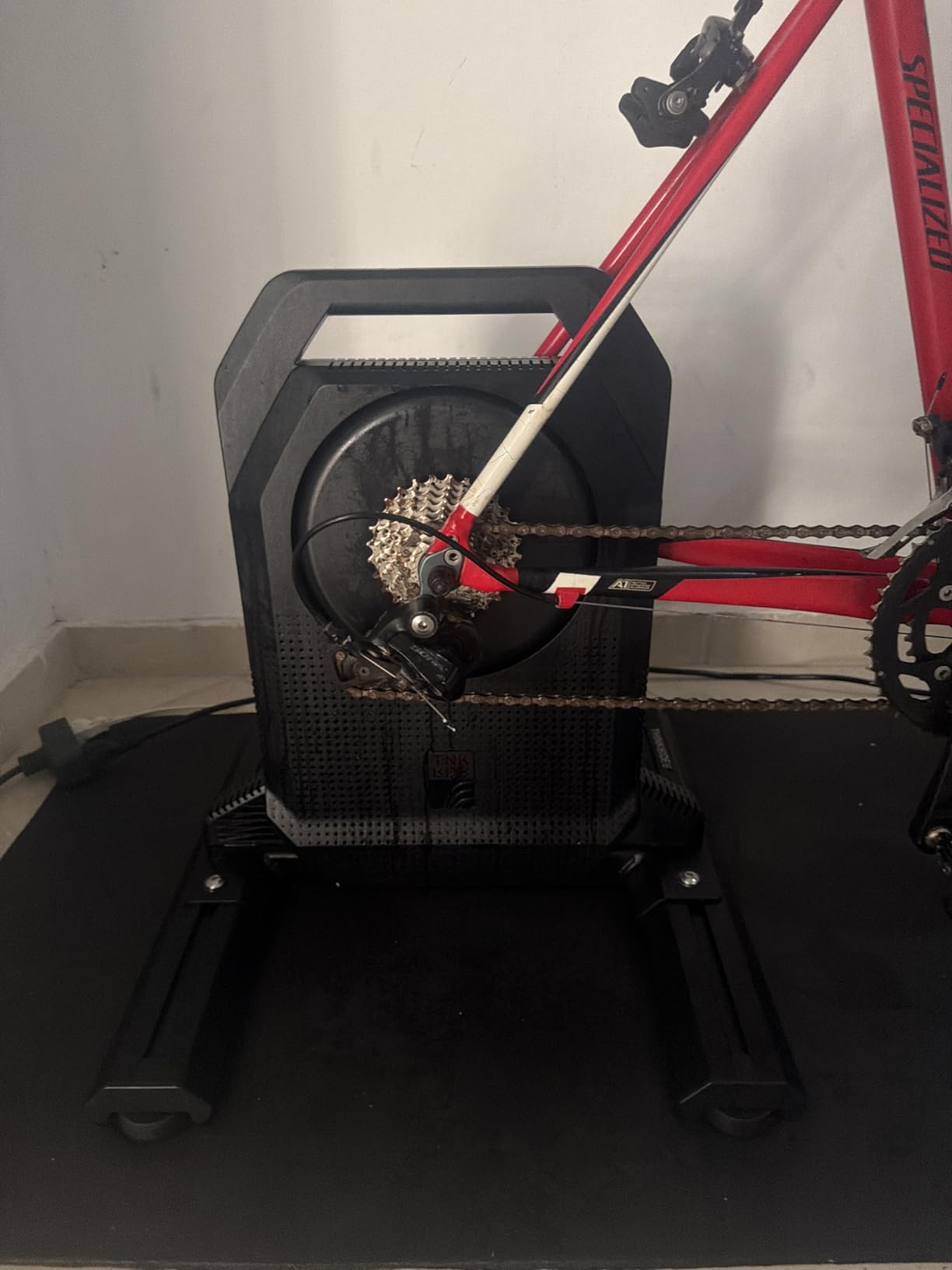
The feature that catches reviewers first is self-power generation. The unit produces its own electricity, so you can ride it in a garage, a spare room or a hotel without hunting for an outlet. For riders training somewhere awkward, that is a bigger practical win than another few percent of gradient.
The iron frame is the trade-off. It adds weight relative to alloy competitors, and the one-year warranty is the shortest we would want on a machine at this capability level. With 109 ratings the unit is well regarded but not yet well documented over time.
Is a 25 percent gradient the same as real climbing realism?
No, and the number needs context. A higher maximum gradient is valuable when your software is set to deliver steep numbers, or when you ride steep simulated routes at low difficulty. It does not add the moving front end, the bar drop or the position change that make a real climb feel like a climb.
What it does deliver is a resistance curve steep enough that you feel the gradient in your legs before you feel it in your head. Riders training for alpine events often find that is enough, especially with a riser block underneath for feel.
If you want the number and the feel, pair it with one of the riser blocks later in this guide. That combination costs less than a dedicated simulator and covers most of the gap.
Who the ThinkRider XXPRO suits and who it does not
It suits riders chasing the highest simulated gradient available without a dedicated device, riders training somewhere with no reliable power outlet, and riders who want downhill simulation that follows the map automatically. Zwift riders get first-class support.
It does not suit riders who want a light, quiet, portable trainer, or anyone who needs a long warranty behind an unfamiliar brand. If build longevity matters more than gradient figures, the Wahoo or Tacx units are the safer pick.
5. ThinkRider X2Max – Quiet Budget Grade Without the Outlet
ThinkRider X2Max Smart Bike Trainer,2000w,Simulates 18% Slope,ANT + & BLE
2000W within 2 percent
18 percent tilt simulation
About 58dB at 30 km/h
Cassette not included
Pros
- Incline changes respond quickly in Zwift and ROUVY
- Very quiet so podcasts and music work
- Setup often takes under five minutes
- Stable for standing intervals and sprints
- Owners repeatedly cite value against mainstream brands
Cons
- Cassette is not included and must be bought separately
- Some chain noise at higher power
- Short feet feel tippy when accelerating hard
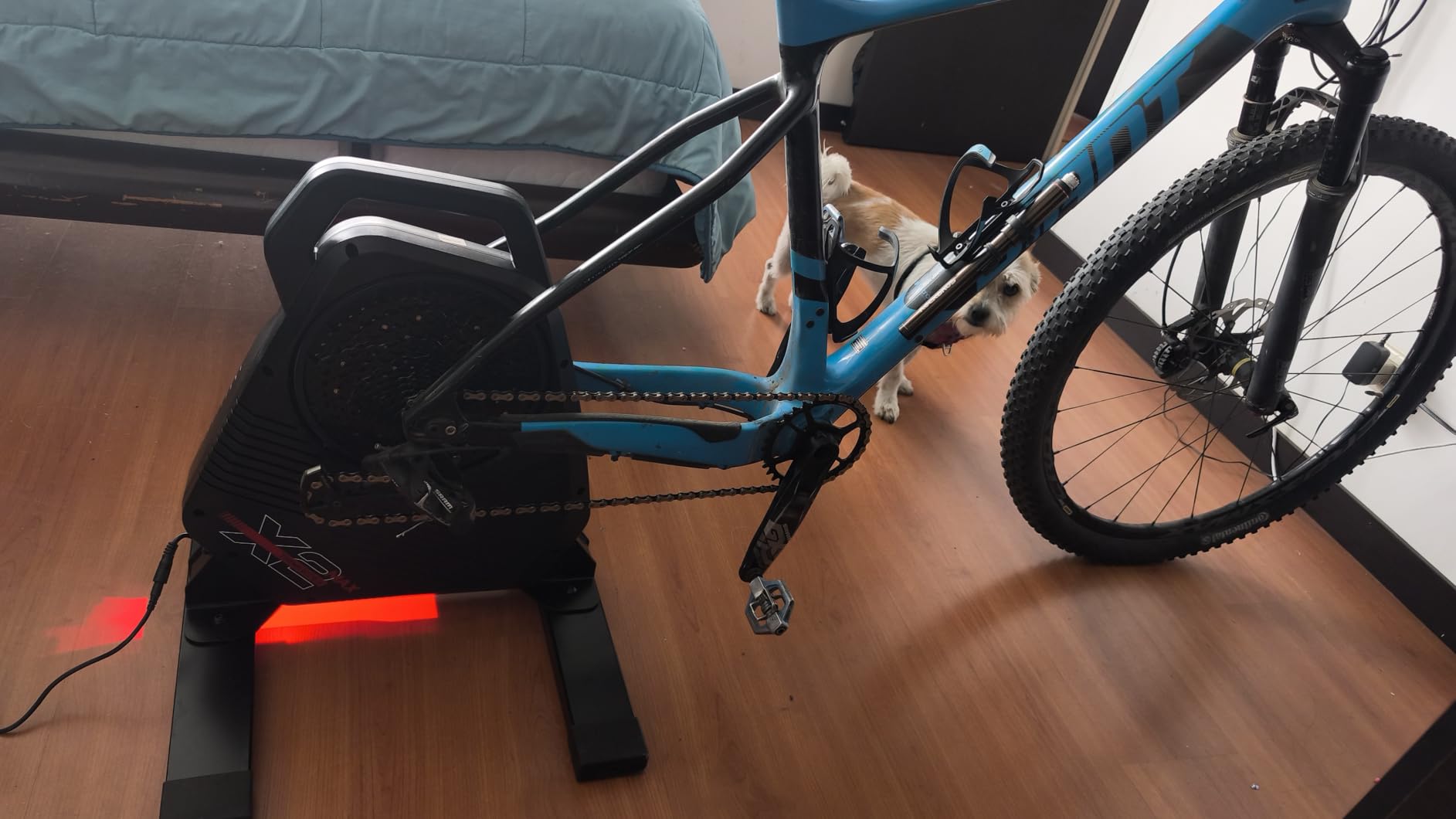
The X2Max is the value route into simulated climbing. It runs a DEPT dynamic electromagnetic torque power meter up to 2000 watts with 2 percent error, simulates 18 percent tilt, and matches the grade to the map automatically in connected software. Bluetooth and ANT+ both work, and Zwift and ROUVY are supported.
The quietness is what surprised us most in the owner feedback. At about 58 dB at 30 km/h, riders report being able to listen to a podcast or music throughout a session, which is exactly what you need to do to keep training indoors through a winter.
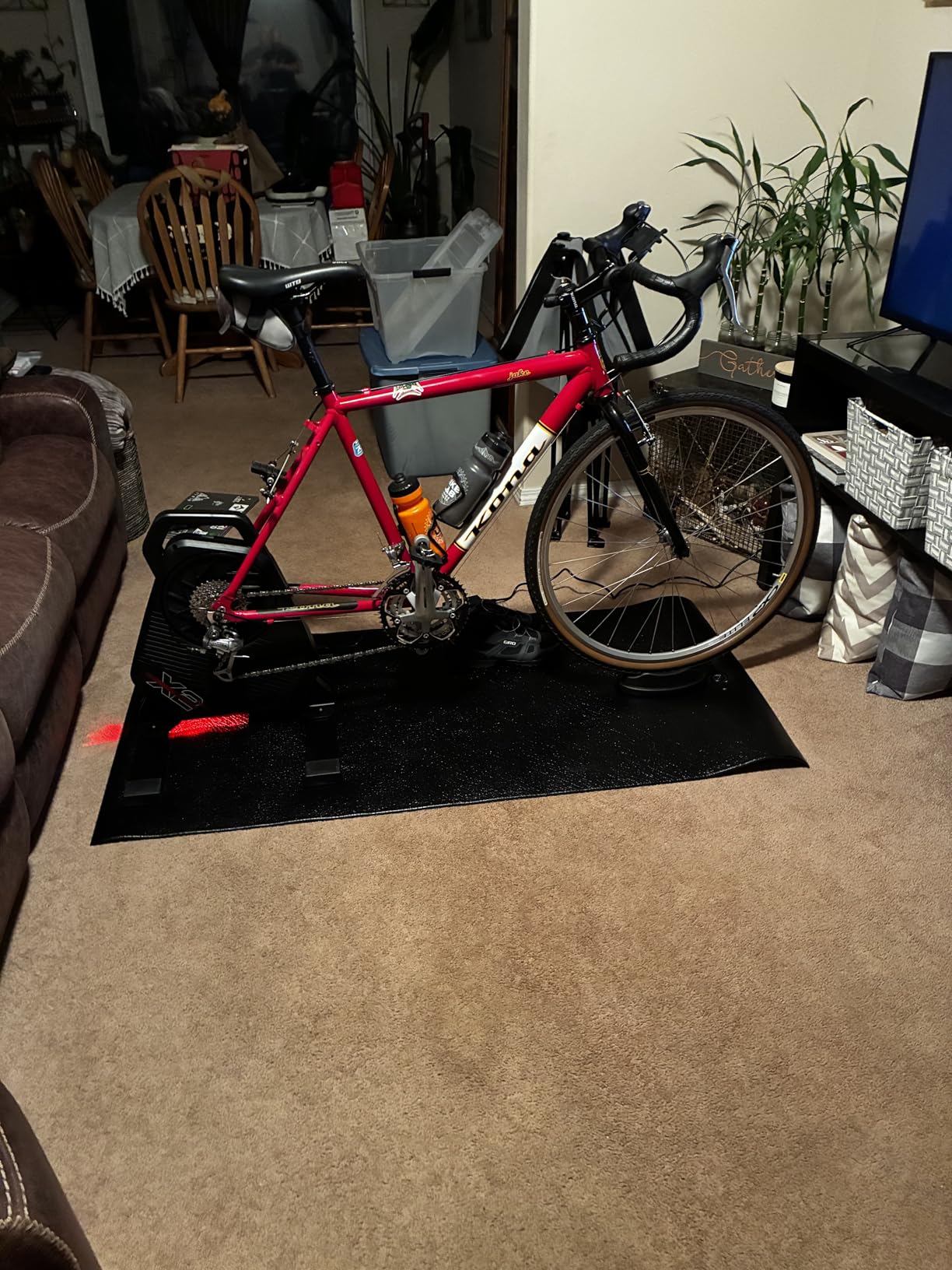
Set-up is fast, often under five minutes, and spacers are supplied for both quick-release and thru-axle bikes. Owners also call out stability for standing intervals and sprints, which is the honest test of a budget trainer.
The negatives are specific rather than fundamental. No cassette is included, so you need one that matches your bike before the trainer is usable with your chain. Some owners report chain noise at higher power, short feet that feel tippy under hard acceleration, a base that sits slightly off-level on uneven floors, and thin instructions on hub spacer placement.
What 18 percent of gradient is actually worth
Plenty, for most riders. Eighteen percent of simulated tilt covers the majority of paved climbing in Zwift and ROUVY once difficulty scaling is taken into account, and the 2 percent power error is tight enough for threshold work if you calibrate your expectations against a known reference.
Where it falls short is the steep stuff and the real feel. Eighteen percent is below what the XXPRO offers and it produces no front-end movement, so on long alpine climbs the position never changes.
That gap is cheap to close. Adding a riser block under the front wheel gives you a raised, more natural position for very little money, and that is the combination we would build first on a budget.
Who the ThinkRider X2Max suits and who it does not
It suits riders on a budget who still want responsive grade simulation, riders who train with audio and need a quiet machine, and anyone who wants a working trainer set up in an afternoon rather than a weekend.
It does not suit riders who want zero parts hunting, since the cassette is not included. It also does not suit riders with a long-term warranty mindset, or anyone training above 2000 watts regularly. Check the floor for levelness before you ride hard on it.
6. KOM Cycling Riser Block – Best Cheap Fix for a Low Front End
KOM Cycling Indoor Trainer Front Wheel Riser Block – 3 Different Heights Creating The Perfect Block for All Trainers Including Zwift Hub Trainer, Cyclops, Wahoo Kickr, TacX Neo, Kinetic
Three selectable heights
1.4 lb plastic block
12 x 13 x 8 inch
Fits 700x23c to 29.3
Pros
- Three height options level the front wheel on nearly any trainer
- Wide wheel compatibility from 700x23c through 29.3
- Webbed base grips resist slipping at high power
- Over 1000 reviews with a 4.7 average
- Light and easy to move
Cons
- Three fixed heights are less granular than five-setting blocks
- Plastic construction is less rigid than metal
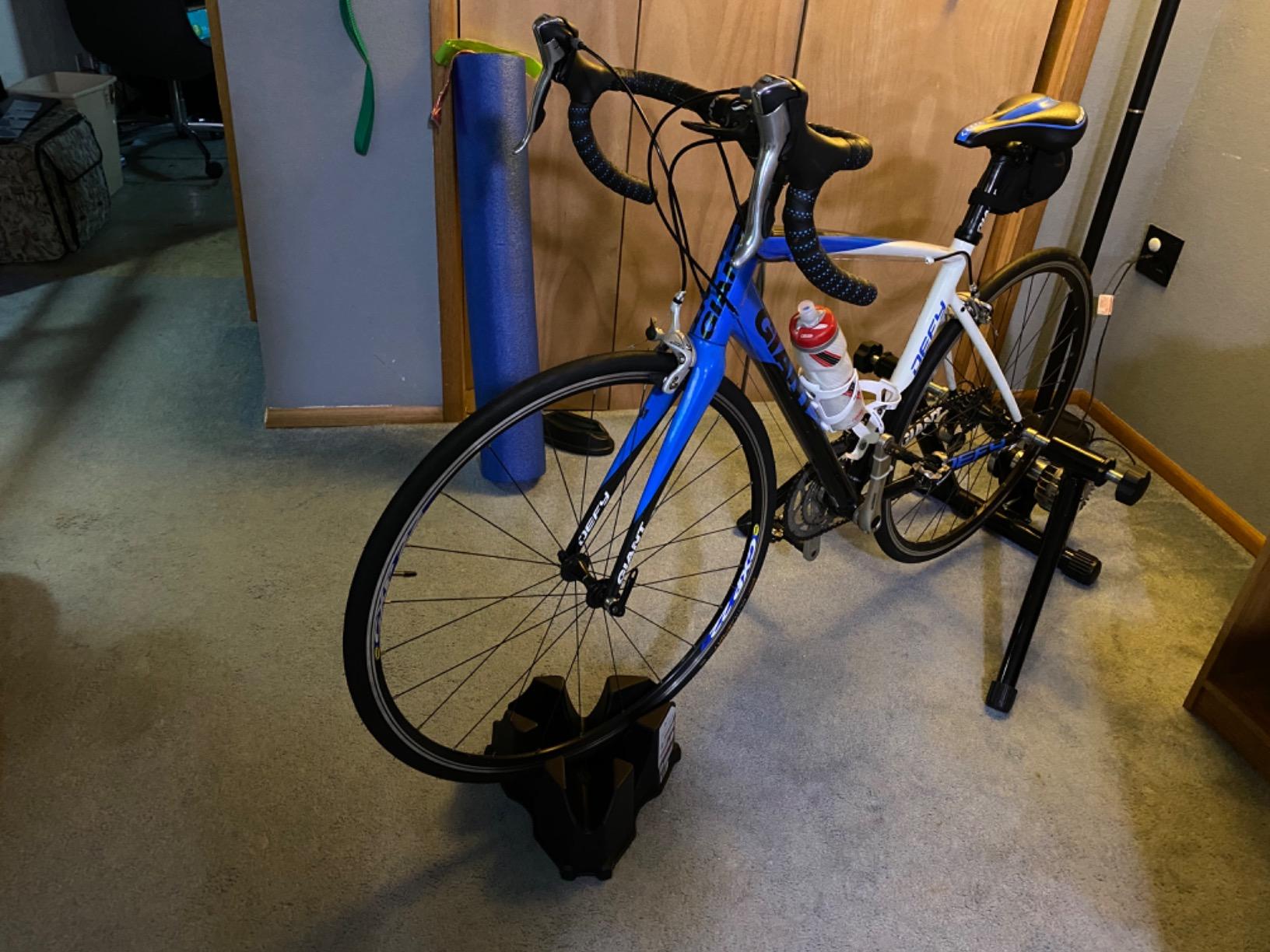
Most riders who feel like they need a climbing simulator actually need their front wheel off the floor. The KOM block is the most straightforward fix for that, and with over 1,000 ratings averaging 4.7 it is the most thoroughly reviewed item in this entire roundup. That kind of volume is worth something when you are buying plastic to hold your bike up.
It offers three selectable heights, engineered to level the front wheel across trainer brands including Wahoo, Cycleops and Kinetic. A tapering valley cradle takes wheel sizes from 700x23c through to 29.3, so road and mountain bikes are both covered, and height difference arrows are marked on both sides to make selection obvious.
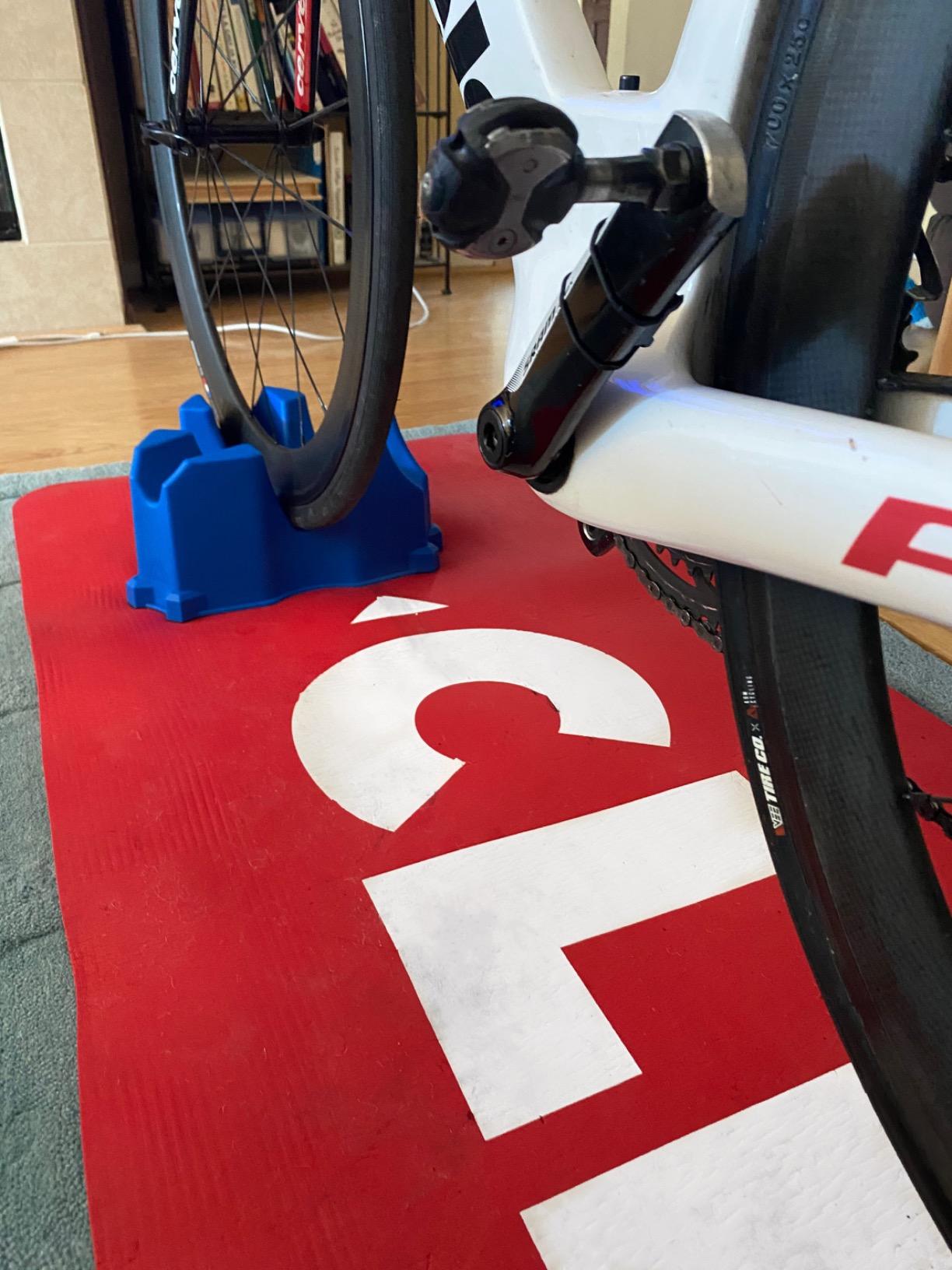
The base is the detail that matters in practice. Three waffle webbed grips on the underside resist slipping during high-wattage sessions, which is where cheaper blocks let the front wheel wander. At 1.4 pounds it is light, and the 12 by 13 by 8 inch footprint is compact enough for a small room.
What it does not do is move. This is a fixed height, so your grade experience comes from the trainer’s resistance and your own position, not from a rising and falling front end. Owners are clear that its job is stopping wobble and giving a level ride, and it does that job extremely well.
Is a riser block enough instead of a climbing simulator?
For a lot of riders, yes, especially as a first step. If your complaints are a low front end, wheel wobble at high power and a cramped position, a three-height block fixes all three for a tiny share of the cost of a dedicated unit.
What it cannot do is simulate a gradient or a descent. Once you have ridden a real moving front end, a fixed riser starts to feel flat, and that is the point at which the dedicated simulator becomes worth it.
Our advice is to buy the block, ride three months of winter training on it, and only then decide whether the upgrade has earned a place in your setup.
Who the KOM block suits and who it does not
It suits almost everyone with a trainer, particularly riders on budget trainers where the front end sits particularly low, and riders in flats who need a compact footprint. The wheel size range makes it safe for mixed bike households.
It does not suit riders chasing gradient simulation, descent practice or a moving front wheel, and the three fixed heights are less granular than blocks with five settings. If you want the finest possible height control, look at the Elite block instead.
7. Elite Su-Sta – Finest Height Control on a Riser Block
Elite Su-Sta Adjustable Elevator Block – Front Wheel Riser Block for Bike Trainers – Adjustable Height – For Indoor Cycling
Five height settings
Gradients up to 6 percent
16 ounce plastic block
2 year warranty
Pros
- Five height settings give finer grade control than three-step blocks
- Rubber base pads grip the floor and protect hardwood
- Large stable platform holds the front wheel firmly
- Clips onto the trainer frame for tidy storage
- 2 year manufacturer warranty
Cons
- Bulky footprint at 20 inch long by 8 inch wide
- Only simulates gradients up to 6 percent
- Larger and costlier than similar risers
Where the KOM block gives you three heights, the Elite Su-Sta gives you five, and the difference matters more than it sounds. Five settings replicating gradients up to 6 percent let you actually set a static incline for a specific stretch of a climb, then change it when the route changes profile. That is a small thing that makes static training more repeatable.
Build and stability are the other reasons owners like it. A reinforced internal channel cradles the wheel through sprints and climbs, rubber feet absorb vibration and stop it sliding on any floor surface, and the platform is large enough that the front wheel feels planted rather than perched.
Storage is a genuine plus in a small space. The block clips onto the trainer frame for transport, so when you are not riding it goes with the trainer rather than taking up floor area of its own. The two-year manufacturer warranty is the longest of any accessory in this roundup.
The trade-offs are footprint and precision ceiling. At 20 inches long by 8 inches wide it is bulky compared with the KOM block, and six percent is the top of its range, which is enough to feel a climb but nowhere near a simulated gradient.
How much static gradient is actually useful?
Enough to change your position, which is the point. A static six percent incline puts the bar lower relative to you, opens up the torso and makes a seated climb far more comfortable, and that position change is where a lot of the benefit lives for riders who spend hours indoors.
It is not a substitute for live gradient following. Nothing fixed-height can respond to a route profile, so on a rolling ride you are still choosing one position and holding it.
That is why we would pair a block like this with a trainer that has a high maximum gradient. The block handles the position, the trainer handles the resistance, and neither is pretending to do the other’s job.
Who the Elite Su-Sta suits and who it does not
It suits riders who want the widest range of static heights, riders on hardwood or laminate floors who need the rubber feet, and anyone who values a two-year warranty on an inexpensive part. The clip-on storage suits shared spaces.
It does not suit small rooms where 20 inches of length is a problem, or riders chasing live gradient or descent. Riders who want the simplest possible fix with the smallest footprint should look at the Sunlite block.
8. Sunlite Forza Riser Block – The Simplest Level Fix
Sunlite Forza Riser Block Gray
Fixed-height levelling block
Tire widths 18mm to 2.5 inch
Suits 26-29 inch bikes
Heavy duty plastic
Pros
- Least demanding purchase in this roundup
- Over 1000 reviews with a 4.5 average
- Wide tire clearance from 18mm to 2.5 inch
- Simple no-adjustment levelling that works with most trainers
Cons
- Fixed height with no gradient adjustment
- Less stable than multi-height or adjustable blocks
- Listed item weight is clearly a data error
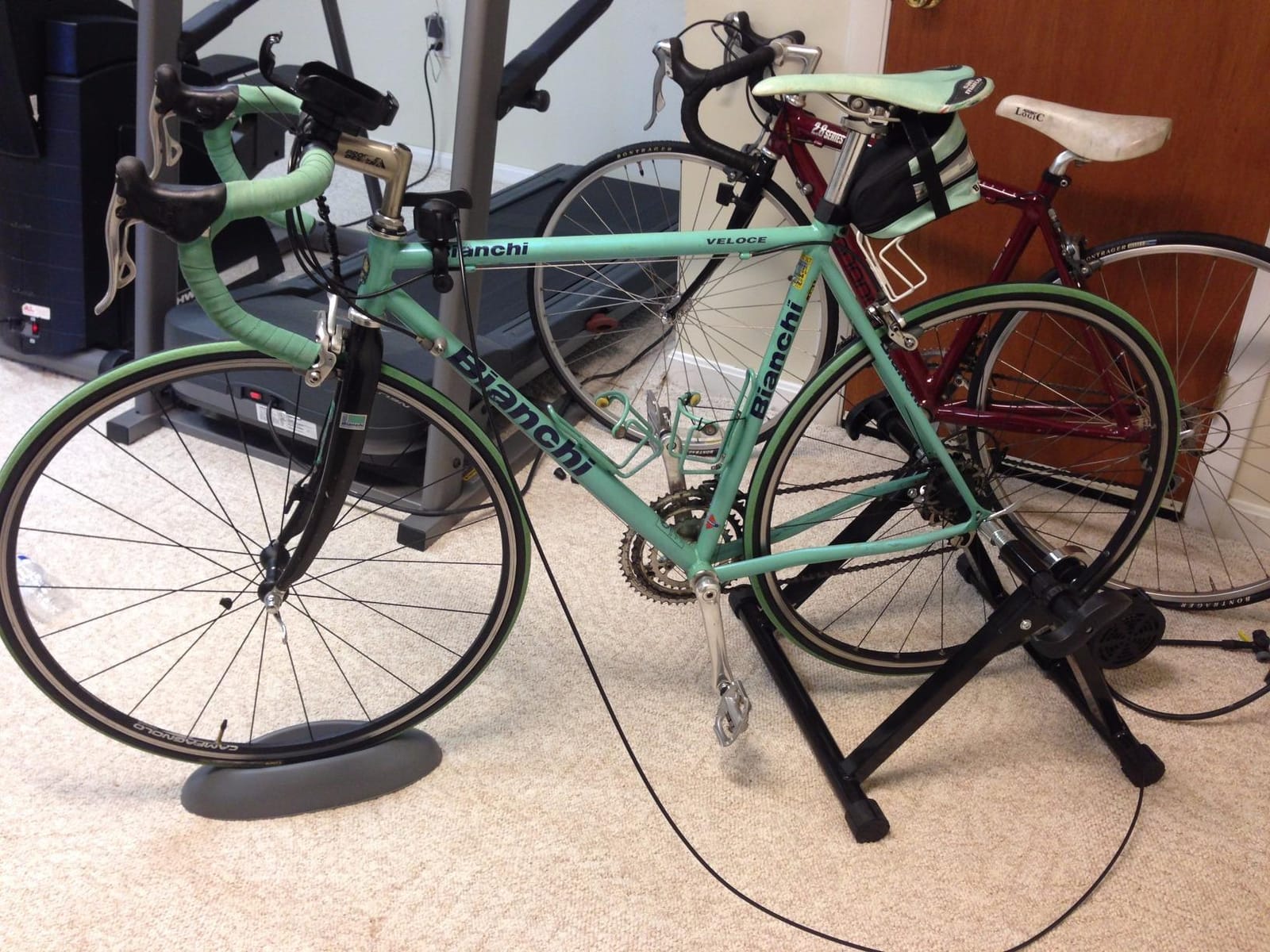
The Sunlite Forza does one job: it levels the front of your bike. There is no adjustment, no height range and no pretence of gradient simulation. It suits 26 to 29 inch bikes, accepts tire widths from 18 mm to 2.5 inch, and it is built from heavy duty plastic that has been doing this for years, with more than 1,000 ratings behind it.
For a rider whose trainer leaves the front wheel scraping the carpet, or tilting the whole bike to one side, that is genuinely all the problem is. Buyers treat it as the simple, cheap fix, and the 4.5 average across 1,015 ratings suggests most of them are satisfied.
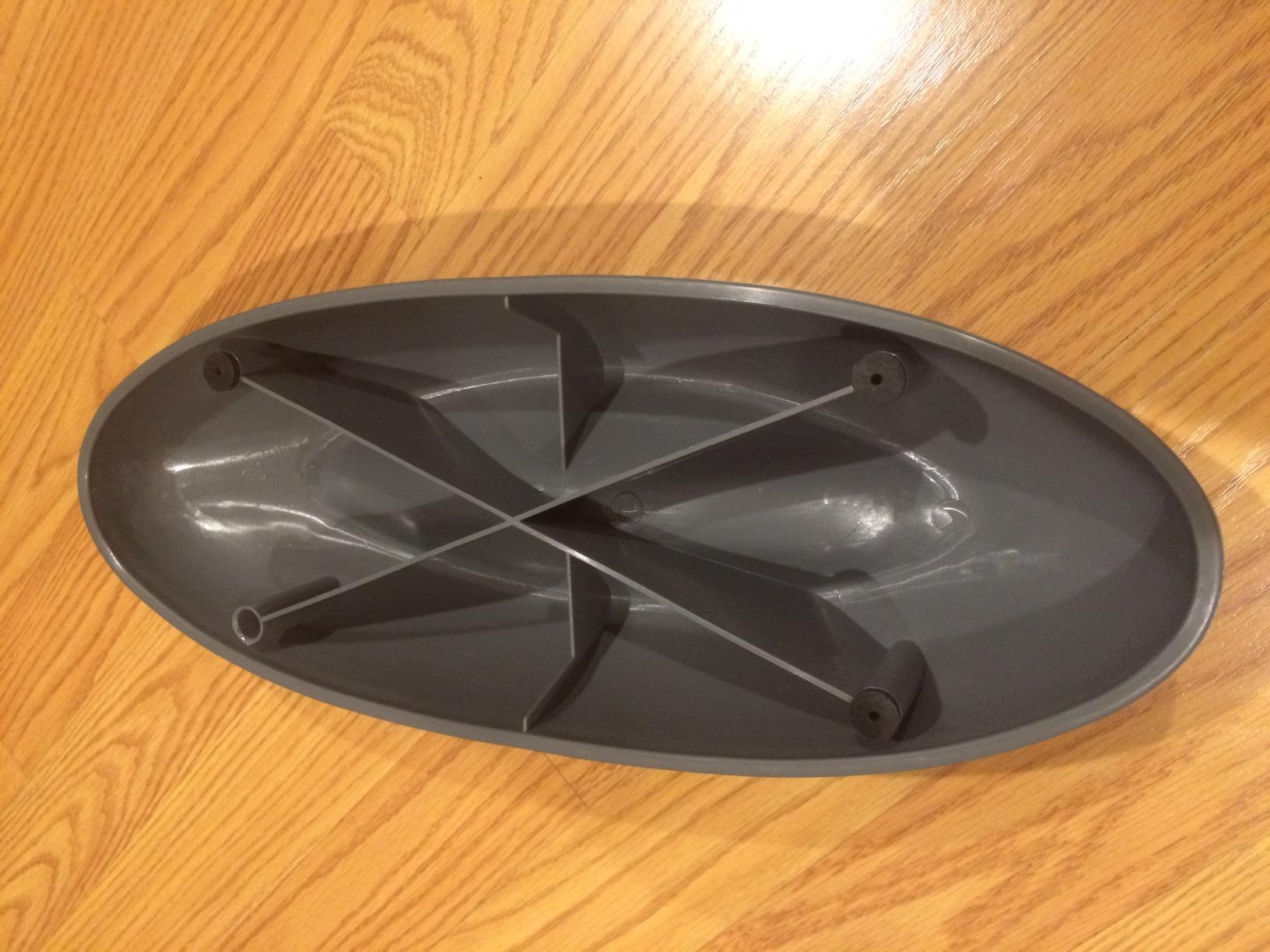
The wide tire clearance is the useful detail. Accepting anything from 18 mm road tyres up to 2.5 inch means the same block works for a road bike, a gravel bike or a mountain bike, which makes it a sensible one-block household solution.
Two honest caveats. A fixed height is less stable under hard acceleration than a multi-height block with a wider platform, and the listed item weight of 0.27 g is plainly a catalogue error rather than a specification, so treat the weight information on this listing with suspicion.
Who should spend more than this on a riser
Spend more if you ride at high power, if your sessions include standing sprints, or if your floor is uneven. In those situations a wider multi-height platform with webbed grips holds the wheel better and the extra money is money well spent.
Do not spend more if your sessions are steady-state endurance work on smooth floors. A fixed block at a sensible height handles that comfortably, and spending further would buy features you never use.
The same logic applies to the whole category. Match the hardware to the kind of riding you actually do, not to the most capable version of it, and the decision gets much cheaper.
Who the Sunlite block suits and who it does not
It suits beginners building a first indoor setup, riders with mixed road and mountain bikes who want one block that fits everything, and anyone who wants the problem solved without research or adjustment.
It does not suit riders chasing any kind of gradient, riders doing hard accelerations who need a wider platform, or anyone who wants to fine-tune their position between sessions. Pick the KOM or Elite block for those.
How to Choose: What to Check Before You Buy
Five things decide whether a climbing setup is worth your money, and the order matters. Check compatibility first, because a beautiful device you cannot mount is a paperweight. Check gradient capability second, then descent, then build, then the room.
One: the trainer requirement and brand lock-in
This is the trap that catches the most riders. The Wahoo KICKR CLIMB works exclusively with Wahoo KICKR, KICKR CORE and KICKR SNAP trainers from the 2017 editions onward, and with nothing else. The Tacx Alpine is built for Tacx trainers. If you buy the accessory first and the trainer second, you may end up unable to use the accessory at all.
Work out your existing trainer before you order anything, and check the maker’s compatibility list rather than a forum answer. Riser blocks are the exception, since they are brand-agnostic and work with almost anything.
Two: gradient and descent figures
Maximum incline is the headline number and it is often inflated by difficulty settings. What actually matters is whether the figure covers your software at your chosen difficulty. A 20 percent trainer with Zwift at 50 percent difficulty gives you a 10 percent ride, which is steeper than most weekend climbs.
Descent is the more overlooked spec. Only the Wahoo KICKR CLIMB and the Tacx Alpine advertise real 10 percent decline capability, and the Elite Rizer class of unit manages roughly 5 percent. If you want to practise descending, that is the column to read.
Three: steering and lateral movement
Steering is a different category of realism again. Only one narrow group of devices, the Elite Rizer style machines, actually lets you lean the bike into a corner, and the mechanical steering is its entire selling point. Everything else here is vertical movement only, however much side-to-side play the trainer feet provide.
The AXIS feet on the Wahoo KICKR V6 add subtle side-to-side movement that is not steering, but it does soften the dead feeling of a long climb at low power.
Four: build, warranty and weight
Check the warranty length before anything else in this category. The one-year terms on the ThinkRider units are the shortest here, and the Elite Su-Sta carries a two-year manufacturer warranty. Weight decides whether you will actually use the thing, particularly if you move it between rooms.
Power accuracy matters for structured work. The ThinkRider XXPRO reports 1 percent accuracy with no calibration, the X2Max sits at 2 percent, and the Wahoo KICKR V6 claims over 2,200 watts accurate to 1 percent. Treat all of these as manufacturer claims.
Five: the room
A climbing simulator raises the front of the bike, so measure your ceiling height with the riser fully extended and your trainer at its normal position. Then measure the floor footprint, because a moving unit needs space in front of the trainer that a fixed block does not.
Noise and vibration come next, and they are the deciding factor for anyone upstairs or in a flat. A mat under the trainer and a pair of fans pointed at the front wheel make more difference to session length than most riders expect. If you cannot spare the floor space, a compact fixed block is your realistic answer.
How this guide was checked
All eight products were reviewed against their manufacturer specifications and current customer listings in October 2026. Ratings and review counts are taken directly from the listing data rather than estimated. We do not run an independent power meter laboratory, so every accuracy, gradient and noise figure in this guide is a manufacturer claim, and we have labelled it as such.
Two data quality notes, both worth having: the Sunlite Forza listing shows an item weight of 0.27 g, which is a catalogue error, and the Elite Su-Sta listing spells its own model as Stu-Sta. When a catalogue disagrees with itself, we report what is listed and let you judge.
Compatibility Checklist: Frame, Axle, Drivetrain, App and Room
Run through this in order before you click buy. It takes five minutes and it prevents the two most common returns in this category, which are a wrong-axle trainer and a bike that will not sit level.
Frame and axle. Confirm your thru-axle or quick-release standard and measure the wheelbase length. The Wahoo KICKR CLIMB ships with adapters for 12×100, 15×100 and 15×110 hubs, the KICKR V6 includes adapters for 130 mm and 135 mm QR plus 12×142 and 12×148 thru-axle, and the Tacx Neo 2T includes 130 mm QR, 135 mm QR, 12×142 mm thru-axle and 12×142 mm Boost. The ThinkRider units ship with spacers for both QR and thru-axle bikes.
Drivetrain and freehub. Decide direct mount or cassette before you order, and check what is in the box. The Tacx Neo 2T includes a Shimano and SRAM freehub body. The ThinkRider X2Max does not include a cassette, and you will need one that matches your chain and gearing before it is usable.
App and connection. Your trainer needs to speak to the software you actually ride. Bluetooth and ANT+ cover Zwift, TrainerRoad, ROUVY and Wahoo SYSTM across most of the products here, while the KICKR V6 adds built-in 2.4 GHz Wi-Fi for a dongle-free data feed. If you plan to use virtual shifting, confirm your drivetrain is supported before you buy the shifting hardware.
The room. Floor flatness, ceiling clearance with the front wheel raised, distance to the wall, and the noise tolerance of anyone downstairs. If any of these fail, a riser block is the honest answer and you will not regret it.
One last thing that is easy to overlook: bike fit. Raising the front of a bike changes saddle-to-bar drop, so re-check your position after any riser or simulator goes in. A saddle that was right on the flat is often too high once the front end is up.
What This Is Not: Step Climbers and Climbing Boards
Shopping results for this keyword are full of equipment that has nothing to do with cycling. It is worth clearing those away before you compare anything, because several of them cost several times more than the devices in this guide.
Vertical step climbers, including the CLMBR Connected 02, the NordicTrack Step Climber XL, Versaclimber and the Spirit Vertical Climber, are fitness machines for walking and stepping upward. They simulate nothing about a bicycle. Rock and training boards such as the Metolius Simulator 3D are hangboard-style products for climbers, and the term overlap with cycling grade simulators is purely accidental.
Commercial rope climbers are gym equipment. If a product page uses the words climber or simulator without ever mentioning a smart trainer, a gradient percentage or ANT+, it is not in this category. If the word simulator sent you here looking for a completely different kind of machine, our golf simulator roundup covers that category instead.
The genuine cycling category is small. There are a handful of dedicated front-end simulators, a group of smart trainers that simulate grade and descent electronically, and a set of riser blocks that raise the front wheel without moving it. That is the whole list, and this guide covers every one of those routes.
Frequently Asked Questions
Is the Wahoo KICKR CLIMB worth it?
Yes, if you already own a Wahoo KICKR, KICKR CORE or KICKR SNAP trainer from the 2017 editions onward. It simulates 20 percent incline and 10 percent decline and pairs directly with Zwift, TrainerRoad and Wahoo SYSTM. It is not worth it for anyone whose trainer is from another brand, and 12 percent of the 88 ratings here are 1-star, largely over variability in the grade actually achieved.
Can I use a Tacx Alpine with a non-Tacx trainer?
No. The Tacx Alpine is designed to work with Tacx trainers such as the Neo 2T and Neo 3M, which means a Tacx Alpine purchase effectively commits you to a Tacx trainer as well. That ecosystem lock-in is the single most important thing to check before buying any dedicated grade simulator, and it is worth more attention than any published specification.
Do I need a climbing simulator or is a good trainer enough?
A good trainer is often enough. Zwift defaults to roughly 50 percent difficulty, so a 10 percent road gradient reaches your trainer as about 5 percent, and a 20 percent trainer still has headroom. Buy a simulator for physical realism, descent practice and position change, not for a steeper number. If you mostly ride flat endurance sessions, a riser block solves the most common complaint for a tiny share of the cost.
Does a climbing simulator work downhill?
Some do. The Wahoo KICKR CLIMB simulates declines of up to 10 percent and the Tacx Alpine does the same, and the ThinkRider trainers handle downhill electronically by reducing resistance to follow the map slope. Riser blocks cannot descend at all because they are fixed at one height, and the Elite Rizer class of unit manages roughly a 5 percent decline.
Will a climbing simulator work in a small apartment?
It can, but measure first. A dedicated simulator raises the front of the bike, so you need ceiling clearance with the unit fully extended plus floor space in front of the trainer. Noise matters as much as size, so a trainer mat and a fan pointed at the front wheel make a measurable difference. If the space is tight, a compact riser block such as the KOM block solves the low front end in a fraction of the footprint.
How does Zwift difficulty setting affect climbing?
Zwift defaults to roughly 50 percent difficulty, which means a 10 percent road gradient is delivered to the trainer as roughly 5 percent, and a 20 percent climb arrives closer to 10 percent. Lowering the difficulty setting pushes those numbers higher and is often the cheapest way to make a decent trainer feel steeper. If you are only ever in the default setting, you probably do not need a dedicated grade simulator.
Final Verdict: Which Setup Suits You
The Garmin Tacx Neo 2T is our pick overall, because it simulates downhill and a 20 percent grade electronically, carries the best-evidenced rating in this group at 4.7 across 472 ratings, and folds flat for storage. It covers most of the climbing use case without a second purchase, and it is the right base if the Tacx Alpine is a future possibility.
For riders who already own a Wahoo KICKR trainer, the Wahoo KICKR CLIMB is the only dedicated grade simulator worth considering on its merits, with 20 percent incline and 10 percent decline plus a handlebar remote. Riders who own nothing and want the steepest simulated grade available should look at the ThinkRider XXPRO at 25 percent, and riders on a tight budget should take the ThinkRider X2Max with a riser block underneath it.
And for most people, the honest answer to the best climbing simulators for indoor cyclists question is that a riser block is the sensible first move. The KOM block is our value pick with the strongest review history here, the Elite Su-Sta gives you the finest static height control, and the Sunlite Forza solves the basic levelling problem outright. Fix the position first, ride a winter on it, and upgrade to a moving front end only if you miss it. If you are still choosing climbing wheelsets for the rides you are training toward, our climbing wheelset guide is the other half of that conversation.