
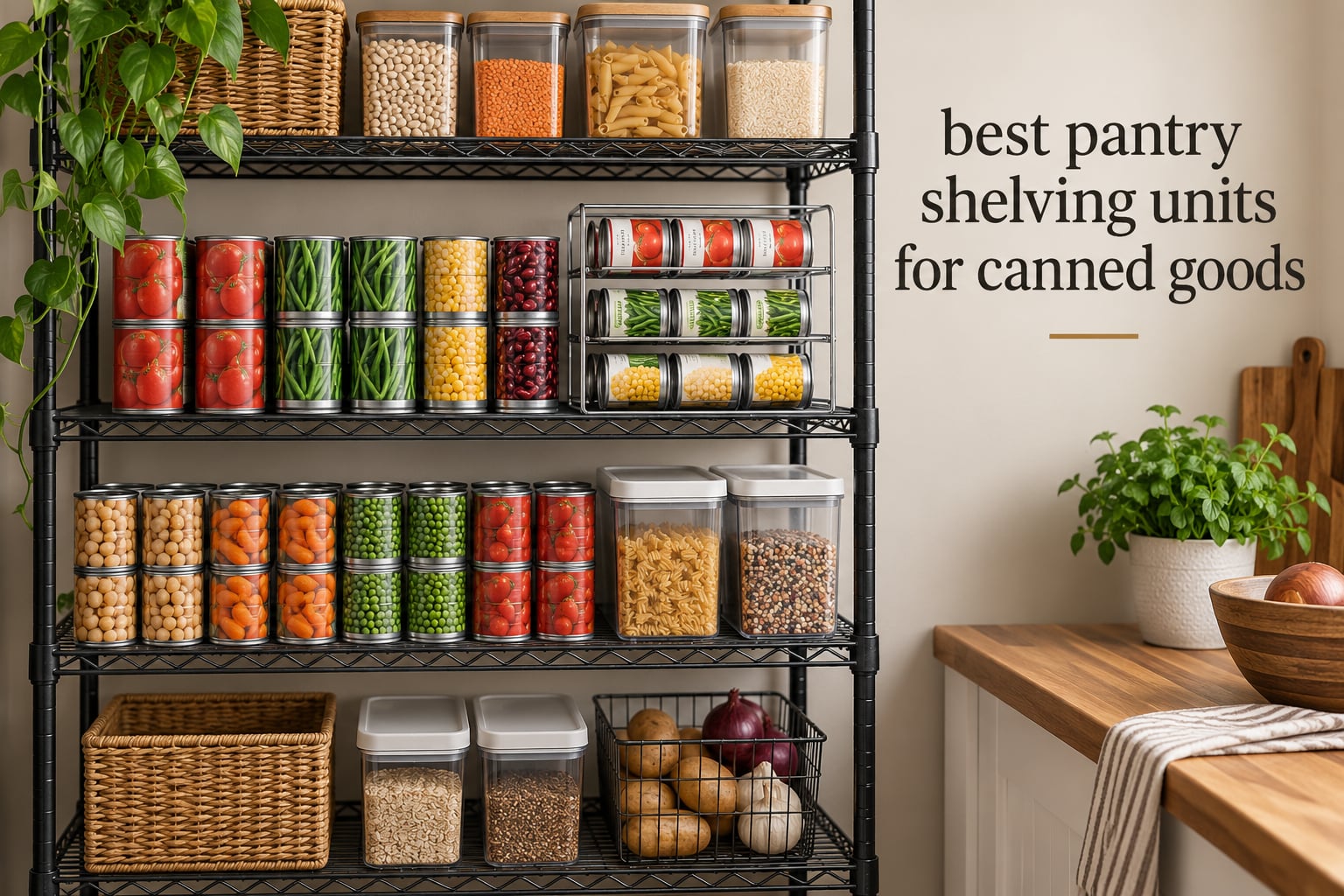
A pantry shelf full of cans has a weight problem that most shelving pages never mention. Canned goods are dense: a fully stocked square foot of stacked cans puts roughly 10-15 pounds on whatever is holding them up, and a single standard can is about 2.6 inches wide. That combination decides your shelf depth, your per-shelf weight rating, and how high you can stack before things topple.
That is the whole thesis of this guide. We looked at the best pantry shelving units for canned goods specifically, not for boxes and baskets, and every pick below is judged on can fit, load rating, shelf depth, and whether you can still see the oldest can in the back. We also included three can organizers and dispensers, because for a lot of households the answer to “where do my cans go” is not another shelf at all. It is a rack that rolls the oldest can to the front.
Short answer to the most common question first: the best kind of shelving for a pantry is a powder-coated steel wire unit with per-shelf ratings stated in pounds, adjustable shelf height, and a depth of at least 12 inches so you can store cans in a single visible row. Anything shallower than 10 inches forces double-stacking, and double-stacking is how cans end up forgotten until they expire. We earn a commission if you buy through the links on this page, and it does not change which units we recommend.
If you are also picking up a new physical skill this year, we spent time on how long it actually takes to get good at rollerblading, and the honest answer there shapes everything in this guide: measured progress beats enthusiasm. Same rule applies to a pantry. Measure before you buy.
Table of Contents
Top 3 Best Pantry Shelving Picks for Canned Goods in 2026
These three cover the three situations most people are actually in: a general-purpose rack for a normal pantry, a stackable can organizer that handles rotation, and a narrow unit for a tight closet. The full list of ten sits below.
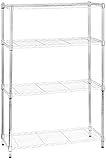
Amazon Basics 4-Shelf Wire Rack
- 350 lbs per shelf
- 1400 lbs total
- 36 x 14 x 54 in
- 1-inch shelf adjustment

Simple Houseware 3-Tier Can Organizer
- Holds 36 cans
- angled shelves roll cans forward
- stackable with clips

SINGAYE 5-Tier Wire Shelving
- 10 in depth
- 600 lbs total
- 1-inch height adjustment
- wall anchor kit
Best Pantry Shelving Units for Canned Goods at a Glance (October)
All ten picks, with the spec that actually matters for cans. Per-shelf and total ratings are listed separately because they tell you very different things.
| Product | Specs | Action |
|---|---|---|
| Amazon Basics 4-Shelf Wire Rack |
|
Check Latest Price |
| Simple Houseware 3-Tier Can Organizer |
|
Check Latest Price |
| SINGAYE 5-Tier Wire Shelving |
|
Check Latest Price |
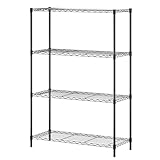 BestOffice 4-Tier Wire Shelf BestOffice 4-Tier Wire Shelf |
|
Check Latest Price |
 REGILLER 5-Wire Storage Rack REGILLER 5-Wire Storage Rack |
|
Check Latest Price |
 FIFO 54-Can Can Tracker Dispenser FIFO 54-Can Can Tracker Dispenser |
|
Check Latest Price |
 Sakugi 4-Tier Heavy Duty Shelf Sakugi 4-Tier Heavy Duty Shelf |
|
Check Latest Price |
 Seville Classics 5-Tier Wire Shelving Seville Classics 5-Tier Wire Shelving |
|
Check Latest Price |
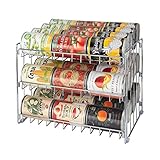 Kitchen Details 3-Tier Can Organizer Kitchen Details 3-Tier Can Organizer |
|
Check Latest Price |
 ClosetMaid 3-Tier Wall Mount Rack ClosetMaid 3-Tier Wall Mount Rack |
|
Check Latest Price |
1. Amazon Basics 4-Shelf Wire Rack – Best Overall for Canned Goods
Amazon Basics 4-Shelf Adjustable Heavy Duty Steel Wire Rack Storage Shelving Unit for Kitchen, Garage, Easy Assembly, 350 lbs Per Shelf, 36″ x 14″ x 54″, Chrome Silver
36 W x 14 D x 54 H in
Alloy steel, chrome
4 shelves
350 lbs per shelf, 1400 lbs total
22 lb unit weight
Pros
- 350 lbs per shelf and 1400 lbs total
- far above what a can load needs
- Shelf height adjusts in 1-inch increments
- Tool-free assembly in about 15 minutes
- Four leveling feet steady it on uneven floors
- 14 in depth holds a single visible row of standard cans
Cons
- Plastic shelf-support sleeves can pop open during assembly
- Usable shelf width is about 3 in narrower than the stated width due to the poles
- Front lip means cans must be lifted slightly when sliding forward
This is the unit we keep coming back to for a normal pantry because the numbers leave no argument. Each shelf is rated at 350 pounds and the whole rack at 1400 pounds, while a full shelf of standard cans typically lands in the 60-80 pound range. In other words, the rating is not a stretch figure that bends the moment you actually load it.
The 36 by 14 by 54 inch footprint is the useful part. At 14 inches deep you can run one row of standard cans with the labels facing you, or squeeze a second row of small cans behind it. That is the single decision that determines whether you can see what you own.
Assembly is tool-free and takes roughly 15 minutes, which matters more than it sounds. Assembling tall shelving is the single biggest reason people give up on buying shelving at all, and reviewers on Reddit product threads repeatedly single this one out for simple setup and adjustable feet on uneven floors.
Check the usable width before you plan your can rows
The stated 36 inch width is the outside measurement. Because the corner poles sit inside the frame, the flat usable shelf area is roughly 3 inches narrower, so count on about 33 inches of can row rather than 36. That still fits a single row of roughly a dozen standard cans with room to spare.
The 1-inch increment adjustment is the feature that keeps this rack useful as your collection changes. A shelf set low holds soup and tuna, a shelf set high holds taller tins, and you can move them without tools. Just know the heights are set during assembly, so decide your spacing before you tighten everything down.
Where it falls short for canned goods
The plastic sleeves that grip the shelf supports are the most reported complaint, and they can pop open mid-assembly and send a shelf to the floor. Seat each shelf firmly before moving on, and keep a thumb on the sleeve while you press down.
The front lip on every shelf is the other recurring note. It stops cans rolling off, but you have to lift a can slightly to slide it forward rather than tipping it out sideways. Fine for cans, mildly annoying for anything glass. The chrome finish also shows fingerprints and flour dust quickly, so plan on a wipe-down routine.
2. Simple Houseware 3-Tier Stackable Can Organizer – Best Can Rotation on a Budget
Simple Houseware 3-Tier Stackable Can Organizer Rack Hold 36 Cans, Chrome
11.5 D x 17 W x 13.75 H in
Metal, chrome
3 tiers, holds 36 cans
3.5 lb unit weight
6 movable dividers
Pros
- Angled shelves roll the oldest can forward automatically
- Stacks with included clips to multiply capacity
- Movable dividers fit different can and jar widths
- No hardware needed
- Weighs 3.5 lb so it moves easily
Cons
- Stack clips are frustrating to snap into place
- Bottom and middle tiers are too short for some large cans
- Occasional bent parts out of the box
This is not a shelf, and that is exactly why it earns a place here. The tiers are angled so gravity rolls the front can forward, replacing the one you take with the one behind it. It is the simplest way to get first-in-first-out behaviour without building anything, and it holds 36 cans in a footprint of 11.5 by 17 inches.
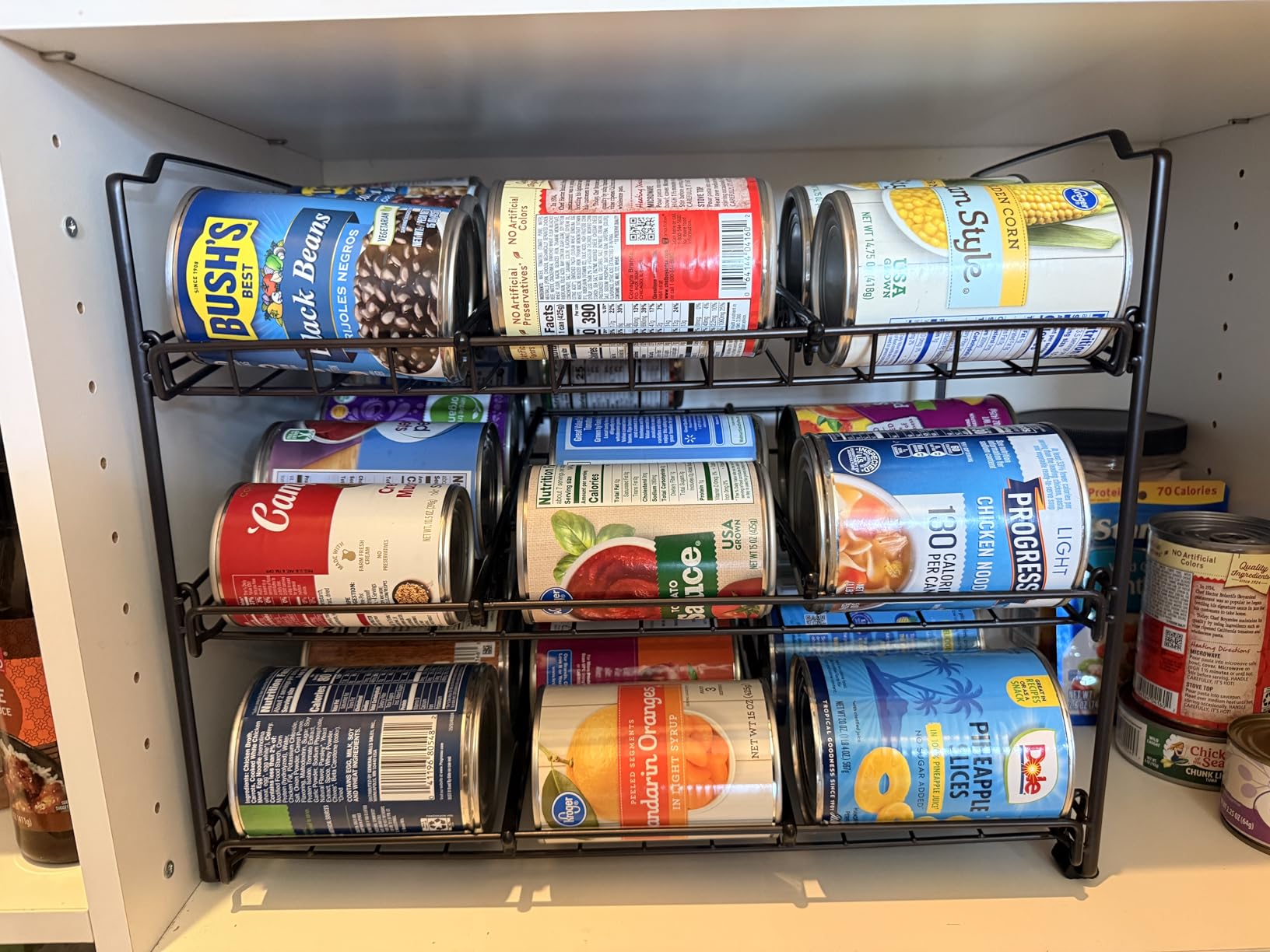
Because it is only 13.75 inches tall and weighs 3.5 pounds, it can sit on top of an existing shelf rather than taking floor space. In a small kitchen that is the difference between storing cans and not storing them. Stack a second unit on top with the included clips and you double the capacity in the same footprint.
Six movable plastic dividers let you set the row length for whatever is in the can. Slim cans of tomato paste, wide cans of pineapple chunks, and jars of home preserves all fit on the same tier if you set the dividers to suit.
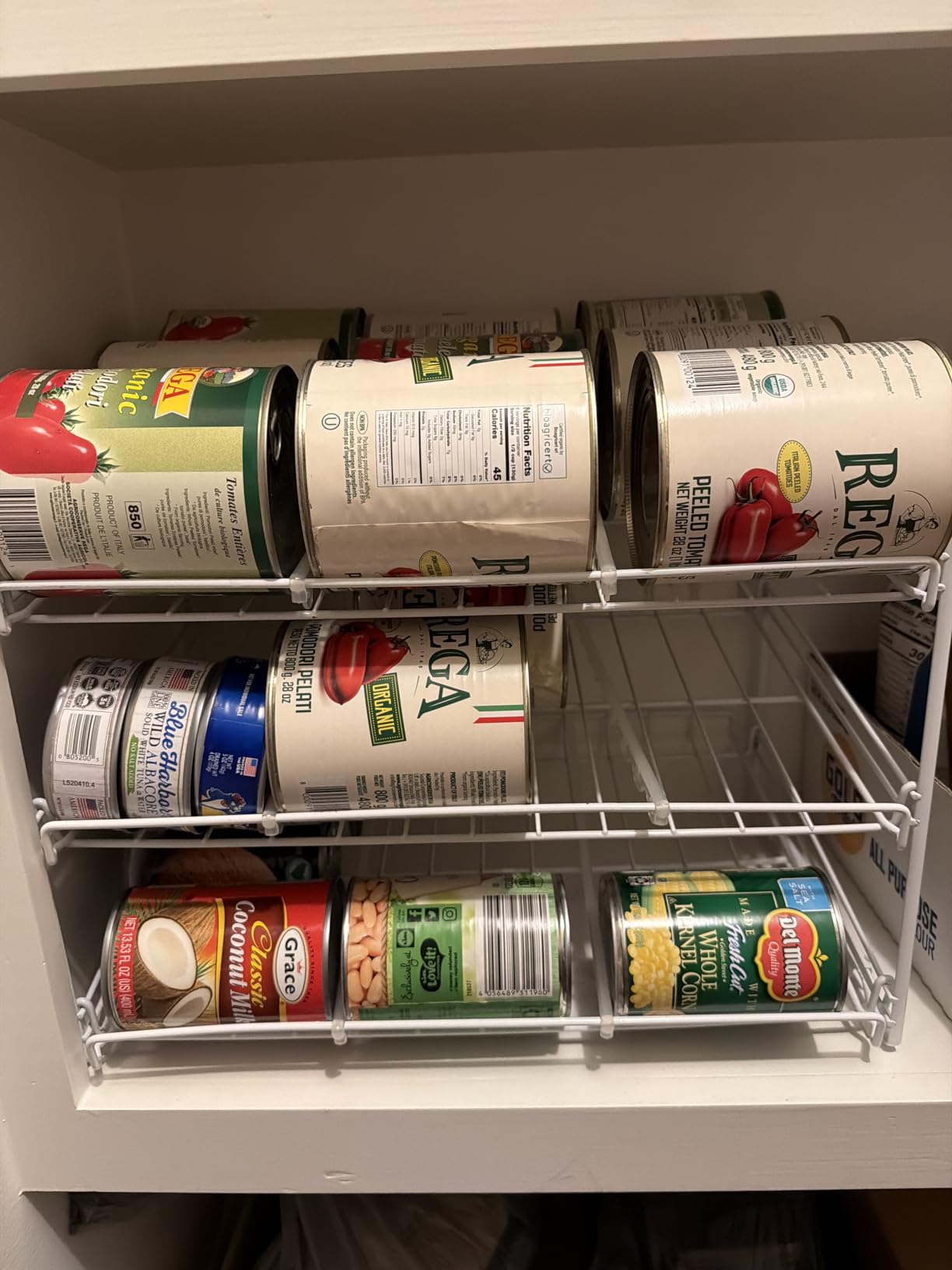
Why rotation beats stacking for canned goods
People on organizing forums are near-unanimous that cans should sit in a single row, oldest at the front, newest at the back, and that stacking cans on cans is what leads to toppled towers and forgotten food. An angled organizer enforces that arrangement for you without labels.
The practical test is simple. Reach in, take the front can, and the next one rolls forward. If you instead have to dig past six cans to check dates, the system is working against you. Reviewers often note it accommodates 32-ounce cans, which are taller than the standard 15-ounce variety.
Where it falls short
The stack clips are the weak point. They do the job, but they are stiff and several reviewers describe the first stacking attempt as the most frustrating part of setup. Assemble both units side by side on the floor first, then stack them where they will live.
Tier height is fixed, and both the bottom and middle tiers are too short for very large cans. A 15-ounce can fits fine, but if your reserve is mostly big family-size tins, look at the FIFO 54-Can unit further down instead. You may also find a bent part on arrival, so check the frame and wires before loading anything.
3. SINGAYE 5-Tier Wire Shelving – Most Versatile for Narrow Pantries
SINGAYE Metal Shelves Wire Shelving Storage Standing Adjustable Shelf Unit
10 D x 16 W x 55 H in
Metal wire, black
5 shelves
600 lbs total, evenly distributed
10.3 lb unit weight
Pros
- 10 in depth fits pantry corners and appliance gaps
- Five tiers turn a small footprint into serious vertical storage
- Shelf height adjusts in 1-inch increments
- Leveling feet and a wall anchor kit are both included
- Dense wire spacing suits small items
Cons
- Posts are thinner at about 5/8 in than comparable racks
- Lighter duty overall than the steel units here
- Wobbles unless the feet and wall anchor are used
- A rubber mallet helps seat shelves on the clips
At 10 inches deep, this is the narrowest shelving in the group, and narrow is the right call when a 33 inch rack simply will not turn the corner. Five tiers over 55 inches of height turn a strip of floor no bigger than a baking tray into roughly 50 square feet of shelf surface.
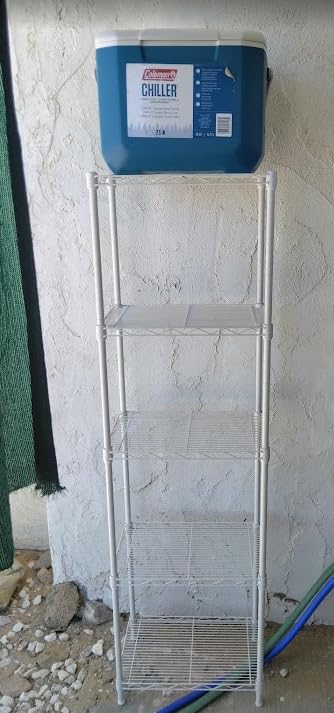
Total capacity is 600 pounds evenly distributed, which is plenty for canned goods. The wire is more densely packed than most budget racks, so small cans and packets are less likely to drop through the gaps. That makes it a decent first wire rack for someone who does not want to buy liners right away.
Owners on Reddit product reviews specifically praise the narrow footprint for pantry corners and between-appliance gaps, along with easy height adjustment and leveling feet. That is a narrow set of use cases, but it is exactly the gap most 36 inch racks leave empty.
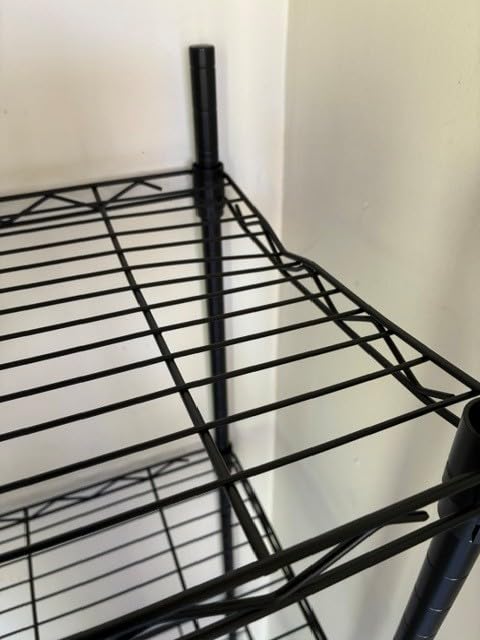
When 10 inches of depth is enough for cans
At 10 inches, you get a single row of standard cans, labels forward, and nothing behind them. That is the right configuration for visibility, and for a family that buys steadily rather than in bulk it is genuinely sufficient. It is not the right configuration for a bulk reserve.
The 1-inch increment adjustment matters more here than on wider units, because five tiers in a 55 inch frame leaves you a lot of room to decide. Set one tier low and flat for heavy cases, set another high and shallow for light cans you use weekly.
Where it falls short
The posts measure about 5/8 inch, noticeably thinner than the alloy steel poles on the heavier units in this list, and they do not screw together. Treat the 600 pound rating as a shared, evenly distributed figure rather than a per-shelf number, and do not stack two of these on top of each other.
It wobbles when lightly loaded unless you use the leveling feet and the included wall anchor kit. Anchor it if you have small children, and use a rubber mallet to seat each shelf on its support clips, because pushing them by hand often leaves a shelf sitting proud.
4. BestOffice 4-Tier Wire Shelf – Best for Garage and Utility Storage Overflow
BestOffice | 4-Tier Wire Shelf | 36″ x 14″ x 54″ | Black
36 W x 14 D x 54 H in
Alloy steel, powder-coated
4 shelves
250 lbs per shelf, 1000 lbs total
17 lb unit weight
Pros
- 1-inch tier adjustment handles varying can and jar heights
- Powder-coated finish resists rust in humid spaces
- Tool-free assembly in minutes
- 14 in depth holds a full visible row of cans
- 90-day manufacturer warranty included
Cons
- Rated capacity drops sharply when rolled on casters
- Wire spacing can let small items fall through without a liner
The BestOffice is the same footprint idea as the Amazon Basics rack, at a 250 pound per-shelf and 1000 pound total rating, with one meaningful difference: a powder-coated finish instead of bright chrome. For a pantry that also doubles as a utility closet, or a garage shelf that sees seasonal humidity, that coating is the reason to pick this one.
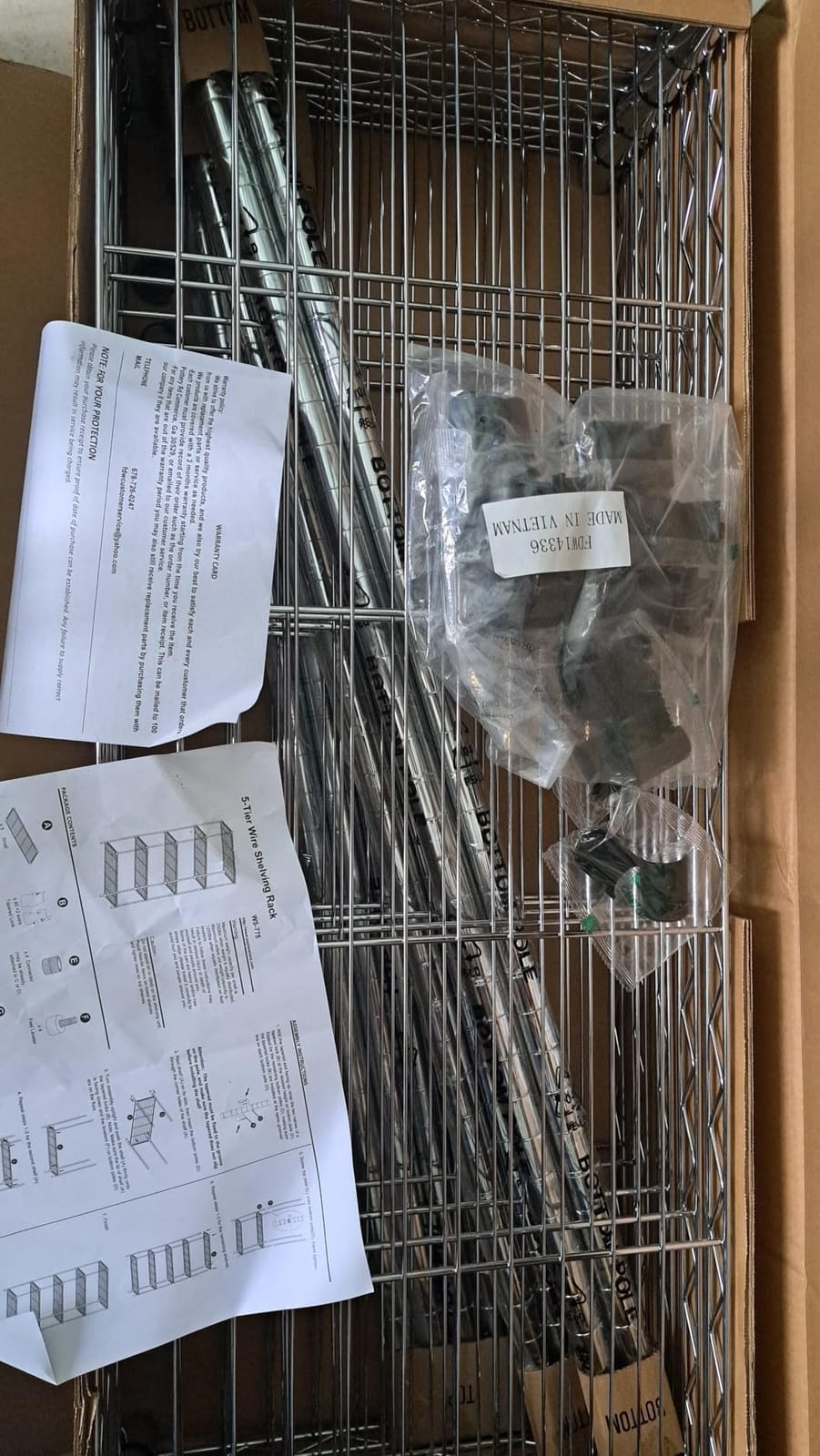
Black powder coat also hides the flour and tomato dust that white or chrome finishes advertise. If you cook from your pantry regularly, that is a bigger daily quality-of-life difference than any spec on the list.
Buyers highlight the 1-inch tier adjustment, the rust-resistant coating, and quick tool-free setup as good value. Assembly genuinely is a matter of minutes, which keeps this in the running for anyone who found assembly the main barrier to buying shelving.
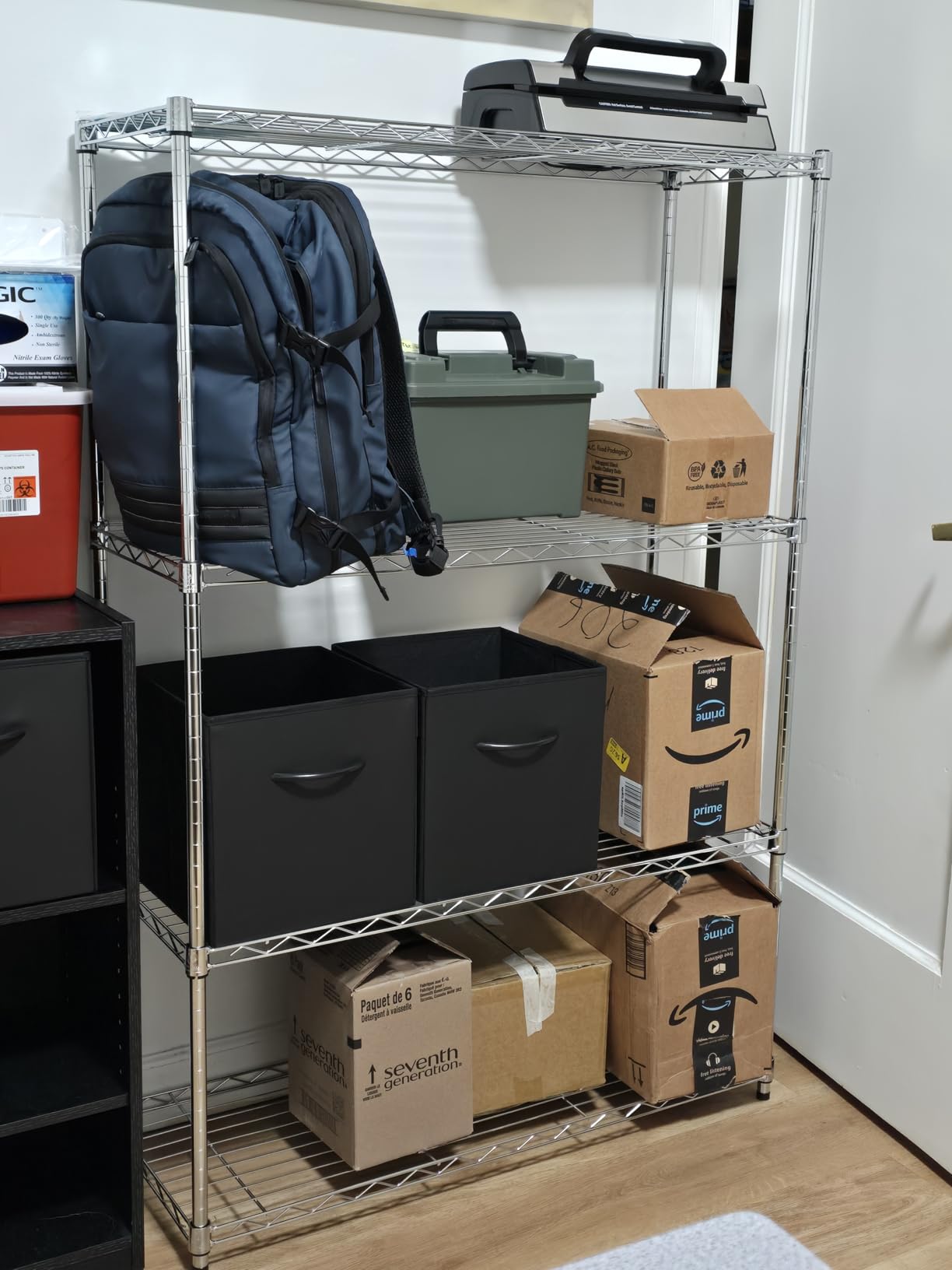
Read the caster rating before you move it
On leveling feet this rack holds 1000 pounds total, or 250 pounds per shelf. Roll it on casters and the rating falls to 220 pounds total. That is not a typo, and it is the single most misunderstood number in shelving listings: a cast-loaded rating covers roughly a fifth of the static rating.
For cans, 220 pounds still means about 70 to 80 standard cans, so a rolling pantry cart works fine. Just do not treat the on-paper 250 pound figure as what you get while it is on wheels.
Where it falls short
Wire spacing is standard, so small spice jars, packets, and short cans will fall through without a liner. That is manageable on a dedicated can shelf, but it is why we would not choose this rack for a mixed pantry where jars live on the same tiers.
The 90-day manufacturer warranty is short next to the 10-year coverage on the Seville Classics unit later in this guide. It is a fair trade for the coating and the price, but check the warranty terms if you plan to anchor this permanently to a stud.
5. REGILLER 5-Wire Storage Rack – Best for Pantry Corners and Lipped Edges
REGILLER 5-Wire Shelving Metal Storage Rack Adjustable Shelves,Standing Storage Shelf Units for Laundry Bathroom Kitchen Pantry Closet(Silver,11.8″ D x 16.6″ W x 53.5″ H)
11.8 D x 16.6 W x 53.5 H in
Metal and plastic, silver
5 shelves
500 lbs static total
Adjustable feet, coated against rust
Pros
- 11.8 in depth works in corners and beside a refrigerator
- Shelf heights are adjustable and shelves are coated against water and rust
- Lipped shelf edges keep jars and containers from sliding off
- Tool-free assembly in under 20 minutes
- Adjustable feet handle uneven floors
Cons
- Cylinder-style brackets pop off the poles during assembly
- Shelf heights need partial disassembly to change
- Lightly loaded unit has some wobble
- Packaging parts are not labeled to match the instruction letters
REGILLER sits between the narrow budget racks and the wide heavy-duty ones. At 11.8 inches deep and 16.6 inches wide, it is the one in this group that fits beside a refrigerator with the door still opening, which is a real constraint in a lot of kitchens.

Two details make it better for cans than its price suggests. The shelves have lipped edges, so a can nudged by a door or a sleeve does not walk off the edge, and the coating is specified against water, rust, and corrosion, which matters if you keep tomato sauce and vinegar alongside the rest.
The spider-web steel tube frame is rated at 500 pounds static total across five shelves. For canned goods that is roughly 100 pounds per shelf if you load evenly, comfortably above what a can shelf actually demands.
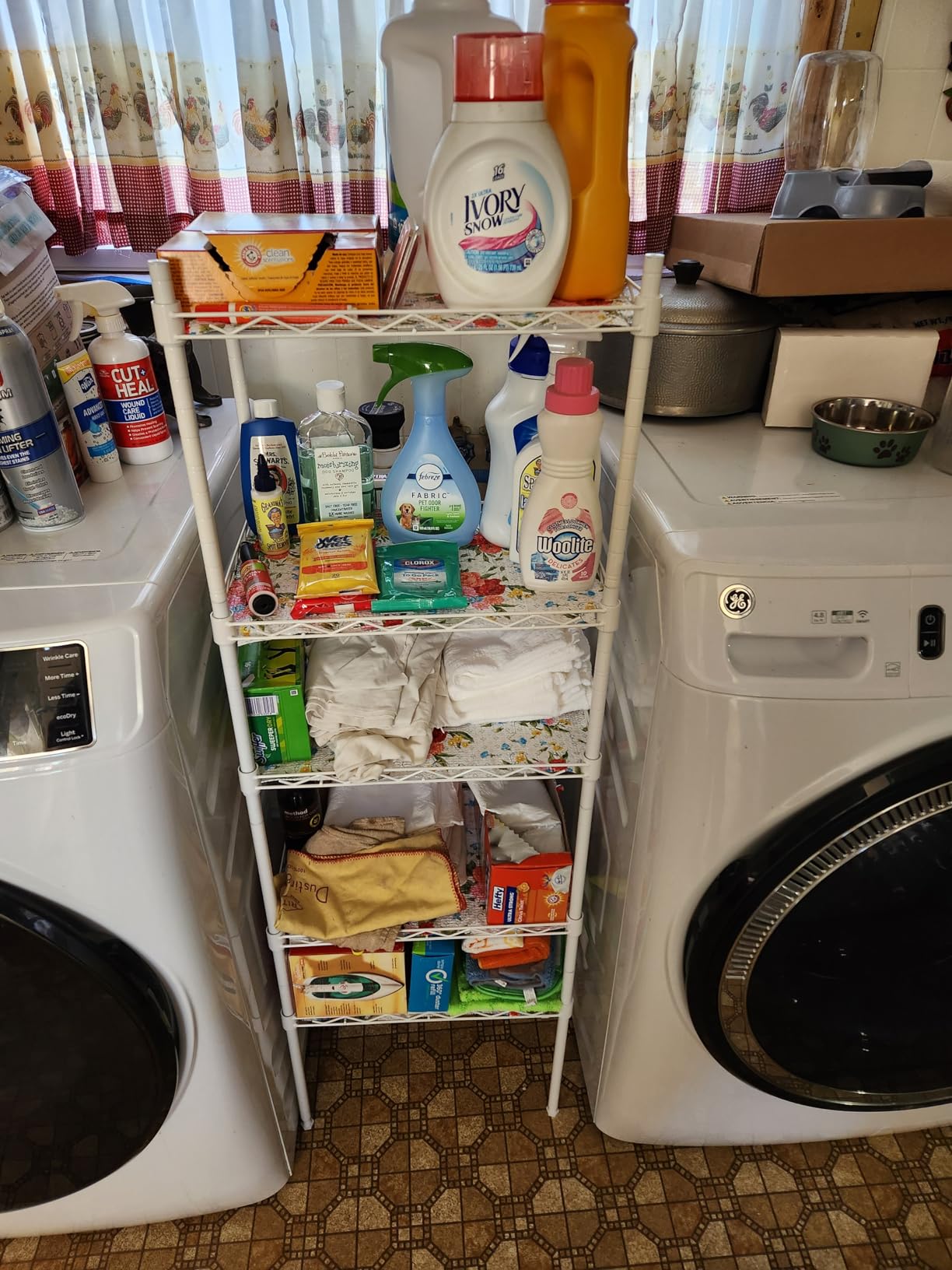
Check the lip height before loading tall tins
The lip is shallow, roughly an inch of raised edge, so it retains a rolling standard can but will not stop a tall tin from tipping if you load the shelf to the very front edge. Set the row back half an inch from the lip and this becomes a non-issue.
Adjustable feet let you level the rack on an uneven floor, which is common in older pantries where the subfloor dips near a wall. A rack that rocks eventually walks, and a rocking rack eventually dumps a shelf of cans.
Where it falls short
The cylinder-style shelf brackets are the assembly complaint. They can pop off the poles while you are trying to seat a shelf, and since the parts are not labeled to match the instruction letters, sorting hardware is part of the build. Budget an extra 10 minutes.
Shelf heights are adjustable in principle but require partially disassembling the unit to change, so treat them as set once built. There is also some wobble when the rack is lightly loaded; it settles under a full shelf of cans, but it will rock when nearly empty.
6. FIFO 54-Can Can Tracker Dispenser – Best for First-In-First-Out Rotation
FIFO Pantry Storage Organizer Dispenser Rack for Canned Goods/Drinks, 54-Can Capacity
16 D x 16 W x 12 H in
Plastic, white
2 shelves, holds 54 cans
20.5 lbs per shelf
14 oz unit weight
Pros
- Highest capacity in this roundup at up to 54 cans
- FIFO dowel design rotates older cans to the front automatically
- Racks link together to expand capacity
- Compact footprint fits inside standard cabinets
- Made in the USA
Cons
- Light plastic construction and dowels are less rigid than metal
- Two shelves only
- so cabinet height goes unused
- Manual loading means you must place cans in date order
If your problem is cans going bad in the back of the shelf, a rotating dispenser attacks the problem directly. This one holds up to 54 cans on two dowel-loaded shelves, and taking the front can shifts everything forward so the next one is always within reach.
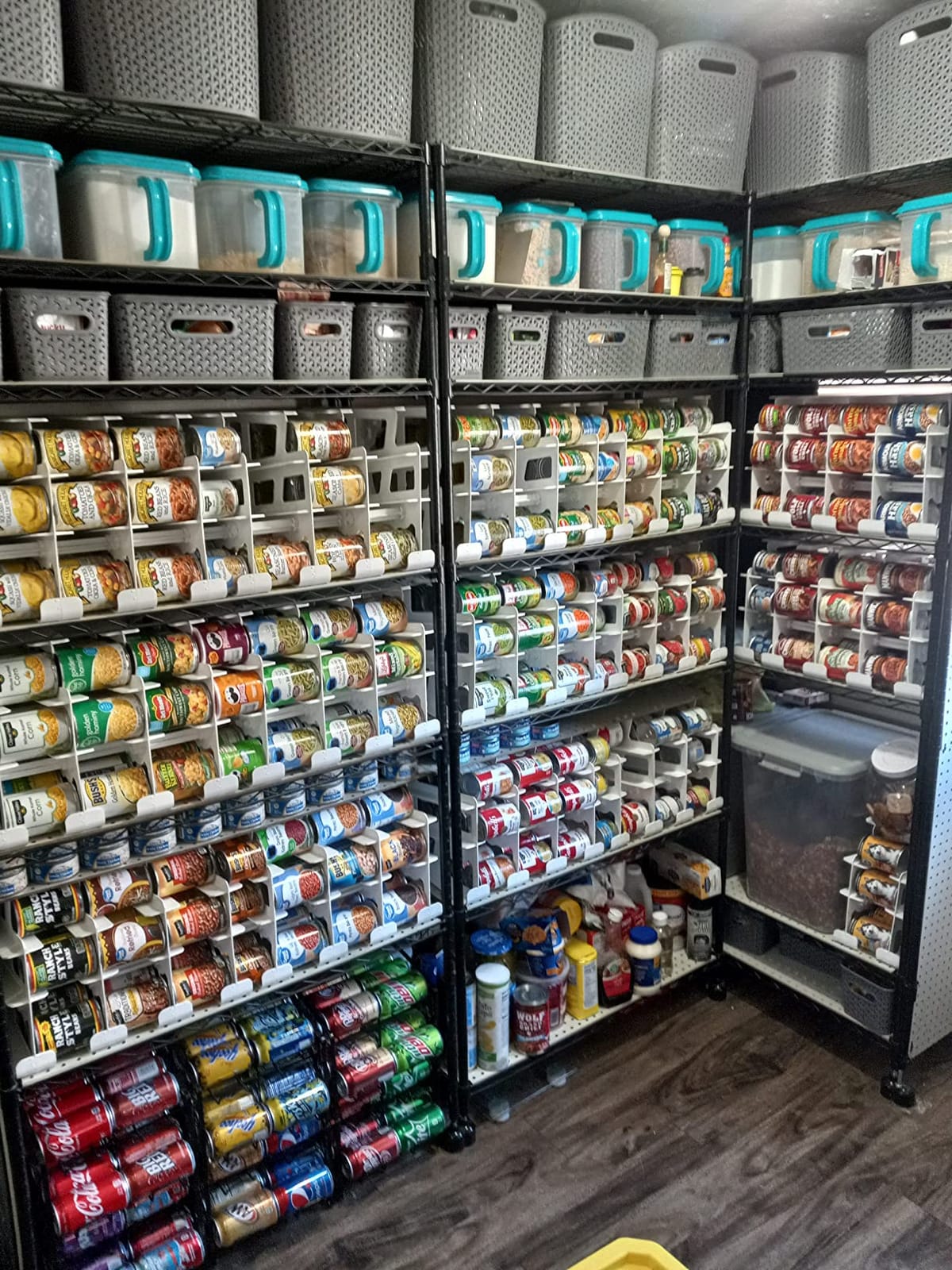
At 16 by 16 by 12 inches, it fits on a pantry shelf or inside a standard cabinet, and it weighs 14 ounces, so moving it is nothing. The dowels drop into the panels without tools, and multiple units link side by side to grow capacity as your collection does.
It carries a 20.5 pound rating per shelf, which is a static figure for a plastic unit. In practice a full load of 27 cans per shelf is well inside that, and canned goods are dense but evenly distributed when a dispenser is filled properly.
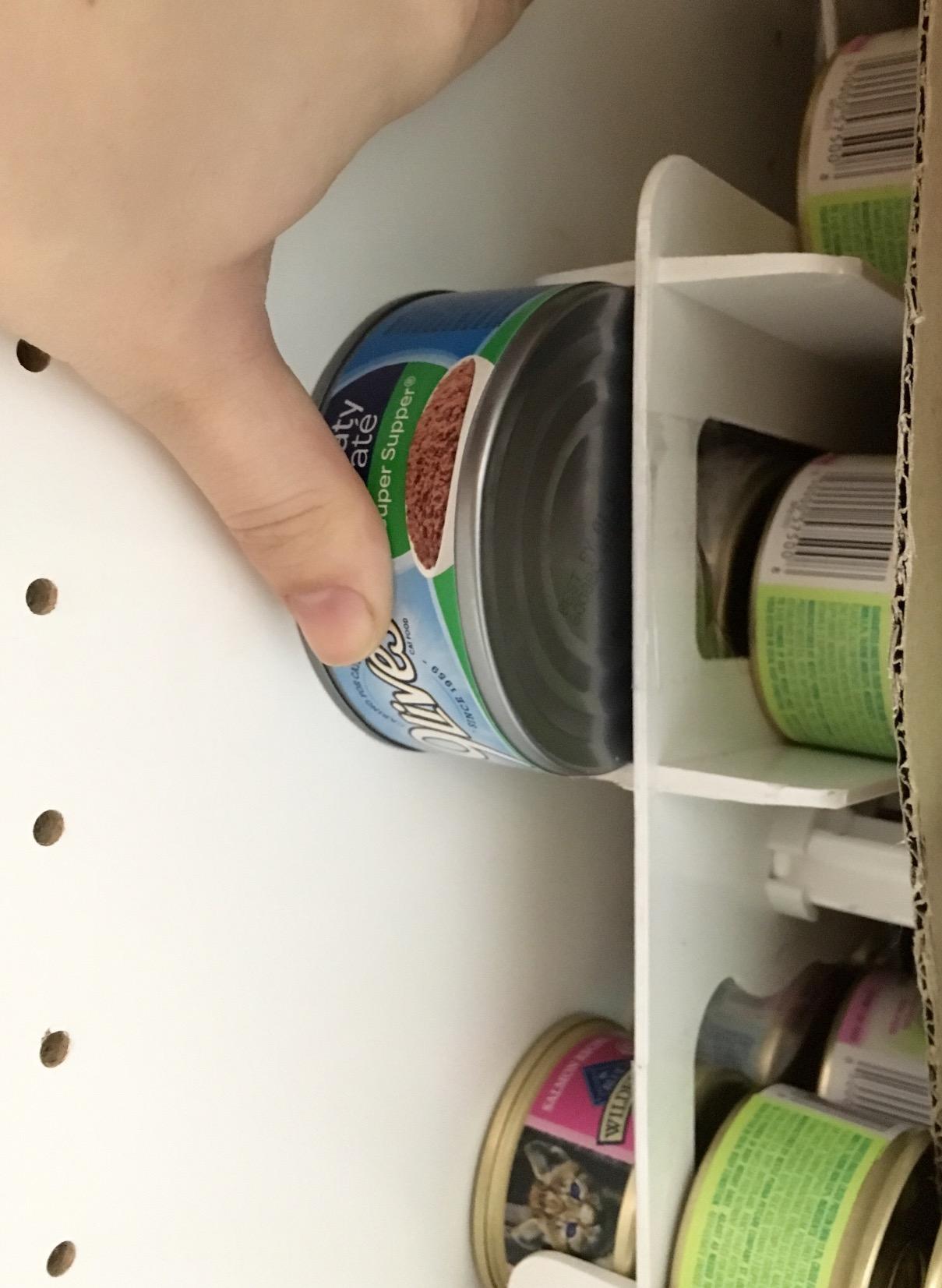
How to load it so rotation actually works
Load from the back first with your newest cans, then fill forward with the oldest. If you reverse that, the oldest can sits at the front and the system defeats itself. Set a reminder to date cans as you load them, because the dowels cannot read expiration dates for you.
Design a home for this unit by thinking about where you grab cans most often. A low cabinet near the counter is ideal. A top shelf where you have to reach over other goods is not, because rotation only saves food if you actually take cans from it.
Where it falls short
It is plastic with dowel rails rather than welded steel wire, so it is less rigid. Do not stack anything on top of it, and expect a little flex when you pull a can from the front row.
With only two shelves, it ignores the vertical space in a tall cabinet. If your problem is volume rather than rotation, a wire rack with five tiers will hold more in the same floor area. It also comes in several capacity variants, so double-check the can count on the listing before you commit.
7. Sakugi 4-Tier Heavy Duty Shelf – Best for Overweight Can Loads
Sakugi Storage Shelves – 4 Tier Shelf Organizer, Heavy Duty Garage Shelving Unit with Leveling Feet, Stable Metal Shelves Organizer for Pantry, Kitchen and Closet, 33.0″ W x 12.6″ D x 57.2″ H, Black
33 W x 12.6 D x 57.2 H in
Alloy steel, black powder coat
4 shelves
800 lbs total
0.9 in diameter tubes
Pros
- 0.9 in diameter tubes feel heavier than most wire racks
- Leveling feet plus an included wall fixing kit prevent wobble and tipping
- 12.6 in depth fits a narrow pantry wall while holding full-size cans
- Assembles in 10 to 15 minutes with two people
- Moves easily once built despite the thick tubing
Cons
- Shelf heights are fixed rather than adjustable
- Shelves meet at a mid-span seam that raises questions about the 800 lb rating
- Wire gaps mean small items need a liner or tray
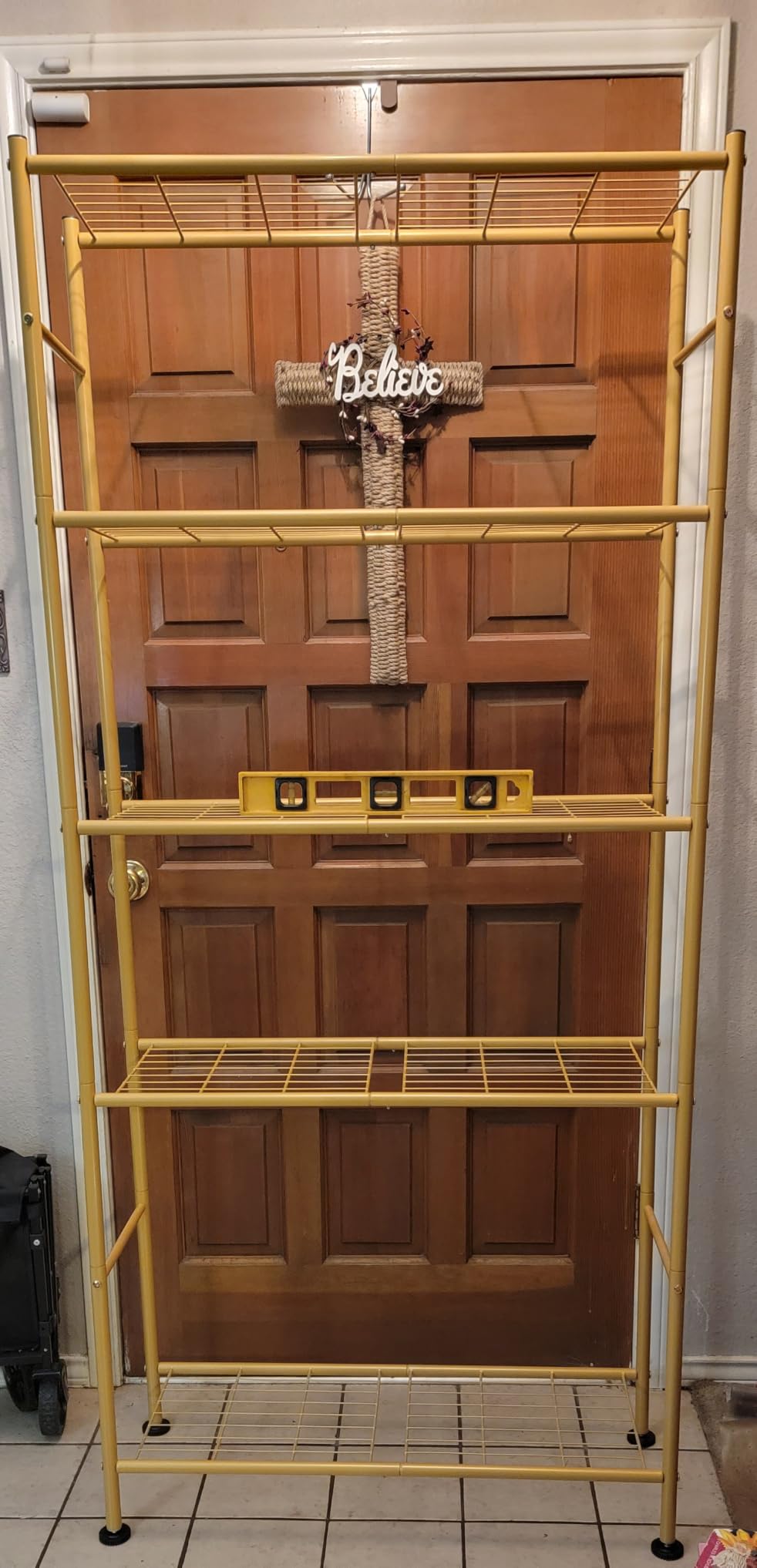
The Sakugi feels heavier than anything else its size in this list, and that comes down to 0.9 inch diameter tubes against the 5/8 inch posts on budget racks. The stated total capacity is 800 pounds, and the waterproof, rustproof powder coat is specified for wet-wiping.
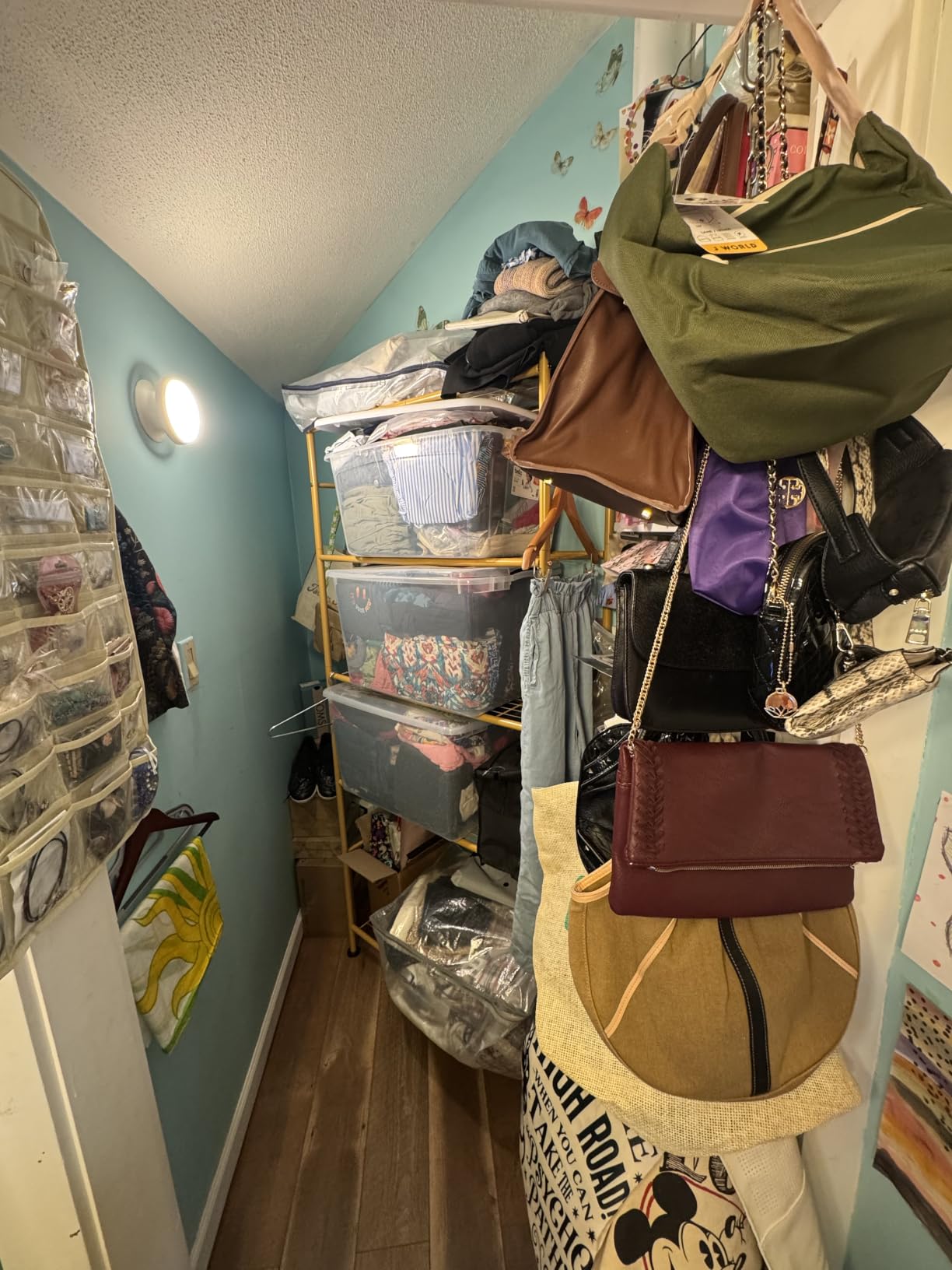
At 12.6 inches deep and 33 inches wide, it hits the sweet spot for canned goods: deep enough for a single visible row of standard cans, narrow enough to leave a walkway in a closet pantry. It is rated number one in its tool shelving category, which is a reasonable read on build quality.
Owners consistently call it sturdier than it looks, easy to assemble, and stable thanks to the four non-slip leveling feet and the included wall fixing kit. Two people and 10 to 15 minutes is the realistic assembly estimate.
Judge the load by the seam, not the number
The shelves meet at a mid-span seam, meaning the middle of each tier is a joint rather than continuous wire. Buyers raise questions about whether the 800 pound total figure holds when weight sits directly over that joint, and that is a fair thing to test with your heaviest case of cans first.
Place your heaviest case on the bottom tier near a post rather than centred over the seam, and work upward. This also lowers the centre of gravity, which is the cheapest anti-tip improvement you can make on any rack.
Where it falls short
Shelf heights are fixed. If you want a low tier for 15-ounce cans and a high tier for tall tins, this rack cannot do both, and adjusting later is not possible. Buyers also note that over-tightening bolts during assembly can ovalize the pole threads.
Wire gaps remain, so small cans and packets need a liner. The bracing is thinner than the heaviest racks here even though the tubes are thick, so treat the 800 pound rating as a real but not unlimited ceiling and keep cans off the very top tier if the unit is in a child-accessible pantry.
8. Seville Classics 5-Tier Wire Shelving – Best for Mobile Pantry Carts
5-Tier Steel Wire Shelving, 30″W x 14″D x 61.5″H
30 W x 14 D x 61.5 H in
Plated steel
5 shelves
300 lbs per shelf, 1500 lbs total
20.5 lb unit weight
Pros
- 300 lbs per shelf and 1500 lbs total on leveling feet
- Five shelves adjust at 1-inch increments
- Four 1.5 in casters with two locking plus four leveling feet included
- Limited 10-year manufacturer warranty
- Solid steel build with a durable plated finish
Cons
- Highest price point among the wire shelving options here
- Capacity falls to 110 lb on the included casters
- Heavier build than most pantries need
This rack ties for the highest average rating in the group at 4.7 stars, with 84 percent five-star ratings, and it is the only one here with a limited 10-year manufacturer warranty. At 30 inches wide, 14 deep, and 61.5 tall, it is also the tallest rack we tested in this roundup, which is why it holds the most cans per square foot of floor.
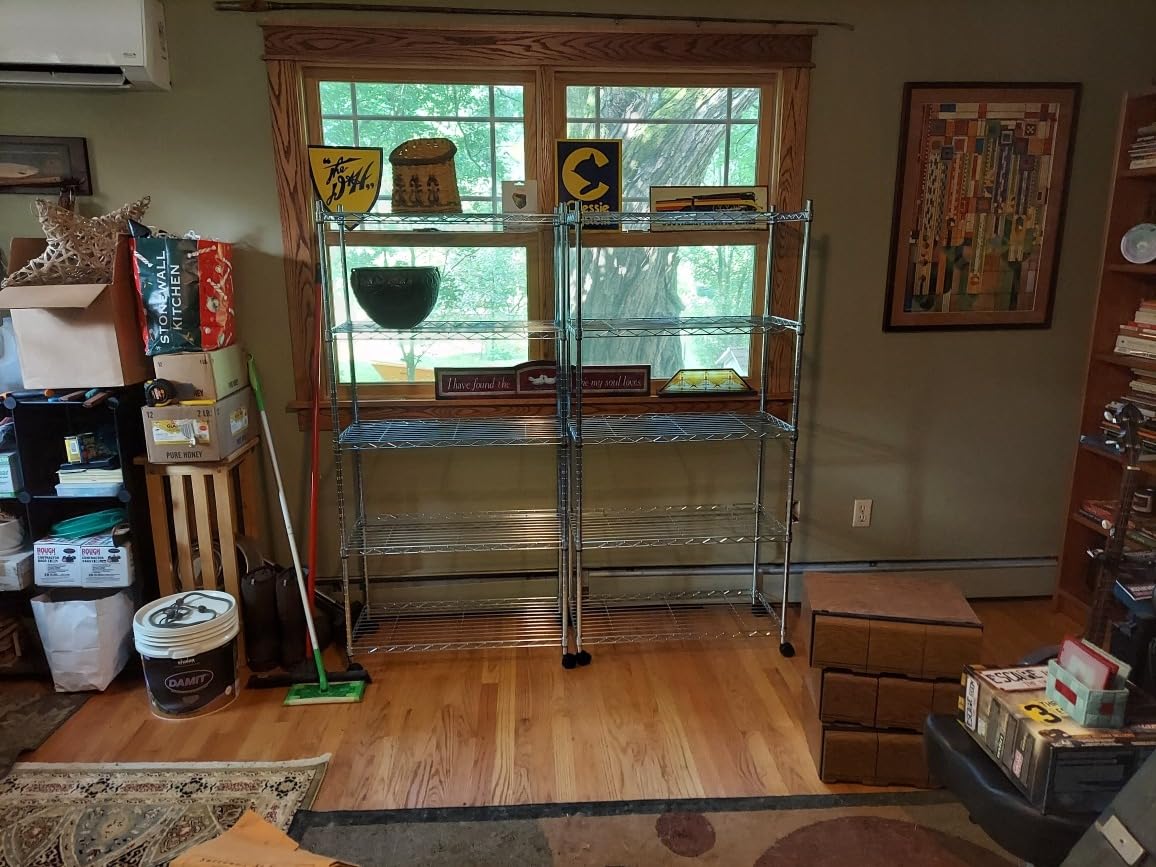
The rating is 300 pounds per shelf and 1500 pounds total on the leveling feet, distributed across five shelves that adjust at 1-inch increments. For canned goods, that is a load rating you will never approach and adjustability you will use constantly.
It includes four 1.5 inch casters, two of them locking, plus four leveling feet. That combination makes it a genuinely mobile pantry cart: roll it out to the counter when you do a big shop, lock it, and level it when it is parked.
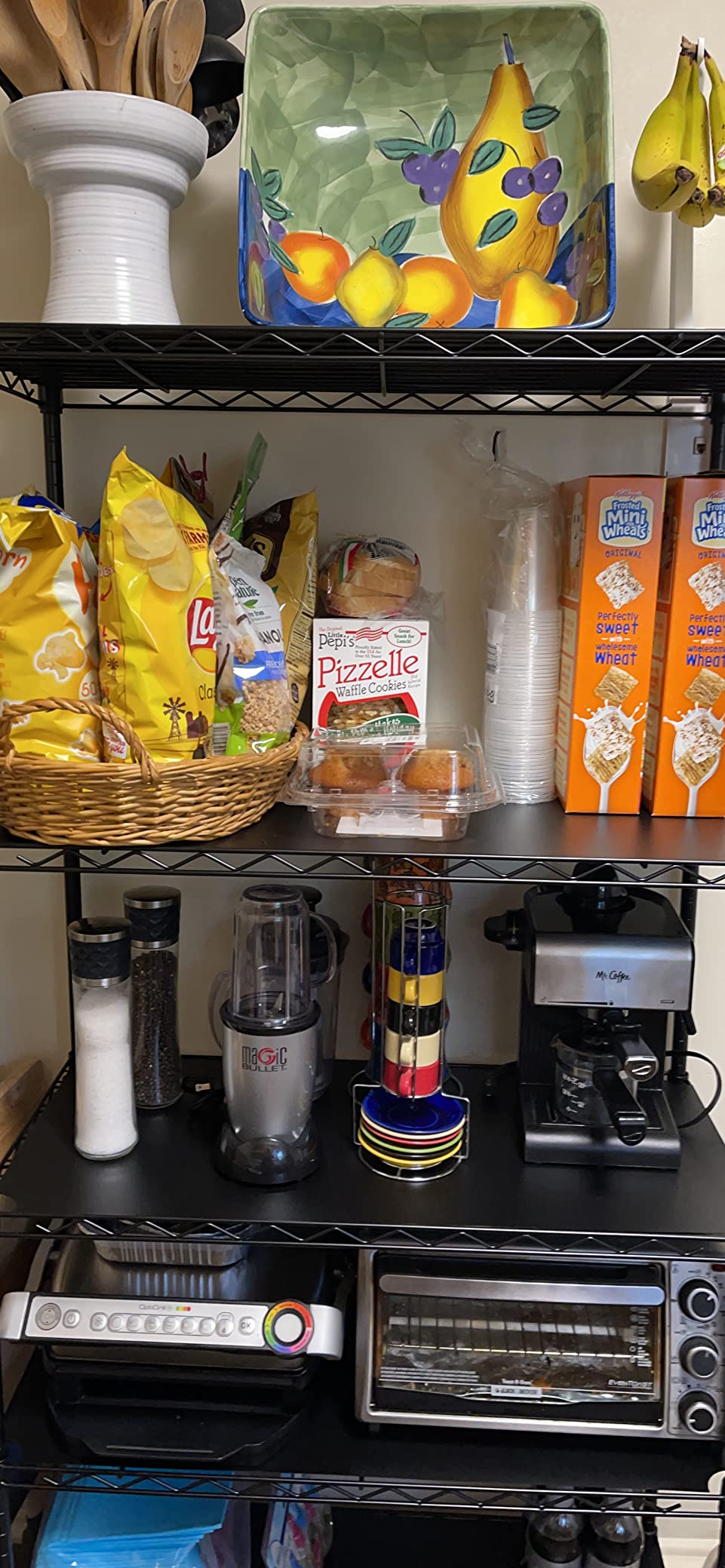
Plan for the caster rating, not the shelf rating
On casters, total capacity drops to 110 pounds. That sounds alarming until you do the math: 110 pounds is roughly 35 to 40 standard cans, which is a perfectly normal weekly pull for a family of three. The number only becomes a problem if you plan to load the whole rack and wheel it around.
Load cans low when the cart is moving. Heavy tiers on top make the cart top-heavy, and a top-heavy cart of cans is exactly the toppling scenario organizing forums keep warning about.
Where it falls short
It is the most expensive wire shelving option in this roundup, and for a modest pantry that spend is hard to justify. You are paying for steel gauge, adjustability, wheels, and a warranty, none of which a small kitchen needs.
The other limitation is capacity in use. A 61.5 inch tall rack needs clearance to assemble and to tip upright, so measure your doorway and ceiling before ordering. Reviewers also flag that the build is heavier than most pantries actually need.
9. Kitchen Details 3-Tier Can Organizer – Best for Pantry Drawers and Cabinets
Kitchen Details 3 Tier Can Organizer | Chrome Steel Canned Food Storage Rack | Holds 36 Cans | Space-Saving Pantry & Cabinet Storage Solution | Easy Access to Canned Goods | Freestanding Design
14.5 D x 11.5 W x 11 H in
Chrome-plated steel
3 tiers, holds 36 cans
36 lbs per shelf
2.4 lb unit weight
Pros
- Open front makes every can visible at a glance
- Assembles in about a minute with no tools
- Compact enough for a pull-out pantry drawer or cabinet
- Frees shelf space previously lost to stacked cans
- Three tiers turn a four-can stack into a twelve-can row
Cons
- Wire frame feels flimsy when fully loaded
- Can rims snag on the wires as they roll forward
- Rubber feet pop off easily and there are no clips to join two units
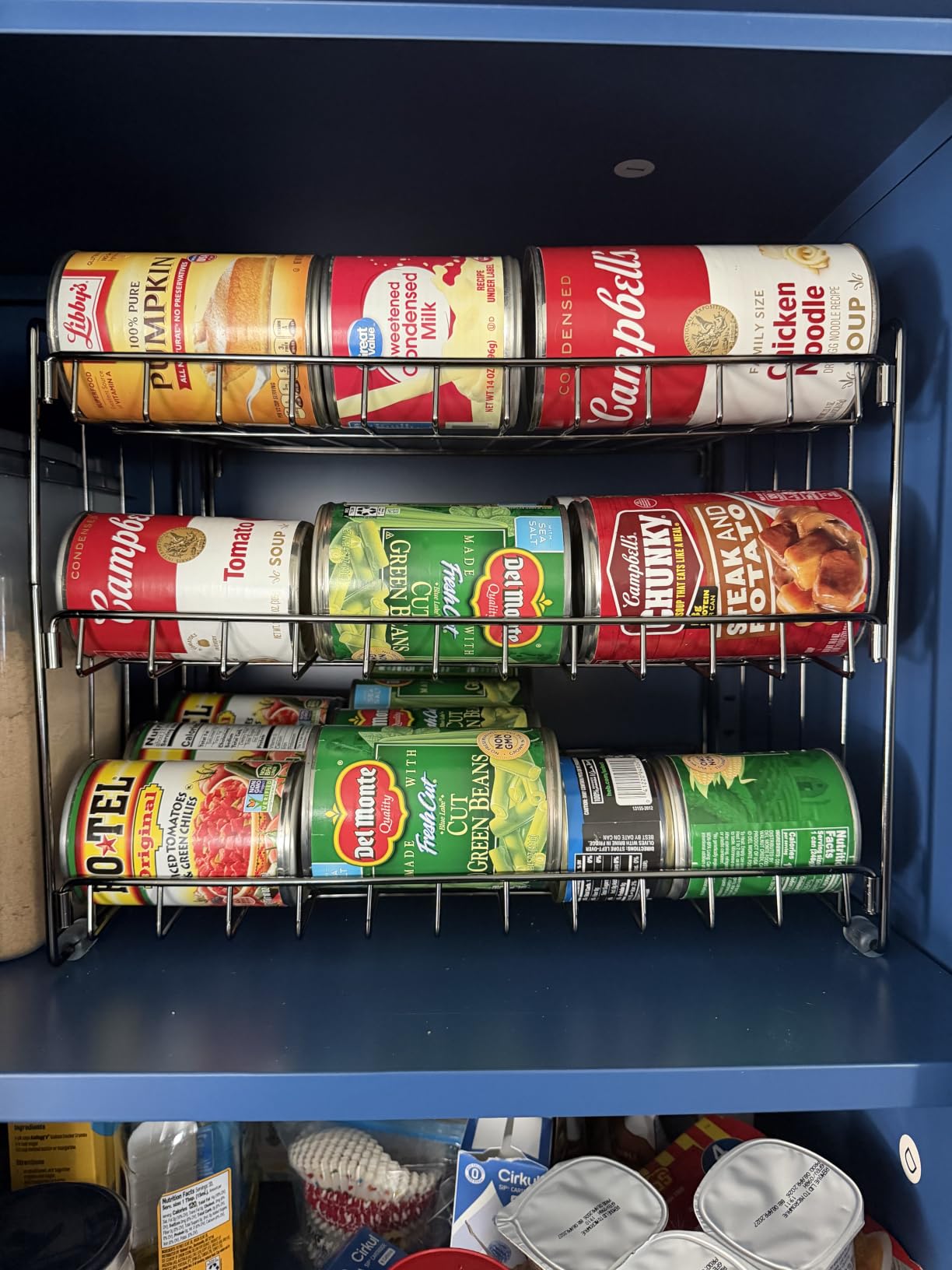
This is the simplest answer to a narrow problem: you own 36 cans, you do not want to stack them, and you want to see the labels. The open front means the whole inventory is legible at once, which is the single most effective way to stop re-buying what you already own.
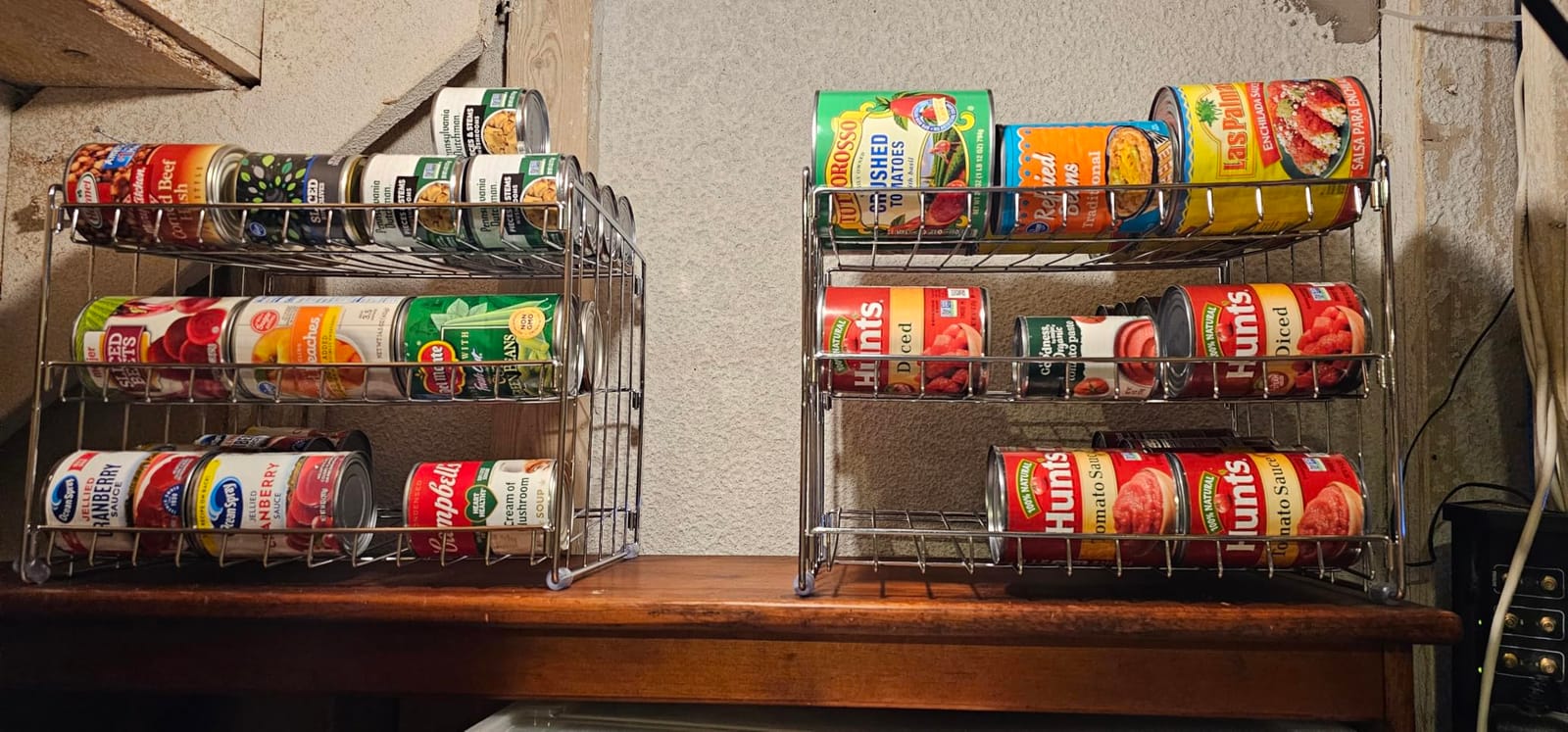
At 14.5 by 11.5 by 11 inches and 2.4 pounds, it moves between a pantry shelf, a cabinet, or a pull-out drawer without any fuss. Assembly is about a minute with no tools, and each shelf is rated at 36 pounds, which covers roughly a dozen standard cans.
Because it is designed to sit on an existing surface, it converts dead shelf space. A tier that previously held a stack of four cans now holds a visible row of twelve.
Check the 11 inch height against your pantry door
The height is fixed at 11 inches, and that is the number to measure first. A tall pantry door that swings shut over the shelf will not close with this organizer sitting on it, which is a common and easily avoidable frustration.
It is also not adjustable, so there is no way to make room for oversized tins. If your cans are mostly standard 15-ounce size, that is fine. If not, skip it.
Where it falls short
The wire frame feels flimsy when fully loaded, and reviewers report the can rims snagging on the wires as they roll forward. Snags bend can rims, and a bent rim can weaken a seam over time, so load it gently rather than shoving cans in.
There are no clips to hold multiple units together, and the rubber feet pop off easily, which can leave it sliding on a smooth shelf liner. Treat it as a single-organizer solution, not a modular system.
10. ClosetMaid 3-Tier Wall Mount Rack – Best for Renters Who Cannot Drill
ClosetMaid 3-Tier Hanging Wall Mounted Metal Rack for Spices, Shelf Storage, Pantry Organization, Laundry, Kitchen, Bathroom, White, 8022
5 D x 18.8 W x 18.5 H in
Epoxy coated steel, white
3 fixed shelves, 5 D x 18 W
Wall mount
2 lb unit weight
Pros
- Wall-mounted design adds storage without using floor space
- Hangs inside a cabinet door or on a wall
- No assembly required
- Epoxy coated steel wipes clean and resists moisture
- Hardware included for drywall
- cabinet doors
- wood or particleboard
Cons
- 5 in depth limits it to small cans and jars
- Shelf heights are fixed and not adjustable
- Not a freestanding design so it cannot be moved once installed
If you rent, the floor is not yours and the walls are not either, but the inside of a cabinet door often is. This rack hangs there and gives you three fixed shelves measuring 5 inches deep by 18 inches wide, rated 4.7 stars across more than four thousand reviews.
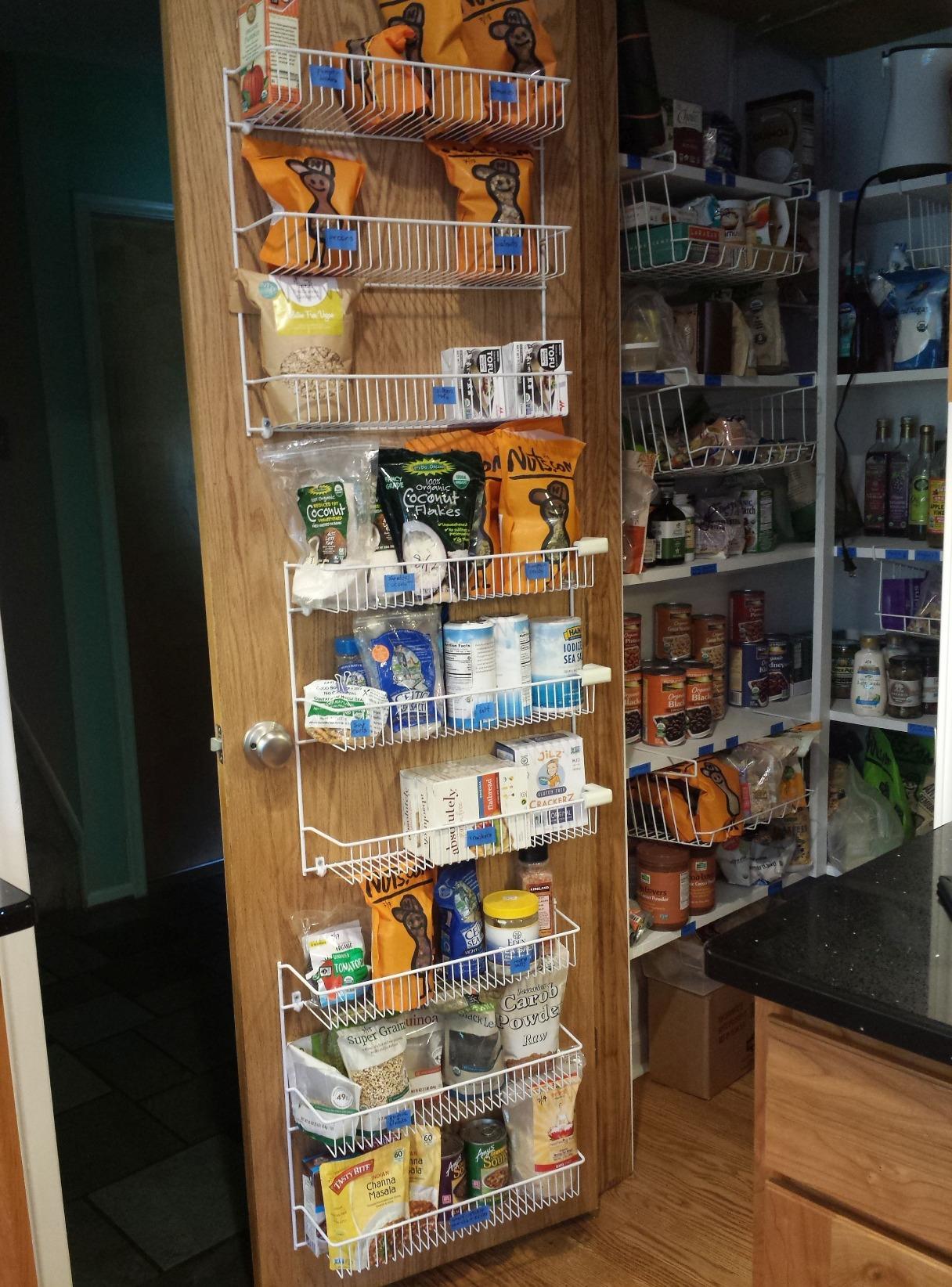
There is no assembly at all. Mounting hardware is included for drywall, cabinet doors, wood, and particle board, and the epoxy coated steel wipes clean and shrugs off moisture. In a kitchen where humidity is the reason MDF shelves swell and crumble, coated steel is the right material.
The trade is depth. At 5 inches, this holds small cans, spice jars, sachets, and packets. Standard soup and tomato cans will not fit, so this complements your main can shelving rather than replacing it.
What this rack is actually good for
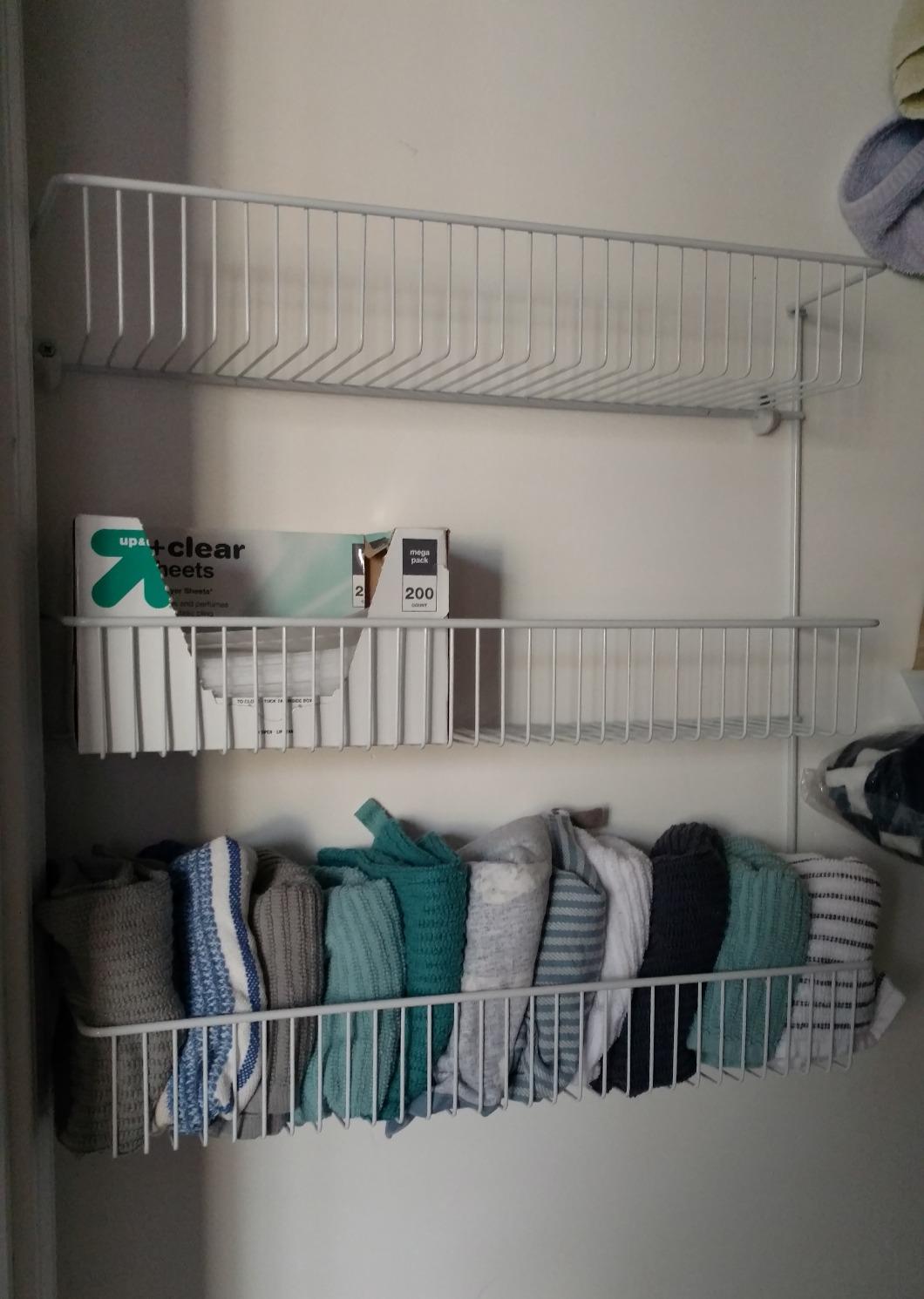
Think of it as the overflow shelf. The small cans, the spice jars, the seasoning packets, and the sachets that currently fall through wire shelves all fit on three fixed tiers that hang inside a cabinet door. That is inventory you already own and cannot currently store anywhere sensible.
Houzz homeowners recommending adjustable shelf systems are usually solving a different problem, tuning height to reach. This one cannot do that, so use it for small items and reserve adjustable shelves for the cans themselves.
Where it falls short
Five inches is the hard limit, and no arrangement changes it. Anything taller than a small can simply will not go on, and shelf heights are fixed at 18 inches of overall width with three tiers.
It also cannot be moved once installed, and it needs a sound mounting surface. On drywall alone use the proper anchors, and if you cannot drill at all, confirm the cabinet door is thick enough and rigid enough to carry the load before you rely on it.
How to Load Cans for First-In-First-Out Rotation
Even the best shelf does not save you money if the oldest can sits in the back. Loading method matters as much as the unit, and this is the routine that organizing forum threads converge on.
Sort before you load. Gather every can from the pantry and group them by type, then by date. Oldest date first, newest last.
Load the back row first. Place the newest cans at the very back of the shelf, against the wall or the unit’s back edge.
Fill forward toward the front. Each new row goes behind the older one, so the oldest can always ends up at the front edge facing you.
Keep cans in a single row where depth allows. On a shelf deeper than about 14 inches you can add a second row of small cans behind, but keep the front row front-facing and one deep.
Never stack cans on cans. A top can on a bottom can is unstable, and toppled towers are the reason cans end up on the floor and out of your inventory.
Label the front row with dates. A strip of masking tape with the oldest date on the tier removes all guesswork.
Pull from the front only. When the front can is gone, slide the next one forward rather than reaching to the back. That is what keeps the system working.
Do a monthly front-to-back check. Two minutes a month is enough to catch anything pushed behind a new purchase.
If you skip the discipline and simply stack by type, you will re-buy what you already have. That is the most common complaint in pantry threads, and it is a loading problem rather than a shelving problem.
Buying Guide: Choosing Pantry Shelving That Holds Canned Goods
Measure the space before you measure anything else
Tape the floor area and record width, depth, and the distance from the floor to the lowest obstruction. Standard units here are 30 to 36 inches wide and 10 to 14 inches deep, so a 24 inch closet gap only accepts the narrow racks. Check the door swing as well: a door that opens past the shelf front makes the front row of cans hard to reach.
Also measure the assembly ceiling. A 61.5 inch rack needs clearance to be built flat and then tipped upright, and that is how a good shelving purchase turns into a doorway problem on delivery day.
Per-shelf capacity is not total capacity
This is the most misquoted number in shelving. Per-shelf ratings assume the weight is evenly spread across that one tier. Total ratings assume the same even spread across every tier. Neither assumes you stack cases of tomato sauce on the top shelf, which is exactly what people do.
As a rule of thumb, budget 10-15 pounds per square foot of loaded shelf for canned goods. A 30 by 14 inch shelf is about 2.9 square feet, so a realistic full load is 30-45 pounds. Every per-shelf rating in this roundup sits far above that, which is good news: canned goods are not actually heavy for a properly built steel rack. The failures we see come from sagging particleboard, not from capacity limits.
Shelf depth decides single row or double stack
A standard can is about 2.6 inches in diameter. Single-row storage needs roughly 3.5 inches of depth per can plus clearance, so anything at or above 12 inches comfortably holds a visible single row. Between 10 and 12 inches you can still do it, but cans sit close to the front edge.
Under 10 inches, and you are into double-stacking or leaning cans, which is where forgotten food and toppled towers begin. Under 6 inches, as on the wall-mounted rack, you are looking at small cans and jars only. A worked example: on a 30 inch wide shelf, roughly 11 standard cans fit in one row with normal spacing, so a 14 inch deep shelf holding one row gives you about 11 visible cans per tier.
Wire, solid, and wood-topped shelves
Wire is the standard for metal pantry racks and the only realistic option at this capacity. Its advantage is airflow, which matters in a humid pantry, and price. Its disadvantages are the gaps that let small items fall through, and the fact that glass jars can teeter on a backless design with no rear rail.
Solid and wood-topped shelves stop anything from falling through and look better in a kitchen, but they cost more, weigh more, and can swell at the joints in humid rooms. If your pantry holds both cans and lots of jars, a wire unit with plastic or vinyl shelf liners gives you the best of both.
Adjustable shelf height beats fixed height for cans
Adjustable tiers, usually in 1-inch increments, let you dedicate a low shelf to short cans and a high shelf to tall tins. Fixed-shelf units force one compromise for everything. The trade-off is assembly convenience: on several units here, changing shelf heights after the build means partially disassembling the rack, so set your spacing before you tighten anything.
As a general rule, leave an inch or two of clearance above the tallest can on each tier, and put your heaviest cases on the lowest shelf. That keeps the centre of gravity down and stops the unit tipping when you pull weight off a high tier.
Rust and acid resistance for preserves
Tomato sauce, vinegar, and other acidic preserves are harder on metal than dry goods are. Look for a powder-coated or epoxy-coated finish rather than bare or bright-plated steel, and wipe spills rather than letting them sit. The BestOffice and Sakugi units here both specify powder-coated finishes for this reason, and the REGILLER rack is coated against water, rust, and corrosion.
Avoid MDF or particleboard shelving in a humid pantry or anywhere you store preserves. It swells at the joints, and once it swells it does not recover.
Wall-mounted, freestanding, and over-the-door
Wall-mounted racks add capacity without touching the floor, which matters in a renter situation or a pantry where floor space is already spoken for. The trade is 5 inch shelf depth and fixed heights, so treat them as overflow for small cans and jars.
Freestanding racks give you depth and adjustability but need a flat spot on the floor. Over-the-door organizers are a different category again, and none of the units here uses that mounting style. Can organizers and dispensers, the fourth category, sit on top of existing shelving and solve rotation rather than capacity.
Anti-tip safety and assembly reality
Any unit over about five feet tall should be anchored, and several picks here include a wall anchor kit or wall fixing kit. If you have small children or live in an earthquake zone, treat anchoring as mandatory rather than optional. Leveling feet solve uneven floors but not tip risk, and they are the reason a heavy load on a high shelf can bring a rack down.
Finally, be honest about assembly. Tool-free snap-together builds take 15 to 20 minutes and need patience with plastic sleeves and clips. Screw-nut builds take longer but stay rigid. If a hex key is a deal breaker for you, pick one of the boltless units and expect to re-seat a few shelf supports along the way.
Shelf Liners: When Wire Gaps Let Small Cans Drop Through
Wire shelves drop small items, and it is the most common complaint about wire pantry racks. The gap between wires on budget units is often wide enough for a small can of tomato paste, a spice jar, or a packet of gelatin to pass straight through.
Two fixes exist. Cut a vinyl or plastic liner to the exact shelf size and lay it on the wire, which converts the wire tier into a solid surface with airflow intact. The second option is a solid shelf insert or tray, which is better if you also want to contain crumbs and spills from tomato and vinegar preserves.
Not every rack needs a liner. Densely spaced wire, as on the SINGAYE unit, is tight enough that small items mostly stay put. Standard-gauge wire on the wider chrome and black racks is where liners earn their keep, and they are cheap enough that adding one to every tier is a reasonable first move.
Frequently Asked Questions
What is the best pantry organizer for canned goods?
The best pantry organizer for canned goods is a powder-coated steel wire shelving unit with at least 12 inches of shelf depth, a per-shelf weight rating stated in pounds, and adjustable shelf height in 1-inch increments. For rotation rather than capacity, a rolling can dispenser that holds 36 to 54 cans is better, because taking one can moves the oldest to the front automatically.
What kind of shelving is best for a pantry?
Steel wire shelving is the best pantry shelving for most homes. It handles the 10-15 pounds per square foot of a loaded canned-goods shelf, wipes clean, allows airflow in humid spaces, and costs less than solid or wood-topped alternatives. Choose a unit with a coated finish if you store tomato sauce or vinegar, since acidic contents wear bare metal faster than dry goods do.
What are the disadvantages of using wire shelving?
Wire shelving has three recurring drawbacks. The gaps let small cans, spice jars, and packets fall through unless you add liners. Bright chrome finishes show flour and tomato dust immediately, while black powder coat hides it. Backless designs also give tall glass jars nothing to lean against, so they can tip on an unloaded shelf. Adjustable shelf heights on many budget racks require partial disassembly to change.
How much weight can a pantry shelf hold?
Read the per-shelf and total ratings separately, because they mean different things. A typical steel wire pantry shelf in this roundup is rated 250 to 350 pounds per shelf and 800 to 1500 pounds total when evenly distributed. A fully stocked shelf of standard cans realistically weighs 30-45 pounds, so capacity is rarely the limit. Failure comes from particleboard, unsupported spans, and a caster rating, which can be a fifth of the static figure.
Do I need shelf liners for wire pantry shelves?
You need liners when the wire gaps are wider than your smallest items. Densely spaced wire holds small cans on its own, but standard-gauge wire lets short cans, spice jars, and packets drop through. Cut a vinyl liner to the exact shelf dimensions to keep airflow while creating a solid surface, or use a solid shelf insert if you also want to catch crumbs and acidic spills from tomato and vinegar preserves.
Final Pick: Which Pantry Shelf Wins for Canned Goods
The best pantry shelving units for canned goods come down to two questions: how deep is your space, and do you need capacity or rotation. For a standard pantry with a straight wall, the Amazon Basics 4-Shelf wire rack wins on measured performance, with 350 pounds per shelf, 1400 pounds total, 14 inches of depth for a single visible row, and 1-inch shelf adjustment across the most-reviewed unit we evaluated.
Buy the Simple Houseware 3-Tier organizer instead if your real problem is cans expiring in the back, and pick the SINGAYE rack if the only free space is a corner. For renters, the ClosetMaid wall rack costs no floor space and no drilling. Whichever you choose, load newest at the back, oldest at the front, and keep cans one row deep where the depth allows. That habit, more than any spec, is what stops you re-buying food you already own in 2026.