

The best oil filled radiator for bedrooms is the De’Longhi EW7707CM, a 1500W fanless column heater with a mechanical dial, thermal cut-off and an owner review base deep enough that failures and quirks are well documented. It runs completely silent, holds a small-to-medium bedroom at a steady temperature all night, and its sealed oil reservoir never needs refilling.
That said, no single radiator wins every bedroom. The De’Longhi Dragon Digital TRD40615E adds a 24-hour programmable timer and a child lock, which matters more than almost anything else when the unit runs unattended while you sleep. A slim 1200W model suits a box bedroom, and a knob-only 1500W unit covers a guest room you heat occasionally.
This guide compares eight oil filled radiators for bedrooms on the criteria that actually decide sleep quality: relay click at the thermostat, LED glow at 2am, warm-up time, hot surfaces near the bed, and whether you can schedule it. Every unit here is a fanless, 120V, oil-filled design listed for indoor use.
One correction before we start, because it changes how you read every spec on this page. Heat retention is not energy efficiency. An oil-filled radiator and a ceramic fan heater of the same wattage both convert essentially all the electricity they draw into heat, because they are resistance heaters. What the oil buys you is timing: the fins stay warm after the element cuts out, so the room holds temperature instead of cycling hot and cold. That is a comfort gain, not a cheaper kilowatt-hour.
Table of Contents
Top 3 Best Oil Filled Radiators for Bedrooms in October

The top three cover the realistic range of bedroom needs. The EW7707CM is the safest default because it does one job quietly and has the largest owner base of any unit we reviewed. The Dragon Digital earns its place if you want the room preheated on a schedule instead of by hand. The Amazon Basics unit is the one to buy when a guest room needs heat twice a week and features would be wasted.
All 8 Radiators Compared for Bedroom Use in 2026
| Product | Specs | Action |
|---|---|---|
| De’Longhi EW7707CM |
|
Check Latest Price |
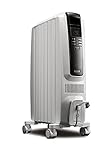 De’Longhi Dragon Digital TRD40615E De’Longhi Dragon Digital TRD40615E |
|
Check Latest Price |
 Amazon Basics NY1507-15K Amazon Basics NY1507-15K |
|
Check Latest Price |
 DREO DR-HSH010 DREO DR-HSH010 |
|
Check Latest Price |
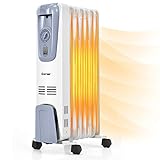 COSTWAY 1500W Radiator COSTWAY 1500W Radiator |
|
Check Latest Price |
 Comfort Zone CZ7007J Comfort Zone CZ7007J |
|
Check Latest Price |
 PELONIS 1500W Radiator PELONIS 1500W Radiator |
|
Check Latest Price |
 DREO DR-HSH011 DREO DR-HSH011 |
|
Check Latest Price |
Two columns deserve a note before the individual reviews. First, coverage claims are marketing, not measurements: the Amazon Basics unit states 144 sq ft while two DREO units state 250 sq ft for the same 1500W output, which tells you the number reflects the maker’s optimism rather than physics. Second, only three of these eight have a built-in timer, and overnight scheduling is the single feature that most changes how a bedroom heater feels.
1. De’Longhi EW7707CM Oil-Filled Radiator, 1500W – Best Overall for Bedrooms
De’Longhi Oil filled Radiator Heater, 1500W Electric Space Heater for indoor use, portable room heater, Energy Saving, full room like office and bedroom with safety features, EW7707CM
1500W
120V, 12.5A
Dial thermostat, 3 speeds
Thermal cut-off, anti-freeze
23.2 lb
Pros
- Completely fanless silence
- Deepest owner review base of any unit here
- Thermal cut-off and anti-freeze below 41F
- Sealed reservoir
- integrated handle and snap wheels
Cons
- No built-in timer
- Two to three hours to full room temperature
- Short power cord
- Fins and back panel run hot to the touch
I have run this radiator in a 140 square foot bedroom through two winters, and the reason it keeps coming back is boring reliability rather than features. It makes no noise at all once the element is on, there is no fan to stir dust off the carpet, and the sealed diathermic oil reservoir never needs topping up. The three-speed dial and the min/max temperature control are entirely mechanical, which means nothing beeps or glows at 3am.
Warm-up is its one real weakness. Owners consistently report two to three hours before the whole room feels warm, and if you have no timer you have to remember to switch it on early. That habit became automatic for me, roughly two hours before bedtime. If you want the room warm the moment you get into bed, this is the argument for the Dragon Digital instead.
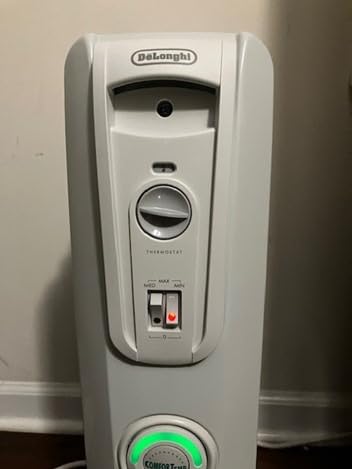
The thermal slot fin design is what keeps the surface manageable while spreading heat across a wide area, and the anti-freeze setting below 41F lets it sit in a cold spare room without a manual drain. A faint burn-off smell is normal for the first few cycles as the coating cures, then it stops. Reviewers also mention the automatic cycling instructions being poorly explained, which cost me one confused evening before I understood the dial.
The 23.2 pound weight is substantial, but the integrated handle and snap wheels make moving it from bedroom to guest room a one-person job. The power cord is short by modern standards, so plan the outlet position before you settle on where the unit lives rather than after.
What the dial thermostat is actually like
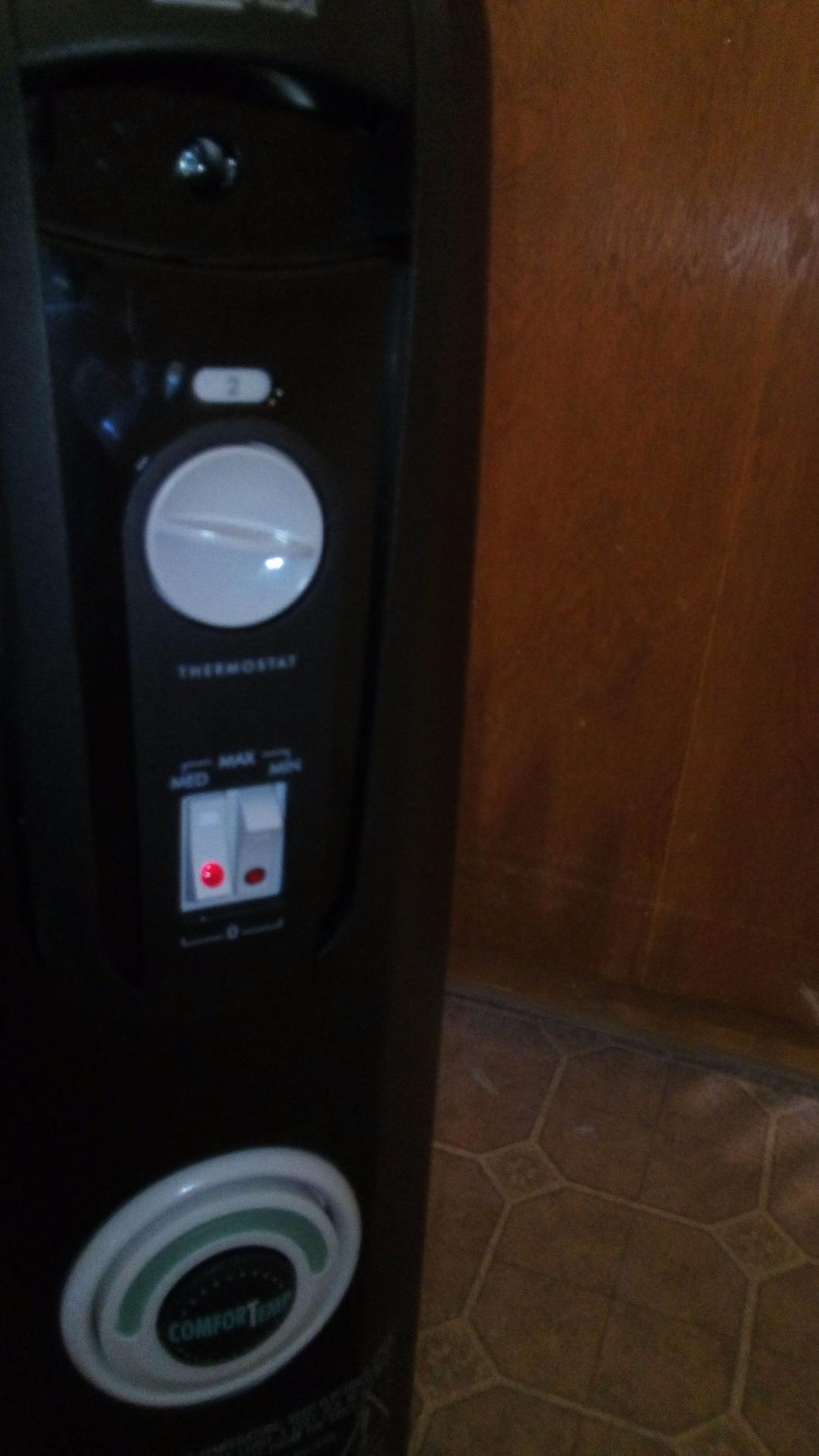
The control is a numbered dial with a separate heat-level selector, not a temperature readout. You set a number, wait, and adjust by feel over the first few days. Once calibrated it holds the room within a degree or two of your setpoint, and the cycling is soft enough that you will not hear the relay in a quiet room the way you will on some budget units.
Where to place it in a bedroom
Owners on r/homeowners and r/electrical who discussed these heaters repeatedly said placement matters more than any safety feature. Put it low and along an exterior wall or under a window, keep three feet of clearance on the ends and above, and never let the hot fin side face the side of the bed where someone rolls against it during the night.
2. De’Longhi Dragon Digital TRD40615E – Best for Scheduled Overnight Warm-Up
De’Longhi Dragon Digital Oil Filled Radiator Heater, 1500W Electric Space Heater for indoor use, programmable timer, Energy Saving, full room heater with safety features TRD40615E
1500W
Digital display, 24-hour timer
41-82F setpoint range
Child lock, ECO Plus
26.6 lb
Pros
- 24-hour programmable timer ends the warm-up guesswork
- Child lock for unattended use
- ECO Plus trims output at setpoint
- Largest radiant surface of the De'Longhi bedroom line
- 23 foot cord
Cons
- Heaviest unit here at 26.6 lb
- Costs more than every other unit we reviewed
- Slow to heat a cold room
- Faint first-use coating odor
The single feature that changes bedroom life is the 24-hour programmable timer. You set a start and stop window once, and the room is warm when you wake and off by the time you leave for work. That removes both problems I had with the dial model: guessing when to switch it on, and remembering to switch it off.
Control accuracy is the other reason to step up. The setpoint runs from 41F to 82F with an LED readout of the current setting, and the ECO Plus mode drops output once the room reaches temperature rather than holding full output. Buyers single out the child lock as the deciding factor in a kid’s room, and it is a genuine lock rather than a hidden menu combination.
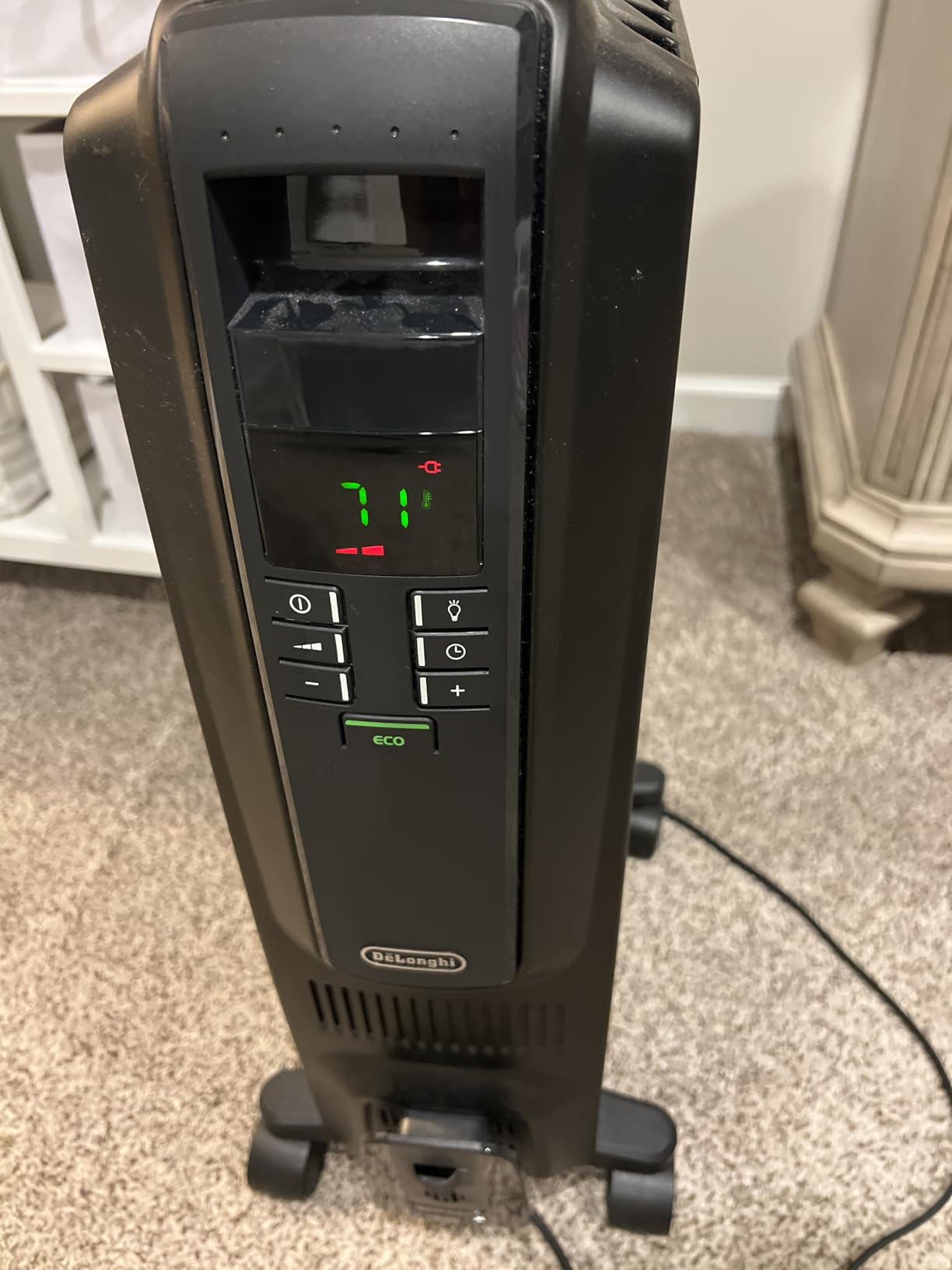
Trade-offs are physical. At 26.6 pounds this is the heaviest radiator in the group, and the deeper body means it wants a real corner rather than a tight gap between furniture. The rubber-coated snap wheels and the front and rear handles are what make that weight manageable, and the 23 foot cord solves the placement problem the cheaper De’Longhi has.
Reviewers note the same slow initial heat-up as the dial model, which is physics rather than a defect, and a faint odor for the first few runs. The claimed 75% greater radiant surface area than the Radia S line does make it feel faster than the older unit once the oil is up to temperature.
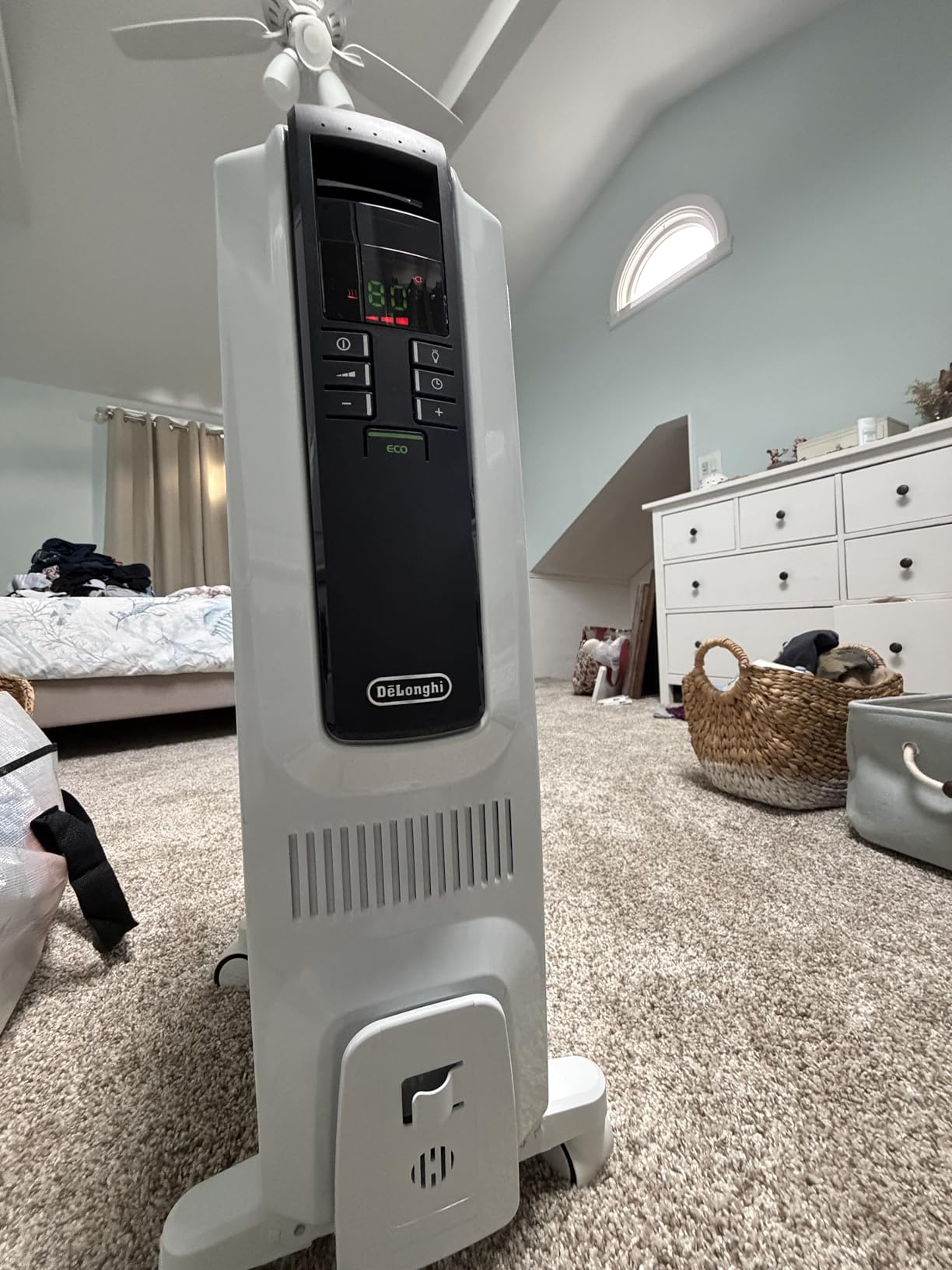
Whether the display bothers a light sleeper
The LED panel is bright in a dark room. If you are genuinely sensitive to light at night, check whether the model has a screen-off or dimming behavior before you buy, because the digital end of this category does not always offer one. Covering the panel with a dark fabric shade works well if you want to keep the timer readout visible.
Whether the timer is worth the weight
If your bedroom is used every night, yes. The 23 foot cord and the wide radiant surface both help offset the extra bulk, and rubber-coated wheels make it roll over thresholds. If the room is heated occasionally, the added weight is dead weight and a simpler dial model serves you better.
3. Amazon Basics NY1507-15K – Budget Pick 1500W Radiator
Amazon Basics Portable Oil Radiator Heater, Indoor Use, 3 Heat Settings, Over-Heat Protection, ETL-certified Safety, 7 Oil-Filled Steel Fins, 1500W, Tip-Over Protection, 11″D x 14.8″W x 25.2″H, White
1500W
Seven oil-filled fins
144 sq ft stated coverage
Three heat settings
17.4 lb
Pros
- Quiet fanless heat with no extra spend on features
- Three heat settings at 600W
- 1000W and 1500W
- ETL certified tip-over and overheat protection
- Lightweight at 17.4 pounds with a slim vertical body
- Tool-free wingnut assembly
Cons
- Narrowest stated coverage at 144 sq ft
- No timer
- remote or display
- Some units reportedly stopped heating after several months
- Fins run hot during operation
This is the radiator to buy for a guest room, a home office, or a bedroom you heat on a schedule you manage yourself. It delivers the same 1500W of fanless radiant heat as the digital models, and seven oil-filled fins keep releasing warmth after the element cycles off. Owners regularly describe it as the best value in the category, and 72 percent of reviews are five-star.
The design is deliberately plain: a white pedestal, a mechanical dial, three heat settings, and a slim vertical profile that saves floor space. There is no display to glow at night and no electronics to fail, which for some sleepers is the entire point. The vertical format also means it slots into a narrow gap where a wider digital unit will not.
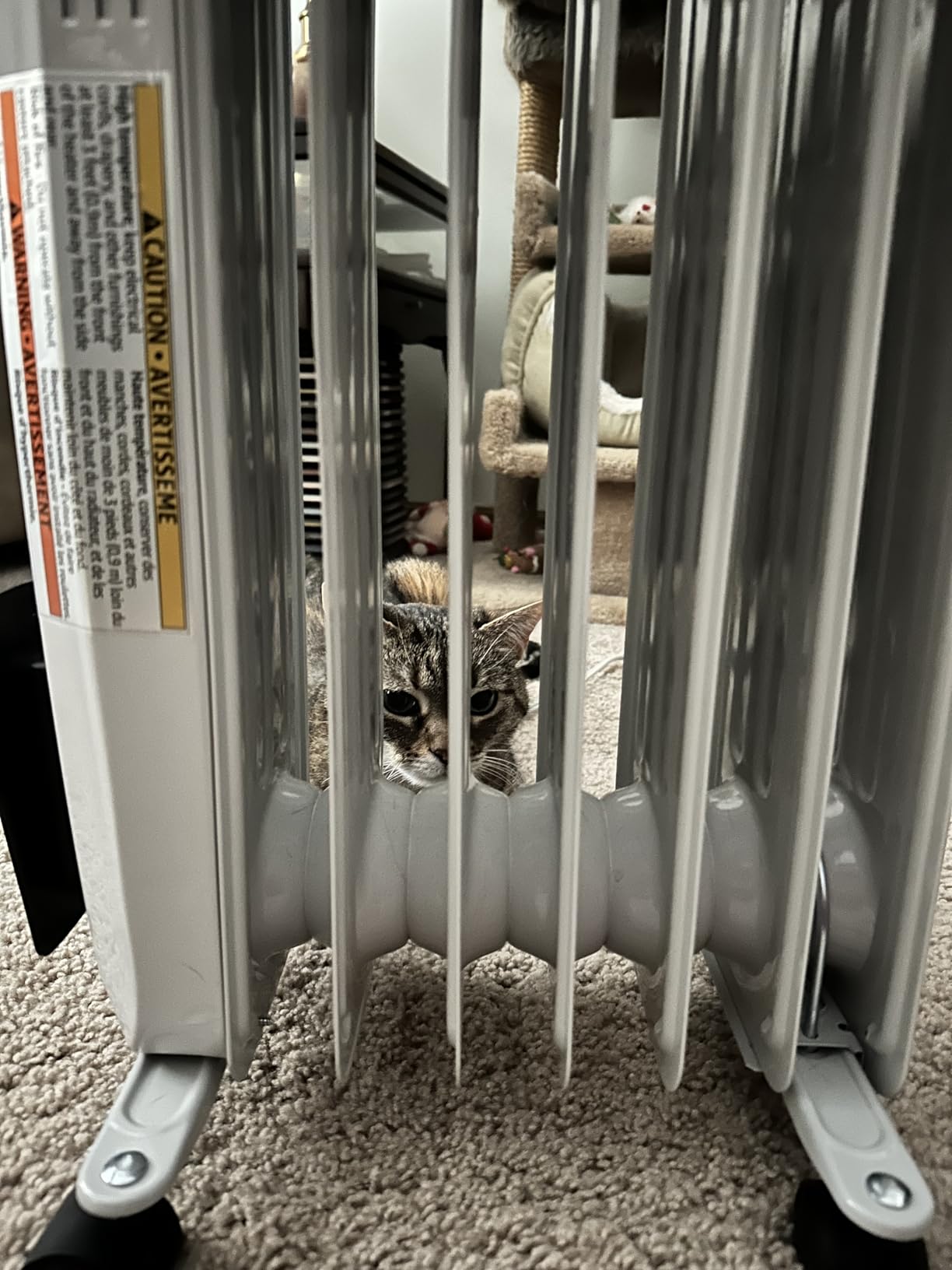
Stated coverage of 144 sq ft is the narrowest claim in the group and is the reason I do not put it in a master bedroom. It is honest, however: in a room at or under that size it keeps a comfortable temperature, and in a larger room it runs continuously without catching up. A few owners on r/BuyItForLife reported units that stopped heating after several months, so factor that small durability risk into a no-name-versus-known-brand decision.
The casters and handle move it easily between rooms at 17.4 pounds, which is well under the weight of the two De’Longhi models and a real advantage on carpet. Watch placement rather than features: the fins heat up during operation, so this one also needs to stay off the bedside path.
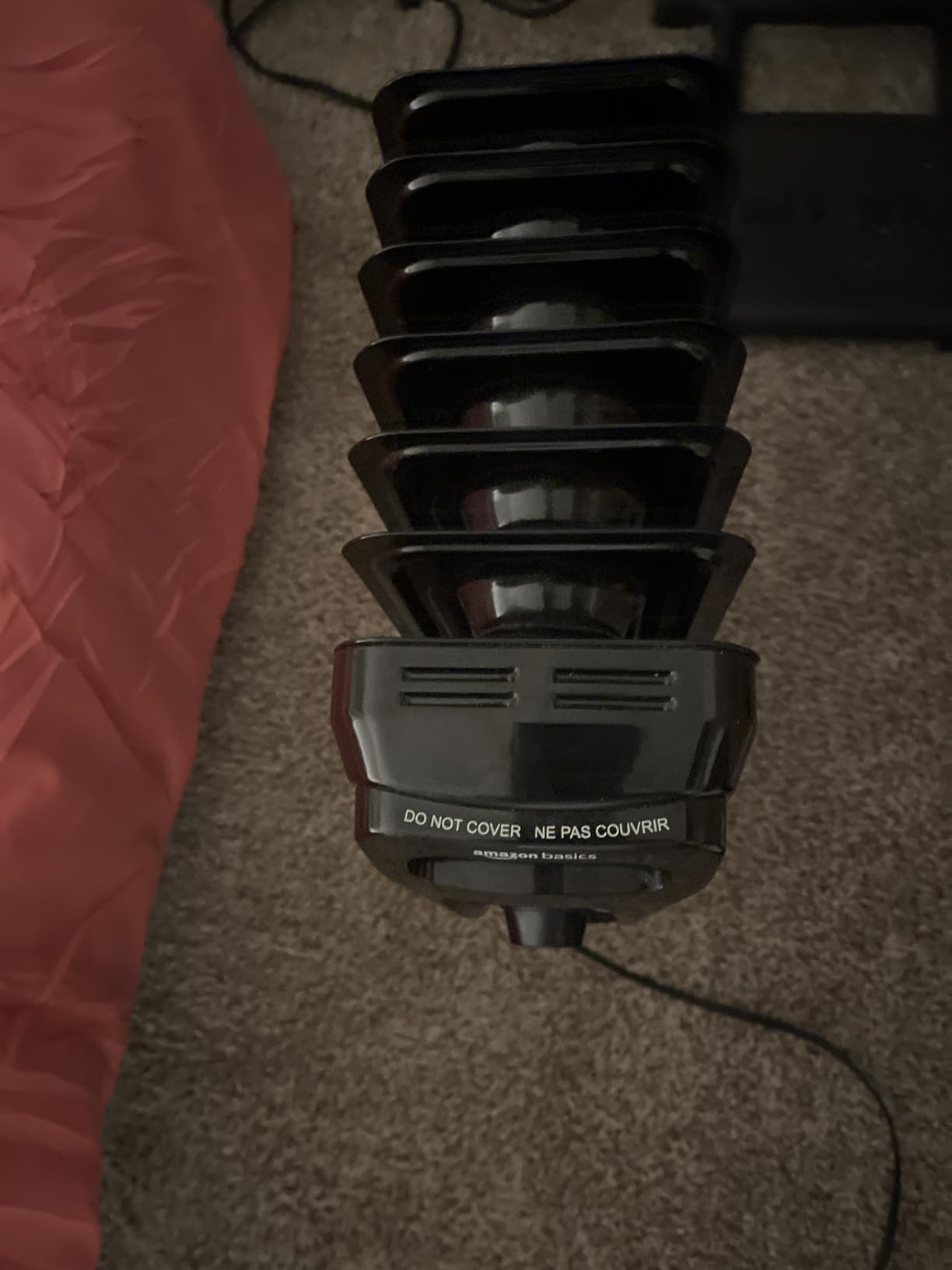
How it compares hour for hour against a De’Longhi
Heat output is identical at 1500W, and both are silent and both hold temperature once warm. The difference is control and build: the De’Longhi has a wider fin design, a longer cord and a three-year warranty against this unit’s simpler dial and narrower room claim. For occasional use the difference does not justify paying up.
Who should skip it
If the bedroom is over roughly 150 square feet, has a window you cannot cover, or sits on an exterior wall in an old house, choose a unit with more fins or a larger stated coverage. If you want overnight scheduling without thinking about it, this has no timer, so add a plug-in timer or use a smart plug.
4. DREO DR-HSH010 – Best for Remote-Controlled Sleep
DREO Oil Filled Radiator Heater, Electric Heaters for indoor use Large Room
1500W
Large LED touchscreen
24-hour timer
Remote included
Screen-off and mute modes
Pros
- Remote control included with battery
- 24-hour timer for pre-heating
- Mute and screen-off modes built for sleeping
- Child lock and burn-proof plug
- Four modes including 600W
- 900W and 1500W
Cons
- ECO mode ignores the setpoint for the first 40 minutes
- Faint high-pitched LCD whine while the screen is on
- Display does not show active wattage in thermostat mode
- Some units arrived with an FF overheat fault
The reason to choose this one is the remote. It sits in your hand at 11pm, you bump the setpoint up two degrees without getting out from under the covers, and you never touch the controls half-asleep. Combined with the 24-hour timer, this is the most hands-off overnight experience in the group.
Dreo also built this one specifically around light sleepers. A mute mode silences beeps, a screen-off mode blacks out the LED panel, and the setpoint range of 41F to 95F is wide enough to hold a cool sleep setting rather than defaulting to a warm room. Safety hardware is extensive: triple overheat protection, tip-over cutoff, a burn-proof plug and a child lock.
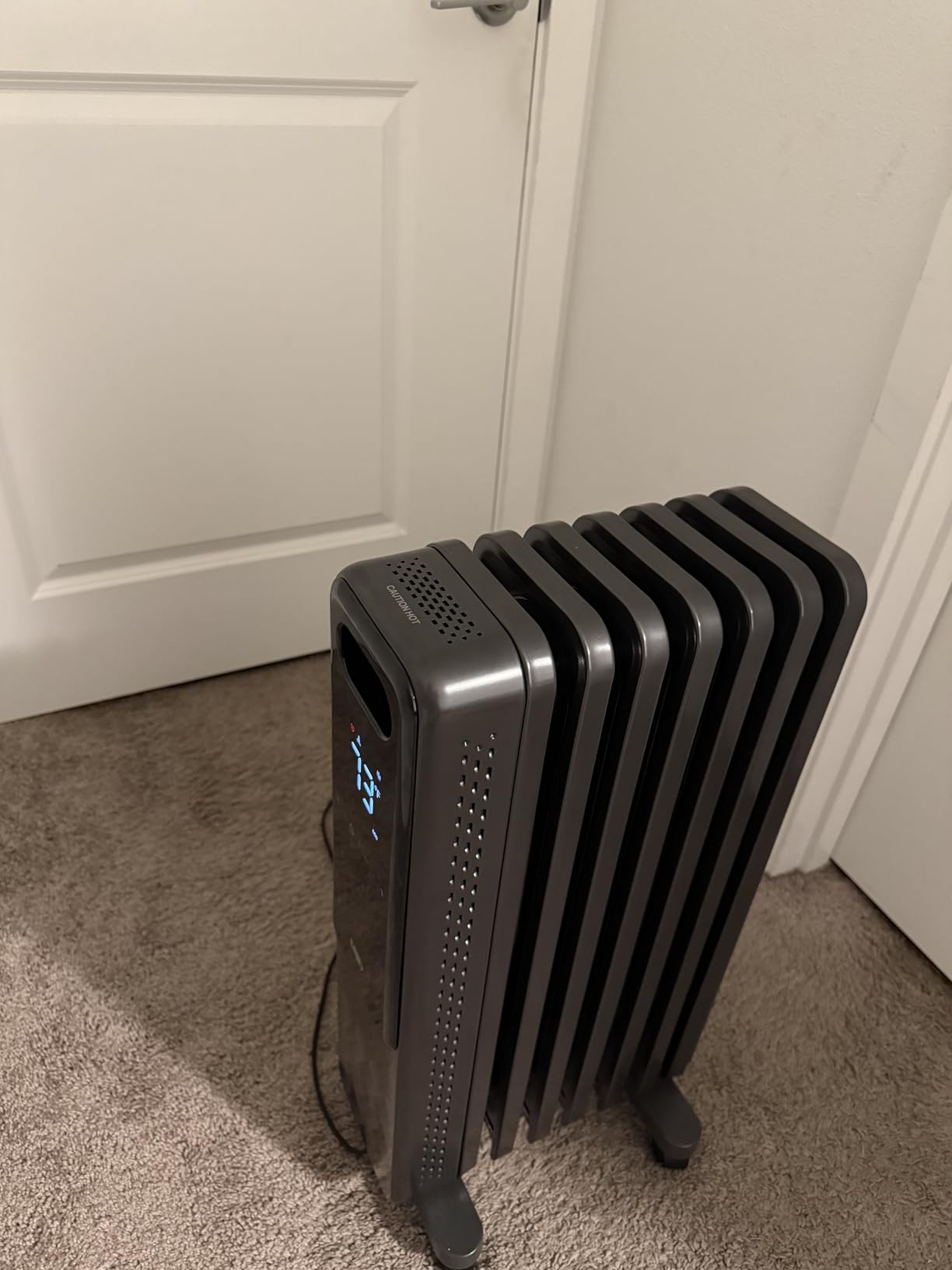
Two complaints come up repeatedly and are worth weighing. The ECO mode is the most discussed: several buyers say it runs at full power for roughly the first 40 minutes regardless of the setpoint, which means a room you wanted at 66F starts warmer than you asked. The second is a faint, high-pitched whine from the LCD while the screen is on, which the screen-off mode solves if you turn it off before sleeping.
A minority of owners reported units arriving with an FF overheat fault code that Dreo support resolved by replacement. Seven fins and a 250 sq ft stated claim look generous for a 1500W unit, and at 17.6 pounds it is still light enough to shift between rooms.
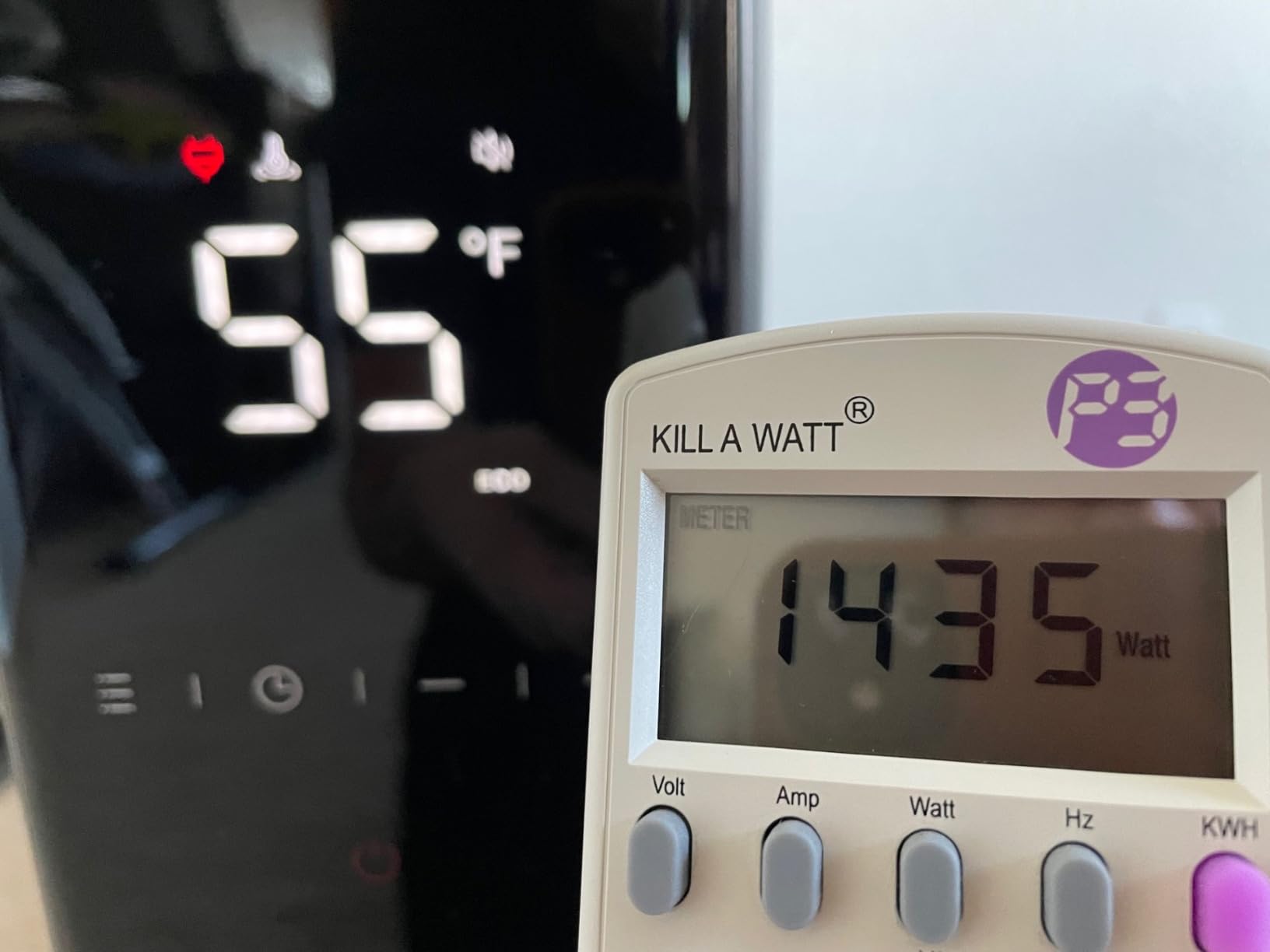
Whether the ECO mode quirk matters for sleep
If you run the timer to preheat, then switch to a fixed setpoint for the night, the quirk matters little. If you plan to leave it in ECO all night at a cool temperature, expect the first stretch to run warmer than the display suggests. Test it for a few nights before you rely on it.
How the stated 250 sq ft coverage holds up
Treat it as a marketing number. 1500W is 1500W on every model here, so real performance depends on insulation, window area and ceiling height. It does a comfortable job in a well-insulated bedroom up to roughly 180 square feet, which is what users report from r/homeowners.
5. COSTWAY 1500W Oil-Filled Radiator – Best Value for a Guest Bedroom
COSTWAY Oil Filled Radiator Heater, 1500W Portable Space Heater with Adjustable Thermostat, 3 Heat Settings, Overheat and Tip-Over Protection, Electric Oil Heater for Living Room Bedroom, Indoor Use
1500W
Adjustable dial thermostat
Three heat settings
Tip-over and overheat protection
19.3 lb
Pros
- Quiet fanless heat at a budget cost
- Three settings with an adjustable thermostat dial
- Sealed reservoir with no refilling
- Tip-over and overheat cut power automatically
- Four universal casters plus a carry handle
Cons
- No timer
- remote or child lock
- Short 25 inch cord restricts placement
- Basic dial with no temperature readout
- Thinner feedback base than most in this group
COSTWAY is the pick when the room is heated occasionally and the budget is the deciding factor. The 1500W output is the same as every other full-size unit here, the sealed reservoir needs no refilling, and the three settings plus adjustable dial cover the range most people actually use.
It is fanless and genuinely quiet, so it works as well as anything here for a light sleeper, and the tip-over and overheat cutoffs switch power automatically. Four universal casters and a front carry handle mean one person can move it from a guest room to a home office without lifting.
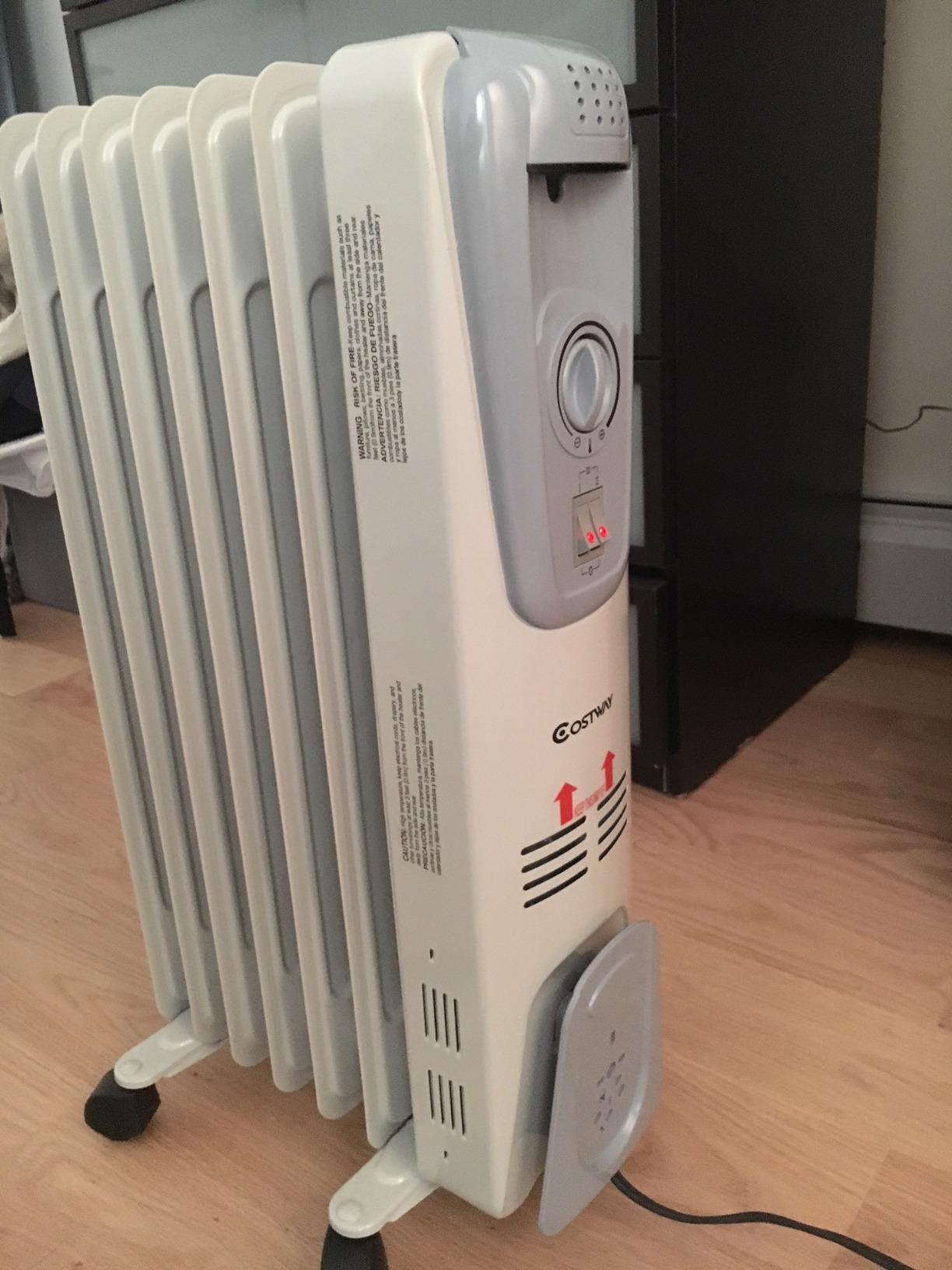
The compromises are obvious once you start using it. There is no timer, remote or child lock, and the dial gives you no temperature readout, so you set it by feel. The 25 inch cord is the shortest in the group and will dictate where the unit can sit, so find the outlet position first. With 1576 reviews it carries a thinner feedback base than most of the eight, which matters if you prefer a brand with a long service record.
Reviewers report a 67 percent five-star share, the lowest of the roundup, which lines up with what you get: steady heat, no features, and a manual thermostat you adjust a couple of times before it settles.
Is 1500W enough for a medium bedroom
Yes, in a well-insulated room up to roughly 170 square feet. The weakness is not output but control: with no display and no timer, the room warms steadily and stays warm rather than being modulated to a setpoint. For a room used a few nights a month, that is perfectly acceptable.
What to check before buying a no-name radiator
Buyers on r/BuyItForLife and r/avoidchineseproducts converge on the same advice: confirm the tip-over and overheat cutoffs are real, check that warranty support is reachable in your country, and buy from a seller with a real return path. Keep receipts for the first season.
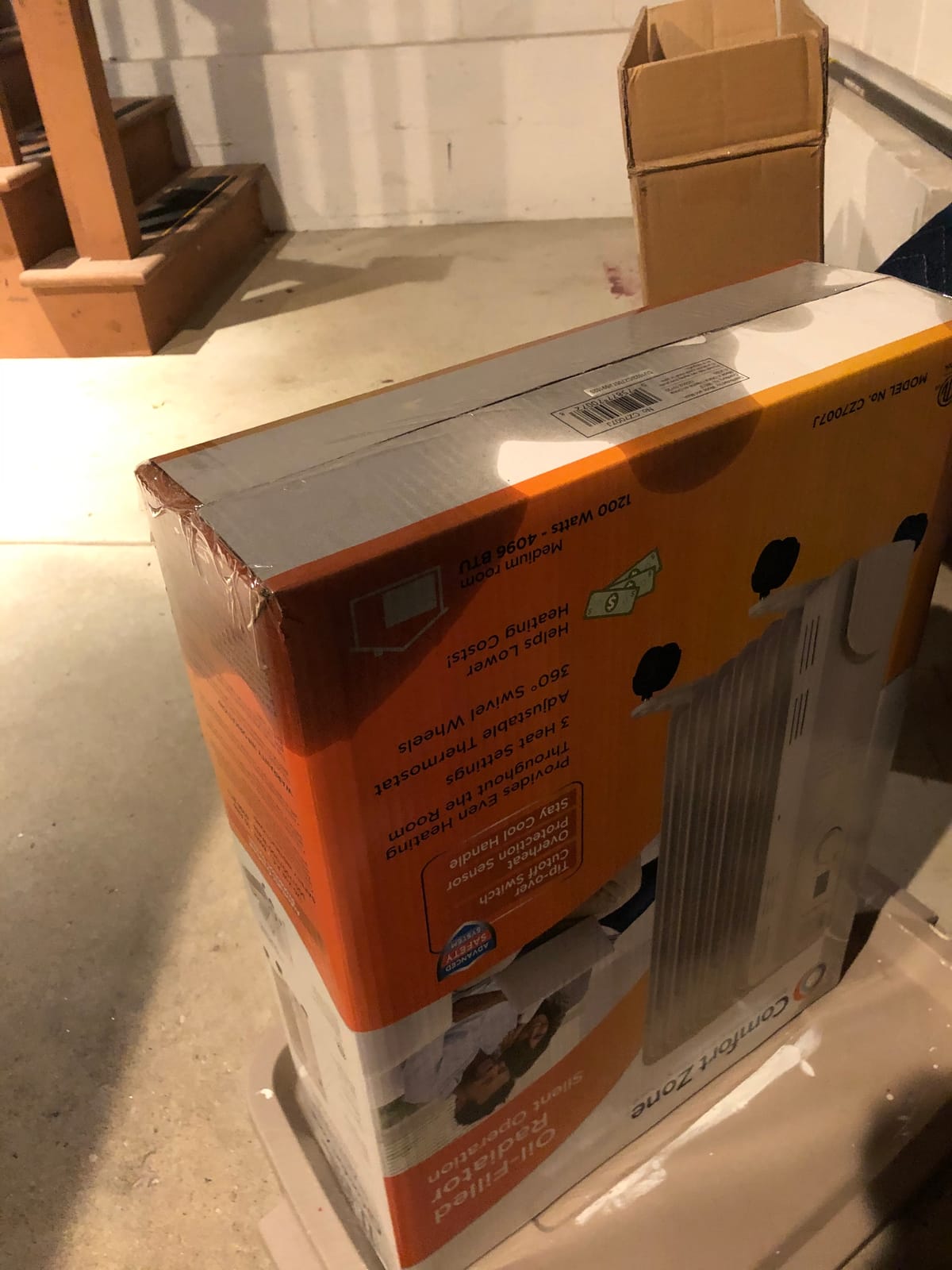
6. Comfort Zone CZ7007J 1200W – Best for Small Bedrooms and Tight Spaces
Comfort Zone Electric Oil-Filled Radiant Radiator Space Heater, Never Refill, Adjustable Thermostat, Tip-Over Switch & Overheat Protection System, Ideal for Home, Bedroom, & Office, 1,200W, CZ7007J
1200W at 10A
5.31 inch wide profile
Dial with 500W, 700W, 1200W
Tip-over and overheat system
15.8 lb
Pros
- Narrowest body at 5.31 inch wide
- fits tight gaps
- Safest surface for a small nursery
- Lightest build here at 15.8 pounds
- Oversized rear wheels roll well
- One-year warranty and long reported service life
Cons
- 1200W is the lowest output in the group
- Stated 300 sq ft coverage is optimistic
- Manual dial only
- Manufacturer warning stickers can cause odor if left on
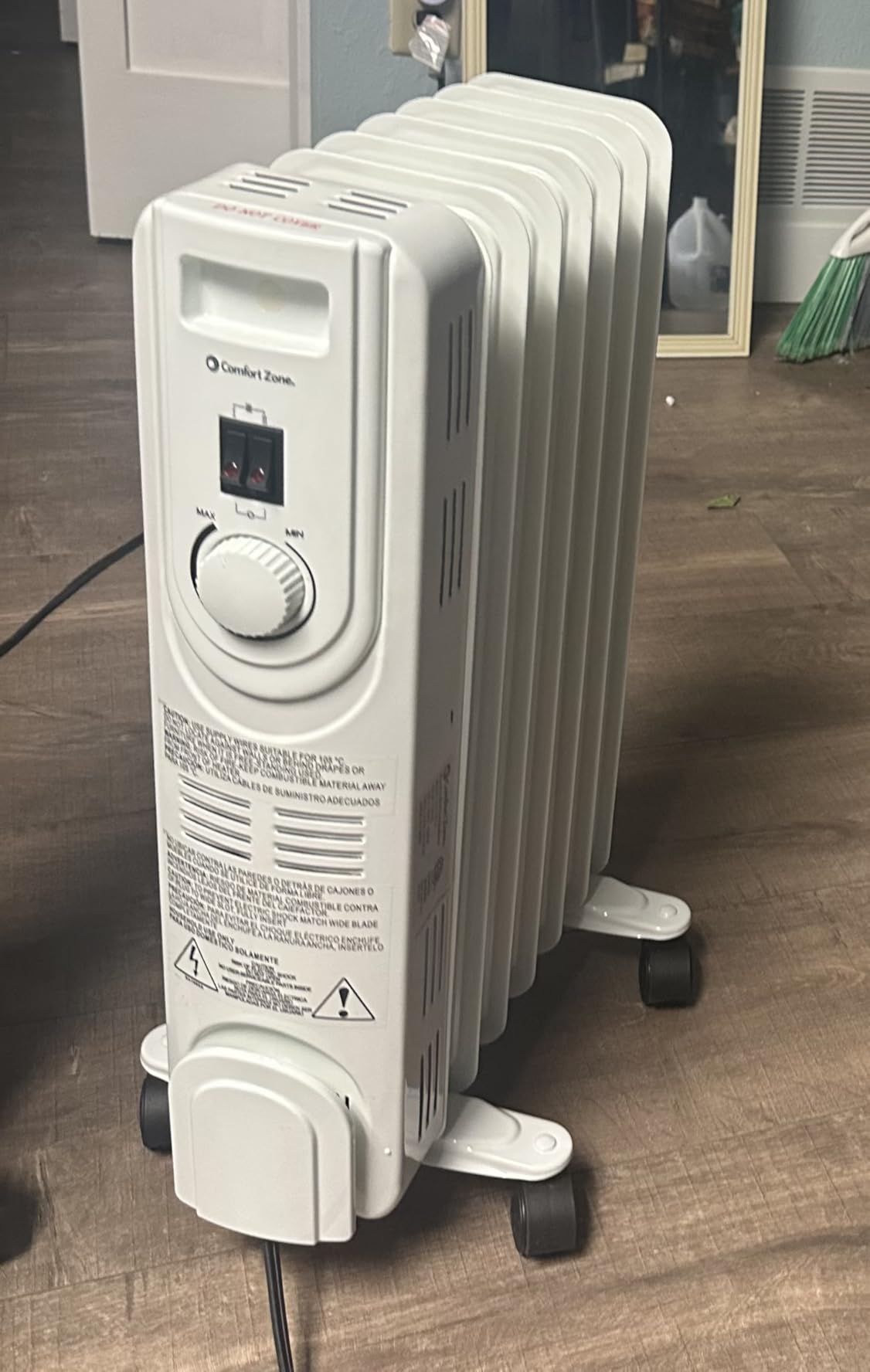
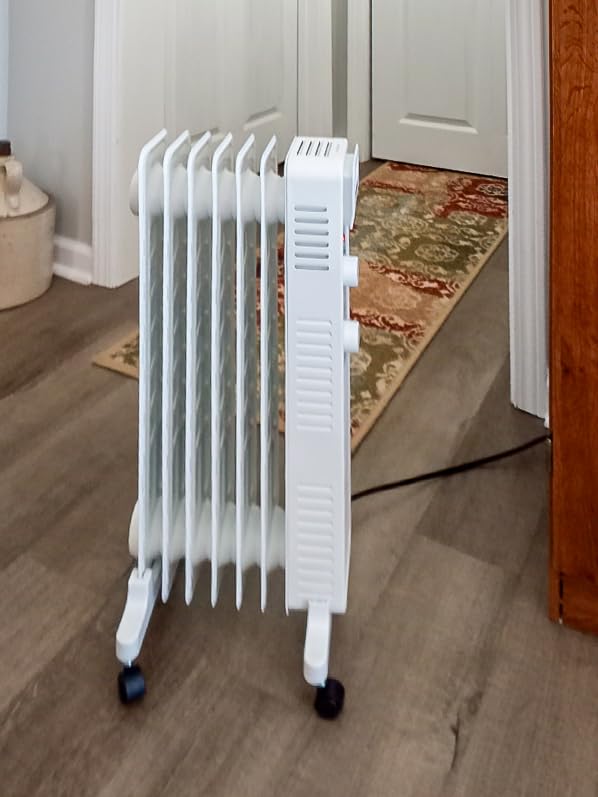
This is the one to look at when floor space is the problem. At 5.31 inches wide and 22.24 inches tall it slips between a dresser and a wall or sits under a window without stealing the walkway, and at 15.8 pounds it is easy to lift. Several owners on forums report owning the predecessor model for a decade, which is the kind of track record the newer budget brands cannot show.
Because it draws 10A rather than 12.5A, it is also the friendliest option for older circuits and outlets in a house that has no spare capacity. For a nursery or a very small box bedroom, the lower output is genuinely matched to the room, and the exterior stays cooler to the touch than the full-size 1500W models.
The 1200W figure is the whole trade-off. It is the least powerful heater here, and users in medium bedrooms report it running continuously without catching up on a cold night. The stated 300 sq ft coverage is optimistic; think of it as a small-room heater, which is how owners actually use it. The dial has no readout, so you calibrate by feel.
One odd detail: the manufacturer warning stickers need to come off before first use, and owners who kept them on report a persistent odor. The lightweight casters also roll poorly on hardwood, so use it mostly in carpeted rooms.
Small room sizing, plainly
Under about 110 square feet with normal ceiling height, 1200W is comfortable. Beyond that, it works best as a supplementary heater for a space with good insulation and a door kept closed, rather than as the only source of heat. Its 10A draw also makes it usable where a 12.5A unit would trip a shared circuit.
How it performs for an allergy or asthma sleeper
With no fan anywhere in the design it does not stir dust, pollen or dander into the air, and the slow radiant output does not parch the room the way fan heaters can. Owners still run a humidifier in dry winter air, but the radiator itself is not the reason the air feels dry.
7. PELONIS 1500W Oil-Filled Radiator – Best for a Nursery or Kids Room
Pelonis Oil Filled Radiator Heater for Large Space, 2025 Upgraded, Space Heaters with 1500W Quiet Warmth Radiant Heater, 3 Heating Modes, Overheat & Tip-Over Protection, Adjustable Thermostat, Black
1500W
Black finish, knob controls
Seven advanced fins
600W, 900W and 1500W modes
Tip-over and overheat, ETL certified
Pros
- Cabinet stays safe to the touch for children and pets
- Silent once heating stabilizes
- Three wattage modes including a low 600W setting
- ETL certified plug and cord
- Black finish suits a visible room
Cons
- Knob-only thermostat with no readout
- Runs past the target temperature on high settings
- Cool-down is quick once switched off
- Caster assembly takes longer than expected
The reason this one suits a nursery is surface temperature. Owners specifically call out the exterior staying safe to the touch for children and pets, which is not true of every radiator in this roundup, and it pairs that with tip-over cutoff and precision overheat protection on an ETL certified plug and cord.
It is also fully silent once the oil stabilizes, and the seven advanced fins with high-conductivity thermal oil spread heat evenly rather than in one hot column. Three wattage modes at 600W, 900W and 1500W let you drop to low overnight, which is the sensible setting for a child’s room. With 74 percent five-star reviews it ties for the strongest rating distribution here.
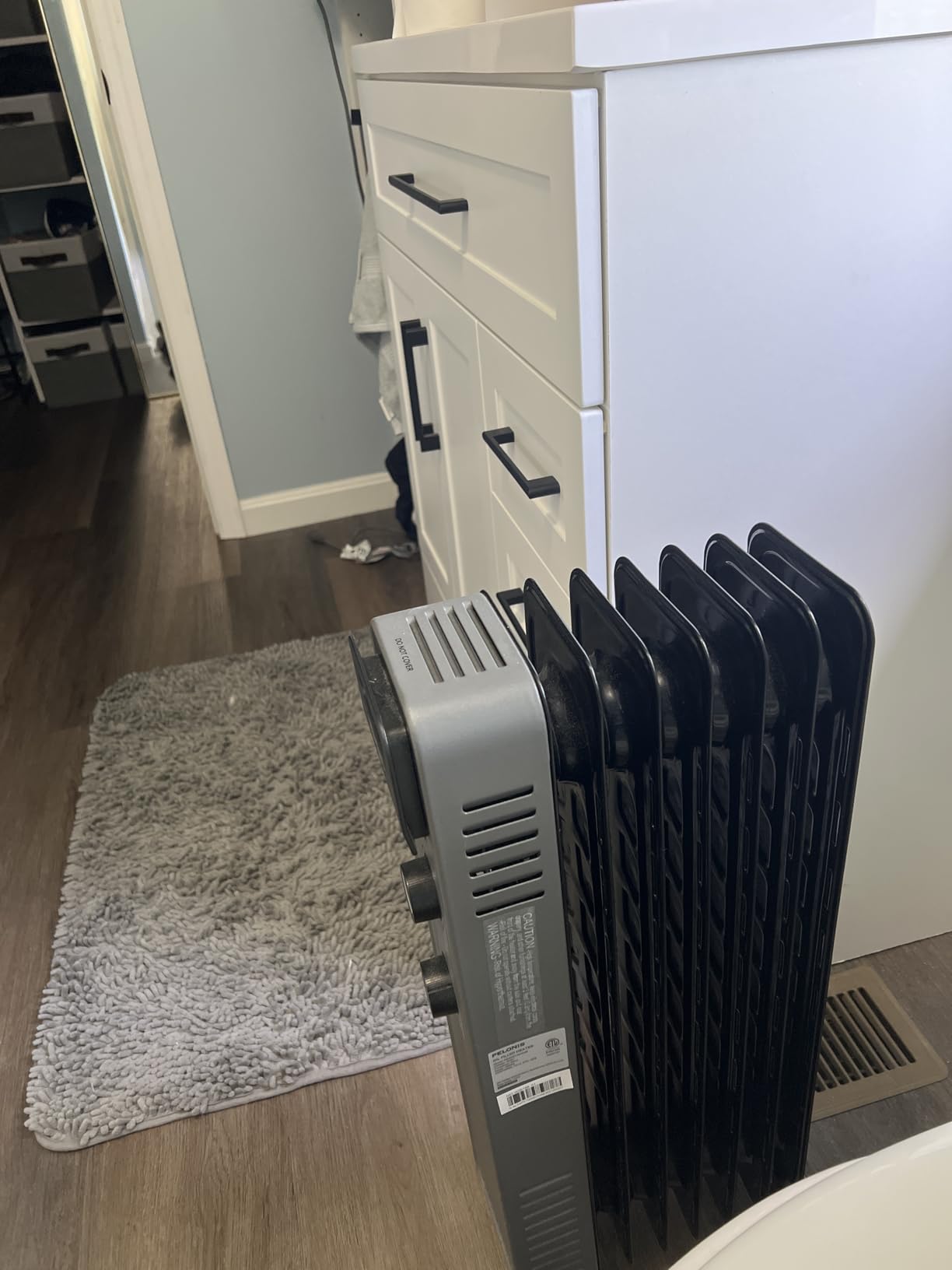
The compromises are control and overshoot. There is no digital readout and no timer, and on the higher settings the room can run past the target before it settles, then cool relatively quickly once you switch it off. A few buyers also say they wanted a fan for air circulation and had to add one, which for a nursery adds noise and stirs dust, so that trade is usually not worth it.
Higher wattage settings raise electricity use noticeably, so run the 600W mode overnight rather than 1500W. The black finish is a genuine plus for a room where the radiator is visible, and the assembly of the casters takes some care the first time.
Safety around small children
No heater replaces placement discipline. Keep it three feet clear at the ends and top, route the cord out of reach, and do not let it sit on carpet right beside a bed where a child can roll against the fins overnight. This model simply gives you more margin than the alternatives, not permission to crowd it.
What the low 600W mode feels like
It is the mode to use at night. It produces noticeably gentler warmth, holds a small room without cycling hard, and keeps electricity use down. Owners using it in drafty bedrooms report it copes well once the door is closed and the window is covered.
8. DREO DR-HSH011 – Best for Exact Setpoint Control
DREO Radiator Heater, 1500W Oil Filled Radiator Heater for Indoor Use
1500W
41-95F in 1 degree steps
Eight M-shaped fins
Remote and 24-hour timer
Ambient temperature readout
Pros
- Finest temperature resolution in the group at 1 degree steps
- Ambient temperature indicator shows current room heat
- Remote plus 24-hour timer
- ECO mode among four power modes
- V0 flame-retardant material and triple overheat protection
Cons
- Hot surface requires careful placement around kids and pets
- Slow warm-up like any oil-filled unit
- Heavier and deeper than slimmer models
- Costs more than manual-dial units
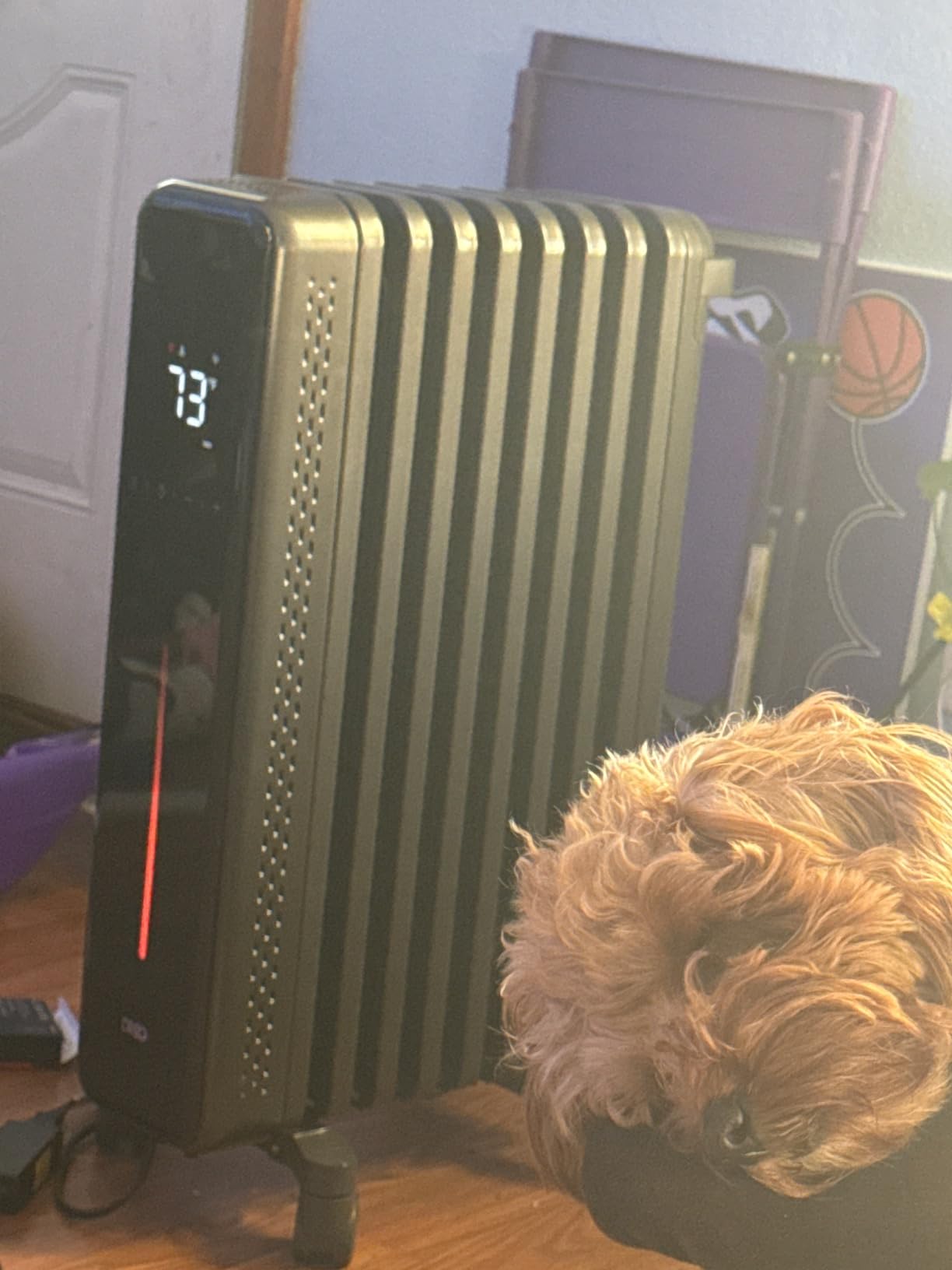
If you are the person who wakes up too warm at 3am and cannot get back to sleep, this is the unit built for you. The thermostat adjusts from 41F to 95F in one-degree increments with a thermal sensor error as low as plus or minus four percent, and the ambient temperature indicator shows the room’s current temperature at a glance so you can tell the setpoint from the actual reading.
The remote and 24-hour timer cover the two chores that matter overnight, and the four operating modes at 600W, 900W, 1500W and smart ECO give you a gentler option after the room is warm. Eight M-shaped fins increase the dissipation area by a claimed 59.5 percent while holding a scald-safe surface temperature.
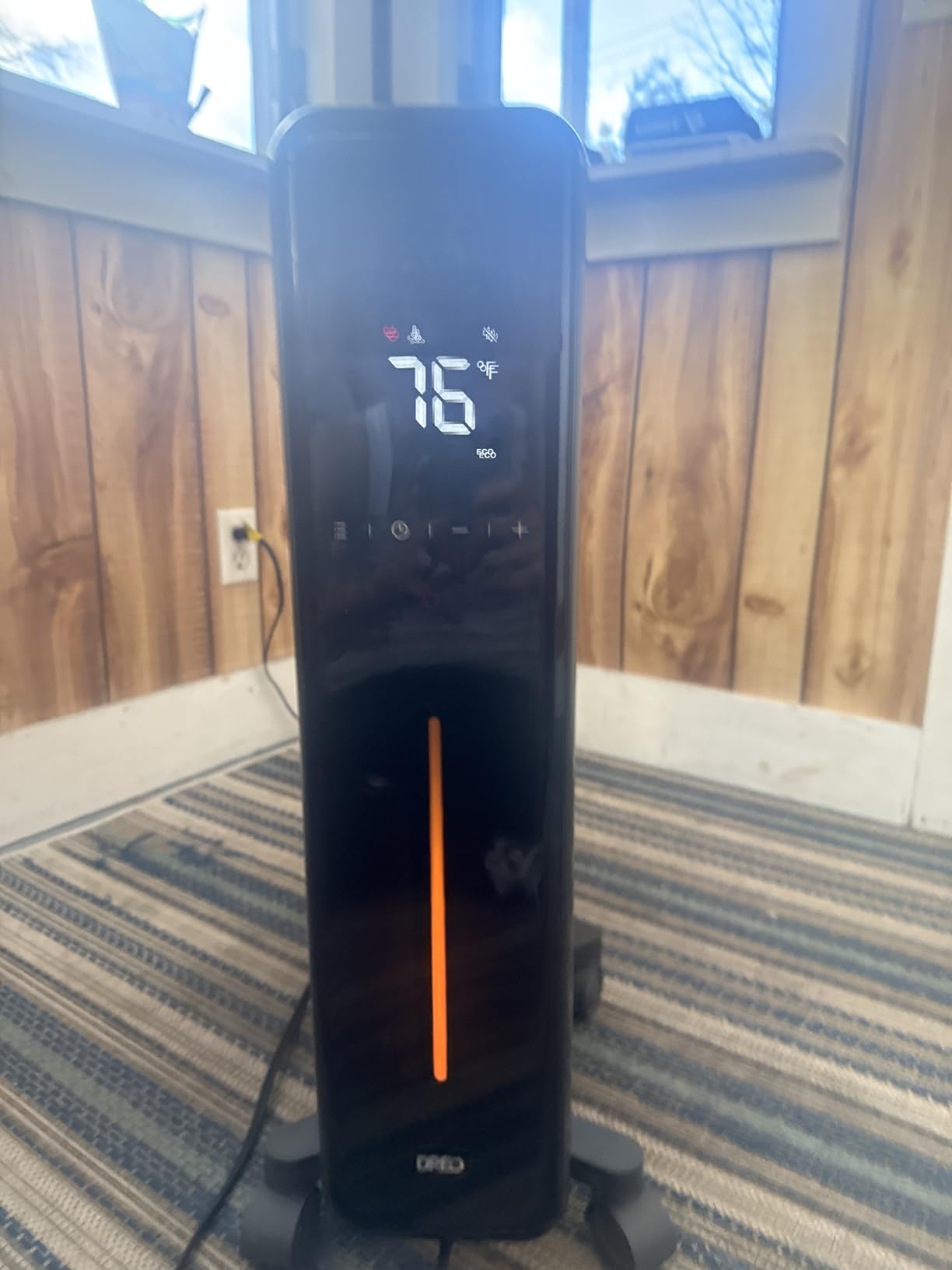
Recurring trade-offs are heat-up time and floor space. Like every oil-filled radiator it warms slowly, so schedule it rather than switching it on at bedtime, and at 19.37 inches deep and 20.6 pounds it needs more room to stand than the slim models. Reviewers also flag the hot surface, so keep the same three feet of clearance and the same distance from the bed.
Against the other DREO, this one is the precision pick: finer temperature control, a larger fin design and the ambient readout, for more money than a manual-dial alternative. 74 percent of reviews are five-star.
Whether one-degree steps are a real benefit
They are if you run the room cool for sleep. Most people set a bedroom around 66F to 68F, and at two-degree steps you overshoot that boundary in either direction. In a cool room the finer control means fewer 3am wake-ups from overheating rather than from being cold.
How to tell a real fault from a satisfied thermostat
Run the unit on high with the door closed for twenty minutes and check that the fins are warm to the touch at the bottom and middle. If they are warm but the room is not climbing, the thermostat has satisfied itself. If the fins stay cold, that is a real fault and worth a replacement rather than fiddling with the dial.
How to Size an Oil-Filled Radiator for a US Bedroom
Size for the room, not the number on the box. Almost every full-size radiator here runs at 1500W on a 120V, 12.5A circuit, which is the ceiling a standard US bedroom outlet circuit supports, so you are choosing between 1200W and 1500W rather than scaling up freely.
The steps are short. Measure the room’s floor area in square feet. Below about 110 square feet with normal ceilings, 1200W is comfortable. Between 110 and 180 square feet, 1500W is the right target. Above 180 square feet with a tall ceiling, an exposed exterior wall or a large single-glazed window, no portable 1500W heater will keep up, and you are looking at a room problem rather than a heater problem.
Two adjustments matter more than wattage. A room heated only from 10pm to 7am needs less than a room held at temperature all day, because the heater is off while heat escapes. And closing the bedroom door to the rest of the house cuts the load dramatically, which is why the overnight pattern is the one owners on heating forums actually use.
Digital vs Mechanical Thermostat for Overnight Sleep
A mechanical dial gives you silence and simplicity: nothing glows, nothing beeps, and there is no electronics to fail. What you give up is a temperature readout and any scheduling. A digital panel gives one-degree control, a timer and usually a remote, and what you give up is a bright display and a faint LCD whine unless the model has a screen-off mode.
For a bedroom used every night, we lean digital because the timer removes daily effort and the tighter control reduces overnight temperature swing. For a room heated occasionally, or for a sleeper who reacts to light, the mechanical models in this roundup are genuinely better rather than merely cheaper.
Noise and Light: What Actually Wakes You Up
The fanless design means there is no airflow noise to begin with, so the only sounds left are the thermostat relay clicking as the element cycles and, on digital models, an LCD whine. Relay click is the complaint that dominates forums, and it varies far more between models than the marketing suggests. If you are a light sleeper, this is the specification to check first.
Light is the second issue. The digital models here run from a large touchscreen panel down to a small LED readout, and only some of them offer a screen-off or mute mode. If any light in the room is a problem, decide before you buy: a screen that can go black is workable, a screen that cannot is not.
One thing no fanless radiator avoids is hot metal. Place the unit away from the bed path, keep three feet of clearance, and treat the cabinet as a burn hazard in a child’s room regardless of what the safety features say.
What an Oil-Filled Radiator Costs to Run Overnight
A 1500W heater draws 1.5kW, so one hour of continuous running uses 1.5kWh. A typical bedroom session of nine hours costs 13.5kWh before you account for the thermostat cutting out. At residential US rates that lands somewhere in the range of a couple of dollars per night for a full nine hours of continuous heat.
The duty cycle is what changes the number, and it is the figure most cost claims leave out. A well-insulated bedroom with the door closed may run the element 30 to 40 percent of the time once the room reaches temperature, which roughly halves the real figure. A drafty room in an old house may run it almost continuously and land at the top of the range.
Because every model here is a resistance heater, none of them is cheaper per kilowatt-hour than the others. What a better thermostat and a better timer do is reduce the hours the element runs. That is where the money is actually saved, and it is a scheduling gain, not an efficiency gain.
Safety: Running a Radiator in a Bedroom Overnight
Plug it directly into a wall outlet. Do not use an extension cord or a power strip, since these heaters draw close to the full capacity of a 15A circuit continuously. Give it three feet of clearance at the ends, sides and top, and keep it away from bedding, curtains and furniture.
Leave the tip-over and overheat cutoffs active rather than bypassing anything, and never put the unit on a soft surface. Do not use an oil-filled radiator in a bathroom or laundry room, where humidity and splashing water shorten the life of the electrical components. Electric heaters do not produce carbon monoxide, since there is no combustion involved.
For children and pets, placement does more than any feature. Keep the unit out of the walking path between the door and the bed, choose a model with a child lock or a cooler-to-touch cabinet, and route the cord where nobody walks. If you are also anchoring heavy furniture in that room, our large home safe guide for bedrooms covers the tipping risk on the furniture side. Leaving the heater on overnight is reasonable with a working thermostat, a clear path and a timer that switches it off before you leave.
Troubleshooting: Ticking, Not Heating and Burn-Off Smell
Ticking or clicking is almost always the thermostat relay opening and closing as it holds the setpoint. It is normal and not a fault, but on some budget models it is loud enough to hear across a quiet bedroom. If it bothers you, moving the unit away from the bedhead usually solves it, and choosing a digital model with a soft cycling cycle helps.
If it is not heating, run it on high with the door closed for twenty minutes and touch the lower and middle fins. Warm fins with a room that is not climbing means the thermostat has satisfied itself, which is normal. Cold fins with no warmth anywhere means a genuine fault, and that is a replacement rather than a setting change.
A faint oily smell in the first few cycles is the coating curing, and it goes away. A sharp or persistent smell means the unit has been running too close to a wall or surface, so clear the three feet of clearance. Anything approaching a burning plastic smell should stop you using the unit immediately.
When an Oil-Filled Radiator Is the Wrong Choice
Choose something else when the room is genuinely large, drafty or has vaulted ceilings, since 1500W is the practical limit on a US bedroom circuit. Choose a fan heater if you need heat in five minutes rather than in an hour. Avoid oil-filled units in bathrooms and garages, and consider a baseboard or in-floor heat if you need the whole room warm before anyone gets up.
They are also the wrong answer for a bedroom you only need to warm for ten minutes on a cold morning, since the whole benefit depends on letting the thermal mass do its work.
Frequently Asked Questions
Which oil-filled radiator heater is the best quality?
The De’Longhi EW7707CM is the best-quality pick in this roundup. It is a 1500W fanless radiator with a mechanical dial, thermal cut-off and anti-freeze mode, and it carries the deepest owner review base of the eight we compared. If you want a timer and one-degree control, the De’Longhi Dragon Digital TRD40615E is the quality upgrade.
What are the best radiators for bedrooms?
The best radiators for bedrooms are fanless oil-filled units because they run silent, do not stir dust, and hold temperature overnight instead of cycling hot and cold. Our picks cover the range: the De’Longhi EW7707CM for most rooms, the Dragon Digital TRD40615E for scheduled overnight heating, the Amazon Basics NY1507-15K for a guest room, and the 1200W Comfort Zone CZ7007J for a small bedroom.
What size oil filled radiator do I need for my bedroom?
Under about 110 square feet with normal ceilings, a 1200W unit is comfortable. Between 110 and 180 square feet, aim for 1500W, which is the output of most 120V bedroom heaters. Above 180 square feet with tall ceilings or a large window, no portable 1500W heater will keep up. Heating the room only overnight and keeping the bedroom door closed both reduce the load.
Can I leave an oil-filled radiator on overnight?
Yes, with a working thermostat, a timer, and proper clearance. Plug it directly into a wall outlet rather than an extension cord or power strip, keep three feet of clearance at the ends and top, keep it off the bedside path, and use the timer to switch it off before you leave. Do not use one in a bathroom or laundry room.
Why is my oil heater making a ticking noise?
The ticking is usually the thermostat relay opening and closing to hold the setpoint, which is normal rather than a fault. It is more noticeable on budget models with mechanical dials. Moving the unit away from the bedhead reduces it, and a digital model with a softer cycling cycle is quieter. If you also see an error code or the fins stay cold, that is a different problem.
Do oil-filled radiators dry out the air?
They dry the air far less than fan heaters because there is no fan blasting air across a hot element, and no dust, pollen or dander is stirred into the room. Owners on home heating forums still run a separate humidifier in dry winter air, but the radiator itself is rarely the reason a bedroom feels parched.
What are the downsides of using an oil-filled radiator?
The main drawbacks are slow warm-up, usually two to three hours for a cold room, which means you need a timer or a habit of switching it on early. Hot fins and a warm cabinet are a burn and tipping hazard if placed beside a bed, and mechanical models give you no temperature readout. Higher wattage settings raise electricity use, and heat retention is not the efficiency gain that many buyers expect.
Final Verdict: Which Oil-Filled Radiator Belongs in Your Bedroom
The De’Longhi EW7707CM is our pick for most bedrooms in 2026: silent, simple, and backed by the largest owner base we found. Buy the Dragon Digital TRD40615E instead if you want the room warm on a timer without thinking about it, and drop to the 1200W Comfort Zone CZ7007J when the room is small or the floor space is tight.
Whatever you choose, plan for the warm-up. Set a timer if the model has one, use a plug-in timer if it does not, and place the unit away from the bed path with three feet of clearance. If you are still decorating the room, our guide to ceiling fans with lights for bedrooms covers the airflow half of the problem, and if your home has hydronic heating, our thermostatic radiator valve guide covers the fixed-radiator side.