
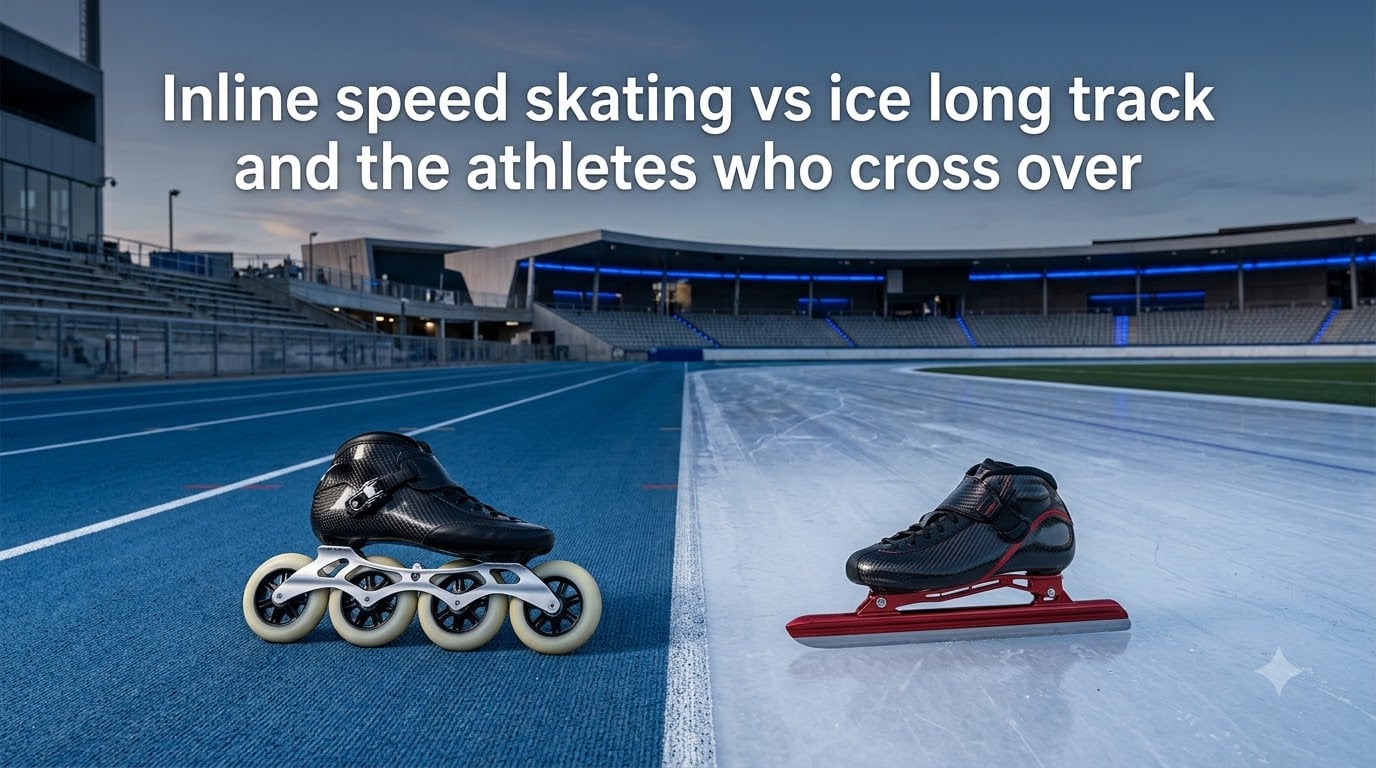
Inline speed skating vs ice long track speed skating isn’t a casual comparison — it’s a story about athletes who spend years training on wheels and then switch to ice to chase Olympic gold. I have followed both sports closely for years, and the crossover pipeline between them is one of the most underrated stories in winter sports. In this guide, I’ll break down exactly how the two disciplines differ, what makes the transition so hard, and which athletes made it work at the highest level.
Table of Contents
Inline Speed Skating: The Summer Discipline
Inline speed skating is a roller sport where athletes race on a track or road using inline skates with three to five wheels arranged in a single line. The boots look similar to ice speed skates, but the chassis holds wheels instead of a blade, and the push mechanics are completely different from what you see on ice.
The defining technique in inline is the double push. Instead of pushing out to the side with each stride the way an ice skater does, an inline skater pushes twice with every stroke — once outward, then a second push inward before recovery. This was popularized by Dutch and Italian skaters in the late 1990s and is now the universal technique at the elite level.
Inline events range from 200m sprints on a 200m banked outdoor track, to road races, point-to-point marathons, and ultra-endurance events like the Berlin Inline Marathon. The sport has World Championships governed by World Skate (formerly FIRS), but it is not yet an Olympic discipline, which is a major reason top inline athletes keep one eye on the ice.
Ice Long Track Speed Skating: The Olympic Oval
Ice long track speed skating takes place on a 400m oval with two lanes and a cross-over zone. Skaters race in pairs against the clock in most distances, switching lanes at each lap so the total distance skated is equal. The distances on the Olympic program stretch from 500m sprints all the way to the 10,000m men’s event and 5,000m women’s event.
The equipment has a hinge — literally. The clap skate (also called the klapschaats) has a blade that detaches from the heel of the boot at the end of each stroke. Skaters adopted it across the 1990s and it spread through the World Cup circuit so quickly that by 2026 it is mandatory in elite competition. The hinge lets the blade stay in contact with the ice longer per stroke, and that extra contact is the main reason long track top speeds have climbed by several kph over the past two decades.
Long track sits at the top of the Olympic winter program. The 1000m, 1500m, 5000m, and team pursuit events draw serious viewership every four years, and the 10,000m remains the most prestigious men’s distance. A new mass start event was added to the program in 2018, which is the discipline where inline skaters have had the easiest crossover success.
Inline Speed Skating vs Ice Long Track: Key Technical Differences
The first big technical difference between inline and ice long track is the push itself. Inline skaters use the double push, where each leg produces two force applications per stroke. Long track ice skaters use a single, powerful push to the side, with the blade staying planted longer thanks to the clap hinge. Switching from one to the other is not as simple as swapping equipment — the muscle memory is genuinely different.
The second difference is the equipment feedback loop. An inline skate grips the ground through wheel friction and a slight lean, but the chassis limits how far a skater can roll the ankle. An ice skate has a true edge that bites into the ice when the skater angles the foot, which is why crossovers on ice feel sharper and tighter than crossovers on inline. As one inline skater put it on a forum I follow: “Ice is far more demanding for me — the crossovers in metric speed skating are different.” That single sentence captures what athletes mean when they describe the ice as harder.
The third difference is body position. Inline skaters tend to skate with a slightly more upright torso because the wheels do not provide the same lateral grip as an ice edge, and they push from a wider stance. Long track ice skaters carry their weight further forward and inside the circle, especially through the curves. Watching a Mantia lap in both disciplines back-to-back makes the contrast obvious.
Race Formats: Time Trials vs Pack Racing
Long track speed skating is mostly a time trial sport. Skaters race head-to-head against the clock in pairs, with the times deciding the final standings. The only exception is the mass start event, which is a pack race over 16 laps with intermediate sprint points and a final finishing sprint.
Inline speed skating runs almost the opposite way. The 200m track events are mass-start pack races with overtaking, drafting, and physical contact — closer to short track on ice than to long track. Road and marathon events add tactical elements like lead packs, breakaways, and lead-out sprints. Very few inline disciplines resemble the controlled, two-skater-at-a-time format of long track.
This format gap is exactly why the mass start on ice has become the natural landing pad for crossover athletes. Their pack racing instincts transfer directly, while their pure time-trial speed takes a year or two to develop.
Speed Comparison: Which Is Actually Faster?
Ice long track is the faster of the two sports at the elite level. Long track skaters average around 56 kph (roughly 35 mph) over a full 1500m race, and top sprinters exceed 60 kph on the back stretch of the 500m. Short track, by comparison, runs about 48 kph on average due to the tighter turns and pack dynamics.
Inline world-class speeds on a 200m track sit in the mid-40s kph over race distance, and elite road racers can hit the low 50s on a fast downhill course. So even though inline wheels have come a long way in grip and rolling speed, ice still wins on outright velocity — mostly because of the lower rolling resistance and the clap skate’s extended contact time.
Athletes Who Cross Over: Inline to Ice Champions
The crossover story starts to get interesting here, because a surprising number of Olympic medals in long track have an inline origin. Joey Mantia is the most famous example. Mantia dominated the inline world championship scene for years, then moved to long track in his mid-20s and built a World Cup-level career. He later switched focus to inline again, then returned to long track to compete at the Olympic Games, where he earned medals in the mass start — the discipline most like his inline background.
Erin Jackson is another name worth knowing. Before she became the 500m Olympic champion in Beijing, she was a competitive inline speed skater and inline hockey player. Her sprint speed translated almost directly to the long track 500m, and her inline-trained explosive first 100m became a weapon on the ice oval.
Bart Swings of Belgium is a third crossover success. He competed in inline world championships at the highest level and then transitioned to long track, winning an Olympic bronze in the mass start at the same Games where Mantia medaled. His training split between the two disciplines is now seen as a model for European skaters.
Earlier in the pipeline sits Chad Hedrick, who was already a multi-time inline world champion before he switched to long track in the early 2000s. He went on to win Olympic gold in the 5000m and a string of World Cup titles. Hedrick’s career is the original proof that an inline background can produce an Olympic champion on ice.
Training Transfer: What Carries Over and What Doesn’t
Cardiovascular fitness is the easiest asset to transfer. An inline skater who can hold 40+ kph for an hour on the road already has the aerobic base to handle a 5000m or 10000m on ice. Explosive power and leg strength also carry over, especially in the gym.
The hardest thing to transfer is the technique itself. Inline skaters have to learn to “detrain” the double push when they get on ice — the double push actually slows them down on long track because it interrupts the long gliding phase that makes the clap skate so effective. The crossover stride is the second big adjustment; it has to be relearned from scratch because the edges behave differently from wheels.
The psychological side is real too. Skaters who switch from inline to ice often report a confidence dip in the first year, because the surface feels slippery and unpredictable after years on wheels. The best transition plans I have seen build in two full seasons on ice before expecting competition results, with summer inline kept only for fitness, not for sharpening.
Frequently Asked Questions
Is inline skating harder than ice skating?
It depends on the discipline. Inline speed skating and ice long track both demand elite fitness, but inline feels harder on the joints because the chassis has no give and the wheels do not carve true edges. Ice long track feels harder on balance because of the low-friction surface, especially through the curves.
What is the most prestigious distance in speed skating?
In long track speed skating, the men’s 10,000m and the women’s 5,000m are widely considered the most prestigious distances because they combine endurance, speed, and tactics over multiple minutes. Winning an Olympic title at these distances is viewed as the top achievement in the sport.
Can you cross lanes in speed skating?
In long track, skaters are required to switch lanes at each crossover zone so every skater covers the same total distance. In short track and in inline speed skating, lane changes are free and overtaking happens throughout the race. Crossing lanes illegally in long track results in disqualification.
What happened to Apolo Ohno, the speed skater?
Apolo Ohno retired from competitive short track speed skating and later competed in other events including marathon distance running and reality television. He did not transition into long track, which is a different discipline with a much longer Olympic history.
Can inline speed skaters compete in the Olympics?
Inline speed skating itself is not on the Olympic program, but many inline skaters have crossed over to compete in Olympic ice long track and short track events. Joey Mantia, Erin Jackson, Bart Swings, and Chad Hedrick are the best-known examples of this pipeline.
Which is faster inline or ice speed skating?
Ice long track is faster overall. Long track skaters average about 56 kph over a 1500m race, with sprinters exceeding 60 kph on the 500m. World-class inline skaters on a 200m track average in the mid-40s kph, with road specialists reaching the low 50s on fast courses.
Conclusion
Inline speed skating vs ice long track speed skating comes down to surface, technique, and race format. Inline is wheels, double push, and pack racing; long track is ice, clap skate, and time trials. The two sports look similar from the outside, but the athletes who try to cross over will tell you the gap is bigger than it appears.
The good news is that the crossover pipeline is real. Mantia, Jackson, Swings, and Hedrick proved that an inline background can produce Olympic medals on ice, especially in mass start events where pack instincts translate directly. If you are an inline skater dreaming of the Olympics, long track is the most realistic path — start training the clap skate technique on ice early, keep the inline work for fitness, and plan on a two-season runway before you expect results.