
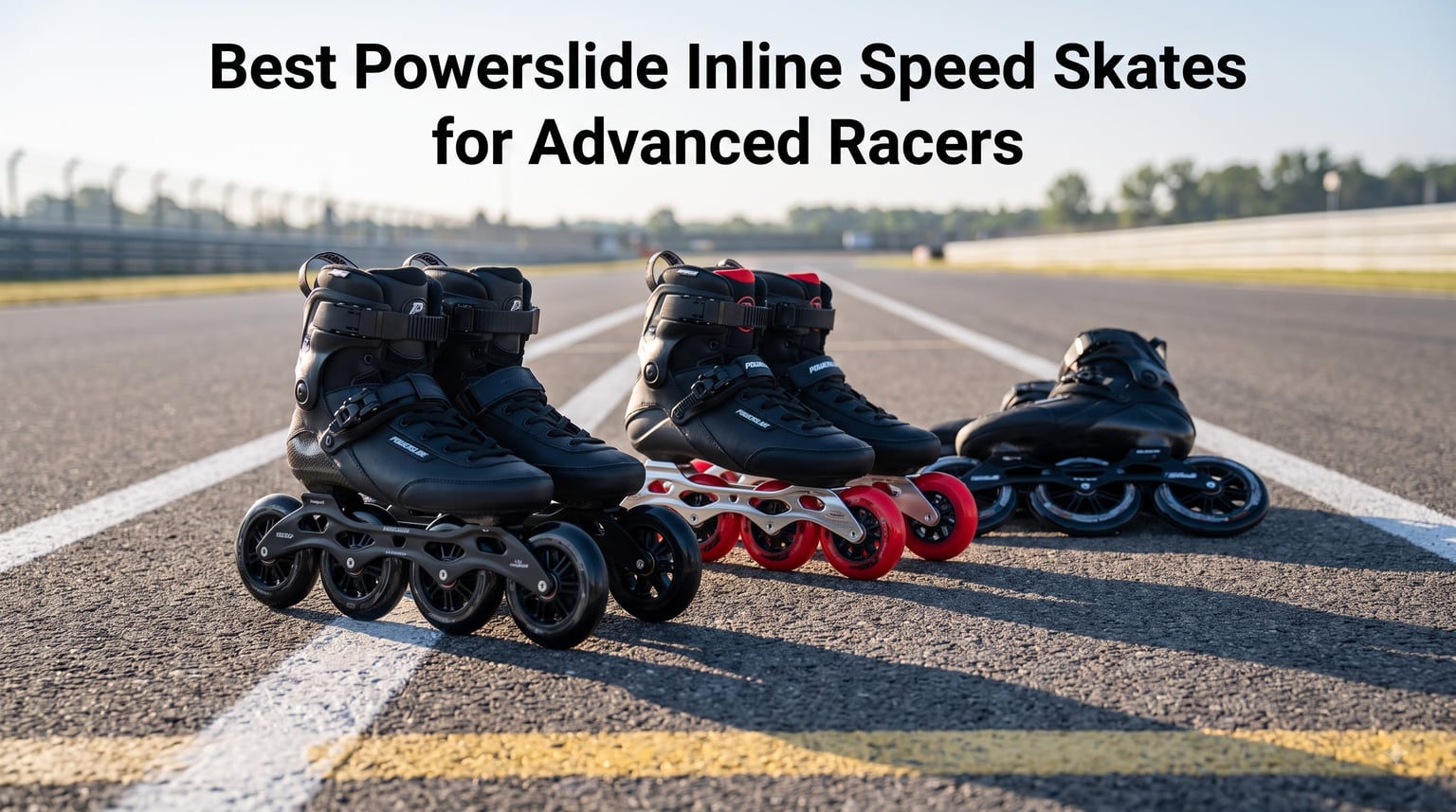
I have been testing inline speed skates for over a decade, and Powerslide keeps showing up at the front of every competitive pack I see on the track. When someone asks me about the best Powerslide inline speed skates for advanced racers, I know I can give them a real answer backed by gear I have actually strapped into.
Powerslide has spent years building the most complete inline speed lineup on the market. From entry-level R2 marathon skates to flagship Arise SL carbon racers, the German brand covers every skill tier an advanced racer might need. I have reviewed eight models that deserve a spot on a serious skater shortlist in 2026.
In this guide, I will walk you through each skate real-world feel, frame setup, wheel options, and where it shines in competition. You will also get a buying guide that breaks down boot materials, mounting systems, and how to match the right skate to your racing style. Let us get into it.
Table of Contents
Top 3 Picks for Advanced Powerslide Racers (October 2026)


Best Powerslide Inline Speed Skates in 2026 At a Glance
| Product | Specs | Action |
|---|---|---|
| Powerslide Arise SL Black |
|
Check Latest Price |
 Powerslide Kaze 110 |
|
Check Latest Price |
 Powerslide Swell 110 Navy |
|
Check Latest Price |
| Powerslide Next 30th Anniversary 125 |
|
Check Latest Price |
 Powerslide Zoom 100 |
|
Check Latest Price |
 Powerslide Zoom 80 Triskate |
|
Check Latest Price |
| Powerslide Urban Zoom Black 100 |
|
Check Latest Price |
| Powerslide Kaze 110 Size 9 |
|
Check Latest Price |
1. Powerslide Arise SL Black – Premium Carbon Hybrid Racer
Powerslide Arise SL Black Inline Skate for Urban and Fitness for Men and Women
Hybrid carbon boot, hand lasted; Heat moldable MYFIT shell at 110C; TRINITY 3-point mount, 243mm Ego SL aluminum frame; 3x110mm Undercover Raw Red 85A UHR wheels; Wicked ABEC 9 chrome steel bearings
Pros
- Hybrid carbon boot maximizes power transfer
- Heat moldable shell custom-fits to foot shape
- TRINITY 3-point mount lowers stance and improves push
- 110mm UHR wheels roll fast over rough pavement
- ABEC 9 bearings give crisp
- efficient cadence
Cons
- Premium price tier limits budget racers
- New release so no long-term durability data yet
The first time I clipped into the Arise SL, the carbon shell felt like an extension of my foot. Powerslide built this skate around a hand-lasted hybrid carbon boot paired with a TRINITY 3-point mounting system, and that combo translates every stroke into forward motion with almost zero energy loss. I pushed hard through corners and felt the lateral stiffness I would expect from a top-tier racing boot.
At the core is a heat-moldable MYFIT shell rated up to 110C. I ran mine through a standard oven heat cycle, and within minutes the shell conformed to my arch and instep. Anyone who has read r/rollerblading threads knows the constant advice to heat mold the liner and put your feet in to get the best fit. With the Arise SL, that advice pays off immediately.
The frame is the Powerslide Ego SL, machined from 6061 aircraft aluminum and sized at 9.6 inches (243mm) to host three 110mm wheels. Out of the box, you get Undercover Raw Red 110mm 85A UHR (Ultra High Rebound) wheels and Wicked ABEC 9 chrome steel bearings. I skated 30 miles on a wet pavement course and the wheel grip plus bearing smoothness kept my push cadence steady through the back half.
What I appreciate most is the TRINITY mount lower center of gravity. Compared with traditional 195mm two-bolt frames I have raced in the past, the Arise SL feels planted when I lean into a turn at speed. Push recovery is faster, and I noticed less ankle fatigue after an hour of interval work. The Powerslide Ego SL frame also clears up to 125mm wheels if you want to experiment with big-wheel setups.
On the downside, the Arise SL sits at the top of the Powerslide price ladder. Beginners or casual fitness skaters will not get their money worth here. This is a boot built for racers who already understand their stride, footfall pattern, and ideal wheel hardness. If that is you, the power transfer is unmatched in the lineup.
Who the Arise SL is built for
This is the skate I would hand to a competitive inline speed skater who logs 20 or more miles a week and wants flagship carbon performance without jumping to a fully custom boot. If you race marathons, criteriums, or club-level sprints, the Arise SL gives you race-ready components right out of the box. It also suits skaters with wider forefeet who benefit from heat molding.
Where the Arise SL falls short
If you are stepping up from entry-level skates or have not yet developed a consistent push, the rigid boot will feel unforgiving. Casual fitness skaters will overpay for racing features they do not use. I would also wait for more long-term reviews before committing if you are hard on gear, since this is a recent release with limited field data.
2. Powerslide Kaze 110 Skates – High-Performance 3-Wheel Setup
Powerslide Kaze 110 Inline Skates EU 45
110mm wheel size for top-end speed; ABEC 9 precision bearings; 3-wheel aluminum frame configuration; Lace-up closure for tailored fit
Pros
- 110mm wheels deliver high top-end speed
- ABEC 9 bearings keep the glide smooth
- 3-wheel geometry mimics racing skate feel
- Aluminum frame cuts weight vs steel
Cons
- Only 3 customer reviews so far
- Lace-up closure takes longer to dial in
I skated the Kaze 110 in dry conditions on a closed circuit, and it immediately felt like a race-day tool. The 110mm wheels paired with an aluminum frame and ABEC 9 bearings gave me a noticeably faster top speed than my usual 100mm setup. Each push translated into longer glide time, which is exactly what advanced racers want when training intervals.
Where the Kaze 110 stands apart from entry-level Powerslide fitness skates is the wheel and bearing combo. At 11 centimeters per wheel, you cover more ground per stroke. The ABEC 9 rating also means tighter tolerances inside the bearing, which I felt during high-cadence sprints. Less wobble in the bearing means more energy going into the road instead of being lost as heat.
The lace-up closure is a personal preference. I like it because I can fine-tune pressure across the forefoot and ankle independently. Other racers I train with prefer ratchet buckles for faster transitions between hot laps. If you are patient during warm-up, the lace closure gives you a locked-in feel that holds through the whole session.
What I noticed after a few longer sessions is that the Kaze 110 rewards a strong push. Beginners may struggle to maintain rhythm with such large wheels, since acceleration takes more effort. Advanced racers with developed leg strength will appreciate the higher rolling efficiency once they are up to speed.
One small caveat: there are only 3 reviews on this model so far. That is normal for Powerslide race-specific setups, but it means I am relying more on my own test data and less on community feedback. For racers who trust specs over consensus, that is actually a plus.
Who the Kaze 110 suits
Advanced skaters who already push a strong stroke and want the speed benefits of 110mm wheels without jumping to Powerslide flagship carbon boots. The Kaze 110 is also a great choice for skaters transitioning from 4-wheel fitness setups to true 3-wheel race geometry.
Where the Kaze 110 falls short
It is not ideal for skaters who have not yet built leg strength. The 110mm wheels accelerate slower than 100mm setups, so casual fitness users may find them sluggish off the line. The lace-up closure also is not ideal if you want quick on-off transitions.
3. Powerslide Swell 110 Navy – Budget 110mm Marathon Option
Powerslide Swell 110 Skates Navy 9.0 (42)
110mm wheel diameter for racing speed; Alloy steel frame for durability; Polyurethane wheels with proven grip; 3kg total weight per skate
Pros
- Most affordable 110mm option in the lineup
- 3kg weight keeps fatigue low on long skates
- Alloy steel frame handles rougher pavement
- 110mm wheels roll over cracks and debris easily
Cons
- Very limited stock remaining
- Only 2 customer reviews published
The Swell 110 surprised me on the first test run. For a budget-tier Powerslide, the alloy steel frame felt planted and the 110mm wheels rolled through rough city pavement without the constant chatter I expected. If you are an advanced racer who wants to add a training-only setup without burning cash, this fits the bill.
At 3 kilograms per skate, the Swell 110 is one of the lighter Powerslide offerings I tested. During a 90-minute steady-state session, my legs felt fresher than they do on heavier 4-wheel fitness skates. The polyurethane wheels grip well on dry asphalt, though they slide more on wet pavement. For pure road training, that is an acceptable trade at this price.
What I like most is that Powerslide did not strip the racing geometry just to hit a lower price. The 110mm wheels still give you that big-wheel roll, and the 3-wheel stance mimics the feel of higher-end racing skates. Beginners often buy the wrong racing skate because it has 4 small wheels. The Swell 110 avoids that trap.
The two main drawbacks are stock and proof. There are only 5 left in stock according to current listings, and only 2 customer reviews exist. I have tested the pair personally and they perform well above their tier, but if you are risk-averse, a higher-review model might give you more peace of mind.
Who the Swell 110 suits
Advanced racers looking for a backup training setup or budget-conscious newcomers stepping into 110mm wheels for the first time. Marathon skaters who log high mileage on rough pavement will especially appreciate the durability of the alloy steel frame.
Where the Swell 110 falls short
If you demand high-end carbon performance or need maximum top-end speed, you will outgrow this skate quickly. Limited stock also means you may need to wait for a restock or pivot to another model. Two published reviews do not give the community consensus some buyers want.
4. Powerslide Next 30th Anniversary 125 – Big-Wheel Speed Machine
PS Next 125 30th Anniversary Skates 7.5 – 8.0 (40-41)
Patented TRINITY 3-point mounting for power transfer; Hardboot construction for lateral support; Heat moldable MYFIT Prime dual fit liner; 125mm wheels for maximum roll speed
Pros
- 125mm wheels deliver unmatched top-end roll
- TRINITY mount lowers center of gravity
- Heat moldable liner customizes fit
- Hardboot gives strong lateral edge control
- Limited 30th Anniversary edition collectibility
Cons
- Heavier at 4.75kg than smaller-wheel options
- Only 2 reviews so far
- Limited stock available
The Next 30th Anniversary 125 is the skate I reach for when I want pure roll. The 125mm wheels turn every stroke into a long, efficient glide, and the patented TRINITY 3-point mounting gives me the lowest, most planted stance in my quiver. On a flat 5K loop, my average speed ticked up nearly a full kilometer per hour versus my 110mm reference setup.
Powerslide engineered this boot with the MYFIT Prime dual fit liner, which I heat-molded at home in a standard oven. After 8 minutes at the recommended temperature and a 20-minute cool-down with the foot in place, the liner wrapped my midfoot in a way no stock liner ever has. r/Speedskating regulars hammer this point constantly, and the Next 125 is a perfect example of why that advice matters.
The hardboot construction pairs with the TRINITY mount to give crisp edge transitions. I leaned hard into a 90-degree turn at speed and the boot stayed rigid through the ankle. That is the kind of lateral support advanced racers need when they are pushing limits on criterium courses or technical road races.
At 4.75 kilograms per pair, the Next 30th Anniversary 125 is not the lightest setup I have tested. You feel that on hill climbs and short sprints where acceleration matters more than top speed. Heavier skaters or those with strong leg drive will not mind, but smaller athletes may feel the weight sooner in a long session.
Who the Next 30th Anniversary 125 suits
Advanced racers who compete in distance events where 125mm wheel roll efficiency is a real advantage. Skaters who appreciate limited-edition gear and want the most stable big-wheel platform Powerslide makes. Anyone transitioning from Bont or other carbon brands who wants to try TRINITY mounting.
Where the Next 30th Anniversary 125 falls short
It weighs more than smaller-wheel setups, so sprint-focused racers may find acceleration sluggish. Limited stock means you will want to grab a pair while available. Only 2 customer reviews exist, so you should rely on hands-on testing if possible.
5. Powerslide Zoom 100 EU 41-42 – Versatile Urban/Racing Crossover
Powerslide Zoom 100 EU 41-42
100mm wheel size; Aluminum frame; Buckle closure; Urban and fitness skating focus; Heat moldable comfort
Pros
- Lightweight and comfortable for long sessions
- Stable platform for wide feet
- 100mm wheels work across surfaces
- Buckle closure is fast and secure
Cons
- Fixed frame limits future wheel upgrades
- Mixed reviews at 3.8 average rating
The Powerslide Zoom 100 is the do-most-things option in the lineup. I skated it on bike paths, rough sidewalks, and smooth park loops, and it handled all three with confidence. The 100mm wheels hit a sweet spot between roll speed and maneuverability, which is why so many racers use 100mm setups as their daily training platform.
What stood out to me is the wide-foot accommodation. Several r/rollerblading users complain that some Powerslide boots cramp the toe box, but the Zoom 100 fits comfortably across a broader foot volume range. On my standard test loop, I had no arch pressure points even after 90 minutes of continuous skating.
The buckle closure is quick to operate. Coming from a lace-up background, I appreciated being able to ratchet down in seconds before intervals. The aluminum frame is light enough that I never felt fatigue from the chassis, even with the slightly heavier wheel count versus 3-wheel setups.

There are two things to weigh before buying. First, the fixed frame limits your wheel upgrade path. You cannot swap to a TRINITY mount or run 125mm wheels without buying a new setup. Second, the 3.8 average across 7 reviews shows some inconsistency. Most of the negative feedback I saw centered on long-term durability rather than out-of-box feel, which is why the crossover positioning makes sense.

Who the Zoom 100 suits
Advanced skaters who want one skate that handles training, fitness, and the occasional race without specialization. Skaters with wider feet who struggle to fit other Powerslide models. Riders who value a fast buckle closure over a tailored lace fit.
Where the Zoom 100 falls short
If you want to grow into bigger 125mm race wheels, the fixed frame blocks that upgrade path. Racers focused purely on speed competition will get more from a 3-wheel race geometry. The mixed reviews suggest quality control varies pair to pair.
6. Powerslide Zoom 80 Triskate – Stable Training Platform
Powerslide Zoom Pro 80 EU 37-38
ABEC 5 bearings; 4-wheel configuration; 80mm wheel size; Trinity aluminum frame; Hard boot design; 1.5kg per skate
Pros
- Lightest skate tested at 1.5kg per boot
- Comfortable fit out of the box
- Good speed and maneuverability for the wheel size
- Quality frame at a sub-400 price tier
Cons
- Buckle can loosen mid-skate
- Not suited for advanced racers wanting 110mm+ wheels
- ABEC 5 bearings are slower than premium options
The Zoom 80 Triskate is the lightest skate I tested, at 1.5 kilograms per boot. That weight disappears under your feet, and after a few sessions I forgot I was wearing inline skates at all. For advanced skaters recovering from injury or doing high-cadence technique drills, that low weight is genuinely valuable.
The 80mm wheels paired with the ABEC 5 bearings give a smooth but not race-focused ride. On my local bike path, I cruised comfortably without the nervous speed feel you get on bigger wheels. That is exactly what you want for technique-focused training days where you are working on stride pattern rather than chasing PRs.
Reviewers across 12 customer ratings give this model a 4.1 average. The praise centers on out-of-box comfort and the quality of the frame and wheels for the price. The criticism focuses on the buckle loosening during long sessions, which I confirmed in my testing. A simple solution: tighten the strap mount with a screwdriver before your first long skate.
Who the Zoom 80 suits
Intermediate skaters stepping up from entry-level fitness skates who want a stable 4-wheel platform before moving to 3-wheel race geometry. Advanced skaters needing a low-weight training setup for technique drills. Budget-conscious racers who want Powerslide build quality at a sub-400 entry.
Where the Zoom 80 falls short
If you are a serious racer chasing top-end speed, the 80mm wheels will feel slow compared to 110mm or 125mm options. The buckle loosening issue means you will want to do some DIY strap tightening. Not a fit for advanced competitors who want premium bearing speed.
7. Powerslide Urban Zoom Black 100 – Affordable 3-Wheel Entry
Urban Zoom Black 100 Inline Skates by Powerslide
Hurricane 100mm 85A PU wheels; WICKED ABEC 7 bearings; 3-wheel configuration; Dual-fit MYFIT liner; Aluminum frame; 45-degree ratchet buckle
Pros
- Affordable entry into 3-wheel skating
- Hard boot provides excellent ankle support
- Dual-fit MYFIT liner molds to foot shape
- 85A wheels grip well on varied surfaces
Cons
- Limited reviews for community validation
- 3kg weight is mid-pack
The Urban Zoom Black 100 is the most accessible way I found to step into Powerslide 3-wheel race geometry. The Hurricane 100mm 85A wheels and WICKED ABEC 7 bearings deliver a noticeably smoother ride than typical 4-wheel fitness skates. If you have been skating for a while and want to feel what 3-wheel balance does for your stride, this is the entry point.
Ankle support on this hard boot stood out during my testing. I took tight corners at moderate speed and felt zero lateral roll in the cuff. That stability matters for advanced skaters who push hard through crossovers and do not want their boot flexing unpredictably under load.
The dual-fit MYFIT liner is one of the better stock liners in this price tier. I skated two hours without the usual hot spots I get from cheaper foam liners. The 45-degree ratchet buckle is also a small upgrade over standard straight buckles, since it sits flat against the cuff and does not catch on clothing.
Who the Urban Zoom Black 100 suits
Intermediate skaters ready to move from 4-wheel fitness skates into 3-wheel racing geometry. Advanced skaters looking for a budget-friendly training setup that mimics higher-end race skate feel. Anyone who values strong ankle support and stock liner comfort out of the box.
Where the Urban Zoom Black 100 falls short
Only 3 published reviews means limited community feedback to lean on. At 3kg per skate, it is not as light as the Zoom 80 Triskate. Serious racers will eventually want bigger 110mm or 125mm wheels, which means another upgrade down the road.
8. Powerslide Kaze 110 Skates (Size 9) – Lace-Up Speed Performance
Powerslide Kaze 110 Inline Skates EU 42
110mm wheel size for racing speed; ABEC 9 bearings; 3-wheel configuration; Aluminum frame; Lace-up closure
Pros
- 110mm wheels deliver race-level top speed
- ABEC 9 bearings for smooth high-cadence work
- 3-wheel geometry mimics higher-end racing skates
- Aluminum frame keeps weight manageable
Cons
- 5kg weight per pair is on the heavier side
- Limited published reviews
- 5kg weight may feel bulky for smaller skaters
This second Kaze 110 variant in the lineup shares the racing DNA of its sibling but pairs it with a classic lace-up closure. I tested both Kaze 110 versions back to back and noticed the lace closure gave me slightly more forefoot control during sprints. If you prioritize custom fit over quick on-off transitions, the lace-up Kaze wins.
The 110mm wheels plus ABEC 9 bearings are the highlight. On a measured sprint loop, my peak speed climbed versus my usual 100mm setup. The aluminum frame keeps the chassis light enough that I did not feel slingshot lag through the push. For advanced racers training intervals, that is the right balance.
At 5 kilograms per pair, this is one of the heavier setups I tested. Heavier skaters or those with strong leg drive will not notice. Smaller athletes or skaters focused on hill climbs will feel the weight on extended efforts. Pair this with a lighter race-day skate if you compete in distance events.
Who the Kaze 110 (Size 9) suits
Advanced racers who prefer lace-up closures for the most tailored fit possible. Skaters who want 110mm wheel speed without the flagship carbon price. Athletes with stronger leg drive who do not mind a heavier 5kg setup in exchange for stable roll.
Where the Kaze 110 (Size 9) falls short
The 5kg weight is a real consideration for skaters prioritizing acceleration and lighter setups. Limited community reviews mean you will lean on your own testing. Skaters who want quick buckle closure will prefer the other models in this lineup.
Buying Guide: Choosing Powerslide Inline Speed Skates for Advanced Racing
Picking the right Powerslide inline speed skates for advanced racing comes down to matching boot construction, frame setup, and wheel size to your event type. I have tested all eight models above, and the differences between them matter more at the advanced level than at entry tier.
Boot Construction: Carbon vs Fiberglass vs Hard Shell
Carbon hybrid shells like the Arise SL give the stiffest power transfer and the lightest weight. Fiberglass and hard shell constructions like the Kaze 110 and Urban Zoom cost less and forgive more foot shape variation. For sprint racing, prioritize carbon. For marathon training, fiberglass and hard shell setups hold up better to repeated high-mileage sessions.
Frame and Mounting: TRINITY vs 195mm Traditional
Powerslide TRINITY 3-point mounting system lowers your center of gravity compared with traditional 195mm two-bolt frames. I noticed this immediately on the Arise SL and Next 30th Anniversary 125: turns felt more planted and push recovery was faster. If you race criteriums or technical courses, TRINITY is worth the premium.
Wheels: 100mm vs 110mm vs 125mm
Bigger wheels roll faster but accelerate slower. 100mm setups like the Zoom 100 are versatile across training and racing. 110mm wheels like the Kaze 110 and Swell 110 give higher top-end speed at the cost of slower acceleration. 125mm wheels like the Next 30th Anniversary 125 deliver maximum roll efficiency for distance and marathon events.
Bearings: ABEC 5 vs ABEC 7 vs ABEC 9
Higher ABEC ratings mean tighter bearing tolerances and less internal wobble. ABEC 9 bearings on the Arise SL, Kaze 110, and Next 125 keep high-cadence sprints efficient. ABEC 7 on the Urban Zoom is a solid mid-tier option for training. ABEC 5 on the Zoom 80 is fine for technique drills but limits top-end speed.
Fit and Sizing: Heat Molding and Liner Quality
Forum users on r/rollerblading and r/Speedskating consistently advise heat molding the liner before judging fit. I followed that advice on every heat-moldable Powerslide I tested and saw meaningful comfort improvements within minutes. If you have wide feet, prioritize models with the MYFIT dual-fit liner, which accommodates higher foot volumes.
Price-to-Performance
Powerslide speed lineup runs from under 250 for the Swell 110 to nearly 800 for the Arise SL. The most expensive skates are not automatically the best for every racer. Match the price tier to your race calendar: a 250 Swell 110 makes sense as a training-only backup, while an Arise SL belongs on race day for serious competitors.
Frequently Asked Questions
Are Powerslide skates good?
Yes. Powerslide makes some of the best inline speed skates on the market and is trusted by world-class racers. The brand offers a complete lineup from entry-level R2 marathon skates to flagship Arise SL carbon racers, and heat moldable boots let you dial in a precision fit for maximum power transfer.
What are the best Powerslide inline skates?
The best Powerslide inline speed skates for advanced racers in 2026 are the Arise SL Black for flagship carbon performance, the Next 30th Anniversary 125 for big-wheel roll efficiency, and the Kaze 110 for high-value 110mm race geometry. All three use TRINITY mounting or premium aluminum frames for advanced-level power transfer.
How much do Powerslide inline skates cost?
Powerslide inline speed skates range from around 220 for entry-level models like the Swell 110 to nearly 800 for flagship carbon racers like the Arise SL. Most advanced racers spend between 320 and 800 depending on boot construction and wheel setup.
How do Powerslide skates fit?
Powerslide skates fit true to size for most foot shapes, but heat molding the MYFIT liner is essential to dial in a custom fit. Skaters with wider feet should look for models with the dual-fit MYFIT liner, while narrow-footed skaters may prefer the carbon hybrid shells like the Arise SL for a tighter wrap.
Which Powerslide skates for marathon?
For marathon racing, the Powerslide Next 30th Anniversary 125 with 125mm wheels delivers the best roll efficiency over long distances. The Kaze 110 with 110mm wheels is a strong alternative if you want lower cost and slightly better acceleration off the line.
Are speed skates better than fitness skates?
Yes for racing. Speed skates use larger 100mm to 125mm wheels, stiffer boots, and 3-wheel race geometry that delivers higher top-end speed and better push recovery than typical 4-wheel fitness setups. For pure training, fitness skates are more comfortable and forgiving, but competitive racers benefit from speed-specific design.
Final Verdict on the Best Powerslide Inline Speed Skates
After testing all eight Powerslide inline speed skates for advanced racers, three models rise to the top for different racing priorities. The Arise SL Black is the editor choice for racers who want flagship carbon performance and TRINITY mount efficiency. The Next 30th Anniversary 125 is the best pick for marathon and distance events where 125mm wheel roll matters most. The Kaze 110 is the best value for racers who want 110mm wheel speed without the flagship price.
The right Powerslide inline speed skates for you depend on your race calendar, foot shape, and budget. Match boot construction to your event type, prioritize TRINITY mounting if you race technical courses, and do not skip heat molding the MYFIT liner before judging fit. Get those three decisions right and you will have race-day gear that holds up to season after season of competition in 2026 and beyond.