
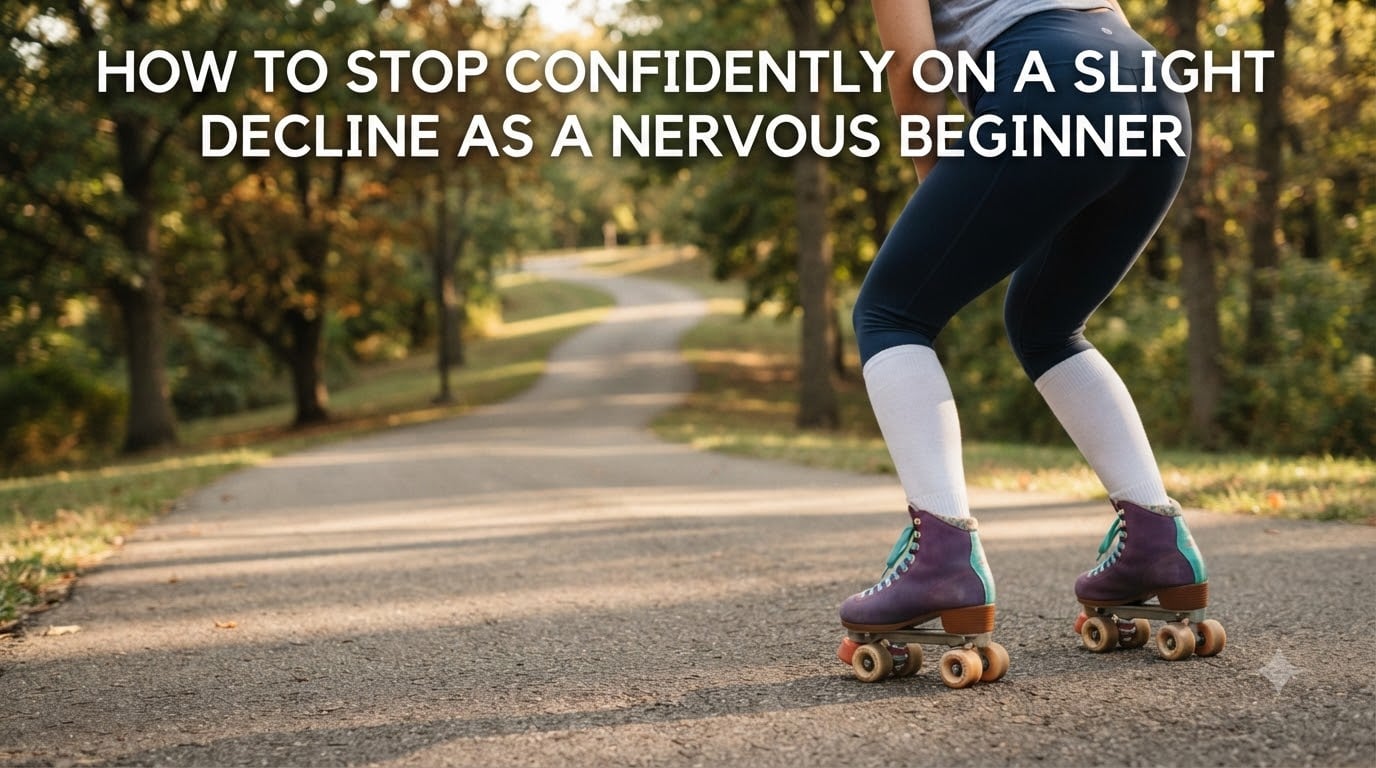
That slight dip in the path caught you off guard, your speed picked up, and suddenly your legs stopped listening to your brain. If you have ever frozen on a gentle slope because you were not sure how to slow down without falling, you are in good company.
I remember my first crosswalk decline vividly. My skates picked up speed, my body went stiff, and I made every wrong choice in the span of about three seconds. What I have learned since then, and what this guide will walk you through, is that stopping on a slight decline is a skill you can build piece by piece. It is not a test of bravery.
How to stop confidently on a slight decline as a nervous beginner comes down to three things: a solid ready position, a reliable stopping technique you have drilled on flat ground first, and a few mental habits that keep you calm when speed builds. We will cover all three in detail. You will get step-by-step instructions for the plow stop, the toe stop drag, and the T-stop, plus a four-week practice plan designed specifically for skaters who feel nervous about slopes.
You are not behind, you are not too anxious, and you are definitely not the only one who finds declines intimidating. By the end of this guide, you will have a clear path from shaky to steady.
Table of Contents
Why Slight Declines Feel Scary for New Skaters?
That creeping sense of acceleration on a gentle slope is real, and it is not just in your head. Slight declines trigger a genuine physical response that every beginner skater experiences, even the ones who look totally calm.
The Gravity Factor You Feel Before You Notice
Even a slope that looks almost flat can accelerate you within a few strides. Gravity is constantly pulling you downhill, and unlike walking, your wheels do not grip the ground the way shoes do. That means speed builds quietly. By the time you realize you are rolling faster, your body has already started to react.
This is why the fear feels sudden. You are not being dramatic. Your skates are doing something your brain has not fully calibrated yet, and that mismatch creates panic.
Why Your Brain Treats Declines Like a Threat
Your brain reads speed without control as danger, plain and simple. When you cannot stop on command, your nervous system treats the slope the same way it would treat any situation where you feel trapped. Your shoulders tense, your breathing gets shallow, and your instinct tells you to go stiff.
Going stiff is the worst thing you can do on skates, but it is also the most natural reaction. I have read dozens of beginner stories on skating forums, and a common one is someone suddenly hitting a downhill section on a crosswalk path and freezing up completely. They did not lack skill. They lacked a plan for that moment.
This is the exact gap we are filling here. Most beginner guides cover stopping on flat ground but never address what changes when the ground tilts even slightly. The techniques are the same, but the timing, the speed, and the mental game all shift. Once you understand that shift, the fear shrinks.
The Ready Position: Your Foundation for Stopping on a Decline
No stopping technique works if your body is not in the right position first. The ready position is the single most important skill for how to stop on a slight decline, and every method in this guide depends on it.
Knees Bent, Weight Centered, Eyes Forward
Get into the ready position before you even start moving downhill, not after you realize you are going too fast. Here is the checklist:
Bend your knees like you are sitting slightly in a chair. Soft knees, not locked knees.
Keep your weight centered over the middle of your skates, not pitched forward or leaning back.
Look ahead at where you want to go, not down at your wheels.
Arms relaxed at your sides or slightly out for balance, not clutching your own elbows.
Think of this position as your emergency brake setup. When you are already low, centered, and balanced, every stopping technique becomes dramatically easier. When you are standing tall, stiff, and looking at the ground, nothing works.
Common Posture Mistakes on a Decline
The biggest mistake beginners make on a slope is leaning backward to try and slow down. It feels logical, like leaning back on a sled. But leaning back shifts your weight behind your wheels, which makes them more likely to shoot out in front of you. It also removes your ability to bend your knees effectively.
The second mistake is standing up taller as speed builds. Your instinct says “get tall and tall means control,” but the opposite is true. Taller means a higher center of gravity, which means less stability and more wobble.
Stay low. Stay centered. Stay soft. Every technique in this guide builds on that base.
How to Stop on a Slight Decline: The Plow Stop Technique
The plow stop is the most recommended technique for nervous beginners on slight declines, and for good reason. It keeps both skates on the ground, gives you continuous speed control rather than an all-or-nothing stop, and works even if you are still building your balance. Skaters on forums consistently point to this as the easiest method for managing speed on any incline.
Step-by-Step Plow Stop Instructions
Practice these steps on completely flat ground first. Once they feel automatic, take them to the gentlest slope you can find.
Start in the ready position. Knees bent, weight centered, eyes forward.
Widen your stance slightly so your skates are a bit wider than hip-distance apart.
Turn both toes inward gently, like you are forming a pizza slice or a snowplow shape with your skates.
Press into the inside edges of your wheels by pushing your knees slightly outward over your toes.
Let the friction build gradually. You will feel resistance as your wheels drag against the ground.
Keep your weight low and centered. Do not stand up as you slow down.
Squeeze the plow tighter to slow more, or ease off to maintain a controlled speed.
The beauty of the plow stop on a decline is that you do not have to come to a full stop right away. You can hold the plow position and glide at a controlled speed all the way down. That alone changes the experience from terrifying to manageable.
Why the Plow Stop Works Best on Slight Declines
Both skates stay on the ground, which means you always have a stable base. You control the intensity by how hard you press into your edges, so you can dial in exactly the right amount of slowing for the slope in front of you. And because you are using friction rather than relying on a single balance point, a wobble does not immediately become a fall.
This is why experienced skaters recommend it for declines before anything else. It is forgiving, adjustable, and builds the skill of edge control that every other stopping technique relies on.
Toe Stop Drag: Your Backup Method for Slight Downhill
If you skate on quad skates with toe stops, the toe stop drag is your second-line technique for controlling speed on a gentle slope. It is especially useful when you need to slow down gradually while keeping one foot rolling smoothly.
When to Use the Toe Stop Drag on a Decline
Use this method when you want to bleed off speed without fully stopping, or when you are approaching a spot where you will need to stop and want to arrive at a manageable speed. It is also a good option if your plow stop feels unstable and you need a simpler method in the moment.
The toe stop drag is less ideal on very steep hills because it puts a lot of pressure on one foot. On a slight decline, though, it is perfectly effective and feels natural once you get the timing.
Step-by-Step Toe Stop Drag Instructions
Start rolling in the ready position with your weight on your dominant skating foot.
Lift the toes of your other foot so the toe stop points down toward the ground.
Touch the toe stop lightly to the ground behind you. Start with almost no pressure.
Gradually press down harder on the toe stop to increase friction and slow down.
Keep your skating knee bent and your weight centered over that front foot.
Look ahead, not down at the toe stop.
Release pressure to roll, press again to slow. Think of it like a brake pedal.
The key is light pressure first, then gradual increase. Slamming the toe stop down will either stop you too abruptly or cause the skate to catch. Gentle, progressive pressure gives you smooth, predictable slowing every time.
T-Stop for Speed Control Before You Need to Stop
The T-stop is a step up from the toe stop drag and works on both quads and inline skates. It is less about emergency stopping and more about managing your speed before it becomes a problem. For nervous beginners on slight declines, learning the T-stop gives you another tool in the toolkit.
How the T-Stop Slows You Without Stopping
In a T-stop, you turn your back skate perpendicular to your front skate and drag the wheels sideways across the ground. The friction from those sliding wheels slows you down smoothly. Unlike the plow stop, your weight is on one foot while the other does the braking work.
This is why the T-stop is a progression skill. You need solid one-foot balance before it feels comfortable. But once you have it, you can drag the T-stop position for long stretches on a gentle slope, controlling your speed the entire way down without ever needing to fully stop.
Practicing the T-Stop on Flat Ground First
Do not try the T-stop on a decline until you can do it smoothly on flat ground. Here is how to build it up:
Step 1: Glide on one foot on flat ground until you feel stable for several seconds.
Step 2: While gliding, lift your other foot and turn it 90 degrees so it points sideways.
Step 3: Set the sideways foot down gently behind you, letting the wheels drag.
Step 4: Apply light, even pressure. You should hear a soft hiss, not a screech.
Step 5: Keep your front knee deeply bent and your weight fully on that front foot.
Once you can do five clean T-stops in a row on flat ground without wobbling, you are ready to try it on the gentlest possible decline. The technique does not change. Only your speed and your timing do.
Mental Techniques for Staying Calm on Declines
Here is where most guides stop, and it is exactly where nervous beginners need the most help. You can know every stopping technique perfectly and still freeze on a slope because your mind went into panic mode. These mental techniques are the missing piece.
Breathe Through the Speed Buildup
When speed builds, your breathing goes shallow or stops entirely. That feeds the panic loop. Before you even approach a decline, take one deliberate exhale. As you start rolling downhill, keep breathing out slowly and steadily.
This sounds too simple to matter, but it changes everything. A slow exhale tells your nervous system that you are safe. It keeps your muscles loose instead of rigid, which keeps your knees soft instead of locked, which keeps you in the ready position instead of standing up stiff.
Try it right now while sitting still. Take a slow breath in, then exhale for twice as long. Feel your shoulders drop. That is what you want on a decline.
Pick a Visual Target Ahead, Not the Ground
Where you look is where you go. When nervous skaters stare at the ground directly in front of their skates, two things happen. First, they lose their sense of balance because their visual reference point is too close. Second, their brain sees every pebble and crack as a threat, which amplifies fear.
Instead, pick a fixed point in the distance. A tree, a bench, a signpost, anything that is level and ahead of you. Keep your eyes on it as you roll. This stabilizes your balance, gives your brain something calm to focus on, and subtly steers your body toward safe ground rather than toward the slope itself.
Reframe the Decline as a Skill, Not a Threat
The skaters who improve fastest on declines are the ones who stop telling themselves they are bad at hills. The story you tell yourself matters. If the internal monologue is “I cannot do slopes, I am going to fall,” your body follows that script.
Try this reframe instead: “This is a slight decline. I have practiced my plow stop. I will stay low, breathe out, and control my speed.” It is not about false confidence. It is about replacing a panic script with a plan script.
Forum skaters who have worked through this exact fear consistently say the same thing. Once they learned to control their speed rather than feeling at the mercy of it, the fear dropped dramatically. Speed control is power, and power replaces panic.
Common Mistakes Nervous Beginners Make on Declines
Most decline disasters come from a handful of predictable mistakes. Knowing them ahead of time means you can catch yourself before they snowball into a fall.
Leaning Back to Slow Down
We covered this briefly, but it deserves repeating because it is the number one mistake. Leaning back feels protective, but it actively makes everything worse. Your weight shifts behind your heels, your wheels lose grip, and your stopping power disappears. If you catch yourself leaning back, drop your hips lower and bring your chest forward over your knees.
Freezing Up and Stopping Mid-Slope
Sometimes beginners panic and try to stand completely still in the middle of a slope. Without momentum, your skates cannot grip well, and you start rolling backward or sliding sideways. If you need to pause, angle your skates across the slope rather than pointing straight downhill. Better yet, keep rolling slowly with a controlled plow stop and pick a safe spot to stop where the ground levels out.
Other common mistakes to watch for: tensing your arms up near your chest, holding your breath, and taking fast tiny steps instead of long controlled glides. All of these come from the same root cause, which is your body trying to grip the ground the way it does when walking. Skating is not walking. Soft, low, and smooth is always the answer.
Practice Drill: A 4-Week Plan to Build Decline Confidence
Confidence on declines is not something you decide to have. It is something you build through repetition. Here is a four-week progression designed for nervous beginners that takes you from flat ground to a real slight decline.
Week 1: Flat Ground Stops Only
Spend this entire week mastering your plow stop and toe stop drag on completely flat ground. Aim for three practice sessions of 20 to 30 minutes each. By the end of the week, you should be able to do a clean plow stop from a comfortable rolling speed without wobbling.
Do not touch a slope yet. The goal is to make the stopping motion automatic so that when you add the stress of a decline, your body already knows what to do.
Week 2: The Smallest Possible Slope
Find the gentlest slope you can. A driveway with a barely noticeable tilt, a park path with a tiny dip, anything where you roll just slightly faster than on flat ground. Skate to the top, get into your ready position, and plow stop your way down at a walking pace.
Repeat this 10 to 15 times per session. The goal is not to go fast. The goal is to teach your brain that this slope is survivable and that your stop works on it.
Week 3: Linking Stops on a Slight Decline
Find a path with a longer gentle decline. Skate down it using a plow stop to control your speed the entire way, without coming to a full stop. Then try the same path using a toe stop drag. Notice which method feels more natural and practice both.
This week is about duration, not speed. You are building the confidence that you can manage a slope for more than two seconds without losing control.
Week 4: Skating a Full Slight Decline with Confidence
By week four, combine everything. Skate the decline, control your speed with whichever stop feels best, and practice coming to a full stop at the bottom in a controlled way. Add the T-stop if your balance is ready for it.
Most importantly, notice your mental state. Are you breathing? Are you looking ahead? Are you staying low? The physical skills are the same as week one. What has changed is your relationship with the slope. That is what confidence actually is.
When You Are Ready for Steeper Hills?
Progress to steeper terrain only after you can handle a slight decline with calm, consistent stops, and without your heart rate spiking. The transition should feel boring, not thrilling. If a slope still makes your stomach drop, you are not ready for the next level, and that is completely fine.
For steeper hills, the plow stop becomes harder because gravity works against the friction. This is where you will need a transition stop, a slalom approach, or a turn-around stop. We will cover those in a future guide. For now, master the slight decline. It is the foundation everything else stands on.
Frequently Asked Questions
How do I stop going downhill on roller skates without falling?
Use the plow stop: bend your knees, widen your stance, turn both toes inward, and press into the inside edges of your wheels. Apply gradual pressure to control your speed rather than trying to stop all at once. Keep your weight centered and your eyes looking ahead, not down. Practice on flat ground first until the motion is automatic.
How do I get over the fear of roller skating declines?
Start with the gentlest possible slope and practice your plow stop on it repeatedly until your brain learns it is manageable. Breathe out slowly as you roll. Pick a fixed visual target ahead of you instead of looking at the ground. Reframe the decline as a speed control challenge, not a threat. Confidence comes from repetition, not from pushing yourself past your comfort zone too fast.
What is the easiest stop for beginner skaters on a slope?
The plow stop is the easiest and most recommended method for beginners on any incline. Both skates stay on the ground for stability, you control the intensity by adjusting edge pressure, and it works for gradual slowing rather than abrupt stopping. It is forgiving if you wobble and builds edge control skills you will use for every other stop.
Should I lean back when going downhill on roller skates?
No. Leaning back is the most common and dangerous mistake beginners make on declines. It shifts your weight behind your wheels, reduces your grip, and makes stopping nearly impossible. Instead, keep your knees bent, your weight centered over your skates, and your chest slightly forward. Stay low and soft at all times.
How long does it take to learn to stop on a decline?
Most beginners can build reliable stopping confidence on a slight decline in about four weeks with consistent practice. Spend the first week mastering stops on flat ground, the second week on the gentlest slope you can find, the third week linking speed control on longer declines, and the fourth week combining everything. Three 20 to 30 minute sessions per week is enough.
Can I practice stopping on a decline without a hill nearby?
Yes. Start by mastering your plow stop, toe stop drag, and T-stop on flat ground until they are automatic. You can also find barely noticeable slopes like a tilted driveway or a park path with a gentle dip. Any surface where you roll slightly faster than on flat ground will work for early decline practice.
You Can Do This
How to stop confidently on a slight decline as a nervous beginner is not about being fearless. It is about having a plan, practicing it until your body trusts it, and showing up for yourself on slopes that used to feel impossible.
You now have the full toolkit. The ready position that makes every stop work. The plow stop for reliable, adjustable speed control. The toe stop drag for gradual slowing. The T-stop for speed management before you even need to stop. And the mental techniques that keep you breathing, looking ahead, and calm when the ground tilts.
Start this week. Find a flat surface and drill your plow stop until it feels boring. Then find the gentlest slope in your neighborhood and do it 15 times. Your brain will learn what your body already knows: you can control your speed, you can stop when you choose, and declines are just another surface to skate.
Every confident skater you admire started exactly where you are right now. The only difference between them and you is the number of repetitions. Go get yours.