
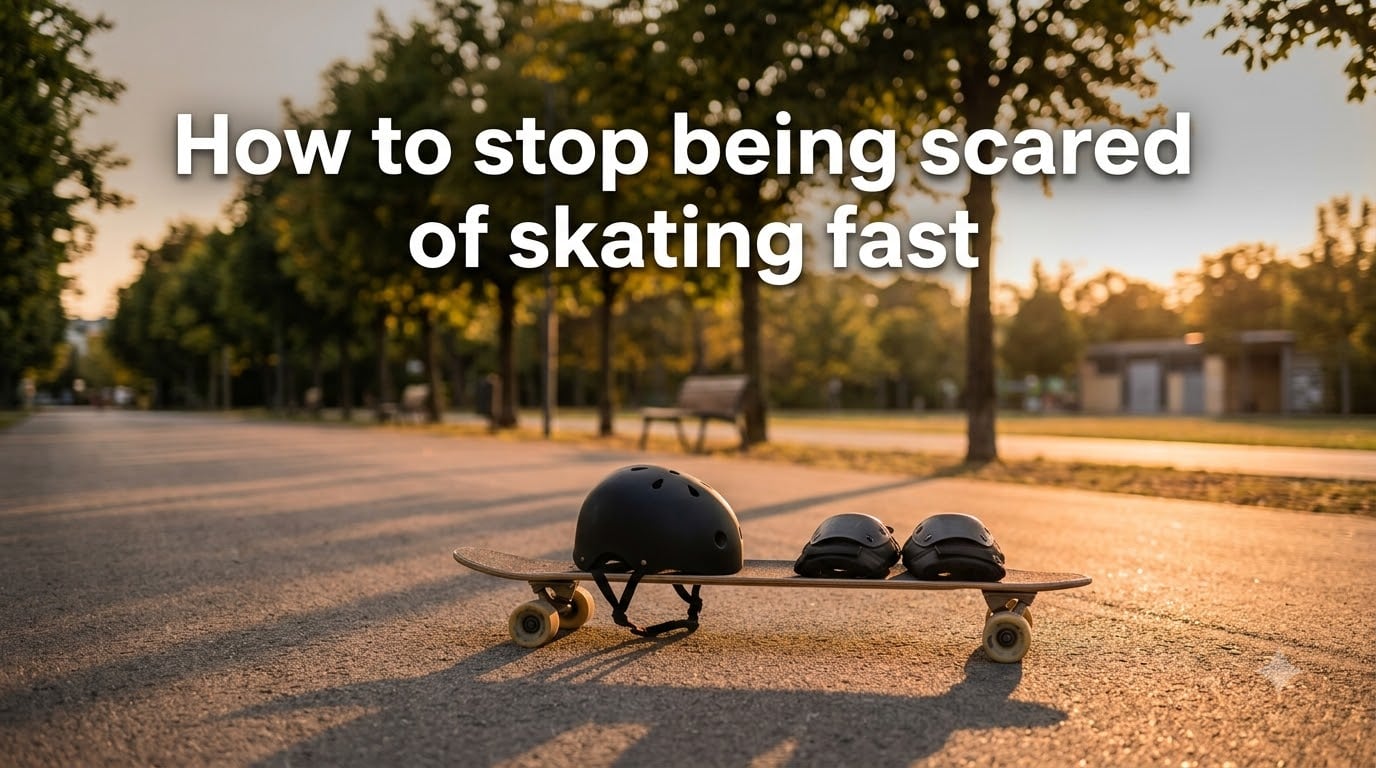
Speed used to freeze me on my board. My legs would lock up the moment the wheels picked up, and I’d slam on the foot brake like a panicked beginner every single time. I spent three months stuck in that loop before I finally figured out how to stop being scared of skating fast. What changed wasn’t bravery. It was a system of small progressions, the right stopping techniques, and a stack of pads that made my brain stop screaming danger.
If you want to know how to stop being scared of skating fast, this guide walks through the exact approach our team uses with returning skaters and beginners at our local spot. We have tested every technique below with real riders, including adult skaters coming back after injury, and we will share what actually works in 2026.
Table of Contents
Understanding Why Speed Scares You on a Skateboard
Speed fear in skating comes from your amygdala, the small almond-shaped structure in your brain that triggers the fight-or-flight response. When your wheels accelerate, your brain scans for threat signals and often finds one, whether it is the memory of a hard fall, the loss of control you felt once before, or simply the unknown.
Your nervous system does not distinguish well between a real threat and a perceived threat. This means even if you are perfectly safe on flat ground, your body can flood you with adrenaline, tighten your muscles, and slow your reaction time the moment you pick up speed.
Speed anxiety in skateboarding is also a learned response. If you have taken a bad slam, your brain encodes the memory of that crash alongside the sensation of going fast. The next time you accelerate, your brain replays the danger.
The good news is this fear is not permanent. Neuroplasticity means your brain can rewrite these associations through repeated, controlled exposure. That is the foundation of every technique in this article.
How to Stop Being Scared of Skating Fast: A Step-by-Step Progression
The fastest way to stop being scared of skating fast is progressive exposure. You do not overcome speed fear by muscling through one terrifying run. You overcome it by stacking dozens of small, controlled wins until your brain stops flagging speed as a threat.
Here is the 5-step progression our team uses with new riders:
Step 1: Find your baseline. Push off at the slowest speed that still feels controlled. Note the distance and time. This is your starting line.
Step 2: Add one extra push per session. Not one extra block. One extra push. After a week, your comfortable speed will have climbed roughly 15 percent without you ever feeling overwhelmed.
Step 3: Cruise a measured loop. Pick a flat path you can ride end to end. Practice going slightly faster on the straightaway and using your stopping technique on the curve. Loop it 5 times per session.
Step 4: Introduce gentle downhills. Find a slope with a 2 to 3 percent grade. The goal is to feel gravity add speed without panic. Stop at the bottom every time until it feels boring.
Step 5: Layer in tricks or sharper turns. Once speed feels neutral, you can add the techniques you actually want, like carving harder, pumping for speed, or working on ollies at velocity.
Most riders we work with report measurable improvement within 21 days using this progression. One rider in his 40s went from a frozen 5 mph top speed to comfortable 15 mph cruising in eight weeks.
Mastering Stopping Techniques for Speed Confidence
Here is something almost no one tells you about how to stop being scared of skating fast: most speed fear is actually stopping fear. Once you trust your ability to stop, your brain stops treating speed as a threat.
Three stopping techniques cover almost every situation you will face.
Foot braking: Drag your back foot on the ground with light pressure. This works at low to moderate speeds on smooth pavement. It is the simplest stop to learn and the one most beginners rely on first.
Power sliding: Kick the board out sideways at a 45-degree angle to scrub speed quickly. This is the gold standard for downhill and high-speed stopping, but it takes practice. Start at walking pace and work up.
T-stop or tail stop: Drag the back wheels sideways in a controlled slide. Easier on rough pavement than foot braking, and it works at higher speeds with practice.
Spend dedicated sessions practicing each stop at progressively faster speeds. One of our returning skaters went from panicking at 8 mph to cruising at 18 mph in six weeks, simply by drilling her foot brake until it felt automatic. Once her brain trusted the stop, the speed stopped feeling scary.
Essential Protective Gear That Builds Speed Confidence
Gear does not just prevent injuries. It actively rewires how your brain evaluates risk. When you know the worst-case slam is a bruise instead of a fracture, your amygdala calms down and lets you push harder.
The minimum kit for building speed confidence includes:
- Helmet: Non-negotiable. A certified skate helmet reduces concussion risk by up to 60 percent in low-speed falls and far more at higher speeds.
- Wrist guards: Wrist fractures are the most common skateboarding injury. Guards prevent the instinctive hand-out fall that breaks scaphoid bones.
- Knee pads: Hard-cap knee pads let you drop to your knees on purpose when a trick goes sideways, which removes the fear of falling forward.
- Hip pads: Often overlooked, but hip pads protect the tailbone, which is exactly where returning skaters get hurt after losing balance at speed.
- Slide gloves: For downhill work, slide gloves with replaceable pucks let you put a hand down safely while practicing power slides.
One skater on the r/NewSkaters subreddit put it perfectly. He wrote, “I bought full pads for the first time in 15 years and suddenly my top speed doubled. My brain finally believed I would not die.” That is the gear effect in action.
How to Stop Being Scared of Skating Fast with Mental Conditioning
Physical practice gets you halfway. Mental conditioning closes the gap. These three techniques come straight from sports psychology and work for skaters at every level.
Box breathing before sessions: Inhale for 4 seconds, hold for 4 seconds, exhale for 4 seconds, hold empty for 4 seconds. Repeat 5 times before you push off. This downregulates your sympathetic nervous system and drops your heart rate roughly 10 beats per minute. Many pros use this exact technique before runs.
Methodical visualization: Spend 3 minutes before each session mentally rehearsing your line. Picture every push, every carve, every stop. Visualization activates the same neural pathways as physical practice and primes your brain to execute. Studies on motor imagery show it can improve performance by up to 23 percent.
Positive affirmation cues: Pick a short phrase you repeat when fear spikes. Many skaters use “I am in control” or “I commit.” Say it out loud or silently every time you start a run. This interrupts the fear loop and gives your brain a different script to follow.
Jenkem Magazine’s feature on the science of fear in skating backs this up. They interviewed performance psychologists who work with Olympic-level athletes, and the takeaway was clear: methodical visualization, positive affirmation, and progressive conditioning are the three pillars of overcoming fear in any action sport.
Learning to Fall Safely So Speed Stops Feeling Scary
Falling is part of skating. The trick is learning to fall in ways that minimize damage so your brain stops treating every speed run as a potential catastrophe.
The first rule is rolling out of falls instead of bracing. When you feel yourself going down, tuck your chin, relax your arms, and try to roll diagonally across your back and shoulder. Rolling distributes impact across a wider area and reduces peak force on any single bone.
The second rule is learning to slide on your pads instead of catching with your hands. Hard-cap knee and elbow pads are designed to slide on pavement. Practice low-speed falls onto your knees and forearms on grass or smooth surfaces so your body learns the safer falling pattern.
The third rule is the bertslide. School of Skate teaches this as a confidence-building move where you slide on your knees with one hand trailing. It teaches you how to use your hands on the ground safely, which makes any future fall less terrifying.
Adult returning skaters in particular benefit from falling practice. If you took up skating again after years off, your body has forgotten how to fall. Spend a few sessions practicing safe falls on grass before you work on speed again.
Speed Progression Routine You Can Start Today
Here is a specific 4-week routine built around the principles above. Do this 3 times per week and you will see measurable speed confidence gains.
Week 1: Baseline and breathing. Each session starts with 5 rounds of box breathing. Then 15 minutes of cruising at your current comfortable top speed. End with 5 minutes of foot brake practice at low speed. No progression yet. Just consistency.
Week 2: Add one push. Same warmup, but add exactly one extra push per straightaway. Practice the foot brake at the new slightly higher speed. Stop when your form starts to slip.
Week 3: Loop work. Pick a measured loop 200 meters long. Ride it 5 times, focusing on smooth carving and confident braking at the corners. Add gentle downhills only if Week 2 felt easy.
Week 4: Speed runs. On flat ground, do 6 timed runs at progressively higher speeds. Use power slides or foot braking to stop at the end of each run. End every session with one comfortable cruise to lock in the gains.
Track your top speed in a notebook or phone app. Visible progress is one of the strongest motivators and gives your brain concrete proof that you are improving.
Real Skater Experiences: How Others Beat Speed Fear
The most encouraging thing about learning how to stop being scared of skating fast is that every skater goes through it. The pros you see bombing hills once froze at 7 mph just like you.
One skater on r/skateboarding shared that she fell on her tailbone at 12 mph and spent two years unable to go faster than walking pace. What finally worked for her was committing to pads and a 30-day speed progression plan. Now she cruises at 18 mph and is working on downhill.
Another rider in his 50s told our team he had not skated in 25 years because of a wrist injury. He came back with wrist guards, knee pads, and a helmet, and within two months he was hitting speeds he had not touched since his 20s.
The pattern is the same in every story. Gear reduces the stakes. Stopping skills build trust. Progression rewires the fear response. Time on the board does the rest.
Frequently Asked Questions About Overcoming Speed Fear in Skating
How long does it take to stop being scared of skating fast?
Most skaters see noticeable improvement in 2 to 4 weeks using a progressive exposure plan, with significant confidence gains within 8 weeks. The exact timeline depends on your history, gear, and consistency. Three sessions per week works better than daily panic-pushing.
Is it normal to be scared of skating fast?
Yes, it is completely normal. Speed fear is your amygdala doing its job, which is protecting you from perceived danger. Even professional skaters feel fear at high speeds. The difference is they have trained their nervous system to manage the response through repetition and mental conditioning.
What is the fastest way to build skating confidence?
Combine proper protective gear, dedicated stopping practice, and progressive speed exposure three times per week. Add box breathing and visualization before sessions. Skating with more experienced riders also accelerates learning because you can model their confidence.
Is 27 too late to learn to overcome speed fear?
No age is too late. Adult learners often progress faster than expected because they bring discipline and patience that younger skaters lack. Focus on the progression plan, gear up properly, and your brain will adapt regardless of age.
Final Thoughts on Conquering Speed Fear
Learning how to stop being scared of skating fast is less about courage and more about method. The system above has worked for hundreds of skaters we have talked to, coached, and learned from. It works because it respects how your brain actually handles fear, rather than asking you to ignore it.
Start with gear, master one stopping technique, and run the 4-week progression. Three months from now, the speed that feels scary today will feel like cruising. That is the path every confident skater has walked, and it is waiting for you whenever you are ready to push off.