
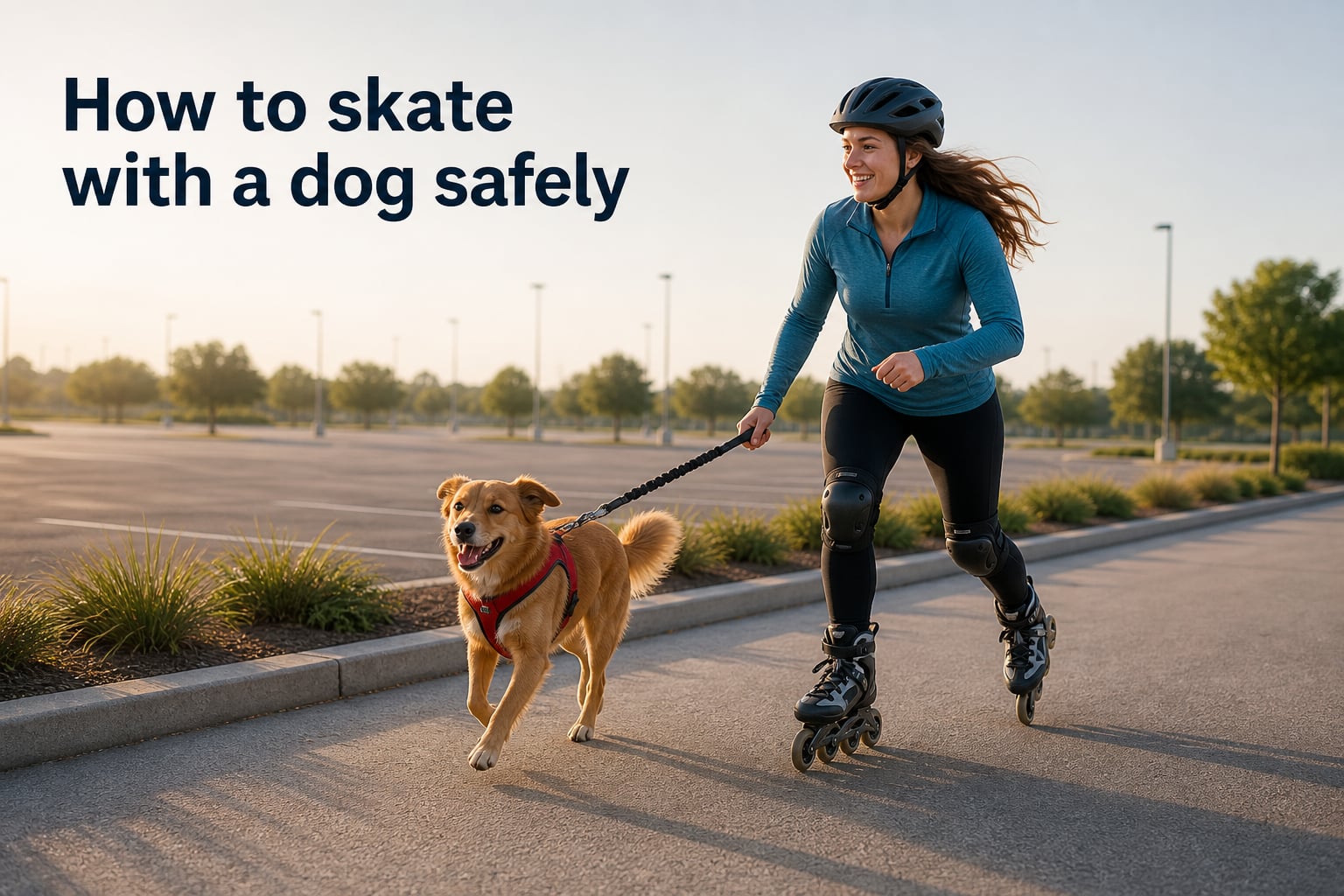
Yes, you can skate with your dog, and thousands of owners do it every week as part of their exercise routine. The short answer is that skating with a dog safely requires three things: a dog over 12 months old with healthy joints, a proper walking harness instead of a collar, and basic obedience commands taught before you ever strap on wheels. Get those right and rollerblading or skateboarding with your dog becomes one of the most rewarding activities you can share.
I started skating with my border collie mix six years ago after we both hit a wall with regular leash walks. He needed more mileage, I needed cardio, and longboard dog walks turned out to be the answer. Since then I’ve coached friends through their first sessions, made every beginner mistake in the book, and watched dogs from chihuahuas to great danes learn the ropes.
This guide pulls together everything I wish I’d known on day one, plus what the Reddit dog-sports community and certified trainers consistently recommend. Whether you’re curious about skateboarding with your dog for exercise, want to try skate mushing, or just need a safer way to cover more ground on your morning walks, you’ll find practical steps below.
Table of Contents
Is Skating With Your Dog Actually Safe?
Skating with a dog is safe when you meet specific prerequisites, but it’s not risk-free for either species. The risks come from three places: sudden leash tension that can snap a dog’s neck or throw a rider, hot pavement that burns paw pads, and unpredictable encounters with off-leash dogs. None of these are deal-breakers, but each one needs a plan.
Most injuries happen in the first month, when dogs haven’t learned to pace themselves and humans haven’t learned to read their dogs’ signals. After the initial training curve, the activity is no more dangerous than a brisk jog together. Many dogs actually prefer it to walking because they cover more ground and burn more energy in the same amount of time.
The 7 7 7 rule for dogs (seven minutes of play, seven hours of rest, seven days a week of activity variety) applies here. Skating can be one of those seven activities, but it shouldn’t be the only one. Mix it up with swimming, fetch, and off-leash time so your dog’s joints and brain stay balanced.
Essential Safety Equipment You Both Need
The right gear is the difference between a fun session and a trip to the emergency room. Here’s what my partner and I use every time we take our dogs out on wheels.
- Walking harness for your dog: A well-fitted Y-front or canicross-style harness distributes pulling force across the chest instead of the throat. Collars concentrate pressure on the trachea and can cause permanent damage if your dog lunges suddenly.
- Hands-free leash: A waist-clip leash keeps both hands free for balance and braking. Most skating accidents happen when riders grab the leash mid-fall.
- Helmet, wrist guards, and knee pads for you: Wrist guards are non-negotiable. A dog that cuts across your path at full speed will send you to the pavement faster than you can react, and broken wrists are the most common skating-with-dog injury.
- Treat pouch and water bottle: A hip treat pouch lets you reward without breaking stride. Carry collapsible water bowls for both of you, especially in warm weather.
- Cooling vest for your dog (summer): Soak it before you head out. It keeps core temperature down by several degrees on hot days.
- Reflective gear: A reflective vest for you and a light-up collar for your dog are essential if you’ll be out near dusk or on shared paths.
Skip the retractable leashes entirely. The thin cord can wrap around ankles and wheels, and the inconsistent tension confuses dogs who are learning to pace.
Is Your Dog Physically Ready to Skate?
Age matters more than breed. Most trainers recommend waiting until your dog is at least 12 to 18 months old so growth plates in the long bones close fully. Starting before that can cause joint problems that show up years later. If you adopted an adult dog with an unknown history, ask your vet to do a quick orthopedic check before you start.
Medium to large breeds with athletic builds tend to thrive. Border collies, australian shepherds, huskies, vizslas, german shorthaired pointers, and standard poodles are popular choices for skate mushing because they have the stamina and the instinct to pull. Sled dog breeds especially love this work. Smaller dogs can do it too, but you’ll need to adjust your speed and pick smoother surfaces.
Skip this activity if your dog falls into any of these categories: brachycephalic breeds (pugs, bulldogs) that overheat easily, dogs with hip dysplasia or arthritis, very young puppies, and seniors over 10 who haven’t done endurance work before. Heart conditions, recent surgeries, and obesity are also reasons to pick a lower-impact exercise.
A simple fitness test before your first session: take your dog on a 30-minute brisk walk. If they keep pace without excessive panting or lameness afterward, they’re likely a good candidate for low-intensity skating. Build up over several weeks before adding hills or longer distances.
Step-by-Step Training Sequence
Don’t put skates on until your dog has mastered every step on foot first. Here’s the progression I use with new dogs, taking roughly 6 to 8 weeks to complete.
Step 1: Teach Directional Commands on Foot
Spend the first two weeks teaching “Gee” (turn right), “Haw” (turn left), and “Whoa” (stop) on regular walks. Use treats and a clicker or marker word. Reward any correct turn or stop within one second. Practice in a quiet area before adding distractions.
Step 2: Desensitize to Wheels and Boards
Roll an inactive skateboard across the floor while feeding treats. Push a rollerblade across the room the same way. The goal is to make the wheels predict good things. Some dogs spook at the sound, so go slow and don’t force proximity.
Step 3: Empty Parking Lot Reps
Pick a flat, empty parking lot and skate alone at low speed while your dog watches from a sit-stay at the edge. After a few sessions, have a helper hold your dog at one end while you skate to the other, call them, and reward the approach. Repeat until your dog chases you confidently without barking at the wheels.
Step 4: First Connected Runs
Attach the hands-free leash and start at walking pace. Keep the first session under 10 minutes and stay on flat ground. Reward your dog every time they match your speed without surging ahead.
Step 5: Build Distance and Terrain
Add 5 minutes per session until you reach 30 to 45 minutes, then start introducing gentle hills and varied surfaces. Always end on a positive note with a treat and a short walk home to cool down.
If your dog stops responding to commands, refuses to move, or pants excessively during any of these steps, go back one stage and stay there for a week. Rushing is the single biggest mistake I see new dog-skaters make.
Key Commands Every Skate Dog Must Know
These are the commands that make the difference between controlled runs and chaos. Forum regulars on r/RunningWithDogs and r/Dogtraining swear by this exact vocabulary.
- Whoa: Immediate full stop. The most important command you can teach. Without it, your dog can pull you into traffic at intersections.
- Let’s go: Release from a stop. Pair it with forward motion and a treat the first 50 times you say it.
- Gee (right) and Haw (left): Sled dog terminology that translates directly to skating. Consistent direction commands keep you both safer on paths.
- Watch me: Eye contact on cue. Use it before crossings and when other dogs approach.
- Leave it: Ignore distractions like squirrels, food scraps, and skate mushing partners running past.
- Steady: Slow down when pulling too hard. Crucial for downhill sections.
Pick the command words you’ll actually use and stick with them. Switching from “stop” to “whoa” mid-session confuses everyone, especially the dog.
Heat, Cold, and Pavement Safety
Pavement is the most overlooked hazard. Asphalt reaches 140 degrees F when air temperature hits 87 degrees F, well above the 120-degree threshold that damages paw pads. Test the surface with the back of your hand for 7 seconds. If you can’t hold it there comfortably, your dog can’t walk on it.
Skate in the early morning or after sunset during summer months. Watch for these heat stroke warning signs: excessive drooling, bright red gums, stumbling, vomiting, and collapse. Normal panting is rhythmic and stops within 10 minutes of rest. Heat stroke panting is frantic, thick, and continuous. Cool your dog with cool (not cold) water on the belly, paws, and ears, then head to a vet immediately.
Cold weather skating is genuinely undercovered in most guides. Dogs can absolutely skate with you in winter, and many northern owners do it year-round. The rules change though: skip sessions below 20 degrees F for short-coated breeds, watch for ice melt chemicals on sidewalks that irritate paws, and consider dog booties if you’ll be out more than 30 minutes. Cooling vests flip into warming vests with hand warmers inserted for very cold days.
Rough pavement, gravel, and broken chip seal wear paw pads faster than smooth concrete. If your regular route has rough sections, get your dog used to booties gradually during off-skating walks first.
Choosing the Right Location
Start in an empty parking lot, ideally one with a slight downhill to practice controlled stops. After two weeks of confident runs, transition to low-traffic residential streets, paved rail trails, or quiet park paths during off-peak hours.
Avoid busy multi-use trails until your dog is fully reliable. Cyclists, joggers, and other dogs all create distractions that can cause sudden direction changes. If your path has intersections, get off the board, walk across, and remount on the other side.
Off-leash dog areas are off-limits for safety reasons. Other dogs running up to greet you can tangle leashes, knock you off balance, or trigger prey drive in your own dog. If you do encounter an off-leash dog on your route, slow down, announce “passing on your left” in a calm voice, and stop completely if the dog approaches. Most encounters end without incident if you stay calm.
Emergency Handling and Common Mistakes
If your dog gets injured mid-skate: stop immediately, get off the board, and assess. Small cuts on paw pads can be cleaned and wrapped before walking home. Anything involving limping, bleeding that won’t stop, or yelping means carry your dog if possible and head to the vet.
If you fall: try to roll rather than catch yourself with straight arms. Wrist guards absorb much of the impact, but if you feel sharp pain, stop your session and get checked. Never try to hold onto the leash during a fall. A loose leash lets both of you recover independently.
If an off-leash dog charges: stop skating, step off the board, and put it between you and the approaching dog. Keep your body language calm and avoid eye contact. Most charging dogs lose interest when the movement stops.
The biggest mistakes I see beginners make:
- Skating with a dog under 12 months old
- Using a collar instead of a harness
- Skipping the off-leash command training
- Going too far on the first session
- Skating in summer midday heat
- Letting the dog set the pace downhill
Fix these and you’ll skip 90 percent of the problems that send new dog-skaters back to walking.
Frequently Asked Questions
Can you skate with your dog?
Yes, you can skate with your dog as long as your dog is over 12 months old, healthy, and has basic obedience training. Use a properly fitted walking harness and a hands-free leash, and always wear wrist guards. Start in an empty parking lot before moving to shared paths.
How old should a dog be to skateboard?
Most trainers recommend waiting until your dog is 12 to 18 months old so growth plates in the long bones close fully. Starting earlier can cause joint problems later in life. Adult dogs of any age can learn, provided they pass a basic fitness check with your vet.
Can dogs be taught to skate?
Yes, dogs can be taught to run alongside a skateboard or rollerblade with consistent training over 6 to 8 weeks. Start by teaching directional commands on foot, then desensitize your dog to the wheels, then progress to empty-lot sessions before adding real routes. Use treats and patience rather than force.
Can dogs enjoy skateboarding?
Many dogs genuinely enjoy skateboarding once they’ve learned the routine. Athletic and working breeds especially thrive on the endurance and the bond it builds with their owner. Signs your dog is enjoying it include a loose wagging tail, eager pace at the start, and bouncing when you reach for the gear.
What is the 7 7 7 rule for dogs?
The 7 7 7 rule for dogs recommends 7 minutes of active play, 7 hours of rest, and 7 different types of weekly activity. Skating can be one of those seven activities, alongside walking, swimming, fetch, and training. Variety keeps dogs physically and mentally healthy.
Final Thoughts on Skating With Your Dog
Learning how to skate with a dog safely is mostly about patience in the first two months and consistency forever after. The actual mechanics are simple: proper harness, the right commands, sensible weather, and a dog who’s old enough to handle the work.
Once you and your dog have the rhythm down, you’ll cover ground faster, burn more energy in less time, and build a kind of partnership that regular walks can’t match. Stay patient through the training phase, respect the heat and pavement limits, and you’ll have a low-cost exercise routine that both of you look forward to.
Start with one short session in an empty lot this weekend. Skip the longboard until your dog is dialed in on foot. Above all, keep the focus on fun rather than speed. Dogs read your energy, and a relaxed human makes for a confident skate dog.