
Skating forwards feels natural. You glide, you push, you move. Then you try going backwards and suddenly your legs forget how to work. If that sounds familiar, you are dealing with one of the most common frustrations every skater faces, and there is a real reason for it.
The question of why you can skate forwards well but not backwards comes down to biomechanics, physics, and neurology working against you in the reverse direction. It is not a lack of talent. Your body is quite literally built to move forward, and backwards skating demands a completely different set of movements that feel unnatural at first.
I have spent years on the ice and talked with coaches, physics enthusiasts, and fellow skaters about this exact problem. The good news is that once you understand why backwards skating is harder, learning it becomes much more manageable. Let us break it all down.
Table of Contents
Why You Can Skate Forwards Well But Not Backwards: The Short Answer
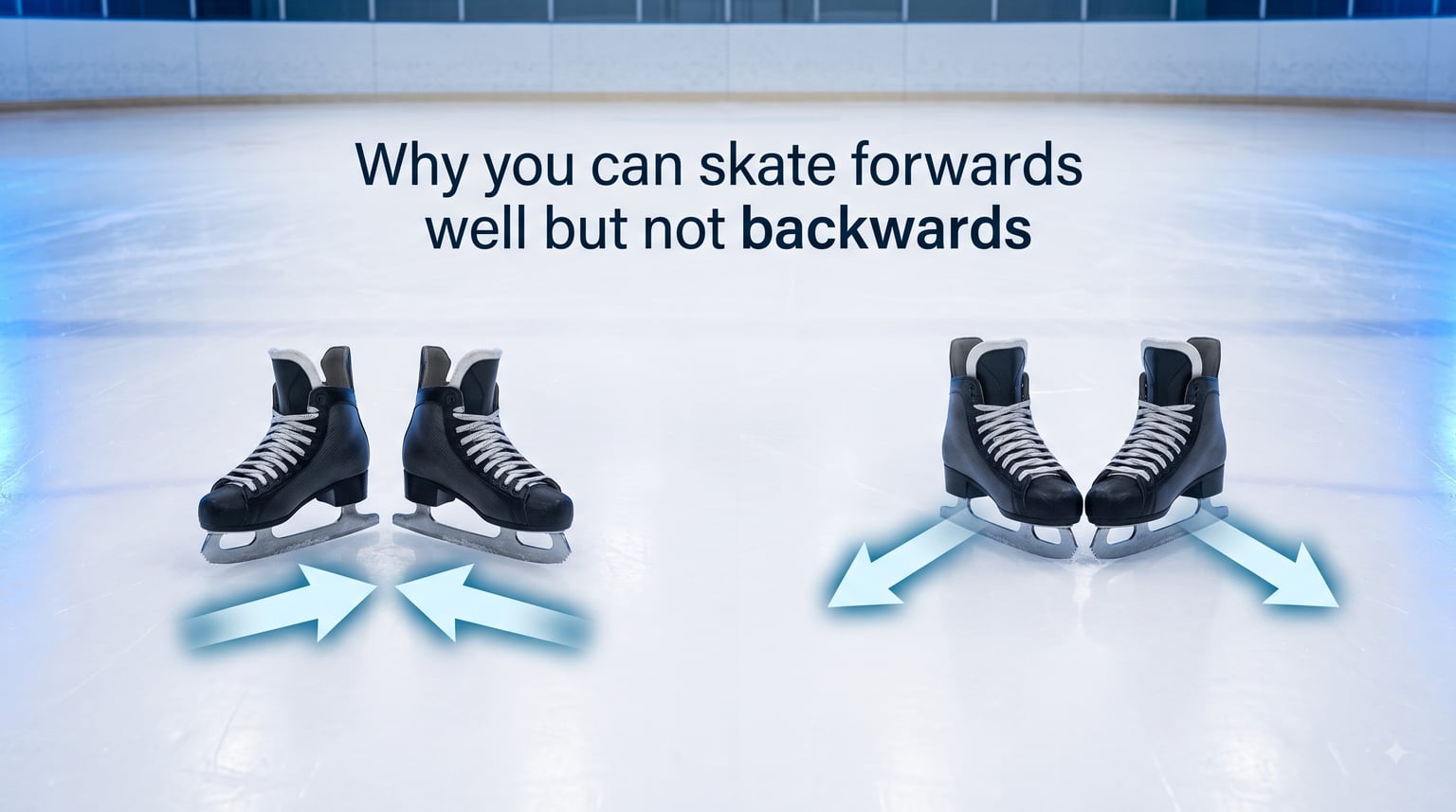
Skating forwards uses a duck-footed stance where you push outward with each foot, which is a motion your body naturally understands. Skating backwards requires a pigeon-toed stance where you push inward, a movement that feels awkward and unfamiliar to most people.
On top of that, you cannot see where you are going when moving backwards, your balance shifts in ways your brain does not expect, and the muscles you need are trained for forward motion from years of walking and running. These three factors combined are why backwards skating can take up to ten times longer to learn than forward skating.
The Physics of Skating Propulsion
To understand the difference between forward and backward skating, you first need to understand how skating works at all. Skates move because of a clever interaction between a thin blade and a low-friction surface like ice or a smooth floor.
When you push against the ice, you do not push straight backward. If you did, the blade would just slide forward without gripping. Instead, you push at an angle that is roughly perpendicular to the direction the blade is pointing. This is called a perpendicular force, and it is the foundation of all skating propulsion.
The blade edges cut slightly into the ice, creating enough friction for you to push off against. That push transfers momentum into forward glide. The harder and more efficiently you push at that perpendicular angle, the faster you accelerate. This principle applies to ice skating, roller skating, and inline skating alike.
What changes between forward and backward skating is not the physics itself but the direction of your push relative to your body. And that small change makes a big difference.
Forward Skating Mechanics: The Duck-Footed Stance
When you skate forward, your feet turn outward in what coaches call a duck-footed stance. Your toes point away from each other, and your heels come closer together. From this position, you push outward against the inside edge of each blade.
This outward push feels natural because it mirrors the way humans walk and run. Every step you take involves a slight outward push and a weight transfer from one leg to the other. Forward skating simply amplifies that motion with longer glides and deeper edges.
The weight transfer in forward skating follows a predictable path. You push with one leg, shift your weight to the gliding leg, recover the pushing leg, and repeat on the other side. Your body knows this rhythm. Your inner ear, your vision, and your proprioceptive system all confirm that you are moving in the direction your eyes are facing.
This alignment of vision, momentum, and natural muscle memory is why forward skating clicks quickly for most beginners. Everything about it agrees with how your body already moves.
Backward Skating Mechanics: The Pigeon-Toed Stance
Backward skating flips the entire mechanics upside down. Instead of duck-footed, you need a pigeon-toed stance where your toes point inward toward each other. From this position, you push inward against the outside edge of each blade.
This inward push is the core reason backwards feels so alien. Humans almost never push inward with their feet in daily life. Walking, running, climbing stairs, and even standing up all involve outward or downward force. The pigeon-toed push is a learned movement that your muscles have zero prior experience with.
The glide pattern also changes. In forward skating, you push and glide in a relatively straight line. In backward skating, your feet trace an S-pattern, sometimes called a figure-eight or C-cut glide. Each push curves slightly inward, and your body weaves side to side as you move backward. This S-pattern requires more coordination and ankle control than the straighter strides of forward skating.
Coaches often describe backward skating as having less efficient push angles too. The inward push generates slightly less propulsion per stride than the outward push of forward skating, which is why even skilled skaters rarely reach the same speed going backwards as they do going forwards.
Why Backwards Skating Is Harder: The Five Key Reasons
Here is a clear breakdown of the main factors that make backwards skating more difficult than forward skating.
1. The pigeon-toed stance is unnatural. Your legs and hips are designed for outward and downward force. Pushing inward requires activating muscle chains that rarely fire together, so it takes dedicated repetition to build that pathway.
2. You cannot see where you are going. Vision is your primary balance tool. When you skate backwards, you must twist your head and shoulders to look behind you while your lower body maintains a completely different alignment. This divided attention destabilizes your balance.
3. Your center of gravity shifts differently. In forward skating, leaning slightly forward feels safe because you can catch yourself. In backward skating, leaning back feels dangerous because a fall means going down hard with no way to brace.
4. Different muscle groups do the work. Backward skating engages your hip abductors, outer glutes, and ankle stabilizers more intensely than forward skating. These muscles are typically weaker because daily movement under-trains them.
5. Your brain is wired for forward motion. Humans have evolved to move forward. Your visual system, vestibular system, and motor cortex all prioritize forward locomotion. Moving backward requires your brain to process motion in a way it is not optimized for, which adds cognitive load to a physical challenge.
Muscle Engagement: Forwards vs Backwards
The muscles you use skating forward are not the same ones you use going backward, and this difference explains a lot of the difficulty. Forward skating heavily recruits your quads, calves, and inner thighs as you push outward and extend each leg.
Backward skating shifts the workload to your hip abductors, gluteus medius, and outer thigh muscles. These muscles stabilize your pelvis during the inward push and control the S-pattern glide. Because most people do not train these muscles in daily life, they fatigue quickly when learning backward skating.
Your ankles also work harder going backwards. The pigeon-toed stance puts continuous pressure on the outer edges of your blades, demanding fine ankle control to maintain balance. Weak ankles are one of the most common reasons beginners struggle with backward skating, regardless of whether they are on ice skates, roller skates, or inline skates.
This is why experienced skaters recommend strengthening hip and ankle stability off the rink. Lateral band walks, single-leg balances, and ankle exercises can dramatically speed up your backward skating progress.
The Neurobiological Factor: How Your Brain Prefers Forward
No competitor currently explains this, but it might be the most important factor of all. Your brain is literally wired to favor forward motion through millions of years of evolution.
Humans walk forward. We run forward. We chase, climb, and navigate our world facing forward. Your visual cortex processes about 90 percent of its spatial information from what is in front of you. Your vestibular system, the fluid-filled canals in your inner ear, is calibrated to detect forward acceleration as normal and backward acceleration as unusual.
When you skate backward, your brain receives conflicting signals. Your eyes see movement in one direction, your vestibular system detects acceleration that feels wrong, and your proprioceptors in your muscles and joints report a stance that does not match any familiar movement pattern. This sensory mismatch creates hesitation, anxiety, and reduced coordination.
This is also why some people actually find backward skating easier after they learn it. Once your brain builds new neural pathways for the pigeon-toed push and the backward glide, the movement becomes automatic. The initial difficulty is not physical weakness but neurological novelty.
How Skating Context Changes the Difficulty
The type of skating you do affects how hard backwards feels. Ice skating offers the lowest friction, which means even a weak push generates glide. This can actually make backward skating feel easier on ice than on wheels because you do not need as much force to maintain momentum.
Roller skating and inline skating introduce more friction, so backward pushes need to be more deliberate. Quad roller skates with wider trucks provide more stability for beginners learning backward skating, while inline skates demand more ankle control due to the narrow wheel base.
In hockey, backward skating is an essential skill that players use constantly to defend and stay facing the play. Hockey coaches drill C-cuts and backward crossovers from day one because the sport demands it. In figure skating, performers spend the majority of their routines skating backward because jumps and spins launch more naturally from backward entry edges.
This is why the question of why figure skaters skate backwards so much has a practical answer. Backward skating allows smoother transitions into jumps and gives skaters better control over rotation and landing preparation.
Common Backward Skating Mistakes to Avoid
Forum discussions from r/iceskating and skating communities reveal the same mistakes repeated by beginners everywhere. Recognizing these early will save you weeks of frustration.
Shuffling instead of lifting. Many beginners try to walk backwards on skates, shuffling their feet without lifting them. Real backward skating requires lifting each foot and pushing through a full range of motion to generate glide.
Not bending the knees enough. This is the number one mistake coaches flag. Backward skating actually requires more knee bend than forward skating. Bent knees lower your center of gravity, engage the right muscles, and give you the ankle angle needed for the pigeon-toed push.
Looking straight down. Beginners stare at their feet to watch what they are doing. This throws off your balance and prevents you from seeing where you are going. Keep your head up and look over your shoulder in the direction of travel.
Stiff ankles. Locked-up ankles prevent the edge control needed for backward pushes. If your skates feel too tight or too loose at the ankle, adjust the fit so your ankles can flex naturally while staying supported.
Practical Tips to Learn Backward Skating Faster
Understanding the theory helps, but you still need to get on the rink and practice. Here is how to make backward skating click faster based on coaching advice and community experience.
Start at the wall. Hold the railing and practice the pigeon-toed push while stationary. Feel the inward push against the edge and let yourself glide backward a few inches. Repeat until the motion feels familiar.
Exaggerate your knee bend. Drop your hips lower than feels comfortable. This engages your glutes and stabilizes your core, making the backward stance far more controlled.
Practice the S-pattern slowly. Do not try to go fast. Focus on tracing clean C-shaped pushes with each foot, alternating left and right. Speed comes from efficiency, not effort.
Look over your shoulder, not down. Pick a direction to look and commit to it. Twisting your upper body in the direction of travel actually helps your lower body maintain the right alignment.
Strengthen off-rink. Add lateral band walks, single-leg deadlifts, and ankle circles to your routine. Stronger hips and ankles translate directly to better backward skating.
Frequently Asked Questions
Is skating backwards harder than forwards?
Yes, for most people backwards skating is significantly harder. It requires an unnatural pigeon-toed stance, inward push mechanics, different muscle engagement, and reduced visibility. Most skaters report that backward skating takes roughly ten times longer to learn than forward skating.
Why do skaters mostly skate backwards?
Figure skaters spend most of their routines skating backward because jumps and spins launch more naturally from backward entry edges. Hockey players skate backward to stay facing the play while defending. In both sports, backward skating offers better control for transitions and advanced maneuvers.
What is the trick to skating backwards?
The key trick is bending your knees deeply, adopting a pigeon-toed stance, and pushing inward against the outside edge of each blade in an S-pattern. Look over your shoulder in the direction of travel and practice slowly before building speed.
Why can’t I skate backwards even though I skate forwards fine?
Forward and backward skating use completely different stances, push directions, and muscle groups. Your body has trained for forward motion your entire life. Backward skating demands pigeon-toed pushes, hip abductor strength, and new neurological pathways that simply take time and dedicated practice to develop.
Conclusion
Understanding why you can skate forwards well but not backwards comes down to three things: the unnatural pigeon-toed push, different muscle and neurological demands, and the challenge of moving in a direction your body was never designed to go. None of this means you cannot learn it. It just means backward skating requires dedicated, patient practice rather than instinct.
Start with deep knee bends, wall-supported pushes, and slow S-pattern glides. Strengthen your hips and ankles off the rink. Commit to looking over your shoulder instead of down at your feet. With consistent practice, the pigeon-toed stance that feels impossible today will eventually become second nature.