
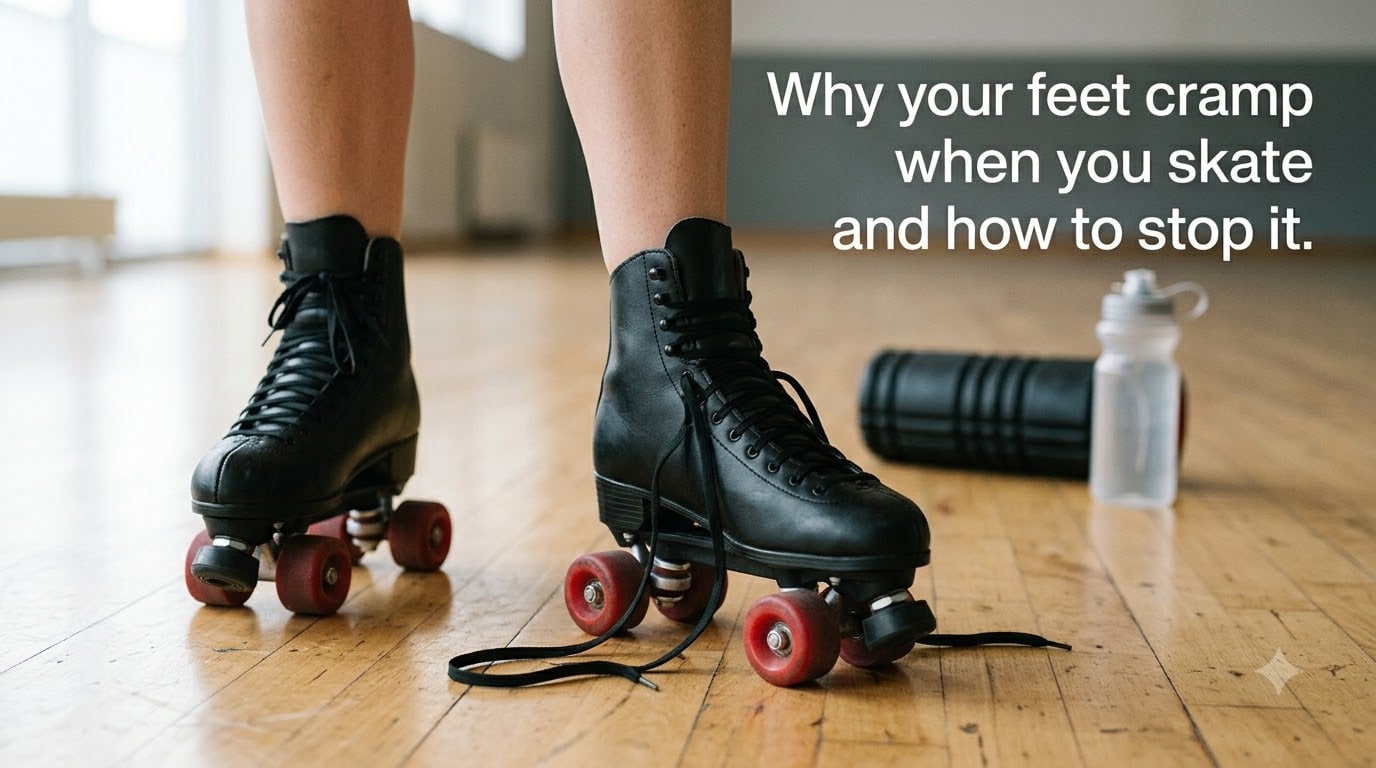
You’re 10 minutes into a skate session when it hits: that fiery, cramping burn across the arch of your foot. You grit your teeth, try to push through, and finally have to sit down and rip your skates off. Sound familiar? You’re not alone. I’ve talked to dozens of skaters who’ve had the exact same experience, and I hit the same wall myself when I started roller skating in 2026.
Here’s the good news: foot cramps while skating are almost always fixable without buying new gear or quitting the sport you love. In this guide, I’ll walk you through what’s actually happening inside your foot, the seven prevention techniques that work, a quick stretching routine, and the lace adjustments that finally let me skate a full session without pain. By the end, you’ll know exactly why your feet cramp when you skate and how to make it stop.
Table of Contents
What Causes Feet to Cramp When You Skate?
The number one cause of foot cramps while skating is something called toe scrunching — and almost every skater does it without realizing. Your toes curl and grip the inside of your skate as a reflex to keep you balanced, and that constant gripping fatigues the small muscles in your foot until they seize up.
Toe scrunching is a symptom of a bigger problem: your weight is on your heels instead of the balls of your feet. When your balance drifts backward, your toes automatically try to grip the skate bed to keep you from tipping over. Speed makes it worse. The faster you go, the more your body panics, and the harder your toes clench.
Over time, this creates a chain reaction. The muscles in your arch tighten. Blood flow gets restricted. Fatigue sets in. Eventually, those overworked muscles cramp — and once a cramp starts, it tends to come back the next time you lace up.
The three main triggers I see over and over
Toe scrunching — your toes curl into the skate as a balance reflex.
Heel-weighted stance — beginners especially tend to lean back, which forces the toes to grip.
Muscle fatigue — long sessions or weak foot muscles mean cramps arrive sooner and hit harder.
Why Ice Skates, Inline Skates, and Roller Skates All Trigger the Same Problem
You might think the answer depends on which type of skate you wear, but the root cause is the same across the board. Ice skates, inline skates, quad roller skates, and rollerblades all lock your foot into a rigid boot. When your weight lands on your heels, your toes grip whatever surface they can find — usually the insole or toe box — and the cramping cycle begins.
The difference between disciplines mostly shows up in how fast the cramps arrive. Ice skaters tend to cramp faster because the boot is stiffer and less forgiving. Inline skaters often feel it across the ball of the foot because of the forward lean built into the frame. Quad roller skaters usually get arch cramps first because the boot sits flatter. But the fix is identical: get your weight forward and relax your toes.
How to Prevent Foot Cramps While Skating: 7 Proven Techniques
These are the techniques that actually work, in order of how quickly you’ll feel the difference. I recommend trying them one at a time so you can tell what’s making the biggest change for your feet.
1. Shift your weight forward onto the balls of your feet
Stand up right now (yes, really) and feel where your weight sits. Now shift it slightly forward, so the ball of your foot and your toes carry more load. That tiny adjustment is the foundation of pain-free skating. When I made this shift on my third week of skating, my cramps dropped by about 70%.
2. Consciously relax your toes every few minutes
Set a mental reminder — every song on your playlist, every lap around the rink, whatever works. When the reminder goes off, ask yourself: “Are my toes clenched?” If yes, deliberately spread them out inside the boot. This feels awkward at first, but it retrains the reflex.
3. Slow down when you feel tension building
Speed is a cramp amplifier. If you notice your toes starting to grip, slow your pace for 30 seconds. The drop in adrenaline lets your foot muscles release, and you can usually speed back up without the cramp returning.
4. Reduce lace tension across the arch of your foot
This one fix eliminated the last 30% of my arch pain. Most skaters pull their laces tight across the entire foot. Instead, leave the middle section (across your arch) a touch looser, then pull firm at the ankle for support. Your arch needs room to flex naturally.
5. Warm up and stretch before every session
Cold muscles cramp faster. Five minutes of dynamic warm-up — ankle circles, toe raises, calf stretches — drops your cramp risk dramatically. I’ll cover the full routine below.
6. Strengthen your feet with targeted exercises
Skating uses small stabilizing muscles that most people never train. Pick up a pair of toe socks, stand on one foot for 30 seconds a day, and try picking up marbles with your toes. Within a month, your feet will hold a skating position without cramping.
7. Hydrate and replenish electrolytes before you skate
Dehydration and low sodium/potassium levels are classic cramp triggers. Drink water steadily through the day before skating, and if you’re sweating heavily, add an electrolyte mix. Plain water alone isn’t always enough for longer sessions.
Best Stretches and Warm-Up Routine for Skaters
This 10-minute routine covers both sides of the equation: getting your feet ready before skating, and helping them recover after. I do this every single session, and it’s the single biggest reason I can skate for two hours now without a single cramp.
Pre-skate warm-up (5 minutes)
Ankle circles — 15 seconds each direction, each foot. Loosens the joint before you lock it into a boot.
Toe raises and spreads — Lift all toes off the floor 10 times, then spread them wide 10 times. Activates the small foot muscles.
Calf stretches — 30 seconds per side against a wall. Tight calves pull on your arch and increase cramping.
Toe touches — Sit and reach for your toes for 30 seconds to lengthen the hamstring and calf chain.
Post-skate recovery stretches (5 minutes)
After you unlace, sit down and roll each foot over a tennis ball or frozen water bottle for 2 minutes. Then stretch your calves against a wall again. Finally, gently pull each toe backward to stretch the plantar fascia. This combo reduces next-day soreness and stops cramps from creeping in overnight.
Skate Fit and Lace Adjustment Tips to Stop Arch Pain
Even with perfect technique, the wrong fit will still give you cramps. Here’s how to dial in your setup so your equipment stops working against you.
Lace tension: loose across arch, firm at ankle
The most common mistake I see is skaters pulling laces uniformly tight from toe to top. Your arch is a flexible bridge that needs to move when you skate. Crank the laces tight at the toe box and ankle, but back off a quarter-turn on the middle two or three eyelets that cross your arch. You’ll feel the difference on your first stride.
Sizing and width considerations
Your toes should have a thumb’s width of room at the front of the boot when standing. If they’re jammed against the toe box, your foot will scrunch to relieve pressure. If they’re swimming, your toes will grip to find stability — and cramp. Width matters just as much as length: many skaters need a wide boot and never realize it.
Insoles and arch support options
A quality insole can change everything for flat-footed skaters or anyone with low arches. Look for insoles with structured arch support and a deep heel cup. They’re a small upgrade that pays off in hours of pain-free skating.
How to Stop a Foot Cramp in the Moment
Sometimes a cramp catches you mid-session anyway. Here’s how to shut it down fast: stop skating, sit down, and gently massage the cramped muscle with your thumb. Flex your foot by pulling your toes back toward your shin — this lengthens the cramped muscle and usually releases it within 30 seconds. Sip some water, take three slow breaths, and only stand back up once the cramp has fully released.
When to See a Doctor About Skating Foot Pain?
Most foot cramps are technique issues and clear up with the steps above. But see a podiatrist or sports medicine doctor if you notice any of these red flags: cramping that hits within the first five minutes of every session, sharp localized pain (not a muscle ache), swelling that doesn’t go down overnight, numbness or tingling in your toes, or pain that lingers for more than 48 hours after skating. These can signal plantar fasciitis, a stress fracture, or nerve compression — all of which need professional treatment.
Frequently Asked Questions
How to stop foot cramping in skates?
Stop foot cramping by shifting your weight forward onto the balls of your feet, loosening your laces across the arch, and consciously relaxing your toes every few minutes. Warm up before skating and stay hydrated. If cramps persist, check that your skates fit correctly in both length and width.
How to immediately stop foot cramps while skating?
Stop skating, sit down, and massage the cramped muscle with your thumb. Flex your foot by pulling your toes back toward your shin to lengthen the muscle. Sip water and wait 30 seconds for the cramp to release before standing up again.
Why do my arches hurt when I ice skate?
Arch pain while ice skating is usually caused by lace tension that’s too tight across the midfoot, combined with toe scrunching from a heel-weighted stance. Loosen the middle eyelets, shift your weight forward, and consciously relax your toes every few minutes.
What drink stops muscle cramps?
Water with electrolytes — sodium, potassium, and magnesium — works best for stopping muscle cramps. Plain water alone isn’t always enough during heavy sweating. Coconut water is a good natural option, and many skaters use sports drinks for sessions over an hour.
Are my skates too tight or too loose?
Your skates are too tight if your toes feel jammed or your arch throbs within the first 10 minutes. They’re too loose if your toes grip and curl to find stability, or your heel lifts when you push off. A proper fit feels snug but never painful, with a thumb’s width of toe room.
When will foot cramps stop as a beginner skater?
Most beginner skaters see major improvement within 2 to 4 weeks of consistent practice once they fix their stance and lace tension. Full adaptation usually takes 2 to 3 months. Daily foot strengthening exercises can shorten that timeline noticeably.
Stop Foot Cramps and Get Back to Skating Pain-Free
Foot cramps while skating are frustrating, but they’re almost always a fixable technique issue. Start with the single biggest change — shifting your weight forward and consciously relaxing your toes every few minutes. Add the stretching routine, loosen your laces across the arch, and stay hydrated. Within a few weeks, you should notice your sessions getting longer and more comfortable. If the pain sticks around despite these adjustments, don’t push through it — get a professional opinion. Now lace up, shift that weight forward, and enjoy the ride.