
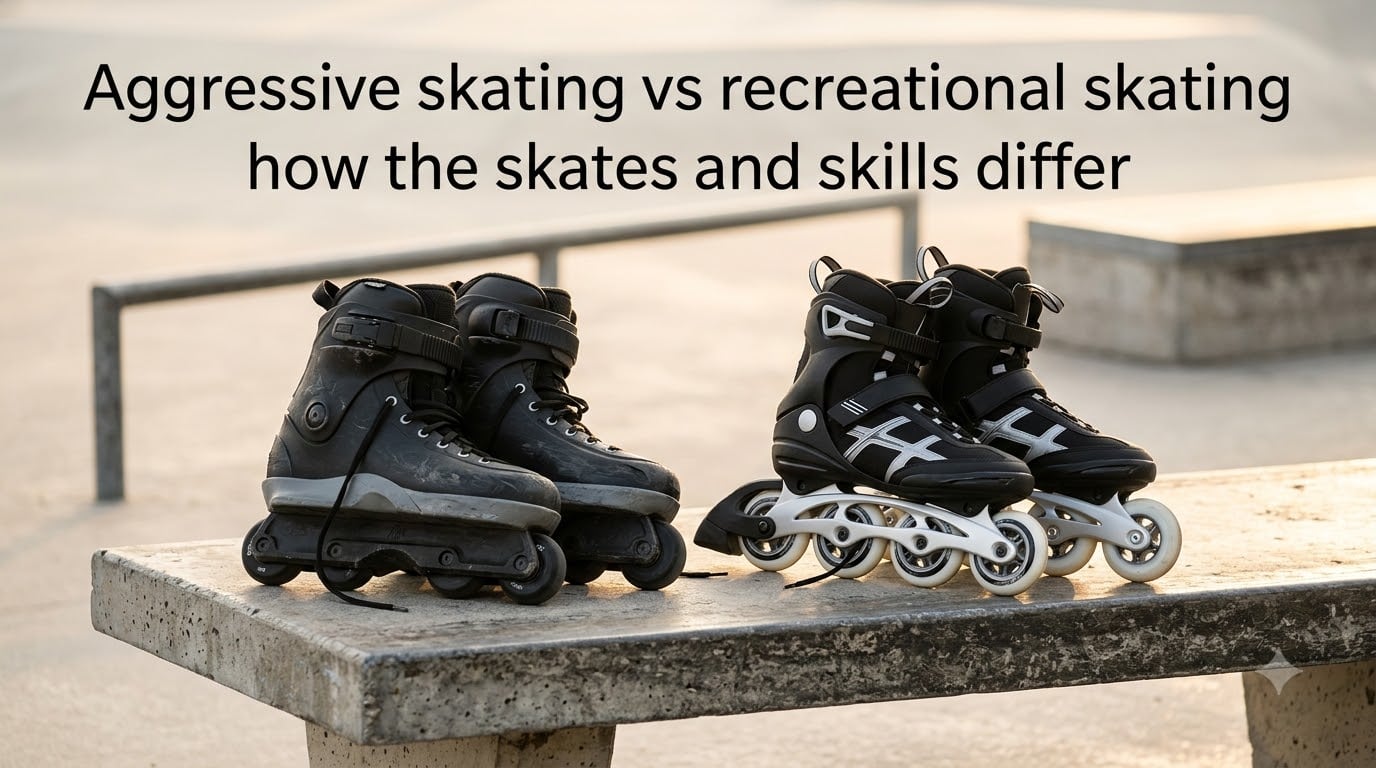
When I first started rolling, I borrowed a pair of chunky skates from a friend, took them down a bike path, and felt like I was skating through wet cement. The next week I tried a lighter pair with bigger wheels and nearly flew into a hedge. That gap is exactly what this guide is about: aggressive skating vs recreational skating, and how the skates and skills differ.
Both are inline skating, but they are built for different jobs. Aggressive skates are designed for tricks, grinds, and skate park landings. Recreational skates are built for comfort, fitness, commuting, and distance.
Our team has spent time in skate parks, on city paths, and in local shops to break down the real differences, not just the marketing copy. This article will help you understand what each skate type does, what skills you need, and which one fits your goals in 2026.
Table of Contents
What Is Aggressive Skating and How Do Aggressive Skates Work?
Aggressive skating is the trick-focused branch of inline skating. Skaters use skate parks, street ledges, handrails, stairs, and vert ramps to perform grinds, jumps, and spins. If you have ever watched someone slide down a handrail on skates, you have seen aggressive skating in action.
The skates themselves look nothing like a typical fitness pair. They have a hard outer shell that wraps around the foot and lower shin, with a soulplate on the side and a grind plate underneath to slide across obstacles.
Most aggressive skates run small wheels, usually 55-72mm, mounted on a short flat frame. The wheel setup is often anti-rocker, meaning the middle two wheels are smaller than the outer two, so you can lock into grinds without the wheels catching.
Here is what defines aggressive inline skates at a glance:
- Hard shell boot, often with a heat-moldable liner for fit
- Short wheel base, around 230-260mm
- Small wheels (55-72mm), usually anti-rocker or flat setup
- Universal Frame System (UFS) mounting so you can swap frames
- Soulplate, grind plate, and H-block built into the shell for sliding
- No heel brake; stopping is done with slide techniques and powerslides
There are three main flavors of aggressive skating. Street skaters use ledges, rails, and gaps in everyday urban environments. Park skaters work the smooth concrete bowls, quarters, and funboxes at skate parks.
Vert skaters ride halfpipes and large ramps and catch serious air. Each style uses the same basic skate, but tricks, setup choices, and skill focus shift between them.
If you are rolling around a paved park on aggressive skates, the small wheels and short frame will feel sluggish on long stretches. That is by design. The setup gives you control for tricks, not efficiency for distance.
What Is Recreational Skating and How Do Recreational Skates Work?
Recreational skating is the broad category most people picture when they think of inline skating. It covers gliding down a path, looping a park, commuting to work, or doing a fitness session on a Sunday morning.
The goal is comfort, stability, and a smooth ride over distance. Recreational inline skates are built around bigger wheels, longer frames, and softer boots.
Wheels usually run 80-90mm in entry models and 90-110mm in higher-end fitness skates. The longer frame spreads those wheels out to add stability, and the boot is often a soft shell that flexes with your ankle so you can skate for an hour without hotspots.
The typical recreational skate looks like this:
- Soft or hybrid boot with a thick, padded liner
- Long frame, typically 280-320mm
- Larger wheels, 80-110mm, often with a slight rocker for easier turning
- Heel brake on the right skate for quick, intuitive stopping
- Closed cell foam or molded plastic cuff for ankle support
- ABEC 5-9 bearings (faster skates use higher numbers) for efficient cruising
Recreational skating covers several activities. Fitness skaters want a cardio workout with low impact on the joints. Commuters want reliable, fast rolling that handles city streets.
Distance skaters want large wheels and good bearings to cover kilometers without burning out their calves. Beginners usually fall into recreational skating first because the brake, soft boot, and stable wheel base make the basics feel manageable.
The trade-off is that recreational skates are not built for impact or grinding. The boot does not have a soulplate, the frame is too long to land jumps comfortably, and there is no grind plate to protect the bottom of the skate. If you tried to grind a rail on recreational skates, you would destroy the frame in a single attempt.
Aggressive vs Recreational Skates: A Side-by-Side Comparison
This is the section most readers want. Here is the direct comparison between aggressive and recreational skates, so you can see the differences at a glance.
- Wheel size: Aggressive skates run 55-72mm wheels; recreational skates run 80-110mm wheels.
- Wheel base: Aggressive skates have a short wheel base around 230-260mm; recreational skates have a long wheel base around 280-320mm.
- Frame type: Aggressive skates use UFS-mounted short frames with anti-rocker or flat setups; recreational skates use integrated longer frames, often with a slight rocker.
- Boot construction: Aggressive skates use a hard plastic shell with grind plates; recreational skates use a soft shell or hybrid boot focused on comfort.
- Brake: Aggressive skates have no heel brake; recreational skates almost always include a heel brake on the right skate.
- Weight per skate: Aggressive skates typically weigh 1.6-2.2 kg each because of the shell, soulplate, and extra hardware; recreational skates weigh 0.9-1.4 kg each.
- Terrain: Aggressive skates are built for skate parks, ledges, handrails, and ramps; recreational skates are built for bike paths, sidewalks, fitness tracks, and city streets.
- Top speed: Aggressive skates top out around 25-30 km/h in skilled hands; recreational skates can cruise comfortably at 20-35 km/h with practice.
- Skill focus: Aggressive focuses on grinds, jumps, and aerial tricks; recreational focuses on stride efficiency, balance, and braking.
- Typical rider: Aggressive attracts skate park enthusiasts and trick-driven skaters; recreational attracts fitness riders, commuters, and beginners.
The weight difference surprised me most on first try. Aggressive skates can feel like twice the weight of a pair of recreational skates once you start rolling. That bulk is real protection, but it costs energy on long rides.
Stability is a common point of confusion. Aggressive skates feel very stable when you are grinding or landing a jump. The short frame keeps your center of gravity close to the ground.
Recreational skates feel stable at speed and on uneven ground because the larger wheels roll over cracks and the longer base resists wobble. Each skate type is stable in its own context.
How Skills Differ Between the Two Disciplines
The skills you build on aggressive skates are mostly vertical and technical. You will learn how to approach an obstacle at the right speed, ollie up onto a ledge, and lock your soulplate onto a rail.
You will also learn to absorb heavy landings, fall safely on pads, and reset your balance mid-air. Park skating adds coping tricks, transfers, and invert-style tricks for advanced skaters.
Vert adds dropping in, airs, and spins above the lip of the ramp. Each style rewards commitment to falling practice as much as trick practice.
The skills on recreational skates are more about rhythm and efficiency. You will learn a proper forward stride with full leg extension, a heel-toe brake stop, and the A-frame or T-stop for slower deceleration.
You will also build crossovers for turning, and learn how to fall forward onto pads. Distance skaters add double pushing, heel-toe stride, and managing fatigue on long routes.
Beginner progression usually goes from standing still, to marching in place, to slow stride, to braking, to turns, and finally to hills. Each step builds on the last.
The learning curve is also different. Recreational skating feels approachable within a week. Most adults are confidently cruising and braking within five to ten hours of practice.
Aggressive skating takes months of basic control before most people attempt even a small grind. The injury risk is also higher in aggressive skating because of falls from height, so protective gear is not optional, it is mandatory.
Which Skate Type Should a Beginner Choose?
If you are brand new to inline skating, start with recreational skates. The soft boot, heel brake, and larger wheels give you a much gentler learning curve. You can build balance, stopping, and turning in a safe environment before you ever think about a skate park.
Aggressive skates make sense as a first pair only if your goals are 100% park and street, you have access to a smooth skate park, and you are willing to learn slide stops without a brake. Even then, most experienced skaters we spoke to recommend learning balance on recreational skates first.
You can then graduate to aggressive once you are confident rolling at moderate speed and stopping reliably. Here is a simple way to choose:
- Choose recreational skates if you want to cruise, get fit, commute, or learn basics.
- Choose aggressive skates if your goal is the skate park, you already skate, or you have a clear plan to learn slides.
- Choose urban or freestyle skates if you want one pair that can handle light tricks and city cruising, accepting trade-offs in both directions.
Urban and freestyle skates are a hybrid option that has grown in popularity. They have larger wheels than aggressive skates, a shorter frame than fitness skates, and a hard shell that can handle small grinds. They are a reasonable middle ground if you want one pair that does a bit of everything, though they will not be as specialized as either pure option.
Safety, Gear, and Cost Considerations
Gear is not optional in either discipline, but the setup looks different. Recreational skaters typically wear a helmet, wrist guards, and knee pads. Aggressive skaters add elbow pads, padded shorts, and sometimes shin guards and full-face helmets for vert.
Hard impacts on concrete make full padding worth the weight. The lack of a heel brake on aggressive skates is a safety concern for new riders. Without that brake, you rely entirely on slide stops, which require good balance and committed technique.
Recreational skaters with a heel brake can stop safely within a couple of hours of practice. Cost varies by tier. Entry-level recreational skates start at affordable price points, while premium fitness skates with carbon shells and 110mm wheels climb into higher price territory.
Aggressive skates range from affordable beginner hard shells to high-end park setups with custom liners and premium frames. Replacement parts like wheels, bearings, and frames are easy to find for both styles, which keeps long-term ownership reasonable.
Our team has found that skaters who invest in proper protective gear, regardless of style, learn faster because they fall more confidently. Pads are part of the equipment, not an extra.
Frequently Asked Questions About Aggressive vs Recreational Skating
What are the key differences between aggressive skates and inline skates?
Aggressive skates have small 55-72mm wheels, a short hard frame, no heel brake, and grind plates built into the shell. Recreational inline skates have larger 80-110mm wheels, a longer frame, a heel brake, and a soft boot focused on comfort.
Are aggressive skates more stable?
Aggressive skates are more stable for short bursts of grinding and jumping because of their short wheel base and flat setup. Recreational skates feel more stable over distance and at speed due to their longer wheel base and larger wheels.
What are the three types of inline skates?
The three core types are recreational, fitness, and aggressive. Each is built for a different purpose: comfort and distance, faster fitness and commuting, and skate park tricks and grinds.
Can I use aggressive skates for recreational skating?
You can roll on aggressive skates for short distances, but the small wheels and heavy shell make longer rides exhausting. Without a heel brake, slowing down takes practice and a confident slide stop.
Are aggressive skates good for beginners?
Aggressive skates are generally not beginner-friendly. Their weight, lack of brake, and small wheels make basic balance and stopping harder. Most beginners do better starting on recreational skates and moving to aggressive later.
Final Thoughts on Choosing Between Aggressive and Recreational Skating
The aggressive skating vs recreational skating question really comes down to what you want to do on wheels. If your goal is tricks, ledges, and skate park sessions, aggressive skates are purpose-built and worth the extra weight.
If your goal is cruising, fitness, commuting, or learning the basics, recreational skates will keep you comfortable and safe while you build skill. Our team recommends trying both if you can.
Many local shops let you test skates in a parking lot, and skate nights are a low-pressure way to see what feels right. Whichever you pick, commit to pads, practice the fundamentals, and give yourself a few weeks before judging your progress.
The right skates are the ones that match your goals and get you rolling often.