
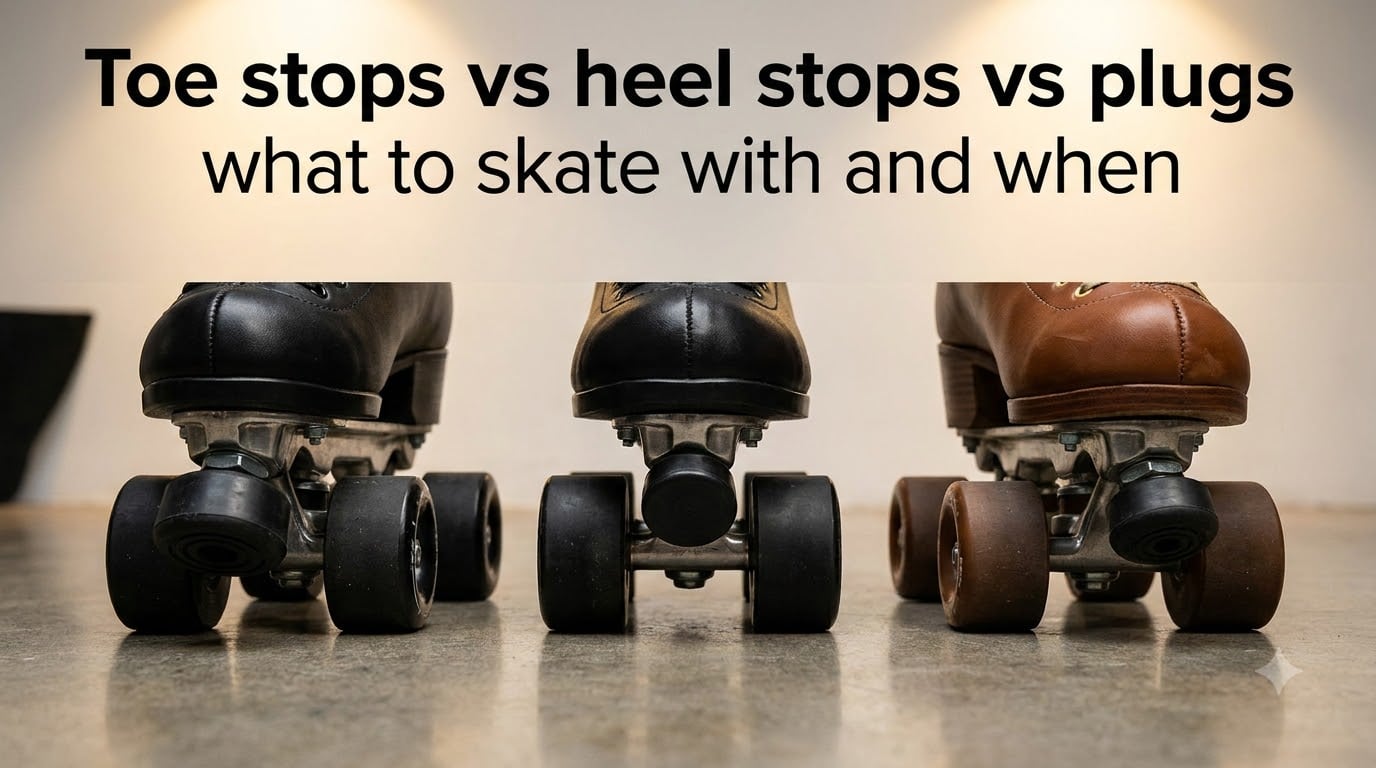
I remember my first derby practice, dragging my toe across the floor so hard my whole body vibrated. I had no idea whether I was using a “good” toe stop, whether I needed plugs, or why the skater next to me had nothing on the front of her plate at all. If you have ever stood in a skate shop staring at a wall of stoppers and small rubber nubs, this guide is for you.
Choosing between toe stops, heel stops, and jam plugs comes down to one question: what kind of skating do you want to do? In this article I will walk you through each option, what it does, and when it makes sense to skate with it. By the end, you will know exactly what to put on the front (or back) of your skates and why.
Table of Contents
What Are Toe Stops and Why Do Skaters Use Them?
Toe stops are rubber stoppers mounted to the front of your skate plate. Their job is simple: when you point your toes and press down, the rubber makes contact with the ground and slows you down through friction.
Most quad roller skates have a threaded housing on the front of the plate specifically designed to accept a toe stop. The stopper is shaped somewhere between a small mushroom and a flat-bottomed button, and the rubber is formulated to grip polished rink floors, concrete, and skate park surfaces without sliding unpredictably.
Toe stops serve two purposes beyond braking. In derby and park skating, they are used for quick takeoffs, where a skater leans back and pushes off the front. They also act as a stability tool, giving you a second point of contact when you drop into a squat or balance on the front trucks.
Fixed vs Adjustable Toe Stops: Key Differences
Toe stops come in two main mounting styles. Fixed, or bolt-on, toe stops attach directly to the plate with a single bolt and do not move. Adjustable toe stops screw into a threaded housing and can be raised or lowered to change how much rubber hangs below the front of your plate.
Bolt-on toe stops are simple, durable, and commonly found on entry-level and recreational skates. Because they sit in a fixed position, they offer consistent feel, which beginners often prefer.
Adjustable toe stops are the standard for derby, park, and aggressive skaters. Raising the stop gives you more ground clearance for tricks and footwork. Lowering it gives you more stopping power and a larger contact patch. The tradeoff is that you have to check the tightness regularly, since vibration can loosen them mid-session.
Stem length matters too. Short stems keep the stop close to the plate, which works well for technical footwork. Long stems give more leverage and stopping force, which helps heavier skaters or anyone skating fast outdoor terrain.
Jam Plugs and Dance Plugs: What They Do
Jam plugs (also called dance plugs) are small inserts that screw into the same housing as a toe stop. Instead of providing stopping power, they simply fill the hole so nothing catches on your foot or the floor during spins and footwork.
If you have watched a jam skater spin on her front trucks, you have probably noticed her toe stop is not in the way. That is because she is using jam plugs, not because she removed the entire setup. Many skaters also run a “stopless” plate, which has no front housing at all, but that is a different (and more expensive) conversation.
Plugs make sense when your priority is footwork, not braking. Rhythm skaters, jam skaters, and dance-focused skaters often prefer plugs because toe stops can catch on the floor mid-spin, ruining a move. Plugs also let you perform toe manuals and stalls more cleanly, since nothing extends below the front truck to drag or click.
The honest answer is that plugs are not a stopping tool. If you skate with plugs, you are committing to T-stops, plow stops, or falling. That is fine for experienced skaters, but it is risky for beginners.
Heel Stops and Heeled vs Flat Skates
Heel stops are small rubber brakes attached under the heel of the skate, similar to the brake on a kids’ bike. You slow down by tipping your weight back so the rubber drags against the ground.
Heel stops are most common on heelled quad skates, the kind with a slight lift under the heel. That heel lift changes your center of gravity, shifts your weight slightly forward, and gives many beginners a more stable, planted feeling compared to flat skates.
That stability is the main reason heelled skates are popular for new and recreational skaters. The trade is reduced agility. Heeled skates are harder to maneuver in tight spaces, less common in derby, and rarely used in park or jam skating. Most derby and park skaters wear flat plates because they need to be lower to the ground for stability during contact and tricks.
So are roller skates with heels better? For casual and beginner skaters, often yes. For derby, park, jam, or rhythm skating, flat skates are almost always the right call.
Toe Stops vs Plugs vs Heel Stops: Head-to-Head Comparison
Each option has strengths, and the right pick depends on what you are doing on your skates. Here is how they stack up against each other.
Toe stops win on raw stopping power and versatility. They work for derby, park, and outdoor skating, and they let you push off the front for fast acceleration. The downside is they can interfere with footwork and spins.
Jam and dance plugs give the cleanest footwork experience. They keep the front of your skate low and snag-free, which is why rhythm and jam skaters love them. The trade is no emergency brake, so you need solid T-stop or plow-stop technique.
Heel stops are beginner-friendly and intuitive. Tip back, slow down. They are not used in serious derby or park skating, and they limit the tricks you can do, but for casual rink skating they get the job done without a learning curve.
When to Use Each Type by Skating Style
Here is how I would match stop type to skating style, based on what I have seen work across hundreds of skaters and what the community on r/Rollerskating tends to agree on.
Roller Derby
Roller derby skaters need adjustable toe stops, almost always long stem and lower-profile. Derby uses toe stops for quick lateral takeoffs, hard stops at the apex, and recovery from falls. Plugs are not used because you need that braking power during gameplay.
Skate Park
Park skaters usually run shorter, harder toe stops so they do not catch on coping or during grinds. Some park skaters switch to jam plugs once they have mastered alternative braking. If you are just starting at the park, a medium-length adjustable toe stop gives you the most flexibility.
Jam Skating and Rhythm Skating
Jam and rhythm skaters almost always use jam plugs. Toe stops interfere with crossovers, spins, and floor work, which are the heart of these styles. Plugs keep the front of the skate clean and out of the way.
Recreational and Outdoor Skating
For casual outdoor skating, adjustable toe stops are the safest pick. They handle rough pavement, give you strong braking on hills, and let you adjust based on the surface. Heel stops also work for casual rink skating, especially on heelled beginner skates.
Artistic Skating
Artistic skaters typically use small, low-profile toe stops so they can hit specific positions and figures without the stopper getting in the way. Some use plugs depending on the routine, but most stick with a slim toe stop for consistency.
Thread Sizes and Compatibility (5/16 vs 5/8)
Before you buy any toe stop or plug, you need to know what thread your plate takes. Most standard plates use one of two sizes: 5/16 inch or 5/8 inch. Some import plates also use metric threads, which are not interchangeable with imperial ones.
The easiest way to check is to look at the documentation that came with your plate. If you do not have it, bring your skates into a local shop. They can measure the housing in seconds and tell you what fits.
Forcing the wrong thread is the fastest way to strip your plate. Once the housing is damaged, you usually need a new plate or a professional thread repair. It is not worth the gamble to guess. If you do not know, ask before you buy.
Common Mistakes to Avoid When Choosing Stops
The first mistake I see new skaters make is skating with no plug and no toe stop in the housing. That open hole is a trip hazard and can catch on debris. If you are not using a toe stop, install plugs.
The second mistake is buying the wrong thread size. Imperial and metric look similar but do not mix. Stripping the threads on a quality plate is an expensive lesson.
The third mistake is choosing a stem length based on looks rather than function. A long stem on a flat plate will drag during low maneuvers. A short stem on a high-speed derby setup will not give you enough stopping power. Match the stem to how you actually skate, not how the setup looks in photos.
The fourth mistake is assuming you have to choose one option forever. Many skaters own multiple plates or swap between toe stops and plugs depending on whether they are at derby practice, the skate park, or the rink. There is no rule that says you have to commit.
How to Choose the Right Stops for Your Skating
If you are brand new, start with adjustable toe stops on flat skates. They give you the most control, the easiest learning curve, and the safest stopping power while you build balance and confidence.
If you are moving into rhythm or jam skating and you have solid T-stop technique, switch to jam plugs. You will notice cleaner spins and easier footwork almost immediately.
If you skate derby or aggressive park, invest in adjustable toe stops with the right stem length for your weight and style. Replace them when the rubber wears flat, since worn stops give unpredictable grip.
If you are a recreational rink skater who wants simplicity, a heeled skate with a heel stop is the path of least resistance. Tip back, slow down, no setup required.
The right answer is the one that matches your skating, not the one that matches what is popular online. Your feet, your style, your call.
Frequently Asked Questions
Can you stop with jam plugs?
No, jam plugs are not designed to stop you. They are small inserts that fill the toe stop housing to keep the front of your skate low and snag-free during footwork. If you skate with jam plugs, you need to stop using T-stops, plow stops, or other friction-based techniques.
Are roller skates with heels better?
Heeled skates are often better for beginners and recreational skaters because the slight heel lift shifts your weight forward, giving a more stable, planted feeling. However, flat skates are preferred for roller derby, skate park, jam skating, and rhythm skating, where lower center of gravity and agility matter more than the heel stability.
What is the best toe stop for park skating?
Park skaters usually prefer shorter, harder adjustable toe stops with a smaller surface area. These give you ground clearance for grinds and tricks without catching on coping. Common picks are smaller natural rubber or harder urethane stops designed for park and street skating.
How do you stop on roller skates with toe stops?
To stop with toe stops, bend your knees slightly, point one foot forward, and press down so the rubber toe stop makes firm contact with the ground. Keep your weight centered over the braking foot and apply steady pressure. The more you lean onto the stop, the harder you will slow down. Practice at low speed first.
Should beginners start with toe stops or jam plugs?
Beginners should start with adjustable toe stops. They give you the most stopping power and safety margin while you are still learning balance, turning, and basic stops. Jam plugs are best reserved for skaters who already have reliable T-stops or plow stops and are focused on footwork-heavy styles like jam or rhythm skating.
Final Thoughts on Toe Stops vs Heel Stops vs Plugs
There is no universal “best” option. Toe stops, heel stops, and jam plugs each serve a different purpose, and the right pick depends entirely on the kind of skating you want to do. Beginners do best with adjustable toe stops, jam and rhythm skaters usually prefer plugs, and heelled skates with heel stops remain a simple choice for casual rink sessions.
Take ten minutes to think about what you actually want from your skates this year. Then match the hardware to that goal. Your skates, your style, your setup.