
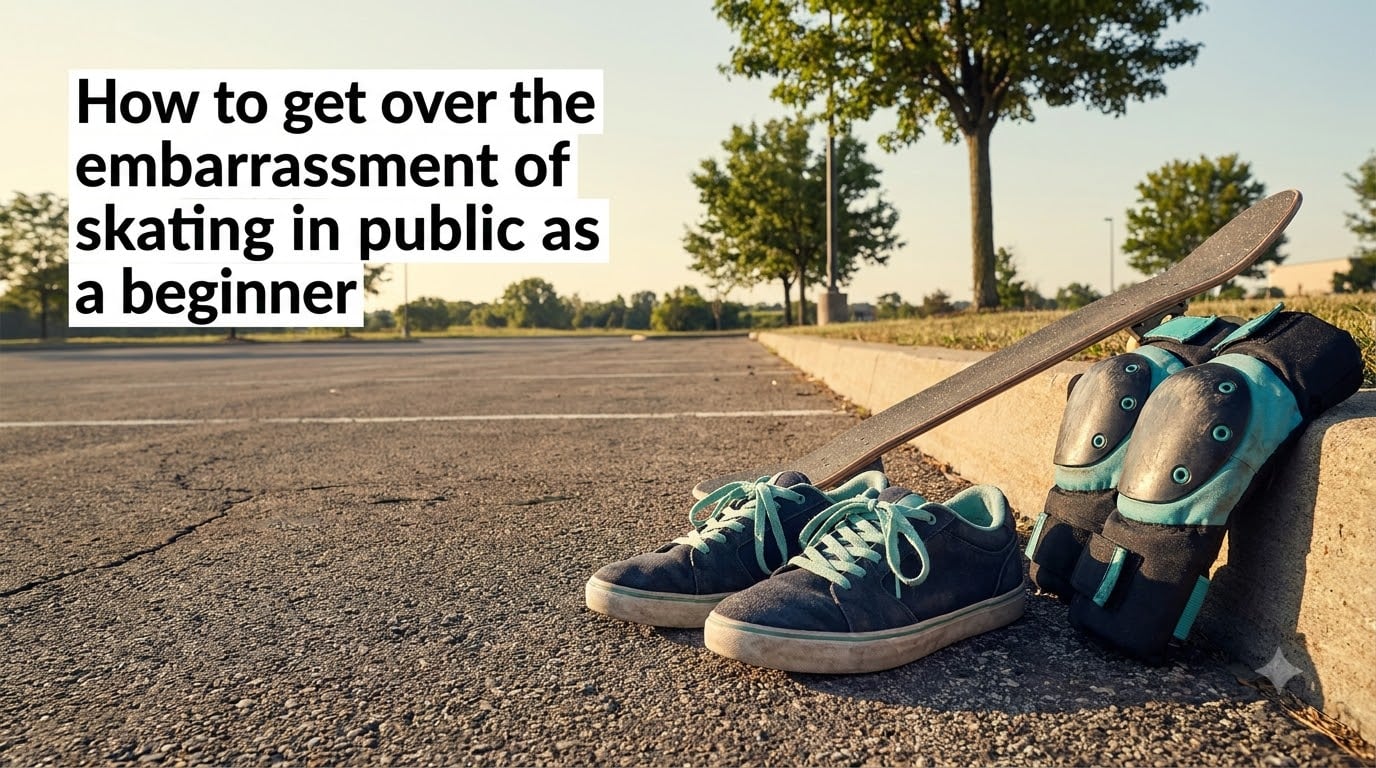
That tight, hot feeling in your chest when you lace up your skates near other people is real. I have felt it. So have the thousands of adult beginners on Reddit threads and forums who ask the same question you are typing right now: how do I stop feeling so awkward when I skate in front of others?
This guide is the one I wish I had when I first rolled out in public with shaky legs and a helmet that felt three sizes too big. I have pulled together practical strategies, the psychology behind the embarrassment, and stories from real skaters who pushed through it. By the end, you will have a clear plan to rebuild your skating confidence, whether you ride a skateboard, roller skates, or ice skates.
The embarrassment does not last forever, and it does not mean you are too old, too uncoordinated, or too visibly beginner to keep going. It means your brain is doing its job a little too well. Let us talk about why that happens and what you can do about it.
Table of Contents
Why You Feel Embarrassed Skating in Public (It Is Not Just You)
Public skating embarrassment is the fear of being judged or laughed at while learning a new skill in view of others. Almost every beginner skater feels it, but very few talk about it openly, which makes the feeling seem lonelier than it actually is.
The first time I tried to push off on a quiet street, I saw a kid on a scooter glance my way and immediately wanted to quit. My brain told me he was laughing. He was not. He was probably just looking at my wheels.
That gap between what your brain tells you and what is actually happening is the core of skating embarrassment. The good news is that understanding the gap is the first step to closing it.
The Spotlight Effect and Your Brain
Psychologists call this the spotlight effect. Your brain overestimates how much other people notice what you are doing, especially when you are doing something new or clumsy. When you wobble on a push-off or stumble off a curb, your internal alarm bells ring as if a stadium of cameras has just turned on you.
In reality, most people glance, register “skater,” and return to their own thoughts within a second. Research on the spotlight effect suggests we routinely overestimate how much others notice by a factor of two or three. Skating embarrassment comes from our brain’s threat-detection system overestimating social risk when we step outside our comfort zone.
Knowing this does not make the feeling vanish, but it does give you something to hold onto when the wave hits. Next time the heat rises, remind yourself: the audience in your head is bigger than the one on the street.
Why Adult Beginners Feel It Most
Adults carry an extra layer that kids usually do not. We have built an identity around competence in our jobs, our homes, and our friendships. Picking up a sport we have no skill in feels like publicly failing at something we “should” already be good at.
One skater on r/NewSkaters put it plainly: feeling like a grown adult doing something childish is the toughest part. The fear of judgment at a skate park hits differently when you are 30 or 40 and the 12-year-olds are effortlessly landing tricks nearby.
The good news is that adults also have something kids do not — perspective. Most adults eventually realize that the awkward phase is short, the learning is permanent, and nobody remembers the wobbly push-off from last Tuesday. You are not too old to start. You are just paying attention to yourself in a way only adults do.
How to Get Over the Embarrassment of Skating in Public as a Beginner: 7 Strategies
Below are the seven strategies that worked for me and for hundreds of skaters I have read about online. Pick two or three to try this week rather than all seven. Small steps beat perfect plans.
These strategies are not theory. They come from forum threads, skating instructors, sports psychologists, and my own trial and error over more than a year of learning to skate as an adult. The order does not matter much — what matters is that you start.
1. Start Where Nobody Can See You
The fastest way to lower embarrassment is to remove the audience entirely. Find an empty parking lot on a Sunday morning, a quiet cul-de-sac, or an indoor skatepark during off-peak hours. You will build muscle memory without anyone watching, and that confidence carries over once you do skate in public.
A 30-year-old beginner on Reddit shared that practicing alone in a car park near his house gave him enough skill to finally book a group lesson without panicking. Solitude first, then small social circles, then wider exposure — that is the order that works.
If you cannot find an outdoor spot, look for indoor options. Roller rinks often run quiet weekday sessions, and many ice rinks have early-morning public skates with just a handful of regulars. Indoor practice is not a compromise. It is a legitimate training environment.
2. Wear Gear That Makes You Feel Ready
Helmets, pads, and proper shoes do more than protect you. They signal to your brain that you are a skater, not an imposter. I noticed a measurable drop in my self-consciousness the day I wore a proper helmet and wrist guards in public instead of a borrowed baseball cap.
Looking the part is not vanity. It is a small but real psychological anchor that says, “I belong here.” Other skaters will treat you with more respect when you are geared up, and your own internal voice will quiet down.
Full protective gear also means you can fall without consequence, which loosens you up. A skater who is not afraid of the ground moves with more flow, and flow looks confident even when the skills are still raw.
3. Reframe What Others Actually Think
Most people are not paying attention to you. The ones who are skaters themselves know exactly what beginner phase looks like, and almost none of them will laugh. The community vibe across every skating forum I have read is supportive, not mocking.
One skater put it best: everyone who skates has gone through this initial phase, and it is extremely unlikely anyone will laugh should you fall. The person who looks intimidating on the half-pipe was once exactly where you are standing.
Reframe the awkward feeling as a sign that you are pushing into new territory. Embarrassment is the admission ticket to a skill you do not have yet. Pay it once, keep moving, and it stops charging you interest.
4. Use the Progressive Exposure Ladder
Do not jump from your living room to a packed skatepark on day one. Build a ladder. Each rung holds a little more exposure than the last, and you climb only when the current rung feels easy.
A simple beginner progression looks like this: empty lot at home, then a quiet street with one passing car, then a sidewalk near a coffee shop, then a beginner-friendly skatepark, and finally a busy session.
Take a week or more on each rung. There is no rush. If a rung feels too big, break it into smaller steps — for example, skate near the coffee shop at 6 a.m. before trying it at noon. The ladder works because each step is barely harder than the last, and your nervous system adjusts without spiking.
5. Find a Skate Buddy or Beginner Community
Shared vulnerability reduces embarrassment fast. Book a beginner lesson, join a local skate meetup, or find one person at your level to practice with. When you fall, someone else is also falling, and that changes the whole emotional equation.
I tried skating alone for three months and stayed stuck. The week I joined a beginner group, my confidence jumped more than it had in the previous quarter. Community is not optional — it is a real training tool.
If your local scene feels cliquey, look online. Discord servers, Facebook groups, and subreddits like r/NewSkaters and r/OldSkaters are full of adults who started late and are happy to share tips, encouragement, and practice-spot recommendations.
6. Master the Self-Talk Loop
What you say to yourself between push-offs matters as much as your stance. Replace “everyone is watching” with “I am learning a new skill” or a simple mantra like “slow and steady.” Breathing exercises help too: four seconds in, six seconds out, before each attempt.
The 5-Second Rule from confidence coaching also works on a skateboard. Count down from five, then push off before your brain has time to talk you out of it. The trick is to move on the count, not on the feeling — feelings catch up later.
Visualization is underrated. Spend five minutes the night before a session picturing yourself rolling confidently, recovering from a wobble, and finishing the session proud. Your brain treats visualized practice almost like real practice, and the next-day session feels calmer as a result.
7. Accept That Falling in Public Is Part of It
You will fall. Everyone does. The goal is not to avoid falling — it is to fall safely and get back up. Learn how to bail forward onto pads, tuck your chin, and roll out of momentum. The fear of falling usually shrinks when you have a plan for it.
On the forums, skaters consistently say that the moment they fell, brushed off, and kept skating was the moment the embarrassment started fading. Falling in public stopped feeling like shame and started feeling like evidence of effort.
If you want to speed up this process, take a dedicated “how to fall” lesson. Many skateparks and ice rinks run short clinics on safe falling technique. One session can shave weeks off your fear timeline.
Where to Practice Skating Without Feeling Watched
Choosing the right location is half the battle with beginner skating anxiety. The right spot removes most of the social pressure before your brain even has to handle it.
Location strategy and timing strategy work together. A great spot at a bad time is worse than a mediocre spot at a quiet time. Think about both before you lace up.
Beginner-Friendly Spots to Try First
An empty parking lot on a weekend morning is the gold standard for first sessions. Look for smooth asphalt, no curbs in your path, and a wide open layout. Schoolyards after hours and quiet industrial parks on Sundays are also strong options.
For ice skaters, public rink early-morning sessions usually have thinner crowds and more forgiving ice. For roller skaters, a smooth bike path early on a weekday gives you long, uninterrupted lines to practice. Skateparks with beginner zones are also worth scouting once you are comfortable with the basics.
When you scout a location, check three things: surface quality, traffic (cars, bikes, pedestrians), and escape routes. A spot where you can bail onto grass or a curb without being seen is ideal while you are still building confidence.
When to Go to Avoid Crowds
Timing is your secret weapon. Weekday mornings, before 9 a.m., are usually empty almost everywhere. Sundays before noon are a strong second choice. Avoid after-school hours, weekend afternoons, and any session that lines up with a local event or league night.
If your city has a skating community Discord or Facebook group, ask when the quietest sessions are. Local skaters love sharing this kind of intel with newcomers, and you will often get invited to a beginner-friendly session as a bonus.
Seasonal timing matters too. Winter mornings are quieter for outdoor skating because fewer casuals are out. Ice rinks are busiest in December and January, so book early-morning slots if that is your discipline.
How Long Until the Embarrassment Fades?
There is no single answer, but there is a real shape to how skating confidence builds over time. Knowing the shape helps you stop measuring yourself against skaters who are years ahead.
The fear does not disappear on a specific day. It thins out gradually, session by session, until one morning you realize you forgot to be embarrassed. That is the goal, and it is closer than it feels from week one.
Your Confidence Timeline
In weeks one and two, expect the embarrassment to be loud and constant. That is normal. Your brain is doing threat detection on a brand-new activity, and it will misfire often.
Show up anyway. Each session shortens the alarm a little, even if you do not feel it happening in real time. Two sessions a week is the minimum to keep momentum; three is better.
By weeks three and four, the hot-in-your-chest feeling softens. You will notice you are thinking about your feet, not the audience. Falling starts to feel like a minor inconvenience rather than a public failure.
Around month two, most beginners report a real shift. You are not fearless — the feeling does not fully go away — but it becomes manageable. One skater described it well: the fear does not fully go away but becomes more manageable over time, and that is enough.
By month four and beyond, skating starts to feel like yours. You will still have off days, but the embarrassment no longer drives your decisions. That is the milestone to aim for, and it is reachable from any starting point.
Common Mistakes That Make Embarrassment Worse
A few habits silently amplify the awkward feeling. Skating in gear that does not fit, skipping warm-ups, comparing yourself to highlight reels on social media, and trying advanced tricks on day one all push the embarrassment dial higher than it needs to be.
Another big one: quitting after a bad session and waiting two weeks before coming back. Long breaks reset the exposure ladder, and the embarrassment comes back stronger. Short, frequent sessions beat long, infrequent ones every time for building skating confidence.
Do not skate hungover, sleep-deprived, or in a rush. Physical discomfort and time pressure feed straight into self-consciousness. Save public sessions for days when you are rested and have at least 30 minutes of slack in your schedule.
Avoid comparing your session one to someone else’s session 300. Social media makes this easy to do by accident. If you catch yourself scrolling highlight reels before a skate, close the app and focus on one small thing you want to improve today.
Frequently Asked Questions
Why is ice skating so hard for beginners?
Ice skating is hard for beginners because your ankles, knees, and hips are learning a brand new balance pattern while wearing a slippery blade on hard ice. The muscles used for skating are not the same ones most people train in daily life, which is why even fit adults feel clumsy on their first sessions. It is not a fitness problem — it is a coordination problem, and coordination improves quickly with practice.
Are skateparks beginner friendly?
Most skateparks are beginner friendly in the sense that other skaters rarely judge newcomers, but they can feel intimidating because everyone there is better than you. Start with weekday mornings when the park is nearly empty, wear full protective gear, and stick to the flat sections. Many parks also run beginner sessions or lessons, which are even safer entry points.
How to get better at skating for beginners?
To get better at skating as a beginner, practice consistently — even 20 minutes three times a week beats a single two-hour session. Focus on one skill at a time, like pushing off smoothly or stopping confidently, before adding the next. Wear protective gear, film yourself sometimes, and accept that falling is part of the learning curve, not a sign that you are bad at it.
How to break out of beginner skater jail?
To break out of beginner skater jail, push yourself up one rung on the exposure ladder each week. Practice in slightly busier or more challenging settings while keeping the core skill you are working on the same. Skate with a buddy or join a beginner group if you can — shared practice breaks the jail feeling faster than solo sessions ever will.
Is it normal to feel embarrassed learning to skate as an adult?
Yes, it is completely normal to feel embarrassed learning to skate as an adult. Surveys of adult learners across skateboarding, ice skating, and roller skating show that the embarrassment phase typically peaks in the first two weeks and fades significantly by week four if you keep showing up. You are not too old, and you are not too awkward — you are just a beginner, and beginners are everywhere.
Final Thoughts on Skating Embarrassment
Getting over the embarrassment of skating in public as a beginner is mostly a matter of repetition, smart exposure, and kinder self-talk. The fear does not vanish, but it fades into the background as your skills grow.
Pick one strategy from this guide and try it this week. Lace up your skates at an empty parking lot on Sunday morning, wear your full gear, and give yourself permission to be a beginner. Within a month, you will look back at the version of you who almost did not start and feel grateful you did.
The only skaters who never feel embarrassed are the ones who never started. You are already past the hardest step — the decision to go. Now go skate.