
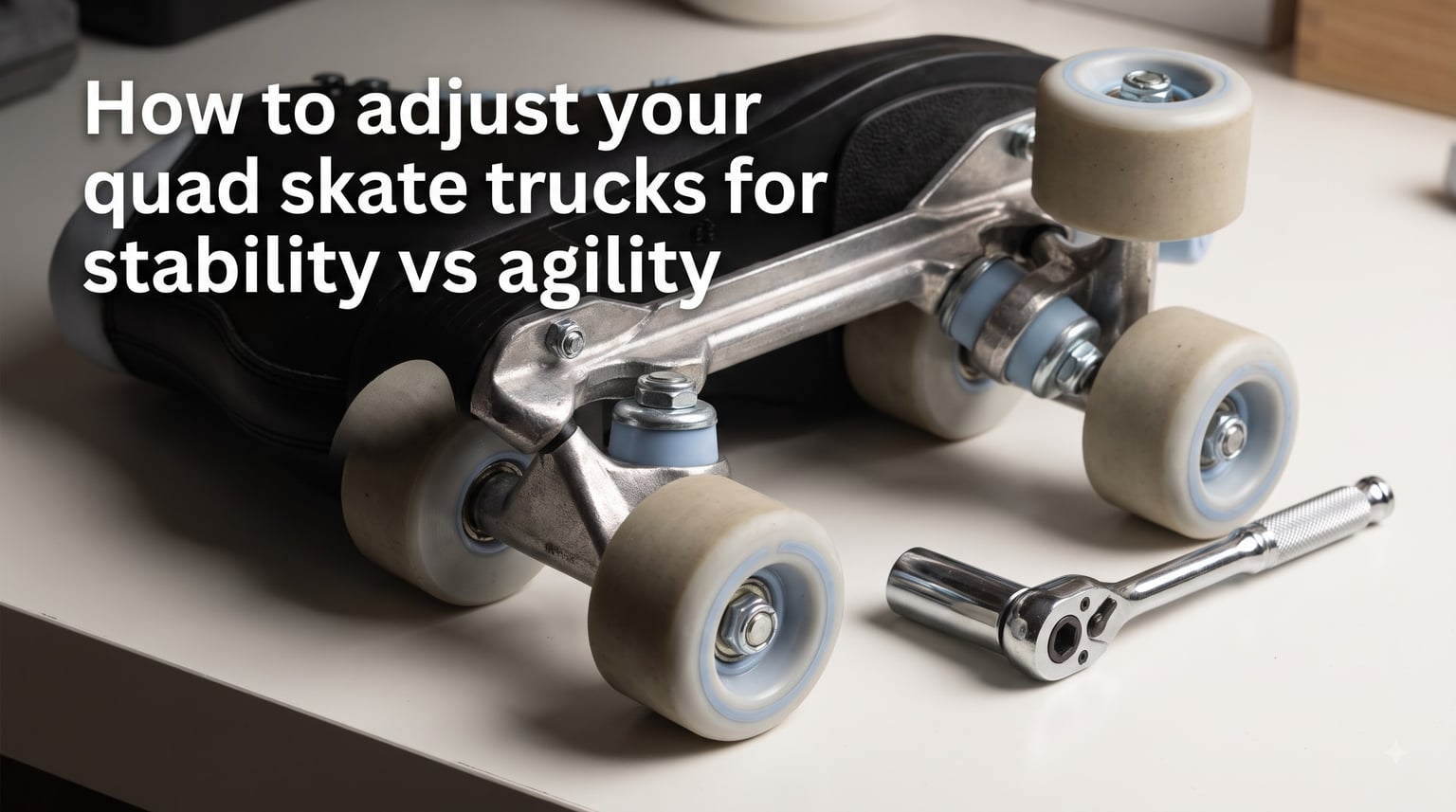
If you have ever felt like your skates fight you on every turn or wobble uncontrollably at speed, your trucks are probably the culprit. Learning how to adjust your quad skate trucks for stability vs agility completely changes how your skates feel under your feet. The difference between a frustrating session and a great one often comes down to a single half-turn of the kingpin nut.
Our team has spent years tuning skates for rhythm skating, derby, trail skating, and park sessions. Along the way, we have learned that there is no universal “correct” truck setting. What works for a 120-pound rhythm skater will feel terrible for a 200-pound trail skater. This guide breaks down everything you need to know about quad skate truck adjustment so you can dial in your perfect setup.
We will cover the mechanics of how trucks work, walk through a step-by-step adjustment process, and share the community-validated techniques that experienced skaters swear by. Whether you are a beginner wondering if your trucks are too tight or an intermediate skater chasing tighter carves, you will find practical answers here.
Table of Contents
What Are Quad Skate Trucks and How They Work?
Quad skate trucks are the metal assemblies mounted underneath your skate plates that hold the wheels and allow them to pivot side to side. Each skate has two trucks, a front truck and a rear truck, connected to the plate by a kingpin. The kingpin runs through cushions (also called bushings) that compress and rebound as you lean, which is what lets you steer by shifting your weight.
Every truck has a hanger that holds the axle, a kingpin that holds everything together, cushions that control resistance, and a pivot pin that seats into a pivot cup. When you lean left or right, the hanger rotates around the kingpin. The cushions push back against that rotation, returning the truck to center when you stop leaning.
The key thing to understand is that the kingpin nut controls how much the cushions compress. Tighten the nut and you squeeze the cushions, making them harder to deform. The truck becomes stiffer and more stable but harder to turn. Loosen the nut and the cushions relax, giving you easier turning but less stability at speed.
How to Adjust Your Quad Skate Trucks: The Stability vs Agility Tradeoff
The stability vs agility tradeoff is the single most important concept in truck tuning. Tight trucks give you a stable, predictable ride that holds a straight line at speed. They resist turning, which means you have to work harder and lean more to carve. For beginners and speed skaters, this predictability builds confidence.
Loose trucks flip that equation. They respond instantly to small weight shifts, making tight turns, crossovers, and dance moves feel effortless. The downside is that loose trucks can feel twitchy and unpredictable, especially at higher speeds or on rough surfaces.
Here is a quick comparison to help you understand where each setting shines:
Loose trucks (agility-focused): Easier turning, faster edge-to-edge transitions, better for rhythm skating and artistic moves, but less stable at speed and more prone to wheel bite.
Tight trucks (stability-focused): Rock-solid straight-line tracking, better high-speed control, ideal for beginners and outdoor trail skating, but turning requires more effort and feels less responsive.
Most experienced skaters land somewhere in the middle. The goal is not to pick one extreme but to find the point where you have enough stability for your skating style without sacrificing the agility you need for your moves.
Signs Your Trucks Need Adjustment
Your skates will tell you when something is off. The trick is recognizing the symptoms before they lead to a fall. Here are the most common signs that your truck adjustment needs attention.
If your trucks are too loose, you will likely experience speed wobbles when skating fast, wheels rubbing the plate during sharp turns (wheel bite), a general feeling of instability or “sloppiness,” and trucks that wiggle easily when you push them with your fingers. You might also notice your ankles working overtime to keep yourself balanced.
If your trucks are too tight, the symptoms look different. You will struggle to initiate turns, feel like you are skating on rails, catch edges unexpectedly, and experience fatigue in your legs from forcing every carve. Beginners often do not realize their trucks are too tight because they have never felt what proper turning should feel like.
A simple test: stand on your skates and lean side to side without moving. If you barely lean and the skate shoots out from under you, trucks are too loose. If you lean hard and nothing happens, they are too tight.
Tools You Need to Adjust Your Trucks
You only need basic tools for most truck adjustments. A socket wrench or skate tool with the correct size socket (usually 9/16 inch for standard kingpin nuts, 14mm for metric) handles most of the work. A screwdriver or allen wrench may be needed to hold the kingpin from spinning on some plates.
That is it for basic adjustments. If you plan to replace cushions or disassemble the truck entirely, add a pair of pliers and a clean workspace to your list.
Step-by-Step: How to Adjust Quad Skate Trucks
Follow these steps to adjust your trucks safely and effectively. The process works the same for both front and rear trucks.
Step 1: Test your current setup. Skate around for a few minutes and pay attention to how the skates feel. Note whether turning feels stiff, sloppy, or somewhere in between. This baseline helps you know which direction to adjust.
Step 2: Loosen or tighten the kingpin nut. Place your socket wrench on the kingpin nut. Turn clockwise to tighten (more stability) or counterclockwise to loosen (more agility). Make small adjustments, a quarter turn at a time is plenty. Making huge changes all at once makes it hard to find your sweet spot.
Step 3: Hold the kingpin if needed. On some plates, the kingpin spins when you turn the nut. If this happens, use a screwdriver or allen wrench on the top of the kingpin to hold it steady while you adjust the nut.
Step 4: Test after each adjustment. Put the skates on and skate around. Make the same turns and stops you normally would. The feel will change immediately, so trust what your feet are telling you.
Step 5: Repeat until it feels right. Keep making quarter-turn adjustments and testing until you reach a setting that feels responsive but stable. Most skaters end up somewhere between a half turn and a full turn looser than fully tight.
Step 6: Check for wheel bite. After loosening, push the truck toward the plate as hard as you can by hand. If the wheel touches the plate, you have wheel bite. Either tighten slightly or consider smaller wheels.
Step 7: Recheck after a session or two. New cushions settle and compress over the first few sessions. What feels perfect today might feel different next week, so plan to fine-tune once or twice after the initial adjustment.
The Goldilocks Zone: Finding the Right Tightness
The Goldilocks zone is that perfect middle ground where your trucks feel responsive without being twitchy. Finding it takes a little experimentation, but there is a reliable method the skating community has used for years.
Start by tightening the kingpin nut until it is snug against the cushions but not cranked down. Then loosen it exactly half a turn. This is your starting point. From here, skate around and feel how it responds.
From this baseline, make quarter-turn adjustments. If turning feels too easy and you get wobbles at speed, tighten a quarter turn. If turning still feels stiff, loosen a quarter turn. The goal is to find the loosest setting where you still feel in control at your normal skating speed.
Your weight matters here too. Lighter skaters (under 130 pounds) generally need looser trucks to get the same responsiveness, because they put less force on the cushions. Heavier skaters (over 180 pounds) compress cushions more easily and may need slightly tighter trucks to maintain stability.
Once you find your Goldilocks zone, memorize or mark the position. Check it every few weeks, as cushions wear and vibrations can slowly change the nut position.
How Bushings and Cushions Affect Your Ride
Cushions (the rubbery pieces on the kingpin) are just as important as the kingpin nut setting. They come in different shapes and hardnesses (measured in durometer), and changing them transforms how your trucks feel.
Standard cushions are barrel shaped, providing even resistance throughout the lean. Cone shaped cushions offer a softer initial lean that progressively stiffens, which many skaters prefer for rhythm and artistic skating. Some setups mix a barrel cushion on top with a cone on the bottom for a hybrid feel.
Softer cushions (lower durometer, around 78A to 85A) compress more easily, giving you a looser feel without loosening the nut. Harder cushions (90A and above) resist compression, giving a tighter, more stable feel. If you have your kingpin nut dialed in but the trucks still do not feel right, swapping cushions is the next step.
Worn cushions are a common hidden problem. Over time, rubber degrades and compresses permanently, making your trucks feel loose even when the nut is tight. If your trucks felt great a year ago and now feel sloppy despite the same nut position, it is time for new cushions.
Front vs Rear Truck Settings
Many skaters do not realize that your front and rear trucks do not have to match. In fact, running different settings front and rear can dramatically improve how your skates handle.
A popular setup among experienced skaters is running the front truck slightly looser than the rear. The looser front truck initiates turns more easily, while the tighter rear truck provides stability and drive as you push through the turn. This gives you responsive steering without sacrificing the platform you push off from.
The exact difference varies by skater, but a quarter turn looser on the front truck is a common starting point. Test it and adjust from there. Some park skaters and bowl riders prefer the opposite, with the rear looser for better pumping and carving on transitions.
If you are new to tuning, start with both trucks at the same setting. Once you find a comfortable middle ground, experiment with slight front-rear differences to fine-tune your handling.
Speed Wobble Prevention and Wheel Bite Solutions
Speed wobble and wheel bite are the two most common problems that send skaters searching for truck adjustment advice. Both have straightforward fixes once you understand the causes.
Speed wobble happens when loose trucks oscillate at high speed, creating a terrifying side-to-side shaking that can throw you off balance. Tighter trucks reduce or eliminate speed wobble by limiting how far the truck can pivot. If you skate fast regularly, do not run your trucks at maximum looseness. A quarter turn tighter can be the difference between a smooth run and a nasty fall.
Wheel bite occurs when a loose truck lets the wheel get close enough to the plate to make contact, usually during a sharp turn. This suddenly stops the wheel and can cause an immediate fall. To prevent wheel bite, check your wheel clearance after loosening trucks by manually pushing the truck toward the plate. If the wheel touches, tighten slightly, switch to smaller wheels, or add wheel wells if your plate supports them.
Both problems are also connected to cushion condition. Worn, soft cushions make both issues worse because they let the truck travel further than it should. Fresh cushions of the right hardness solve a lot of mystery handling issues.
Frequently Asked Questions
How loose should quad skate trucks be?
Your trucks should be loose enough to turn when you lean but tight enough that you cannot wiggle them easily with your fingers. A good starting method is to tighten the kingpin nut snug, then loosen it half a turn. From there, adjust in quarter-turn increments until turning feels responsive but controlled.
Do tighter trucks prevent speed wobble?
Yes. Tighter trucks limit how far the hanger can pivot, which directly reduces the oscillation that causes speed wobble. If you experience wobbles at your normal skating speed, tighten your kingpin nut a quarter turn at a time until the wobble stops.
How do adjustable quad skates work?
Adjustable quad skates use a standard kingpin and cushion system. The kingpin nut controls cushion compression, which determines truck stiffness. Loosening the nut reduces compression for easier turning, while tightening it increases compression for more stability. Cushion hardness and shape also affect how the truck responds.
How to fix misaligned trucks?
Loosen the kingpin nut and remove the truck. Check that the pivot pin sits fully in the pivot cup and that cushions are seated correctly and not cracked. Reassemble, making sure the cushions align with their seats. If the hanger is bent or the axle is damaged, replace the truck, as bent parts cannot be reliably straightened.
Conclusion
Learning how to adjust your quad skate trucks for stability vs agility is one of the highest-impact skills you can develop as a skater. The process comes down to understanding the kingpin-cushion relationship, making small quarter-turn adjustments, and trusting what your feet feel. Start with the half-turn method, find your Goldilocks zone, and do not be afraid to experiment with front-rear differences and cushion swaps.
Your perfect truck setting is personal, and it will evolve as your skating improves. Check your adjustments every few weeks, replace worn cushions when handling starts to feel off, and remember that the best setting is the one that makes you want to lace up and skate.