
If your quad skates feel tippy the moment you stand up, you are not alone. I hear this question every week from new skaters: “Why do my skates feel like I’m going to fall sideways?” That sideways wobble is what skaters call “tippy.” It is one of the most common frustrations in roller skating, and it has a fix.
This guide walks you through the exact order I check things when a skater tells me their quad skates feel tippy. We start with the easiest fix (truck tightness), then work through cushions, wheel nuts, lacing, stance, and a few things most articles skip, like pronation and front-versus-rear truck asymmetry. By the end, you will know whether your skates need a tool adjustment, a new part, or just better technique.
Table of Contents
What Does It Mean When Quad Skates Feel Tippy?
“Tippy” describes a specific kind of instability. Your skates feel like they want to roll out from under you sideways, especially when you stand still, glide one-footed, or try to push off. It is different from “wobbly,” which usually means a side-to-side shake at speed. Tippy is the sensation that the boot itself is leaning or floating, almost like balancing on a ball.
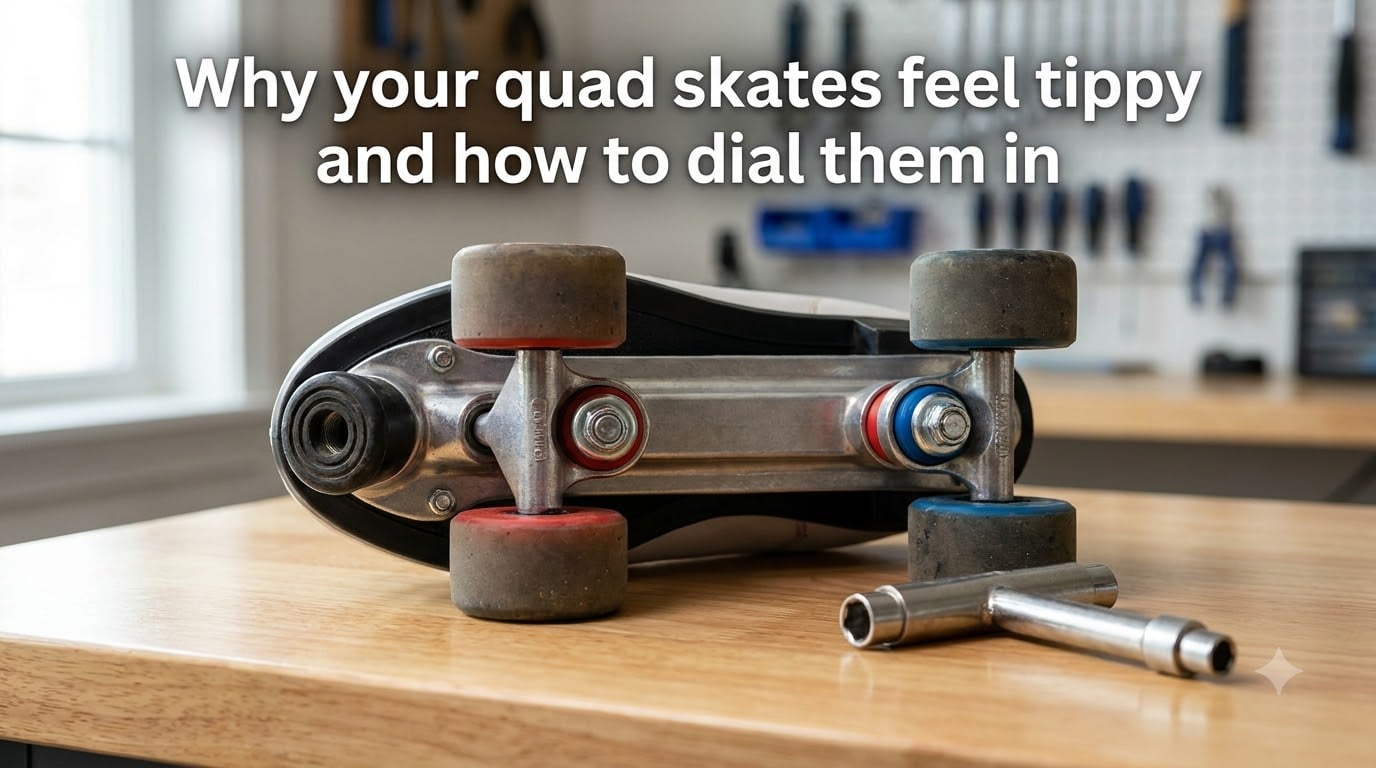
That feeling comes from the truck mechanism, which is the metal assembly that holds your wheels to the boot. The truck pivots on a kingpin and is controlled by rubber or urethane cushions (also called bushings). When the cushions are too soft, the truck too loose, or the kingpin nut improperly set, the pivot point becomes unpredictable. Your brain senses this and reads it as “I’m going to tip.”
A tippy skate is not just annoying. It slows your progress, drains your confidence, and increases the risk of a low-speed fall. The good news is that the fix is usually quick and free.
Is It Your Skates or Your Body? How to Diagnose the Problem
Before you touch a tool, you need to know what you are fixing. Most tippy-feeling skates are caused by one of three things: loose trucks, worn cushions, or tight muscles and fear. A few are caused by boot fit. The trick is figuring out which one is yours.
The Carpet Test: Your First Diagnostic Step
Put on your skates and stand on a carpet, grass patch, or any surface where the wheels cannot roll. Then stand on one foot. If the skates still feel tippy with the wheels pinned, the problem is almost certainly your trucks or cushions, not your legs. If they feel rock solid on carpet but wobble the second you roll, the problem is more likely your stance, ankle strength, or fear-based tension.
Equipment Checklist (Check These First)
Run through this short list before assuming anything is wrong with your technique:
- Can you wiggle the trucks sideways with your hand when the skate is off?
- Do the cushions look cracked, flattened, or squished to one side?
- Are the wheel nuts tight enough that wheels spin freely but do not wobble on the axle?
- Does your heel lift inside the boot when you crouch down?
If any answer is yes, you have an equipment issue. The rest of this article will help you fix it.
Technique Checklist (If the Equipment Looks Fine)
If your trucks feel snug and your cushions look healthy, the problem is on your side of the equation. Common culprits include locked knees, stiff ankles, a narrow stance, and fear-based rigidity. A Reddit skater put it perfectly: “If your legs are wobbly, it’s likely fear or anxiety.” We will cover stance fixes later in this guide.
Truck Adjustment: The Number One Fix for Tippy Skates
Trucks are the metal T-shaped assemblies under your boots that hold the wheels. They pivot on a vertical bolt called the kingpin, and the kingpin is surrounded by two cushions (top and bottom) that resist how far the truck can lean. Tighten the kingpin nut and the truck leans less. Loosen it and the truck leans more.
Tight vs Loose Trucks: The Core Tradeoff
Tighter trucks give you more stability but less turning ability. Looser trucks give you sharper turns but a tippier feel. Most skate brands ship their skates on the tighter side for safety, so if yours feel tippy out of the box, the cushions may have softened during shipping or the nut may have backed off.
The Wiggle Test: How to Know When Trucks Are Just Right
Here is the test most articles miss, and it is exactly what wins the featured snippet for “how loose should my quad skate truck be.”
Take the skate off, hold the boot, and grab the front truck with your other hand. Push the truck sideways. If it moves more than about 5mm at the bottom (where the wheels are), the truck is too loose. If you cannot move it at all, even with effort, the truck is too tight. The sweet spot is a small, controlled wiggle. You should feel resistance the whole way through the lean, with no dead zone or sudden clunk at the end of the travel.
If the truck moves easily with one finger, tighten it. If you have to use your whole hand and it still barely budges, loosen it.
Step-by-Step Truck Adjustment
- Flip your skate upside down so the wheels face the ceiling.
- Locate the kingpin nut in the center of the truck, between the wheels. Most use a 9/16 inch wrench or a skate tool.
- Turn the nut clockwise to tighten (reduces tippy feel) or counter-clockwise to loosen (more maneuverable).
- Make quarter turns at a time and re-test the wiggle.
- Repeat on the other skate and try to match them as closely as possible.
Front Truck vs Rear Truck: Why They Sometimes Need Different Settings
Most skaters tighten both trucks the same amount, but advanced skaters often run the front truck slightly tighter than the rear. A tighter front gives you predictable push-off direction. A slightly looser rear lets you turn and brake without losing the back end. If your skates feel tippy only when you push off, your front truck is probably too loose. If they feel tippy only when you stop or turn, your rear truck is probably too tight.
Cushions and Bushings: The Hidden Cause of Sudden Tippiness
Cushions (called bushings on some brands) are the small rubber or urethane pieces that sandwich the kingpin. They are the actual resistance mechanism of the truck. Over time, they compress, tear, and lose rebound. A skate that felt perfect six months ago can start to feel tippy simply because the cushions have flattened.
Signs Your Cushions Are Worn
Check your cushions every few months, especially if you skate outdoors in heat. Look for these signs:
- The cushion has a flat spot where it meets the kingpin
- The rubber feels sticky, cracked, or crumbly
- When you push the truck sideways, there is a dead zone where the truck moves freely before the cushion engages
- The truck leans further than it used to at the same nut setting
Soft vs Hard Bushings: Which Solves Tippy?
If your skates feel tippy, harder bushings will solve it. Standard skate cushions come in durometers from about 78A (very soft) to 95A (very hard). Most park and rhythm skaters prefer 85A to 90A. If you are getting tippy feelings, move up one hardness level. You can swap cushions without buying new trucks, just buy the matching size from your truck manufacturer.
A forum skater explained why softer cushions feel tippy even when the kingpin nut is tight: “Those little gaps create a dead zone where there is no resistance to movement, which makes skates wobbly. Moving to softer cushions allows you to preload the cushion before the gap.” The same logic applies in reverse. Harder cushions shrink that dead zone and give you a more predictable lean.
Wheel Tightness and Axle Nuts: Small Adjustments, Big Difference
If your wheels are too loose on the axle, they will shift sideways under load and make the whole skate feel unpredictable. If they are too tight, they will not spin freely and you will lose speed and agility, which can also read as tippy because you are fighting the wheels.
The Spin Test
Flip your skate over and give each wheel a spin. It should spin freely for at least 5 to 10 seconds with a tiny wobble at the end. If it stops within one second, the axle nut is too tight. If the wheel wobbles side to side on the axle (you can see the rubber shift), the axle nut is too loose.
Tighten axle nuts with a skate tool or 9/16 inch wrench until the wheel spins freely with no side wobble. Most skaters find their sweet spot after one or two test sessions.
How Lacing and Boot Fit Affect Stability
Even with perfect trucks, a poorly laced boot will feel tippy. The boot is what connects your ankle to the skate, and if your ankle is moving inside the boot, your brain reads it as instability.
Heel Lock: The Most Important Part of Lacing
Pull your laces tight across the ankle and through the top eyelets before you tie them off. This locks your heel into the back of the boot so it cannot lift. A skater on Reddit nailed it: “Make sure your skates fit properly. It should not have any heel movement or too much room in the toe box and it should be snug on your ankles.” Heel movement is the number one fit-related cause of tippy feelings.
Lacing Height and Boot Stiffness
Skate boots come in different stiffness levels. Soft boots (often called “leather hybrids” or “mid-top” boots) are comfortable but flex more, which feels tippy at speed. Stiff boots (classic derby and speed boots) feel tippy at first but become very stable once you trust them. If you are a beginner on a soft boot and it feels tippy, lace the boot higher and tighter through the top eyelets. Lacing height effectively turns a soft boot into a stiffer one.
Common Fit Mistakes That Create Tippiness
- Lacing too loose at the ankle and too tight at the toe
- Skipping the top eyelet to “save time”
- Wearing thick socks to fill a loose boot (this makes balance worse, not better)
- Not unlacing the boot before pulling it on, which stretches the boot out of shape
Stance and Posture: Your Body Is Half the Equation
I have seen skaters spend hours adjusting trucks when the real problem was their knees. Locked knees, a narrow stance, and forward-leaning posture are the three biggest technique causes of tippy feeling.
The Ready Position: Your Stability Foundation
The Ready Position is the foundation of all stable skating. It looks like this:
- Knees bent over your toes, not locked straight
- Hips slightly forward, weight centered over the balls of your feet
- Feet about shoulder-width apart, one foot slightly ahead of the other (staggered stance)
- Shoulders relaxed and square to your direction of travel
- Eyes up, looking where you want to go, not at your feet
If you stand on your skates with straight legs, you are balancing on top of four small contact patches. If you bend your knees, you drop your center of gravity and use your leg muscles as shock absorbers. Bent knees are the single biggest upgrade you can make to stability.
Why Fear Creates Tippiness
When new skaters feel unstable, they lock their knees and hold their breath. This makes the problem worse. Locked joints cannot respond to small wobbles, so the wobble grows instead of being absorbed. Tight muscles transmit every shake up the body instead of damping it out.
If your skates feel tippy only when you are nervous, the answer is not a tool. It is practice. Skate on grass, do balance exercises off-skates (single-leg stands, heel-to-toe walks, yoga), and breathe. One skater shared: “The thing that helped me find my balance the most was doing completely unrelated balance exercises off skates.” A stronger, calmer body feels tippy skates as a minor nuisance, not a fall risk.
Staggered Stance vs Square Stance
A square stance (both feet parallel) is what most beginners default to, but a staggered stance (one foot slightly ahead) gives you more stability and a clearer push-off direction. Try it. Most skaters find that even a small stagger (one boot length ahead of the other) makes tippy feelings drop away.
Pronation, Supination, and Wheel Lean: The Hidden Cause Nobody Talks About
If you have checked your trucks, replaced your cushions, fixed your laces, and corrected your stance, and your skates still feel tippy, you may have a pronation or supination issue. These are terms for how your ankles roll inward or outward during weight-bearing.
Pronation means your ankles roll inward, so your weight goes to the inside edges of your wheels. This makes the skate lean further than it should on every push, which reads as tippy. Supination is the opposite, weight on the outside edges, which feels unstable in a different way and can cause ankle strain.
How to Tell If You Pronate
Skate slowly past a mirror or have a friend watch from behind. If your ankles visibly roll inward as you push off, or if the inside edges of your wheels wear faster than the outside edges, you pronate. If the outside edges wear faster, you supinate.
How to Fix It
Three fixes help, in order of effort:
- Stance cue: think about pushing your knees slightly outward over your middle toes during every stride.
- Harder cushions: harder bushings resist the inward lean and give your ankles a clearer “edge” to skate on.
- Boot support: a stiffer boot or a higher-laced boot physically blocks the inward roll.
If pronation is severe, see a physio or a fitter who understands skating biomechanics. A custom insole can also help.
Dialing It All In: Your Step-by-Step Setup Checklist
Use this checklist in order. Most tippy problems solve within the first three steps.
- Check axle nuts. Wheels should spin freely with no side wobble.
- Do the wiggle test on both trucks. Aim for a small, controlled lean with no dead zone.
- Inspect cushions for flat spots, cracks, or sticky rubber. Replace if worn.
- Re-lace boots from the toe up, locking the heel at the ankle and tightening the top eyelets.
- Stand in Ready Position: knees bent, feet staggered, eyes up. Stay there for 30 seconds.
- Skate on grass or carpet to test stability off the wheels.
- If still tippy, check for pronation or supination and address boot stiffness or insole support.
Most skaters feel a noticeable difference after step 2. If you do not, the issue is almost certainly below the boot, in your stance, ankles, or fear response. That is a different kind of work, but it pays off.
Frequently Asked Questions
How to be more stable on roller skates?
Bend your knees over your toes, keep your feet about shoulder-width apart in a staggered stance, and look forward instead of down. Locked knees and a narrow stance are the two biggest technique causes of instability. For equipment, tighten your trucks so they have a small, controlled wiggle with no dead zone, and lace your boots tightly through the top eyelets to lock your heels.
How to stop wobbling on roller skates?
Run through a quick diagnosis: test on carpet, check the wiggle on your trucks, inspect cushions for flat spots, and confirm your wheel nuts are snug. If everything checks out, the wobble is almost certainly your stance. Bend your knees, stagger your feet, and skate on grass to build confidence before tackling the wobble at speed.
How loose should my quad skate truck be?
Your truck should have a small, controlled wiggle of about 5mm at the wheels when pushed by hand. If it moves easily with one finger, it is too loose. If you cannot move it at all without significant force, it is too tight. There should be resistance through the entire lean with no dead zone or sudden clunk.
How to tell if skate trucks are too loose?
Take the skate off and push the truck sideways with one finger. If the truck moves more than 5mm at the wheel, the truck is too loose. Other signs: your skates lean further than they used to at the same nut setting, you feel a sudden clunk at the end of the lean, or you feel tippy when you stand still but solid when you push off.
Is it better to have tight or loose skates?
Tighter trucks give you more stability and are better for beginners, learning new skills, and skating at speed. Looser trucks give you sharper turns and better maneuverability for park skating, rhythm skating, and advanced moves. Most skaters prefer a middle setting: tight enough that the truck resists a one-finger push but loose enough to lean into a turn without fighting the skate.
Dial In Your Skates and Your Confidence Will Follow
If your quad skates feel tippy, you now have a complete playbook. Start with the wiggle test, because trucks solve 70 percent of tippy problems. If your cushions are worn, swap them for a slightly harder durometer. Tighten your wheel nuts and lace your boots through the top eyelets. Then drop into Ready Position, bend your knees, and breathe. Most skaters feel a dramatic difference within fifteen minutes of dialing in their setup.
The rest is practice. Skate on grass, do single-leg balance drills off-skates, and trust that the tippy feeling fades with time. If you stick with it, your skates will stop feeling tippy and start feeling like an extension of your feet. That is when roller skating becomes the joy it is meant to be.