
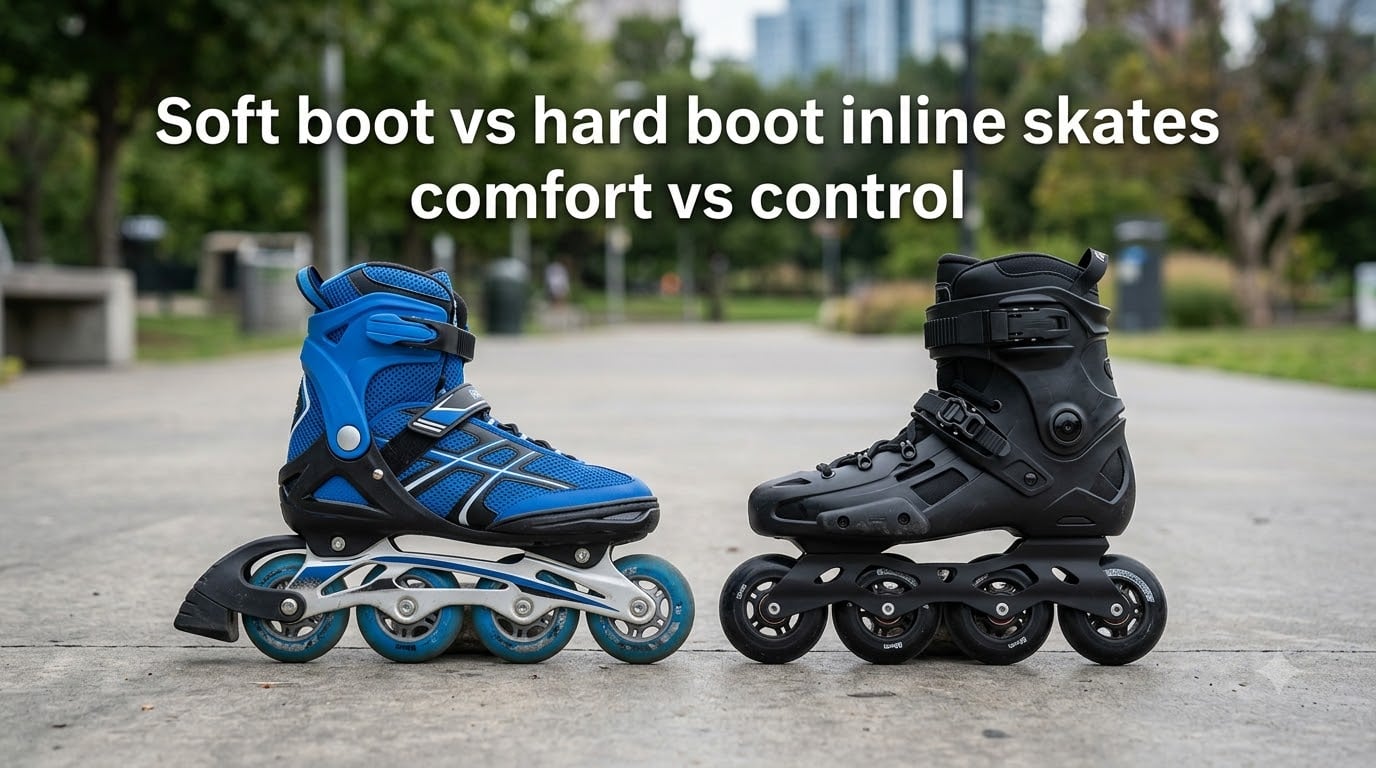
Choosing between soft boot vs hard boot inline skates is the single biggest decision you will make when buying your first or next pair of rollerblades. Get it right and every session feels dialed in. Get it wrong and you are looking at blisters, wobbly ankles, and a skate that fights your style. The choice comes down to one trade-off the inline skating community has debated for decades: comfort versus control.
I have spent years skating both styles, talking with experienced skaters on r/rollerblading, and watching beginners struggle through the same fork in the road. This guide breaks down what actually differs between soft shell skates and hard shell skates, so you can pick the boot type that matches your feet, your climate, and the way you want to skate.
Quick version: a hard boot inline skate has a rigid outer shell with a removable liner built for support and power transfer. A soft boot inline skate uses a flexible textile upper with an integrated liner that flexes with your foot for all-day comfort. Neither is universally better. Which one wins for you depends entirely on how and where you skate.
By the end of this article you will know exactly which boot type fits your skating style, your foot shape, and even the weather where you live. We will cover definitions, side-by-side comparison, beginner guidance, break-in expectations, and real skater experiences pulled straight from the forums.
Table of Contents
What Is a Hard Boot Inline Skate?
A hard boot inline skate is built around a rigid outer shell, usually made from glass-fibre reinforced plastic, carbon composite, or full carbon fibre. This rigid shell is the structural backbone. It holds its shape under load, which is what gives hard boots their signature locked-in feel and precise handling.
Inside the shell sits a separate, removable liner. This is the part that touches your foot and provides cushioning. Because the liner is removable, you can swap it out, wash it, or upgrade to a heat-mouldable performance liner down the road. That modularity is a major reason experienced skaters gravitate toward hard boots as their skills progress.
The construction also matters for weight. Hard boots tend to be heavier than soft boots of the same price tier, and that added weight actually has an upside. A heavier skate keeps your centre of gravity lower, which increases stability and balance at speed. Skaters doing urban freeskate, slalom, or aggressive tricks often rely on that planted, grounded feel.
Stiffness is the other defining trait. A rigid shell transfers every input from your leg directly to the frame and wheels. That means sharper edge control, faster transitions between edges, and far less energy wasted on boot flex. For anyone pushing technique, that responsiveness is non-negotiable.
Common examples of hard boot construction include carbon shell speed boots, composite urban freeskate boots, and aggressive skate boots designed for grinds and park riding. Premium models use full carbon fibre construction to keep the weight down while preserving stiffness.
What Is a Soft Boot Inline Skate?
A soft boot inline skate uses a flexible textile or mesh upper, similar to a hiking shoe or sturdy sneaker, that wraps around your foot. Instead of a rigid plastic shell, the structure comes from the upper material itself combined with internal reinforcements and a plastic or composite base plate.
The liner in a soft boot is typically integrated rather than removable. That means it is sewn into the upper and shaped to work as a single system. This delivers the immediate, sneaker-like comfort that soft boots are famous for. You put them on and they feel broken in from day one.
That flexibility comes with a real cost in support. A soft shell boot will flex laterally when you push hard into an edge, which can feel unstable at high speeds or during aggressive manoeuvres. Skaters who try tricks in soft boots often complain about a lack of ankle support exactly when they need it most.
Where soft boots shine is the combination of low weight and excellent ventilation. The textile upper breathes far better than a sealed plastic shell, which makes soft boots the natural choice for fitness skating, long recreational rides, and anyone skating in a hot or humid climate. Your feet simply stay cooler and drier.
Entry-level fitness skates from brands like Rollerblade and K2 lean heavily into soft boot construction because comfort sells. They are forgiving on beginners who are still building ankle strength and balance, and they make those first few sessions enjoyable rather than painful.
Hard Boot vs Soft Boot Inline Skates: Key Differences at a Glance
The fastest way to understand the comfort vs control split is a side-by-side comparison. Below is a summary of how soft shell skates and hard shell skates differ across the six factors that actually affect your skating.
Support: Hard boots win. The rigid shell locks the ankle and resists lateral flex, giving you a planted, secure feel. Soft boots flex more, which feels comfortable but offers noticeably less support during hard pushes.
Control and Power Transfer: Hard boots win again. A stiff shell transfers leg input to the wheels with minimal loss, sharpening edge control and acceleration. Soft boots absorb some of that input through upper flex.
Comfort: Soft boots win. The flexible textile upper and integrated liner feel broken in from the first wear. Hard boots usually require a break-in period before the liner conforms to your foot.
Ventilation: Soft boots win. Mesh and textile uppers breathe freely, keeping feet cool in hot and humid conditions. Hard boots trap heat unless the shell has engineered vents.
Weight: Soft boots win on weight. Hard boots are typically heavier, though carbon construction narrows the gap on premium models. The extra weight does add stability at speed.
Durability: Hard boots win. A rigid shell resists abrasion, impact, and deformation over years of abuse. Soft boot uppers can wear, tear, or compress, especially under heavy use.
Read that list and you can already see the pattern. Hard boots dominate control, support, and durability. Soft boots dominate comfort, ventilation, and weight. That is the entire soft boot vs hard boot debate distilled into six bullets.
Support, Control, and Power Transfer Compared
Support and control are the heart of why hard shell skates exist. When you push off on an inline skate, your leg applies force through the boot, into the frame, and onto the wheels. Any flex in the boot absorbs some of that force before it reaches the ground. That lost force is wasted energy and imprecise edge control.
A rigid hard boot shell barely flexes under load. That means almost every watt you push goes straight to the wheels. Skaters describe the feel as responsive, precise, and connected. When you carve an edge or transition between edges, the boot reacts instantly because there is no soft material squishing in between.
Ankle support follows the same logic. Hard boots surround your ankle with stiff material that resists rolling inward or outward. This is critical for slalom, urban freeskate, and aggressive skating, where sudden lateral loads are constant. Without that support, your ankle has to do all the stabilising work, which fatigues quickly and raises injury risk.
Soft boots, by contrast, are designed to flex. The textile upper gives with your foot, which feels natural and forgiving, but it cannot match the locked-in lateral support of a rigid shell. Skaters on r/rollerblading consistently report that soft boots lack the support needed for advanced tricks, grinds, and high-speed urban riding.
The takeaway on the control axis is straightforward. If your skating demands precision, hard boots win. If your skating is about cruising comfort, the flex of a soft boot will not hold you back and may even feel nicer.
Comfort, Fit, and Ventilation Compared
Comfort is where soft boots pull ahead decisively. The flexible upper and integrated liner conform to your foot from the first wear, which is why soft boot skates are the go-to recommendation for fitness, recreational, and long-distance skating. They feel like a well-padded shoe, not a piece of sports equipment.
Break-in period matters here. Hard boots typically need anywhere from a few sessions to a couple of weeks to break in, depending on liner thickness and your foot shape. The liner has to compress and mould to your foot before the skate feels truly comfortable. Soft boots skip most of that process.
Ventilation is the second comfort factor and it hits hardest in hot weather. A textile mesh upper breathes freely, allowing air to circulate around your foot. Hard boots trap heat inside the sealed shell, which can leave your feet soaked in sweat during summer sessions or in humid climates like Singapore or Florida. Some hard boots add engineered vents, but they still cannot match mesh for airflow.
Foot shape compatibility is something almost no competitor guide covers, and it is genuinely important. According to experienced skaters on r/rollerblading, K2 soft boots tend to suit slimmer feet, while Rollerblade and Powerslide models run wider and accommodate broader foot shapes better. Hard boots have an advantage here too: because the liner is separate and often heat-mouldable, a fitter can customise the fit to your foot in ways a soft boot simply cannot match.
So if you have unusual foot shape, wide forefoot, bunions, or high arches, a hard boot with a heat-mouldable liner may actually end up more comfortable than a soft boot once broken in. The initial comfort gap closes over time.
Best Use Cases for Each Boot Type
Matching boot type to skating style is the most practical way to decide. Here is how soft and hard boots line up against the most common inline skating disciplines based on what the skating community actually recommends.
Choose soft boots for:
Fitness skating and cardiovascular training rides
Casual recreational cruising on bike paths and park loops
Long-distance and marathon-style skating where comfort over hours matters
Beginners building ankle strength and confidence
Skating in hot or humid climates where ventilation is critical
Choose hard boots for:
Urban freeskate and city skating with sudden stops, jumps, and obstacles
Slalom and freestyle skating that demands precise edge control
Aggressive skating, grinds, and park riding where boot abuse is constant
Speed skating and high-performance skating that needs maximum power transfer
Skaters who want modular, heat-mouldable fit customisation
Climate plays into this too. Skaters in Singapore and other humid environments often lean toward soft boots for the breathability alone. Skaters in cooler climates gain less from mesh ventilation and can prioritise the support and durability of a hard boot without sacrificing much comfort.
Forum consensus from r/rollerblading is clear on one point: soft boots are suitable for anything except aggressive skating, grinds, and heavy freeskate tricks. Push a soft boot into that territory and you will hit its limits fast.
Which Boot Type Is Better for Beginners
Beginners ask this question more than any other, and the honest answer depends on what kind of beginner you are. The default recommendation from most skate shops and experienced skaters is a soft boot. The reason is simple: comfort drives consistency, and consistency is what keeps a new skater on wheels long enough to build real skill.
A soft boot feels good from minute one. That removes the most common reason beginners quit early, which is painful, blistered feet after the first session. The flexibility also forgives the wobbly, uncertain movements new skaters make while learning balance and edge control. That forgiveness builds confidence faster than a stiff, unforgiving shell.
That said, there is a case for starting on a hard boot if you already know you want to progress into urban, aggressive, or slalom skating. Buying a hard boot first saves you from upgrading six months later when your soft boot starts holding back your technique. The trade-off is a tougher first few weeks while the liner breaks in.
The decision factors to weigh are your skating goals, your foot shape, and your climate. If you want relaxed fitness rides in a hot climate and you have average-width feet, a soft boot is the easy call. If you are itching to hit the city, learn slides, or you have hard-to-fit feet that need a mouldable liner, a hard boot is worth the initial discomfort.
Real skater experience backs this up. Many skaters on r/rollerblading describe starting on one boot type, then going a little crazy buying different types as their skills and preferences evolve. That is normal. Your first skate does not have to be your forever skate. It just has to get you rolling long enough to discover what you actually love.
Practical Tips for Choosing Between Soft and Hard Boots
Once you have a direction in mind, these practical checks will help you confirm the right pick and avoid a costly mistake.
Try before you buy when possible. Visit a skate shop, try on both boot types in your size, and pay attention to how your ankle feels. If your heel lifts inside a soft boot, that is a warning sign of poor lockdown. If a hard boot pinches anywhere on day one, ask whether the liner is heat-mouldable.
Size for snug, not loose. Both boot types should hold your heel firmly. A loose skate causes blisters and kills control regardless of boot type. Many beginners buy too large because comfort skates feel tight initially. Snug is correct; painful is not.
Match the liner to your foot. Hard boots with removable liners let you upgrade or replace the liner later, which extends the life of the skate. Soft boots have integrated liners, so what you buy is what you live with.
Factor in the break-in. Budget two to ten sessions for a hard boot to feel comfortable. Soft boots are comfortable immediately but may pack out and loosen over months of use, so check fit periodically.
Know when to upgrade. If you started on a soft boot and you are now hitting urban features, attempting slides, or craving more edge precision, that is your signal to move to a hard boot. The control upgrade will feel like unlocking a new tier of skating.
Frequently Asked Questions
Do I need a hard boot or soft boot for inline skates?
Most beginners do best with a soft boot because it is comfortable from day one and forgives the wobbly movements of new skaters. Choose a hard boot if you plan to skate urban, aggressive, slalom, or speed, or if you need a heat-mouldable liner for a hard-to-fit foot shape.
What is the difference between a hard boot and a soft boot inline skate?
A hard boot inline skate has a rigid outer shell with a separate removable liner, built for support, control, and power transfer. A soft boot inline skate uses a flexible textile upper with an integrated liner that flexes with your foot for immediate comfort and ventilation.
Are soft or hard boot rollerblades better?
Neither is universally better. Soft boots are better for fitness, recreational, and long-distance skating in hot climates because they are lighter, cooler, and more comfortable. Hard boots are better for urban, aggressive, slalom, and speed skating because they offer superior support, control, and durability.
How long does it take to break in hard boot inline skates?
Hard boots typically take two to ten skating sessions to break in, depending on liner thickness and your foot shape. Heat-mouldable liners can shorten this period because a skate shop can shape them to your foot. Soft boots are usually comfortable from the first wear.
Why are hard boots better for aggressive skating?
Hard boots provide the rigid ankle support and precise power transfer that aggressive skating demands. Tricks, grinds, and jumps generate sudden lateral loads that would collapse a soft boot upper. The rigid shell also withstands the impacts and abrasion that aggressive skating produces.
Final Verdict: Comfort vs Control
The soft boot vs hard boot inline skates debate will never have a single winner because the right answer depends on the skater, not the boot. Soft boots win on comfort, ventilation, and weight, making them the natural choice for fitness, recreational, and long-distance skaters, especially in hot climates. Hard boots win on support, control, durability, and power transfer, making them the clear choice for urban, aggressive, slalom, and speed skaters who need precision.
If you are a beginner who just wants to roll comfortably, start soft. If you are chasing technique and progression, go hard. Either way, fit matters more than boot type, so prioritise a snug lockdown and the right sizing above everything else. Pick the boot that matches how you actually skate, and the comfort versus control trade-off resolves itself.