
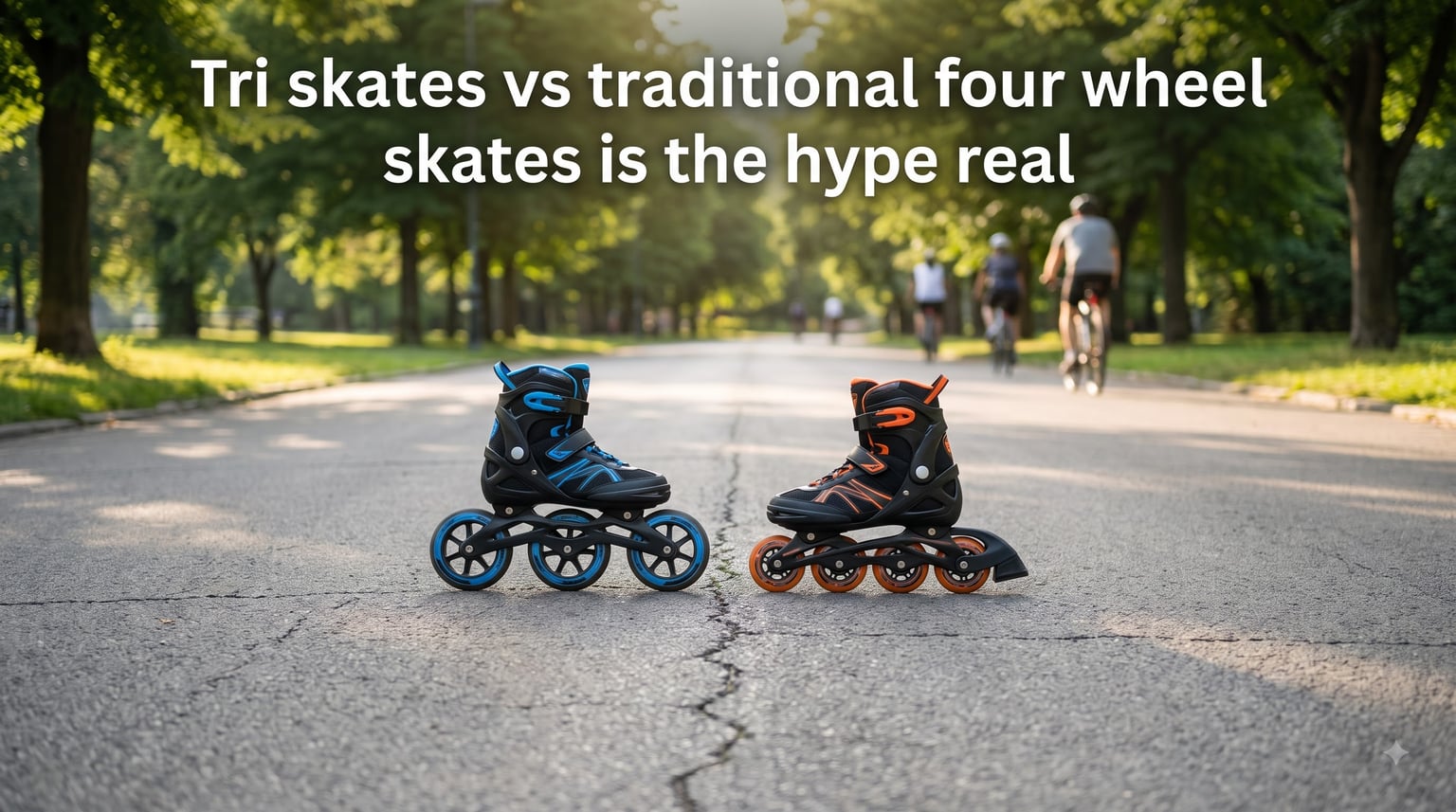
Tri skates vs traditional four wheel skates is a debate that has split the inline skating community for years. The short answer: tri-skates (3-wheel setups) deliver more speed, roll longer on rough surfaces, and feel lighter on your feet, while traditional four-wheel skates win on stability, braking confidence, and beginner-friendliness. The hype around tri-skates is real for experienced skaters who want to go fast and cover long distances — but it is overstated if you are just starting out or mostly skate in tight urban spaces.
Our team has spent months analyzing forum discussions, skater testimonials, and technical specifications from every major brand to give you a straight-shooting comparison. No marketing fluff. Just real differences that matter when you are trying to decide which setup fits your skating style.
Whether you are eyeing those flashy big-wheel tri-skates or sticking with a trusty four-wheel setup, this guide breaks down exactly what changes when you drop a wheel. We cover speed, stability, braking, surface performance, transitioning tips, and honest recommendations for every type of skater in 2026.
Table of Contents
What Are Tri-Skates and How Do They Work?
Tri-skates are inline skates that use three large wheels instead of four smaller ones. Most tri-skate setups run wheels between 100mm and 125mm in diameter, compared to the 76mm to 90mm wheels you typically find on traditional four-wheel inline skates. The larger wheels are the defining feature — they are what create the performance differences that make tri-skates feel like an entirely different beast.
The frame on a tri-skate is usually shorter than a four-wheel frame even though the wheels are bigger. This sounds counterintuitive, but removing one wheel frees up frame space. A 3-wheel frame holding 110mm wheels can be roughly the same length as a 4-wheel frame holding 80mm wheels. That shorter wheelbase combined with taller wheels creates a unique skating feel — more agile in some ways, more twitchy in others.
Brands like Powerslide pioneered the modern tri-skate movement with their Triskate line, and Rollerblade followed with models like the Maxxum. The concept has been around since the 1990s, but improvements in frame materials and wheel manufacturing made big-wheel tri-skates practical and affordable in recent years.
Tri Skates vs Traditional Four Wheel Skates: The Core Differences
The core difference between tri-skates and traditional four-wheel skates comes down to wheel size, frame length, and how those two factors change everything about the ride. Three large wheels roll over imperfections more easily and maintain momentum better. Four smaller wheels distribute your weight across more contact points, giving you a more planted, stable feel.
Here is a quick snapshot of how the two setups compare across the factors that matter most:
Speed: Tri-skates hold higher cruising speeds with less effort. Four-wheel setups accelerate faster from a standstill but require more energy to maintain top speed.
Stability: Four-wheel wins hands down. More contact points and a lower center of gravity make four-wheel skates feel locked in.
Maneuverability: Tri-skates turn quicker due to shorter frames, but the taller wheels make them feel less predictable at low speeds.
Weight: Tri-skates are typically lighter because there is one less wheel, axle, and bearing set per skate.
Skill requirement: Four-wheel is more forgiving for beginners. Tri-skates demand better balance and more confident technique.
The rest of this guide digs into each of these areas with specifics so you can make an informed call for your situation.
Speed and Performance: 3-Wheel vs 4-Wheel
Tri-skates are faster than four-wheel skates at cruising speeds, and the reason is simple physics. Larger wheels have a larger circumference, meaning each rotation covers more ground. A 110mm wheel travels roughly 345mm per revolution, while an 80mm wheel covers about 251mm. That means fewer revolutions to cover the same distance, which means less energy spent maintaining speed.
This is the one area where forum skaters almost universally agree. Users on r/rollerblading consistently report that tri-skates maintain speed with noticeably less effort once you are moving. One common observation: skaters who switch to 3-wheel setups find themselves cruising at higher speeds without feeling like they are working harder.
However, acceleration tells a different story. Four-wheel setups get up to speed faster from a dead stop. Smaller wheels are lighter and spin up quicker, which matters in stop-and-go urban skating. If you are constantly stopping at lights and starting again, a four-wheel setup will feel snappier off the line.
For fitness skating, marathon training, or long-distance rides on bike paths, tri-skates are the clear winner. The speed advantage compounds over distance — less energy per stroke means you can skate longer before fatigue sets in. Skaters doing 20+ mile rides almost universally prefer big-wheel setups.
Stability and Balance Comparison
Traditional four-wheel skates are more stable than tri-skates, and it is not even close for beginners. Four wheels mean four contact points with the ground at all times. Your weight spreads across a wider base, and the shorter wheel diameter keeps your center of gravity lower to the ground. This combination creates a planted, confidence-inspiring feel.
Tri-skates raise you higher off the ground. A 125mm wheel puts your foot significantly taller than an 80mm wheel, and that extra height shifts your balance point. Newer skaters often describe the feeling as “wobbly” or “top-heavy” during their first sessions on tri-skates.
The space between the wheels also matters. On a four-wheel setup, there is always a wheel directly under the ball of your foot and another under your heel. On a three-wheel setup, there is open frame space between the wheels. If you hit a crack or rough patch in that gap area, you feel it more. This is why tri-skate setups can feel more twitchy on imperfect pavement.
That said, stability improves dramatically with experience. Skaters who put in the hours on tri-skates report that the wobbly feeling disappears within a few weeks. Your stabilizer muscles adapt, and what felt unstable becomes second nature. The key is giving yourself enough practice time before judging the setup.
Maneuverability and Control
Tri-skates are more maneuverable than four-wheel skates in tight turns and quick direction changes. The shorter frame length means less contact area with the ground, so the skate pivots more freely. For slalom-style skating, weaving through cones, or navigating crowded sidewalks, tri-skates offer a responsive, flickable feel.
But there is a trade-off. That same shorter frame makes tri-skates less stable at high speeds and less forgiving of imperfect technique. If you wobble at speed on a tri-skate, the shorter wheelbase has less self-correcting tendency. Four-wheel setups track straighter and are more forgiving when your form gets sloppy.
For freestyle and slalom skaters, three-wheel setups are increasingly popular despite the stability trade-off. The agility advantage outweighs the stability cost once you have the skills to control it. Powerslide and Seba both make dedicated freestyle tri-skates designed specifically for this market.
Urban skaters face a tougher call. City skating involves a mix of tight turns, straight-line cruising, and unexpected stops. Some urban skaters love tri-skates for the agility. Others prefer four-wheel for the predictability when traffic throws surprises at them.
Braking and Acceleration Differences
Braking is where tri-skates face their biggest criticism. The taller wheels give you more leverage over the brake, which means the skate wants to tip forward when you apply pressure. Skaters transitioning from four-wheel to three-wheel setups almost universally report that braking feels less confident at first.
The higher center of gravity also means you need better core strength and ankle stability to brake effectively on tri-skates. Heel brakes on tri-skate setups exist but are less common — many tri-skate frames do not include a brake mount at all, which means learning to T-stop or use other stopping techniques.
Acceleration favors four-wheel setups. Smaller, lighter wheels spin up faster, so you get moving quicker from a standstill. This matters most in urban environments with frequent stops. For skaters who do a lot of city commuting with stop signs and traffic lights, the acceleration advantage of four wheels is a real quality-of-life factor.
Surface Performance: Rough Roads vs Smooth Pavement
Tri-skates handle rough surfaces significantly better than traditional four-wheel skates. This is arguably the biggest practical advantage of the three-wheel design, and it comes down to wheel diameter. A 110mm or 125mm wheel rolls over cracks, pebbles, and pavement seams that would stop an 80mm wheel dead.
If you skate on rough asphalt, brick, or chip-seal roads, the difference is night and day. Tri-skate wheels absorb small imperfections that smaller wheels catch on. Forum users consistently mention this as their favorite thing about switching — suddenly, routes that were unbearable on four-wheel skates became enjoyable.
On smooth pavement, the advantage narrows. Both setups perform well on freshly paved bike paths or indoor rink floors. The speed difference is still there, but the comfort gap closes significantly.
For outdoor skaters who deal with mixed surface quality, tri-skates are a strong upgrade. The bigger wheels turn “unskatable” roads into manageable ones. This alone makes the hype feel justified for skaters whose local routes include rough patches.
One caveat: the gap between the wheels on a tri-skate frame can catch on obstacles if you hit them at the wrong angle. A stick or large rock wedged between wheels can still cause problems. The advantage is in rolling over small imperfections, not eliminating all obstacle risks.
Are 3-Wheel Skates Better for Beginners?
No, 3-wheel skates are not better for beginners. Four-wheel skates remain the better choice for new skaters, and the reasons are straightforward. The lower center of gravity, wider wheelbase, and more predictable braking make four-wheel setups more forgiving while you build fundamental skills.
Beginners need stability above everything else. When you are learning to balance on inline skates, the last thing you want is a taller, twitchier setup that amplifies every wobble. Four-wheel skates keep you closer to the ground with more wheel contact, which builds confidence faster.
That said, there is a growing school of thought that says motivated beginners can start on tri-skates if they are willing to accept a steeper learning curve. Some skate schools have begun teaching on tri-skates with success, arguing that if you learn on the harder setup, everything else feels easy. This approach works for athletic learners with good balance but is not ideal for most newcomers.
Our recommendation: start on four wheels, build your fundamentals, and switch to three wheels once you feel confident on skates. The typical timeline is 3 to 6 months of regular skating before making the jump.
How to Transition from 4-Wheel to 3-Wheel Skates?
Transitioning from four-wheel to three-wheel skates is a process that takes patience and specific steps. No competitor covers this topic, and it is one of the most common questions we see in skating forums. Here is a practical approach based on skater experiences.
Step 1: Use 80mm or 90mm wheels as a bridge. Before jumping to 110mm or 125mm tri-skates, try four-wheel skates with larger wheels. This gets you used to bigger wheels and higher speeds while keeping the stability of four contact points. Many skaters recommend 84mm or 90mm as the sweet spot bridge size.
Step 2: Start with smaller tri-skate wheels. When you make the switch, do not go straight to 125mm. Start with 100mm or 110mm three-wheel setups. The transition from 90mm four-wheel to 110mm three-wheel is much more manageable than going from 80mm four-wheel straight to 125mm three-wheel.
Step 3: Practice in a controlled environment. Spend your first tri-skate sessions in an empty parking lot or smooth bike path where you do not have to deal with traffic, obstacles, or pressure. Get used to the balance, the braking feel, and the acceleration characteristics without distractions.
Step 4: Focus on ankle stability. The taller setup demands more from your ankles and core. Do balance exercises, practice one-foot glides, and build those stabilizer muscles before tackling long or fast rides.
Step 5: Relearn your braking. Braking on tri-skates feels different. Whether you use a heel brake or T-stop, practice stopping at various speeds until it feels natural. Do not skip this step — overconfidence on unfamiliar brakes leads to accidents.
Most skaters report taking 2 to 4 weeks of regular sessions to feel comfortable on tri-skates after the switch. Give yourself that time before making any judgments about whether the switch was worth it.
Which Setup Is Right for You? Use Case Breakdown
Choosing between tri-skates and four-wheel skates depends entirely on how and where you skate. Here is our breakdown based on use cases.
Fitness and distance skating: Tri-skates are the better choice. The speed advantage and reduced effort at cruising speeds make long rides more enjoyable. If you are doing 10+ mile fitness rides, the three-wheel advantage is real and meaningful.
Urban commuting: It depends on your route. Smooth streets with minimal stops favor tri-skates for the speed. Rough, stop-and-go city routes favor four-wheel for the acceleration and stability. Many commuters end up with four-wheel setups for daily use.
Freestyle and slalom: Both work, but the choice depends on your skill level. Advanced slalom skaters increasingly prefer tri-skates for the agility. Intermediate freestyle skaters often do better with four-wheel for the predictability.
Marathon skating: Tri-skates dominate. Almost all competitive marathon and distance skaters use three-wheel setups with large wheels. The efficiency advantage over 26-mile events is substantial.
Recreational and casual skating: Four-wheel is the safer bet. If you skate occasionally for fun, the stability and ease of use matter more than speed gains you may never fully exploit.
Beginners: Four-wheel, without question. Build your skills on a forgiving setup before considering the switch.
Frequently Asked Questions
Are 3 wheel skates better than 4?
It depends on your skating style and experience. Three-wheel skates are better for speed, long-distance skating, and rough surfaces due to larger wheels that roll faster and smoother. Four-wheel skates are better for beginners, urban skating, and anyone who values stability and braking confidence. Neither is universally better — they serve different needs.
Why is rollerblading not popular anymore?
Rollerblading declined in mainstream popularity after its 1990s peak due to changing fashion trends, competition from other activities, and a lack of organized competitive infrastructure. However, the sport has seen a resurgence in recent years as fitness skating, urban commuting, and inline skate technology have improved. The community remains active and is growing again.
Are 3 wheels better than 4?
Three wheels offer more speed, better rough surface performance, lighter weight, and shorter frame maneuverability. Four wheels offer better stability, easier braking, faster acceleration from stops, and a lower learning curve. For experienced skaters focused on speed and distance, three wheels are better. For beginners and stability-focused skaters, four wheels are the right choice.
Are 4 wheel roller skates easier?
Yes, four-wheel skates are easier for most skaters, especially beginners. The four contact points provide more stability, the lower wheel height keeps your center of gravity closer to the ground, and braking feels more controlled. The wider wheelbase makes balancing simpler, which is why most skate schools recommend four-wheel setups for new skaters.
Conclusion
So, is the tri-skates vs traditional four wheel skates hype real? Yes — for the right skater. Tri-skates genuinely deliver on speed, rough surface performance, and long-distance efficiency. The advantages are measurable and well-documented across the skating community. But the hype oversimplifies the story. Four-wheel skates remain the better choice for beginners, urban commuters, and anyone who prioritizes stability and braking confidence.
Our bottom line advice: if you are an experienced skater looking to go faster and farther, tri-skates are worth every penny of the hype. If you are new to skating or mostly ride in stop-and-go city environments, four-wheel skates will serve you better. Pick the setup that matches your actual skating, not the one that looks flashier on Instagram.
Start where you are, build your skills, and let your skating style tell you when it is time to switch. The best skate setup is the one that gets you rolling consistently and keeps you excited to lace up.