
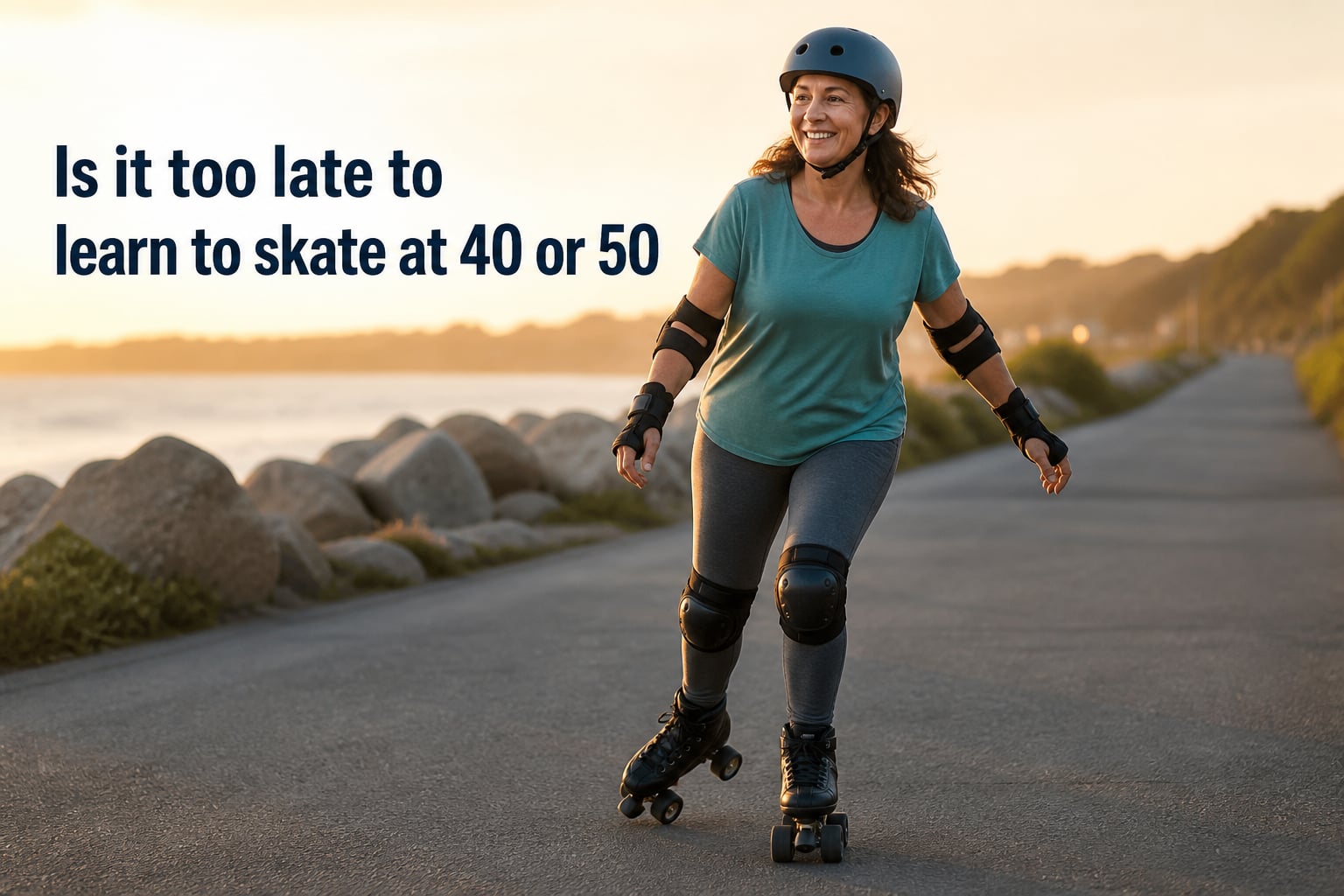
No, it is not too late to learn to skate at 40 or 50. I have seen firsthand how adults in their 40s, 50s, 60s, and even 70s pick up skating and turn it into a lifelong joy. If your body can move and your mind is willing, age is just a number on the journey.
Many of the readers who land on this page share the same quiet worry: “What if I embarrass myself?” or “What if I fall and break something?” Those are fair concerns, and I will address every one of them below. By the end, you will know exactly what to expect, what gear to buy, and how long it really takes to feel confident on skates.
Table of Contents
Is it too late to learn to skate at 40 or 50? The honest answer
The short answer is a clear no. I have taught and coached adults well into their 60s and 70s who laced up skates for the very first time as grown-ups, and every single one of them learned to roll. Some now skate weekly. A few even joined adult roller skating leagues.
What changes as you age is not your ability to learn. It is your recovery time, your fear response, and sometimes your baseline fitness. Those are workable variables, not dealbreakers. Most adult beginners I have worked with hit a comfortable cruising pace within 8 to 12 weeks of consistent practice.
If you can walk, balance on one foot for a few seconds, and commit to 20 minutes of practice three times a week, you can learn to skate at 40, 50, or beyond. The body adapts at any age. The mind just has to get out of the way.
Real adults who started skating at 40, 50, 60 and beyond
Proof matters more than promises, so let me share what I have seen in the adult skating community. These are not celebrities or athletes. They are regular people who decided age was not going to win.
One woman started roller skating at 52 after her daughter invited her to a rink. She fell on her first night. By month three, she was skating backward and joining adult skate nights every Friday. She told me she cried the first time she did a clean crossover.
A 75-year-old man picked up skating again at his birthday party after a 40-year break. He said muscle memory kicked in within a week, but his body needed twice the warm-up time it used to. He now skates every Saturday morning with a local group.
A 70-year-old skater named Ellen added roller skating to her bucket list at 68. She skated her first lap at 69 with wrist guards and a helmet. Two years later, she completed a 5K outdoor skate event. Her secret was patience and a great instructor.
Forum communities on Reddit and Facebook are full of similar stories. Overweight beginners at 40, former figure skaters returning at 55, and parents who learned alongside their kids at 47. The pattern is consistent: age predicts nothing about success.
The growth mindset advantage older beginners bring
Older skaters actually have hidden advantages that younger beginners do not. After two decades of teaching, I can tell you the adults who progress fastest are rarely the most athletic. They are the most patient.
You are not in a hurry. Kids race to keep up with their friends. Adults understand that 15 minutes of focused practice beats an hour of frustration. That slower pace leads to deeper motor learning, because your brain actually has time to encode the movement patterns.
You have less ego driving you. Teenagers panic when they cannot nail a trick in two tries. Adults shrug and try again. That emotional regulation is gold for learning a physical skill like skating.
You get more pleasure from small improvements. The first time you glide 10 feet without holding the wall, your adult brain recognizes that as a real achievement. Kids take it for granted. Adults celebrate it, and that celebration fuels the next practice session.
This is what educators call a growth mindset, and it is the single biggest predictor of success for adult beginners. If you can approach skating with curiosity instead of judgment, your age becomes irrelevant.
Safety gear every adult beginner needs (40 and older)
Gear is not optional when you are learning to skate at 40 or older. Wrist fractures are the most common skating injury for adults, and they heal slower than they did at 20. Here is the non-negotiable setup I recommend to every beginner I coach.
A certified helmet is the first purchase. Look for CPSC, ASTM, or Snell certification on the inside label. Multi-impact helmets designed for skateboarding or roller derby are usually more comfortable than bike helmets for skating.
Wrist guards are next. Your instinct when you fall is to put your hands out. Wrist guards absorb that force and prevent the most common fracture in adult beginners. Brands like Triple Eight, Pro-Tec, and Smith Scabs make reliable options.
Knee pads and elbow pads round out the set. You will fall on both. Hard plastic caps with foam padding protect your joints and let you get up without scraping skin off. Pad up every single time you skate, even for “just a few minutes.”
One more tip from years of watching adults learn: do not buy the cheapest gear you can find. Mid-range protective equipment lasts longer, fits better, and actually stays on during a fall. Think of it as insurance for your joints.
Realistic timeline: what to expect in your first 90 days
Setting the right expectations upfront saves a lot of frustration. Here is the timeline most adult beginners I have coached actually follow, assuming three practice sessions per week.
Week 1 to 2 is about finding your balance. You will hold the wall or a friend. You will shuffle awkwardly. You will fall, probably on your knees. This is normal. Spend these weeks wearing your gear at home and standing on skates on carpet to build confidence.
Week 3 to 4 brings your first real strides. You will start gliding on both feet, taking small steps, and possibly letting go of the wall for a few seconds. Most adults feel clumsy here. Stick with it. Your brain is rewiring balance pathways that have been dormant since childhood.
Week 5 to 8 is where it clicks. You will cruise 20 to 30 feet at a time, turn slowly, and start experimenting with stopping techniques. This is the phase where most adults either fall in love with skating or quit. Practice with a friend or in a rink full of supportive people to push through.
Week 9 to 12 brings real confidence. You will skate for 10 to 15 minutes straight, stop on purpose, and maybe try a slow backward roll. By the end of three months, you are officially an adult skater. Not advanced, but functional, which is the goal.
Compare this to kids, who often cruise in a few sessions but plateau at intermediate skills for years. Adults take longer to start but often reach higher levels because of their consistent practice habits.
Roller skating vs ice skating: which is easier for older beginners?
Both are learnable at 40 or 50, but they present different challenges. Ice skating requires sharp blades and a slippery surface, which means falls can be harder. Roller skating gives you more control through wheels and toe stops.
Roller skating tends to feel more stable for adult beginners because you can stop with a toe stop and the surface is predictable. Ice skating offers smoother gliding but takes longer to master the edges and stops. If balance is your main worry, start with roller skates.
If your goal is figure skating or hockey, ice is the only path. If you want casual fitness, social skating, or outdoor trails, roller skating is the friendlier starting point for most adults over 40.
How to handle the fear of falling and looking silly
The fear of falling is the number one reason adults quit before they start. I get it. As a 50-year-old, a broken wrist is not a 6-week inconvenience. It is a 3-month life disruption.
Here is the truth: you will fall. Every adult who learns to skate falls. The question is not whether you fall, but how you fall. That is what protective gear is for. With wrist guards and knee pads, you can fall safely and bounce back up within minutes.
As for looking silly, every single person at the rink is either learning, remembering, or watching someone else. Nobody is judging. In fact, adult beginners often get the most encouragement from the skating community because everyone respects the courage it takes to start at 40 or 50.
If you want extra confidence, take a lesson or two before joining open skate. A good instructor will normalize the falls, correct your form, and fast-track your progress. After two or three lessons, the rink stops feeling intimidating.
Frequently asked questions about learning to skate at 40 or 50
Is 50 too old to learn to skate?
No. Adults in their 50s learn to roller skate and ice skate every year. What matters is your overall health, not your age. With proper protective gear and consistent practice, most 50-year-old beginners are cruising comfortably within 8 to 12 weeks.
Can a 40 year old learn to roller skate?
Yes, absolutely. Many adults pick up roller skating for the first time at 40 and progress into intermediate skills within a few months. Balance improves quickly when you practice three times a week, even if your first sessions feel awkward.
Is 40 too old to learn to ice skate?
Not at all. Ice skating lessons for adults over 40 are offered at most rinks, and instructors are used to working with older beginners. Expect a slightly longer adjustment period for edges, but the basic glide and stop come within a handful of sessions.
How hard is it to learn to roller skate as an adult?
It feels hard at first because adult brains expect instant competence. In reality, the skill itself is moderate. With three weekly practice sessions, helmet, and wrist guards, most adults reach a comfortable cruising level in two to three months.
Is roller skating harder than ice skating?
Roller skating feels more stable for beginners because you can stop with a toe stop and the surface is less slippery. Ice skating rewards smoother glide and edge control but demands more patience with falling. Both are entirely learnable for adults in their 40s and 50s.
Your skating journey starts today, not someday
Is it too late to learn to skate at 40 or 50? No. It is not. Thousands of adults have answered that question with skates on their feet and smiles on their faces.
Lace up. Wear your gear. Find a rink or a smooth path. Take one lesson this week, even if it is just 20 minutes in your living room. The only deadline that matters is the one you set for yourself.