
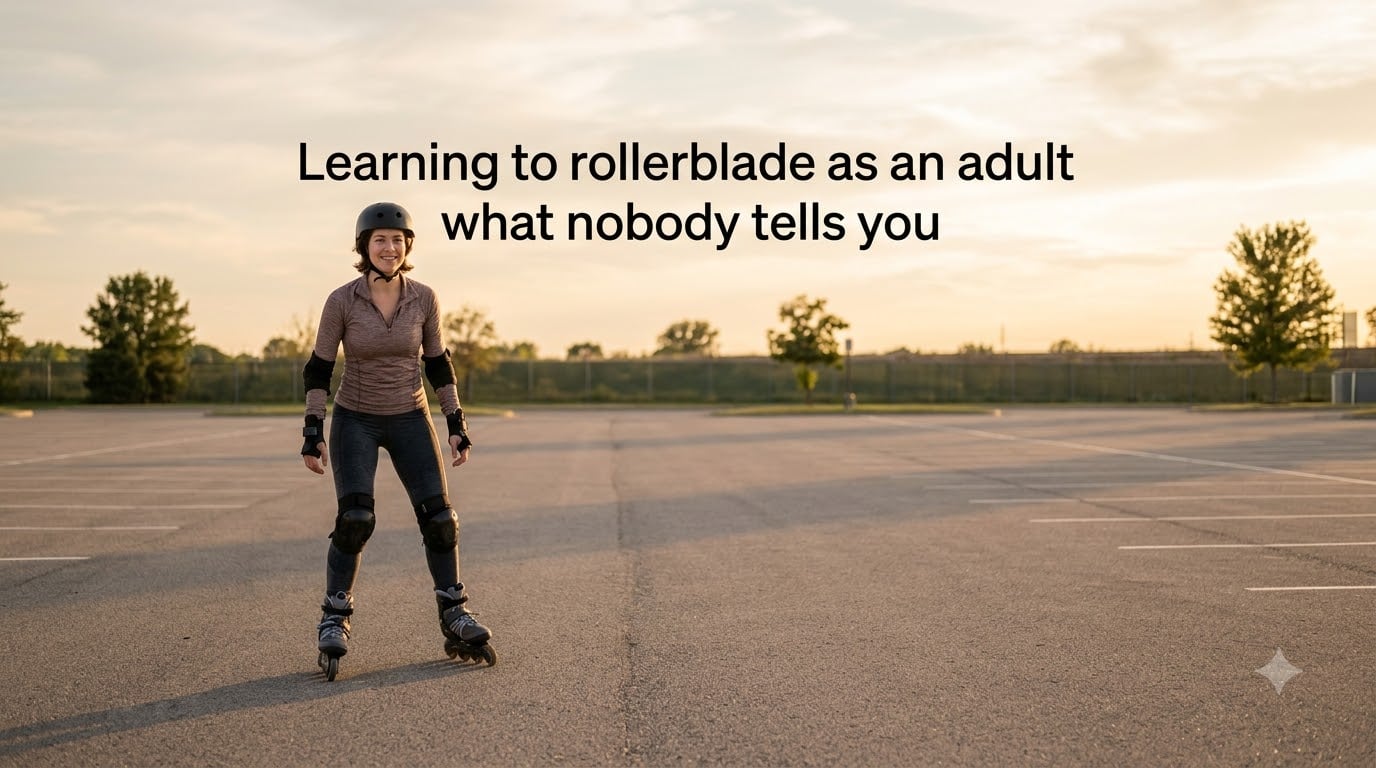
Learning to rollerblade as an adult hits differently than learning as a kid. When you are 8 years old, you fall, you get up, and you fall again without a second thought. At 35 or 45, your brain is busy calculating insurance deductibles before you even lace up.
I remember staring at my first pair of inline skates like they were a dare rather than a gift. Every guide I found online told me to “just have fun” or “embrace the wobble.” Nobody told me why my hands would sweat inside my gloves, why my legs would feel like concrete blocks, or why I would cry out of frustration in an empty parking lot at 6 PM on a Tuesday.
This article is what I wish I had read before strapping in. Learning to rollerblade as an adult comes with mental barriers that most tutorials skip entirely. The physical side is learnable in a few weeks. The fear, the embarrassment, and the constant inner voice telling you that you look ridiculous — those are the real challenges.
We will cover everything nobody tells you: why smooth surfaces matter more than willpower, why your knees do the heavy lifting, how to stop without panicking, what gear actually helps you feel confident, and how long this process realistically takes. If you are wondering whether you are too old to start, spoiler — you are not.
Rollerblading for beginners is not about talent or athletic ability. It is about repetition, surface choice, and managing the voice in your head that says you should have learned this three decades ago.
Table of Contents
Why Learning to Rollerblade as an Adult Feels So Different?
Learning to rollerblade as an adult is a fundamentally different experience from learning as a child, and the reason is almost entirely mental. Children do not carry a concept of consequence the way adults do. They fall, they laugh, they try again. Adults carry decades of learned caution.
Your brain after 25 has spent years perfecting the art of keeping you upright on two feet. When you put on inline skates, you are asking that same brain to let go of its primary job. Every instinct you have will fight you. This is not weakness — it is biology working as intended.
Adults also have a sense of self that children have not developed yet. When a child falls in a park, they do not think about whether someone saw them. When an adult falls, the first thought is often “who is watching?” That embarrassment factor is real, and it is one of the biggest reasons adults quit before they give themselves a fair chance.
Forum discussions from communities like Reddit’s r/rollerblading reveal that almost every adult learner describes the same sequence: shaky knees, lead feet, sweating palms, and a feeling of terror on anything that is not perfectly flat. This is universal. If you are feeling it, you are doing it right.
What nobody tells you is that this fear actually decreases faster than you expect. After your first successful glide — even if it is only five feet — something clicks. The terror does not vanish, but it shrinks. Each small victory replaces a layer of anxiety with a layer of confidence.
What Nobody Tells You Before Your First Session?
Most beginner guides will tell you to bend your knees and wear a helmet. Those are true, but they barely scratch the surface. Here is what experienced adult learners wish they had known from day one.
Smooth Surfaces Matter More Than Willpower
This is the single most under-discussed topic in all of rollerblading advice. Sidewalks are the enemy of adult beginners. Every crack, every expansion joint, every pebble feels like a speed bump when your wheels are small and your balance is shaky.
What nobody tells you is that the surface you practice on will determine your success more than your determination will. A smooth basketball court, an empty parking garage, or a freshly paved bike path will make you feel like a natural. A cracked sidewalk will make you feel like you have no business being on skates.
One blogger described her experience perfectly: on sidewalks, she could barely move. On a smooth bike path near the water, she glided freely and felt the fear melt away. The difference was not her skill level. It was the asphalt under her wheels.
Your Knees Do the Work, Not Your Feet
Beginners obsess over foot position. They angle their toes in, out, parallel — constantly adjusting. What nobody tells you is that knee position matters ten times more than foot position.
When your knees are bent deeply, your center of gravity drops. Your balance improves automatically. Your feet will naturally find the right position when your knees are doing their job. Straight legs on rollerblades are a recipe for backward falls, and backward falls are the falls that hurt.
Think of it this way: your feet are just the contact points. Your knees are the suspension system. Get the suspension right, and the contact points figure themselves out.
Falling Is Coming — Plan for It
You will fall. Not “you might fall” — you will fall. Accepting this before your first session removes half the anxiety. The fear of falling is worse than falling itself, because the fear is constant and the actual fall lasts about two seconds.
Protective gear does two jobs: it protects your body, and it protects your confidence. Wearing wrist guards and knee pads is not just about preventing injury. It is about giving your brain permission to try without catastrophizing every wobble.
Forum users consistently report that wearing full protective gear changed their mental state entirely. The pads became a psychological comfort blanket. When you know your wrists and knees are padded, you stop fearing the fall and start focusing on the glide.
Finding Your First Practice Spot (Without Embarrassment)
Where you practice matters as much as how you practice. Adult beginners need three things from a location: smooth surface, flat terrain, and low foot traffic. Finding this combination is harder than it sounds, but it is worth the effort.
Empty parking lots are the gold standard for adult learners. Go on a Sunday morning, or a weeknight after businesses close. The asphalt is usually smooth and well-maintained. You have open space to wobble without crashing into anything. Best of all, there is no audience.
Parking garages are a hidden gem, especially the top levels that sit empty. The concrete is incredibly smooth. The slight incline between levels can actually help you practice gentle speed control. Just avoid busy hours.
Bike paths made of smooth asphalt are excellent once you have basic balance dialed in. Look for paths that run along waterfronts or through parks — these tend to have the best paving. The Belmont Pier to Queen Mary path in Long Beach is a famous example that adult learners swear by.
What nobody tells you is that time of day matters as much as location. Early morning and late evening mean fewer witnesses, cooler temperatures, and empty spaces. If embarrassment is your biggest barrier, schedule your practice sessions when the world is quiet.
Indoor roller rinks deserve a mention too. They charge a small entry fee, but the surface is perfect, the environment is controlled, and nobody cares if you cling to the wall for the first hour. Some rinks even offer adult beginner nights specifically designed for people who feel self-conscious.
The Basic Technique: Balance Before Movement
Before you try to move, you need to stand. This sounds obvious, but adult beginners consistently skip this step and pay for it immediately. Standing on inline skates is a skill unto itself.
How to Stand Without Toppling Over
Start on grass or a textured surface where your wheels will not roll. Position your feet shoulder-width apart with toes pointing slightly outward in a small V-shape. Bend your knees until you feel your thighs engage — deeper than you think you need.
Keep your weight centered over the middle of your feet, not on your heels and not on your toes. Lean your torso slightly forward. Your shoulders should be ahead of your knees, and your knees should be ahead of your toes. This forward lean is non-negotiable.
Practice this stance for ten minutes before you ever try to move. Get comfortable in it. Your body needs to learn that this bent-knee, forward-leaning position is its new default on wheels.
The First Weight Shift
Once you can stand, the next skill is shifting weight from one foot to the other without moving. Lift one foot slightly and balance on the other for a few seconds. Then switch. This single-leg balance is the foundation of everything that comes next.
What nobody tells you is that inline skating is essentially alternating one-legged balance. You are never truly standing on both skates equally when you are in motion. You are constantly shifting from one leg to the other. Mastering this on dry land first makes everything else click faster.
How to Actually Move Forward on Rollerblades?
Once balance feels manageable, it is time to move. The basic stride — sometimes called the V-formation or duck walk — is how beginners generate forward motion safely. It relies on physics more than strength.
The V-Formation Stride
Point your toes slightly inward so your heels are wider than your toes — like a duck stance. Now shift your weight to your right foot. Push off with your left foot at a 45-degree angle, letting the push come from the inside edge of the wheel.
Bring your left foot back to center. Now shift weight to your left foot and push off with your right. That alternating push is the stride. It is not a walking motion — it is a series of controlled pushes from one leg while the other glides.
The key detail that most tutorials gloss over: the push comes from shifting your weight, not from pushing hard with your leg. When you transfer your body weight to one skate, the other skate naturally pushes out. Let gravity and weight do the work.
Why Leaning Forward Saves You
Every experienced skater says the same thing: lean forward. This is not optional. When you lean back, your weight shifts behind your wheels, and the skates shoot forward without you. That is how most backward falls happen.
A slight forward lean keeps your weight over your skates. If you lose balance, you fall forward — onto your knee pads and wrist guards, which is exactly where you want to fall. Forward falls are controlled falls. Backward falls are not.
What nobody tells you is that leaning forward feels unnatural at first. Your brain will scream at you to lean back because leaning back feels safer on solid ground. On skates, that instinct is your enemy. Trust the forward lean.
Stopping Methods That Actually Work for Beginners
Stopping is the skill that keeps you alive. It is also the skill that adult beginners neglect most often, because practicing stopping is less fun than practicing gliding. Do not skip this. Knowing how to stop is what separates a confident skater from a terrified one.
The Heel Brake: Your Best Friend
Most recreational inline skates come with a heel brake attached to the right skate. This is the easiest stopping method for beginners, and it should be your primary stop for the first few months.
To use it, stagger your feet with the braking foot (usually right) ahead of the other. Bend your front knee deeply. Lift the toe of your braking foot so the brake pad drags on the ground behind you. Apply gradual pressure — do not slam it down.
The most common mistake is not bending the front knee enough. If your front leg is straight, the brake will not engage properly and you will wobble. Drop that knee low and let the brake do its job.
The T-Stop: A Useful Backup
The T-stop involves dragging one foot perpendicular behind you to create friction. It is more advanced than the heel brake but worth learning because it works even if your brake pad wears down.
To execute a T-stop, transfer all your weight to one leg. Bring the other leg behind you at a 90-degree angle, so the wheels are perpendicular to your direction of travel. Let the wheels drag on the ground to slow you down.
This requires solid one-leg balance, which is why you master standing and weight-shifting first. Do not attempt T-stops until you can glide on one foot confidently for several seconds.
Practice Stopping Before You Need Speed
What nobody tells you is that you should practice stopping more than you practice moving. A common beginner trap is gaining confidence in forward motion without developing equal confidence in stopping. The moment you need to stop and cannot, panic sets in — and panic makes everything worse.
Spend the first several sessions practicing stop-start cycles. Glide for five feet, stop completely. Glide for ten feet, stop completely. Build the reflex so that stopping becomes automatic rather than something you have to think about.
Realistic Timeline: What to Expect Week by Week
Setting realistic expectations prevents the frustration that makes most adult learners quit. The timeline below assumes you practice two to three times per week for 30 to 60 minutes per session.
Week 1: Standing and Wobbling
Your first week is about surviving. You will spend most of your time just standing, balancing, and getting used to the sensation of wheels under your feet. Expect shaky legs, sweaty palms, and a strong urge to quit. This is normal. Do not quit.
By the end of week one, you should be able to stand comfortably in your bent-knee stance and shift weight from one foot to the other. You may manage a few short, unsteady glides. Celebrate these. They are bigger wins than they feel.
Weeks 2 to 3: Short Glides and Basic Stopping
This is where things start clicking. The V-formation stride begins to feel natural. You can glide for 20 to 30 feet without panicking. Your heel brake starts working reliably. The fear is still present but it is quieter now.
You will still fall during this phase. You will still have moments where your legs feel like they belong to someone else. But you will also have moments where you glide and actually enjoy it. Those moments multiply quickly.
Month 1: Confidence on Smooth Surfaces
After about four weeks of consistent practice, you will feel genuinely comfortable on smooth, flat surfaces. Parking lots and bike paths become fun rather than terrifying. Your stride becomes more efficient. Stopping becomes reflexive rather than deliberate.
This is the milestone where most adult learners stop thinking about quitting and start thinking about where they can skate next. The mental barrier has shrunk enough that enjoyment outweighs anxiety.
Months 2 to 3: Handling Varied Terrain
From here, progression is about expanding your comfort zone. Slight inclines, rougher surfaces, longer distances. You start to develop the skills that make inline skating a genuine hobby rather than a learning project.
By month three, most adult beginners can skate several miles on a bike path, handle minor terrain variations, and stop confidently in multiple ways. The person who cried in a parking lot three months ago is now gliding past joggers with a smile.
Essential Protective Gear: What You Actually Need to Start
Protective gear is not optional for adult beginners. It serves a dual purpose — physical protection and psychological confidence. Skipping gear to save money or look cooler is a false economy that will cost you in falls and fear.
Helmet: Non-Negotiable
A helmet is the one piece of gear you absolutely cannot skip. Head injuries do not forgive, and asphalt does not care how experienced you think you are. Get a helmet designed for skating or cycling — something with proper impact certification.
What nobody tells you is that wearing a helmet also signals to yourself that you are taking this seriously. It is a mental commitment. When you put the helmet on, your brain shifts into practice mode.
Wrist Guards: Preventing the Most Common Injury
When you fall — and you will — your instinct is to catch yourself with your hands. Wrist injuries are the single most common rollerblading injury for beginners. Wrist guards with hard plastic splints prevent broken wrists and scraped palms.
Forum users repeatedly cite wrist guards as the piece of gear that made the biggest difference to their confidence. Knowing your wrists are protected lets you focus on skating instead of bracing for impact.
Knee Pads: Your Landing Gear
Knee pads serve a dual function: they protect your knees when you fall forward, and they let you intentionally drop to your knees as a controlled stop. Many beginners use the knee-drop as an emergency stop method before mastering the heel brake.
Look for knee pads with hard caps rather than soft sleeves. The hard cap slides on pavement, which is what you want. Soft pads grip the ground and can cause you to tumble.
Elbow Pads: Optional but Recommended
Elbow pads are the least essential piece of gear, but they are cheap insurance. If you fall sideways or backward, your elbows take a beating. Bruised elbows are not serious, but they are annoying enough to discourage practice.
If budget is tight, prioritize in this order: helmet, wrist guards, knee pads, elbow pads. The first three are essential. Elbow pads are a smart addition once you can afford them.
Choosing the Right Skates
Beyond pads, your skates themselves matter enormously. Adult beginners should look for recreational inline skates with a brake attached, soft-boot construction for comfort, and wheels in the 80mm to 84mm range. Larger wheels roll faster but are harder to control. Smaller wheels are more stable but slower.
A supportive boot is more important than wheel quality at this stage. Your ankles need structure while they build strength. Look for skates that feel snug without pinching — loose boots cause blisters and poor control.
If you are between sizes, size up slightly and wear thicker socks. Skates that are too small will make your feet go numb within twenty minutes, cutting your practice short.
Frequently Asked Questions
How long does it take to learn to rollerblade as an adult?
Most adults can learn the basics of rollerblading in 1 to 2 weeks with consistent practice. Standing, balancing, and short glides typically click within the first few sessions. Confident skating on smooth surfaces usually takes 3 to 4 weeks. Full comfort on varied terrain takes 2 to 3 months of regular practice.
Is 40 too old to start rollerblading?
No, 40 is absolutely not too old to start rollerblading. Adults well into their 50s and 60s learn to skate successfully. The main difference is that older adults should prioritize protective gear, choose smooth surfaces, and progress more gradually. Age affects recovery time from falls, not your ability to learn the skill.
How hard is it to learn rollerblading as a beginner?
Rollerblading has a moderate learning curve. The physical skills are achievable for most people within a few weeks. The real challenge for adults is mental — overcoming the fear of falling and the self-consciousness of practicing in public. With proper protective gear and a smooth practice surface, the difficulty drops significantly.
What is the hardest part of learning to rollerblade?
For most adult beginners, the hardest part is not the physical technique but the mental barrier of fear and embarrassment. Physically, mastering the forward lean and deep knee bend is the biggest hurdle, because it feels unnatural compared to standing upright. Stopping is the second most challenging skill.
Can you lose belly fat by rollerblading?
Yes, rollerblading is an effective cardiovascular exercise that can contribute to fat loss when combined with proper nutrition. A 150-pound person can burn approximately 400 to 500 calories per hour of moderate rollerblading. It engages the core, glutes, and legs, making it a solid low-impact workout for overall fitness.
Why is rollerblading not popular anymore?
Rollerblading peaked in popularity during the 1990s and early 2000s but declined as other activities like cycling, running, and later electric scooters gained traction. However, inline skating has seen renewed interest since 2020 as adults seek outdoor, socially distanced exercise. The community is smaller but passionate and growing again.
Final Thoughts: You Are Not Too Old, Too Clumsy, or Too Late
Learning to rollerblade as an adult is entirely possible, and the only real barrier is the one between your ears. The physical skills come with repetition. The fear shrinks with every successful glide. The embarrassment fades the moment you realize nobody is watching as closely as you think they are.
Start on smooth ground. Bend your knees deeper than feels necessary. Lean forward always. Practice stopping more than you practice moving. Wear every piece of protective gear you own. And when you fall — because you will — get back up knowing that every skater you admire has fallen a hundred times more than you have.
The freedom of gliding under your own power, wind on your face, legs pumping in rhythm, is worth every awkward minute in that empty parking lot. Rollerblading for beginners is a humbling process. But the payoff — a low-impact workout that actually feels like play — is one of the best gifts you can give yourself as an adult.