
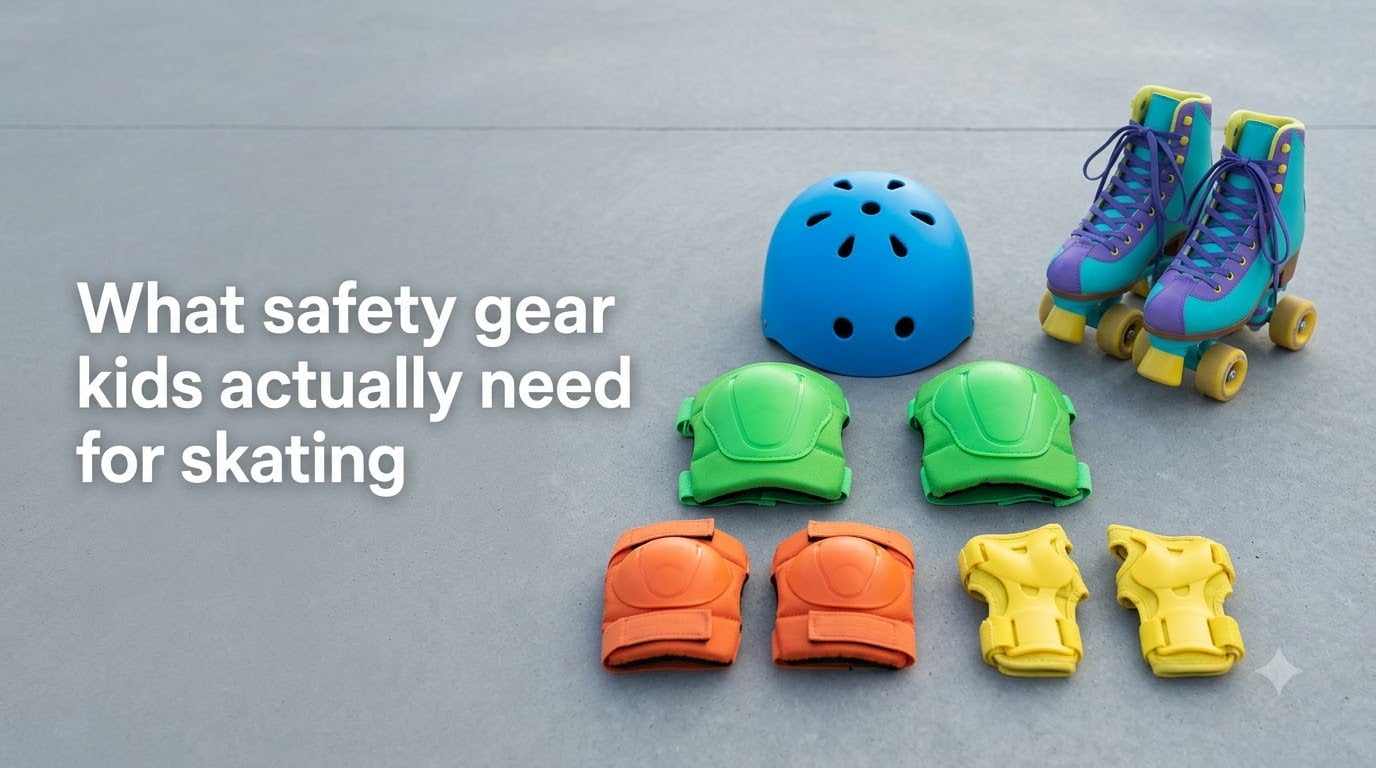
When my daughter first asked for roller skates, I assumed a helmet would be enough. Then I spent an afternoon at our local rink watching kids wipe out, and I realized I had a lot to learn about what safety gear kids actually need for skating. The difference between a scraped knee and a fractured wrist often comes down to four simple pieces of equipment worn correctly.
Skating is one of the most physically rewarding activities you can give a child, but it carries real risks. Every year, more than 50,000 children under 15 end up in U.S. emergency rooms from skating injuries, and most of those incidents involve the head, wrists, or knees. The good news is that proper protective gear prevents the majority of serious injuries.
In this guide, I’ll walk you through the four essential pieces of safety gear kids need for skating, how to choose the right protection for their age, and how to get them to actually wear it. Whether your child is rolling through the neighborhood on roller skates, hitting the skatepark on a board, or trying electric roller skates for the first time, this breakdown applies to all of them.
Table of Contents
Helmet: The Non-Negotiable Piece of Safety Gear Kids Need for Skating
If your child wears only one piece of safety gear, make it a helmet. Head injuries are the most serious risk in any skating activity, and a quality helmet reduces the risk of traumatic brain injury by up to 60%. No other piece of equipment offers that level of protection.
A skate helmet is not the same as the bike helmet sitting in your garage. Skate helmets are designed for multiple low-to-medium impacts, which matches the reality of skating where falls happen often but usually at moderate speeds. Bike helmets, by contrast, are engineered for a single high-impact crash.
What Makes a Skate Helmet Different from a Bike Helmet
Skate helmets typically have a rounded, lower-profile shape without the visor found on many bike helmets. They use denser EPS foam that can absorb repeated smaller hits without cracking apart. The chin strap is usually a thinner, more flexible style to allow the head to rotate during falls, rather than the rigid straps on bike helmets.
For multi-sport helmets (those approved for both biking and skating), look for dual certification stickers showing both CPSC and ASTM F1447 compliance. These work well for kids who switch between activities.
How to Fit a Kid’s Skate Helmet Properly
A helmet only protects if it sits on the head correctly. Here’s the fitting process I use with every parent I help:
- Position: The helmet should sit level on the head, covering the forehead about two finger-widths above the eyebrows. It should not tilt back or to the side.
- Side straps: Form a “V” shape just below each ear. Adjust until the straps are snug but comfortable.
- Chin strap: Buckle it and allow only one finger’s width between the strap and the chin. If you can fit more, it’s too loose.
- The shake test: With the buckle fastened, have your child shake their head side to side and up and down. The helmet should not shift or slide.
If the helmet rocks back and forth, the chin strap needs tightening. If it slides side to side, the side straps need adjustment or the helmet is the wrong size.
When to Replace Your Child’s Helmet
Replace a kids skating helmet immediately after any significant impact, even if you cannot see damage. The EPS foam compresses on impact and loses protective ability. Most manufacturers recommend replacing helmets every 5 years regardless of crashes, because the foam and plastic degrade over time.
Watch for these warning signs: cracked shell, crushed or dented foam, frayed straps, or a helmet that no longer fits because your child has outgrown it. A helmet that wiggles or sits too high on the forehead is no longer offering proper protection.
Knee Pads: Protecting the Most Common Impact Point
When kids fall while skating, their knees hit the ground first about 70% of the time. It’s an instinctive reflex, and it makes knee pads the second most important piece of safety gear kids need for skating. Without them, even a small fall on pavement can mean road rash, deep bruising, or a patellar fracture.
Beyond impact protection, knee pads give beginners the confidence to try new movements. My son spent weeks refusing to practice turning until I convinced him his knee pads would let him fall safely. He fell a dozen times that afternoon and bounced right back up.
Why Knees Take the Hardest Hits
The knee is a complex joint that doesn’t flex outward the way an ankle does. When a child loses balance, the knee tends to land flat against the surface with the full weight of the body behind it. A quality knee pad distributes that force across a wider area and absorbs the shock before it reaches the kneecap.
Look for knee pads that wrap around the knee fully, with a hard cap on the front and padding around the sides. The pad should stay in place during movement, which means adjustable straps are essential for growing kids.
Hard-Shell vs Soft-Shell Knee Pads
Hard-shell knee pads have a rigid plastic cap that slides across the ground during falls, reducing friction and preventing the pad from catching and twisting the knee. Soft-shell pads use thick foam that compresses on impact but offers less abrasion resistance.
For beginners and skatepark riders, hard-shell is the safer choice. The sliding action prevents the pad from gripping the surface and causing the knee to twist. For casual cruising on smooth surfaces, soft-shell offers more comfort and flexibility.
Elbow Pads: Joint Protection That Often Gets Overlooked
Elbow pads are the piece of safety gear most parents forget to buy. They look optional, and kids often assume their elbows are tough enough to handle a fall. But the elbow joint is one of the most fragile parts of a child’s body. A hard fall on an unprotected elbow can mean a fracture that requires a cast and weeks of recovery.
Elbow pads work by absorbing the impact before it reaches the olecranon, the bony point at the back of the elbow. They also prevent the joint from hyperextending during awkward falls.
Why Elbow Pads Matter More Than Kids Realize
When a child falls backward, the natural reaction is to extend the arms and break the fall with the hands. But if the hands slip or the fall is faster than the reaction, the elbows take the brunt. Without elbow pads, the result is often a deep scrape, a bruise that lasts for weeks, or in serious cases, a dislocation.
I learned this lesson watching a friend’s daughter slide down a small ramp without elbow pads. The fall looked harmless until we saw the bleeding gash on her elbow that needed five stitches. A $20 pair of elbow pads would have prevented the entire injury.
Sizing and Fit Tips for Elbow Pads
Elbow pads should cover from the upper forearm to the lower bicep, with the hard cap centered directly over the point of the elbow. The straps need to be tight enough that the pad doesn’t slide down during movement, but not so tight that they cut off circulation.
A good test: have your child bend their arm fully. The pad should stay in place and not pinch the skin at the back of the elbow. If it pinches or shifts, try the next size up or a different brand.
Wrist Guards: The Gear Most Parents Forget
Here’s a statistic that surprises most parents: wrist fractures are the most common skating injury in children, accounting for roughly 30% of all emergency room visits. They’re more common than head injuries, knee injuries, and elbow injuries combined. Yet wrist guards remain the least-used piece of safety gear kids need for skating.
The reason is simple. When a child falls forward, the instinct is to put the hands out to catch themselves. That instinct protects the face and head but transfers all the impact energy directly into the wrists. The result is often a distal radius fracture, a broken bone that requires a cast for four to six weeks.
Why Wrist Injuries Are So Common in Skating
Children’s bones are still developing, with growth plates that are more vulnerable than adult bone. A fall that would bruise an adult’s wrist can fracture a child’s. Combined with the natural protective instinct to extend the arms, this creates a perfect storm for wrist injuries.
Wrist guards work by stiffening the wrist joint and distributing the impact force across the palm and forearm. This prevents the wrist from bending backward beyond its normal range, which is the motion that causes most fractures.
How Wrist Guards Actually Work
A quality wrist guard has a rigid plastic splint that runs along the palm side of the wrist, supported by padding on both sides. The splint limits backward bending while still allowing the child to grip and steer. Most wrist guards also have a palm pad that absorbs the initial impact.
Look for wrist guards with adjustable straps at the wrist and forearm. The splint should sit directly behind the palm, with the rigid edge running parallel to the wrist bones. If the splint sits too far up the forearm, it won’t protect during a forward fall.
Safety Certifications Explained: CPSC, ASTM F1492, and What They Mean
Walk into any sporting goods store and you’ll see helmets and pads with various certification stickers. Understanding what those stickers mean helps you make sure the safety gear kids need for skating actually meets safety standards.
Two certifications matter most for skating gear: CPSC and ASTM F1492. Neither is required by law in every state, but both represent the industry baseline for impact protection.
CPSC Certification: The Bike Helmet Standard
CPSC stands for the Consumer Product Safety Commission, a U.S. federal agency that sets safety standards for consumer products. A CPSC-certified helmet has passed standardized drop tests measuring impact absorption.
For skate helmets, CPSC certification is the minimum bar. Any helmet you buy for your child should have this certification, regardless of brand or price. If a helmet lacks CPSC certification, do not buy it, no matter how cool it looks.
ASTM F1492: The Skateboard-Specific Standard
ASTM F1492 is a standard developed specifically for skateboard helmets. It requires additional testing for multiple impacts and improved coverage. Helmets with both CPSC and ASTM F1492 certification offer the best protection for skating activities.
For pads and wrist guards, look for ASTM standards specific to each piece. Wrist guards should meet ASTM F2541, and pads should meet relevant impact protection standards. These certifications are usually printed on the packaging or the gear itself.
How to Spot Certified Gear
Certified gear will have a sticker or printed label showing the certification mark. Inside helmets, look for a sewn-in label. On pads, the certification is usually printed on the inside of the strap or the back of the hard shell.
If you can’t find a certification label, that’s a red flag. Reputable manufacturers display their certifications prominently because the testing is expensive and they want consumers to know about it.
Age-Specific Safety Gear Recommendations
Not all kids need the same protection. A toddler on roller skates has different needs than a tween hitting the skatepark. Here’s how to match the safety gear kids need for skating to their developmental stage.
Toddlers and Preschoolers (Ages 3-5)
Children under 5 are still developing balance and coordination, which makes falls more frequent and less predictable. They also have larger heads relative to their bodies, which means helmets need to be sized carefully.
For this age group, I recommend a full set of gear including helmet, knee pads, elbow pads, and wrist guards, even for casual cruising. Look for pads with extra padding, adjustable straps that can grow with the child, and lightweight materials that won’t tire out small muscles.
Avoid wheeled shoes or skateboards for this age group. The American Academy of Pediatrics recommends children under 5 should not use skateboards due to developmental risks. Roller skates with adjustable widths and inline skates designed for beginners are safer choices.
Early Elementary (Ages 6-9)
Kids in this age range are usually enrolled in lessons or learning from older siblings. They have better balance than toddlers but still lack the experience to recover from falls smoothly. This is the age group most likely to suffer wrist fractures.
Full gear remains essential for this age. Hard-shell pads work well because this group spends more time at higher speeds and may start attempting ramps or tricks. Look for gear with growth-adjustable features because kids at this age outgrow equipment every 12 to 18 months.
Older Kids and Tweens (Ages 10-14)
Older kids often resist wearing full safety gear because they see it as childish or restrictive. This is the age group where style and peer perception start to matter as much as function.
For this group, focus on the helmet and wrist guards as non-negotiable. Knee and elbow pads can be flexible based on the activity. A kid cruising the neighborhood needs different protection than a kid hitting the skatepark every weekend.
Let older kids participate in choosing their gear. Brands like Triple 8, Pro-Tec, and TSG make protective gear in styles and colors that look more like athletic equipment than children’s toys.
Hard-Shell vs Soft-Shell Protection: Which Is Better for Kids?
One of the most common questions parents ask is whether hard-shell or soft-shell pads are better for their child. The answer depends on the skating activity, the child’s experience level, and personal preference.
Here’s how to think through the choice:
Choose hard-shell protection when:
- Your child is a beginner learning to fall safely
- The skating takes place at skateparks, ramps, or downhill paths
- Speed is involved (electric roller skates, aggressive inline skating)
- Your child tends to fall on rough surfaces like concrete or asphalt
Choose soft-shell protection when:
- The skating is casual cruising on smooth paths or indoor rinks
- Your child finds hard-shell pads uncomfortable or restrictive
- The activity is low-impact recreational skating
- Comfort and flexibility are higher priorities than maximum protection
For most kids learning to skate, hard-shell offers better protection. The sliding action prevents the pad from catching on the surface during a fall, which reduces the risk of the pad twisting the joint. Soft-shell pads can grip the surface and cause the joint to bend in unnatural directions during a fall.
How to Fit Each Piece of Safety Gear Correctly
Buying the right gear is only half the battle. Improperly fitted safety gear offers reduced protection and can even cause injuries of its own. Here’s how to make sure every piece fits correctly.
The Two-Finger Rule for Straps
For helmet chin straps and pad straps, the two-finger rule is the standard test. After buckling or fastening the strap, you should be able to slide exactly two fingers between the strap and the body. If you can fit more than two fingers, the strap is too loose. If you can’t fit two fingers, the strap is too tight.
This rule works for helmets, knee pads, elbow pads, and wrist guards. Check the fit every few months because kids grow quickly, and a strap that fit in spring may be too tight or too loose by fall.
Common Fitting Mistakes Parents Make
The most common mistake I see is parents buying gear one size too large so the child can grow into it. Oversized gear shifts during use, leaving the protected area exposed during falls. A helmet that slides forward leaves the back of the head unprotected. A knee pad that drops below the kneecap leaves the joint exposed.
The second most common mistake is buying gear with too many adjustable features. More adjustments mean more chances for something to be wrong. For beginners, simple elastic straps and Velcro closures work best because they’re easy to put on and adjust correctly.
The third mistake is assuming that the gear fits because the child says it feels fine. Kids often don’t know how protective gear should feel. Always do the shake test and the two-finger check yourself before letting your child head out.
Getting Kids to Actually Wear Their Safety Gear
Knowing what safety gear kids need for skating and getting them to wear it are two different challenges. Forum discussions are full of parents asking how to convince resistant kids to put on their pads. Here are the strategies that actually work.
Why Kids Resist Safety Gear
Kids resist safety gear for predictable reasons. The gear feels bulky. It restricts movement. Their friends don’t wear it. It looks childish. It takes time to put on. These aren’t excuses, they’re real concerns from the child’s perspective.
The most common resistance comes from the helmet. Children between 6 and 10 are especially sensitive to how helmets look and feel. Many will claim helmets give them headaches or block their vision, when the real issue is the social stigma.
Practical Strategies That Work
Let kids choose their own gear. Take them to the store or shop online together. Let them pick the colors, the designs, the brands. When a child chooses their own helmet, they’re far more likely to wear it without a fight.
Set clear rules before the skating starts. “No helmet, no skating” is a non-negotiable boundary that removes the negotiation each time. Once the rule is established, kids stop asking because they know the answer.
Connect gear to goals. If your child wants to learn a new trick or skate at a faster pace, explain that the gear is what makes those goals possible. Safety gear isn’t a restriction on fun, it’s the ticket to more advanced skating.
Lead by example. If you skate with your child, wear your own helmet and pads. Kids imitate what they see, and a parent who takes safety seriously sends a powerful message.
Make it routine. Put the gear on before leaving the house so it becomes part of the skating experience. Don’t make putting on pads optional or something to debate each time. The faster it becomes a habit, the less resistance you’ll face.
Gear Maintenance and When to Replace It
Safety gear kids need for skating isn’t a one-time purchase. Helmets expire, pads wear out, and kids outgrow equipment. Knowing when to replace gear keeps the protection effective.
Signs Your Child’s Gear Needs Replacing
Replace any piece of gear that has taken a significant impact. Pads can crack, foam can compress, and straps can stretch. A helmet that has absorbed a major fall should be retired immediately, even if it looks fine.
Replace gear that no longer fits. A helmet that sits too high on the forehead, knee pads that slide down the leg, or wrist guards that shift during movement are no longer offering proper protection. Don’t try to make do with gear that has become too small.
Replace gear with visible damage. Cracked shells, torn straps, exposed foam, and frayed stitching are all signs the gear has reached the end of its useful life. Patches and repairs are not effective for safety equipment.
Storage Tips to Extend Gear Life
Store gear in a cool, dry place away from direct sunlight. UV rays break down the foam and plastic in helmets and pads, reducing their protective ability over time. A gear bag hung in a closet or stored in a garage works well.
Clean gear regularly by wiping it down with a damp cloth. For pads with removable liners, wash the liners according to the manufacturer’s instructions. Bacteria and sweat can break down materials faster than wear and tear.
Keep gear out of the car trunk during summer. Temperatures inside a car can exceed 140 degrees, which damages foam and warps plastic. Bring gear inside after every session.
The Complete Safety Gear Checklist for Skating Kids
Here’s the quick-reference checklist of everything we’ve covered. Print this out or save it on your phone for the next trip to buy skating gear:
Essential gear for every child who skates:
- Helmet certified to CPSC or ASTM F1447 standards
- Knee pads with hard shell or soft shell based on activity
- Elbow pads covering the full joint
- Wrist guards with rigid palm splint
Before each session, verify:
- Helmet sits level, two fingers above eyebrows
- Chin strap fits one finger’s width from chin
- All pad straps pass the two-finger tightness test
- Gear shows no visible damage or excessive wear
- All buckles and straps are properly fastened
Replace gear when:
- Any piece has taken a significant impact
- Gear no longer fits correctly
- Visible damage to shell, foam, or straps appears
- Helmet reaches 5 years of age
- Pads show compression that doesn’t rebound
Frequently Asked Questions About Kids Skating Safety Gear
What is the most important safety gear for kids who skate?
A properly fitted helmet is the most important piece of safety gear. Head injuries are the most serious risk in skating, and a CPSC-certified helmet reduces the risk of traumatic brain injury by up to 60%. Every other piece of protective gear is secondary to making sure your child wears a helmet on every session.
What does my kid actually need for skating?
Your child needs four pieces of safety gear for skating: a helmet, knee pads, elbow pads, and wrist guards. The helmet should be CPSC or ASTM F1447 certified. Knee and elbow pads should have hard shells for beginners or soft shells for casual cruising. Wrist guards should have a rigid palm splint to prevent fractures during forward falls.
Should kids wear helmets when roller skating?
Yes, kids should always wear helmets when roller skating. Roller skating involves frequent falls, and head injuries can be severe even at low speeds. A properly fitted helmet certified to CPSC or ASTM F1447 standards is the most important piece of safety gear kids need for skating, regardless of where or how fast they skate.
How do I know if my child’s helmet fits properly?
A helmet fits properly when it sits level on the head, about two finger-widths above the eyebrows. The side straps should form a V shape below each ear, and the chin strap should allow only one finger’s width between the strap and chin. Have your child shake their head side to side and up and down; the helmet should not shift or slide in any direction.
How often should you replace a kids skating helmet?
Replace a kids skating helmet immediately after any significant impact, even if no damage is visible. The EPS foam compresses on impact and loses protective ability. Replace helmets every 5 years regardless of crashes because the foam and plastic degrade over time. Replace sooner if the helmet no longer fits or shows visible damage.
Do kids really need wrist guards for skating?
Yes, kids need wrist guards for skating. Wrist fractures are the most common skating injury in children, accounting for about 30% of emergency room visits. Children instinctively put their hands out to break falls, which transfers impact directly into the wrists. Wrist guards with rigid palm splints prevent the wrist from bending backward and fracturing.
Putting It All Together
Knowing what safety gear kids need for skating comes down to four essential pieces: a properly fitted helmet, knee pads, elbow pads, and wrist guards. Each piece addresses a specific injury risk, and together they create a complete protection system that lets your child skate with confidence.
Start with the helmet as your top priority, then add the other pieces as your child’s skills develop. Make sure each piece fits correctly using the two-finger rule and the shake test. Replace gear when it no longer fits, shows damage, or has absorbed a significant impact.
Most importantly, make wearing safety gear a non-negotiable part of every skating session. When kids understand that gear is the ticket to more advanced skating, not a restriction on fun, the resistance fades. Equip your child properly today, and you’ll spend less time worrying and more time watching them progress.