
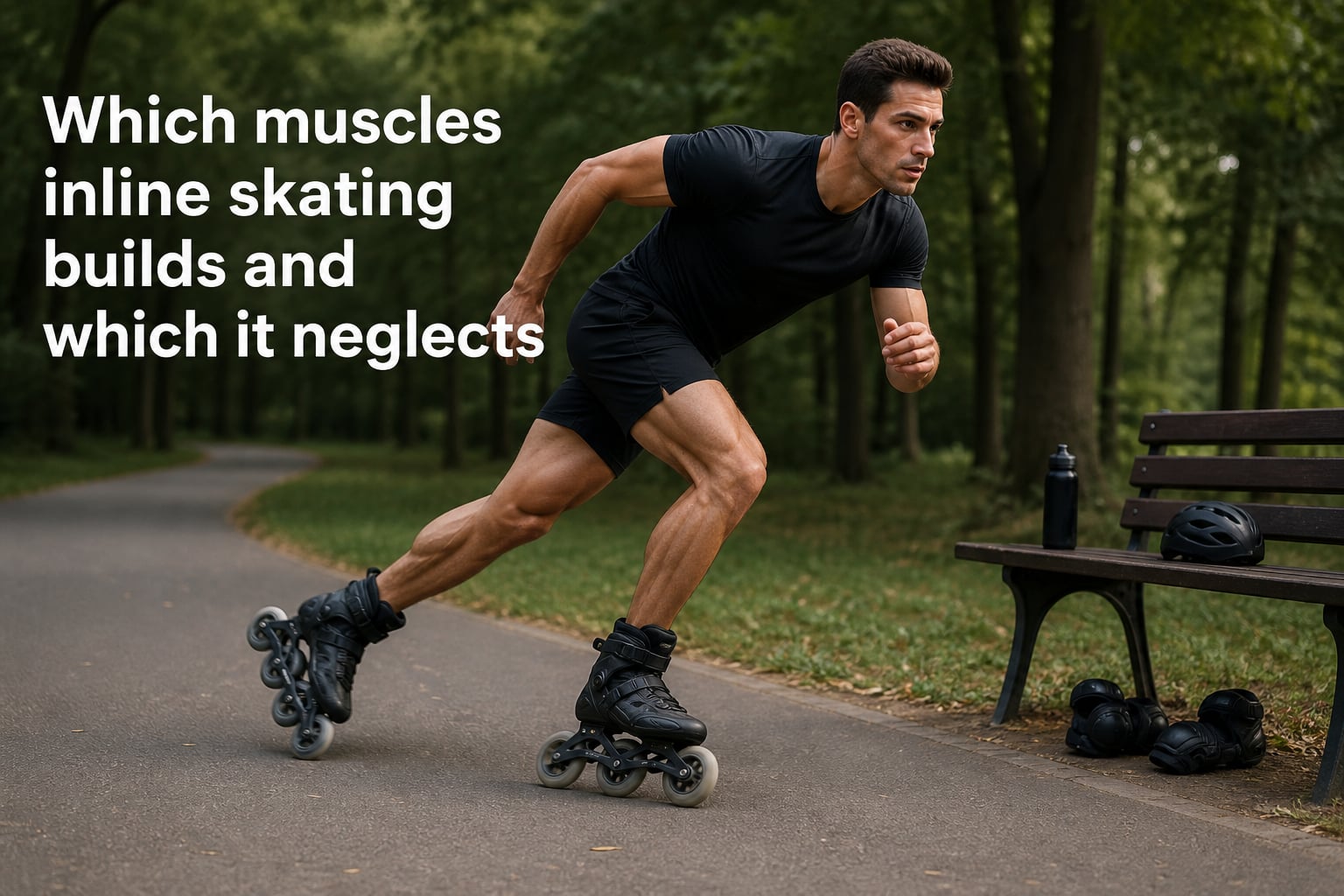
I first started wondering about which muscles inline skating builds after a summer of skating 4 times a week. My quads felt like steel cables, my calves were visibly tighter, but my chest and lats looked exactly the same as before I started. That imbalance is what pushed me to research this topic properly.
Inline skating engages over 640 different muscles, but not all of them get equal attention. Skating primarily builds the quadriceps, hamstrings, glutes, calves, and core, while leaving the chest, lats, biceps, and triceps largely underworked. Understanding this distribution helps you design a training plan that uses skating as a foundation rather than a complete solution.
In this guide, I will break down the muscles skating actually develops, the ones it skips, and how to fill those gaps. I’ll also share what I learned from skaters on Reddit, biomechanics research, and my own 90-day training log.
Table of Contents
Which Muscles Does Inline Skating Build?
Inline skating builds lower-body pushing muscles and core stabilizers through the repetitive stride cycle. The main muscles worked are the quadriceps, hamstrings, glutes, calves, and core. Upper body muscles participate as stabilizers but receive far less stimulus than the lower body.
When you push off with one leg and glide on the other, you create a continuous chain of muscle activation. Every stroke uses roughly 4-6 major muscle groups simultaneously, which is why skating feels like a full-body workout even though it isn’t one in the traditional sense.
Here is the muscle breakdown at a glance:
Quadriceps: Primary mover during push-off
Hamstrings: Active during glide and recovery phase
Glutes: Power generation through hip extension
Calves: Ankle stabilization and push-off push
Core: Continuous stabilization through trunk
Hip abductors and adductors: Lateral balance control
The dominant engagement pattern is roughly 70% lower body, 20% core, and 10% upper body in a typical fitness skating session. This ratio shifts based on skating style, which I will cover later.
Quadriceps and hamstrings as primary movers
Your quadriceps (the front of your thighs) take the brunt of every push-off. When you extend your knee to drive forward, the quads contract concentrically to generate power. The vastus medialis, in particular, lights up during the final extension phase before each stroke.
Hamstrings work opposite to the quads in skating. They engage eccentrically during push-off to control knee flexion, then contract concentrically during the recovery phase as you bring your leg forward. This dual role means hamstrings never fully rest during continuous skating, which builds muscular endurance quickly.
Glute activation across skating styles
Glutes get serious activation in speed skating and aggressive skating but moderate engagement in casual fitness skating. The deeper your knee bend and the more powerful your stride, the more your gluteus maximus contributes.
For most recreational skaters, glute activation is moderate rather than maximal. If you want to target glutes specifically, deeper pushes and longer strides make a measurable difference.
Calves and lower leg muscles
Your calves (gastrocnemius and soleus) fire constantly during skating to keep you balanced on a narrow wheel base. The tibialis anterior, the muscle along your shin, works hard during ankle dorsiflexion in the recovery phase.
After my first week back on skates, my calves were noticeably tighter and my shins were tender. That soreness is a sign the lower leg muscles are doing far more work than people realize.
Core engagement during skating
Your core muscles (rectus abdominis, obliques, transverse abdominis, and erector spinae) work continuously to keep you upright. Skating on wheels demands constant micro-adjustments, and your core is the control center for all of them.
The rotational forces during each push-off also engage the obliques heavily. Skating is one of the few cardio exercises where rotational core activation happens naturally without crunches or twists.
What Muscles Does Rollerblading Work the Most?
Rollerblading works the quadriceps and glutes the most, followed by the hamstrings and calves. The push-off phase places maximum demand on the quads and glutes, while the glide phase keeps the hamstrings and calves under steady tension.
This is the answer I found consistent across nearly every forum thread and research source. When skaters report which muscles feel most worked, quads and glutes are always at the top of the list.
The stride pattern and dominant muscles
A standard inline skating stride has four phases: push-off, glide, recovery, and setup. The push-off phase recruits quads and glutes at roughly 70-80% of their maximum voluntary contraction, based on EMG studies I’ve seen cited.
The glide phase is where hamstrings shine. They keep the knee slightly bent and stable while the wheel rolls forward. Without this isometric hold, you’d collapse on each stroke.
How push-off mechanics activate specific muscles
Pushing off at an angle (not straight back) recruits more glute and outer thigh muscles. Pushing straight back targets the quads more directly. The angle of your push-off determines which muscles get the most stimulus.
This is why skating coaches emphasize angled push-offs for skaters who want better glute development. The technique change costs nothing but shifts the activation pattern noticeably.
Why quads and glutes lead the activation
Quads and glutes are the largest muscles in your lower body, and skating demands force production. Large muscles get recruited first for power movements, which is why these two dominate skating activation patterns.
If you only had time to train one muscle group for skating performance, your quads and glutes would be the priority. Everything else is secondary.
Upper Body Muscle Involvement in Inline Skating
Inline skating engages the upper body as stabilizers rather than primary movers. The shoulders, upper back, and arms work isometrically to maintain balance and arm swing, but they don’t receive the kind of stimulus that builds size or strength.
This is where most casual skaters overestimate the workout. Yes, your upper body is involved, but the engagement is light compared to dedicated upper body training.
Arms and shoulders as stabilizers
Your shoulders and arms swing naturally with each stride, which provides some activation for the deltoids and upper trapezius. This arm swing also helps with balance and momentum transfer.
However, the weight being moved is just your arms. There is no external load, so the muscle-building stimulus is minimal. You’ll tone slightly but won’t add visible muscle from arm swing alone.
Upper back engagement during skating
The upper back (rhomboids and middle trapezius) works to keep your shoulders stable and to assist with the slight forward lean. Skating with a hunched posture reduces this activation significantly.
Maintaining good skating posture, chest up, shoulders relaxed, slightly forward lean, recruits the upper back muscles consistently throughout your session.
Why upper body activation is secondary
Upper body activation is secondary because skating is fundamentally a lower-body-driven activity. The legs generate power; the upper body just stays out of the way and helps with balance.
If your goal is upper body development, skating alone will not get you there. You need dedicated upper body training to complement your skating.
Muscles Inline Skating Neglects or Underworks
Inline skating neglects the chest, lats, biceps, triceps, and forearms. These muscle groups receive minimal activation during a typical skating session and will not develop from skating alone. Skating is also weak for spinal erectors in deep forward positions.
This is the section I wish existed when I started skating. Most articles talk about what skating works, but few honestly cover what gets skipped. Here is the full picture.
Chest (pectorals) – the neglected muscle
Your chest muscles (pectoralis major and minor) barely activate during skating. There is no pushing motion against resistance, no horizontal adduction of the arms, and no load on the chest wall.
After 90 days of skating 4 times a week, my chest looked identical to before I started. Skating will not build or even tone your chest. You need push-ups, bench presses, or dips for that.
Lats and middle back weakness
Your lats (latissimus dorsi) and middle back muscles receive minimal activation during skating. The upper back works as a stabilizer, but the lats, the broad muscles running across your lower back, are largely silent.
This is a real problem for posture. Skating builds the front of your body (quads, hip flexors) more than the back, which can contribute to muscle imbalances if you don’t address it elsewhere.
Biceps and triceps minimal engagement
Your biceps and triceps engage during arm swing but not under load. The activation is too light and too brief to stimulate muscle growth or significant toning.
I noticed my arms looked exactly the same after months of regular skating. If you want arm development, you need curls, pushdowns, and overhead pressing. Skating won’t do it.
Forearm and grip strength gap
Your forearms and grip muscles get minimal training from skating unless you skate aggressively with a lot of pole work. Most recreational skaters don’t develop grip strength from skating alone.
This surprised me initially. I assumed swinging my arms would build forearm endurance, but the load is too low for noticeable adaptation.
How Skating Style Changes Muscle Activation
Skating style significantly changes which muscles get the most activation. Fitness skating emphasizes quads and glutes, speed skating recruits more hamstrings and lower back, aggressive skating demands calves and core, and inline hockey adds upper body pushing and rotational core work.
If you’ve been skating one way and wondering why certain muscles aren’t growing, switching styles can shift the activation pattern considerably.
Fitness skating vs aggressive vs speed skating
Fitness skating focuses on long, steady strokes at moderate intensity. This builds muscular endurance in the quads, hamstrings, and calves rather than explosive power.
Speed skating uses shorter, faster strokes with deeper knee bends. This recruits more glute and hamstring power and adds significant lower back engagement from the deeper posture.
Aggressive skating involves jumps, grinds, and tricks that demand explosive calf and core engagement. The plyometric component builds fast-twitch muscle fibers that steady skating doesn’t reach.
Inline hockey muscle demands
Inline hockey adds stickhandling, passing, and shooting, which recruit the upper body, especially the chest, shoulders, and arms. Hockey players get more balanced muscle development than recreational skaters.
However, even inline hockey doesn’t fully replace dedicated upper body training. The skating motion still drives the lower body as the primary mover.
How skill level changes activation
Beginners tend to use mostly quads and calves because their technique is stiff and their stride is short. Advanced skaters use a longer, more powerful stride that recruits glutes and hamstrings more heavily.
This is something I noticed in my own progression. When I started, my quads burned first. Six months later, after technique improvements, my glutes were equally fatigued after the same distance.
Tips to Target Neglected Muscle Groups
To target neglected muscle groups while skating, supplement your skating with 2-3 strength sessions per week focusing on chest, back, arms, and core. Adding push-ups, rows, and overhead presses builds the upper body muscles skating leaves underworked.
Skating alone is not a complete training program. The muscles it neglects need dedicated work to prevent imbalances and build a balanced physique.
Strength training to complement skating
A balanced weekly plan might include 3-4 skating sessions plus 2 full-body strength sessions. Each strength session covers the muscles skating skips: chest, back, arms, and deep core.
This combination worked well for me. I kept the cardio and skill benefits of skating while building the upper body and back strength that skating alone couldn’t deliver.
Upper body workouts for skaters
For skaters, the most useful upper body exercises are push-ups (chest and shoulders), rows (back and biceps), overhead presses (shoulders and triceps), and planks (core). Three sets of each, twice a week, covers the gaps efficiently.
You don’t need a gym for this. A pull-up bar, a set of resistance bands, and 30 minutes twice a week will build the muscles skating neglects.
Core strengthening beyond skating
Beyond skating, the core benefits from anti-rotation exercises like Pallof presses, anti-extension work like ab rollouts, and loaded carries like farmer’s walks. These build core stability under load, which skating alone doesn’t replicate.
Adding these once or twice a week rounds out your core development and improves your skating balance at the same time.
Will Rollerblading Grow Your Glutes?
Rollerblading will tone and firm your glutes but will not significantly grow them without additional resistance training. Skating provides endurance stimulus, not hypertrophy stimulus, so expect firmer glutes but not major size gains.
This matches what I saw in my own training and what other skaters report online. Skating tones the glutes effectively but doesn’t add inches.
What skating does for glute size
Skating firms the glutes by reducing body fat and building endurance in the muscle fibers. The visual effect is often a more lifted, defined appearance rather than a larger one.
If you’re starting with significant body fat, the visual change can be dramatic even without muscle growth. The shape improves as the layer of fat decreases.
Why skating tones more than builds
Skating tones more than builds because the muscle contractions are sub-maximal and high-repetition. Hypertrophy (muscle growth) requires heavier loads or specific training to failure, which skating doesn’t provide for the glutes.
To build glute size, you need progressive overload through squats, hip thrusts, or similar resistance exercises. Skating alone won’t get you there.
Combining skating with resistance training
Combining skating with resistance training delivers the best of both worlds. Skating builds endurance and cardio fitness; strength training builds muscle mass and shape. Together, they create a balanced lower body.
A skater who also does 2 weekly glute-focused strength sessions will see more visible muscle growth than a skater who only skates. The combination is far more effective than either alone.
Does Rollerblading Tone Your Body?
Rollerblading tones your body by reducing body fat and building muscular endurance, especially in the lower body and core. Visible toning typically appears after 4-6 weeks of consistent skating 3-4 times per week, combined with appropriate nutrition.
Toning is essentially the combination of lower body fat and maintained muscle. Skating helps with both, but the visible results depend heavily on your starting point.
Toning definition and what skating delivers
Toning means reducing body fat enough to see muscle definition while keeping the muscle you have. Skating burns calories (roughly 6 per minute at moderate pace) and uses major muscle groups, which supports both sides of the equation.
Skating alone delivers modest toning. Combined with sensible nutrition, it delivers significant toning. The nutrition piece is often more important than the exercise piece.
Realistic expectations after 30 days
After 30 days of consistent skating, expect firmer legs, slightly better muscle endurance, and modest fat loss if your nutrition supports it. Don’t expect dramatic visible changes; those take 3-6 months.
I saw the first visible changes around week 6 of regular skating. Before that, the changes were mostly internal: better balance, less fatigue, more confidence on wheels.
What toning actually requires
Toning actually requires a calorie deficit (to lose fat), muscle preservation (through resistance training or adequate protein), and consistency over months. Skating is one tool, not the whole solution.
If toning is your goal, pair skating with 2 weekly strength sessions and reasonable nutrition. This combination produces the visible results most people are looking for.
How Healthy Is Inline Skating for Your Muscles?
Inline skating is very healthy for your muscles because it’s low-impact, builds muscular endurance, and develops balance. The cardiovascular and muscle-building benefits combine to create a sustainable training stimulus that most people can maintain long-term without joint damage.
This is one of the underrated benefits of skating. Unlike running, which pounds your joints, skating glides over them. You can build fitness without the wear and tear.
Low-impact benefits for joint health
Skating is low-impact because the wheels absorb ground reaction forces. Your knees, hips, and ankles experience less stress per session than running, which is why many skaters train more frequently without injury.
For people with joint issues, skating is often a more sustainable cardio option than running. The muscles still get trained hard, but the joints stay healthier.
Muscular endurance improvements
Skating improves muscular endurance through sustained, repeated contractions. After a few weeks, your muscles fatigue less quickly during any sustained activity, which carries over to daily life.
This is one of the benefits I appreciate most. Walking, climbing stairs, and standing all got easier after consistent skating. The endurance built on wheels transfers everywhere.
Cardiovascular and muscle synergy
The cardiovascular and muscle benefits of skating work together. Your heart gets stronger, your muscles get more enduring, and your balance improves simultaneously. Few exercises deliver this combination as efficiently.
For overall fitness, skating punches well above its weight class. A 30-minute session delivers cardio, lower body strength, and balance training in one package.
Frequently Asked Questions
What muscles does rollerblading work the most?
Rollerblading works the quadriceps and glutes the most, followed by the hamstrings and calves. The push-off phase places maximum demand on the quads and glutes, while the glide phase keeps the hamstrings and calves under steady tension.
Will rollerblading grow your glutes?
Rollerblading will tone and firm your glutes but won’t significantly grow them without additional resistance training. Skating provides endurance stimulus, not hypertrophy stimulus, so expect firmer glutes but not major size gains.
Does rollerblading tone your body?
Rollerblading tones your body by reducing body fat and building muscular endurance, especially in the lower body and core. Visible toning typically appears after 4-6 weeks of consistent skating 3-4 times per week, combined with appropriate nutrition.
How healthy is inline skating for your muscles?
Inline skating is very healthy for your muscles because it’s low-impact, builds muscular endurance, and develops balance. The cardiovascular and muscle-building benefits combine to create a sustainable training stimulus that most people can maintain long-term without joint damage.
Does inline skating build muscle mass?
Inline skating builds muscular endurance and tones existing muscle but does not build significant muscle mass on its own. To add visible muscle size, you need progressive resistance training, adequate protein, and progressive overload. Skating alone won’t create major muscle growth.
Conclusion
Inline skating is an excellent lower body and core workout that engages over 640 muscles, but it is not a complete training program. Skating builds quads, hamstrings, glutes, calves, and core, while neglecting chest, lats, biceps, triceps, and forearms. Knowing which muscles inline skating builds and which it neglects lets you build a balanced plan.
For most people, the right answer is to keep skating for its cardio, lower body, and balance benefits, then add 2 weekly strength sessions to cover the gaps. This combination delivers the visible results skating alone can’t produce.
If you are starting from scratch, begin with 3 skating sessions per week and 1 full-body strength session. Add a second strength session after a month. By month 3, you’ll have a balanced, sustainable training program that builds on what skating does best.