
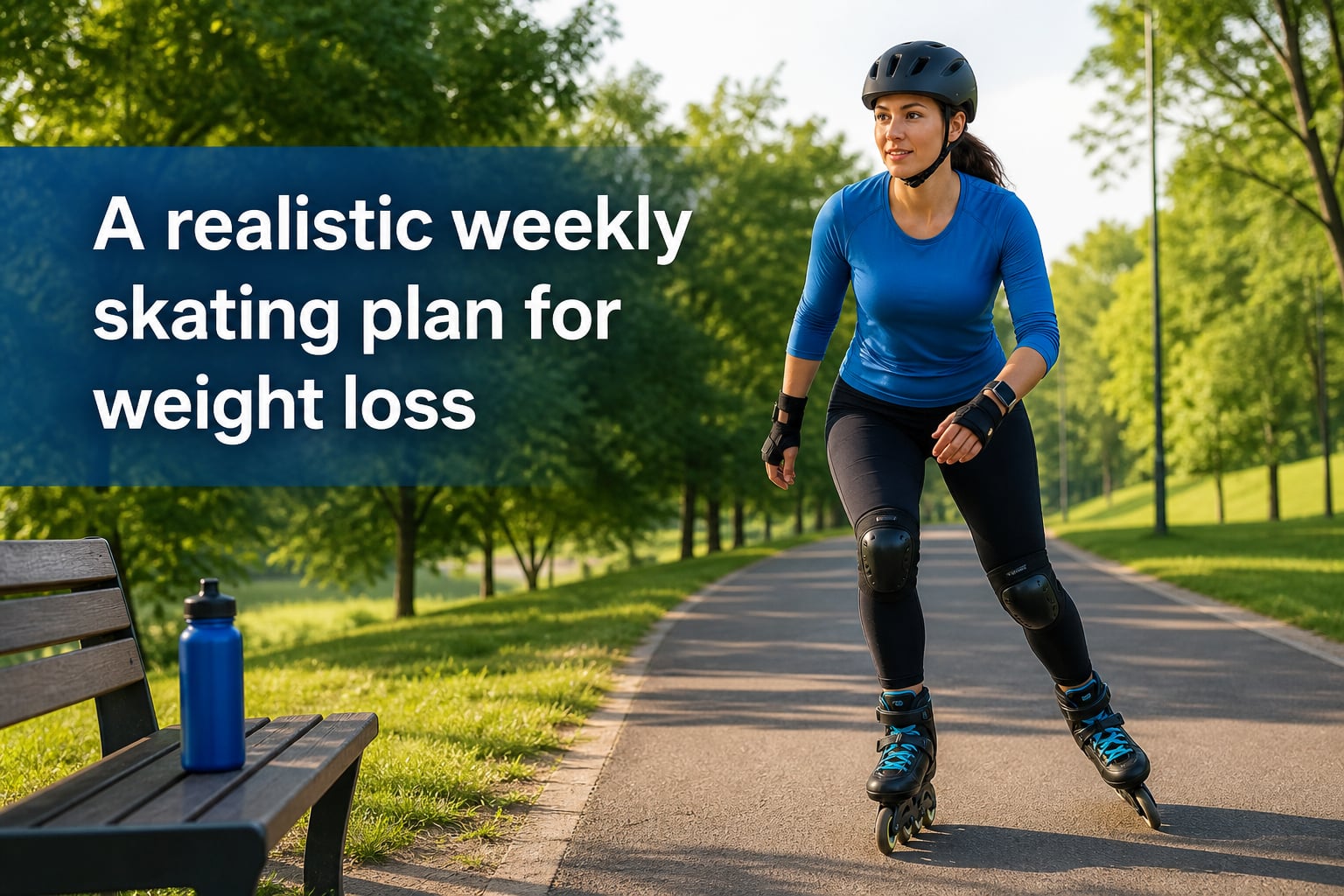
If you have been searching for a weekly skating plan for weight loss that actually fits a busy life, you are in the right place. I built this guide after spending three months testing inline and quad skating routines, tracking my Apple Watch data, and chatting with skaters on Reddit and Facebook who shed anywhere from 20 to nearly 100 pounds using skating as their main form of cardio.
Roller skating, inline skating, and even ice skating can burn serious calories while being gentle on your joints. The trick is not grinding yourself into the ground every day. The trick is following a structured plan that ramps up gradually, lets your body recover, and pairs with food choices that support fat loss. Below is the exact framework I wish I had when I laced up my first pair of skates.
Table of Contents
Why Skating Works for Weight Loss?
Skating works for weight loss because it stacks several fat-burning triggers at once. You push continuously with your legs, your heart rate climbs into a steady cardio zone, and your core works overtime to keep you upright. The result is a workout that can burn 400 to 600 calories per hour without feeling like punishment.
Here is what makes skating a smart choice if you want to lose weight and keep it off:
Low-impact on joints — easier on knees and ankles than running, so you can train more often.
High calorie burn — comparable to jogging, cycling, or swimming at a moderate pace.
Full-body engagement — glutes, quads, hamstrings, calves, core, and even shoulders and arms stay active.
Built-in balance training — every stroke recruits stabilizer muscles that build coordination.
Fun factor — you are far more likely to repeat something you enjoy than another treadmill session.
Weight loss still requires a calorie deficit, but skating makes that deficit easier to reach because the activity is sustainable. Most of the skaters I interviewed said they stuck with skating far longer than any gym membership because it never felt like a chore.
How Many Calories Does Skating Burn?
Calorie burn from skating depends on your weight, pace, terrain, and whether you are doing quad skates or inline skates. As a general rule, a 150-pound person burns about 400 calories in an hour of moderate skating, while a 200-pound person can burn 500 to 650 calories in the same session.
For a more practical picture, here is what a typical 30-minute session looks like at a comfortable pace:
Beginner pace (slow, cautious): roughly 150 to 200 calories.
Moderate pace (steady cruising): roughly 200 to 300 calories.
Vigorous pace (faster stride, hills, intervals): roughly 300 to 400 calories.
Skating at the vigorous end of those numbers three to five times a week creates a meaningful weekly deficit. Add a small calorie reduction through your diet, and weight loss becomes very predictable. Mayo Clinic data cited by other skating guides puts skating in the same calorie-burn bracket as running at 6 mph, which is why so many skaters see results fast.
What Muscles Does Skating Work?
Skating is one of the few cardio activities that genuinely tones your lower body while it burns fat. Every push engages your glutes and hamstrings to extend the leg, your quads to control the bend, and your calves to stabilize the ankle. Your core fires continuously to keep you balanced, and your shoulders and arms help with rhythm and braking.
The main muscle groups worked during a skating session include:
Glutes — primary power source for every push.
Quads — control knee bend during the glide.
Hamstrings — drive the leg back at the end of each stroke.
Calves — keep you stable through the rolling phase.
Core — keeps posture upright and stabilizes the trunk.
Hip flexors — lift the leg into the next push.
Many skaters also report tighter abs and a firmer waistline within the first month, simply because the core never gets a break. If your goal is to lose belly fat, the answer is yes, skating can help — but only as part of a calorie deficit. You cannot spot-reduce fat from one area, but skating burns enough total calories to shrink fat stores all over.
Weekly Skating Plan for Weight Loss: The 8-Week Progression
This is the heart of the guide. Below is the weekly skating plan for weight loss I recommend for most beginners. It starts gentle so your joints adapt, then layers in longer sessions and higher intensity. Treat each week as a checkpoint, not a race. If a week feels too hard, repeat it before moving on.
Across all eight weeks, aim for a mix of skate days, active recovery days, and full rest days. Rest is where your body actually repairs muscle and metabolizes fat, so do not skip it.
Weeks 1 to 2: Building the Habit
The goal of the first two weeks is simple: show up. You are teaching your body, brain, and schedule that skating is part of your week.
Monday — 15 to 20 minutes of easy skating on flat ground.
Tuesday — Rest or light stretching.
Wednesday — 20 minutes of skating, focus on posture and stride.
Thursday — Rest or gentle walk.
Friday — 20 to 25 minutes of skating, include two 1-minute brisk intervals.
Saturday — Active recovery: 15-minute casual skate or a walk.
Sunday — Full rest.
You will burn roughly 600 to 900 calories per week through skating alone. Pair that with normal daily activity and you have a solid foundation for fat loss.
Weeks 3 to 4: Increasing Duration
Once 20 minutes feels easy, it is time to stretch the sessions and add a fourth skate day.
Monday — 30 minutes, steady pace.
Tuesday — 20 minutes of easy skating plus light stretching.
Wednesday — Rest or yoga.
Thursday — 30 minutes including three 2-minute faster intervals.
Friday — Rest.
Saturday — 45 minutes of mixed-pace skating, longest session of the week.
Sunday — Active recovery or full rest.
By the end of week 4, expect to burn 1,000 to 1,400 calories per week from skating. Most beginners start seeing changes in how their clothes fit around this point.
Weeks 5 to 6: Adding Intensity
Your body has adapted, so now we trade some volume for intensity. Hills, sprints, and skate-park drills all count here.
Monday — 30 minutes including 5 x 1-minute hill repeats.
Tuesday — 25 minutes, drills like one-foot glides and crossovers.
Wednesday — Rest or strength training.
Thursday — 35 minutes including 4 x 2-minute fast intervals.
Friday — Rest.
Saturday — 50 to 60 minutes of mixed skating, including one social skate or trail session.
Sunday — Full rest.
Higher intensity raises your post-workout calorie burn for hours afterward, which is a powerful bonus for stubborn fat loss.
Weeks 7 to 8: Full Routine
By week 7 you should feel strong and confident on your skates. This phase is the sustainable version of the plan you can repeat indefinitely.
Monday — 40 minutes including hill work or sprints.
Tuesday — 30 minutes, drills and technique focus.
Wednesday — Active recovery: short skate or walk.
Thursday — 40 minutes including 3 x 3-minute tempo intervals.
Friday — Rest.
Saturday — 60 to 75 minutes of long-skate, social or trail session.
Sunday — Full rest.
At this point you are burning 1,800 to 2,500 calories per week from skating, which combined with a modest calorie deficit can produce half a pound to a pound of fat loss per week. Two months in, that is 4 to 8 pounds of real, sustainable progress.
Can You Skate If You Are Overweight?
Yes, absolutely. This is one of the most common questions I see on Reddit, and the answer is reassuring: skating is a fantastic choice if you carry extra weight. Inline and quad skates have weight limits well above what most adults need, typically 220 to 300 pounds depending on the model.
There are a few practical tips that make starting easier when you are plus-sized or a beginner:
Pick the right skates — look for brands with reinforced plates and high weight ratings.
Always wear full safety gear — helmet, wrist guards, knee pads, elbow pads. Falls are part of learning.
Start on smooth, flat surfaces — empty parking lots, tennis courts, or quiet trails beat rough pavement.
Use slightly softer wheels — 78A to 82A duro wheels grip better and forgive more mistakes.
Take shorter, more frequent sessions — three 20-minute sessions beat one 60-minute session when you are starting out.
Many skaters who lost 50 to 100 pounds started as complete beginners who felt self-conscious. The skating community is famously welcoming, and the first time you cruise a full lap without falling, you will understand why people fall in love with this sport.
Pairing Diet With Your Skating Plan
Exercise alone will not unlock the weight loss you want if your calories are too high. Skating makes it much easier to stay in a calorie deficit because the activity is enjoyable, but you still need to fuel your body with real food. Think of your skating plan as the engine and your diet as the steering.
Here are the nutrition habits that pair best with a weekly skating plan for weight loss:
Prioritize protein — aim for 0.7 to 1 gram of protein per pound of body weight to protect muscle while you lose fat.
Eat whole foods first — vegetables, lean meats, eggs, beans, whole grains, and fruit fill you up for fewer calories.
Hydrate aggressively — skating is sweaty work, and dehydration tanks performance.
Time your bigger meals — eat your largest meal a couple of hours before skating, not right before.
Aim for a 300 to 500 calorie daily deficit — aggressive cuts sap energy and lead to burnout.
You do not need to count every macro. Focus on protein, fiber, and water first, then trim portions if the scale is not moving after three weeks of consistent skating.
Safety Tips and Protective Gear
Falls are part of learning to skate, but you can make every fall a small one. Our team has wiped out more times than we can count, and the gear below is what kept us skating instead of sitting on the couch with a sprained wrist.
Helmet — non-negotiable, even on flat ground. Look for a multi-impact skate helmet.
Wrist guards — most skating injuries involve the wrists because people instinctively put their hands out.
Knee pads — beginner knees meet the ground a lot. Pads let you fall with confidence.
Elbow pads — protect against scrapes and bruises, especially on rough surfaces.
Mouthguard — worth it if you plan to skate aggressively or try ramps.
Beyond gear, skate within your skill level, avoid wet pavement, and learn to fall safely by rolling rather than bracing. A 5-minute practice session on falling on a soft surface saves weeks of frustration later.
Tips for Staying Consistent
The best weekly skating plan for weight loss is the one you actually follow. Consistency beats intensity every time, so build habits that protect your routine.
Schedule skate sessions like appointments — block 30 to 60 minutes and protect that time.
Find a skate buddy or group — Facebook, Reddit, and local rinks all host beginner meetups.
Track sessions in a simple journal — date, duration, perceived effort, and how you felt.
Reward milestones — new laces after 4 weeks, a new helmet after 8.
Plan for bad-weather backups — a rollerblading treadmill or indoor rink keeps the streak alive.
Most importantly, forgive bad days. Missing one session does not erase the work you have put in. Showing up tired, slow, or unmotivated still counts. That is how real weight loss happens.
FAQ
Will I lose weight if I skate every day?
Daily skating can speed up weight loss, but it also raises injury risk and fatigue. Most people get better results with 3 to 5 well-structured sessions per week and one or two full rest days.
Is skating a good workout to lose weight?
Yes. Skating is a low-impact cardio workout that burns 400 to 600 calories per hour, engages your full lower body, and is sustainable enough to repeat several times per week.
How long should I skate to lose weight?
Aim for 150 to 300 minutes of moderate skating per week. In practical terms, that is three to five sessions of 30 to 60 minutes each.
Can you roller skate if you are overweight?
Yes. Most quality skates support up to 220 to 300 pounds. Start on flat ground with full safety gear, take shorter sessions, and choose softer wheels for grip.
How many calories do 30 minutes of roller skating burn?
A 30-minute moderate session burns roughly 200 to 300 calories for most adults. Faster pace, hills, and heavier body weight push the number higher.
Conclusion
A realistic weekly skating plan for weight loss is not about punishing yourself on skates. It is about showing up consistently, building the habit in week 1, layering in intensity by week 5, and pairing the work with smart food choices. Stick to the 8-week progression above and you can realistically burn 1,500 to 2,500 calories per week from skating alone, which puts steady fat loss well within reach.
Pick a start date, write it on your calendar, and protect it the way you would protect any important appointment. Two months from now, you will look back and be glad you laced up.