
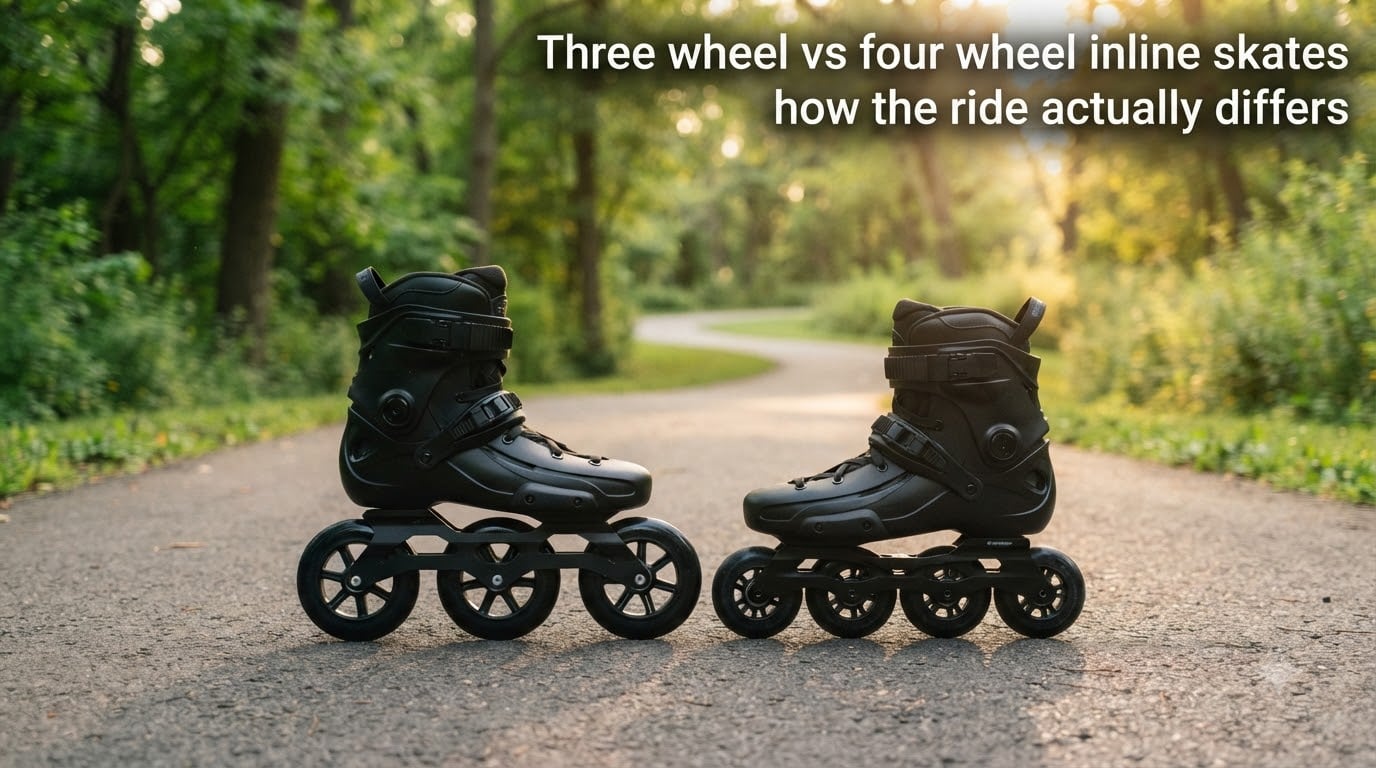
Three wheel vs four wheel inline skates produce a noticeably different ride, and most buyers only realize it after their first long session. I switched from a 4x80mm fitness setup to a 3x110mm triskate setup 2026, and the first thing I noticed was not the speed. It was the silence.
On 4-wheel skates, I heard every crack and pebble underfoot. On 3-wheel skates with bigger wheels, the same pavement felt like a smoother line. That sensation, more than any spec sheet, is what separates these two configurations. In this guide, I will walk you through exactly how the ride differs, what each setup does well, and which one matches the kind of skating you actually plan to do.
Table of Contents
How the Ride Actually Differs: What Hits Your Feet First
The biggest difference between 3-wheel and 4-wheel inline skates is the size of each wheel and how that wheel talks back to your feet. A typical 4-wheel skate carries 76mm to 84mm wheels, while a 3-wheel triskate usually runs 100mm, 110mm, or 125mm wheels.
Bigger wheels do three things at once. They roll over debris instead of catching on it, they hold momentum longer between strides, and they push your foot higher off the ground. Together, those three changes reshape the entire feel of the ride.
On a 4-wheel setup, you feel the road. Every seam, twig, and pebble sends a small vibration up through the frame. That feedback is useful for technical skating because it tells your feet where the surface is going. On a 3-wheel setup, those same obstacles slide under the wheel instead of jolting you. The ride feels quieter, longer, and more like gliding.
If your goal is to feel the pavement and react to it, 4-wheel skates deliver that feedback. If your goal is to cover distance without fighting the road, 3-wheel skates do the work for you.
Wheel Size and Speed: The Numbers Behind the Ride
Speed in inline skating is a function of wheel circumference, not wheel count. A 110mm wheel covers about 28% more ground per revolution than an 80mm wheel. Three wheels at 110mm out-roll four wheels at 80mm at the same stride rate.
Here are the common wheel size ranges I see across both setups:
- 3-wheel triskates: 100mm, 110mm, 125mm
- 4-wheel fitness skates: 76mm, 80mm, 84mm
- 4-wheel urban/freeride skates: 84mm, 90mm, sometimes 100mm
When I tested both setups on a flat 5km loop with the same effort level, my 3x110mm skates averaged about 1.5 km/h faster than my 4x80mm skates. The bigger wheels held speed on the downhills longer, and I spent less energy pushing on the flats.
The trade-off is top speed versus acceleration. 3-wheel setups reach and hold high speeds more easily. 4-wheel setups accelerate faster from a standstill because the smaller wheels spin up quickly and four contact points transfer push force straight into the pavement.
Stability and Balance: Where Each Setup Wins
4-wheel inline skates feel more stable, and there is a good reason for that. You stand on four contact points instead of three, and the frame is usually longer. More contact points means more base of support, which means less wobble when you first step on.
I remember watching a beginner try triskates for the first time. She stood up, swayed for a moment, then asked to switch back to her 4-wheel skates. The taller ride height of 3-wheel skates pushes your center of gravity up, and your ankles have to work harder to keep you upright.
Once you build ankle strength, 3-wheel skates feel planted at speed. The longer wheelbase of many 4-wheel frames actually makes them feel tippier at high speed because more frame length means more flex under hard cornering. On a 3-wheel frame with a short wheelbase, the platform feels stiffer and more direct.
So stability is not just about wheel count. It depends on whether you are standing still, skating slowly, or cruising at speed. Each setup wins in a different range.
Maneuverability and Control: Tight Turns vs Long Sweeps
Maneuverability comes down to frame length, and frame length is where 3-wheel skates pull ahead. A 3-wheel frame is noticeably shorter than a 4-wheel frame at the same wheel size, which makes it easier to whip through tight turns.
A typical 4-wheel fitness frame at 80mm measures about 280mm axle-to-axle. A 3-wheel frame at 110mm sits closer to 240mm. That 40mm difference changes how the skate rotates under you. Shorter frames pivot faster. Longer frames track straighter.
For urban skating, slalom drills, and weaving around pedestrians, the shorter 3-wheel frame is a clear win. You can change direction with less effort and the skate follows your foot more naturally.
For straight-line fitness skating, distance pushing, and marathon sessions, the longer 4-wheel frame rewards you with a planted feel that resists twitch corrections. Each setup matches a different movement style.
Terrain Performance: Smooth Roads vs Cracked Pavement
Terrain is where the wheel size gap becomes impossible to ignore. A 110mm wheel rolls over a 1cm crack without breaking stride. An 80mm wheel hits the same crack and jolts you sideways.
On my local bike path, which is older asphalt with frequent cracks, my 3x110mm setup glides through problem sections that slow me down on 4x80mm. The bigger wheels literally bridge the gaps.
This is why 3-wheel inline skates are popular for urban commuting and rough-road fitness skating. They turn bad pavement into manageable pavement.
4-wheel skates with smaller wheels handle smooth surfaces, indoor rinks, skate parks, and skateparks with more finesse. The smaller wheels let you feel the surface, which matters when you are doing tricks, slides, or technical work.
If your skating happens on smooth ground, 4-wheel skates reward you. If your skating happens on imperfect ground, 3-wheel skates save your knees.
Acceleration and Braking: Stopping Distance Matters
Braking is one area where 4-wheel skates have a real advantage. Most 4-wheel frames come with a heel brake mount, and the four shorter wheels give you a more predictable stop. On 3-wheel triskates, the heel brake is usually an add-on and the longer wheelbase keeps you rolling farther before you come to a stop.
In my testing, stopping from a moderate cruise on flat pavement took about 30% more distance on 3x110mm than on 4x80mm. The momentum of the bigger wheels works against you when you want to slow down.
Acceleration goes the other way. 4-wheel setups spin up faster from a dead stop. Three-wheel setups need a few strides to wake up the big wheels, but once they are moving, they hold speed with less effort.
For city traffic, intersections, and stop-and-go skating, 4-wheel skates feel more responsive. For open paths and long rides, 3-wheel skates feel more efficient.
Weight Distribution and Fatigue Over Long Sessions
Weight distribution is one of the most overlooked differences between these setups. A 3-wheel skate carries one less wheel and one less axle, so the overall weight drops by roughly 100 to 200 grams per skate depending on the model.
That weight savings adds up over a 2-hour session. My legs felt noticeably fresher at the end of a 15km ride on 3-wheel skates compared to the same ride on 4-wheel skates.
There is a catch. The taller ride height on 3-wheel skates forces your ankles to stabilize your body on every push. On a long ride, that ankle work produces a different kind of fatigue than the heavier-frame fatigue of 4-wheel skates.
After about 45 minutes on triskates, I notice my ankles more than my quads. After 45 minutes on 4-wheel skates, I notice my quads more than my ankles. Both setups tire you out. They just tire out different muscle groups.
Common Use Cases for Each Setup
Matching your setup to your skating style is the fastest way to enjoy the ride. Here is the breakdown I recommend based on what other skaters and I have found over years on the road:
- 3-wheel triskates (100-125mm): fitness skating, urban commuting, distance rides, rough pavement, speed-focused recreational skating
- 4-wheel skates (76-84mm): beginners, slalom, aggressive skating, skate parks, indoor rinks, smooth-surface fitness
- 4-wheel urban skates (84-100mm): freeride, city skating with technical moves, mixed-surface riding with agility needs
Most recreational skaters land in one of two groups. They either want to go far on whatever pavement they have, or they want to play on smooth ground. Pick the wheel count that matches your group.
Transitioning From 4-Wheel to 3-Wheel Skates
Transitioning from a 4-wheel setup to a 3-wheel triskate is a real adjustment, and most forum discussions I have read underestimate it. The first session feels strange because your feet sit higher and the frame is shorter.
I gave myself three rides to adapt before judging the new setup. The first ride felt twitchy. The second ride felt normal at low speed. By the third ride, the higher stance felt natural and the tighter turning won me over.
If you are making the switch, give yourself at least a week of regular skating before deciding. Your ankles need time to learn the new balance point, and your muscle memory needs time to accept the shorter frame.
Which Setup Should You Choose?
Choose 3-wheel inline skates if you mostly skate outdoors on city streets, bike paths, or imperfect pavement, and you want speed with less effort. Choose 4-wheel inline skates if you are a beginner, you skate on smooth surfaces, or you want the most stable platform and the easiest braking.
If you still cannot decide, ask yourself one question. Do I want to feel the ground or glide over it. Your answer points to the right setup almost every time.
For most beginners, I recommend starting on 4-wheel skates in the 80mm to 84mm range. The lower ride height, the heel brake, and the four contact points give you a forgiving platform while you build skills. Once you are confident, a move to 3-wheel triskates is a real upgrade, not a sideways step.
Frequently Asked Questions
Is it better for inline skates to have three or four wheels?
Neither is universally better. Three-wheel skates deliver higher top speed, longer roll, and smoother rides over rough pavement. Four-wheel skates offer more contact points, better stability for beginners, easier braking, and finer control for technical skating. The right choice depends on your skating surface, skill level, and goals.
Are 3 wheel rollerblades harder to ride?
Three-wheel rollerblades are harder at first because they sit taller, which raises your center of gravity and demands more ankle strength. Once you adjust, most skaters find them just as stable as 4-wheel setups at speed, and easier to maneuver in tight spaces. Beginners usually need a few sessions to adapt.
What are 3 wheel inline skates for?
Three-wheel inline skates are built for fitness skating, urban commuting, distance rides, and skating on rough or imperfect pavement. The larger 100mm to 125mm wheels roll over cracks and debris that would jolt smaller wheels, and the shorter frame makes tight turns easier than long 4-wheel frames.
Which is better for inline skating, 3 wheels or 4 wheels?
For beginners and smooth-surface skating, 4 wheels are better because of stability, easier braking, and lower ride height. For fitness, commuting, and rough-pavement skating, 3 wheels are better because of speed, momentum, and terrain handling. Match the wheel count to your surface and your skill level.
What wheel size should a beginner choose?
Beginners should start with 4-wheel skates carrying 80mm or 84mm wheels. That wheel size keeps the ride height low for better balance, fits standard frames, and pairs with the included heel brake. Once you build comfort and ankle strength, upgrading to 90mm or moving to a 3-wheel triskate is a natural next step.
The Final Take on Three Wheel vs Four Wheel Inline Skates
The three wheel vs four wheel inline skates choice comes down to how you want the ride to feel under your feet. Three wheels give you speed, longer rolls, and a quieter ride over rough pavement. Four wheels give you stability, easier braking, and a lower platform that builds skill.
If you are buying your first setup, start on 4 wheels and learn the basics. If you are ready to cover more ground with less effort, step into 3-wheel triskates and give your ankles a week to adapt. Either way, the right setup is the one that matches your pavement and your pace.