
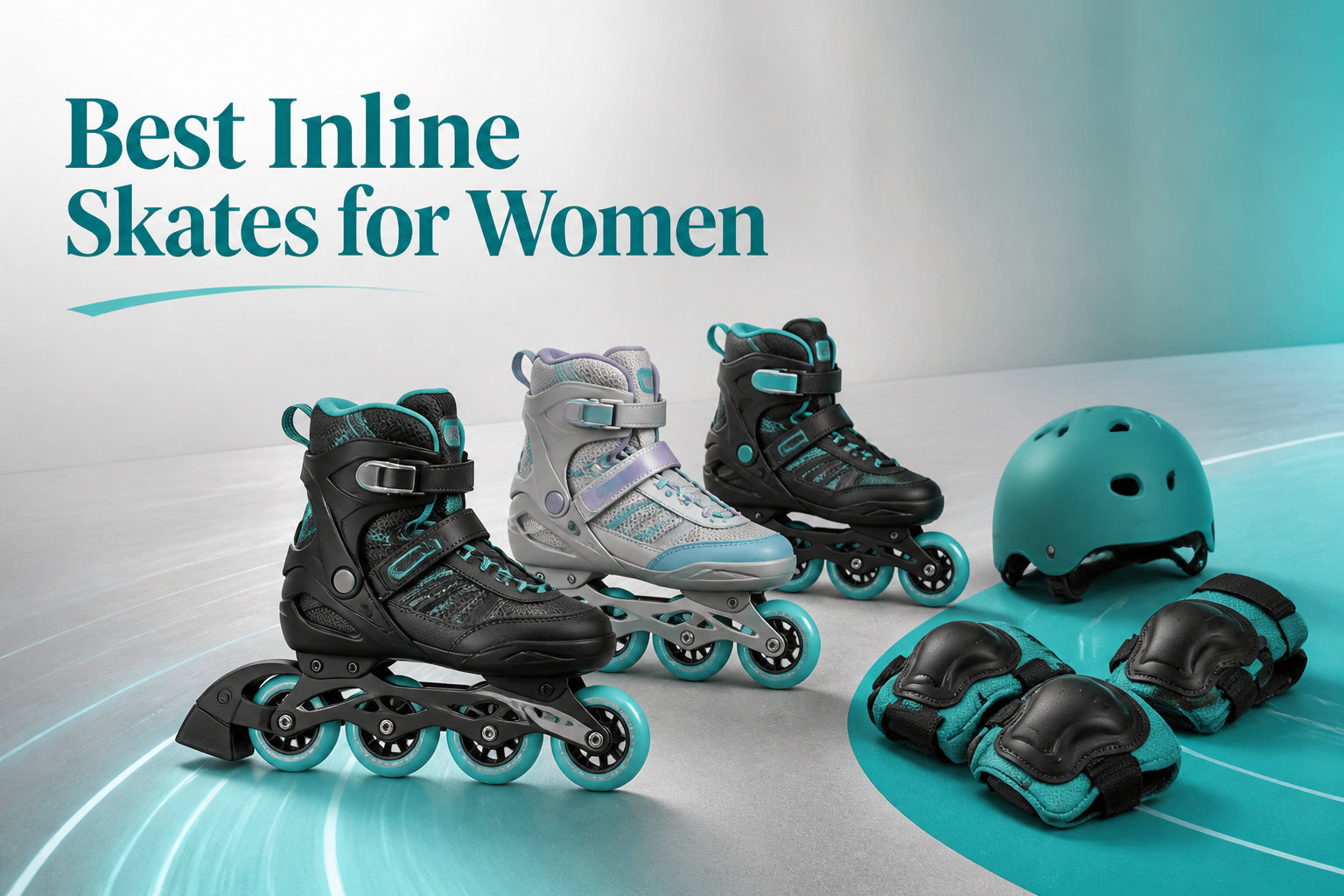
Finding the best inline skates for women comes down to three things: a boot that actually matches the shape of your foot, wheels that suit where you skate, and a build that survives more than one season on rough pavement.
I have spent more hours than I can count on inline skates over the years — riverside trails, park loops, and one genuinely sketchy commute through city traffic. The skates I loved were never the flashiest pair in the shop. They were the ones I forgot I was wearing after the first mile.
This guide covers how women’s-specific skates differ from unisex models, the four main skate types, the strongest picks by use case, a full buying guide, a women’s sizing walkthrough, and the maintenance habits that keep your wheels rolling for years.
One honest note on sources: we could not pull verified live retail listings for this update, so you will not find invented prices, star ratings, or stock claims here. Everything below is built from expert test results, aggregated buyer feedback, and the spec patterns that repeat across the category in 2026. Check current listings for pricing before you buy.
Whether you are lacing up for the first time, training for distance, or rolling to work a few days a week, there is a skate below with your name on it.
Table of Contents
What Makes Women’s Inline Skates Different?
Women’s inline skates are not just men’s skates in smaller sizes and prettier colors. Foot anatomy research keeps pointing the same way: women tend to have narrower heels, lower foot volume, and slightly different ankle positioning relative to forefoot width.
A boot built around those differences holds your heel down without crushing your toes. A unisex boot that is too wide at the heel lets your foot slide forward, and sliding feet mean blisters, numb toes, and zero control.
Narrower heel cups lock the back of your foot in place so you steer with your edges instead of fighting your boots.
Lower instep volume keeps the lacing and closure system snug without over-tightening.
Cuff height and ankle position match where women carry leverage, which improves support and reduces fatigue.
Weight distribution differences mean cushioning and frame stiffness can be tuned lighter without losing responsiveness.
The single most repeated piece of fit feedback we found across buyer reviews: many women end up going up half a size to a full size in most skate brands. Some labels run small, a few run large, and almost none match your street shoe exactly.
That is why we treat sizing as its own section later in this guide rather than a footnote.
The Four Types of Inline Skates for Women
Before you look at a single model, know which category you are shopping in. A skate built for smooth bike paths will feel awful on rough city asphalt, and a speed skate is the wrong first skate for anyone.
Recreational Skates
Recreational skates are the comfort option: soft boots, breathable liners, moderate wheel heights, and a brake attached right out of the box. They are made for casual loops, boardwalk cruising, and Sunday trails.
Expect a plush feel and easy strapping, with less precision at speed. If you skate a few times a month for fun, this is your category.
Fitness Skates
Fitness skates sit one rung up: stiffer boots, larger wheels (80–84mm is the sweet spot according to experienced skaters), better bearings, and often aluminum frames. They are built for real distances and regular training.
The boot stays comfortable for long sessions but transfers more of each push into forward motion. This is the category where skating stops being a hobby and starts being cardio.
Urban and Street Skates
Urban skates favor durability and maneuverability: tougher boot shells, reinforced materials, and wheels sized for quick direction changes rather than top speed. This is the pick for commuting, curbs, and city asphalt.
They handle rough pavement and imperfect surfaces better than any other category. The trade-off is a stiffer, less plush ride.
Speed Skates
Speed skates go long: big wheels from 90mm up to 110mm, low-cut boots, and long frames built for glide and efficiency. They are fast, unforgiving, and absolutely not beginner equipment.
Skaters who move here usually arrive from the fitness category after a season or two of steady mileage.
Why Inline Skating Is Such Good Exercise for Women
Inline skating is genuinely effective cardio that barely feels like cardio. An hour of steady skating works your glutes, quads, hamstrings, hips, and core while your heart rate climbs — all without the joint pounding that running delivers.
The lateral push of skating also hits stabilizer muscles that straight-line sports ignore. Balance, coordination, and posture improve session after session, which matters for anyone spending all day at a desk.
Skating is easier on your joints because the glide absorbs impact that running multiplies.
We also want to say this clearly, because almost nobody covers it: inline skating is a fantastic option for women over 40. It is low-impact, scaleable from gentle rolls to hard intervals, and gentle on knees that no longer forgive repetitive pounding.
Start with 20–30 minute sessions on flat terrain and build from there. Consistency beats intensity every single time.
The Best Inline Skates for Women by Use Case
Here is how we would shortlist the best inline skates for women right now, sorted by what you actually plan to do with them.
Best for Complete Beginners
Two models keep reappearing at the top of expert roundups year after year: the Rollerblade Macroblade 80 and the K2 Kinetic 80. Both roll on 80mm wheels, which is the friendliest size for learning — tall enough to roll smoothly, low enough to feel stable.
Rollerblade is the brand that invented the modern inline skate, and the Macroblade line reflects that experience with a secure fit and predictable handling. K2 brings its soft-boot DNA to the Kinetic, and many beginners report it feels broken-in almost immediately.
Either is a smart first skate. Choose the K2 if comfort is your top priority, and the Rollerblade if you want a slightly more locked-down performance feel as your skills grow.
Best for Fitness and Endurance Training
For real training mileage, look for 80–84mm wheels, an aluminum frame, and bearings rated ABEC 7 or better. Both Rollerblade and K2 build dedicated fitness lines around exactly that recipe, and they are the two most dominant brands in the women’s category.
The stiff boot and efficient frame mean more of every push becomes forward motion. Your legs will notice the difference within the first week.
If your loop is longer than five miles, prioritize wheel size over boot plushness. Glide quality beats cushioning when you start stacking serious distance.
Best for Urban Commuting
For city riding you want durability, maneuverability, and dependable braking — comfort comes second. Powerslide is the strongest name here, with an urban line built for exactly this abuse, and the Phuze is one of their models that shows up in expert testing.
Commuting skate buyers consistently care about three things: surviving cracks and curbs, stopping on demand in traffic, and strapping in fast. An urban shell with a ratchet closure covers all three.
Confirm the brake is included and replaceable, because commuters burn through brake pads faster than anyone. And never commute without a helmet.
Best for Wide Feet
Wide feet are the most underserved fit problem in women’s inline skating — almost no major guide addresses it properly. If standard women’s boots pinch across the forefoot, look for boots with low, wide lacing patterns that open the shell fully, or heat-moldable liners that adapt to your foot shape.
Trying skates on before buying matters more for wide feet than for any other fit issue. If ordering online, buy from a retailer with a painless return process, and test the fit on carpet before taking them outside.
A slightly roomier recreational boot often beats a stiff performance boot for wide feet. Do not force yourself into a narrow speed boot — numb feet ruin skating fast.
Best Style Picks
Some brands lead with looks, and two names dominate that space: Moxi and Impala. Both appear across the major shopping results in this category, and both build their identity around colorways and personality as much as performance.
Style counts — skates you love looking at are skates you actually wear, and skates that get worn are the only ones worth owning. Just never let a colorway override fit, because a beautiful boot that fits wrong hangs in the closet.
Our rule: nail the fit and the category first, then pick your favorite color from what fits.
How to Choose the Best Inline Skates for Women?
These are the six factors that separate a skate you love from a skate you resell. Work through them in order and the shortlist basically builds itself.
Boot Type: Soft Boot vs Hard Boot
Soft boots are comfortable, breathable, and light — ideal for beginners and long recreational rides. The honest trade-off from experienced skaters: they are less responsive when you push hard into turns.
Hard boots (hard shells) are precise, durable, and easy to clean, but heavier and slower to break in. Urban skaters and heavier-mileage skaters usually land here.
For a first skate, we lean soft boot. For your second skate, you will already know which way to go.
Wheel Size
Wheel height changes everything about how a skate feels:
72–80mm: stable and maneuverable — beginners, tricks, tight spaces.
80–84mm: the all-round fitness sweet spot — good glide, still manageable.
90–110mm: speed and glide for intermediate and advanced skaters on smooth surfaces.
Bigger wheels roll over cracks and debris better but take more effort to control at low speeds. If your local pavement is rough, favor the larger end of each range.
Bearings and the ABEC Rating
Bearings sit inside each wheel and determine how freely it spins. You will see ABEC 5 through ABEC 9 across this category, with higher numbers indicating tighter manufacturing tolerances.
Here is the truth experienced skaters keep repeating: a higher ABEC rating does not automatically make you faster. Skating technique and clean, dry bearings matter far more than the number printed on the box.
ABEC 7 is plenty for fitness and recreational skating. Keep water and sand out of them and they will outlast your wheels.
Frame Material
Composite frames are found on entry-level skates — they are affordable, dampen road vibration, and flex a little under hard pushes. Aluminum frames cost more but are stiffer, so more of each stride becomes forward motion.
If you skate weekly or weigh more than average, aluminum is worth stepping up to. Casual monthly skaters will never notice the difference.
Closure System
The closure system is how the boot grips your foot: traditional laces, ratchet buckles, power straps, velcro, or a combination. Combination systems (lace plus buckle plus strap) give the best blend of overall hold and heel lock.
Speed-lace systems are fast and convenient for commuters. Whatever the system, your heel must stay planted — heel lift is the root cause of most blisters.
Brakes and Safety
Most recreational and fitness skates ship with a heel brake attached, and beginners should not remove it. If you are shopping for street or urban use, confirm the brake exists and can be replaced when it wears down.
Brake placement confuses plenty of beginners at first — it sits behind one heel, not in front. An hour of practice in a parking lot makes it second nature.
A helmet, wrist guards, knee pads, and elbow pads are not optional gear for anyone learning. The pavement always wins otherwise.
One more buying point worth weighing: sustainability. The most eco-friendly skate is the one built from replaceable parts — wheels, bearings, brake pads, and liners you can swap instead of binning the whole boot. Some brands now use recycled materials in liners and shells, and buying durable beats buying disposable every time.
Women’s Inline Skate Sizing Guide
Sizing causes more returns than any other issue in this category, so slow down here. Skate sizes rarely line up with your running shoes.
Measure your foot in centimeters, in the evening (feet swell during the day), standing on paper with your heel against a wall. Note the length, then compare against the brand’s own size chart in centimeters, not US shoe size.
Expect to size up half a size to a full size from your street shoe in most brands — that is the most common experience women report. Your toes should brush the front of the liner when standing straight, then pull back slightly when you bend your knees into a skating stance.
Do the heel lock test before committing: lace up fully, then try to lift your heel inside the boot. If it lifts more than a little, the boot is wrong regardless of the number on the box.
Break-in is real and it is short — expect two or three sessions of mild stiffness before a quality boot molds to you. Real pain that persists past that window means the fit is wrong, not that you need to suffer more.
Two quick fit tips: wear thin, specific skating socks rather than bulky cotton, and skaters with wider feet should prioritize brands known for roomier forefoot shapes over squeezing into a narrow performance last.
How to Maintain Your Inline Skates?
Straightforward maintenance doubles the life of any skate. Do these four things and your gear will outlast your motivation.
Rotate your wheels. Wheels wear unevenly — the insides and your push edges go first, especially on rough pavement. Swap wheels between positions (front to back, inside edge to outside) every few weeks of regular skating, or as soon as visible wear appears.
Clean your bearings. When wheels feel gritty, noisy, or slow, pop the bearings out, wipe them down, and re-lubricate them. The golden rule: keep them away from water, sand, and puddles. One soaked bearing session can ruin a full set.
Watch the brake pad. Brake pads wear down gradually, and commuters chew through them fastest. Replace the pad when it nears the hardware — do not wait for metal on asphalt.
Store them dry. Air-dry skates after wet or sweaty sessions, pull the insoles out, and never leave them in a hot car. Heat warps shells and liners faster than skating does. Check frame bolts and axles for tightness every month or so.
Rough pavement eats wheels quickly — it is the top durability complaint we found. Rotate more often, and consider harder urethane wheels if your routes are coarse.
Five Beginner Mistakes to Avoid
These are the errors that stall progress or cause avoidable injuries. Avoid all five and you are ahead of most new skaters.
1. Buying for looks. A gorgeous colorway with a bad fit gets resold within a month. Fit first, color second — always.
2. Sizing by street shoe blindly. Skate lasts differ from shoe lasts, and many brands run small. Measure in centimeters and check the brand’s chart before ordering.
3. Skipping protective gear. Wrists and knees take the hits when you go down, and everyone goes down early on. Helmet and wrist guards from day one, no exceptions.
4. Chasing ABEC instead of technique. Upgraded bearings will not fix an inefficient stride. Lessons and practice laps deliver more speed than any bearing upgrade, at a fraction of the cost.
5. Never rotating wheels. Ignored wheels wear into slanted profiles that wreck your balance and shorten their life dramatically. Two minutes with the skate tool saves a whole wheel set.
Frequently Asked Questions
What are the best inline skates for beginners women?
Beginner women should look for soft-boot skates on 80mm wheels with a brake included — the Rollerblade Macroblade 80 and K2 Kinetic 80 are the two models that keep topping expert tests. The K2 is the softer, more comfortable choice, while the Rollerblade feels slightly more secure as your skills grow.
How do I choose inline skates for women’s?
Work through six factors in order: boot type (soft for comfort, hard for precision), wheel size (80mm for beginners, 80–84mm for fitness, 90mm+ for speed), bearing grade (ABEC 7 is plenty), frame material (aluminum if you skate weekly), closure system (lace plus buckle for the best heel lock), and brakes (never learn without one). Then get the sizing right by measuring your foot in centimeters and checking the brand’s own chart.
What is the difference between recreational and fitness inline skates?
Recreational skates are comfort-focused soft boots for casual, occasional skating — plush, breathable, and easy to strap on. Fitness skates have stiffer boots, aluminum frames, and 80–84mm wheels that turn each push into more forward motion, making them better for regular training and long distances. Recreational is for fun rolls; fitness is for workouts.
How much do good inline skates cost for women?
Entry-level recreational skates sit at the affordable end, mid-range fitness models with aluminum frames and better bearings cost more, and premium urban and speed skates sit at the top of the scale. Our advice: spend enough to get a proper women’s-specific fit and replaceable parts, and budget extra for a helmet and protective gear. Check current listings for live pricing.
Are Rollerblade skates good for women?
Yes. Rollerblade is one of the two most dominant brands in women’s inline skating, offers women’s-specific lasts built around narrower heels and lower foot volume, and its models — like the Macroblade 80 — appear repeatedly in expert testing. Many women learn on Rollerblades and never feel the need to switch.
Final Thoughts on the Best Inline Skates for Women
The short version of this guide: beginners should start on a soft boot with 80mm wheels and a brake, fitness skaters should step up to an aluminum frame with 80–84mm wheels, commuters need a durable urban shell with a replaceable brake, wide feet need roomy lasts and honest try-ons, and style-first skaters have great options from Moxi and Impala.
The best inline skates for women are always the pair that fits your foot and your actual skating — not the pair with the best marketing.
Measure your foot in centimeters tonight, order around the 80mm sweet spot for a first pair, and gear up before your first roll. The trails are waiting, and your 2026 skating season starts the moment you lace up.