
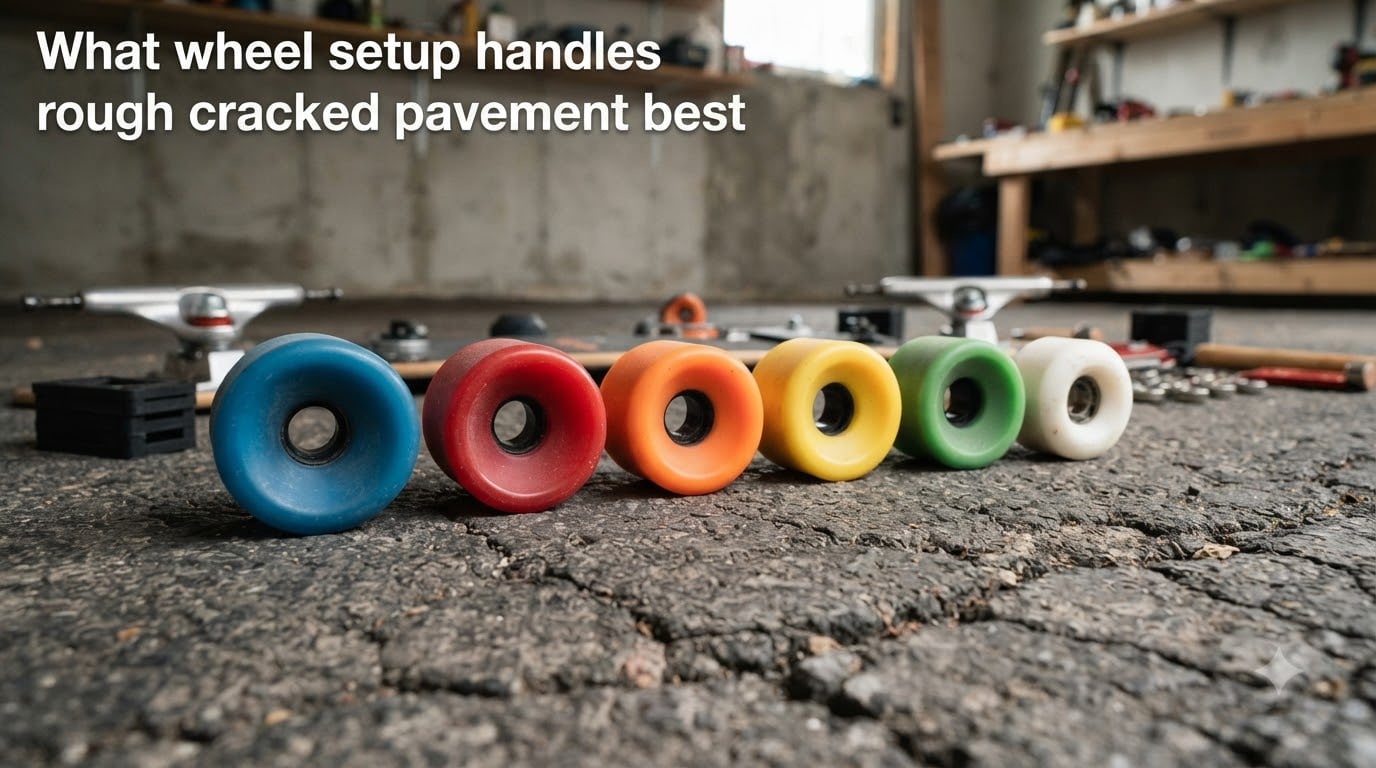
If you have ever ridden stock 95a wheels down a cracked sidewalk and felt every single seam in your ankles, you already know the problem. The right wheel setup for rough cracked pavement is a mix of softer durometer, larger diameter, and a shape that rolls over gaps instead of catching in them. I have spent months riding on busted neighborhood streets, switching wheels every few weeks, and I want to share what actually works.
Most beginners show up with 99a or 100a wheels because that is what the shop sold them. Those wheels slide great on smooth ledges but turn a sidewalk full of cracks into a vibrating torture rack. In this guide I will walk you through the durometer range that softens the ride, the wheel size that lets you roll over gaps, and the setup tricks that keep you upright when the pavement gets ugly.
Table of Contents
Why Rough Cracked Pavement Beats Up Standard Skateboard Wheels
Rough cracked pavement punishes wheels because every crack edge, pebble, and seam sends a sharp pulse up through the trucks and into your feet. Hard wheels do not compress when they hit an edge, so 100% of that impact transfers into your ankles, knees, and lower back. After a 20-minute session on bad asphalt you feel like you ran a road race.
The second problem is wheel bite. Small, hard wheels sit low to the ground. When you carve or turn hard, the inside edge of a wheel catches on a crack and the board stops instantly. Your momentum keeps going. This is the number one cause of surprise falls for new skaters learning on rough streets.
The third issue is vibration fatigue. Constant micro-bumps through stiff wheels tire your joints faster than smooth cruising ever would. I rode 56mm 99a wheels on a mile of cracked residential street and had to sit down after because my legs were shaking. The same route on softer wheels felt like a different sport.
The three forces working against you on bad pavement
Impact transfer: hard wheels cannot absorb energy, so cracks feel like hammer hits
Wheel bite: small wheels drop into seams and stop the board mid-roll
Vibration fatigue: hours of micro-vibration wear down your balance and stamina
Wheel Hardness for Rough Pavement: The Durometer Sweet Spot
For rough cracked pavement, the wheel hardness sweet spot sits between 78a and 87a on the durometer A scale. That range is soft enough to deform over cracks and absorb shock, but firm enough that you can still pop an ollie and slide when you want to. Hardness is measured with a durometer, and lower numbers mean softer urethane.
Standard street wheels run 99a to 101a. Cruiser wheels run 78a to 87a. The 87a to 95a range is the compromise zone where some brands park their all-terrain models. If you want both rough pavement comfort and trick ability, 87a is your best starting point.
Durometer ranges and what they actually feel like
78a to 83a: cloud-soft cruiser feel, absorbs almost everything, very poor for tricks
84a to 87a: the all-terrain sweet spot, soft enough for comfort, firm enough to ollie
88a to 92a: still comfortable on rough ground, much closer to a real street feel
95a to 101a: classic street hardness, will rattle your teeth on cracked pavement
I keep a set of 86a wheels on my daily driver for exactly this reason. They roll over expansion joints, sidewalk seams, and small gravel without complaint. When I want to film a ledge trick I swap to 99a, but the 86a set gets 80% of my riding time.
Best Wheel Size for Cracked Sidewalks and Rough Roads
Bigger wheels roll over cracks better than smaller wheels because they have a taller profile. A 56mm or larger wheel can ride up and over a 1cm crack without the wheel dropping into the gap. A 52mm wheel drops straight in and stops. Diameter matters more than people think for rough terrain navigation.
For rough pavement, aim for 54mm to 60mm wheels. The 54mm to 56mm range is the minimum that handles urban cracks well. The 56mm to 60mm range is the cruiser zone and rolls over almost any small road imperfection. Smaller than 53mm is rough-terrain suicide.
Wheel size also changes how your board feels. Larger wheels accelerate slower because they have more mass to spin up. Smaller wheels feel flicky and responsive. For a rough-pavement commuter setup, 56mm to 58mm gives you the best balance of roll-over ability and quick acceleration.
Why bigger wheels handle cracks better
Taller profile: lets the wheel climb up and over a seam instead of dropping in
Higher top speed: more momentum helps push through small obstacles
Better gap clearance: 56mm+ wheels clear most sidewalk expansion joints
Smoother roll: more rotation per push means less vibration per inch traveled
Wheel Shape and Material Choices That Absorb Impact
Wheel shape affects how you handle rough terrain almost as much as hardness. Rounded wheels (small contact patch, narrow profile) slide easily but catch in cracks. Square or wide wheels (large contact patch, flat profile) grip better and roll over rough ground more confidently.
For rough pavement, choose a wheel with a wider riding surface and a slightly rounded edge. The wide contact patch spreads your weight across more urethane, which dampens vibration. The rounded edge still lets you carve without catching. Pure sharp-edged wheels slide too much on rough ground and feel unstable.
Material is mostly about urethane formula. Most quality skateboard wheels use polyurethane, but the formula varies. Softer pours create grippier, shock-absorbing wheels. Harder pours create faster, slide-friendly wheels. Look for brands that specifically market their urethane as all-terrain or cruiser-friendly.
Profile shapes and where each works best
Rounded: best for smooth parks and street ledges, too catchy on rough ground
Semi-rounded: the versatile choice, handles both cracks and ledges
Square/wide: maximum grip and crack-clearing, slower for technical tricks
Cone: classic cruiser shape, smooth carve, decent roll-over ability
Riser Pads and Wheel Setup Adjustments for Bumpy Terrain
When you combine soft, large wheels with a low deck, you risk wheel bite on sharp carves. The fix is a riser pad. Riser pads sit between your truck and the deck and add clearance. A 1/8 inch riser is the minimum for soft wheels. A 1/4 inch riser gives you full carving freedom without bite.
Risers do more than prevent bite. They also absorb some impact because the rubber or plastic compresses under hard landings. On rough pavement, that small amount of damping adds up over a long session. Many skaters over 50 swear by taller risers because they save their knees.
If you are running 56mm+ wheels under 87a durometer, plan on at least a 1/8 inch riser. If you want maximum comfort and clearance, go with a 1/4 inch shock pad. The extra height changes your push mechanics slightly, so give yourself a few sessions to adapt.
Top Wheel Brands That Handle Cracked Pavement Well
Three brands consistently show up in conversations about rough terrain wheels. I have ridden all of them on cracked residential pavement and they each have a clear personality.
Ricta Clouds are 86a cruiser wheels in the 56mm to 60mm range. They are the softest option that still feels like a real skateboard wheel. I ran a set of 56mm Clouds for a month of commuting and barely felt the cracks.
Bones All Terrain Rough Riders are 80a wheels designed for exactly this use case. The 56mm size clears most sidewalk cracks. The 80a durometer is softer than the Rictas, so they feel cushier but also slower for trick learning.
Spitfire 80HD sits in the harder end of the all-terrain range at 80a. They last longer than the softer options because denser urethane wears down slower. If you want rough terrain comfort but do not want to replace wheels every few months, the Spitfires are a smart pick.
OJ Hot Juice is the budget-friendly 78a cruiser wheel. They work great for short commutes and learning tricks on rough ground. The trade-off is urethane that flatspots faster than premium brands.
How to Roll Over Cracks Without Falling?
Even the best wheel setup will not save you if your technique is wrong. The single most important rule is to hit cracks at an angle. Square-on, the front wheel drops into the gap and stops you. At a 45 degree angle, the wheel slides across the seam instead of catching it.
The second rule is weight distribution. Shift your weight toward the back truck when approaching an unavoidable crack. The back wheel is less critical for steering, so a small catch there is recoverable. A front-wheel catch almost always means a fall.
The third rule is speed. Slow roll on rough ground amplifies every crack because you have less momentum to push through small obstacles. Maintain a comfortable cruising speed when the pavement gets ugly. You will roll over more cracks and feel fewer of them.
Quick technique checklist for rough pavement
Approach cracks at 30 to 45 degree angles, not straight on
Shift weight to the back foot before unavoidable obstacles
Keep a consistent cruising speed, avoid slow rolling
Carve gently to let the wheels find their own line across seams
Bend your knees to absorb whatever still comes through
Frequently Asked Questions
Is 99a too hard for street?
99a is fine for smooth street spots like ledges and flat bars, but it is too hard for typical cracked residential pavement. On rough ground, 99a transfers every crack and pebble straight into your ankles, which causes fatigue and increases fall risk. If most of your skating happens on rough streets, drop to 84a to 87a for a much more comfortable ride.
Why are smaller wheels better for potholes?
Smaller wheels drop deeper into cracks and potholes before they hit bottom, which means they catch and stop you. Larger wheels have a taller profile that rides up and over the gap instead of falling in. For rough pavement, 54mm to 60mm wheels handle small potholes far better than 52mm wheels do.
What are the best rollerblade wheels for rough roads?
For inline skates on rough roads, look for 80a to 85a durometer wheels in the 80mm to 110mm range. Larger diameters roll over cracks and the softer durometer absorbs vibration. Many commuter inline setups use 90mm 85a wheels for exactly this reason.
Is 82A good for asphalt?
82a is excellent on rough asphalt and cracked pavement. The softness absorbs most vibration from the road surface while still giving you enough firmness to push, carve, and learn basic tricks. Pure 78a feels mushy for tricks, so 82a to 87a is the sweet spot for asphalt cruising with some skatepark versatility.
Final Thoughts on Choosing the Right Wheel Setup
The best wheel setup for rough cracked pavement combines 84a to 87a durometer, 54mm to 60mm diameter, a semi-rounded wide profile, and a 1/8 to 1/4 inch riser pad. That combination rolls over cracks, absorbs most vibration, and still lets you ollie and learn tricks. Add proper technique (diagonal approach, weight back, steady speed) and the cracked streets stop being your enemy.
Start with Ricta Clouds or Bones Rough Riders if you want a known-good setup. Measure your axle width, check your trucks for kingpin clearance, and commit to a week of adjustment. After that, you will wonder how you ever rode hard wheels on bad ground.