
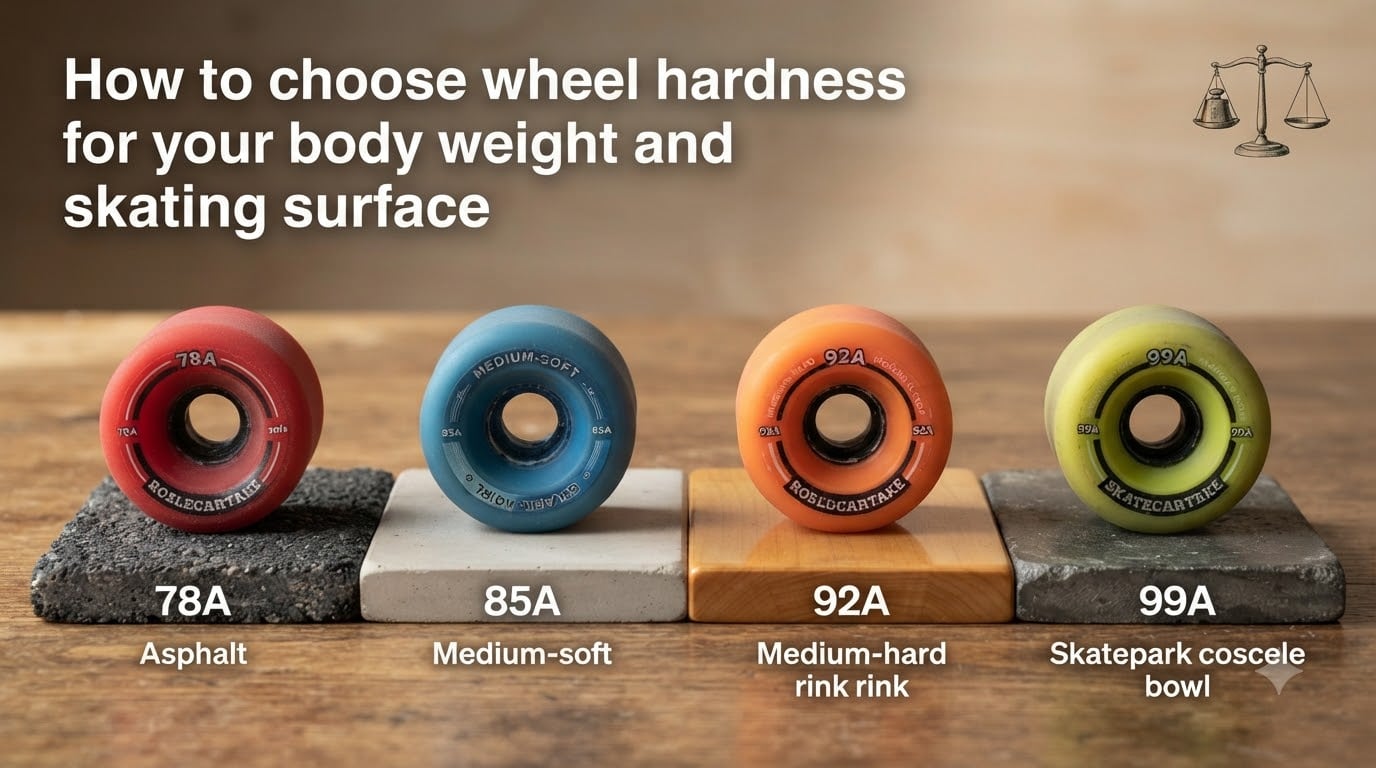
Picking the right roller skate wheels can change everything about your ride. I learned this the hard way during my first outdoor skating session, when my factory wheels locked up on every crack in the sidewalk. After years of testing different setups, I can tell you that understanding wheel hardness (called durometer) is the single most important factor when you choose skate wheels. This guide walks you through how to choose wheel hardness for your body weight and skating surface, so you can stop guessing and start rolling with confidence.
The number on the side of your wheel (like 78A or 95A) tells you how soft or hard the urethane is. That number, paired with where you skate and how much you weigh, decides whether you glide smoothly or feel every bump in the road. I put together this breakdown after comparing dozens of wheel sets on rinks, sidewalks, trails, and skateparks.
Table of Contents
What is Durometer and How Does It Measure Wheel Hardness?
Durometer is the standard measurement scale used to rate how hard or soft a material is. For roller skate wheels, we use the Shore A scale, which is designed for soft to semi-hard materials like rubber and urethane. The measurement works by pressing a small needle into the wheel under a fixed load and recording how deep it sinks.
A lower durometer number means the wheel is softer and the needle sinks deeper. A higher number means the wheel is harder and resists the needle. Skate wheel durometers typically fall between 78A (very soft) and 103A (very hard). The “A” tells you we are using the Shore A scale rather than Shore D, which is used for harder plastics.
The Shore A scale is used for skate wheels because urethane is a flexible polymer. The same needle test on a skateboard wheel would use a different scale (Shore D) since those wheels are made from a harder formulation. When you see “95A” printed on a roller skate wheel, that rating tells you exactly where the urethane sits on the softness-to-hardness spectrum.
The Durometer Scale Explained (78A to 103A)
The durometer scale for skate wheels spans roughly 25 points, but each segment behaves very differently. I think of it in three practical bands that match real-world use.
Soft wheels (78A to 85A): These are the grippiest, slowest wheels. They absorb shock well and roll over cracks, pebbles, and rough asphalt with ease. Outdoor recreational skaters typically live in this range.
Mid-range wheels (86A to 92A): This is the sweet spot for hybrid skating. Wheels in this band work on polished outdoor surfaces, sport courts, and some indoor rinks. They offer a balanced mix of grip and roll speed.
Hard wheels (93A to 103A): These are built for speed, slide, and indoor performance. Roller derby, artistic skating, skatepark, and indoor rink skaters generally use wheels in this range. They roll fast, last longer, and let you slide when you need to stop or carve.
Most beginner skaters start around 82A to 85A. Most advanced skaters using rinks and parks run 95A to 101A. The difference between 90A and 95A can feel dramatic on the same floor.
How Surface Type Affects Wheel Hardness Choice
The surface you skate on has just as much impact as your weight, and often more. A durometer number only means something when you pair it with the floor or ground beneath you.
Outdoor Surfaces (Sidewalk, Asphalt, Concrete, Trail)
Outdoor surfaces are rough, gritty, and uneven. You need a softer wheel that can flex around debris and absorb vibration. I recommend 78A to 85A for outdoor recreational skating.
Trail skaters who hit packed dirt, boardwalk planks, and rough asphalt should stay in the 78A to 82A range. These wheels bite into uneven terrain instead of bouncing off it.
Basketball courts, tennis courts, and smooth concrete can handle slightly harder wheels (85A to 88A) because the surface itself is polished and predictable. Park skaters who use outdoor plazas often run 88A wheels as a compromise between roll and grip.
Indoor Surfaces (Roller Rink, Sport Court, Polished Concrete)
Indoor floors are smooth and often coated with a thin layer of sealant or wax. Hard wheels (88A to 101A) perform best because they roll fast without grabbing. Most rink rental skates use wheels around 92A to 95A.
Roller derby floors are typically sport court or polished concrete with grip levels set by the venue. Derby skaters usually pick 88A to 95A depending on how sticky the floor feels. A slippery derby track needs softer wheels in that range.
Skatepark Surfaces (Concrete Bowl, Ramp, Street)
Skatepark concrete is poured smooth but usually left unsealed. Hard wheels (95A to 101A) work best because they resist flat spots from slides and grinds. Softer park wheels wear down quickly when you lock into a powerslide.
Most street skaters running ledges, rails, and gaps use 99A to 101A. Bowl skaters sometimes drop to 95A for extra grip on transitions.
How Body Weight Affects Wheel Hardness Selection
Your body weight compresses the wheel under load, which effectively makes the wheel behave softer than its printed number suggests. A 100-pound skater and a 220-pound skater on the same 90A wheel will experience very different grip levels.
Light Skaters (Under 120 lbs / 55 kg)
Light skaters compress wheels less, so the wheel feels harder than the number implies. You often need to drop one or two hardness points below the standard recommendation to get the grip you want. A 110-pound skater skating outdoor pavement might prefer 78A or 80A instead of 82A.
Light skaters who want to skate parks or rinks on harder wheels may find even 95A wheels too slippery. Going to 92A or 90A usually fixes this. I have seen light skaters struggle with “speed” wheels that simply did not engage enough traction for their weight.
Average Weight Skaters (120 to 180 lbs / 55 to 82 kg)
This is the range that most durometer charts assume. You can follow standard recommendations without much adjustment. An average skater on 82A outdoor wheels will feel solid grip. On indoor rinks, 92A to 95A will feel balanced.
Heavy Skaters (180 to 220+ lbs / 82 to 100+ kg)
Heavy skaters compress wheels more, which makes the wheel feel softer than its printed number. To get the same grip as an average skater, you usually need to go one to two hardness points harder than the standard recommendation. A 200-pound skater who needs 85A outdoor grip will often prefer 88A or even 90A.
Real-world reports confirm this. Forum skaters over 200 lbs regularly note that wheels labeled 84A felt like mush under their weight, and switching to 88A to 92A restored the control they wanted. Light skaters report the opposite problem, finding 90A wheels dangerously slippery at their weight.
This is why a wheel hardness chart should always include a body weight adjustment column. The printed number alone is not the full story.
Indoor vs Outdoor Wheel Hardness Guidelines
The general rule across the skating community is simple. Use softer wheels outdoors and harder wheels indoors. I have seen this rule hold up across hundreds of skate sessions and dozens of wheel swaps.
Outdoor Skating Hardness Range
Most outdoor recreational skaters do well between 78A and 85A. Skaters who want more roll and less effort can push to 87A on smooth surfaces. Anything harder than 88A outdoors starts to feel jarring, since the wheels no longer flex over rough texture.
Indoor Skating Hardness Range
Indoor skaters typically run 88A to 100A. Beginners at the rink should start around 90A to 92A. Artistic and derby skaters often run 93A to 97A. Speed skaters push to 100A and beyond for pure roll.
Hybrid Wheels (85A to 88A)
Hybrid wheels claim to bridge indoor and outdoor use, and the 85A range does the best job of this. These wheels roll reasonably well indoors while still absorbing outdoor cracks. They are not perfect on either extreme, but they save you from swapping wheels every time you change venues.
Many skaters on our team run 85A wheels as their daily driver because we skate both parking lots and the local rink. They are not the fastest, but they are the most forgiving setup.
Hardness Recommendations by Skating Style
Different skating styles prioritize different hardness ranges. Here is how I break it down based on what I see working in the real world.
Recreational Outdoor Skating
Pick 78A to 85A. These are the classic soft cruiser wheels that absorb sidewalk cracks and roll smoothly over rough ground. New skaters usually do well at 82A.
Roller Derby
Pick 88A to 95A depending on your venue. Derby skaters need both grip (to accelerate and stop) and slide (to whip around turns). The exact number depends on the floor at your home rink. Test wheels before committing to a full set.
Artistic Skating
Pick 88A to 92A for figures and dance. Artistic skaters doing spins, jumps, and footwork need a wheel that grips predictably without being slow. Medium-hard wheels give the right balance of control and roll.
Speed Skating
Pick 95A to 103A. Speed skaters want pure roll and minimal flex. Hard wheels transfer energy directly into forward motion instead of absorbing it.
Skatepark and Street
Pick 95A to 101A. Park skaters need hard wheels to handle slides, grinds, and impact without chunking. Anything softer wears down too quickly under the stress of powerslides and rails.
Trail and Long-Distance
Pick 78A to 82A. Comfort matters most here. Softer wheels dampen vibration over miles of mixed terrain, which keeps your legs fresh.
Wheel Size, Core Material, and Rebound Ratings
Hardness does not act alone. Wheel size, core type, and rebound rating all change how a wheel feels on your feet.
Wheel Size and Hardness Interaction
Larger wheels (65mm to 110mm) roll over rough surfaces more easily, which lets you run slightly harder wheels outdoors without losing comfort. Smaller wheels (54mm to 62mm) accelerate faster but transmit more road feel. Many outdoor skaters pair larger diameter with softer durometer for the smoothest ride.
Core Material
The core is the hub inside the urethane. Aluminum cores are stiff and transmit energy directly, great for speed and park. Nylon cores are slightly flexible and absorb more vibration, which suits cruising. Hollow cores reduce wheel weight for faster acceleration. The durometer does not change, but the feel does.
Rebound Ratings (HR, SHR, UHR)
Rebound measures how much energy the wheel returns when compressed. Standard HR (High Rebound) wheels are common and predictable. SHR (Super High Rebound) wheels feel lively and springy, good for responsive skating. UHR (Ultra High Rebound) wheels are the liveliest, often used in performance park and aggressive inline setups. Rebound is not the same as hardness. A soft wheel can have high rebound, and a hard wheel can have low rebound.
Signs You Need Harder or Softer Wheels
Your wheels will tell you when something is off. Pay attention to these signals.
You probably need softer wheels if:
- You feel every crack and pebble through your feet.
- Your wheels chunk or tear instead of wearing smooth.
- You struggle to slide or break into turns.
- You skate outdoors and want more grip on rough ground.
You probably need harder wheels if:
- Your wheels feel slippery and unpredictable.
- You cannot accelerate and your push feels wasted.
- You skate indoors and your wheels feel slow or “sticky”.
- You wear through wheels quickly with no chunking.
Uneven wear (one side worn more than the other) is usually a setup issue, not a hardness issue. Check your trucks and frame alignment if you see this pattern.
Common Mistakes When Choosing Wheel Hardness
A few pitfalls trip up most new skaters. Avoid these and you will save yourself a lot of frustration.
Buying one set for everything. Outdoor 82A wheels feel terrible on a rink floor, and 95A indoor wheels feel brutal outdoors. If you skate both, plan for two sets or invest in a true 85A hybrid.
Ignoring your body weight. The chart says 85A but you weigh 200 lbs. You will probably want 88A instead. Always factor your weight into the recommendation.
Trusting marketing labels over floor testing. “All-terrain” and “hybrid” labels mean different things to different brands. Borrow or rent before committing to an expensive set.
Skipping break-in adjustment. New wheels sometimes feel different after a few sessions as the urethane conditions. Give your wheels a few hours of skating before deciding the hardness is wrong.
FAQ
What is the best wheel hardness for skateparks?
For skateparks, 95A to 101A is the standard range. The smooth concrete at most parks handles hard wheels well, and softer wheels will chunk and wear down too fast from powerslides and grinds. Bowl skaters sometimes drop to 95A for extra grip, while street skaters usually stick with 99A to 101A.
Is 99A too hard for street?
No. 99A is a popular street skating hardness because it rolls fast, resists flat spots, and handles rough concrete. If you are light (under 120 lbs), 99A may feel slippery, but most skaters find 99A to 101A ideal for street skating.
Is 85A good for outdoor skating?
Yes, 85A works well for outdoor skating, especially on smoother surfaces like tennis courts, boardwalks, and well-paved bike paths. For rough asphalt or trail surfaces, you may want to drop to 82A for more grip and shock absorption.
Are 78A wheels hard or soft?
78A wheels are very soft. They are the grippiest standard durometer and absorb the most vibration. They are designed for rough outdoor surfaces, trails, and long-distance cruising where comfort matters more than speed.
What is the best hardness for skate wheels?
There is no single best hardness. Outdoor skaters usually do best at 78A to 85A, indoor skaters at 88A to 95A, and park or street skaters at 95A to 101A. Your body weight, skating style, and local surface should all factor into the choice.
What hardness is best for outdoor skating?
For most outdoor recreational skating, 78A to 85A is the best range. Beginners typically start around 82A. Skaters who want more roll on smooth concrete can push to 87A. Heavy skaters (over 180 lbs) often go one or two points harder within this range for proper grip.
Conclusion
Choosing the right wheel hardness comes down to three factors: where you skate, how much you weigh, and what style you ride. Start with the surface rule (softer outdoors, harder indoors), then adjust one or two points based on your body weight. If you remember nothing else, remember this. Outdoor recreational skating wants 78A to 85A, indoor rinks want 88A to 95A, and skateparks want 95A to 101A. From there, tweak to match your weight and your local floor. Test when you can, trust the data when you cannot, and you will find your perfect setup.