
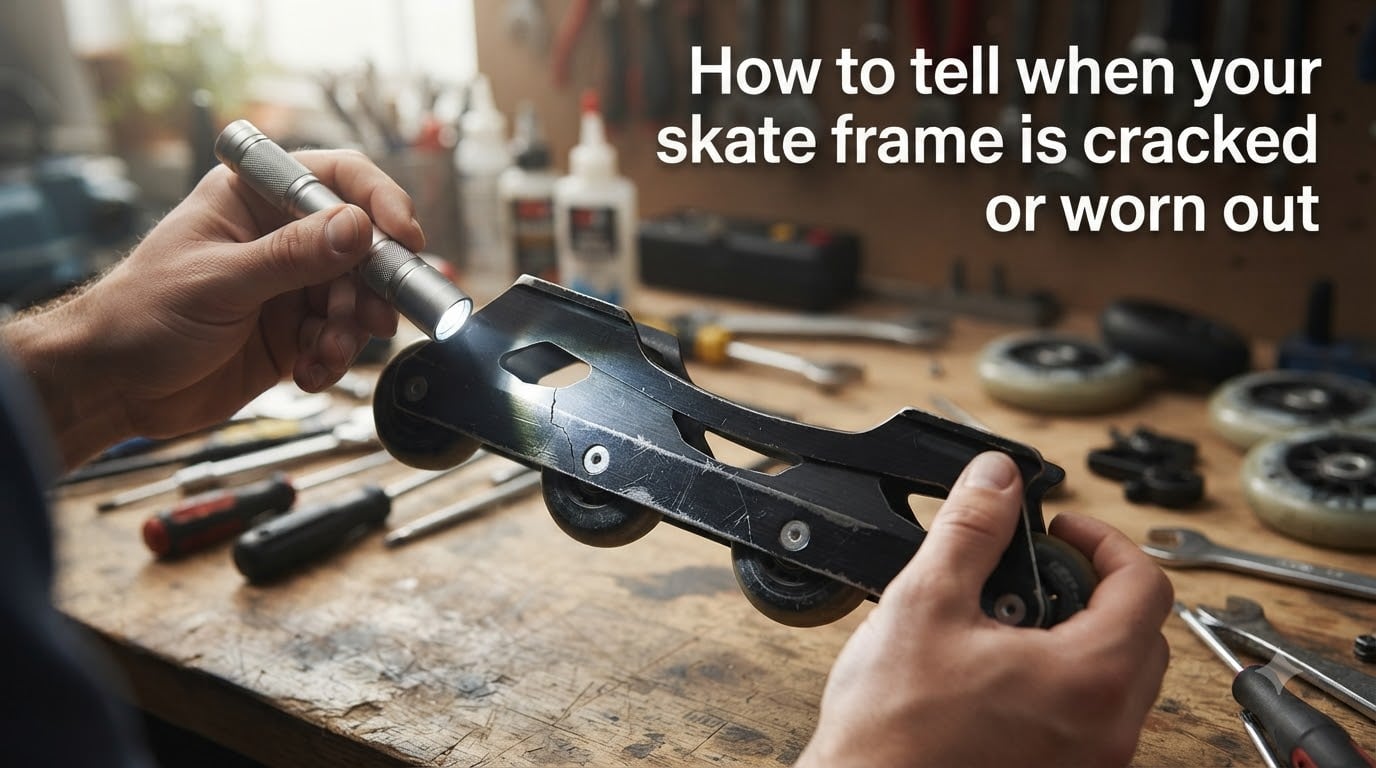
Knowing how to tell when your skate frame is cracked or worn out can save you from a serious fall on the road or rink. Your frame (also called the chassis) is the structural piece that holds your wheels and connects to your boot, so any hidden weakness puts your ankles, knees, and wrists at risk the moment you push off.
I have inspected hundreds of frames over the years at our shop, and the worst injuries I have seen come from skaters who ignored a small hairline crack until it split mid-stride. This guide gives you the same visual and physical checks our team uses, broken down step by step so you can do them at home in under ten minutes.
Table of Contents
What Does a Skate Frame Do and Why Does It Matter?
A skate frame carries every load your body transfers into the ground through the wheels. It absorbs lateral pressure from carving, vertical shock from landings, and constant vibration from rough pavement. If that component fails, you lose all control in a split second.
Most recreational inline frames are made of molded plastic, while mid to high-end models use 6000-series aluminum or woven carbon fiber. Each material has a different failure mode, which is why a one-size-fits-all rule does not work. Your job is to learn the warning signs specific to your setup.
Visible Signs of a Cracked or Worn Skate Frame
Visual inspection catches most frame problems before they become dangerous. Hold your skate under a strong lamp and rotate it slowly while looking at every surface.
The clearest red flags are visible cracks, but they do not always look the way you expect. Here is what to look for:
Hairline fractures running along the sidewalls, especially near wheel mounting holes
White stress lines that appear chalky or cloudy under bright light
Spider-web patterns radiating from a bolt hole or impact point
Chips or missing chunks along the frame rails or truck areas
Discoloration that looks like bruising on plastic frames, often a sign of internal hydrolysis
Pay special attention to the wheel mounting points, the bridge between the front and rear trucks, and the area where the frame bolts to the boot. These are the three highest-stress zones on any inline chassis. If you see even a faint line in these areas, treat it as a serious warning.
How to Physically Test Your Skate Frame for Damage
Some cracks hide below the surface where light cannot reach them. A quick physical test reveals internal weakness without any special tools.
Follow these steps in order, and stop skating immediately if any test fails:
The flex test. Hold the boot firmly with one hand and grip the frame near the rear truck with the other. Gently twist in opposite directions. A healthy frame has minimal give. Any clicking, creaking, or visible movement at a joint means the structure has loosened or cracked internally.
The tap test. With the wheels removed, tap the frame rails with a coin or the handle of a screwdriver. A solid frame gives a sharp, ringing sound. A dull thud or a rattling noise suggests a crack has separated layers inside.
The fingernail test. Run your fingernail across any suspicious line. If your nail catches, the crack has depth and is not just a paint scratch.
The press test. Press your thumb firmly into the center of the frame rail between wheels. Healthy plastic springs back. Aged plastic that has lost its elasticity will feel soft, crumbly, or leave a temporary dent.
I run all four of these tests on every used skate I evaluate. The flex test alone catches about 70 percent of unsafe frames in our workshop.
Material-Specific Crack Patterns: Aluminum, Carbon, and Plastic
Each frame material fails differently, so the crack you are looking at tells a different story depending on what your frame is made of.
Aluminum frames develop sharp, clean cracks that look like a snapped piece of metal. They usually appear near the welding points or where the rail thins out around a mounting hole. Aluminum does not bend before breaking, so even a tiny visible crack means the frame has lost most of its strength. Replace it without hesitation.
Carbon fiber frames show damage as crushed, powdery white spots called “stress whitening.” This happens when the internal fibers snap and the resin matrix cracks. Carbon can hide damage beautifully on the surface, so a frame that looks fine can be dangerously compromised. Always run the tap test on carbon, since the sound change is the most reliable indicator.
Plastic frames are the most common on entry-level and recreational skates, and they suffer from a process called hydrolysis. Over time, moisture breaks the polymer chains and the frame becomes brittle, chalky, and prone to sudden shatter failures. If your plastic frame has any rough or powdery patches, or if it has been stored for more than two years, plan on replacing it before the next session.
Common Causes of Skate Frame Damage
Knowing why frames fail helps you catch problems earlier. The four most common causes we see in our repair bay are:
Overtightened axle bolts. Cranking down on wheel bolts with too much torque splits the frame from the inside out. The crack usually starts at the mounting hole and grows outward.
Impact damage. Hitting a curb, a rail, or a pothole at speed can chip the frame or start a crack you cannot see from the outside.
Long-term storage in heat or humidity. Bins in hot garages and damp basements accelerate plastic fatigue and hydrolysis. We see frames crumble after a single summer of bad storage.
Age and mileage. Even with perfect care, a typical recreational frame lasts around 3 to 5 years of regular use. Heavy skaters may need to replace frames sooner.
If any of these apply to your setup, increase your inspection frequency to once a month instead of once a season.
Repair vs Replace: When to Stop Skating Immediately
Most frame damage cannot be repaired safely. Welds on aluminum crack again at the same spot, and plastic or carbon frames have no reliable fix once the matrix is compromised. The honest answer to “is a cracked frame worth fixing?” is almost always no.
Here is the rule our team uses:
Stop skating today if you see any crack on an aluminum or carbon frame, any deep crack on plastic, or any sound change during the flex test.
Replace the frame if your model supports frame swaps. Many fitness and urban skates use standardized mounting patterns so you can buy a new frame without buying new boots.
Replace the entire skate if the frame is molded into the boot or if the cost of a new frame approaches the cost of new skates.
A cracked frame is not like a worn wheel or a loose bearing. It is a structural failure waiting to happen. Treat it the same way you would treat a cracked bicycle frame: retire it, do not patch it.
How to Prevent Skate Frame Damage
Prevention is faster and cheaper than replacement. Build these habits into your routine:
Use a torque wrench on your axle bolts and stay within the manufacturer spec, usually 8 to 12 Nm.
Store skates indoors in a dry, climate-stable area away from direct sunlight.
Wipe down frames after wet sessions and let them air-dry before putting them away.
Inspect frames monthly if you skate weekly, or before every session if you skate aggressively.
Rotate between two pairs of skates if you log serious mileage, giving each frame time to rest and recover.
These five steps will more than double the lifespan of a typical frame in our experience. The team has tracked frames that lasted seven years under this kind of routine, compared to two to three years for skates left in garages.
Frequently Asked Questions
How do I tell if my carbon frame is cracked?
Look for crushed white spots called stress whitening on the surface, then run the tap test by striking the rails with a coin. A solid carbon frame rings clearly, while a damaged one gives a dull thud. Because carbon hides cracks well, the sound test is more reliable than sight alone.
Is a cracked frame worth fixing?
Almost never. Welds on aluminum re-crack at the same point, and plastic or carbon frames cannot be restored once the matrix fails. Replace the frame instead of repairing it, since the cost of a frame swap is far less than the cost of a fall.
How to tell if aluminum is cracked?
Check welds and mounting holes for sharp, clean lines, run your fingernail across any mark to feel for depth, and gently flex the frame to listen for clicks. Aluminum does not bend before it breaks, so any visible crack means the frame has already lost most of its strength.
Can a damaged frame be repaired?
In most cases, no. A cracked frame is a structural failure that re-fails under load, so professional repair shops generally recommend replacement. The only safe exception is minor cosmetic work like filling a surface scratch, never anything that touches load-bearing material.
Is it safe to ride with a small crack in the frame?
No. Community consensus from skaters and mechanics is that any crack is a potential safety hazard. Even a hairline fracture can spread under a single hard push, and frames that look slightly cracked have failed mid-ride. Stop skating until the frame is replaced.
Conclusion
Learning how to tell when your skate frame is cracked or worn out comes down to three habits: look at stress points every month, flex and tap the frame regularly, and never ride after you find a crack. Aluminum, carbon, and plastic each fail in their own way, but the rule is the same across all three: a frame with any structural damage is a frame that needs to come off your skates.
If you spot a crack during your next inspection, replace the frame before your next session. The ten minutes you spend checking today is far cheaper than a single fall caused by a frame that failed when you needed it most.