
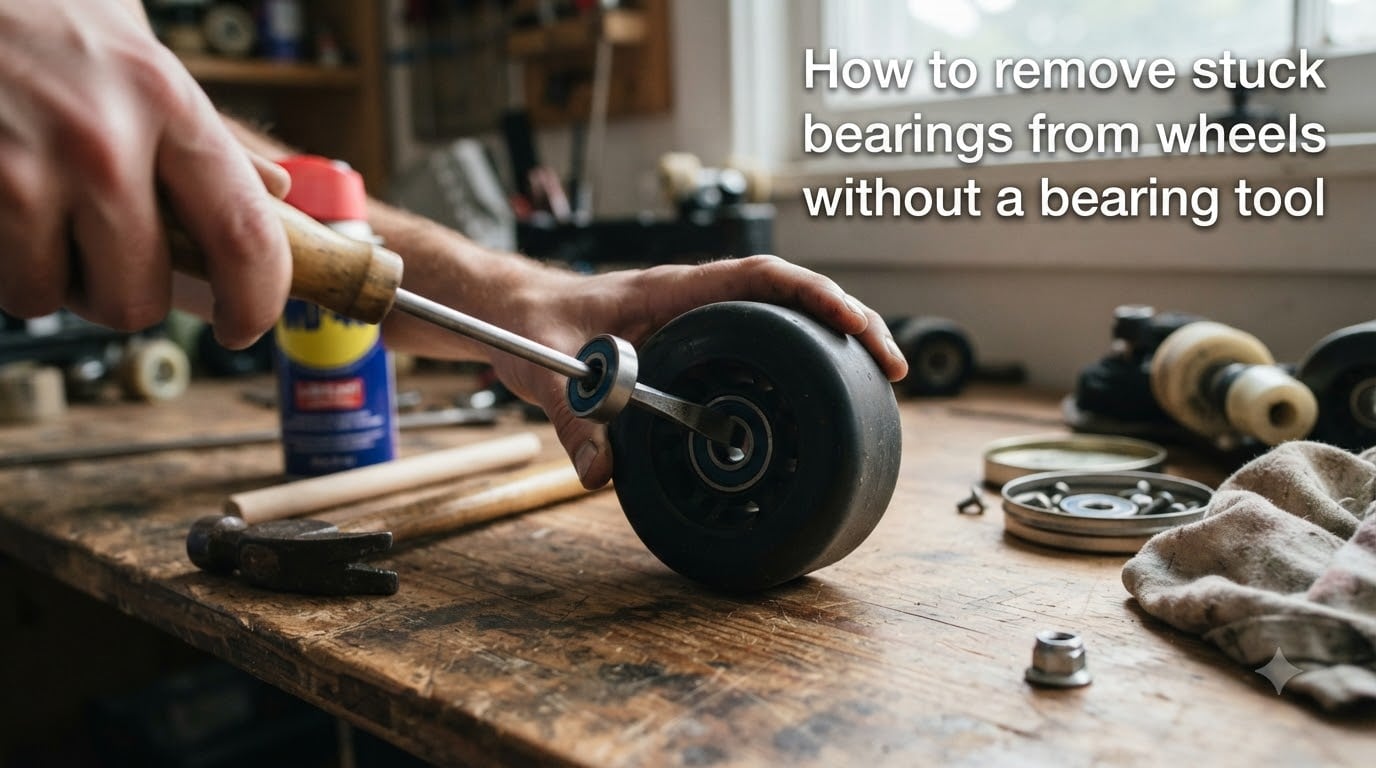
Few things are more frustrating than grabbing your skates for a session and finding bearings that won’t budge. I’ve been there, sitting on my garage floor with a jammed wheel and no skate tool in sight. The good news: you can remove stuck bearings from wheels without a bearing tool, and I’ve done it dozens of times using stuff I already had in my toolbox.
This guide breaks down three reliable methods I use depending on the wheel type, plus the household items that work as substitutes. Whether you’re dealing with rusty inline skate bearings or stubborn rollerblade wheels, there’s a fix here.
Table of Contents
What You Need: Household Alternatives to a Bearing Tool
You don’t need a specialty bearing puller to get the job done. Over the years, I’ve pulled bearings using a flathead screwdriver, an axle bolt, a wooden dowel, even a paint can opener. Here’s what works when you don’t have a bearing puller:
- Flathead screwdriver – the most common stand-in. Use one with a wide tip so it doesn’t slip into the bearing race.
- A second bearing (the “whip” method) – actually the cleanest approach for plastic core wheels with an 8mm axle.
- Hammer and a wooden dowel or punch – required for metal core wheels where you can’t push through the hub.
- Paint can opener – curved edge works surprisingly well as a bearing popper on softer plastic wheels.
- Penetrating oil (WD-40 or PB Blaster) – essential for rusted or corroded bearings that have seized in place.
- Clean rag and gloves – because bearings get greasy fast.
A tip I picked up from a roller derby forum: keep a worn-out bearing in your skate bag. It becomes your free puller and saves you every single time.
Identify Your Wheel Type and Axle Size First
Before you force anything, you need to know what you’re working with. The removal method depends entirely on two things: whether your wheel has a plastic core or a metal core, and whether your axle is 6mm or 8mm.
To check the axle size, look at the side of your skate truck or the bolt that clamps the wheel. Most modern inline skates use 8mm axles, while some roller skates and older setups use 6mm. Hold the bolt against a ruler or coin to compare.
For the wheel core, look at the inside of the bearing seat. If you can see colored plastic (often white, black, or translucent), it’s a plastic core wheel. If you see silver or grey metal extending into the bearing area, it’s a metal core wheel. This matters because plastic cores flex slightly under pressure, while metal cores need direct force to drive the bearing out.
Method 1: The Whip Method for 8mm Axle Plastic Core Wheels
The whip method is the fastest way to remove stuck bearings from wheels without a bearing tool, and it works best on plastic core wheels with 8mm axles (most inline skates and rollerblades). I learned this from a rink mechanic who used it daily across hundreds of rental skates.
- Make sure the wheel is fully off the skate and you can freely hold both sides.
- Take a second bearing (any old one will do) and drop it into the wheel on one side, roughly halfway into the bearing seat.
- Hold the wheel horizontally with both hands, fingers underneath and thumbs on top.
- Press your thumbs down on the protruding bearing and quickly snap your wrists downward to drive the trapped bearing out the other side.
- Catch the bearing as it pops free and grab it with your free hand.
- Repeat on the opposite side to remove the second bearing.
The motion is sharp and quick, not slow. Think of it like snapping a towel. I’ve removed bearings in under 10 seconds this way once I got the rhythm.
Method 2: The Push Method for 6mm Axle Plastic Core Wheels
If your wheel has a 6mm axle, the whip method won’t work because the bearing doesn’t have enough surface area to grip. The push method steps in here, and it requires a long bolt or axle that fits through the wheel’s center hole.
- Remove the wheel from the skate completely.
- Find a bolt, threaded rod, or screwdriver shaft that fits through the small center hole of the wheel hub (around 6mm or smaller).
- Insert the bolt through one side of the wheel so it pushes against the inner race of the first bearing.
- Place the wheel flat on a workbench or piece of scrap wood with the bolt pointing down.
- Tap the top of the bolt with a hammer until the first bearing pops out the bottom.
- Flip the wheel and repeat to push out the second bearing.
I had a neighbor try this for the first time last month with a 6mm hex key and a soft mallet on top of an old phone book. Both bearings came out within a minute, and he didn’t scratch the wheels once.
Method 3: The Hammer Method for Metal Core Wheels
Metal core wheels are tougher because the metal hub runs through the center. You can’t push a bolt through, so the hammer method is your only realistic option without a bearing press.
- Take the wheel off the skate and place it on a scrap piece of wood. The wood protects your work surface and gives the bearing something to push against.
- Locate the inner race of the bearing (the small metal ring inside the bearing itself).
- Position a flathead screwdriver, chisel, or punch against the inner race. Make sure it sits flat against the race, not the outer shield.
- Tap firmly with a hammer, working your way around the bearing in small increments.
- Rotate the wheel a quarter turn, reposition your tool, and tap again.
- Keep rotating and tapping until the bearing walks out of the wheel evenly.
- Repeat for the second bearing on the other side.
This is the noisiest method but it works on virtually every wheel. A forum user on r/rollerblading pointed out that tapping the inner race instead of the outer race is what stops you from denting the wheel’s plastic or urethane surface.
Troubleshooting Really Stuck or Rusted Bearings
Sometimes the methods above aren’t enough, especially if the bearings have been sitting exposed to moisture. When I get a wheel where the bearing absolutely refuses to move, I run through three extra steps before giving up.
First, soak the bearing area with penetrating oil. Spray WD-40 or PB Blaster around the bearing seat and let it sit for 10 to 15 minutes. The oil works into the gap and breaks down rust. Second, apply gentle heat with a hair dryer or heat gun on a low setting. Warming the metal expands it slightly and can break the bond. Third, alternate between heating and tapping. The thermal cycling can free even severely corroded bearings.
If the inner race stays on the wheel after the outer bearing slides out, slide the inner race onto your axle bolt and tap it sideways until it pops free. Don’t try to yank it with pliers or you’ll damage the bearing seat permanently.
Safety Precautions Before You Start
Bearings under tension can fly out unexpectedly when they release. I learned this the hard way when a bearing shot across my garage and pinged off a shelf.
- Always wear safety glasses. Bearings and metal fragments can launch at high speed.
- Wear work gloves to protect your fingers when using the hammer method.
- Cover your work surface with an old towel or cardboard. Bearings roll away fast.
- Keep your free hand out of the path of the popping bearing.
- Never use a center punch or sharp tool in place of a proper screwdriver. Slipping tools cause cuts.
When to Replace Bearings Instead of Removing Them
If you’ve gone through all the steps above and the bearings still feel gritty, spin roughly, or have visible rust pits, replacement is the smarter move. Removing them just to reinstall the same worn bearings is wasted effort.
Replace bearings when they spin less than 3 seconds after a flick with a clean finger, when you hear grinding sounds, or when the bearing has a wobble when spun. Cleaning and re-lubricating only buys you time when the bearings are still smooth but dirty.
Frequently Asked Questions
How do I remove a stuck bearing without a puller?
Use the whip method for plastic core wheels with an 8mm axle (snap the wheel sharply with a second bearing inside), the push method for 6mm axle wheels (drive the bearing out with a bolt and hammer), or the hammer method for metal core wheels (tap the inner race around the edge until it walks out).
What can I use instead of a bearing puller?
A flathead screwdriver, a second old bearing, a hammer with a wooden dowel, a paint can opener, or a bolt that fits your axle size. All of these work as substitutes for a purpose-built bearing puller.
How do I get a wheel bearing off when it is stuck?
Soak the bearing with penetrating oil for 15 minutes, then work it out with the hammer method, tapping the inner race from multiple angles in small increments. Heat from a hair dryer can help expand the metal and break the bond for especially rusted bearings.
How do I get wheel bearings out without a press?
Use the whip or push method for plastic core wheels, working by hand or with a bolt tapped by a hammer. For metal core wheels, tap around the inner race in small increments until the bearing walks out evenly on a piece of scrap wood.
Final Thoughts on Removing Stuck Bearings
The trick to removing stuck bearings from wheels without a bearing tool comes down to matching your method to the wheel type. Plastic core wheels with 8mm axles respond to the whip method, 6mm axle wheels need the push method, and metal core wheels need controlled hammer taps around the inner race.
Save yourself the frustration by pulling bearings regularly before they seize, and keep a spare bearing tucked in your tool kit for whip-outs. Next time a wheel locks up at the rink, you’ll have the bearings out and cleaned up before anyone asks for the skate tool.