
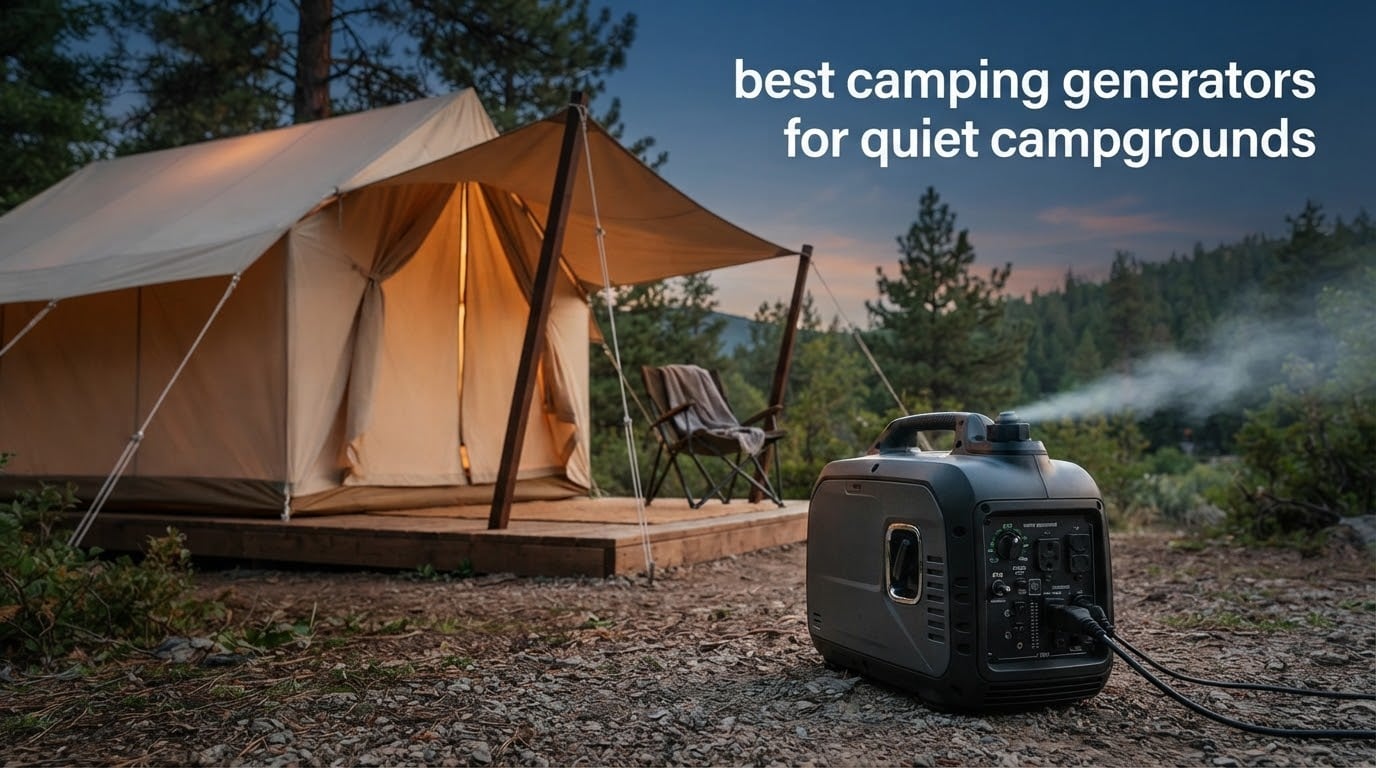
The quietest generator you can use for camping is a low-decibel inverter unit rated around 48 to 58 dB(A) at 23 feet, or a battery power station that makes no noise at all. Both let you run inside campground generator hours. Open-frame gas units at 64 dB and above are the ones that get you asked to shut it off.
That is the short version. The longer version is that noise is the least interesting thing about this decision until you pull into a site at 8 p.m. and realize the neighboring tent is 25 feet away. Most campgrounds publish generator hours, often an 8 p.m. or 10 p.m. cutoff, and many add a quiet-hours rule that applies even before the cutoff. A loud generator is how campers get ticketed, warned, or asked to move.
So the question is not really which generator is best. It is which generator can do your load quietly enough, at a distance that keeps you in good standing. We compared ten units in the current market, pulled the published noise figures, checked running watts against the loads campers actually plug in, and sorted them by decibel tier rather than by gas-versus-battery marketing. Every number below comes from the manufacturer spec sheet or from the owner reviews attached to the listing.
If you want the wider picture first, our portable generator roundup covers the non-camping use cases, and our inverter generator guide goes deeper on how inverter technology changes throttle behavior.
Table of Contents
Top 3 Picks for Quiet Campgrounds in October 2026

Honda EU2200i 2200W Inverter
- 48-57 dB(A) operation
- 1800W running watts
- 46.5 lb body
- CO-MINDER auto-shutdown

WEN 56235i 2350W Inverter
- 39 lb body
- 1900W running watts
- verified 13500 BTU RV AC use
- up to 10 hour runtime

Champion 4000W Dual Fuel…
- Runs on gasoline or propane
- 3000W running watts
- 30A TT-30R outlet
- CO Shield shutoff
All 10 Quiet Camping Generators at a Glance for October 2026
| Product | Specs | Action |
|---|---|---|
| Honda EU2200i 2200 Watt Inverter Generator |
|
Check Latest Price |
| WEN 56235i 2350W Super Quiet Inverter |
|
Check Latest Price |
 AIVOLT 1600W Super Quiet Inverter AIVOLT 1600W Super Quiet Inverter |
|
Check Latest Price |
 PowerSmart 4000W Portable Inverter PowerSmart 4000W Portable Inverter |
|
Check Latest Price |
| Champion 4000W Dual Fuel RV Ready Inverter |
|
Check Latest Price |
 ERAYAK 2400W Portable Inverter Generator ERAYAK 2400W Portable Inverter Generator |
|
Check Latest Price |
 Champion 4250W Dual Fuel Open Frame Inverter Champion 4250W Dual Fuel Open Frame Inverter |
|
Check Latest Price |
 Pulsar PGD40ISCO 4000W Gas Inverter Pulsar PGD40ISCO 4000W Gas Inverter |
|
Check Latest Price |
 Oxseryn 2800W Portable Inverter Oxseryn 2800W Portable Inverter |
|
Check Latest Price |
 Oxseryn 4400W Open Frame Inverter Oxseryn 4400W Open Frame Inverter |
|
Check Latest Price |
A note on the noise column before you read further. Every dBA figure below is quoted from the manufacturer or listing at the stated test distance, usually 23 feet or 7 meters. Forum users point out, correctly, that these are measured in an empty lot with nothing for sound to bounce off, which is not a campground. Expect the real number at your site to be higher, and treat the differences below as tiers rather than exact readings.
1. Honda EU2200i – The Editor’s Choice Unit You Can Carry To A Tight Site
Honda EU2200i 2200 Watt Inverter Generator (EU2200ITAN)
1800W running / 2200W starting
48-57 dB(A)
9 hours runtime
46.5 lb
Pros
- Very quiet 48-57 dB(A) operation
- Clean inverter output for sensitive electronics
- Reliable electric and recoil first-pull starting
- Compact 46.5 lb body with long runtime
Cons
- Most expensive unit in this lineup
- Not sold in California
- 2200W starting ceiling is modest for large air conditioners
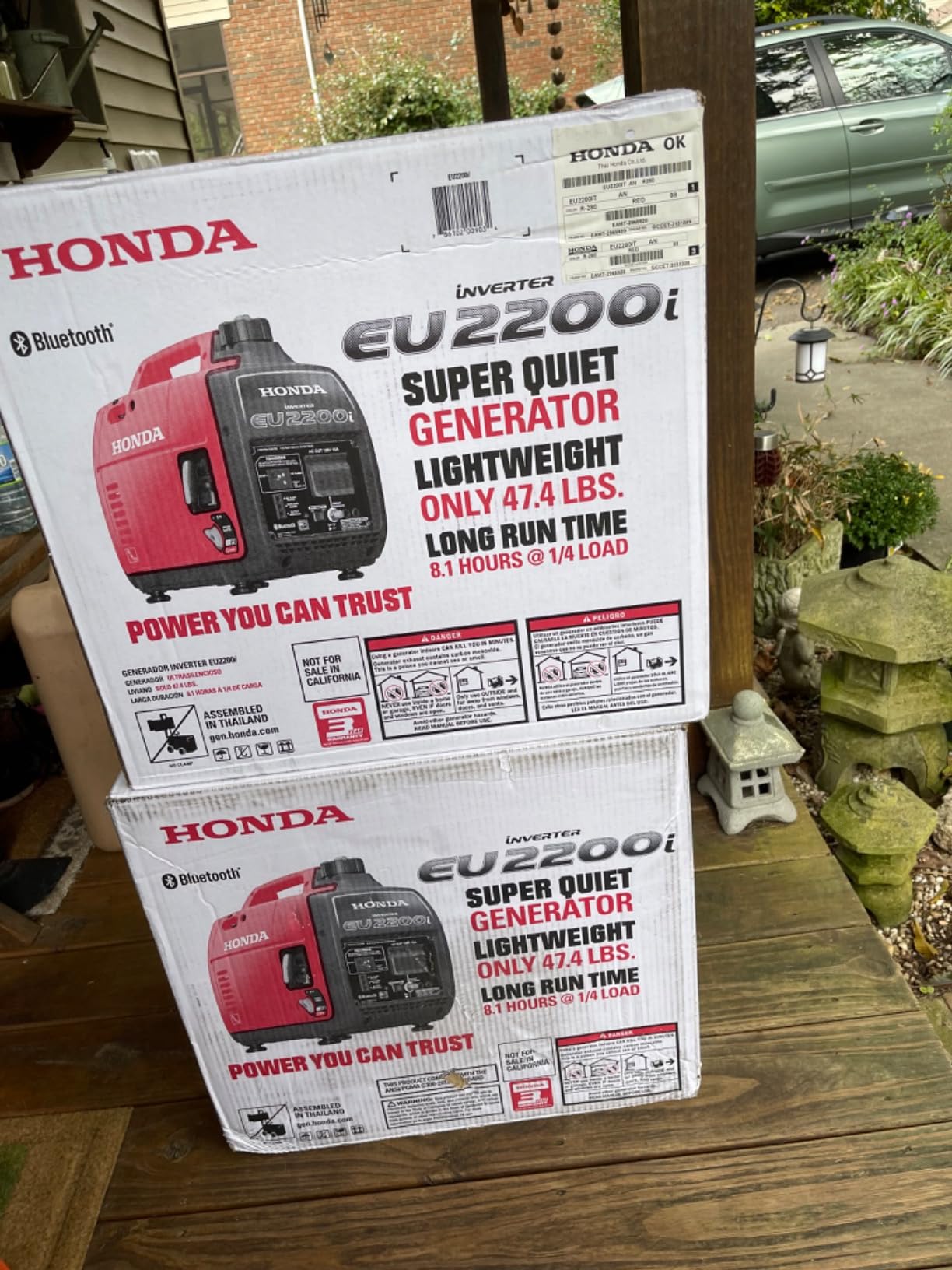
I keep the Honda EU2200i at the top of this list for one reason: it is the unit I can put at 20 feet in a crowded RV park and still hear nothing over a conversation. Owners describe the same thing in their reviews, calling it quieter than a normal conversation across thousands of reviews. That is the tier that lets you run past a 10 p.m. cutoff without becoming the neighbor everyone complains about.
The 1800 running watts cover the loads most campers actually have. Phones, laptops, a CPAP machine, a 12V fridge on its inverter, a router, and LED lighting all fit with room to spare. The 0.95-gallon tank gives roughly 9 hours of runtime, which covers a full night without a refill.
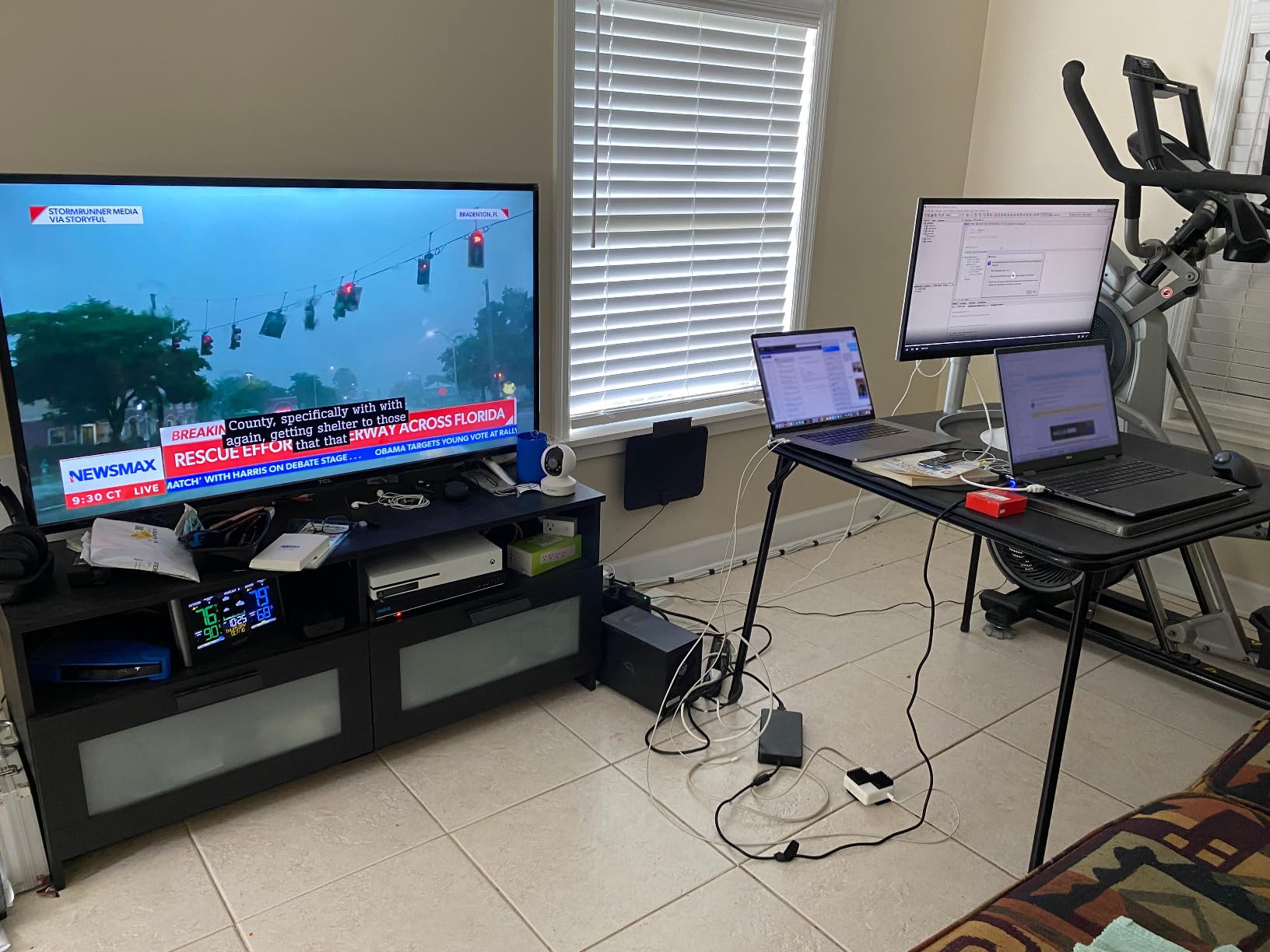
Build quality is the other reason it has 3228 reviews behind it. The four-stroke engine starts on the first or second pull, the frame is balanced enough to carry with one hand at 46.5 pounds, and the inverter keeps total harmonic distortion low enough for laptops and medical devices. The CO-MINDER sensor shuts the engine down if carbon monoxide climbs where it should not.
Bluetooth control through the Honda My Generator app is genuinely useful at a campground. You can check fuel level and runtime from inside the trailer instead of walking out in the dark with a phone flashlight, which is exactly the situation where fumbling around next to a running generator is unpleasant.
When the Honda EU2200i is the right pick
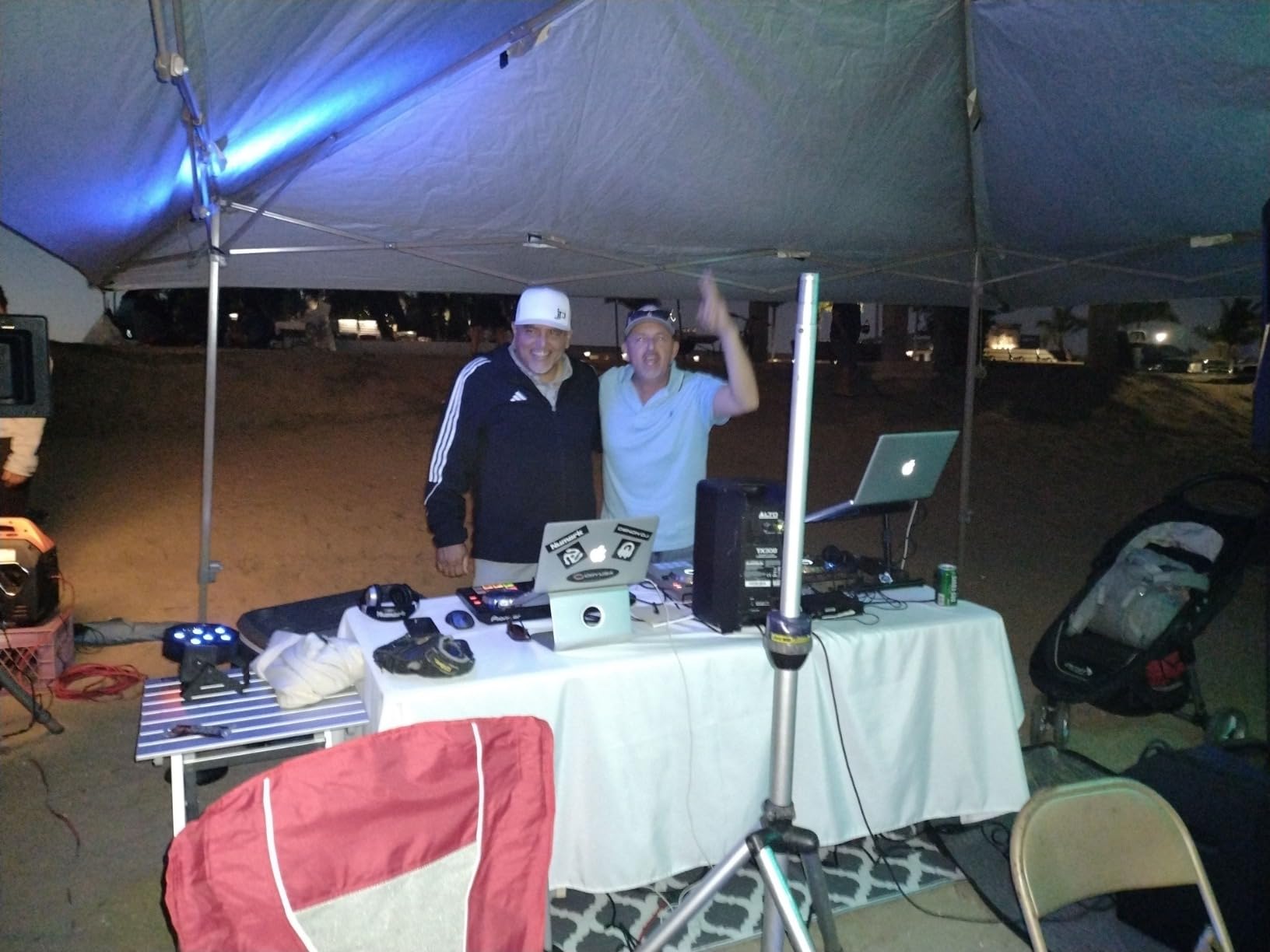
It wins when your neighbor is close and your load is moderate. A CPAP machine, a fridge, and a charge bank is the classic EU2200i campsite. It also wins if you travel solo, because 46.5 pounds is carryable and the 21 by 20 by 13 inch footprint fits in a hatchback trunk without a dolly.
Where it will not fit your trip
It will not run a 13500 BTU rooftop air conditioner. The 2200W starting ceiling is the constraint reviewers mention most, and adding a soft-start module helps but does not erase the gap. It is also not sold in California, and it carries the highest cost in this lineup by a wide margin.
2. WEN 56235i 2350W – Best Value Inverter With Confirmed Air Conditioner Use
WEN Super Quiet 2350-Watt Portable Inverter Generator with Fuel Shut Off, Gasoline Power, Ultra Lightweight (56235i), Black
1900W running / 2350W starting
Conversation-level noise
39 lb
10 hours
Pros
- Quiet enough to hold a conversation beside it
- Only 39 lb so one person can load it
- Verified to run a 13500 BTU RV air conditioner with a soft-start module
- Eco mode noticeably extends runtime
Cons
- Struggles with high inrush starting loads
- Sustained output tops out around 1850W
- Low-oil shutdown can trip on a gentle slope
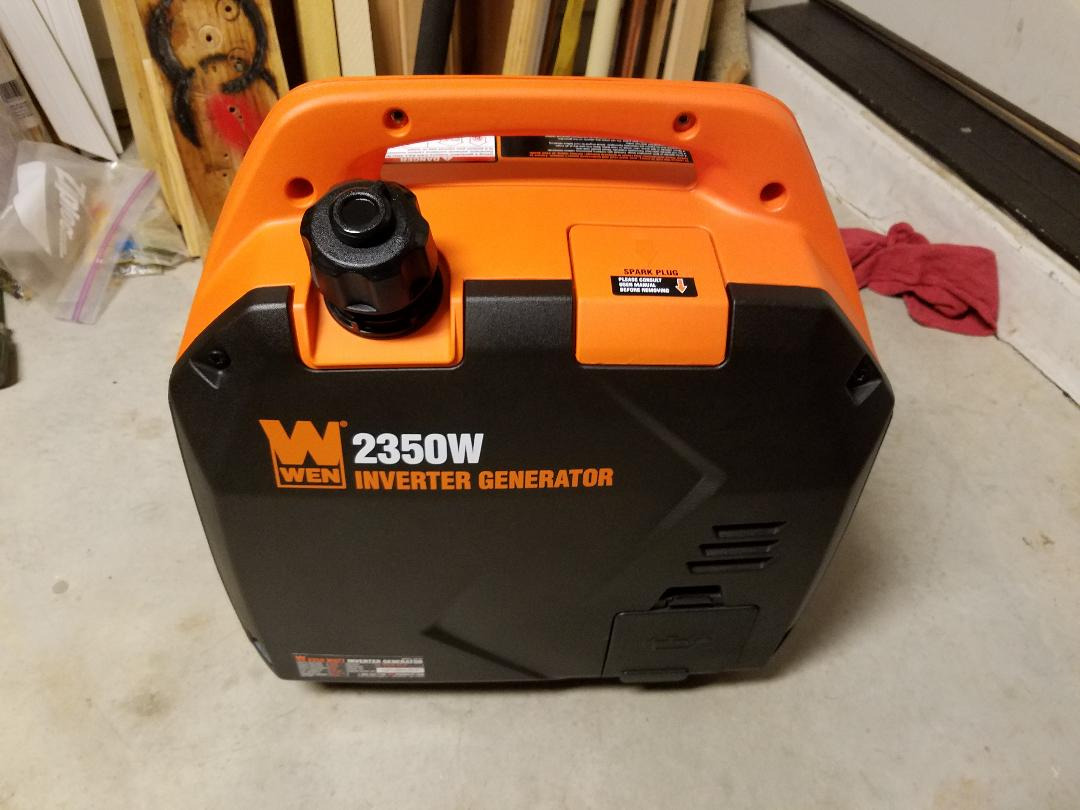
The WEN 56235i is the answer for anyone who wants Honda-tier quiet behavior without the Honda-tier invoice. At 39 pounds it is the second-lightest inverter here, and the listing describes noise as comparable to a normal conversation. That places it in the same decibel neighborhood as the EU2200i for a lot less money.
What separates it from the other budget inverters is a specific owner verification: multiple buyers report running a Dometic 13500 BTU RV air conditioner off it with a Micro-Air EasyStart soft-start module. That is the top forum question in this category answered in the affirmative by a specific machine.
Outlet selection is better than most at this size. You get two 120V three-prong receptacles, a 12V DC receptacle, and two 5V USB ports, which means a phone-charging session does not compete with the fridge for a wall socket. The fuel shutoff switch drains the remaining carburetor fuel before shutdown, which cuts stale-fuel gumming complaints on the first start after storage.
Runtime is a genuine strength. A full 1-gallon tank runs about 10 hours, and eco mode stretches that further when your load is mostly electronics. Several owners report first-pull or second-pull starting without exception across seasons.
When the WEN 56235i is the right pick
It is the pick for a couple running a travel trailer air conditioner on a budget, and for anyone who will not lose sleep over a soft-start module. It also suits campers whose load is mixed: fridge plus coffee maker plus phone charging fits inside 1900 rated watts if you sequence the big loads rather than running them at once.
Where it will not fit your trip
Surge starting is the weak point. Reviewers advise starting big appliances first, because a compressor trying to pull inrush on a cold fridge can trip the overload. Sustained output also settles around 1850W before the overload light comes on, and the low-oil cutoff can trip on a slope, so the site has to be level.
3. AIVOLT 1600W – The Lightest Option For Walk-In Sites
AIVOLT 1600W Super Quiet Inverter Generator 28lbs Portable for Camping
1260W running / 1600W starting
57 dBA at 23 ft
28 lb
8 hours at 25 percent load
Pros
- Lightest machine in this group at 28 lb
- 57 dBA at 23 ft is quieter than conversation
- Eco mode gives up to 8 hours on a light load
- CO auto-shutoff plus low-oil and overload protection
- Under 3 percent THD clean sine wave output
Cons
- Only 1260W running watts
- Runtimes drop to about 2 hours at full load
- Highest share of one-star ratings in this group
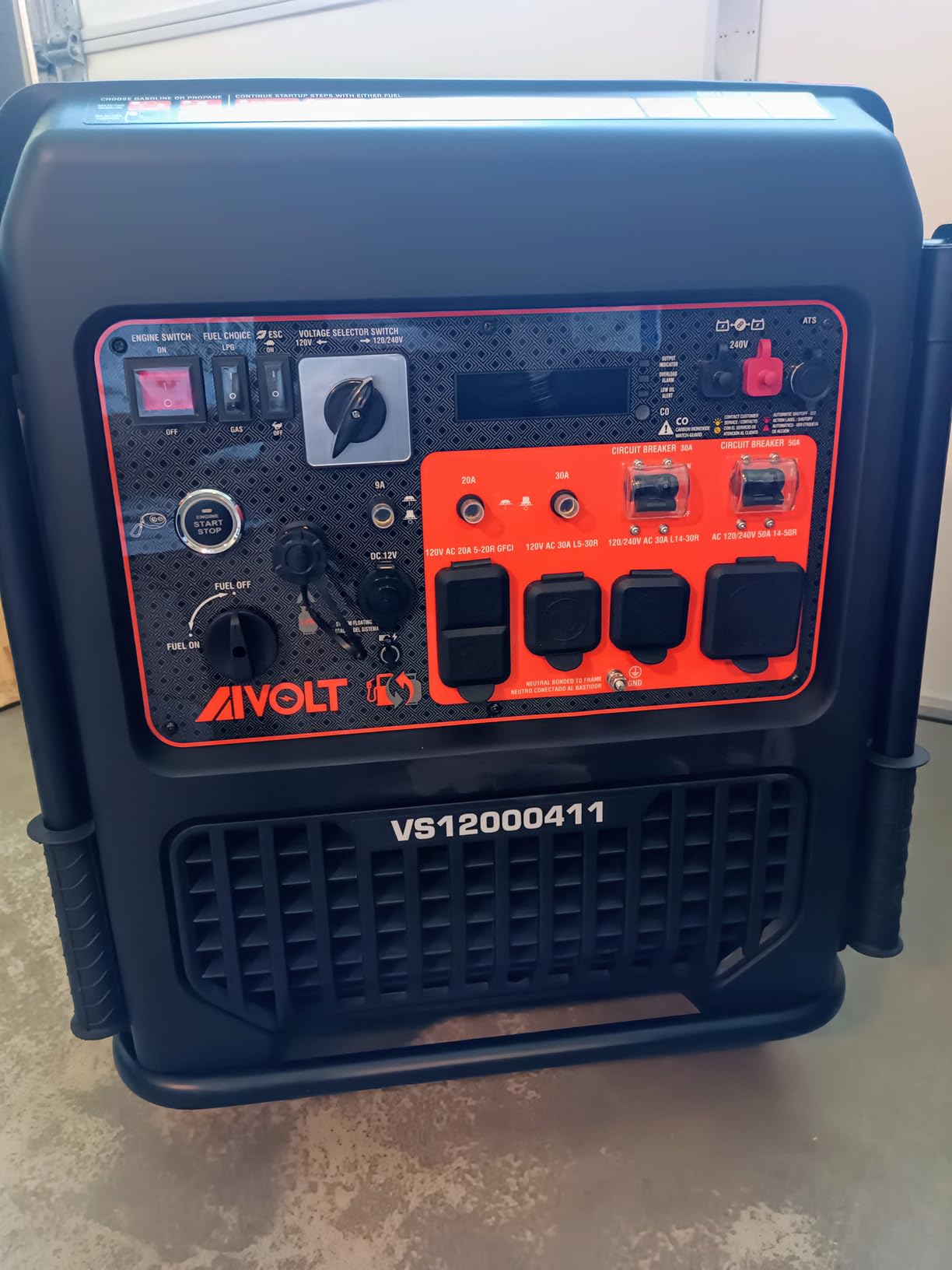
At 28 pounds, the AIVOLT is the only machine in this group light enough to carry from the car to a back-in site in one hand with a full tank. For a walk-in tent camper or anyone who refuses to drag a wheel kit across gravel, that weight number is the whole decision.
Noise is genuinely good. The 57 dBA figure at 23 feet sits below conversation level, and the output is clean, with total harmonic distortion under 3 percent, which makes it safe for phones, laptops, and small sensitive electronics. The 60cc four-stroke engine with copper windings also earns a CO alert auto-shutdown alongside low-oil and overload protection.
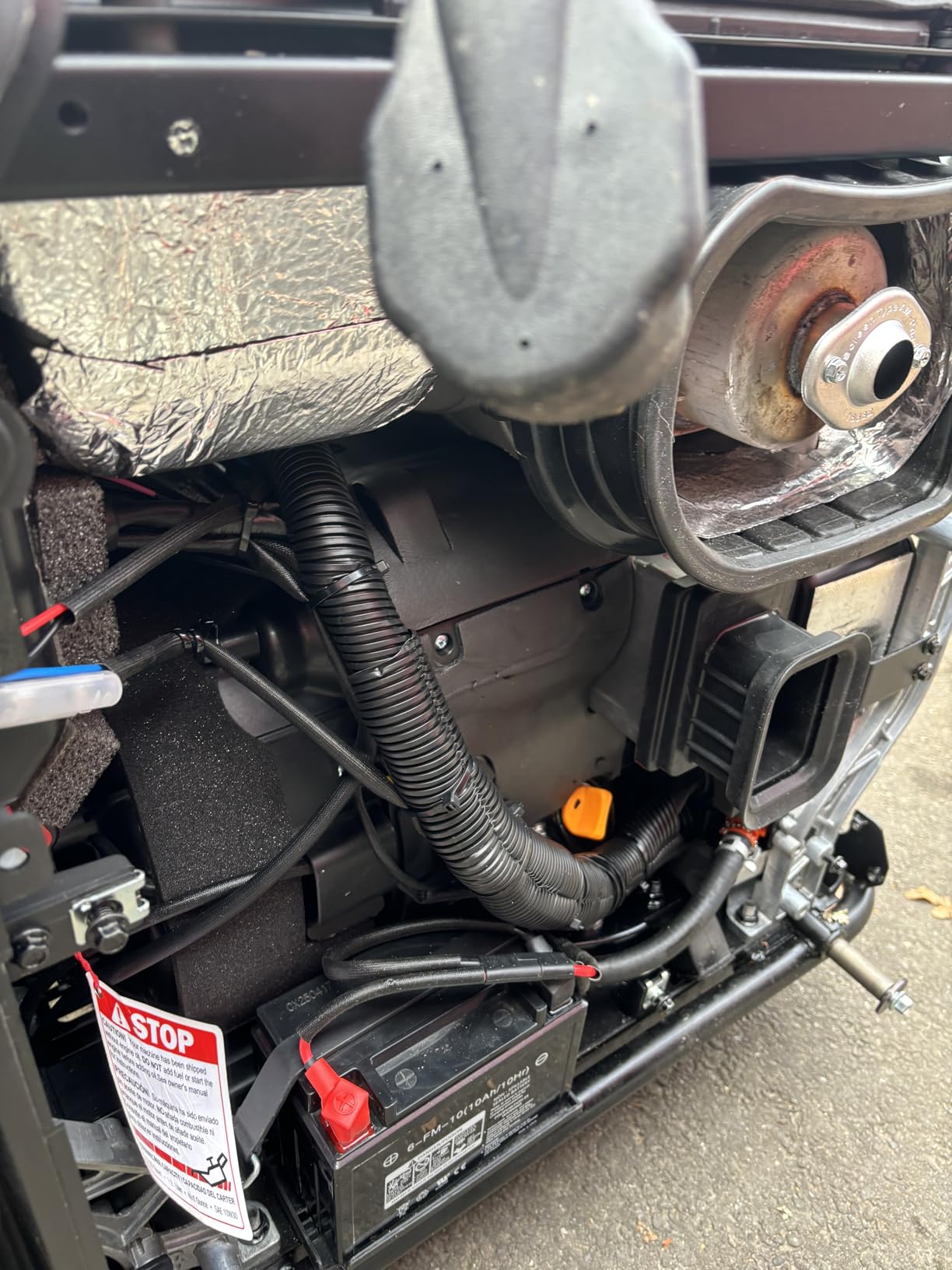
It is also parallel-ready through a separately sold kit, so two of these can be paired into a setup that covers loads the single unit cannot. That is the upgrade path that keeps the 28-pound purchase from feeling like a dead end.
The 4.1 average is the lowest here, and the reasons are consistent in the reviews. It is the smallest capacity in the group, it does not include engine oil, and 12 percent of its ratings are one-star, which points to a slice of early durability and quality-control complaints rather than a design flaw.
When the AIVOLT 1600W is the right pick
It is right for two people on a tent or rooftop-tent site where the load is a phone charger, a fan, a lantern, and a small speaker. Carry weight dominates in that scenario, and no other machine here gets under 39 pounds.
Where it will not fit your trip
It will not run an air conditioner, a microwave, or a water pump. With 1260 running watts, adding a single mid-size kitchen appliance can trip the overload, and full-load runtime falls to roughly 2 hours. If your site has a 30A RV pedestal, this is the wrong machine for the trip.
4. PowerSmart 4000W – 30A RV Output In The Standard Box
PowerSmart 3800 Watt Portable Inverter Generator for Home Use
3200W running / 4000W starting
59 dBA at 23 ft
30A twist-lock
50.7 lb
Pros
- 4000W starting and 3200W running gives real headroom
- 59 dBA at 23 ft suits campground quiet hours
- 30A twist-lock outlet feeds an RV directly
- Six outlets including 12V DC and USB
- Eco mode plus parallel capability
Cons
- 50.7 lb is heavy for carry-in camping
- Parallel kit sold separately
- Fewer published owner details than better-known brands
The PowerSmart 4000W solves a problem the smaller inverters cannot: it has a 120V 30A L5-30R twist-lock outlet in the standard package. If you want to plug an RV or a travel trailer directly into the generator rather than running extension cords back to a pedestal, that outlet is the reason to look here.
Noise is 59 dBA at 23 feet. That is a step above the sub-55 dB group, but it remains inside the range most campgrounds accept during posted generator hours, and buyers report it running through quiet evening hours without complaints.
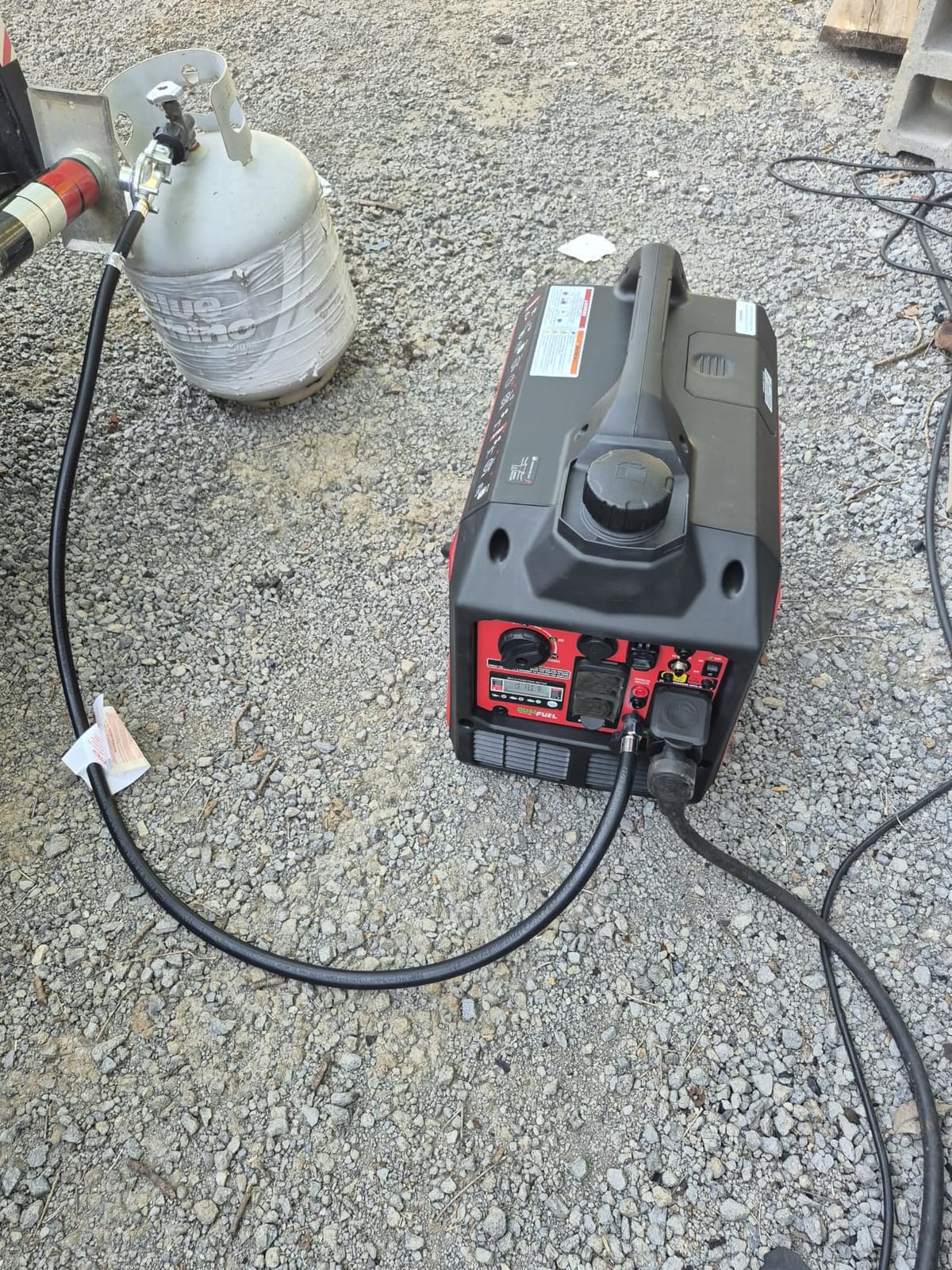
Power headroom is the other argument. 3200 running watts covers a rooftop air conditioner plus a fridge plus a coffee maker, which is a load that defeats the 2000W class entirely. Total harmonic distortion stays under 3 percent, so electronics are safe. The panel carries a 20A duplex, the 30A twist-lock, 12V DC, and dual USB.
It has a fuel gauge on the 1.3-gallon tank, which sounds minor until you are running past quiet hours and need to know how much is left. Cold start technology and low-oil shutdown handle cold-morning and slope-related problems that catch cheaper units out.
When the PowerSmart 4000W is the right pick
It is right for RV campers who want a 30A feed from a quiet-ish inverter rather than paying for a dual-fuel premium model. It also fits anyone with a heavy load and a short walk from the truck, since 50.7 pounds stays within wheel-kit territory.
Where it will not fit your trip
It is not a carry-in unit, and it is a 59 dBA machine, so it needs the same downwind placement discipline as everything else. The parallel kit costs extra, and the brand publishes less verified owner detail than the big names, which makes long-run durability harder to judge before you buy.
5. Champion 4000W Dual Fuel – Headroom For A Rooftop Air Conditioner
Champion 4000-Watt Dual Fuel RV Ready Portable Inverter Generator
3000W running / 4000W starting
Runs on gasoline or propane
64 dBA
30A TT-30R outlet
Pros
- Dual fuel with up to 25 hours on propane
- 30A TT-30R outlet runs a travel trailer air conditioner
- Easy first-pull starting reported repeatedly
- Overload lights a panel button instead of cutting out
- Clean under 3 percent THD power
Cons
- 64 dBA is the loud side of this class
- Newer model needed a gasoline break-in before propane use
- 52 lb is heavier than the 2500W Champion models
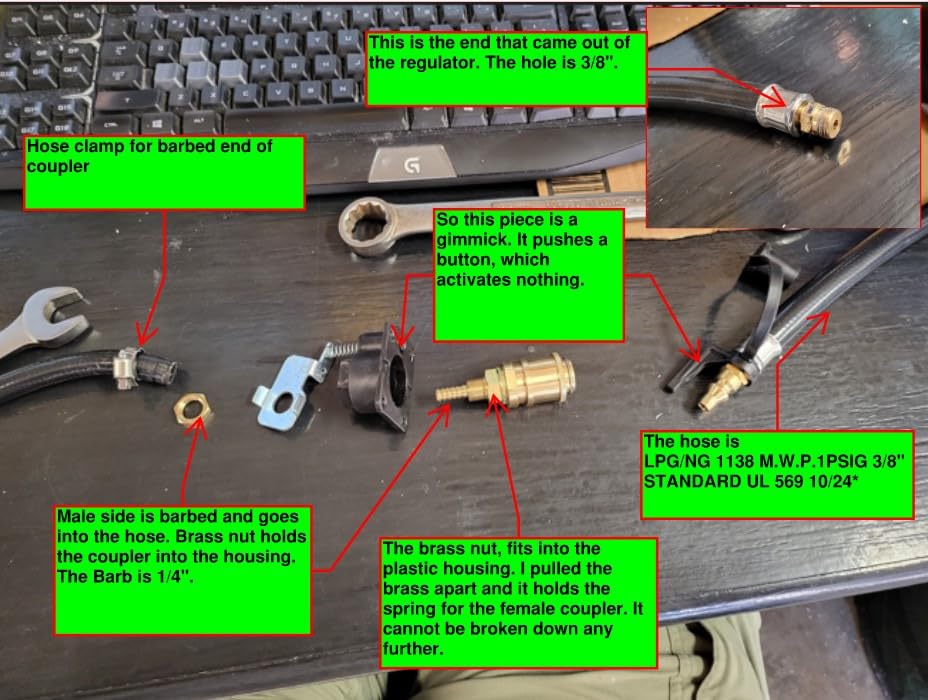
This is the machine for the top forum question: running a rooftop RV air conditioner all night on one tank. Several owners report a full seven-hour session with a 15000 BTU unit, and the 30A TT-30R outlet means the trailer plugs straight in. That combination is the reason it earns the premium slot on this list.
Dual fuel is the quiet advantage nobody talks about. Gasoline gives about 10 hours; propane stretches that to 25 hours at 2700W, and propane burns cleaner, which matters if you want to run close to your own tent wall for a long evening. A 1.54-gallon tank is larger than the one on most 2000W machines.
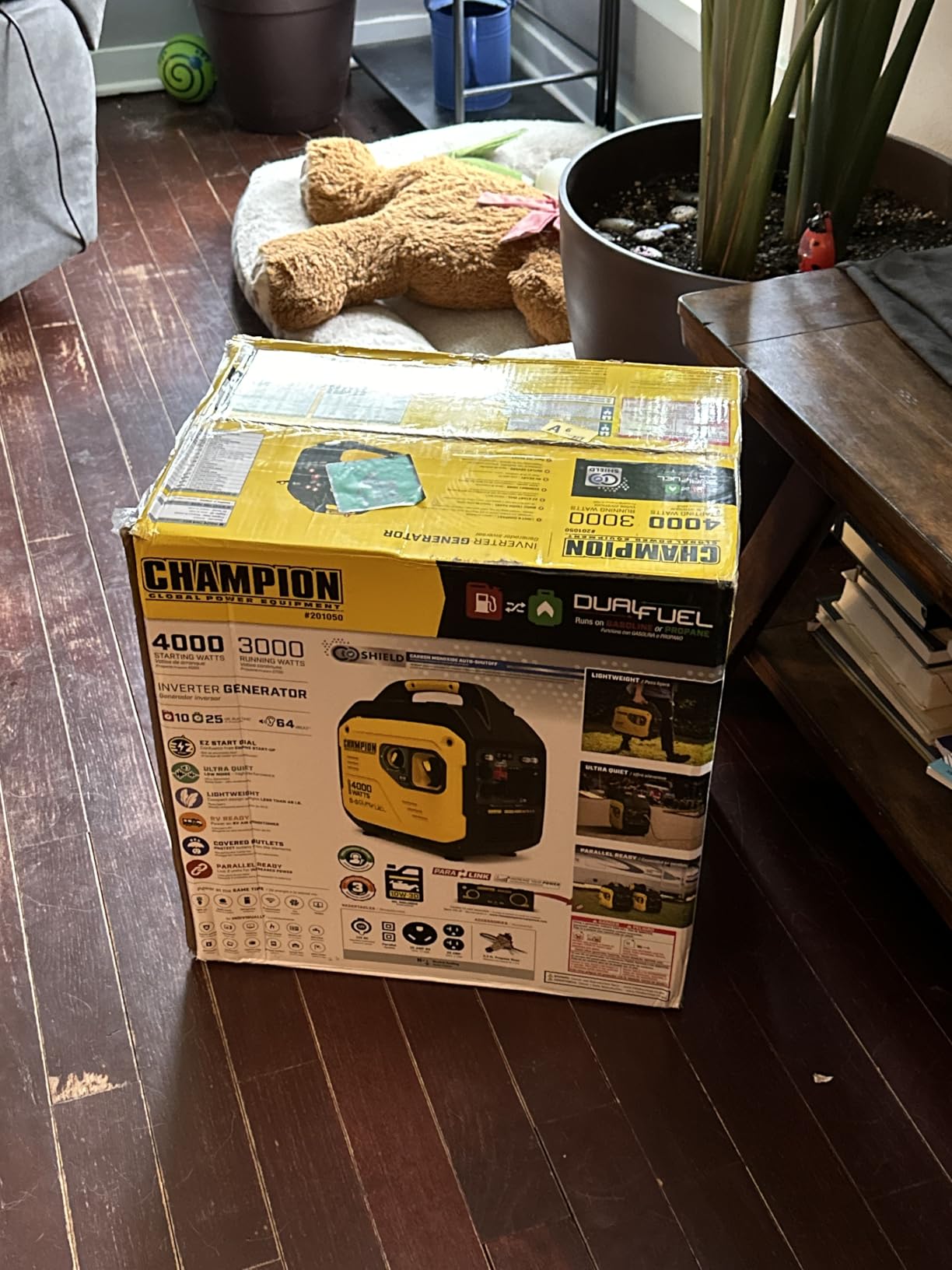
Starters will like it. Owners repeatedly report first-pull starting, and overload protection lights a red panel button and keeps running rather than cutting power on a surge, which is a small thing until an air conditioner compressor kicks in. The 20A duplex and 12V automotive outlet are both under 3 percent total harmonic distortion.
The CO Shield system shuts the machine down if carbon monoxide climbs in a confined space. Buyers do report the detector being touchy in a few cases, so treat it as a working sensor rather than a formality.
When the Champion 4000W dual fuel is the right pick
It is right for boondockers and RV parks where the air conditioner has to run through the night and the site has no pedestal. It is also the right answer for a multi-week trip where carrying two fuel types is manageable and propane availability is a deciding factor.
Where it will not fit your trip
It is 64 dBA, the loud end of the quiet-inverter class, and it climbs toward 70 dBA at full load. At a close, well-occupied site that is the sound that ends generator hours early. It also cannot run the air conditioner and a microwave at the same time, and some owners reported needing a gasoline break-in before running on propane out of the box.
6. ERAYAK 2400W – Cleanest Power For CPAP Machines And Laptops
ERAYAK 2400W Portable Inverter Generator for Home Use, Super Quiet Small Generator for Camping Outdoor Emergency Power Backup, Gas Powered Engine, EPA, ECO Mode
1800W running / 2400W starting
52.5 dB at 22 ft
0.2-1.2 percent THD
42 lb
Pros
- Very quiet 52.5 dB at 22 ft and 25 percent load
- 42 lb with a footprint that fits a sedan trunk
- Cleanest output here at 0.2 to 1.2 percent THD
- Eco mode stretches a gallon across 16 hours
- Quick warranty replacement reported by one owner
Cons
- No circuit breaker protection on the 110V section
- No authorized service centers and parts are hard to source
- Not rated above 1000 meters without a high-altitude kit
Total harmonic distortion of 0.2 to 1.2 percent is the tightest number in this group, and that is the entire pitch. A CPAP machine, a sensitive audio setup, or a laptop bank is happier on that kind of waveform, and reviewers using it for RV air conditioners, microwaves, and water pumps report it handling those loads without complaint.
Noise is 52.5 dB at 22 feet measured at 25 percent load, one of the lowest published figures here. At 42 pounds with an 18.8 by 11.7 by 18.1 inch footprint, it is also the easiest of the mid-size units to pack into a midsize sedan trunk.
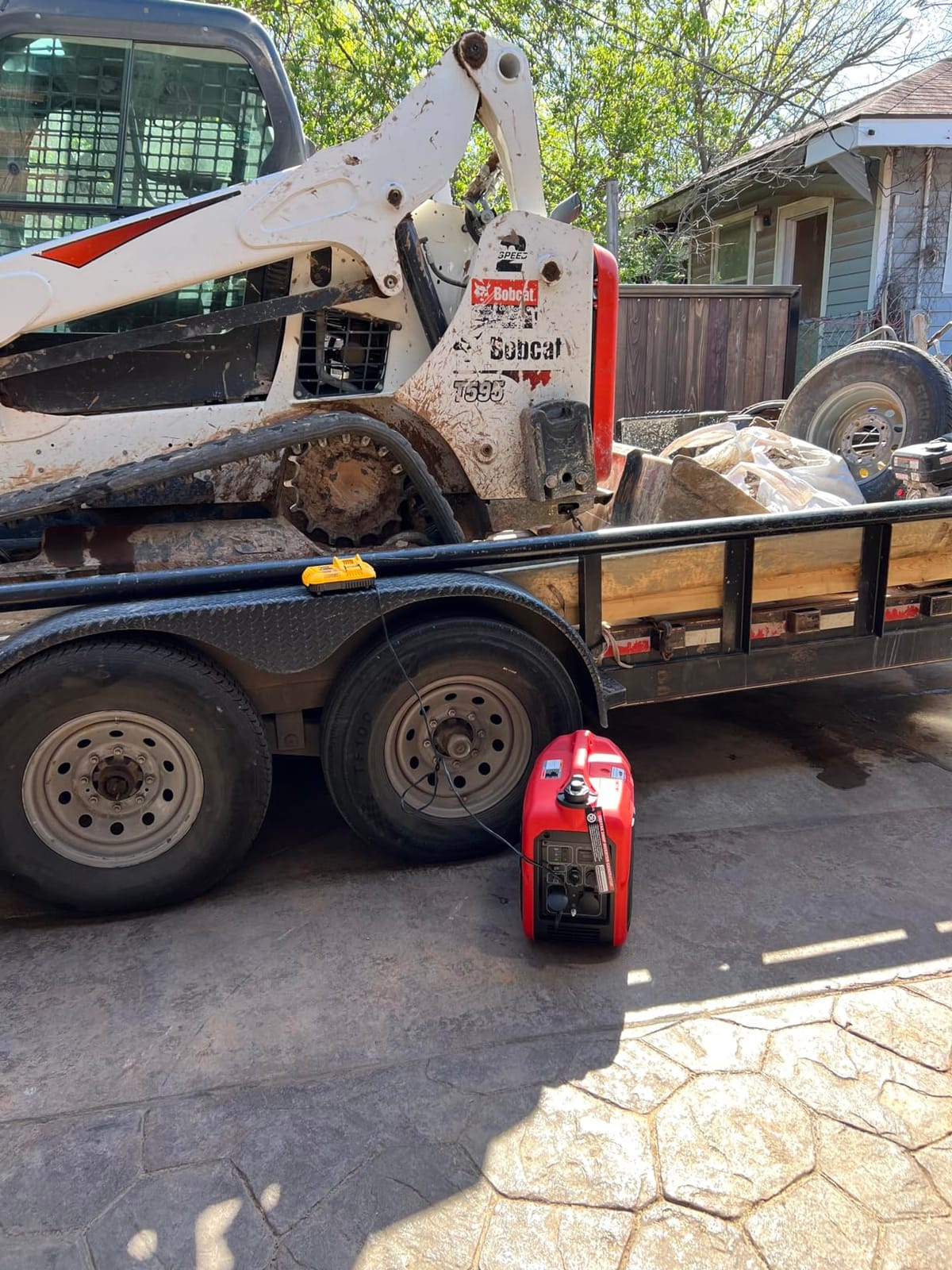
Fuel economy is a quiet strength. At 0.21 gallons per hour under quarter load, a tank goes a long way, and the eco mode can stretch a single gallon across 16 hours. Outlet layout is two AC receptacles, two USB ports, and one DC output, which covers a typical car-camping kitchen.
This is also the model with the least certain ownership support. Reviewers specifically flag the absence of circuit breaker protection on the 110V section, the lack of authorized service centers, and a manual that references features and parts which do not exist. Plan for replacement rather than repair.
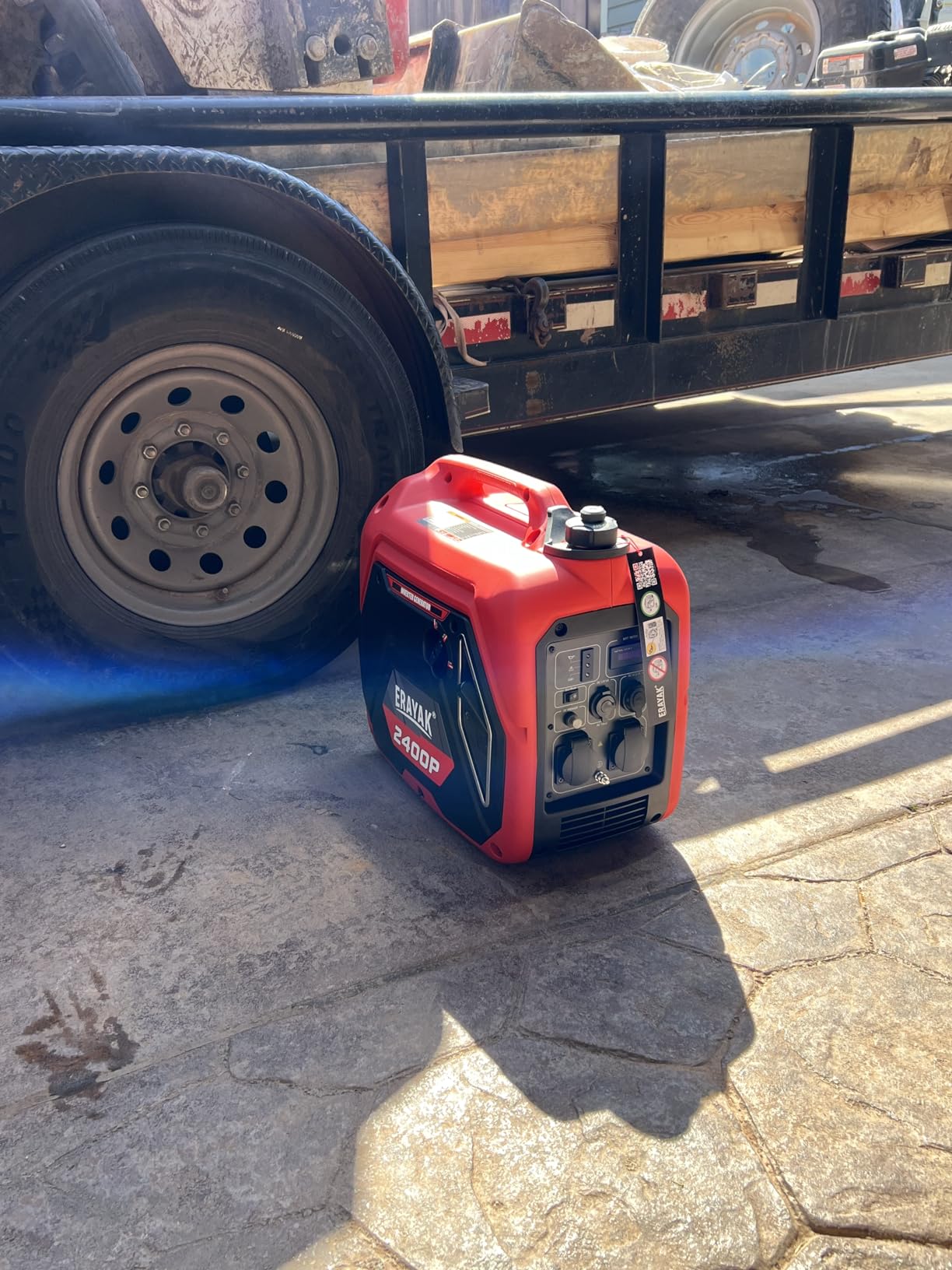
When the ERAYAK 2400W is the right pick
It is right when power quality matters more than power quantity, and when the site is tight enough that a low dB figure changes your neighbor’s evening. It is also a strong car-camping choice given the trunk-friendly dimensions and the USB plus DC port mix.
Where it will not fit your trip
It is not the right pick if you plan to mountain camp above 1000 meters without buying a high-altitude jet kit, and it is not right if you want a serviceable machine. With no circuit breakers on the AC section and no service network, a failure means a new generator, not a fixed one.
7. Champion 4250W Open Frame – Long Runtime, Wrong Tool For Quiet Sites
Champion 4250-Watt Dual Fuel Portable Open Frame Inverter Generator, CARB
3500W running / 4250W starting
64 dBA
4 gallon tank
22 hours on gasoline
Pros
- 4 gallon tank with up to 22 hours on gasoline
- 3500W running watts handles heavier draws than most of the group
- 30A RV outlet plus two 20A household outlets
- Dual fuel on gasoline or propane
- Economy mode cuts fuel use
Cons
- 79 lb and a 27.9 inch frame are far too heavy for carry-in camping
- 64 dBA is the loudest figure in this group
- Open frame has no weather protection
- Parallel kit sold separately
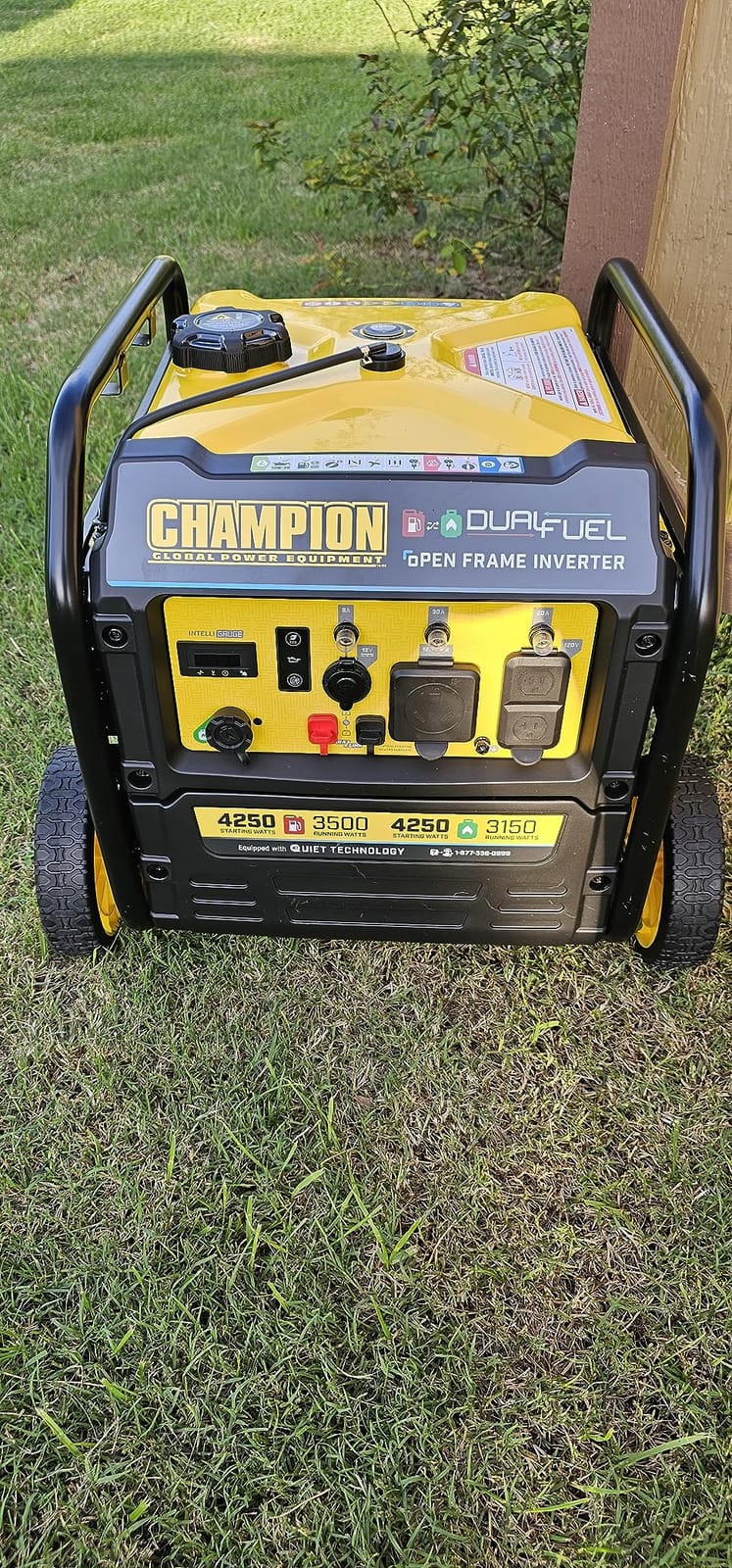
I am including this one because readers ask about it constantly, and the answer is that it is a jobsite and RV backup machine rather than a campground quiet machine. A 4-gallon tank with up to 22 hours on gasoline and 3500 running watts is real capability, and the 30A RV outlet plus two 20A outlets will carry a large travel trailer.
What rules it out for this topic is a single number: 64 dBA. Buyers describe it as the loudest unit in their own comparisons, and the open frame has no weather protection, which means rain exposure at a site you cannot drain is a real risk to the electronics.
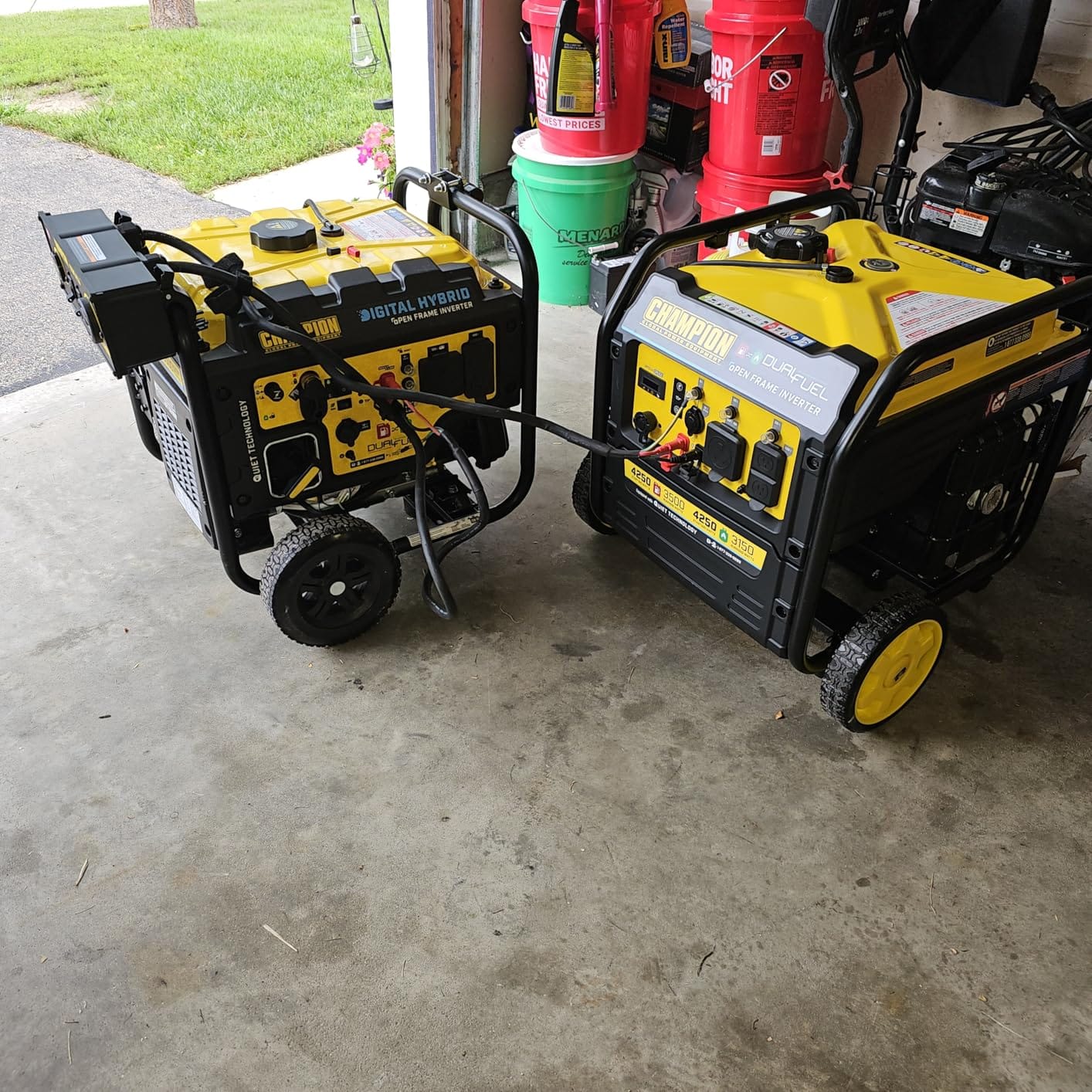
The digital hybrid design does make it 50 percent quieter and 20 percent lighter than the traditional 3500W Champion it replaces, and it is parallel-ready with the ParaLINK kit. CARB compliance also widens where you can legally run it, including parts of California where other machines here cannot be sold.
The 79-pound weight and 27.9 inch frame settle the portability question permanently. Once it is unloaded from the truck, you are not moving it again without a second person or a cart, which defeats the whole point of positioning it downwind.
When the Champion 4250W is the right pick
It is right for a large group site, a long stay where refueling is inconvenient, or a whole-site backup scenario where noise is a secondary concern. It is also the one here worth owning if you want propane as a backup fuel for a long trip.
Where it will not fit your trip
It fails at close, neighbor-dense sites and in bad weather. Real-world noise runs higher than the marketing figure under full load, and the 79-pound frame means placement is fixed by wherever you first dropped it, which is rarely the ideal downwind spot.
8. Pulsar PGD40ISCO – Rated Specifically For 13500 BTU RV Air Conditioners
Pulsar PGD40ISCO Ultra Light Quiet 4000W Portable Gas Inverter Generator, white
3200W rated / 4000W peak
59 dB
47.3 lb
Rated for A/C up to 13500 BTU
Pros
- 3200W rated output in a relatively compact frame
- 59 dB rating suitable for campground use
- Rated to run RV air conditioners up to 13500 BTU
- Parallel ready
- Aluminum
- plastic and steel construction with 3 year warranty
Cons
- 1 gallon tank limits runtime to about 4 hours at half load
- No DC or USB outlets listed
- Several variants share the listing so configuration is easy to misread
The Pulsar PGD40ISCO is the rare unit where the manufacturer states an air conditioner rating in the same breath as the noise figure. It is rated for air conditioning units up to 13500 BTU and produces 3200 rated watts from a 4000W peak, in a frame weighing 47.3 pounds. That is a better power-to-weight ratio than most of the 3000W class.
At 59 dB it belongs in the same tier as the PowerSmart, which means it works during posted generator hours but is not the machine to run at midnight beside a sleeping neighbor.
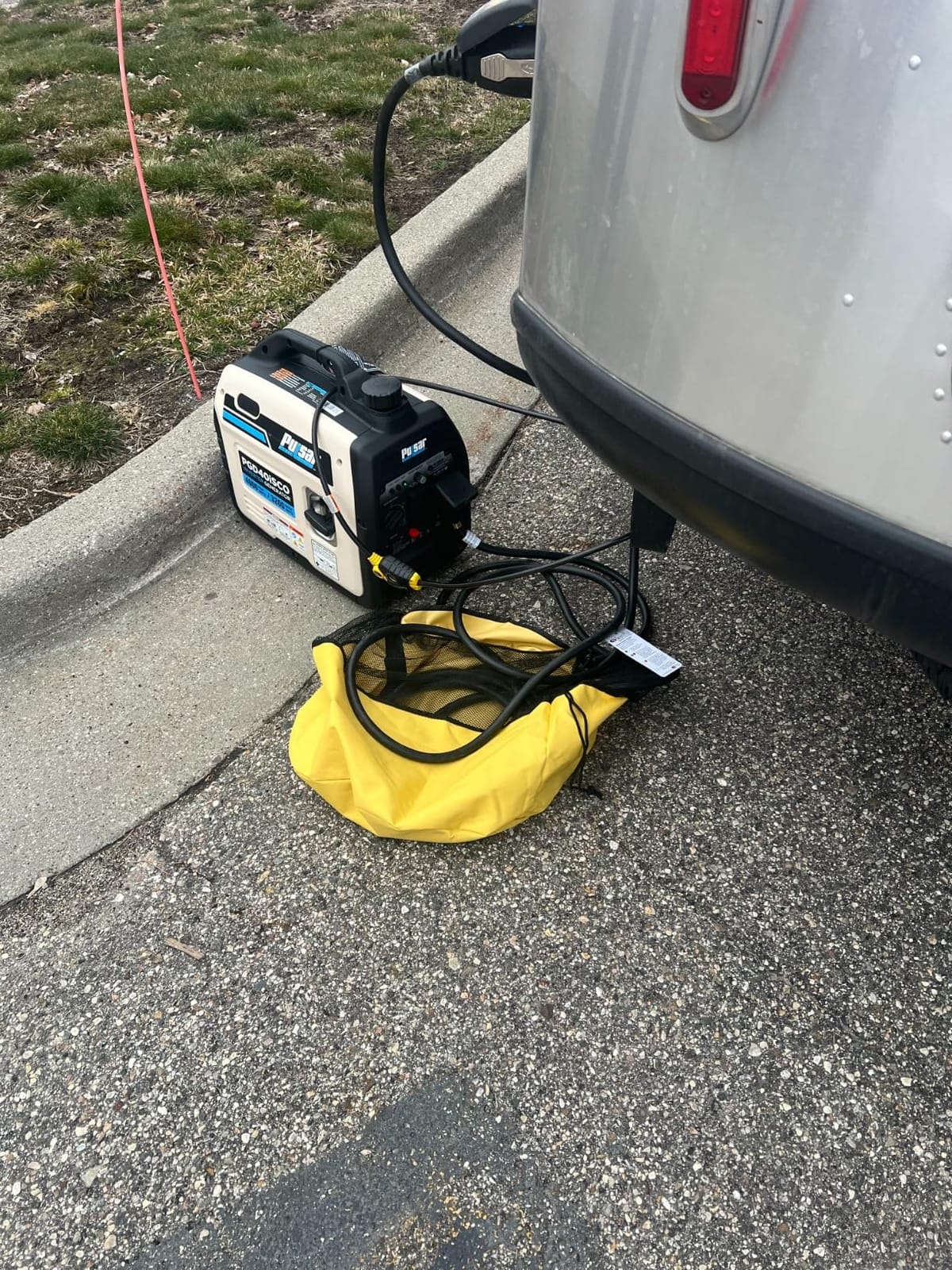
Construction is aluminum, plastic, and steel rather than the all-plastic shells used by the lightest units, and the warranty runs three years, which is longer than the one-year coverage several budget inverters carry. Parallel readiness lets you pair it with a matching unit later.
The one-gallon tank is the significant weakness. At half load you get about 4 hours, which is roughly a long evening rather than a full night of air conditioning. The absence of DC and USB outlets also means every phone and fridge plug competes for one of the three AC receptacles.
When the Pulsar PGD40ISCO is the right pick
It is right for an RV camper whose air conditioner is the 13500 BTU class and who wants to carry something lighter than a 3500W open frame. It also suits a mid-size trailer where a 30A feed and a compact footprint matter more than all-night runtime.
Where it will not fit your trip
It does not suit multi-night air conditioner use without a fuel stash, because four hours at half load is the whole tank. The shared listing means you should confirm the exact configuration you receive, and owners report a 9 percent share of one-star ratings for early durability issues.
9. Oxseryn 2800W – Best Port Mix For Phones And Laptops
Oxseryn 2800-Watts Portable Inverter Generator, Gas Generators for Home Use, Camping, Super Quiet Emergency Home Backup, with Fuel Shut Off, 1.1Gal Fuel Tank, 39Lbs, EPA Compliant
2000W running / 2800W peak
Under 58 dBA at 23 ft
40 lb
1.1 gallon tank
Pros
- Under 58 dBA at 23 ft is quiet enough for campground hours
- 40 lb with a built-in carry handle
- USB and Type-C ports for phones and laptops
- Up to 9 hours at 25 percent load with a fuel gauge
- Eco mode and parallel function
Cons
- Only 2000W running watts limits larger appliances
- High-altitude kit sold separately and needed above 4000 ft
- Only a 1-year manufacturer warranty
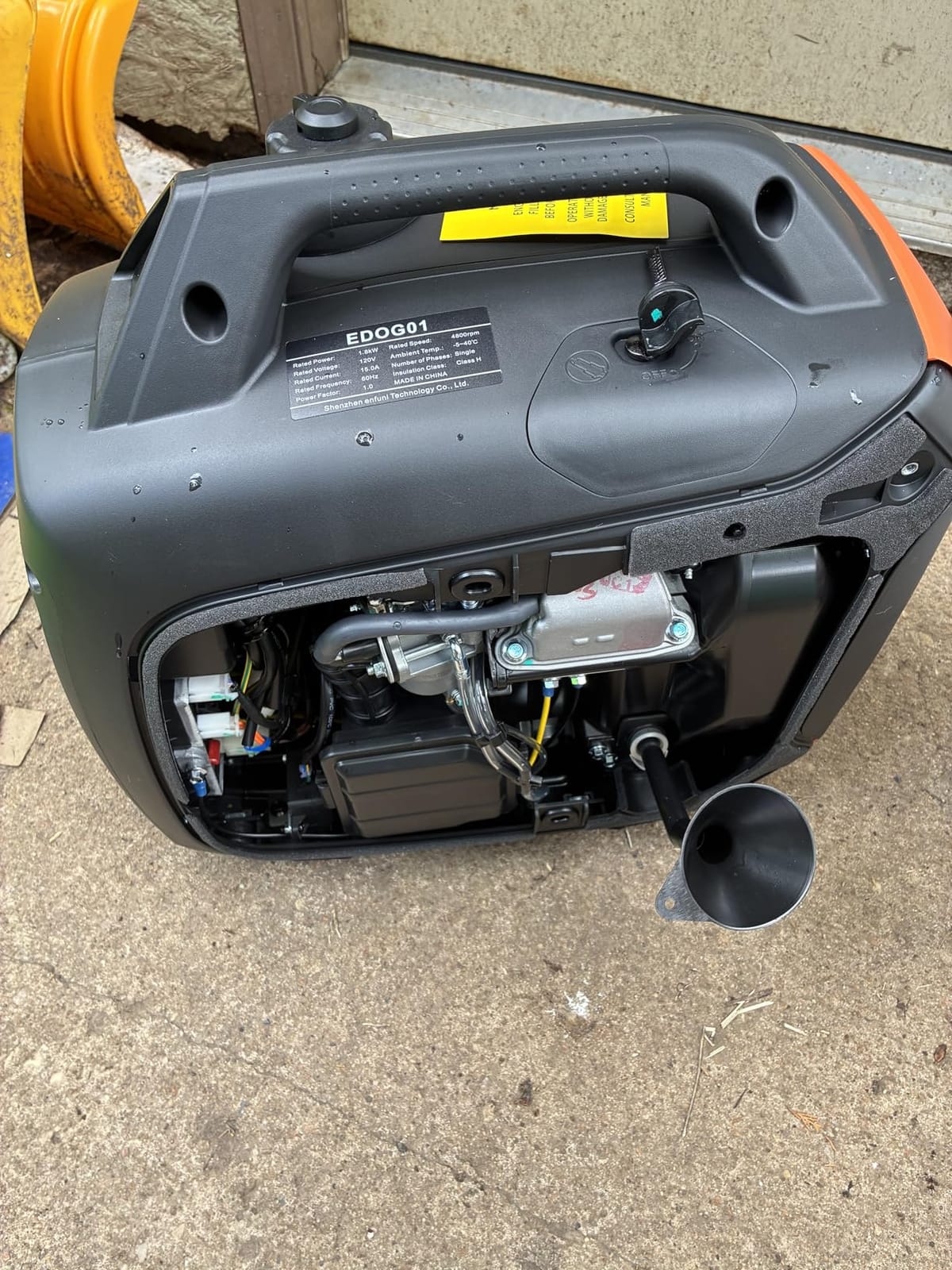
The Oxseryn 2800W is the one to buy if your campsite is a table, a laptop, and a ring of phones rather than an air conditioner. It runs under 58 dBA at 23 feet, weighs 40 pounds with a built-in carry handle, and its panel carries two 120V AC outlets, a 12V DC outlet, a USB port, and a USB Type-C port. That Type-C output is the detail that separates it from every other unit in the 2000W class.
Clean power under 3 percent total harmonic distortion means laptops and camera gear charge without drama. Owners also report using it for drones and other sensitive electronics, which tells you the waveform is doing its job.
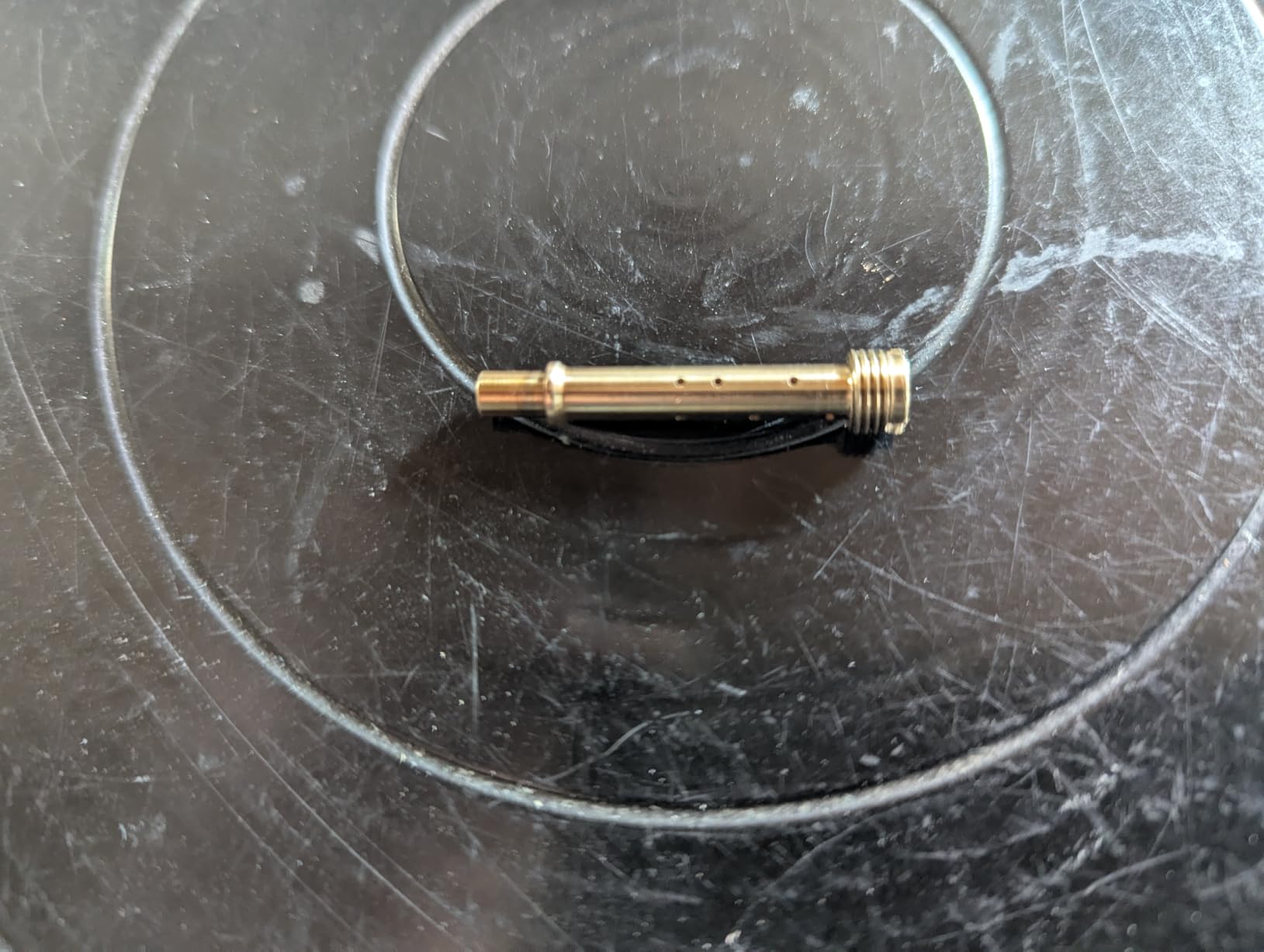
The 1.1-gallon tank carries a fuel gauge, which is a small design choice that matters on a long evening, and it delivers up to 9 hours at quarter load. The 79.8cc four-stroke OHV engine is a common, widely serviceable size, which is worth something if you camp at altitude or in cold conditions.
The one-year warranty is the shortest in this group, and that is the trade you make for the port selection and the 40-pound carry weight. If you plan to store it over winter, drain the tank or run it dry, since ethanol-blend fuel gumming is a recurring complaint across this whole category.
When the Oxseryn 2800W is the right pick
It is right for a work-weekend setup with a laptop, a monitor, and multiple devices charging, and for anyone above 4000 feet who can budget the high-altitude kit. It is also a solid pick for a family car-camping load with a 12V fridge and no air conditioner.
Where it will not fit your trip
It will not carry a rooftop air conditioner or a microwave plus anything else, because 2000 running watts is the ceiling. If you are camping above 4000 feet, the separately sold high-altitude kit is a required extra rather than an option, and the one-year warranty leaves a shorter support window than most here.
10. Oxseryn 4400W – 30A RV Output Without A Published Noise Figure
Oxseryn 4400-Watts Inverter Generator, Open Frame Generator Gas Powered, Emergency Home Backup, RV Ready 30A Outlet, EPA Compliment
3400W running / 4400W peak
2 gallon tank
30A RV port
57 lb
Pros
- 3400W running watts in a compact inverter frame
- 30A RV port as standard
- 2 gallon tank gives up to 14 hours at 25 percent load
- Inverter output with eco mode for sensitive electronics
- Low one-star share in the review distribution
Cons
- No published dBA figure so quiet performance is unverified
- 57 lb is heavy for its portable inverter peers
- Starting wattage listed at 3400W below the 4400W peak
- Only a 1-year manufacturer warranty
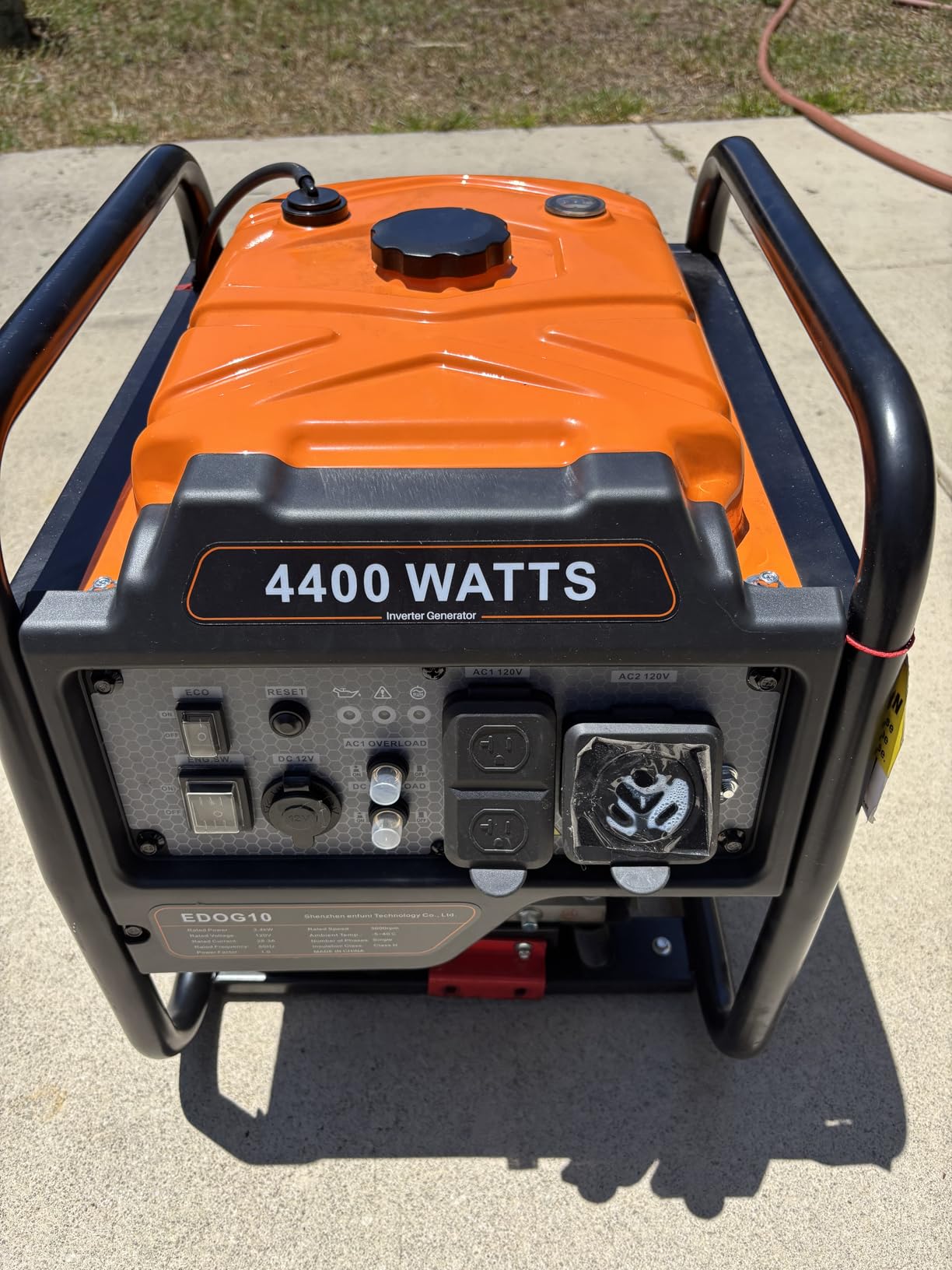
On paper this is the strongest sleeper in the group. 3400 running watts from a 4400W peak, a 2-gallon tank with up to 14 hours at quarter load, and a 30A RV port plus two 120V AC outlets and a 12V DC port. Reviewers respond to the value of that combination, and the review distribution is among the most favorable of the ten.
The problem for a quiet-campground article is the missing number. There is no published dBA figure, so we cannot place it in a decibel tier honestly. For a home backup application, where neighbors are further away, that gap matters much less.
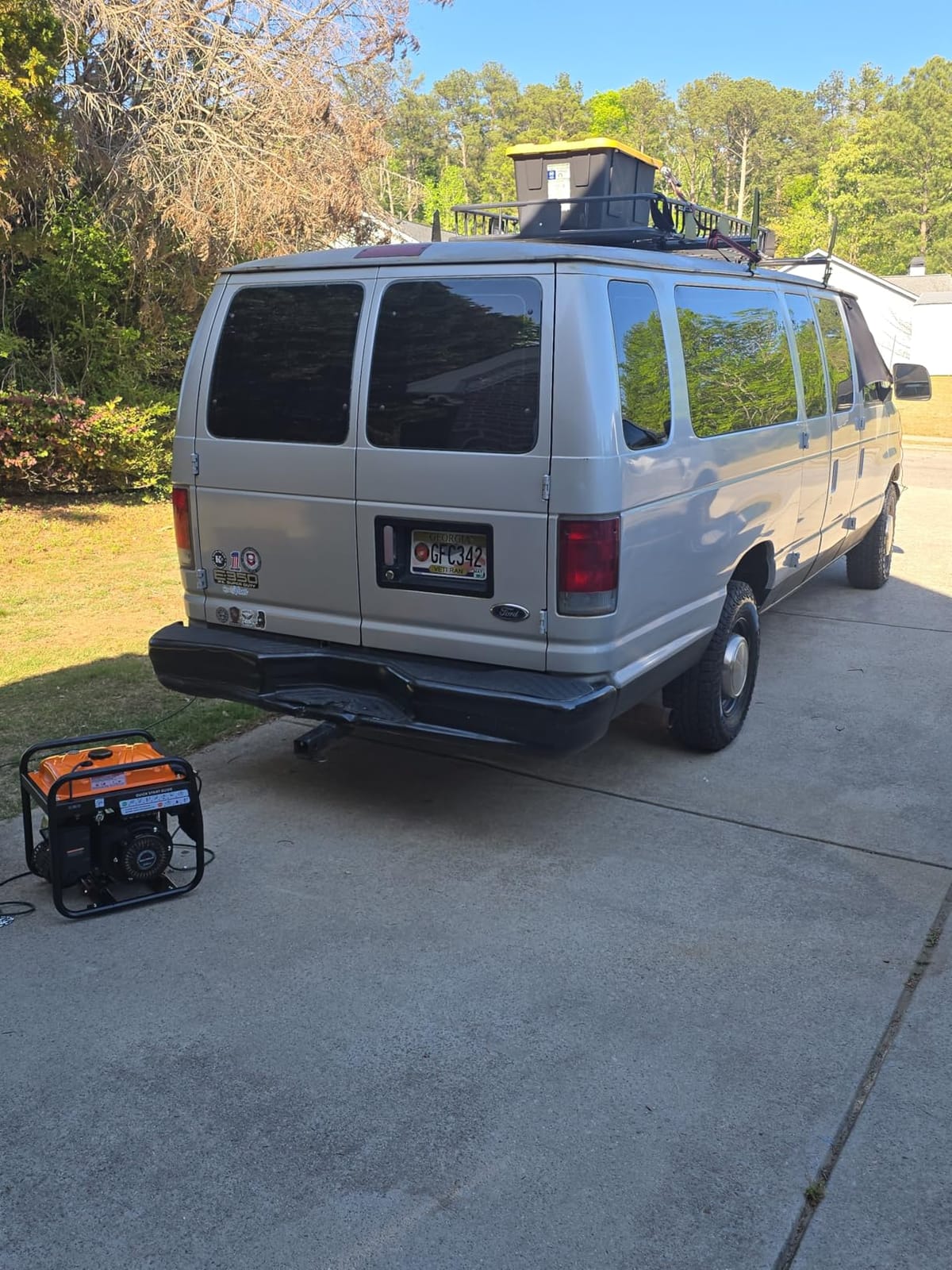
Inverter technology with eco mode, overload protection, low oil shutdown, and cold start technology cover the basics properly. The unit is factory functionally tested before it leaves the warehouse, so a fuel smell on arrival is a leftover from that test rather than a fault.
Weight is 57 pounds, which puts it with the PowerSmart and the two Champions rather than the carry-in class, and the listed starting wattage of 3400W sits below the 4400W peak headline, so treat surge claims for compressors with caution until you see it in person.
When the Oxseryn 4400W is the right pick
It is right for a home or cabin backup where you need real running watts and a 30A outlet, and for boondocking trips where the site is far enough from other people that an unverified noise figure is an acceptable risk. The 14-hour quarter-load runtime covers a long night of essentials.
Where it will not fit your trip
It is a poor fit for a close, neighbor-dense campground, because you cannot verify how loud it is before you unpack it. There are no USB outlets on the panel either, and the one-year warranty is the shortest offered here.
How To Make A Generator Quieter At A Campground
Placement does more for perceived noise than any spec sheet. A commenter in a large festival forum thread put it plainly: they have used a small quiet gas generator for four years, and placement is what makes it work. A unit that is loud at 20 feet is often unnoticeable at 60 feet in the right direction.
Here is the sequence we would use on arrival.
Set the distance first. Push the generator as far from your own tent, your awning, and your neighbors as the site allows. Sound falls off quickly with distance, so extra 20 feet beats any upgrade in the decibel tier.
Point it downwind. Position the exhaust away from the tent and the neighboring sites, and check the breeze at two different hours. Wind direction shifts, which is why a morning placement often needs a night adjustment.
Raise it off the ground. A unit on a folded-duffel or a plastic tote radiates less into your tent than one on bare dirt, because the ground is not reflecting the sound back up at you.
Use a soft barrier. Your vehicle, a fabric awning, or a canvas windscreen positioned between the generator and the campsite breaks the sound path far more effectively than a rigid panel, and it does not reflect noise back at you.
Right-size the load. Inverter generators vary engine speed with demand. Running near half load rather than at full output keeps the engine at its lowest RPM, which is the quietest state it has.
Respect the cutoff. Switch to battery power for the last hour of the night. CPAP machines, phones, and lighting all run quietly from a power station, and a silent last hour is what neighbors remember.
Our solar generator and power station roundup covers the battery side of that last step, including realistic runtime for a four-night trip.
Campground Generator Hours And The 20/20 Rule
Most campgrounds do not ban generators. They regulate them, and the regulation is where quiet-campground decisions are actually made. Posted generator hours commonly run to 8 p.m. or 10 p.m., and many sites extend a quiet-hours rule past the cutoff, during which any audible conversation-level sound can be treated as a violation.
The 20/20 rule is the convention most campers learn first. It has two parts and both matter: set a gas generator at least 20 feet from your tent, awning, and vehicle windows, and run it only during posted generator hours rather than all night. Treat it as a floor, not a target, because the carbon monoxide risk with pop-up canopies and enclosed tents is the reason it exists.
Two more rules settle most disputes. Never run a gas generator inside a tent or a screened vestibule, where exhaust has nowhere to go. And never leave a running generator where a child or a pet can reach the exhaust end. If your machine has a CO sensor with auto-shutdown, treat it as a working safety device rather than a feature to test and reset.
Policy varies by setting type, and the difference is worth knowing before you book. National park and national forest campgrounds frequently prohibit generators outright at some sites and restrict them heavily at others, often with fixed hours. Private campgrounds and RV parks usually publish written hours in the site rules or on a sign at the hookup, and those are enforceable. Dispersed camping has no posted hours, which means neighbor tolerance is the only rule that exists, and there is no appeal when it is not on your side.
If you need overnight power, our whole-house generator guide explains sizing for fixed installations, which is a different problem from a weekend campsite.
Which Portable Generators To Stay Away From
Some categories of generator are simply wrong for this topic, and skipping them will save you money and a conversation with a camp host.
Non-inverter open-frame units in the 70 dB and above range are the first thing to rule out. They run a fixed-RPM engine, which means the noise floor is high even when your load is small, and the exhaust note is the part that carries.
Any gasoline unit you plan to run after the posted cutoff also falls into that category, regardless of its wattage. If your site ends generator hours at 8 p.m. and your load is overnight, you need a battery solution, not a quieter gas machine.
Dual-fuel open frames in the 3500W and up class are third on the list. They are excellent for jobsites and RV backup, and they are the wrong shape for a campground with a 10 p.m. quiet rule.
Finally, skip anything with no published noise figure if noise is your deciding criterion. You cannot plan placement and cutoff timing around a number the manufacturer will not commit to.
Matching Watts To Loads: What Each Size Can Power
Rated running watts, not peak or surge watts, decide whether your campsite works. Peak watts describe a few seconds of compressor start-up. Sustained load is what drains the tank and what the inverter has to hold steady.
Phones, laptops, cameras, LED lanterns, and a CPAP machine together draw well under 500W. The 1260W running class covers all of it with headroom for a small fan, which is why the AIVOLT and the ERAYAK serve that group well.
A 12V portable fridge draws around 40 to 60W on a duty cycle, so it adds very little. A microwave is the real kitchen test at roughly 1000 to 1200W while running, and starting it alongside a fridge compressor is exactly the moment smaller inverters trip their overload. Sequence big loads instead of stacking them.
A 13500 BTU RV air conditioner is the number that decides most of these purchases. Draw is typically 1000 to 1500W running and considerably more on start, which is why a soft-start module keeps appearing in the reviews of the 2000W class. The WEN 56235i at 1900W running is verified by its owners to handle that air conditioner with a Micro-Air EasyStart attached. Units with 3000W and above handle it without the module.
One more rule of thumb for overnight use. Add your running loads, then add 30 percent for compressor inrush and aging components. A campsite that computes to 1700W on paper needs a 2200W unit, not a 1800W unit, and that is the arithmetic behind most of the capacity complaints in the reviews here.
Buying Guide: How To Choose A Quiet Camping Generator
Start with your load, not your budget. List every device, add running watts, add 30 percent, and pick the class that clears the number. A family running a 13500 BTU rooftop air conditioner needs 3000W running minimum, and a couple running a CPAP and a fridge needs under 1000W. The gap between those two answers is what actually picks the machine.
Next, match the decibel tier to the site. Under 55 dBA units work at close sites with tight spacing. Units in the 55 to 60 dBA range work during posted hours at normal spacing. Anything at 64 dBA and above is a jobsite and RV backup machine, not a quiet campground machine.
Then check three things that decide whether a unit survives a season. Look for CO auto-shutdown, since a generator that kills itself in a confined space is a safety device and one that does not is a liability. Check the warranty, because the gap runs from one year to three across this list and a three-year warranty is a reasonable proxy for build quality. And check the weight, with the rule of thumb that anything past 100 pounds is not going to get repositioned once you set it down.
Decide gas versus battery last, because it is not a close call for most campers. Gas wins on sustained high-draw loads like air conditioners, microwaves, and water heaters, and it refuels in minutes anywhere. Battery power stations win outright on noise, since they produce zero decibels and solve the quiet-hours problem completely, and our inverter guide covers how inverter technology handles the engine-speed side of that comparison. For most campers, the practical answer is both.
Finally, plan the fuel. Ethanol-blend gasoline gumming carburetors over winter storage, which is the most common durability complaint in this category. Run the tank dry at the end of the season or add fuel stabilizer, and expect propane capability to matter more than you think on a two-week trip.
Frequently Asked Questions
What is the quietest generator I can use for camping?
A low-decibel inverter generator rated around 48 to 58 dB(A) at 23 feet is quiet enough for most campgrounds. The Honda EU2200i publishes a 48-57 dB(A) figure and the ERAYAK 2400W publishes 52.5 dB at 22 feet, while a battery power station produces no noise at all and is the only option that works past posted generator hours.
How do I make a generator quieter at a campground?
Distance, direction and load are the three levers. Set the generator at least 20 feet from your tent and neighbors, point the exhaust downwind, raise it off the ground, place your vehicle or fabric awning between the unit and the campsite, and run it near half load so the inverter engine holds its lowest RPM. Switch to battery power for the last hour after the cutoff.
What is the 20/20 rule for generators?
The 20/20 rule has two parts: set a gas generator at least 20 feet from your tent, awning, and vehicle windows, and operate it only during posted generator hours rather than all night. It is a minimum set-back, not a target, and it is the reason you should never run a gas generator inside a tent or a screened vestibule.
What portable generators should I stay away from at a campground?
Skip non-inverter open-frame units rated at 70 dBA and above, because they hold a fixed engine RPM and stay loud even at low load. Also skip any gas unit you intend to run past your site cutoff, dual-fuel open frames in the 3500W class, and any model with no published noise figure at all.
Will a quiet generator run my RV air conditioner all night?
It depends on the unit size and whether you use a soft-start module. A 13500 BTU rooftop air conditioner draws roughly 1000 to 1500W running with a much higher inrush, which is why the WEN 56235i at 1900W running is verified with a Micro-Air EasyStart, while machines with 3000W and above handle the same load without one.
Are inverter generators really quieter than standard generators?
Yes, and the reason is engine speed. An inverter generator uses a digital control system to vary RPM to match demand, so it idles low and steady under a small load. A standard generator runs a fixed RPM, which means the noise floor stays high no matter how little you are drawing. Inverter models here range from 48 to 64 dBA against 70 dBA and above for open frames.
The Verdict
The best camping generators for quiet campgrounds in 2026 come down to one question: how close is the next tent. The Honda EU2200i is our pick because it pairs a 48-57 dB(A) figure with a 46.5-pound carry weight and 3228 reviews behind it, which makes it the safest default for a tight or partially occupied site.
Buy the WEN 56235i if you want verified 13500 BTU air conditioner capability without premium pricing, and pick the Champion 4000W dual fuel if you need a 30A trailer feed and 25 hours of propane runtime. Whatever you choose, set it 20 feet out, point it downwind, and plan to hand the last hour of the night to battery power. That routine is worth more decibels than any model swap.