
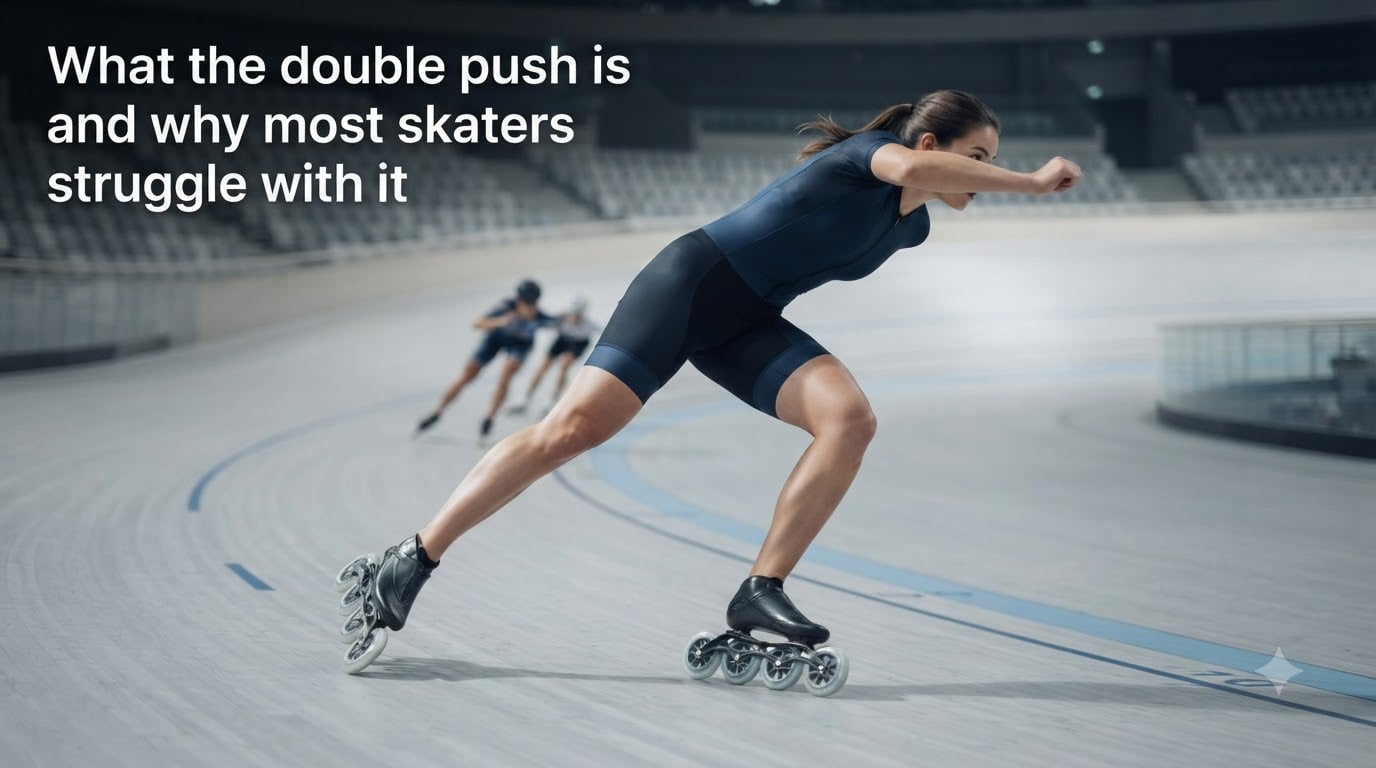
The double push is an inline speed skating technique that lets the skater generate propulsive force during the part of the stride that was previously wasted in the classic technique. By replacing the simple glide with an underpush on the outside edge, the skater produces two distinct bursts of power per stride instead of one. That single change is why the technique has dominated competitive inline skating for the past two decades.
Even with hundreds of YouTube tutorials available, our team has seen the same pattern repeat itself at our local track: skaters try to copy the motion, fail to feel anything stable, and quietly give up after a few frustrating weeks. I have personally coached skaters for 2026 who struggled with the double push, and the reasons are far more specific than “you just need to practice more.”
In this guide I will walk you through what the double push really is, how it works at a mechanical level, and the five specific reasons most skaters fail to learn it. I will also cover the prerequisites you need before starting, a step-by-step breakdown of the motion, and the common mistakes that quietly sabotage progress.
Table of Contents
What Is the Double Push in Inline Speed Skating?
The double push is a modern inline speed skating technique where the skater performs two consecutive pushing motions on the same leg: first an underpush on the outside edge, then a classic push on the inside edge. The major advantage over the previously practised classic technique is that it allows the skater to do useful work during the part of the stride that was wasted.
In the classic technique, the glide phase between pushes was effectively dead time. Your leg was just sliding, not producing force. The double push turns that dead zone into a productive one by pressing outward against the outside edge before the leg recovers.
The Core Definition
To put it simply, the double push is a stride pattern in speed skating that produces propulsion twice per cycle. The first push comes from an outward underpush on the outside edge of the skate, and the second comes from the traditional inside-edge push in the lateral direction. Together they extend the effective stroke length and smooth out the surge-and-slow rhythm of the classic stride.
How It Differs From the Classic Technique
The classic technique uses a single lateral push per stroke, then glides until the recovery leg is ready to push again. The double push eliminates most of that glide by adding an underpush that fires just before the leg lifts. The result is a more continuous application of force, which is why top inline racers like Chad Hedrick used the technique to break world records in the early 2000s.
The Technical Mechanics Behind the Double Push
Understanding the mechanics is what separates skaters who learn the double push in months from those who never get it at all. The technique has three interlocking components that all have to happen at the right time.
Inside Edge Push and the Glide Phase
The inside edge push is the foundation. You plant the skate at a slight angle, press outward through your heel and the inside of the boot, and extend your knee to push your body forward. After full extension the skate glides on the inside edge until your other leg is ready to take over.
In the classic technique, that glide is where momentum carries you. In the double push, the glide is where the underpush begins.
The Underpush on the Outside Edge
The underpush is the new piece. As the inside edge push finishes and your leg starts to recover, you roll the skate slightly onto its outside edge and press outward in a smaller, quicker motion. This produces a second pulse of propulsive force that was previously lost.
The outside edge is the part most skaters have never consciously used. Your wheels naturally want to roll on the inside edge when you push, so learning to load the outside edge requires a real shift in how you think about edge control.
Weight Transfer and Knee Extension
Weight transfer is what powers both pushes. After the inside edge push, your body weight sits over the recovering skate. To execute the underpush, you have to keep that weight centered while shifting it slightly toward the outside edge of the supporting skate. Full knee extension at the end of each push is what gives the motion its power.
Without proper weight transfer, the underpush collapses into a wobble. With it, the motion feels almost effortless.
Double Push vs Classic Technique: Full Comparison
I have timed skaters at our local track switching between the two techniques over 400m intervals, and the difference is consistent. Here is how the two stride cycles stack up against each other.
Propulsion phases per stride: Classic technique produces one push per stride; double push produces two. This is the single biggest mechanical difference.
Glide phase: In the classic technique, the glide is passive and unused. In the double push, the glide is replaced by an active underpush on the outside edge.
Speed maintenance: The classic technique shows a clear surge-and-slow pattern with each stride. The double push produces a smoother velocity curve, which is faster over distance.
Muscle fatigue: The classic technique is less demanding on the legs because there is less work per stride. The double push is more fatiguing because every stride now has twice the propulsion work.
Learning curve: The classic technique can be learned in weeks. The double push realistically takes 6 to 18 months of focused practice according to the experienced skaters I have trained alongside.
Top speed: The classic technique caps out at a lower top speed because of the wasted glide. The double push extends the ceiling significantly, which is why every elite inline racer uses it.
Why Most Skaters Struggle to Learn the Double Push?
This is the question I get asked most often at the rink, and it is the one almost no guide answers properly. Skaters do not fail at the double push because they lack talent. They fail because of five very specific issues that compound over time.
It Requires Unlearning First
Most skaters who try the double push already have thousands of hours of classic technique in their legs. That muscle memory fights the new motion every single stride. You cannot layer the double push on top of the classic technique. You have to replace one with the other, and that replacement phase is uncomfortable and slow.
I have watched experienced skaters regress in their overall speed for two to three months while rebuilding their stride. Most quit before that window closes because they feel like they are getting worse.
Edge Control Is Harder Than It Looks
The underpush demands that you consciously load the outside edge of your skate, which is a motion almost nobody has practiced. Your wheels, your frame, and your natural balance all default to the inside edge. Working the outside edge feels awkward, slippery, and unstable for the first several months.
Edge control is its own skill. Skaters who try to learn it at the same time as the double push tend to confuse the two and never really lock down either one.
YouTube Tutorials Skip Fundamentals
This one is hard to hear, but it is true. I have watched almost every popular double push tutorial on YouTube, and nearly all of them show the final motion without decomposing it into the underlying fundamentals. Reddit users in r/rollerblading consistently report the same issue: following YouTube leads to bad habits that take years to fix.
Our community of coaches has learned that skaters who use a structured course or in-person coaching progress three to four times faster than skaters learning purely from free videos.
The Recovery Phase Confuses Beginners
Once the underpush fires, the leg has to recover to the front of the stride without dragging or swinging wide. Most beginners swing the recovering leg in a big arc, which kills momentum and looks nothing like the smooth motion you see in elite skaters. This recovery is its own technical challenge and is rarely explained as a separate skill.
It Takes Longer Than Anyone Expects
The honest answer is that the double push takes 6 to 18 months of consistent practice to feel stable. Some skaters with backgrounds in skiing, martial arts, or ice skating pick it up faster because they already understand lateral weight transfer. Recreational skaters with no sports background often take a full year before the motion feels natural.
When progress is invisible for months, motivation collapses. That is the single biggest reason people quit.
Prerequisites Before You Start Learning the Double Push
Before you spend a single session on the double push, there are a few skills you need to have locked down. Skipping these is the fastest path to building bad habits.
Solid Classic Technique
You need a clean, efficient classic stride before you attempt the double push. That means full knee extension at the end of each push, a stable glide on one skate, and a relaxed recovery. If your classic technique has wobbles or short pushes, the double push will amplify them.
Balance and Single-Leg Stability
You should be able to glide comfortably on one skate for at least five seconds without losing balance. The double push spends more time on each leg than the classic technique, so single-leg stability is non-negotiable.
Body Awareness From Other Sports
Skaters with backgrounds in skiing, snowboarding, martial arts, or dance tend to learn faster because they already understand how to load and shift weight through their edges. If you have no sports background, do not worry. It just means you should expect the longer end of the 6 to 18 month timeline.
Step-by-Step Breakdown of the Double Push
Here is the cleanest breakdown I have found after coaching this technique for several seasons. Each step builds on the previous one, and you should not move on until the prior step feels automatic.
Step 1: Start in a stable stride position. Glide on one skate with the other leg ready to push. Your shoulders should be square and your weight centered over the supporting skate.
Step 2: Complete the classic inside-edge push. Press outward through the inside edge, fully extending your knee. This is the same push you already know.
Step 3: Shift weight onto the outside edge. As your push leg reaches full extension, allow the skate to roll slightly onto its outside edge. Do not force this. It should feel like the skate is settling outward under your weight.
Step 4: Execute the underpush laterally. From the outside edge, press outward in a smaller, faster motion. The underpush should be about half the power of your main push but twice as quick.
Step 5: Recover and prepare for the next stroke. Lift the recovering leg and bring it forward in a tight arc. Your knee should travel close to the supporting leg, not swing wide.
Step 6: Repeat on the other side. Mirror the entire sequence with your other leg. The double push has to be symmetric or your stroke will pull you off line.
Common Mistakes and How to Avoid Them
These are the mistakes I see over and over at our local track. Each one is fixable once you can see it.
Pushing too hard on the underpush. The underpush is a finesse motion, not a power motion. If you are grunting or losing balance during it, you are pushing too hard. Reduce the force and focus on quickness instead.
Swinging the recovery leg wide. A wide recovery arc wastes energy and breaks your rhythm. Practice lifting your recovering knee close to your supporting knee on every stroke.
Looking down at your feet. Your head should be up and looking forward. Looking down shifts your center of gravity forward and destabilizes the underpush.
Skipping the outside edge work. If you cannot feel the outside edge of your skate, you are not ready for the full double push. Spend dedicated sessions just rolling on the outside edge to build that awareness.
Quitting during the awkward phase. Expect two to three months where you feel worse than before. This is normal. Your body is rebuilding its stride pattern, and that process is uncomfortable.
The History and Origins of the Double Push
The double push emerged in the late 1990s as inline speed skating started separating itself from ice speed skating. Inline wheels and frames gave skaters more lateral grip than ice blades, which made the outside edge push physically possible at high speed.
American inline racer Chad Hedrick popularized the technique at the 2002 Winter Olympics exhibition events and went on to break multiple world records using it. Within five years, nearly every elite inline skater in the world had switched to the double push, and the classic technique became a relic of the 1990s.
Today the technique continues to evolve. Skaters are experimenting with variations like the offset double push and the power double push to squeeze out even more efficiency. The basic principle, however, has remained the same since the late 1990s: turn the wasted glide into a productive push.
FAQ
What is the double push in skating?
The double push is an inline speed skating technique that produces two pushes per stride instead of one. It adds an underpush on the outside edge before the traditional inside-edge push, which lets skaters generate propulsive force during the part of the stride that was wasted in the classic technique.
How do you do the double push step by step?
Start in a stable glide on one skate, complete the classic inside-edge push with full knee extension, roll the skate onto its outside edge, execute a quick lateral underpush, then recover the leg in a tight arc. Mirror the sequence on the other leg.
Why is the double push so hard to learn?
The double push is hard because it requires unlearning the classic technique, demands outside edge control most skaters have never practiced, involves a complex recovery phase, and takes 6 to 18 months of consistent work before it feels stable. Most skaters quit during the awkward transition phase.
How long does it take to learn the double push?
Most recreational skaters need 6 to 12 months of consistent practice to feel stable. Skaters with backgrounds in skiing, martial arts, or ice skating often learn faster. A small percentage of beginners with strong body awareness can reach a basic level in 3 to 4 months.
Is the double push worth learning for recreational skaters?
For recreational skaters who want to skate faster and more efficiently, the double push is worth learning. It does require patience and a willingness to feel worse for several months while rebuilding your stride. If you skate mostly for casual fitness, the classic technique is perfectly fine.
Do I need a coach to learn the double push?
A coach dramatically shortens the learning curve. Skating forums consistently report that skaters with structured coaching progress three to four times faster than skaters learning from YouTube alone. If a coach is not available, a structured online course is the next best option.
Conclusion
The double push is one of the most rewarding techniques in inline speed skating, but only if you understand what you are walking into. It is not a quick upgrade you can add to your stride. It is a full rebuild of how your legs move through every stroke.
If you take one thing away from this guide, let it be this: most skaters do not struggle with the double push because they lack talent or fitness. They struggle because they try to learn it without the prerequisites, without structured coaching, and without the patience to survive the awkward rebuilding phase. Give yourself 6 to 18 months, lock down the outside edge first, and consider working with a coach or a structured course. Do that and you will join the small but growing group of skaters who have made the double push part of how they move.
For 2026 and beyond, the technique will continue to evolve, but the principle never changes: turn the wasted glide into a productive push, and you will skate faster than you ever thought possible.