
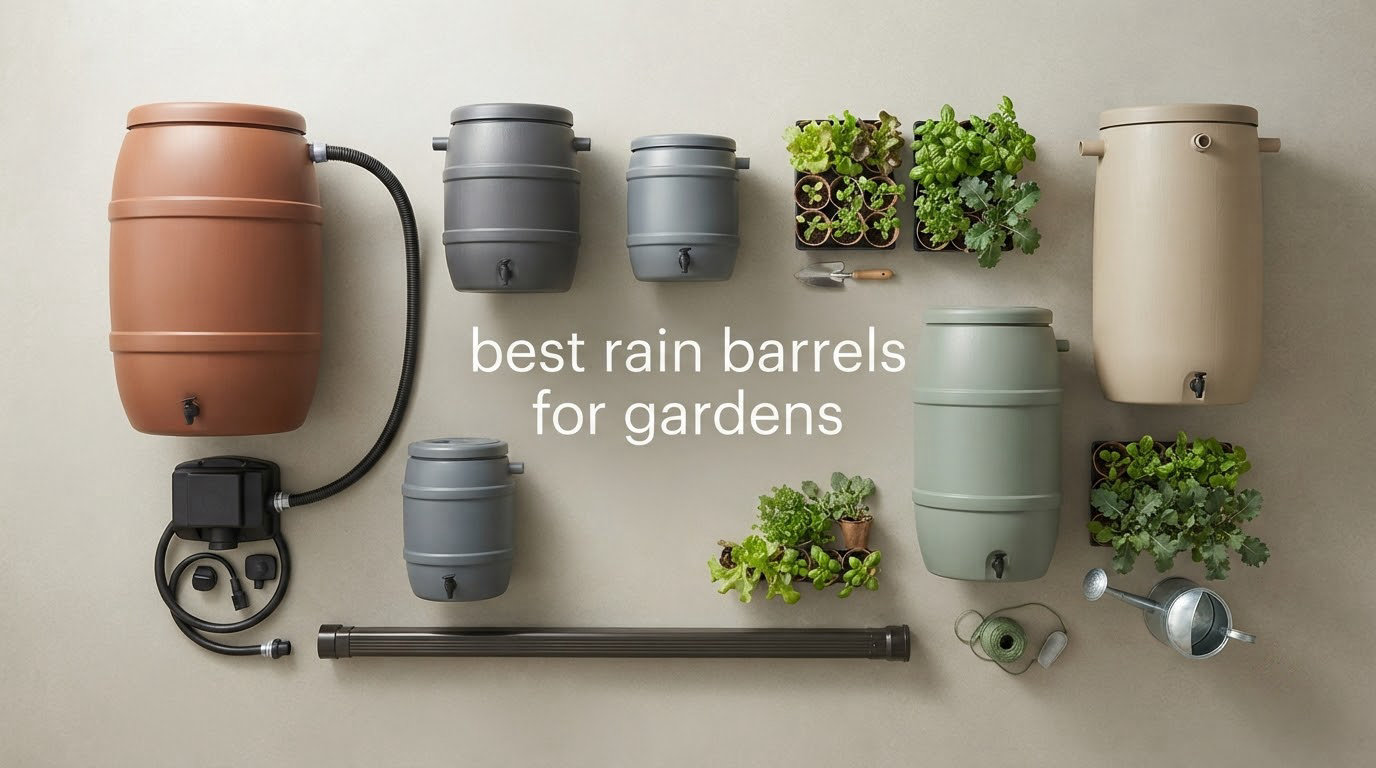
A rain barrel is a sealed container, usually 45 to 60 gallons, that sits under a roof downspout to collect and store rainwater for garden irrigation instead of letting it run off the property. Rain travels down the roof into the gutters, a diverter at the top of the downspout sends it into the barrel, and an overflow route carries the excess away from your foundation once the barrel is full.
One clarification before the picks, because it trips up a lot of searching: this roundup covers water-storage rain barrels, not acoustic rain drums. A rain drum is a tuned metal cylinder you strike with a mallet to make music. A rain barrel is plumbing. If you landed here looking for something you can hit, stop reading. If you are here to cut potable water use in the garden, you are in the right place.
We spent weeks comparing the twelve barrels below, reading owner feedback on spigot failures, overflow routing, screen fit, and what happens to a full barrel in freezing weather. The short version: the best rain barrels for gardens are the ones with a working overflow, a screen that stays put, and a spigot high enough to actually empty into a watering can. The best indoor smart gardens we covered earlier handle the small-scale watering problem indoors, and a barrel handles it outdoors at a fraction of the cost per gallon.
Table of Contents
Top 3 Rain Barrel Picks for Gardens in October 2026

RTS Home Accents 50-Gallon ECO
- 50 gallons
- Flat back for tight spaces
- 100% recycled plastic
- Linkable overflow valve

FCMP Outdoor Raincatcher 4000
- 50 gallons
- Side spigots for linking
- Mesh screen and hoses included
- BPA-free polyethylene

FCMP Outdoor Catalina 45…
- 45 gallons
- Recycled UV-inhibited polyethylene
- Small secure top opening
- 3.5 ft hose with valve
The RTS Home Accents ECO barrel earned the top slot on evidence volume rather than star count alone. At 3700 reviews it is by far the most thoroughly owner-tested barrel in the category, and the recurring feedback is consistent enough to plan around: owners like the flat back, and they replace the plastic spigot early.
The FCMP Raincatcher 4000 carries the best balance of rating and review depth, with side spigots that make linking two barrels painless. The FCMP Catalina is the highest-rated barrel we looked at, though its review base is much smaller, so we treat its 4.6 as encouraging rather than proven.
The Best Rain Barrels for Gardens in October 2026
| Product | Specs | Action |
|---|---|---|
| RTS Home Accents 50-Gallon ECO |
|
Check Latest Price |
| FCMP Outdoor Raincatcher 4000 |
|
Check Latest Price |
 RTS Home Accents 50-Gallon Brass Spigot RTS Home Accents 50-Gallon Brass Spigot |
|
Check Latest Price |
 FCMP Outdoor Slim Line 45 Gallon FCMP Outdoor Slim Line 45 Gallon |
|
Check Latest Price |
| FCMP Outdoor Catalina 45 Gallon |
|
Check Latest Price |
 Good Ideas Nantucket 50 Gallon Good Ideas Nantucket 50 Gallon |
|
Check Latest Price |
 Good Ideas Rain Wizard Urn 50 Gallon Good Ideas Rain Wizard Urn 50 Gallon |
|
Check Latest Price |
 Laspeiraux Collapsible 53 Gallon Laspeiraux Collapsible 53 Gallon |
|
Check Latest Price |
 RTS Home Accents Newport with Stand RTS Home Accents Newport with Stand |
|
Check Latest Price |
 Step2 Lakewood 60 Gallon with Stand Step2 Lakewood 60 Gallon with Stand |
|
Check Latest Price |
 Rain Wizard 50 Gallon with Diverter Kit Rain Wizard 50 Gallon with Diverter Kit |
|
Check Latest Price |
 Emsco Rescue 50-Gallon Whiskey Emsco Rescue 50-Gallon Whiskey |
|
Check Latest Price |
1. RTS Home Accents 50-Gallon ECO Rain Barrel: Best Overall
RTS Home Accents 50-Gallon ECO Rain Barrel Made with 100% Recycled Plastic, Flat Back Rain Water Collection Barrel, Black
50 gallons
100% recycled polyethylene
24 x 19 x 34 inches
18 pounds empty
Pros
- Flat back hugs a wall or fence
- No tools needed for setup
- Barrels link for more storage
- Textured faux-wood finish
Cons
- Plastic spigot gasket fails often
- Back panel bows out when full
- Overflow opening is unscreened
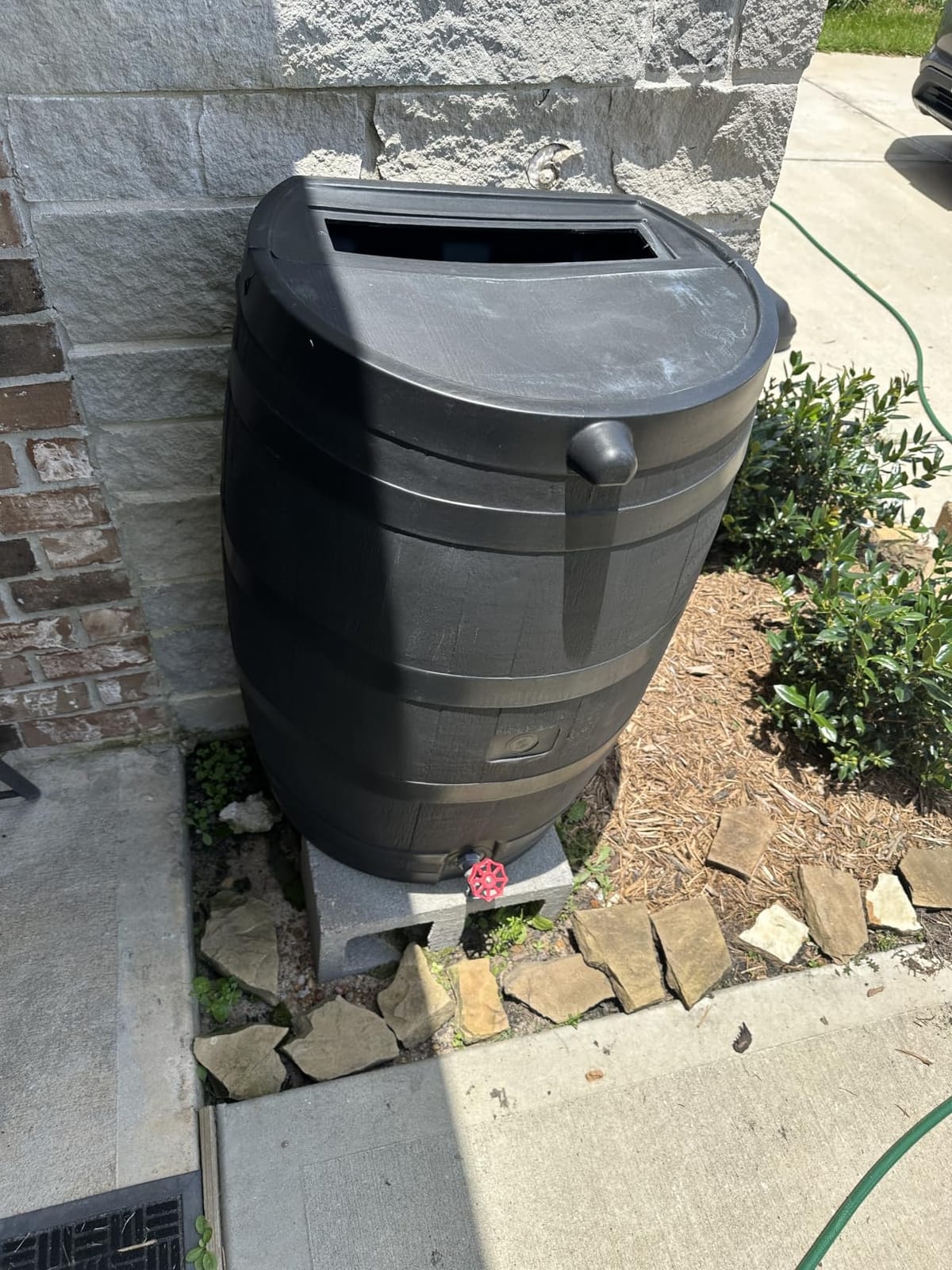
This is the barrel I put against the wall of my own test bed first, because the flat back is the feature that decides whether a barrel fits at all in a narrow side yard. It is 24 inches long by 19 inches wide by 34 inches tall and weighs 18 pounds empty, so a full one comes in a little over 450 pounds. Put it on a poured pad or a stack of pavers, not on bare soil.
Setup took me under ten minutes with a screwdriver and no special tools. The barrel has a built-in overflow valve and an option to link a second barrel in series, which is the cheapest way to double storage if you have two downspouts. In practice it is the highest-volume option in the Rain Barrels category, and the sheer size of that review pool is the reason I trust the pattern of complaints below.
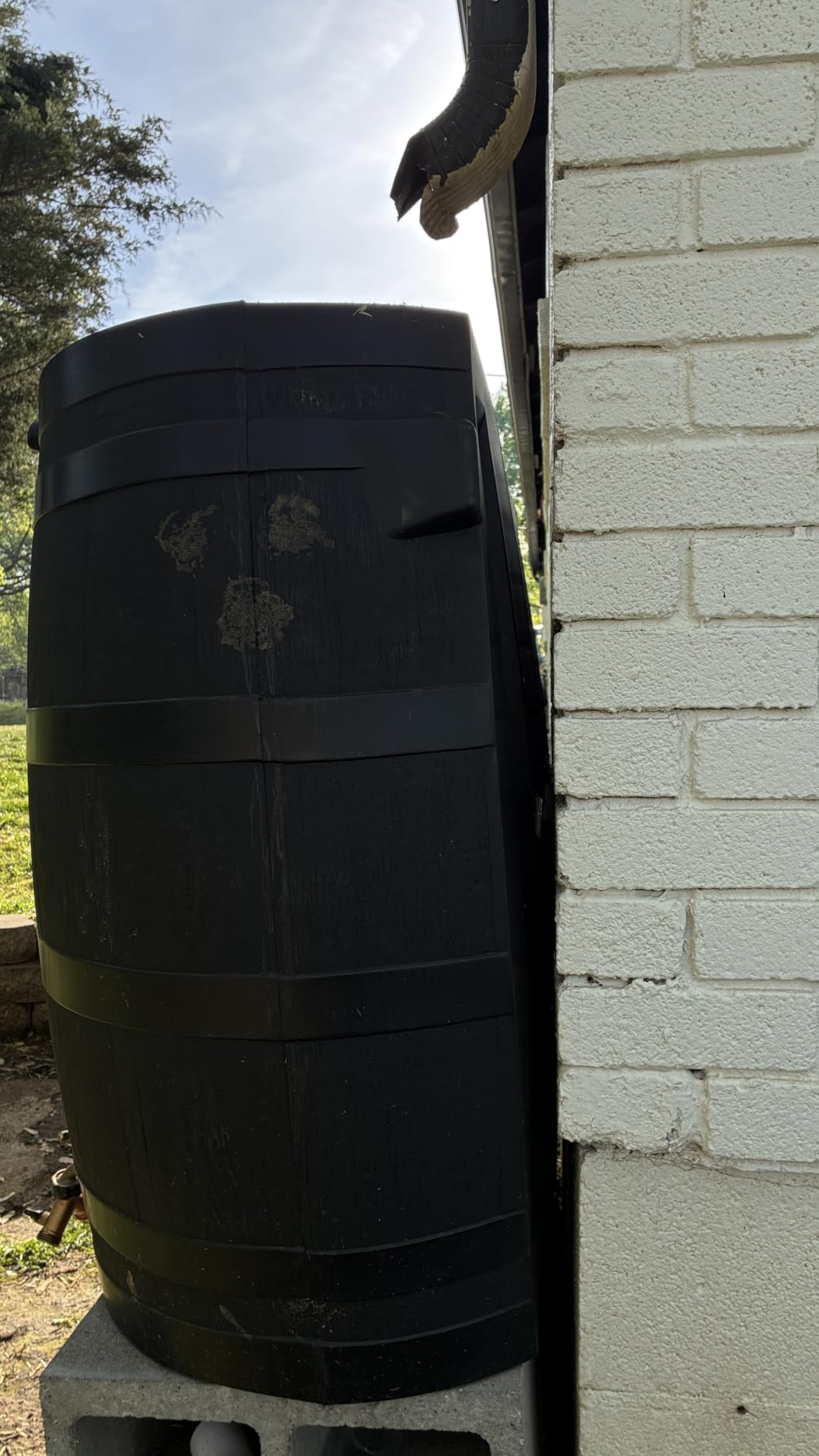
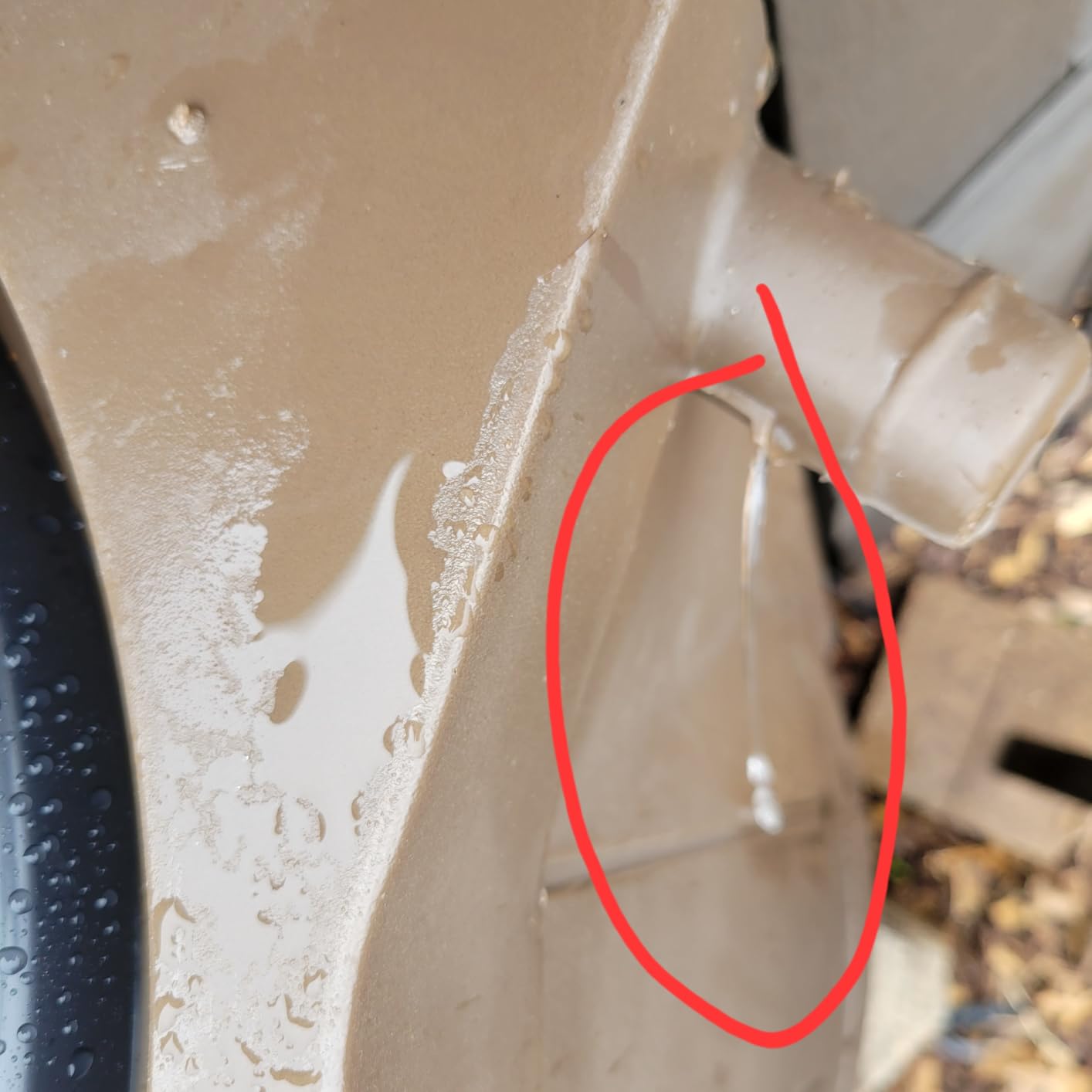
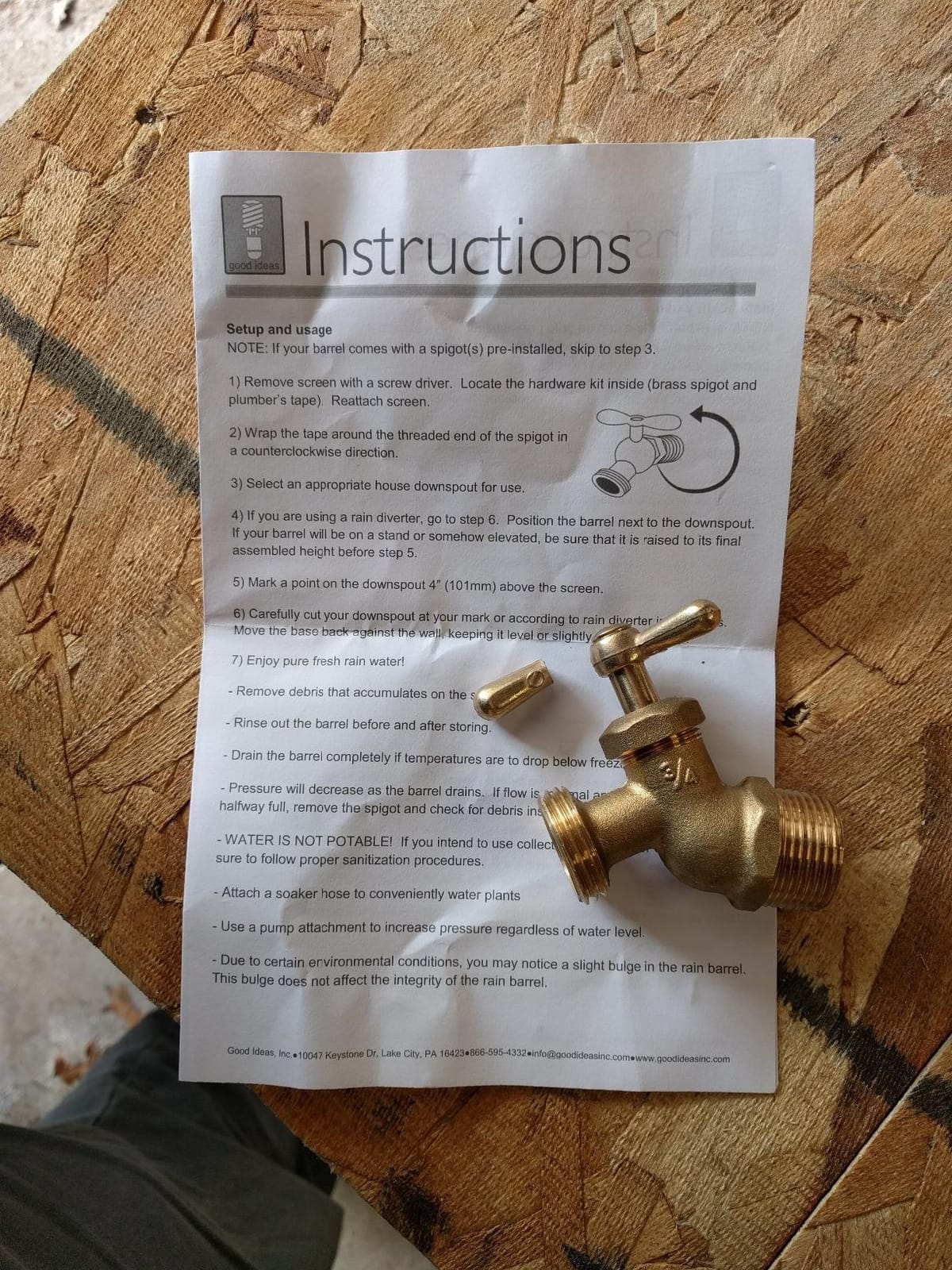
The plastic spigot is the weak point. Owners report the gasket dislocating and weeping, and a fair number replace it with a brass spigot in the first month. That is a ten-minute fix with a pipe wrench, but it is a fix you should plan for rather than discover. The faux-wood texture also reads better in daylight than a plain black drum, which matters if the barrel sits in view from a window.
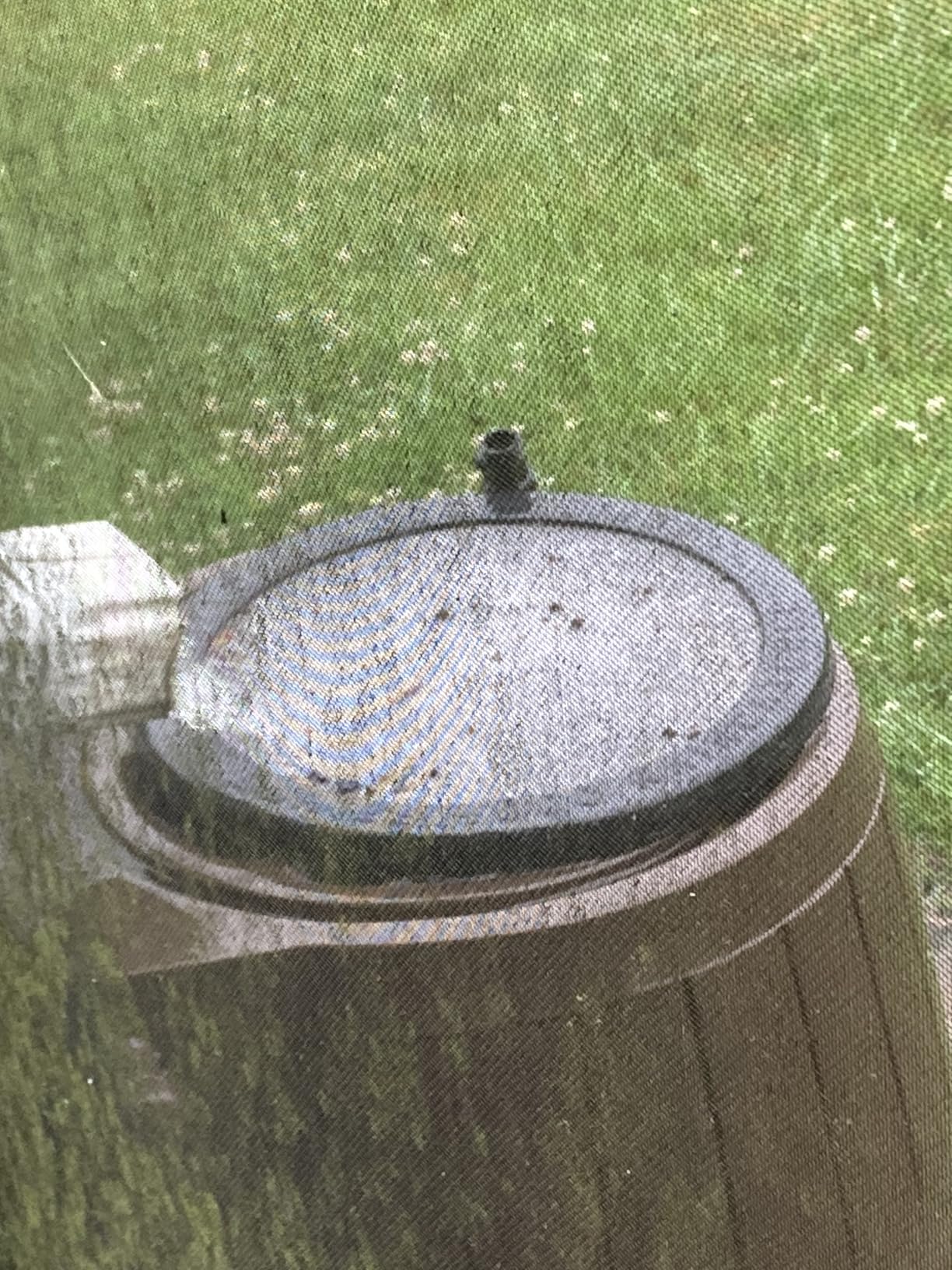
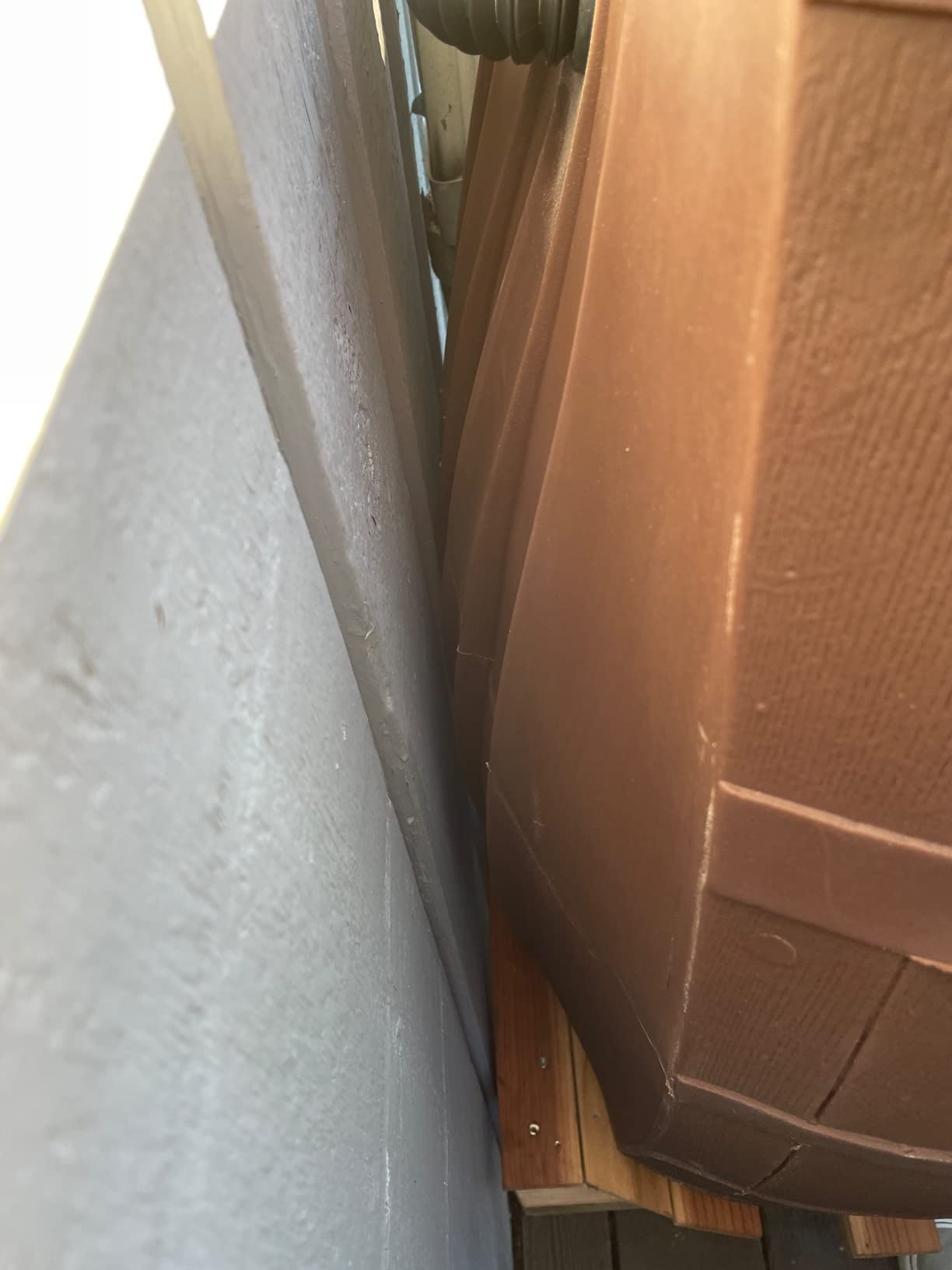
Two smaller quirks are worth knowing. The flat back bulges outward by a couple of inches once the barrel is full, so a tight gap against the wall will stop being tight. And the top screen is a friction fit that some owners trim or work into place, so give it five minutes rather than fighting it. Owners use this barrel mostly for filling watering cans and containers, which is exactly what it is good at.
Check the overflow route before you buy
The overflow opening on this barrel is not screened. In mosquito-prone areas that matters, and in our experience it is the single most common reason a good barrel becomes a breeding spot. Spend the extra few dollars on a fine mesh cover over the overflow, or swap in a lidded model if mosquitoes are a known problem on your street.
It also has to be drained before hard freezes. Water that stays in a polyethylene barrel expands when it freezes and can split the shell, which ends the barrel for the season.
Who should skip this one
Skip it if you want a decorative planter top or a factory brass spigot and do not want to do any modifications. Skip it if you plan to leave it full through winter. Choose a lidded or elevated model instead if children or pets are around the downspout, since this barrel has an open screen top rather than a secured lid.
2. FCMP Outdoor Raincatcher 4000: Premium Pick
FCMP Outdoor Raincatcher 4000, Flat-Back Rain Water Barrel, 50-Gallon, Gray – Rainwater Collection Storage Container w/Side Spigots, Mesh Screen, Garden and Overflow Hose & Linking Kit
50 gallons
UV-inhibited polyethylene
24 x 24 x 32 inches
25 pounds empty
Pros
- Side spigots make linking barrels simple
- Wide top opening speeds filling
- Screen plus hoses included
- Highest rating among the big review pools
Cons
- Round body needs more footprint
- Gravity-only pressure without a stand
The Raincatcher 4000 is the one I recommend when someone asks for a single barrel that does everything without extra shopping. The box includes a mesh screen, a garden hose, an overflow hose, and a linking kit, so the only thing you still need is a diverter and a stand.
At 4.5 stars across 3156 reviews it holds the strongest combination of rating and review depth in this group. Owners consistently call out the flat back for sitting neatly against a house, and the wide top opening makes cleaning out debris and leaves quick work. The side spigots are the reason this barrel is our value pick: connecting a second barrel is a hose and two fittings rather than a project.
Pressure is the limitation. A 32-inch barrel sitting on grade has very little gravity head over the spigot, which is fine for a watering can resting on the ground and frustrating for anything else. Most owners in the reviews pair it with a stand, and that is the single change that turns it from adequate to genuinely useful. Plan for the stand in your budget and your footprint.
Construction is UV-inhibited, BPA-free polyethylene at 25 pounds empty and 24 inches square, so it is a larger footprint than the slim-line barrels even though the capacity is the same 50 gallons. Made in Canada, and the polyethylene is the kind that stays rigid rather than going soft after a season of sun.
Why side spigots matter more than they sound
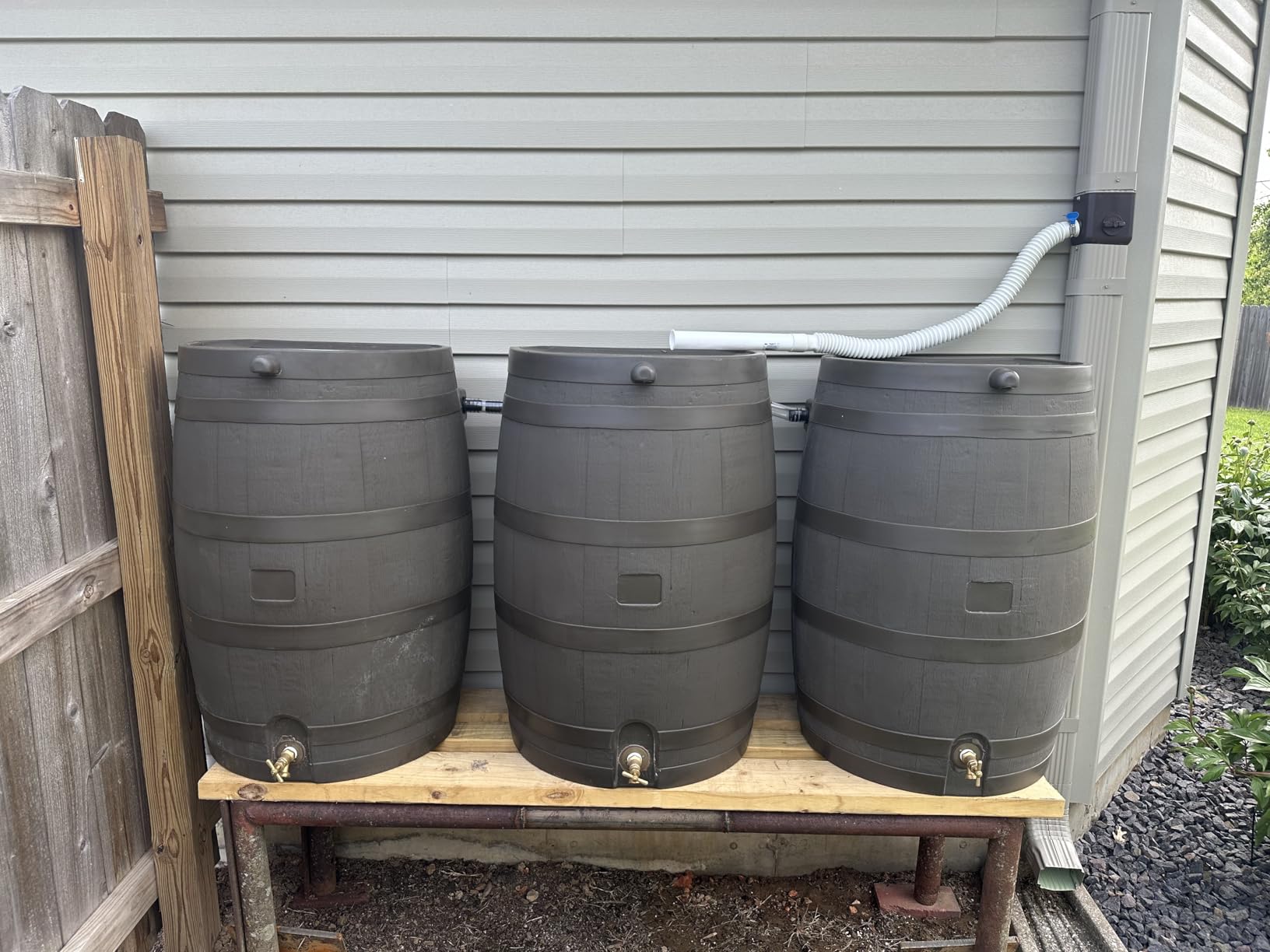
Linking is the cheapest way to double storage, and a second barrel roughly doubles the water you have between storms. Barrels with a single low spigot force you to run an overflow hose from one to the next, which means an extra hose on the ground and a connection that can freeze. Side spigots let the second barrel feed the first directly with the link kit.
Two barrels also make winterizing easier in one specific way: a linked pair drains more completely, so less water is trapped in low spots.
Where it falls short
The round body costs you about five inches of width compared with a slim-line model, which matters in a tight side yard between a house and a fence. And without a stand, expect weak flow at the end of a dry week. This is the barrel for a gardener with an open corner of yard, not for a narrow alley.
3. RTS Home Accents 50-Gallon with Brass Spigot: Best Brass Fitting
RTS Home Accents 50-Gallon Rain Barrel with Brass Spigot, Flat Back Rain Water Collection Barrel, Walnut Color
50 gallons
Brass spigot
Walnut faux-wood finish
21 x 19 x 34 inches
Pros
- Brass spigot outlasts plastic
- Attractive walnut finish
- Flat back sits close to the wall
- Rear overflow supports linking
Cons
- Back bows out about 3 inches when full
- Spigot threads strip if cross-threaded
- Top screen too large for the opening
This is the barrel I reach for when the spigot is the weak point in a cheaper model, which is the single most common complaint across the whole category. The brass fitting feels solid, threads cleanly, and accepts a standard garden hose. At 4.4 stars from 2042 reviews, it is one of the most proven designs in the group.
The walnut faux-wood finish is the reason it shows up in more front gardens than its utilitarian rivals. It is cylindrical, 21 by 19 by 34 inches, 18 pounds empty, made in the USA, and covered by a one-year parts warranty. The built-in overflow valve supports linking, and the flat back keeps the body close to the house.
Read the spigot install note before you start. The threads strip easily if you cross-thread the fitting, and you will need a pipe wrench rather than fingers to tighten it. That is a five-minute lesson and a small annoyance, but the fix is simply to thread slowly and hand-tight, then snug with the wrench.
Same expansion caveat as the other flat-back barrels: the back panel bows outward by roughly 3 inches when full, so leave a gap from the wall. The top screen is also slightly oversized for the opening and lacks screw holes to hold it, which is why it sits loosely for some owners.
Why the spigot matters more than the barrel
A plastic spigot fails by weeping at the handle seal or cracking at the thread. A weeping spigot puts water against siding or a foundation corner, and that is exactly the failure mode gardeners describe on forums: rot and mold appearing right where the barrel sits. Brass removes that risk from the equation for the part that actually wears.
If you already have a barrel with a failed plastic spigot, replacing just the spigot costs far less than replacing the whole barrel. Match the thread pattern before you buy.
Watch these two details
The front overflow opening has no hose fitting, so plan where excess water goes before the first heavy storm. And gravity pressure is low, same as most 50-gallon barrels on grade, which means blocks or a stand for comfortable watering-can flow.
4. FCMP Outdoor Slim Line 45 Gallon: Best for Narrow Side Yards
FCMP Outdoor Slim Line Design Rain Barrel, 45 Gallon, Brown
45 gallons
16 inch deep
22 x 16 x 32 inches
20 pounds empty
Pros
- Only 16 inches deep against a wall
- Everything hoses included in the box
- Side spigots support linking
- Corrosion-resistant debris screen
Cons
- 45 gallons is under the 50-gallon class
- Nearly useless on the ground without a stand
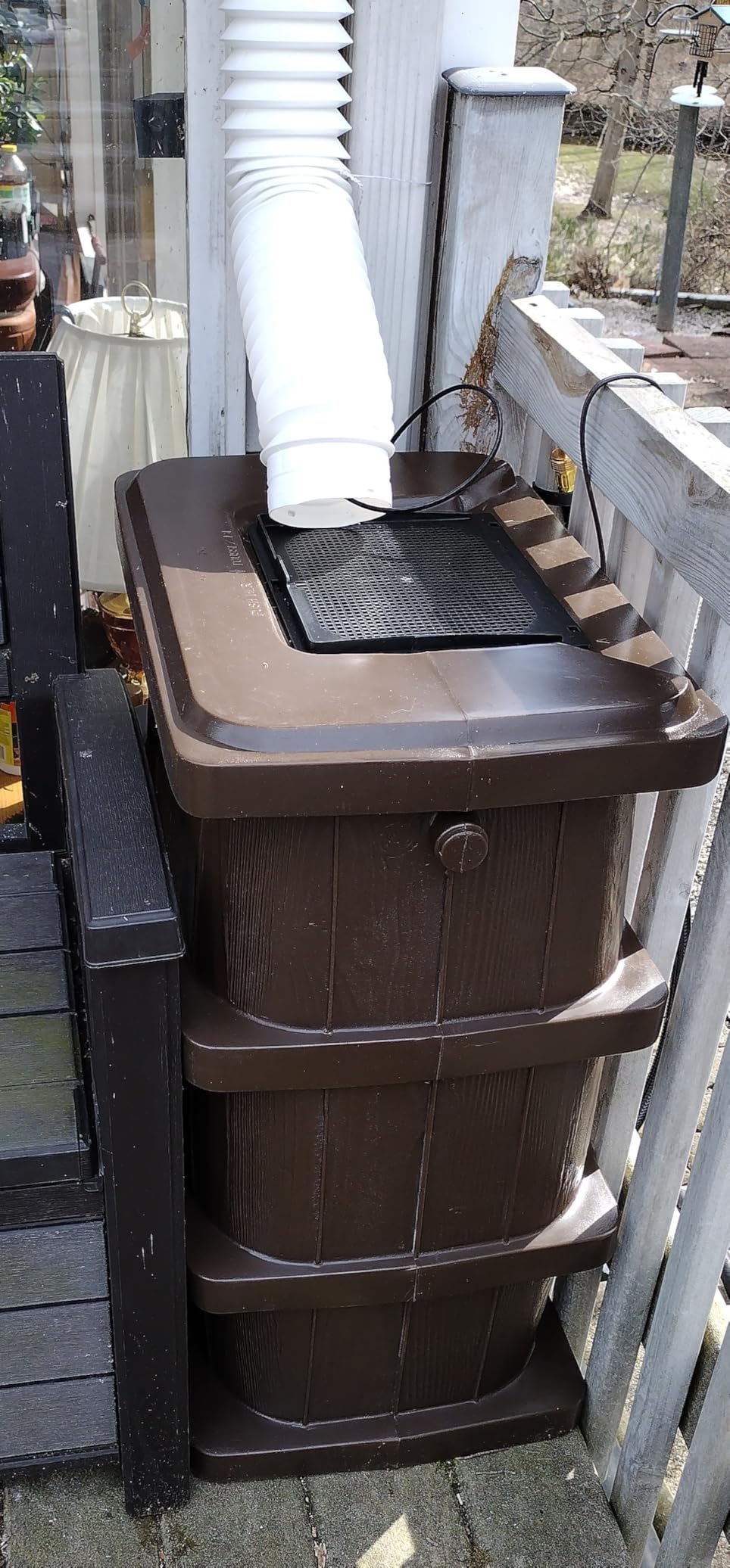
When the constraint is width, this is the barrel. At 22 inches long by 16 inches deep by 32 inches tall, it is the slimmest model in the lineup and the only one that genuinely hugs a wall in a tight side yard between a house and a fence. The wood grain finish keeps it from looking like an industrial drum in a space where you will see it every day.
The box is unusually complete: debris screen, garden hose, shut-off thumb valve, hanging hose clip, overflow hose, and a linking kit. That is the same accessory bundle as the larger Raincatcher in a smaller shell, and at 4.3 stars from 1055 reviews owners are largely satisfied with what arrives.
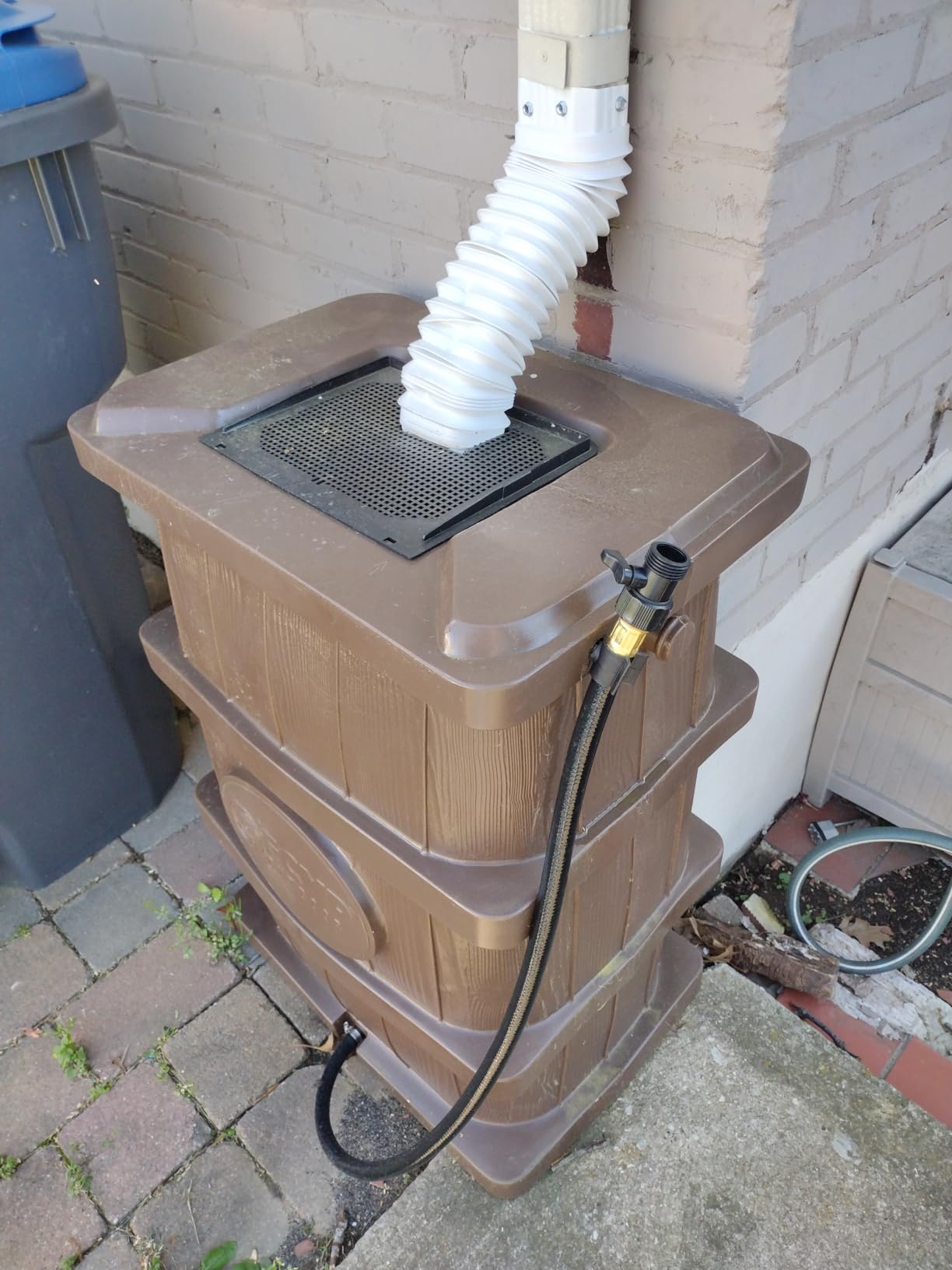
The trade is capacity. At 45 gallons it sits a step below the 50-gallon class, and on a roof catchment that fills quickly during a storm you will find yourself with a full barrel and nowhere to put the excess until the overflow handles it. For a small vegetable bed or a set of containers, 45 gallons is plenty. For raised beds feeding a family all summer, it means more trips with the watering can.
Because it is only 32 inches tall, the low gravity pressure issue is more pronounced here than on a larger barrel. Reviewers consistently pair it with a stand, and we would not skip that step. The shut-off thumb valve and hose clip on the front are genuinely useful for a slim profile, because there is not much surface to hang things on.
Measure the gap before you order
Measure the actual clearance between your downspout and the nearest wall or fence, then subtract an inch or two for the bulge the flat back develops when full. Most side-yard installs that look fine on paper are about 18 inches, and this is the barrel that fits 18 inches. The round 50-gallon models do not.
If you have room for 24 inches, the Raincatcher gives you five more gallons for a similar footprint, and we would take that trade.
What you give up
Nothing on accessories, which is rare. What you give up is storage volume and a little flow, since a shorter barrel has less head over the spigot. If your garden is a single raised bed, a row of containers, or a small herb patch, that is an easy sacrifice. If you are watering a young orchard, it is not.
5. FCMP Outdoor Catalina 45 Gallon: Highest Rated in the Lineup
FCMP Outdoor Catalina 45 Gallon Rain Barrel, Light Granite
45 gallons
Recycled UV-inhibited polyethylene
22.5 x 20.5 x 29.75 inches
25 pounds empty
Pros
- Highest customer rating we found
- Small opening keeps pets out
- Includes hose shut-off valve and clip
- Light granite finish suits a garden
Cons
- 45 gallons is below the 50-gallon class
- Fixed lid is harder to reach into
The Catalina holds the highest average rating in this roundup at 4.6 stars, with 80 percent five-star feedback among 596 reviews. We want to be straight about what that means: the rating is excellent and the review base is a fraction of what the RTS and FCMP flagships carry. Read it as a very good sign, not as a guarantee.
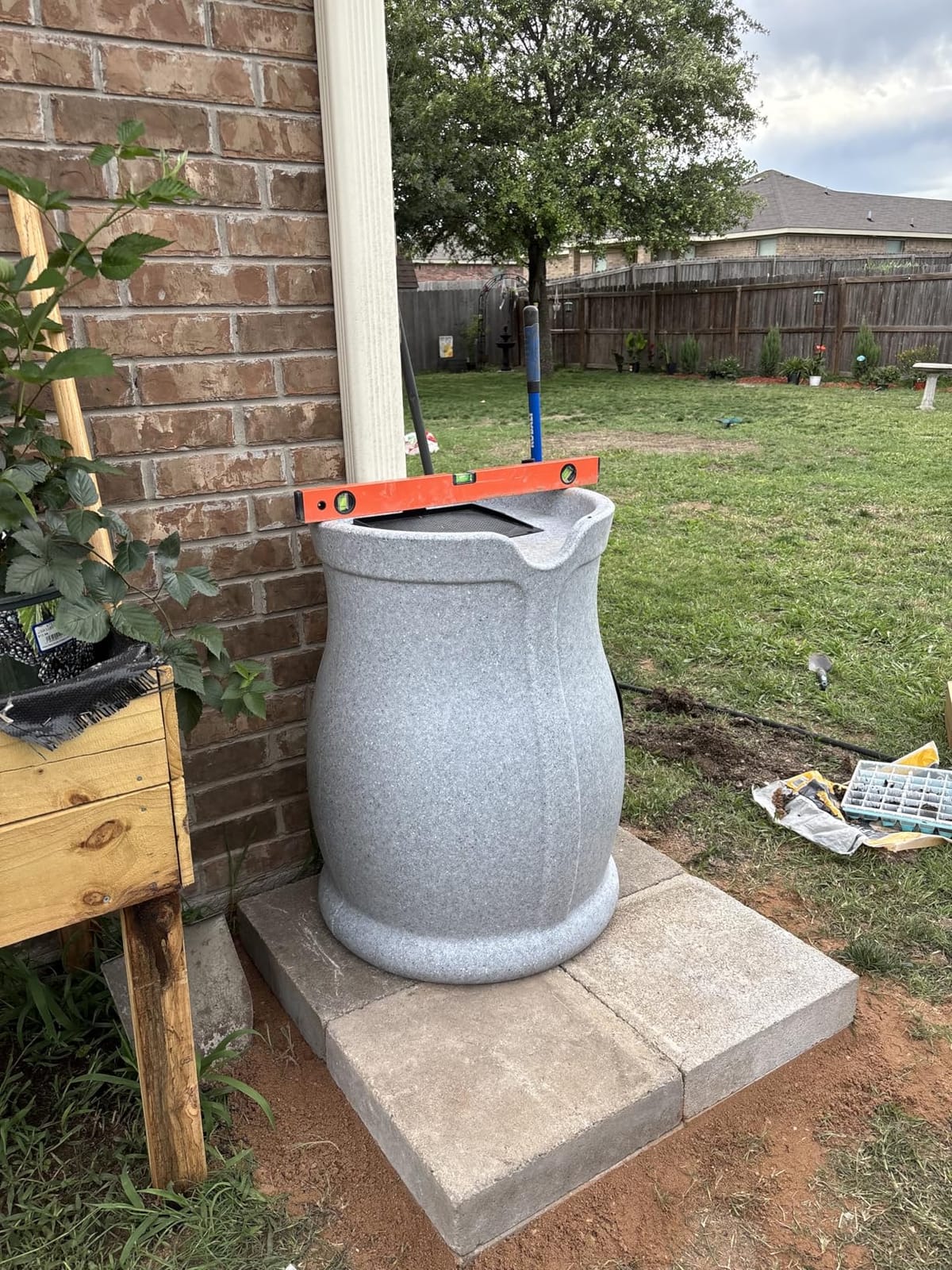
What earns those stars is the finish and the fit. The light granite decorative surface looks deliberate rather than utilitarian, and the flat back positions tightly against a house so the downspout lands cleanly. At 22.5 by 20.5 by 29.75 inches it is compact, and at 25 pounds empty the shell is recycled, UV-inhibited, BPA-free polyethylene. Among the round 50-gallon-class barrels it is also the shortest, so gravity flow off the spigot is gentle by design.
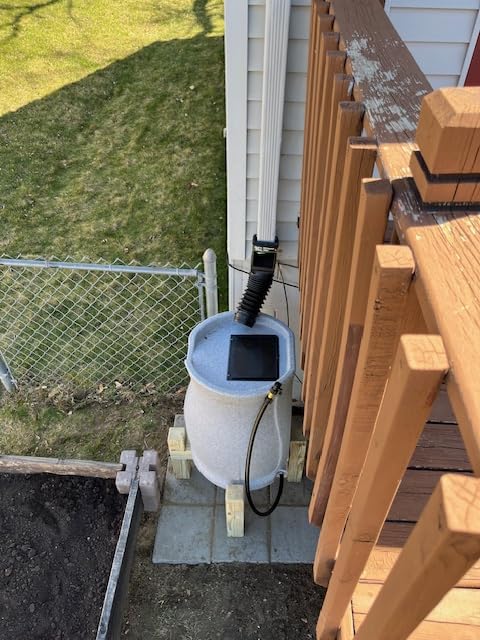
The small top opening is the detail that sets this barrel apart from the screen-top models. It is narrow enough that children and pets are not going to fall into it, which is real peace of mind in a yard with a curious dog. It also limits what ends up in the water, since most debris lands on the lid instead of in the barrel.
In the box you get a 3.5 foot garden hose with a shut-off thumb valve and a hanging clip, which is enough to fill watering cans at the barrel and enough to connect to a longer hose if you run one. The one-year limited replacement warranty covers manufacturing defects. Made in Canada.
When a fixed lid is the right call
A fixed lid wins on two fronts: it blocks debris and mosquitoes without a separate screen purchase, and it keeps children and pets out. If your yard is next to a road with standing water problems, that is a real advantage over every screen-top barrel here.
The cost is access. When leaves, silt, or a stray plastic bag end up inside, a fixed lid means reaching past the opening with a scoop rather than lifting the whole top off. The removable-lid model below is better if you expect to clean out frequently.
Where it stops short
45 gallons is the smaller capacity class, and this barrel is also short at just under 30 inches, so gravity flow off the spigot is gentle. If you are running a soaker hose or a low-pressure drip line rather than filling cans by hand, budget for a stand. For a hand-watered herb bed and a patio, it is more than enough.
6. Good Ideas Nantucket 50 Gallon: Best Built-In Planter Top
Good Ideas Impressions Nantucket Rain Water Collection Barrel, 50 Gallon
50 gallons
4 inch planter top
Two metal spigots
23.25 x 23.25 x 32 inches
Pros
- Planter top grows herbs or flowers
- Routed overflow protects the foundation
- Dual metal spigots for hose or buckets
- Dark brown hides water streaking
Cons
- Second spigot is fiddly to seal
- Shallow planter dries fast in heat
The Nantucket is the barrel to buy if you want the water storage and a small herb bed in the same footprint. The 4 inch planter top sits above a mesh screen and takes a row of thyme, chives, or decorative flowers that gets watered every time you draw from the barrel. It is a genuinely useful use of otherwise dead top surface, and at 4.4 stars from 539 reviews owners rate the finish highly.
The overflow design is the part I like most. Rather than a bare opening, a routed channel carries excess water to the front of the barrel and away from the house, which is the single best defense against the foundation rot that gardeners complain about on forums. Rated 4.4 across 539 reviews, with a one-year limited manufacturer warranty.
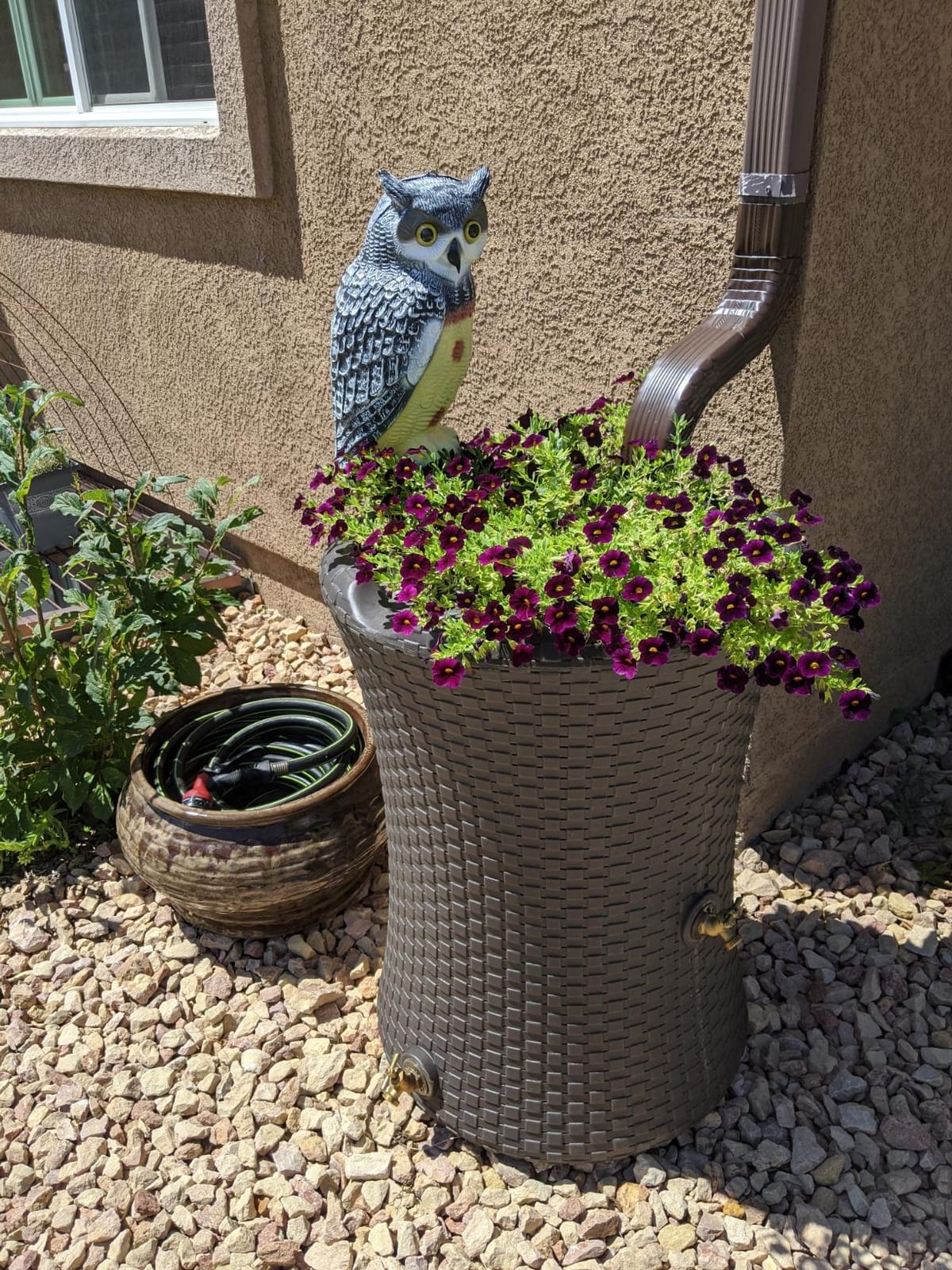
Two metal spigots give you options. The front one accepts a hose, and the side one is positioned to fill a tall bucket or to link a second barrel, or to act as a secondary overflow control. That versatility is genuinely useful when you are filling a five-gallon bucket instead of a two-gallon can.
Plan on care with the second spigot. Owners report that it takes effort to install and can be tricky to seal properly, so budget time and PTFE tape. The dark brown finish also has a practical advantage over lighter colors: rainwater streaking down the side is far less visible.
Making the planter top actually work
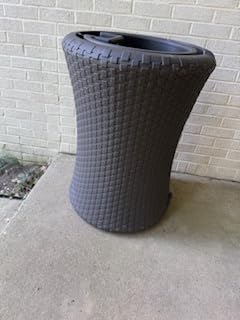
A 4 inch planter is shallow, and shallow planters in a barrel lid dry out fast in summer heat and wash out their planting in a heavy storm. Owners add a layer of pebbles or a heavier succulent mix to weigh the soil down and slow evaporation. If you skip that step, expect to replant twice a season.
It is a small surface, so choose shallow-rooted plants. Herbs and succulents handle the wet-dry swings better than a flowering annual.
Who should pick something else
Choose a plain barrel if you plan to hang a trellis or a large container plant off the side, because the planter top and the shallow 32 inch height give you less to work with. And if the second spigot looks like a feature you would use, have the fittings on hand before you start.
7. Good Ideas Rain Wizard Urn 50 Gallon: Best Decorative Shape
Good Ideas Rain Wizard Urn Shaped Water Collection Barrel, 50 Gallon
50 gallons
Urn silhouette
22 x 23 x 30 inches
17 pounds empty
Pros
- Urn shape looks good by a front door
- Sturdy resin holds up over seasons
- Integrated planter top drains itself
- Flat back allows tight placement
Cons
- Shallow planter washes out in heavy rain
- Light finish streaks where rain drips
- Spigots need real effort to install
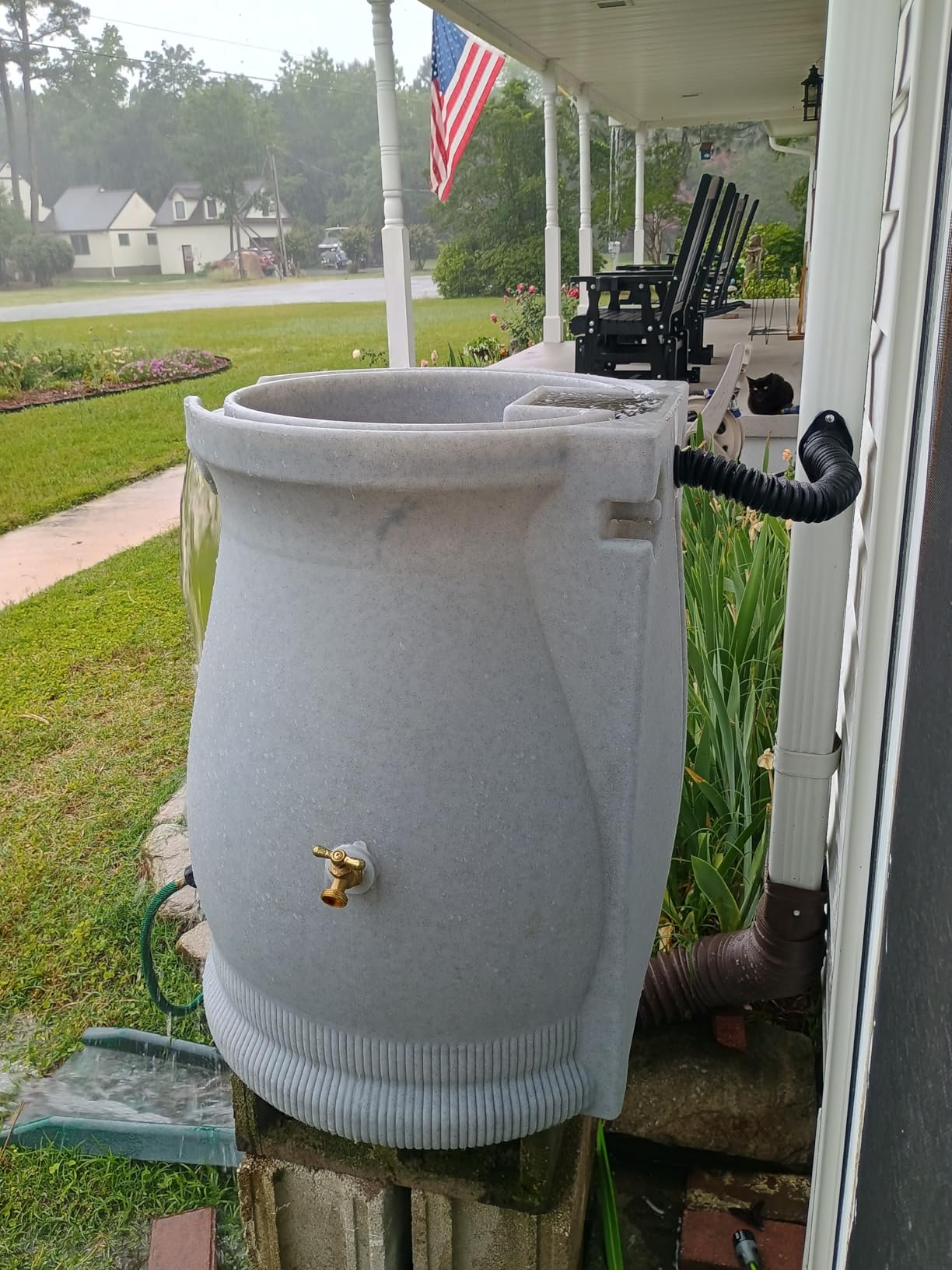
The urn silhouette is the reason this barrel exists and the reason it sells. If the barrel will be visible from the street or sit beside a front entry, the 17 pound urn profile in light granite reads as a planter rather than as infrastructure. It is also the lightest barrel here, which makes repositioning it a one-person job while empty.
Underneath the styling it is a real 50-gallon barrel made from thick polyethylene resin, measuring 22 by 23 by 30 inches with a flat back for tight placement. The integrated channel diverts overflow away from the home, and the mesh screen keeps leaves out. At 4.4 stars from 500 reviews, the complaints are about the planter and the finish rather than the barrel itself.
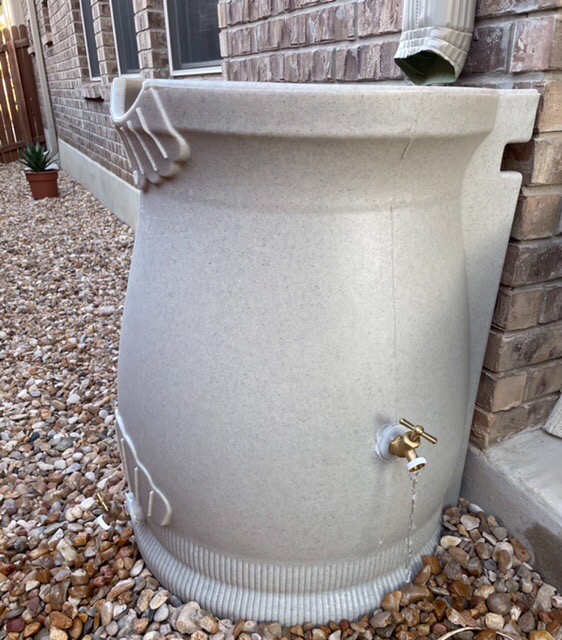
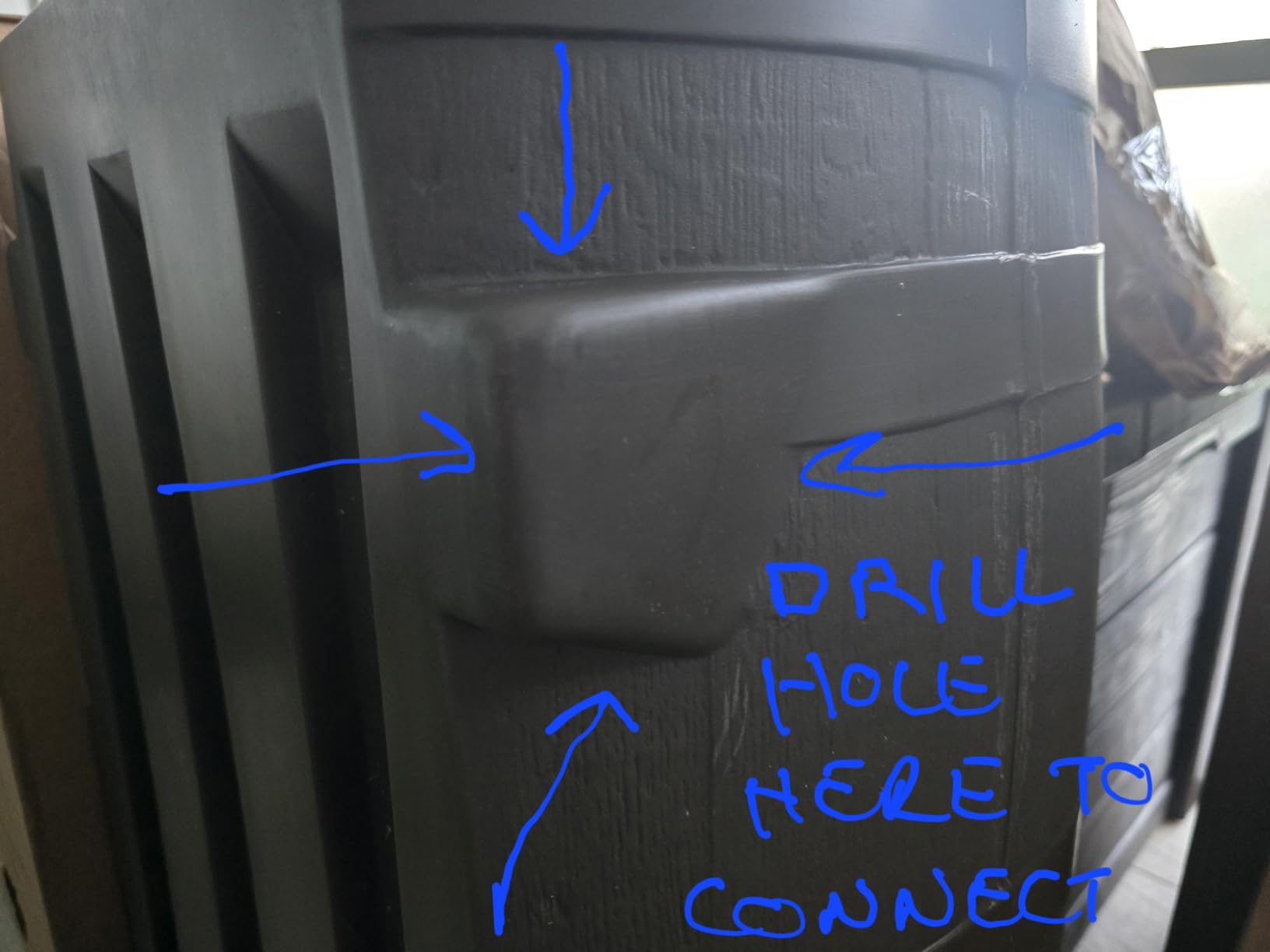
The planter top is self-draining, which is better than most, but it is still shallow. Owners who want it to look good through a wet spring add rocks to stop washout. One owner also drilled a rear inlet hole to route the downspout directly, which is a clean solution if your downspout does not naturally land on the opening.
Two practical notes. The spigots take real effort to screw in and want care with plumber’s tape, so do not rush them. And light colorways streak where rain drips down the exterior, which is normal for decorative resin and not a defect.
Where the downspout lands matters more than the shape
An urn shape is round, and a round barrel rarely sits flush to a wall, so the downspout often has to reach across a gap to the opening. Before buying, stand a tape measure at the height of the inlet and check the horizontal offset. If the gap is more than a few inches, the slim-line or flat-back barrels feed more cleanly.
For a front-yard feature where the visual matters more than every gallon, the gap is a fair price to pay.
Where it falls short
At 30 inches tall it is one of the shorter barrels in the lineup, so gravity pressure is modest and a stand is worth adding if you are running a hose. The finish also shows drip staining. If you want a barrel that disappears against a wall rather than one that draws the eye, this is the opposite of what you want.
8. Laspeiraux 53 Gallon Collapsible Barrel: Best for Renters and Short Seasons
Collapsible Rain Barrel Water Storage Containers 53 Gallon
53 gallons
Three-layer PVC
23.6 x 23.6 x 27.6 inches
Folds flat when empty
Pros
- Folds flat between seasons
- Screw-in faucet instead of parts assembly
- Weighs little enough to reposition
- Mesh filter and overflow kit included
Cons
- Light feet under a 442 pound load
- Coarse built-in mesh needs fine netting
- Slow leak reported at bottom outlet
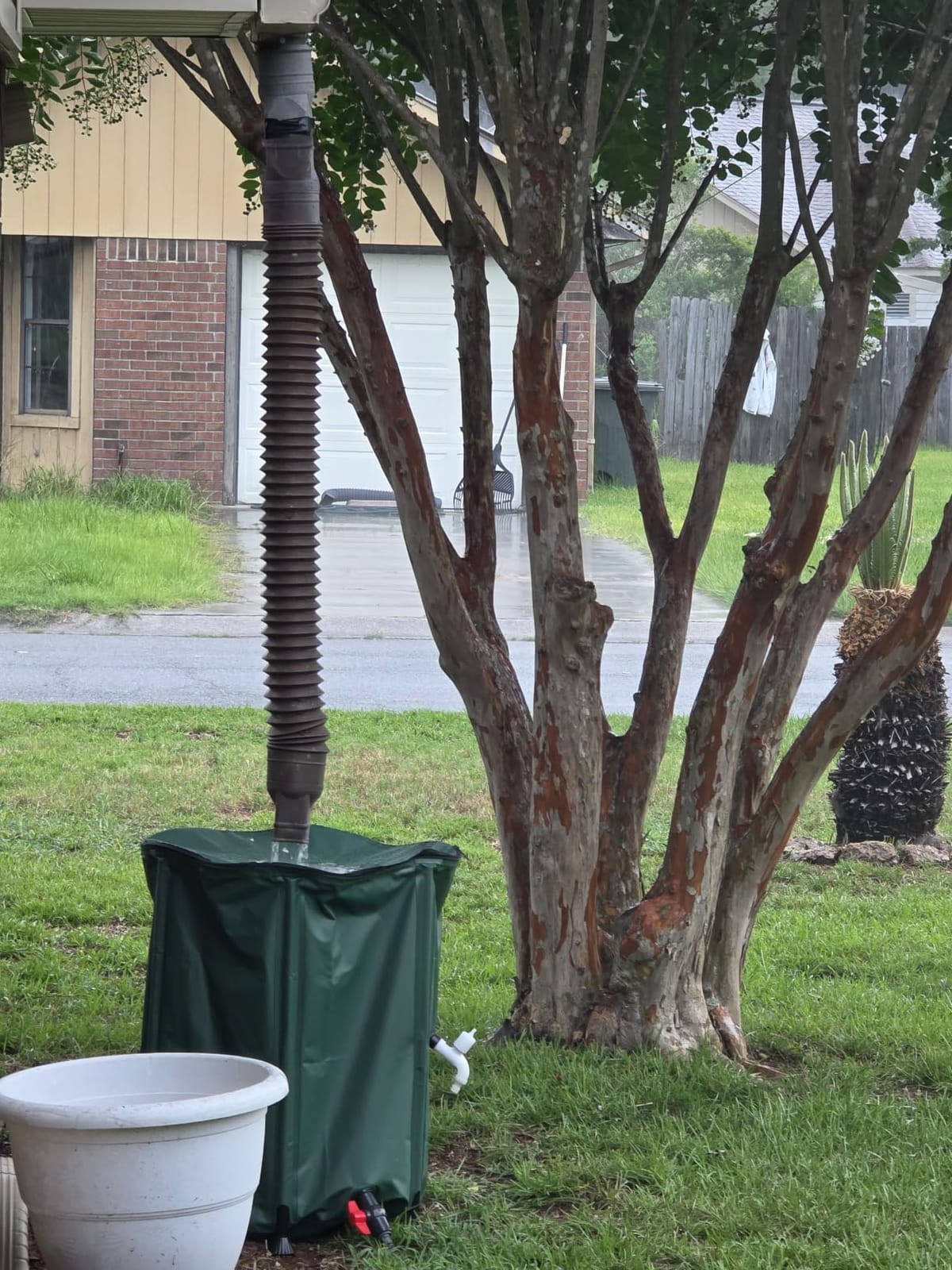
This is the only barrel in the roundup that answers a problem none of the rigid barrels solve: what to do with it when it is empty. It is a three-layer PVC cylinder that folds flat at 2.66 kilograms, so a renter, a seasonal-property owner, or anyone in a freezing climate can store it indoors between uses instead of draining and covering it outside.
Capacity is the surprise: 53 gallons in a 23.6 by 23.6 by 27.6 inch footprint, which is more storage than most of the 50-gallon rigid barrels in a similar footprint. Construction is a single screw-in faucet rather than a multi-part assembly, which means fewer joints and fewer places to leak. Owners report it holds its shape without wobbling when full.
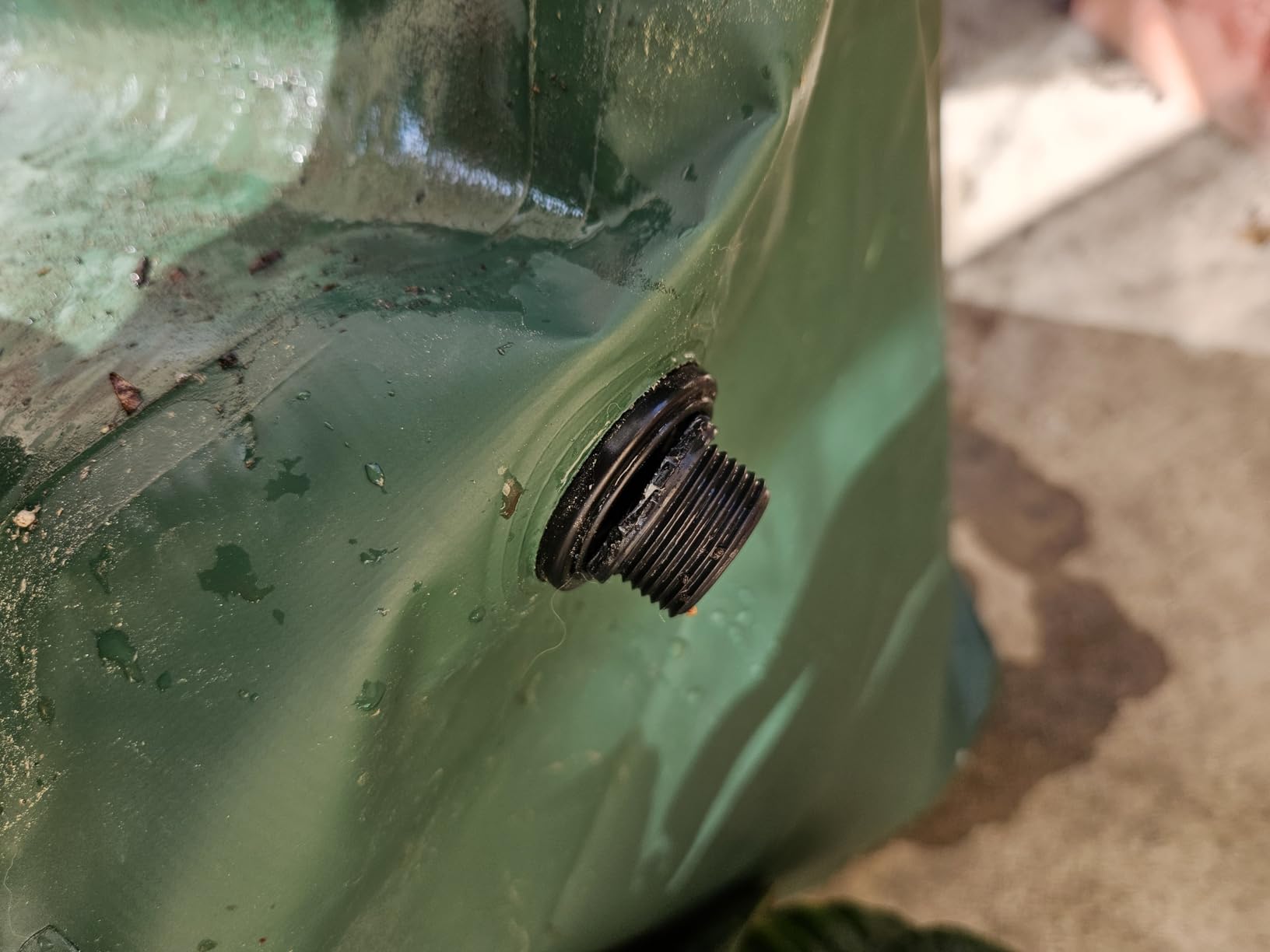
Owners also like the zipper-style top, which gives easy access for buckets and watering cans without a screen to trim. The mesh top filter and the overflow outlet both handle heavy rain, and the kit includes the spigot, filter, and overflow fittings so nothing else is required to connect it.
The trade-offs are honest ones. The plastic spigots have no internal stabilizing plate and can flex out of square as you work them. The feet are light for the 442 pound load of water, and a paver underneath is a sensible precaution. The built-in mesh is coarse enough that some owners add fine mosquito netting, and one buyer reported a slow leak at the bottom outlet that needed propping up. Long-term seam durability after a single season is not yet proven by owners.
Why folding beats draining in cold climates
Rigid barrels have a winter problem: either you drain them completely or you risk split shells from frozen water. A folding barrel solves that by going inside. For anyone in a hard-freeze zone, or anyone renting who cannot leave a 450 pound object beside the house, that is worth a lot more than five extra gallons.
If you keep it out year round, treat the drainage rules the same as for any other barrel. Empty it before the first freeze.
Where it is not the right pick
Choose a rigid polyethylene barrel if you want the thing to sit untouched for five or ten seasons. A flexible PVC shell is a different proposition from a rotomolded barrel, and the review history here is one season deep. It is also the lightest on weather resistance, so a dark finish in a sunny corner is the kinder choice.
9. RTS Home Accents Newport 50 Gallon with Stand: Best for Maintenance
RTS Home Accents 50-Gallon Newport Rain Barrel with Stand and Removable Lid, Slate Color
50 gallons
Includes stand and lid
22.7 x 21.7 x 44.5 inches assembled
20 pounds empty
Pros
- Removable lid makes cleaning simple
- Stand raises the spigot for filling
- Brass spigot included
- Overflow nozzle fits either side
Cons
- Tall 44.5 inch footprint
- Lower review volume than barrel-only models
This bundle solves the two complaints that recur most often across every other barrel here. The stand raises the spigot to a comfortable working height, which is the answer to the leftover-water problem that owners describe, where a few inches sit in the bottom and only come out if you tip the barrel. The removable lid solves cleaning: no screen to trim, no awkward reach-through.
You also get a brass spigot, a screen kit to keep debris out, and an overflow nozzle that can be installed on either side so you can point it away from the house no matter which side the downspout is on. The barrel itself is 50 gallons in slate, and the whole assembly stands 22.7 by 21.7 by 44.5 inches.
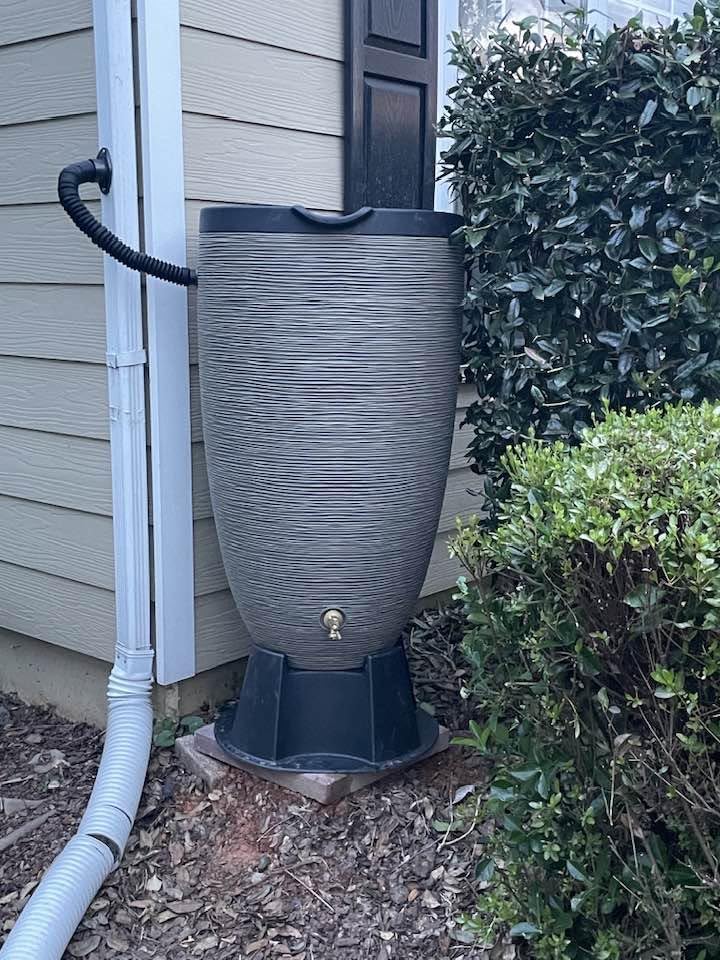
At 4.4 stars from 208 reviews, the feedback is positive but thinner than the flagships, so we have less long-term durability evidence to draw on. What owners praise most is straightforward: the elevated stand for watering-can access and the removable lid for maintenance. The barrel body and the stand arrive as one unit, so there is no separate stand to source.
Consider the dimensions seriously. At 44.5 inches assembled this is the tallest setup in the lineup, which is a real consideration under a low eave or a tight side yard. The extra height is not wasted, though, because it is the height that produces usable gravity pressure rather than a dribble.
Height is the cheapest pressure upgrade there is
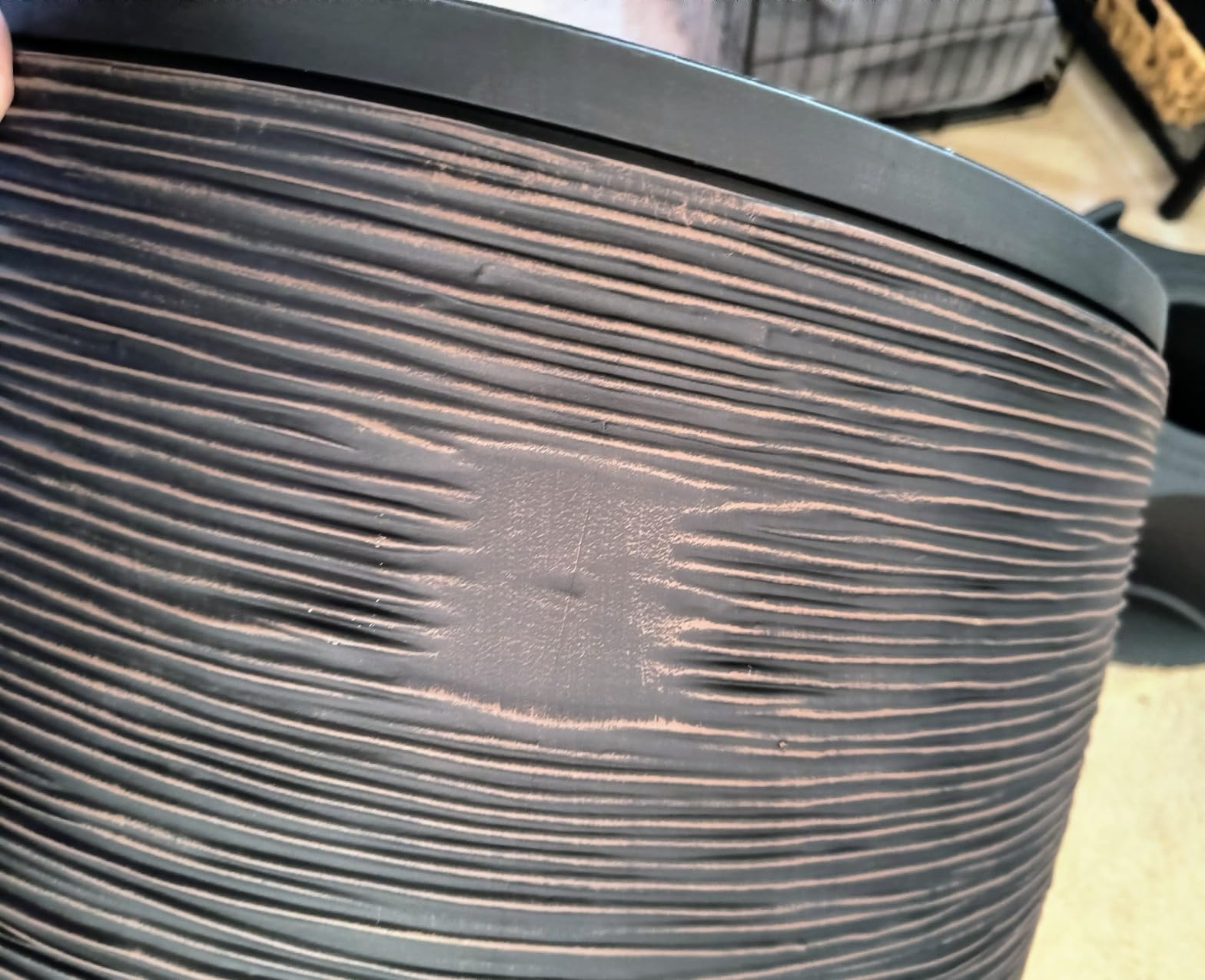
Everything on a rain barrel runs on gravity, and pressure is simply the height of water above the spigot. Add 18 inches of stand and you roughly double the head. That is the difference between a watering can that fills briskly and one you hold under the spigot while the barrel drains an inch at a time. No pump required, no electricity, no fittings to fail. Higher placement also means less water stranded in the bottom of the barrel, which is where debris and mosquito larvae tend to collect.
Who should buy something different
Skip it if vertical clearance is tight or if you want the lowest possible profile. Pick a barrel with a wider footprint instead, since extra width also adds head. And if longevity across many seasons is your priority, a standalone rigid barrel with a separately purchased stand gives you more choice of stand height later.
10. Step2 Lakewood 60 Gallon with Stand: Largest Capacity in the Lineup
Step2 Lakewood Rain Barrel with Stand, Outdoor Water Conservation Container, Holds 60 Gallons, Brown
60 gallons
Elevated stand
46 x 24 x 20 inches assembled
34 pounds empty
Pros
- Largest capacity we tested
- Elevated stand gives real hose pressure
- Stainless steel screen filters fine grit
- Double-walled plastic resists cracking
Cons
- Tall and heavy at 34 pounds empty
- Widest rating spread in the group
The Lakewood holds 60 gallons, more than any other barrel in this roundup, and it does it on an integrated stand that puts the spigot at working height. For thirsty raised beds, a young orchard, or a gardener who wants to stop refilling mid-week, the extra 10 to 15 gallons over a standard 50-gallon barrel is a real difference in how often you go outside in the heat.
The hardware is the most durable in the group: a stainless steel mesh screen that filters fine particulate rather than just leaves, and a 3/4 inch brass spigot. The double-walled plastic resists chipping, fading, and cracking, and the design links to additional barrels for more storage and overflow management.
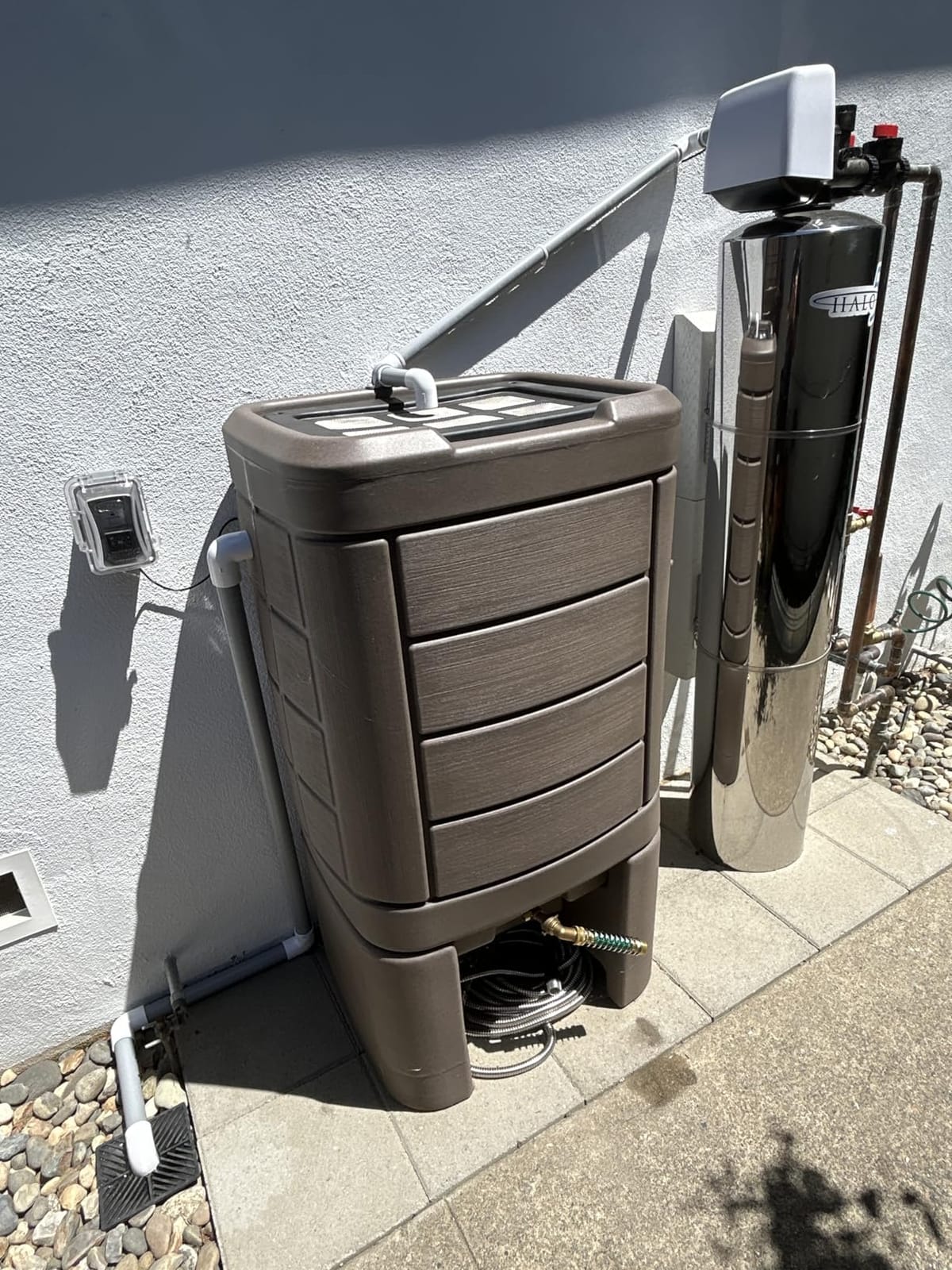
The stainless screen is worth calling out. Coarse plastic debris screens stop twigs and leaves but let grit through, and grit is what ends up in a low-pressure drip emitter. If you are running drip irrigation rather than a hose, this is the screen to buy.
Dimensions are 46 inches tall by 24 wide by 20 deep assembled, and the empty weight is 34 pounds, the heaviest barrel here. Expect the widest rating spread in the lineup at 4.2 stars from 139 reviews, with a visible cluster of two-star feedback on the overall build. At 139 reviews the long-term picture is less settled than the 3000-plus review barrels, and it is the one on this list we would want to see more owner history on before recommending without reservation.
When 60 gallons changes the equation
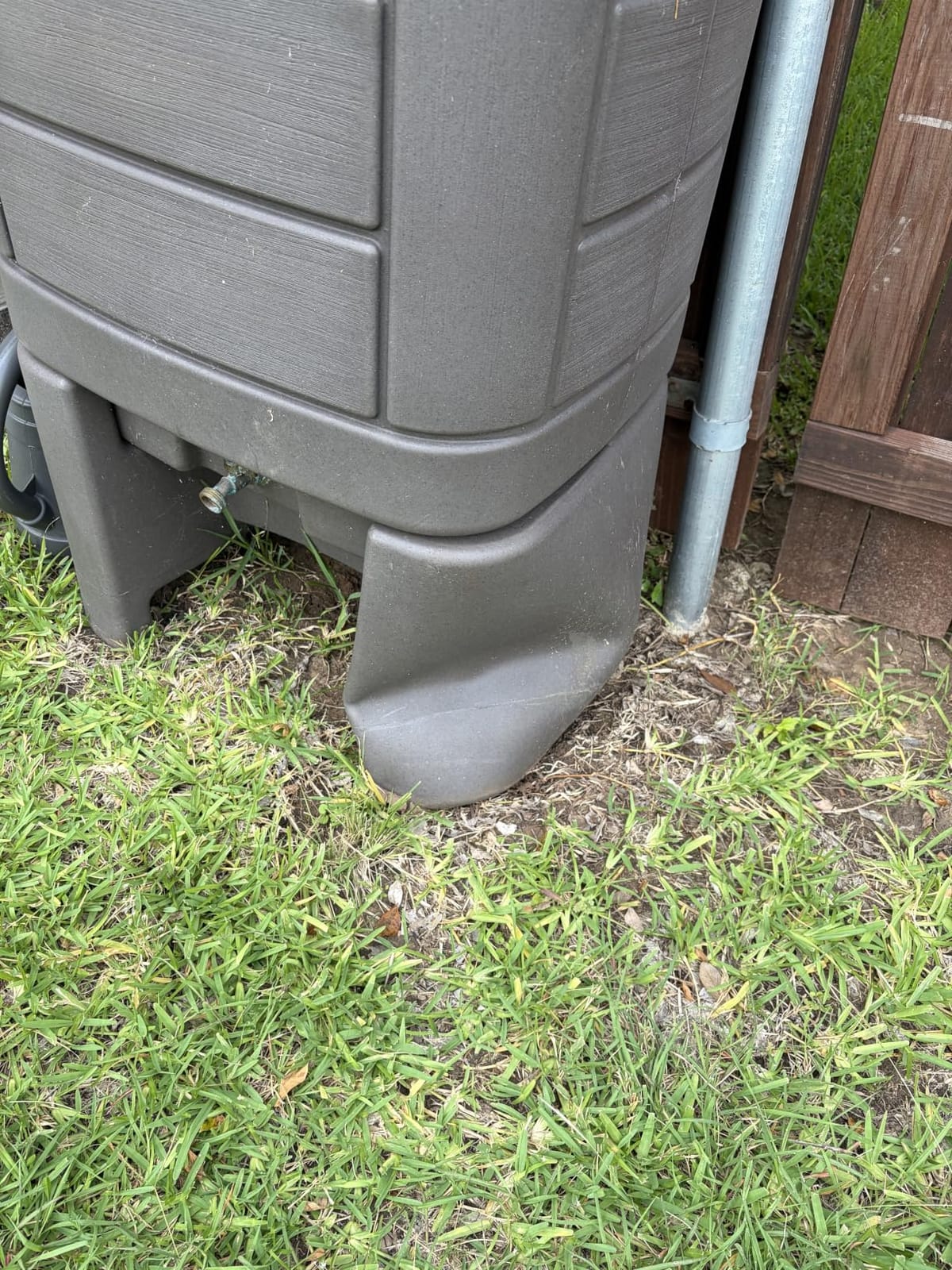
Capacity only matters if the barrel can hold a meaningful share of a storm. A 50-gallon barrel on a large roof catchment fills in minutes and spends the rest of a storm dumping water through the overflow, so you are effectively collecting a fixed ceiling. If your roof is large, extra capacity mostly reduces waste rather than increasing supply.
Where the extra 10 gallons genuinely helps is between storms, in a dry week when a smaller barrel is empty by Wednesday. That is the situation the elevated stand also helps with.
The honest caveat
At 4.2 stars with a cluster of two-star build complaints, this barrel has the least settled reputation of the twelve. It is still our pick for maximum capacity, and the screen and spigot hardware are the best in the roundup. Just check recent reviews for your specific production run before committing, and give the base a solid level pad for the weight.
11. Rain Wizard 50 Gallon with Diverter Kit: Easiest Installation
Rain Wizard 50 Gallon Rain Barrel with Diverter Kit – Terra Cotta
50 gallons
Diverter kit included
BPA-free resin
Brass spigot
Pros
- Diverter included so nothing else to buy
- Closed-loop overflow returns to the downspout
- Diverter disconnects for off-season storage
- Installs in about 15 to 20 minutes
Cons
- Included diverter hose is stiff and kinked
- Downspout screen blocks flow until trimmed
- Sized for 2x3 downspouts
This is the barrel to buy if the word installing is the thing standing between you and a barrel. The diverter kit is in the box, so the purchase is a single decision rather than a barrel plus a diverter plus a screen plus an overflow hose. Owners report about 15 to 20 minutes with basic tools from unbox to filling.
The closed-loop design is the quiet advantage. When the barrel fills, the diverter returns the excess back into the downspout rather than discharging it onto the ground, which means no standing water beside the foundation and no mosquito breeding pool next to your house. It is also the cleanest answer to the mosquito question in this roundup.
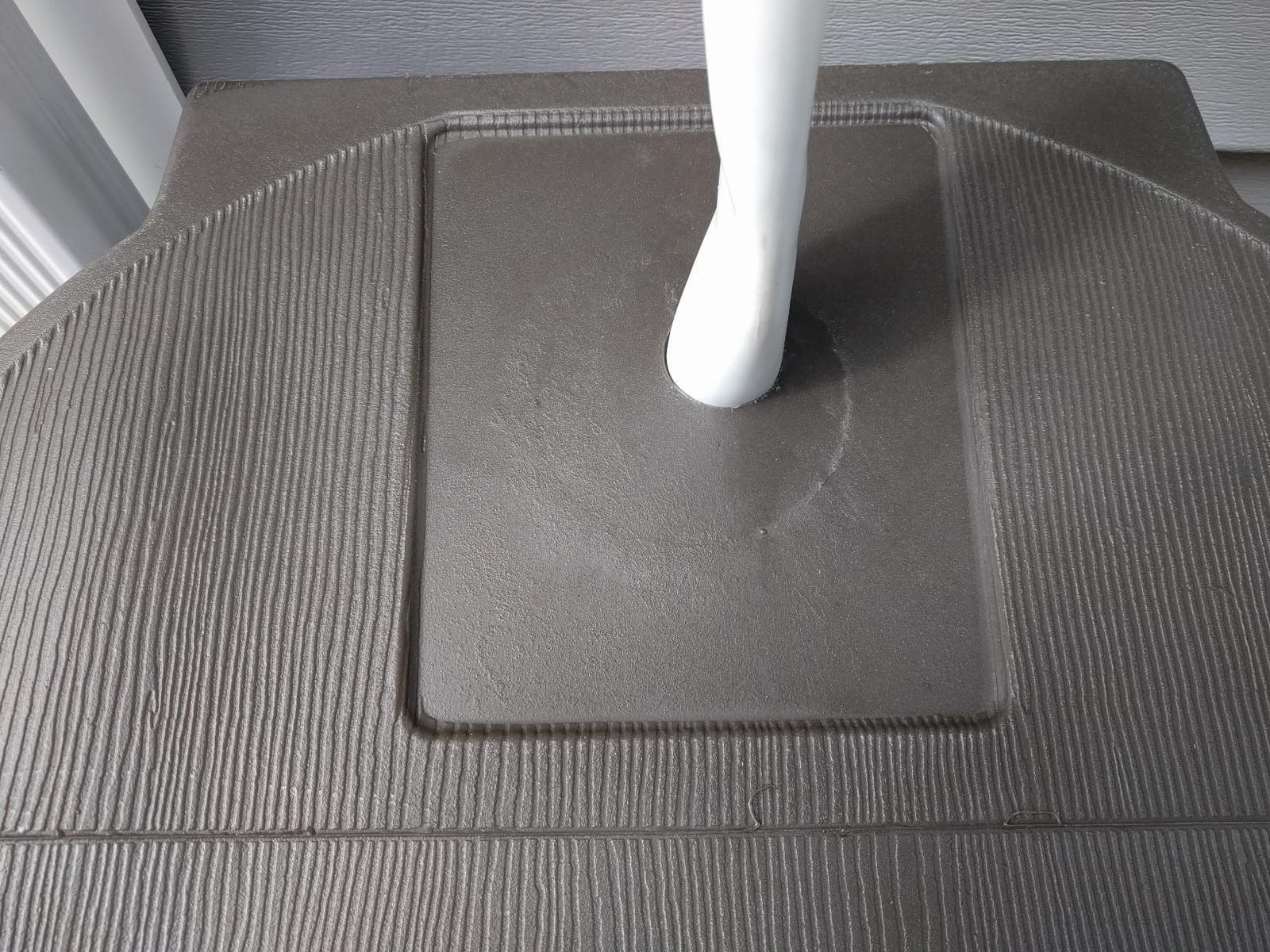
The brass spigot is sturdy and seals well with plumber’s tape, and the diverter disconnects so the barrel comes out for winter storage without dismantling the downspout. The terracotta colour suits a garden bed better than most utilitarian finishes.
Plan one modification. The included diverter hose is rigid and often arrives kinked from being folded in the box, and several owners replace it outright. The downspout screen can also block flow until it is trimmed, and the diverter is sized for 2×3 downspouts, so larger gutters may need adapting. A few buyers report pinhole leaks along the weld seam, so check the seam before you install.
Why closed-loop overflow is worth a few extra dollars
Most barrels discharge overflow through a hose you have to route away from the foundation yourself, and misrouted overflow is the leading cause of the rot and mold gardeners report. A closed-loop diverter eliminates that decision entirely. The water goes back down the pipe it came from, where it belongs.
It also means your barrel can sit tight against the house without you having to plan a drainage path first, which is a meaningful constraint in many yards.
Who should choose a different kit
Choose a separate-barrel-and-diverter setup if your downspouts are larger than 2×3 or your gutter design is unusual, because this diverter is dimensioned for standard residential downspouts. And if you are not able to trim or replace the included hose, expect a frustrating first storm. At 102 reviews this is the least-reviewed barrel here, so it is a buying-on-simplicity bet rather than a buying-on-evidence one.
12. Emsco Rescue 50-Gallon Whiskey Barrel: Best Rustic Look
Rescue 50-Gallon Whiskey Rain Barrel – Includes Planter, Rain Water Diverter, Outlet Hose – Flatback Design – Brown
50 gallons nominal
Rustic half-barrel styling
27.9 x 29.9 x 19.9 inches
15 pounds empty
Pros
- Whiskey barrel styling suits a cottage garden
- Planter top has a built-in weep hole
- Diverter included and returns overflow
- Closed-loop overflow avoids standing water
Cons
- Half-barrel shape holds well under 50 gallons
- Quality control reports of pinholes and mismatched parts
When the goal is a garden that looks like it belongs in a cottage planting rather than a modern patio, the half-barrel silhouette is the whole point. The Emsco Rescue in brown is 15 pounds empty, among the lightest decorative barrels in the lineup, and the integrated planter top includes a built-in weep hole that drains the soil and prevents root rot. That weep hole is a detail the cheaper planters skip.
The included diverter is a real advantage. It sends overflow back through the downspout automatically, so there is no standing water next to the barrel and nothing to attract mosquitoes. An outlet hose for directing water to your beds is also in the box, along with an installation guide.
Now the honest part. At 4.0 stars from 89 reviews this is the lowest-rated barrel in the roundup, and the dominant complaint is capacity: the half-barrel shape delivers well under the advertised 50 gallons. If you are buying for volume, this is the wrong barrel and we would not pretend otherwise.
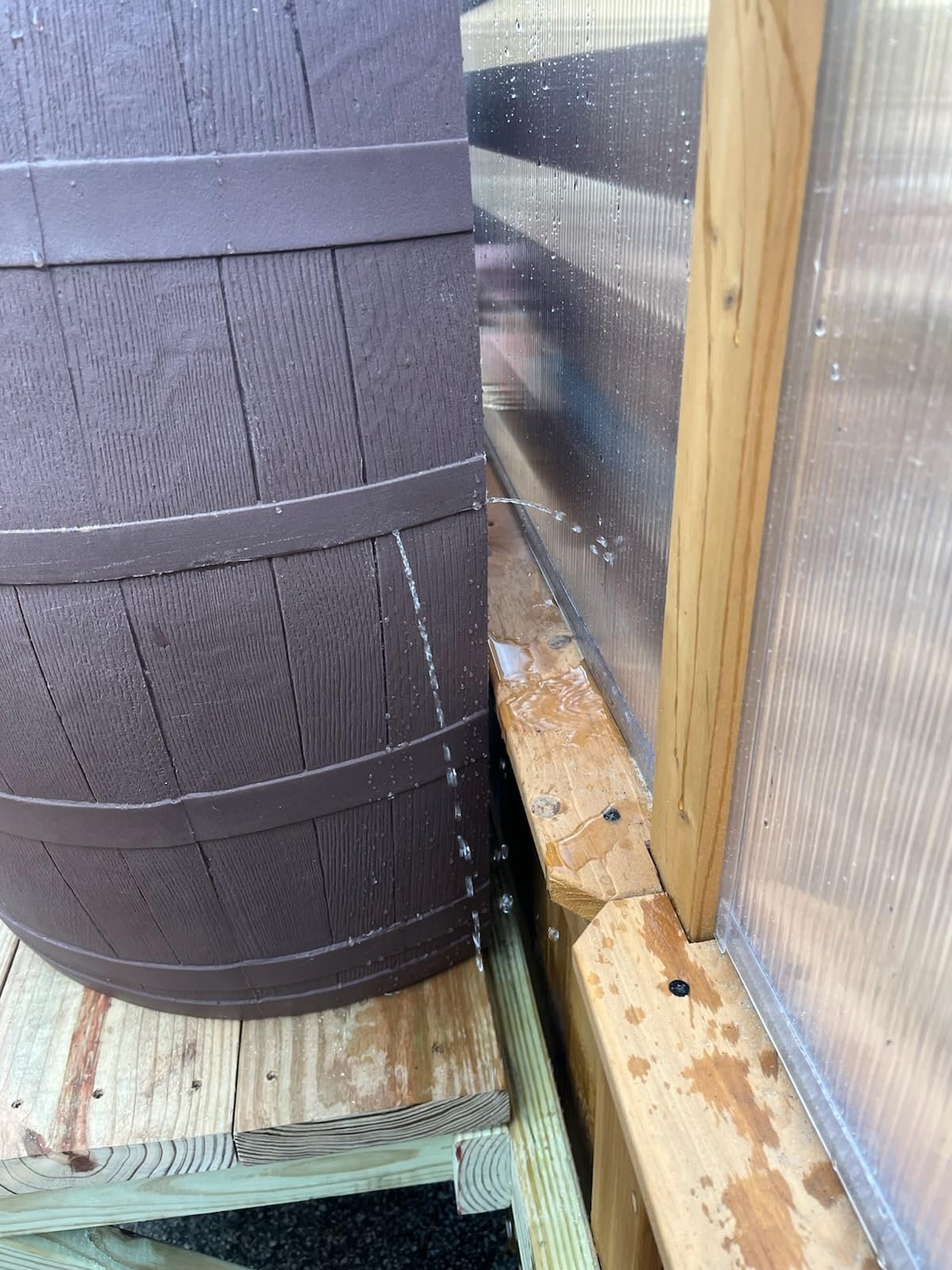
Quality control also comes up repeatedly. Owners report receiving barrels with pinholes or two holes in them, and one buyer got instructions and parts that did not match the barrel in the box. There is no built-in way to hold the outlet hose off the ground, and the top is closed apart from the planter weep hole, so all water has to arrive through the diverter. Inspect the shell and the fittings on arrival.
What the shape costs you
A half-barrel profile cannot deliver a true cylinder’s volume, so the label number and the real number drift apart. That matters for anyone sizing against roof catchment, because a barrel that underdelivers fills less often in a heavy storm and therefore collects less over a season. For appearance-driven use, a smaller real capacity is a fair trade.
The flat back still lets it sit close to the side of a house, and the 27.9 by 29.9 by 19.9 inch footprint is the widest in the lineup, so plan the space.
Who should pick something else
Pick any of the 50-gallon cylindrical models if you want the rated capacity to be real. This barrel is for a front garden where the look is the point and you are watering a small bed. Inspect it on arrival, keep the return option, and have your diverter and fittings ready before the first storm.
How to Choose a Rain Barrel for Your Garden in 2026
Capacity follows catchment area, and catchment area is just the roof footprint that drains into one downspout. As a working rule, one inch of rain on 1000 square feet of roof yields roughly 620 gallons. A 50-gallon barrel on a 1000 square foot roof therefore fills about once per inch of rain and spends the rest of the storm sending water to the overflow. On a small 400 square foot outbuilding roof the same barrel fills far more often, which is the setup where a second linked barrel pays for itself.
Match the barrel to the roof, not to the number on the box. A big roof feeding one barrel means you collect the same ceiling every storm no matter how hard it rains. Two linked barrels, a larger tank, or a deliberate overflow route away from the foundation is the better answer. If you are planning a vertical garden alongside the barrel, our guide to the best garden trellises for vertical gardens covers the trellis side of that build.
Faucet height and gravity pressure
Everything runs on gravity. Pressure equals the height of water above the spigot, so an 18 inch stand roughly doubles the usable head of a 32 inch barrel. Gardeners describe the same effect plainly on forums: the higher the barrel, the better the flow, and the less water left stranded in the bottom. That stranded inch or two is where debris collects and where larvae settle, so height solves a maintenance problem as well as a flow problem.
If you run drip irrigation or a soaker hose, pressure is the deciding factor rather than capacity. A low-flow emitter that works from a stand will simply not work from a barrel sitting on the lawn. We keep coming back to the elevated models for this reason, and it is also why a solar water fountain works well alongside a barrel-fed setup for a small pond or water feature.
Screen, lid, or both
A mesh screen keeps leaves out and lets you see the water. A fixed or removable lid keeps leaves, mosquitoes, children, and pets out, and costs you a little cleaning convenience. For most gardeners a screen plus a screened overflow is the working answer. For yards where standing water is a known mosquito issue, buy the lidded or elevated models and stop negotiating with the mesh.
One thing never to do is cut a hole in a lid the size of the gutter opening and call it done. That hole is large enough for mosquitoes. If you must drill, cover it with fine mosquito netting sealed around the edge.
Downsides to know before you buy
Weight is the first one. A 50-gallon barrel holds about 450 pounds of water, so it needs a poured pad or pavers and it is not a one-person lift. Second, storage is genuinely limited. A single 50-gallon barrel supplies on the order of a thousand gallons a year in a moderate rainfall area, which is a meaningful slice of a garden’s water but not a replacement for mains supply, and forum users who outgrew it all moved to 1600 to 2400 gallon tanks. Third, water quality: algae shows up within a few days in warm weather, and standing water is a mosquito risk if the top or the overflow is open.
Fourth, roof runoff. Fifth, the cost math. A barrel covers irrigation. It will not serve a whole house, and it is not a fire reserve. On economics, the forum consensus is that the bigger the container, the cheaper the cost per gallon, which is the same reason people chain 55-gallon drums rather than buy a large tank. If you want storage beyond a few weeks, a chained set of barrels is the cheap middle step.
Roof material and edible gardens
Rainwater off an asphalt shingle roof carries trace residues from the shingle surface, flashing, and any treated timber in the path, and the honest answer is that the evidence points different ways. Extension services generally treat metal roofs as the cleanest and consider shingle runoff acceptable for many edible uses with screening and a first-flush diverter. Gardeners argue that any tar or flashing in the water path is a reason to keep runoff off food. Both positions are defensible, so the practical rule is to use harvested water on soil-level irrigation, fruit trees, and ornamentals, and keep it off leafy greens you intend to eat raw. If you do want to spray it on edibles, a first-flush diverter that discards the first several gallons of every storm is the minimum.
A first flush is the first water of each storm, which carries the heaviest concentration of roof debris, and routing it away costs you a small volume of water per storm for a cleaner barrel. It is optional on a metal roof and worth having on a shingle roof.
Never use harvested rainwater for drinking or for washing produce. If you want a supply for a small water feature or a wildlife pond, a barrel is genuinely well suited, and the mesh screen keeps the largest debris out.
How to Install a Rain Barrel Step by Step
The easiest way to collect rainwater for a garden is one downspout, one diverter, one barrel on a level raised pad, and an overflow route. That is genuinely the whole method, and it is why several owners of the kit-style barrels report finishing in under half an hour.
First, pick the downspout that drains the largest roof area you can reach, and check the horizontal distance from the barrel’s inlet opening. Flat-back and slim-line barrels feed more cleanly than round decorative ones.
Second, build the base. A poured pad or a stack of pavers, level, and rated for roughly 450 pounds. A 442 pound load on unfirm soil is how a barrel ends up leaning into a corner board by the second year.
Third, assemble the barrel on flat ground, fit the spigot, and hand-tighten before you snug anything with a wrench. Cross-threading brass fittings is the number one install mistake and it strips threads permanently.
Fourth, cut the downspout above the barrel inlet, remove the elbow, and install the diverter at the top. Trim any supplied screen until water flows freely.
Fifth, mount the barrel and connect the overflow. This is the step people skip and regret. Route the overflow away from the foundation, or use a closed-loop diverter that returns water to the downspout.
Sixth, flush the barrel. Run the downspout until the water runs clear, which discards the first flush and gives you a clean start. Then screen the top and the overflow, and check the spigot for weeping after ten minutes.
Maintenance, Winterizing and Water Quality
Rainwater should not sit long. In warm weather algae becomes visible within a few days, and while a green tinge is harmless for direct soil-level watering, it is a real problem in low-pressure gravity drip systems, where algae clogs emitters and then the emitter stays clogged. Keep the barrel moving, keep it shaded, and keep it opaque where you can.
Clemson Extension materials recommend screening both the top and the overflow and suggest painting the barrel to limit algae, with white preferred over black because black absorbs heat. Barley straw and window-screen filtration to a compost pile are the other remedies people use. None of them matter much if you draw water every few days, which is the real fix.
For mosquitoes, the checklist is short: a latched or fixed lid is best, a fine mesh screen over the top is next, the overflow needs screening too, and a hole cut to gutter size is not screening at all. Watering from the barrel frequently disturbs the surface and makes it harder for larvae to establish. Some local codes require a closed-loop system, and a few municipalities have specific rules about screening, so check before you install.
Winterizing is a five-step job. Disconnect the diverter and bring the barrel indoors if it is portable or collapsible. If it stays outside, drain it completely and leave the spigot open. Empty the overflow hose. Do not leave a solid block of water in the bottom, because frozen water expands and splits polyethylene. And if the barrel has a removable lid, take it off so any water that does get in can escape.
One more failure mode worth stating plainly, because it appears over and over in owner accounts: water that goes past the spigot or sits against the house causes rot. Keep the spigot tight, keep the overflow routed, and keep the barrel off bare wood siding. If you are out working in the weather, proper layering matters more than the barrel itself, and our best rain jackets for cycling covers that for colder months.
Frequently Asked Questions
Are rain barrels worth it?
For garden irrigation, usually yes. A single 50 gallon barrel supplies on the order of a thousand gallons a year in a moderate rainfall area, cutting potable water use and stormwater runoff. Reported utility savings are modest in ordinary years and much larger during watering restrictions. They are not worth it for drinking water or whole-house supply.
What are the downsides of using a rain barrel?
The main ones: a full barrel weighs roughly 450 pounds, so it needs a proper base. Storage is limited, algae appears within days in warm weather, standing water can breed mosquitoes if the top or overflow is unscreened, and the water is irrigation only. Overflow water beside the foundation is the most common cause of rot.
How long can rainwater sit in a barrel?
A few days before algae becomes visible in warm weather. The green tint is harmless for direct soil-level watering, but it clogs low-pressure drip emitters and bubblers, so it matters if you run irrigation from the barrel. Draw water every few days, keep the barrel shaded, and screen both the top and the overflow.
What is the easiest way to collect rainwater for my garden?
One downspout, one diverter, one barrel on a level raised pad, and an overflow route. Install the diverter at the top of the downspout, mount the barrel so the water level sits above the spigot, and route the overflow away from the foundation. Kits with the diverter included finish in about 20 minutes.
Is rainwater from an asphalt shingle roof safe for vegetables?
Use it on soil-level irrigation, fruit trees, and ornamentals. Extension services consider shingle runoff acceptable for many edible uses with screening and a first flush, though some gardeners avoid it entirely. Keep harvested water off leafy greens eaten raw, and never use it for drinking or washing produce.
Do rain barrels get mosquitoes?
Yes, if the top or the overflow is open. A fixed or latched lid is the best defense, followed by a fine mesh screen over the top. Screen the overflow as well, because water entering there bypasses the top screen. A hole cut to the size of the gutter opening is not enough, and some local codes require a closed-loop system.
Final Verdict: Which Rain Barrel Should You Buy in 2026?
For most gardeners, the RTS Home Accents 50-Gallon ECO is the barrel to buy. Its 3700-review history is the most thoroughly tested in the category, the flat back solves tight placement, and the only real change you should plan on is swapping the plastic spigot for a brass one early. If you want a cleaner decorative finish and do not want to make that swap, the RTS barrel with the brass spigot already fitted is the direct upgrade.
Pick the FCMP Outdoor Raincatcher 4000 if the complete accessory bundle and easy barrel linking matter most, and add a stand. Pick the FCMP Catalina for the best-looking finish and the most secure top opening. Pick the Good Ideas Nantucket if you want herbs growing on the barrel itself, and the Rain Wizard Urn if the barrel will be seen from the street.
Pick the Step2 Lakewood 60 Gallon for the largest capacity and the best screen and spigot hardware, accepting the tallest footprint and the least settled review history. Pick the Rain Wizard kit with the diverter if you want the shortest install and a closed-loop overflow. Pick the collapsible barrel if you are renting or freezing, and the Emsco Whiskey only when the rustic look is the entire point.
Whichever one you choose, the three things that matter are the same: a solid base for 450 pounds, an overflow routed away from your foundation, and a screen on both the top and the overflow. Get those right and any of these twelve will serve a garden well for years. Check the current price for the barrel that fits your space, and get it plumbed before the first autumn storm rather than after.