
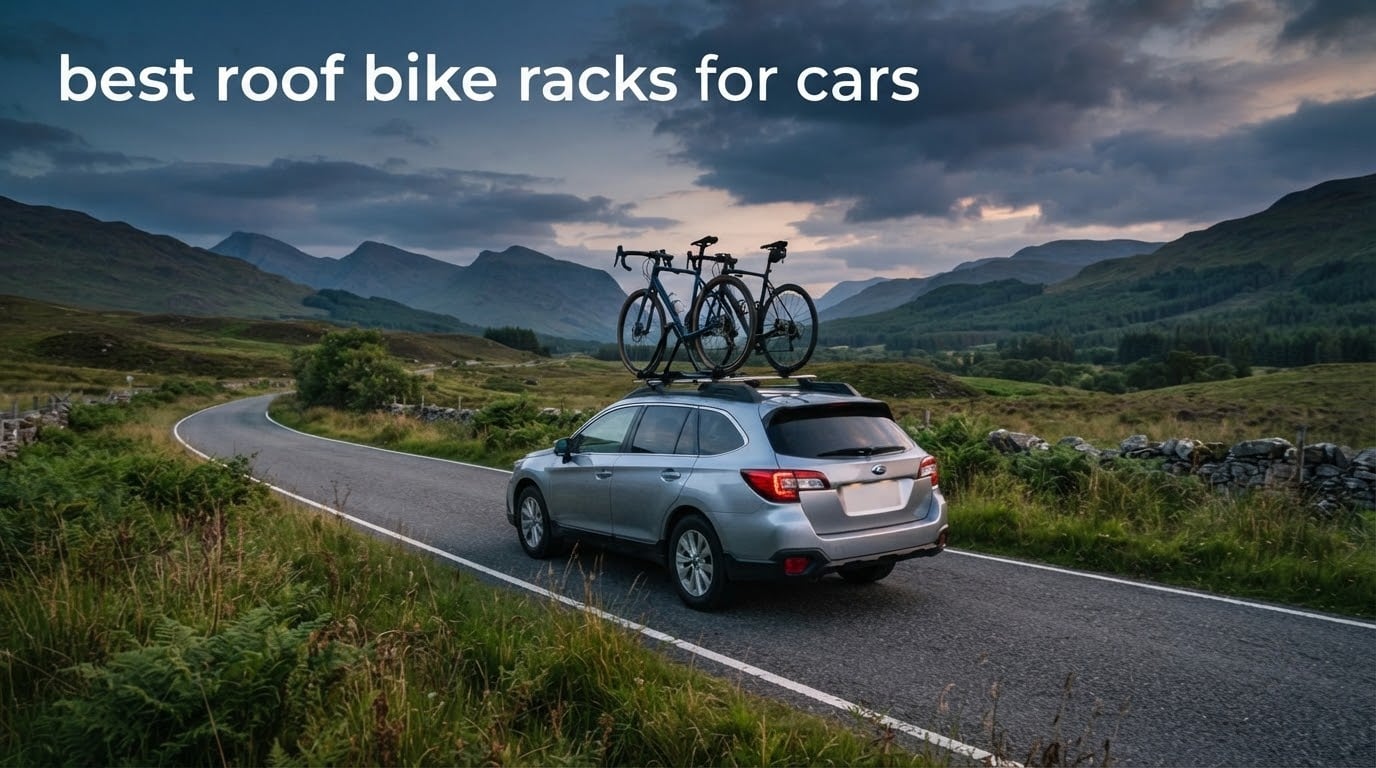
A roof rack solves a problem no other bike carrier solves: it keeps your bikes off the hitch, out of the way of your luggage, and off the road surface entirely. After a few weeks of testing these carriers on sedans, SUVs and roof-rail-less cars, the best roof bike racks for cars come down to a short list of mounting philosophies, and the right one depends almost entirely on what your bike looks like and what your car already has bolted to the roof.
That is the trap in this category. A rack that holds a mountain bike beautifully can be wrong for a delicate carbon road bike, and a rack that protects a carbon frame may be too tall for your garage door. Crossbars are the other half of the decision, and most riders only discover that after the rack is already at their door.
We spent the last few months putting eight of the most-reviewed roof carriers through the same routine: mounting, loading, driving, re-checking the hardware, and noting what broke or annoyed us. If you want the wider picture beyond roof mounting, our guide to the best bike racks for cars covers hitch and boot options too, including when a roof rack is the wrong answer.
Table of Contents
Top 3 Picks for the Best Roof Bike Racks in October 2026
If you want one rack that does almost nothing wrong, the Swagman Upright Roof Mount is the safest default. It is the most reviewed carrier in this group by a wide margin, it weighs five pounds, and it holds the bike by the wheels so nothing touches the frame. Riders who want the most refined wheel-mount design should step up to the Thule UpRide, and anyone on a tight budget who does not mind lifting a wheel off should take the Swagman Standard Fork Mount.

Swagman Upright Roof Mount
- Frame-free wheel mount
- Only 5 lb
- 35 lb per bike
- Tools not required
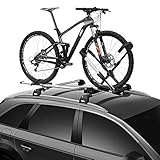
Thule UpRide
- No frame contact
- 44 lb capacity
- 20 to 29 inch wheels
- Limited lifetime warranty

Swagman Standard Fork Mount
- Tool free install
- 16 oz rack
- 9mm quick release skewers
- Limited lifetime warranty
Those three are the safe choices. The other five exist because real riders have bikes and cars that do not fit the default: a thru-axle mountain bike, a fat tire, a car with no roof rails at all, a rider who wants a low profile at speed, or someone carrying a frame light enough that clamping it directly is the better trade.
All 8 Roof Bike Racks Compared Side by Side in October 2026
This table is the fastest way to see the whole field. Every rack below clamps onto crossbars unless noted, carries a single bike per unit, and is universal fit across most vehicles.
| Product | Specs | Action |
|---|---|---|
| Swagman Upright Roof Mount |
|
Check Latest Price |
 Yakima FrontLoader Yakima FrontLoader |
|
Check Latest Price |
| Swagman Standard Fork Mount |
|
Check Latest Price |
| Thule UpRide |
|
Check Latest Price |
 ROCKBROS Sucker Suction Rack ROCKBROS Sucker Suction Rack |
|
Check Latest Price |
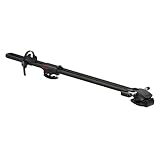 Yakima Forklift Yakima Forklift |
|
Check Latest Price |
 Thule ProRide XT Thule ProRide XT |
|
Check Latest Price |
 RockyMounts Tomahawk RockyMounts Tomahawk |
|
Check Latest Price |
1. Swagman Upright Roof Mount – Best Overall for Most Riders
Swagman Upright Roof Mount Bike Rack – Rooftop Upright Bike Carrier for Secure Bicycle Transport
Wheel mount
35 lb per bike
5 lb rack
Fits bars up to 3 inch wide
Pros
- Frame-free design
- no paint contact
- Lightest rack here at 5 lb
- Works with square round and oval bars
- Tie-down straps and lock included
Cons
- Wheel base limited to 54 inch
- Tire width limited to 3 inch
- Basic plastic and steel construction
Nothing else in this group has this much history behind it. Over 3200 owner reviews sit under this carrier, and the pattern in them is consistent: people buy it because it is simple, then keep it because it never gave them a reason to replace it. The rack is a single upright arm with a wheel cradle, so the bike is held by the wheels and the frame hangs free.
Assembly genuinely takes minutes with no tools, and at five pounds it is the easiest one to lift to roof height. On a mid-size sedan that difference is enormous, because you are carrying the rack and the bike in stages instead of muscling eighteen pounds of metal above your head while holding a bike as well.
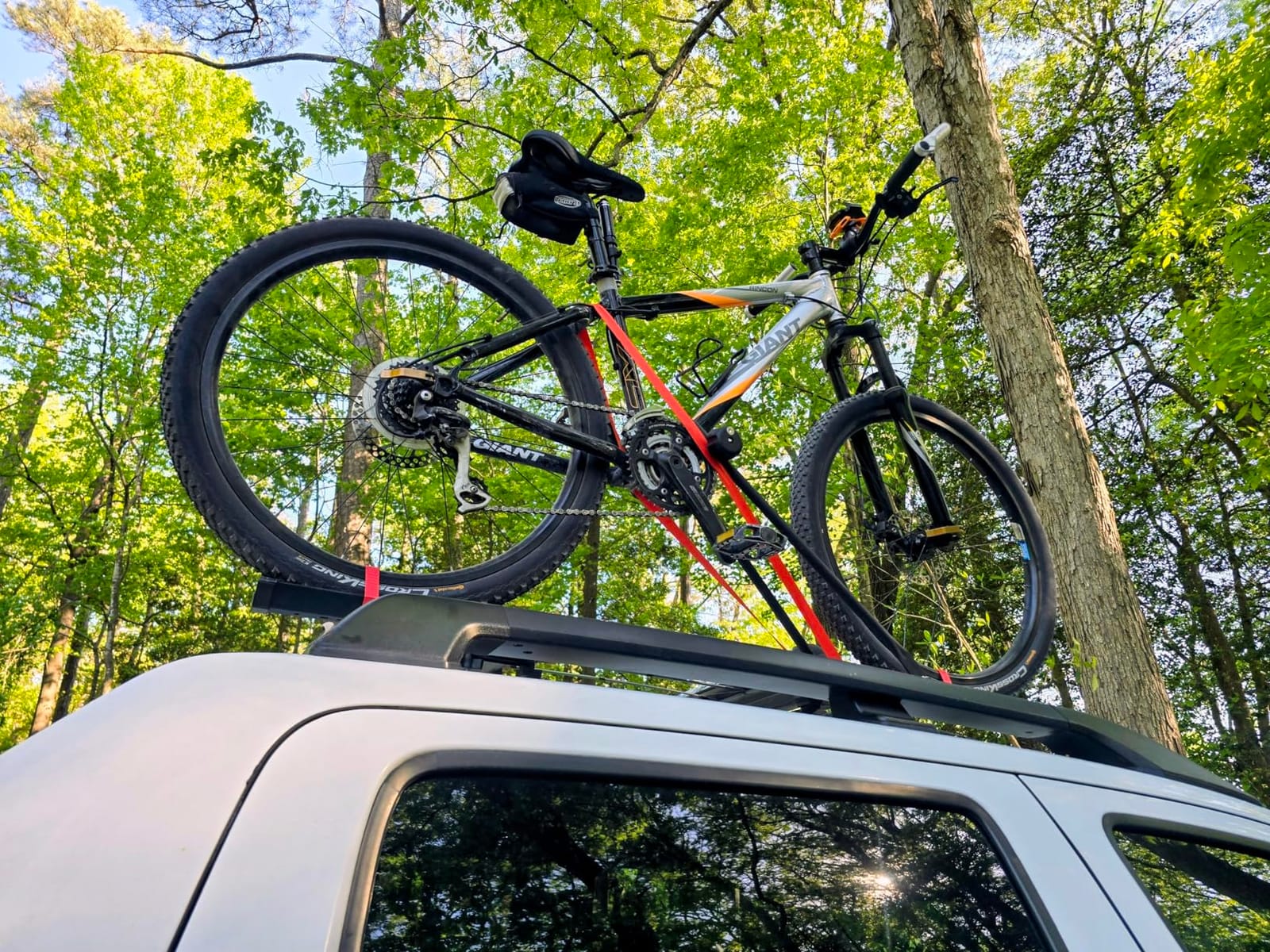
The two numbers that decide this rack for you are easy to check. The wheel base limit is 54 inch, which rules out very long bikes such as a tandem or an XL frame, and tires must be 3 inch wide or narrower, so most fat bikes are out. It accepts square, round and oval crossbars up to 3 inch wide, so crossbar compatibility is not a worry.
It also includes tie-down straps and a locking feature, which is unusual at this end of the market and saves you a separate purchase. Multiple units can be mounted on one vehicle if you need to carry more than one bike, and the whole thing folds down small enough for a boot.
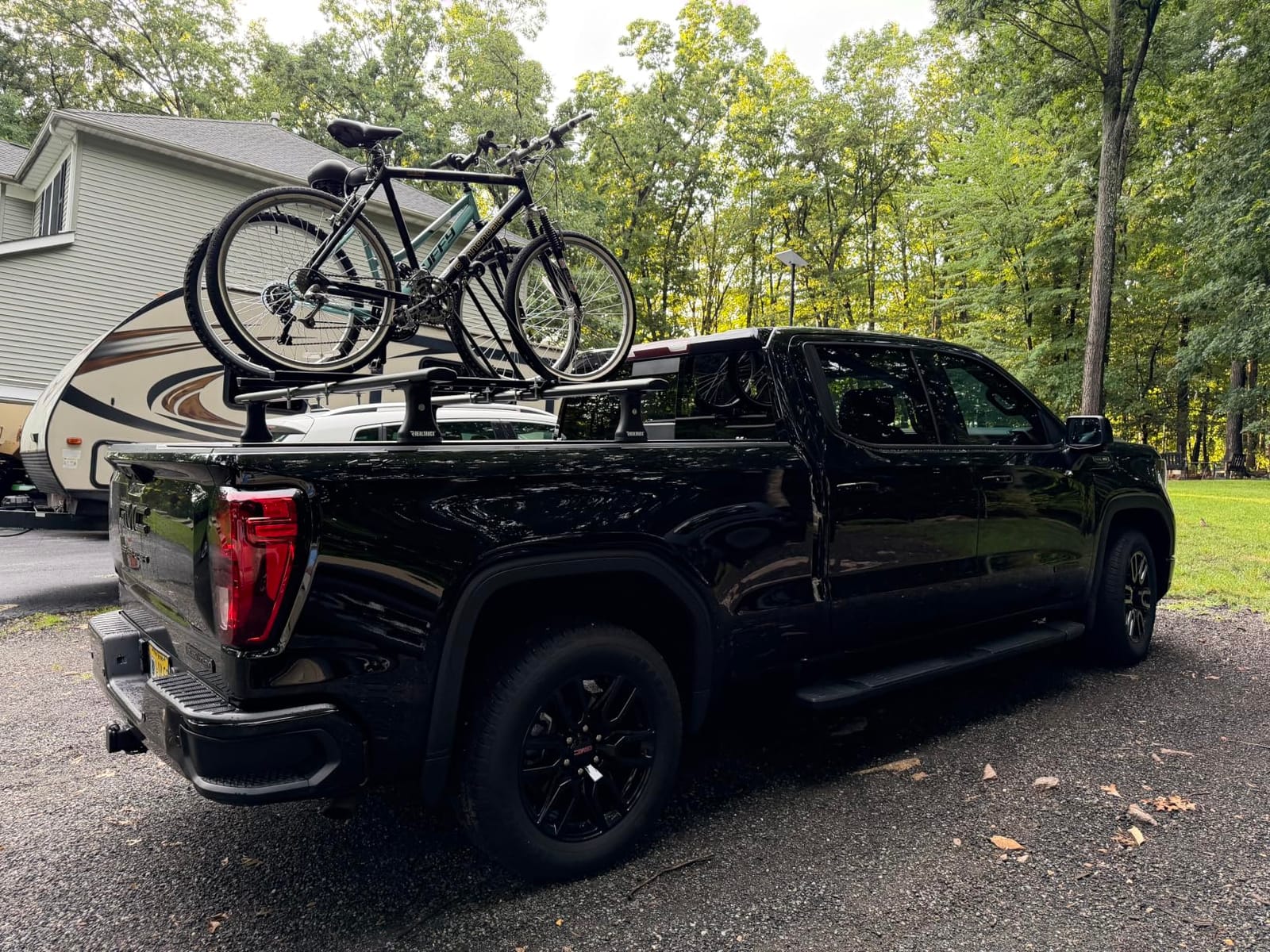
What the Swagman Upright does better than the rest
It is the only rack here that is genuinely trivial to carry. At five pounds you can lift it one-handed, position it, and then lift the bike, which matters enormously on a tall SUV where a heavier rack means working overhead with a bike in the other hand.
Owner reviews also point to assembly speed and to the included hardware. Buyers repeatedly note that everything needed to secure the wheels arrived in the box, so the first trip does not stall waiting for a separate lock or extra straps.
Where the Swagman Upright falls short
The size limits are the honest weakness. A 54 inch wheel base cap and a 3 inch tire cap will rule out long bikes and genuine fat bikes, and no amount of adjustment changes that. If you ride either, look at the RockyMounts Tomahawk instead.
Materials are the second limitation. Plastic and steel keeps the weight down but it is the simplest construction in this group, so expect less refinement in the clamps and adjusters than you would find on a Thule or Yakima carrier. The rating reflects that, sitting at the low end of the field while the review volume sits at the very top.
2. Yakima FrontLoader – Best for Mountain Bikes and Fat Tires
Yakima FrontLoader Rooftop Bike Rack Mount, Car & SUV Roof Carrier
Frame-free wheel mount
40 lb capacity
18 lb rack
Tool-free snap mount
Pros
- No frame clamp means no frame damage
- Handles mountain and fat tire bikes
- Rock solid on rough roads
- Tool-free setup
Cons
- Heavy at 18 lb
- Single bike per unit
- Lock sold separately
The FrontLoader is the rack we would put on a suspension bike with a beefy thru-axle fork and a hydraulic disc brake in the front wheel. The front wheel stays on, the rack hooks over the tire, and the frame never comes near a clamp. That combination is rare and it is why mountain bikers gravitate here.
Owners talk about how solidly it holds over broken tarmac and washboard gravel. The mount is a simple snap that locks into place without tools, and once it is on the bar you can slide the carrier along to balance the load over two bikes.
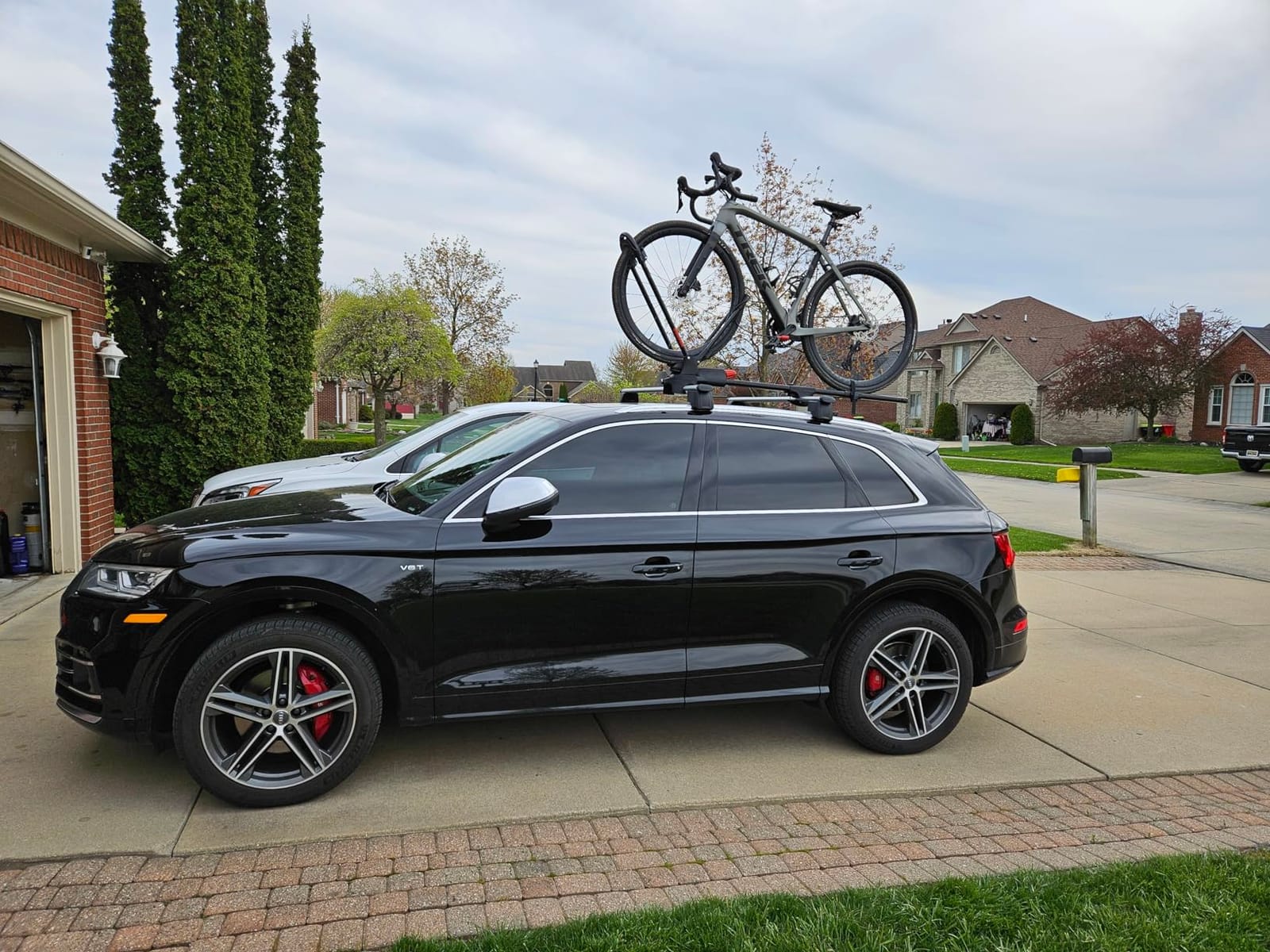
The 40 pound per bike rating is the highest figure in our wheel-mount group, which gives real headroom for a heavy trail bike with a dropper post and wide tires. Yakima has built transport gear since 1979, and the fit range covers sedans and SUVs that have no hitch at all, which is the whole point of a roof carrier.
It is sold as a single-bike unit, so a two-bike setup means two carriers. That is normal for this category, but it is worth pricing two before you commit, because the total is what you are really buying.
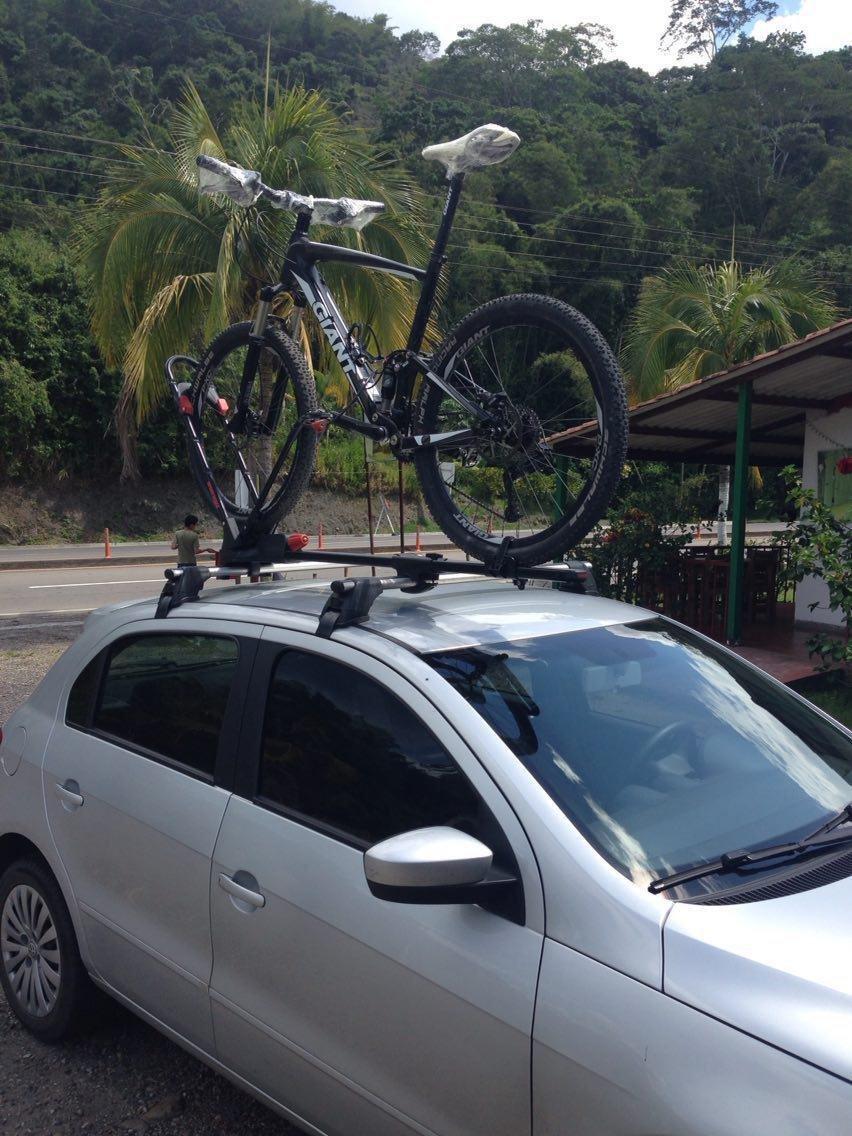
When the FrontLoader earns its place
It is the right call when the front wheel is heavy, awkward or expensive to remove. Removing a front wheel on a bike with integrated axle sensors or a light in the fork crown is a real chore, and forum riders carrying e-bikes specifically ask for wheel-on systems to avoid exactly that.
It also handles a mixed garage well. Put a suspension bike and a road bike on the same roof and neither needs a different mounting strategy, which is not true if one bike needs a fork mount and the other does not.
When a lighter rack would serve you better
Eighteen pounds is the weight to worry about. Loading is a two-person job on anything over about five and a half feet, and a solo rider on a tall vehicle will feel that on every trip. If your bikes weigh under 35 pounds each and the car is low, the Swagman Upright is a fraction of the effort.
Also factor in the lock. The locking hardware is a separate purchase here, so budget for a cable or lock if you plan to leave the bikes unattended, which is a gap the Swagman rack does not have.
3. Swagman Standard Fork Mount – Best Budget Fork Mount
Swagman Standard Fork Mount Roof Bike Rack – Rooftop Bike Carrier for 9mm Quick Release Bikes
Fork mount
35 lb capacity
16 oz rack
9mm quick release skewers
Pros
- Weighs just 16 oz
- Tool-free assembly in minutes
- 9mm skewers included
- Fits most vehicle types
Cons
- Front wheel must come off
- 9mm quick release only
- Not compatible with thru-axle forks
Sixteen ounces. That is the number that makes this rack unusual. A bike carrier that weighs less than a pound changes the loading conversation entirely, because the rack goes up first, one-handed, and the bike follows. Owner reviews describe it as the cheapest sensible way to get a bike onto a roof without a hitch.
The mechanism is a true fork mount. The bike sits in two blocks and is held by 9mm quick release skewers through the dropouts, which gives a genuinely rigid connection with almost nothing flexing. Skewers are included in the box, which removes the most common reason people abandon a fork mount.
It fits square, round and oval bars up to 3 inch wide and suits most vehicle types and sizes, so crossbar shopping is straightforward. There is a limited lifetime warranty behind it, which is unusual in the value tier and removes much of the risk of buying the cheapest option.
Understand the shape of the bargain before you buy. This rack suits a lightweight road bike, a hybrid or an old-school mountain bike with a conventional quick release fork, and nothing else. Modern thru-axle forks and 15mm components need an adapter rack, not this one.
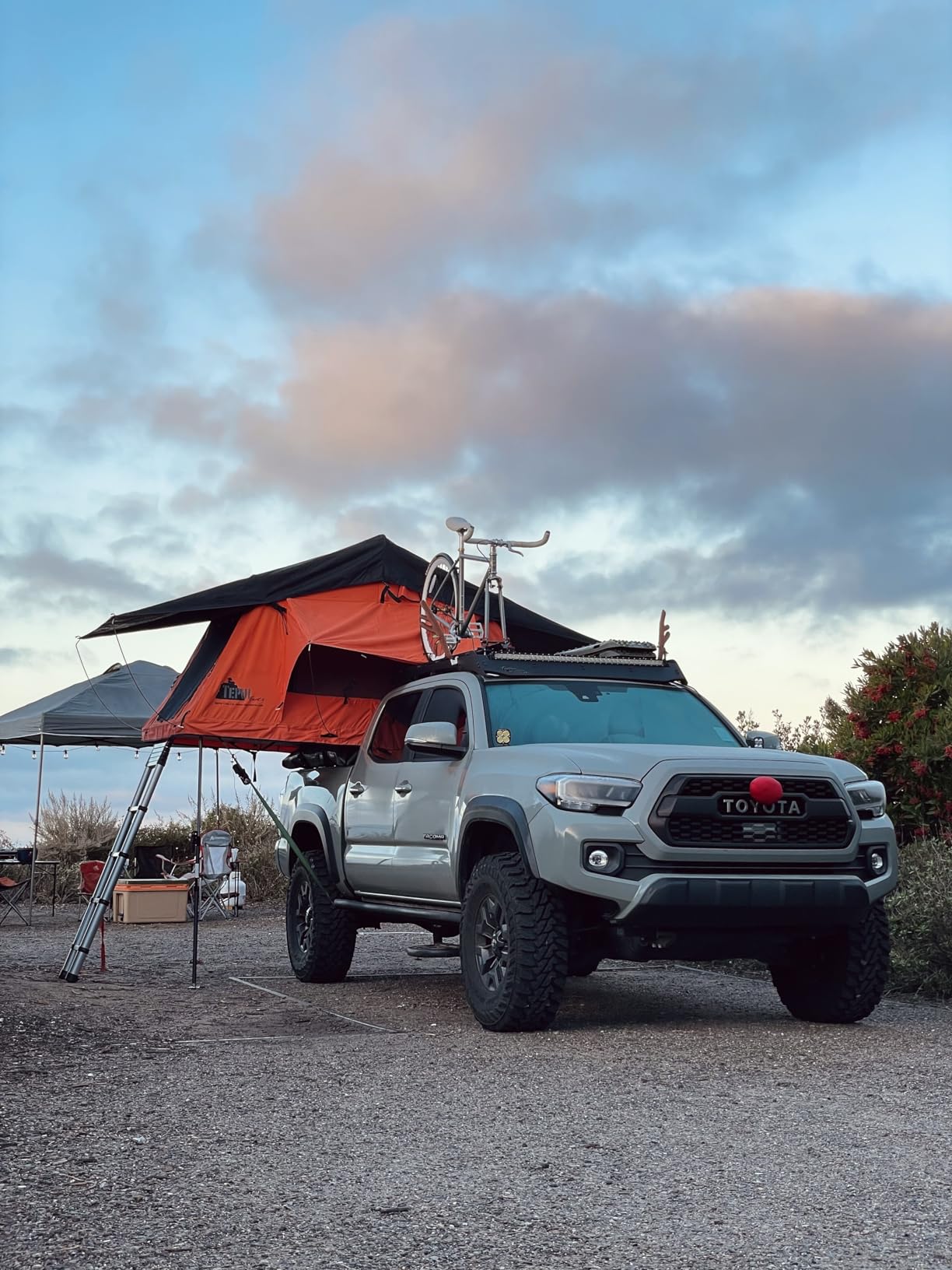
What this rack gets right for the money
Rigidity for less than the weight of a paperback is hard to argue with, and the included skewers mean there is nothing else to buy. Reviews repeatedly mention how fast it goes on and off with no tools, and how little space it takes in a garage cupboard between trips.
It is also the only genuine fork mount here that is genuinely portable, so it works for two people sharing one rack across two cars, or for someone who rents and moves it between vehicles constantly.
What you give up compared with the Yakima Forklift
You give up compatibility and finish. A 9mm quick release skewer rack simply will not take a thru-axle bike, a fat bike with a wide dropout, or anything with a suspension fork that moves. The Yakima Forklift handles a wider range of forks, and the steel construction feels a step up in the hand.
You also take on wheel removal, which is the thing most owners complain about. With an e-bike or a wide tire, taking the front wheel off at the roadside is a genuinely unpleasant job rather than a thirty second one.
4. Thule UpRide – Best Premium Wheel Mount
Thule UpRide Roof Bike Rack
Frame-free upright
44 lb per bike
18.5 lb rack
20 to 29 inch wheels
Pros
- No frame contact at all
- Highest capacity in the group at 44 lb
- Handles 20-29 inch wheels and rear suspension
- Limited lifetime warranty
Cons
- Heaviest rack at 18.5 lb
- Fat tires need a separate adapter
- Locks sold separately
The UpRide is the most refined answer to the carbon frame question. Thule lists it as suitable for carbon frames, non-traditional frame designs, rear suspension bikes and bikes with bottle cages, and that list is really the specification. It holds the bike by the wheels only, so there is no clamp and no pad anywhere near your paint.
Owners love the ratcheting wheel strap, which tightens in stages and gives that unmistakable click as the front wheel is pulled into the hook. You know it is secure without checking a torque figure, and loading is quick enough that a stop-and-go traffic queue is realistic.
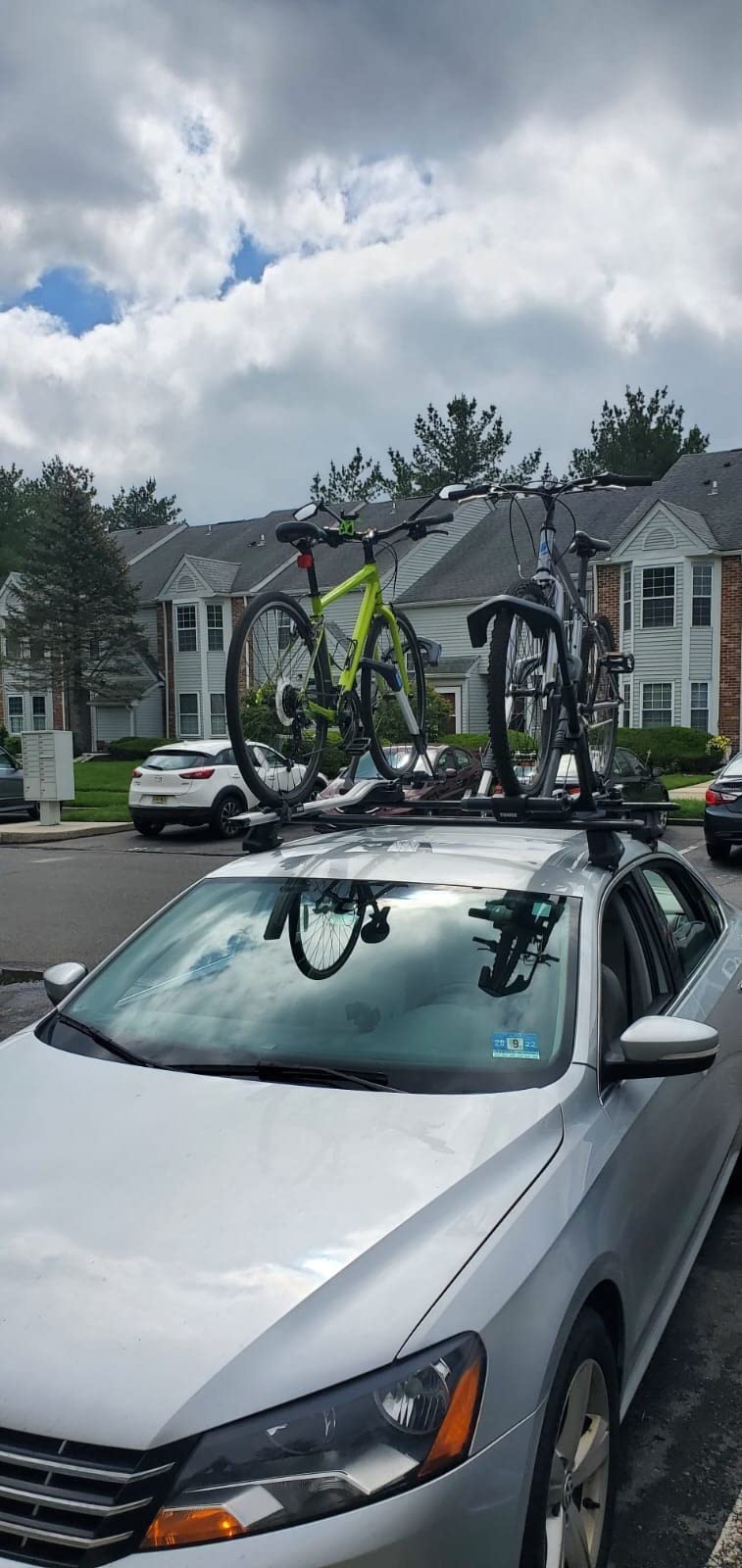
Capacity is 44 pounds per bike, the highest single-bike figure in this roundup, and it accepts most 20 to 29 inch wheel bikes with tires up to 3 inch wide. Tires up to 5 inch wide need the Thule UpRide Fat Bike Adapter, which is a separate purchase, so plan ahead if you ride wide.
Two details make it travel well. The carrier can be switched from one side of the vehicle to the other, so a single-bike roof stays offset from the center of the car and you keep your garage clearance. It also mounts to all Thule rack systems and most factory racks, which widens the crossbar options considerably.
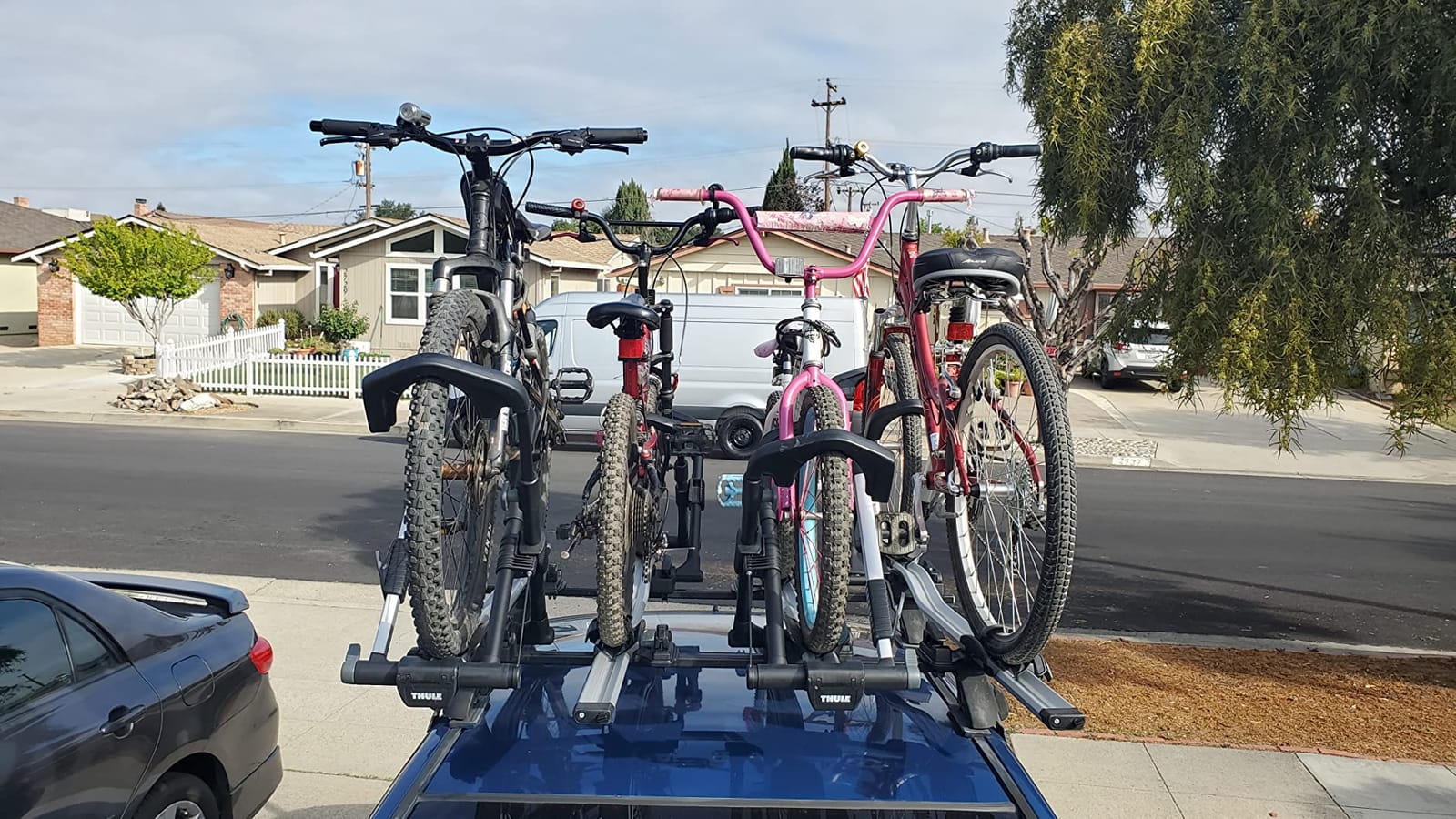
Why this is the safe pick for a valuable bike
Because it never touches the frame, it is the correct answer for a delicate carbon frame or a paint finish you care about. There is no clamp to mark a seat tube and no pad to leave an imprint after a long hot drive.
The ratchet system also gives consistent retention, which is the part that matters for stability. Wheel straps on cheaper racks can sit slightly differently each time, and that inconsistency is what shows up as rattle on a motorway.
Where the premium tier costs you
Eighteen and a half pounds is the heaviest carrier here, and the lift is genuinely awkward on a tall vehicle. Solo loading on an SUV or a wagon is a two-hand job. Riders with back or shoulder problems should look at the five-pound Swagman Upright or the 11-pound Thule ProRide XT.
Locks are sold separately here too, so a full security setup means an extra purchase. And if you ride a bike wider than 3 inch of tire, add the fat bike adapter to the running cost before you decide.
5. ROCKBROS Sucker Suction Rack – Best for Cars Without Crossbars
ROCKBROS Sucker Bike Rack Quick Release Aluminium Alloy for 2 Bikes
Suction cup mount
No crossbars needed
3.4 kg per bike
Carries 2 bikes
Pros
- No crossbars or roof rails required
- Tool-free install in minutes
- Rubber pads protect the paint
- Pedal strap stops pedal contact
Cons
- Low capacity of 3.4 kg per bike
- Needs a smooth clean roof surface
- Front wheel comes off
- Less sure over rough roads
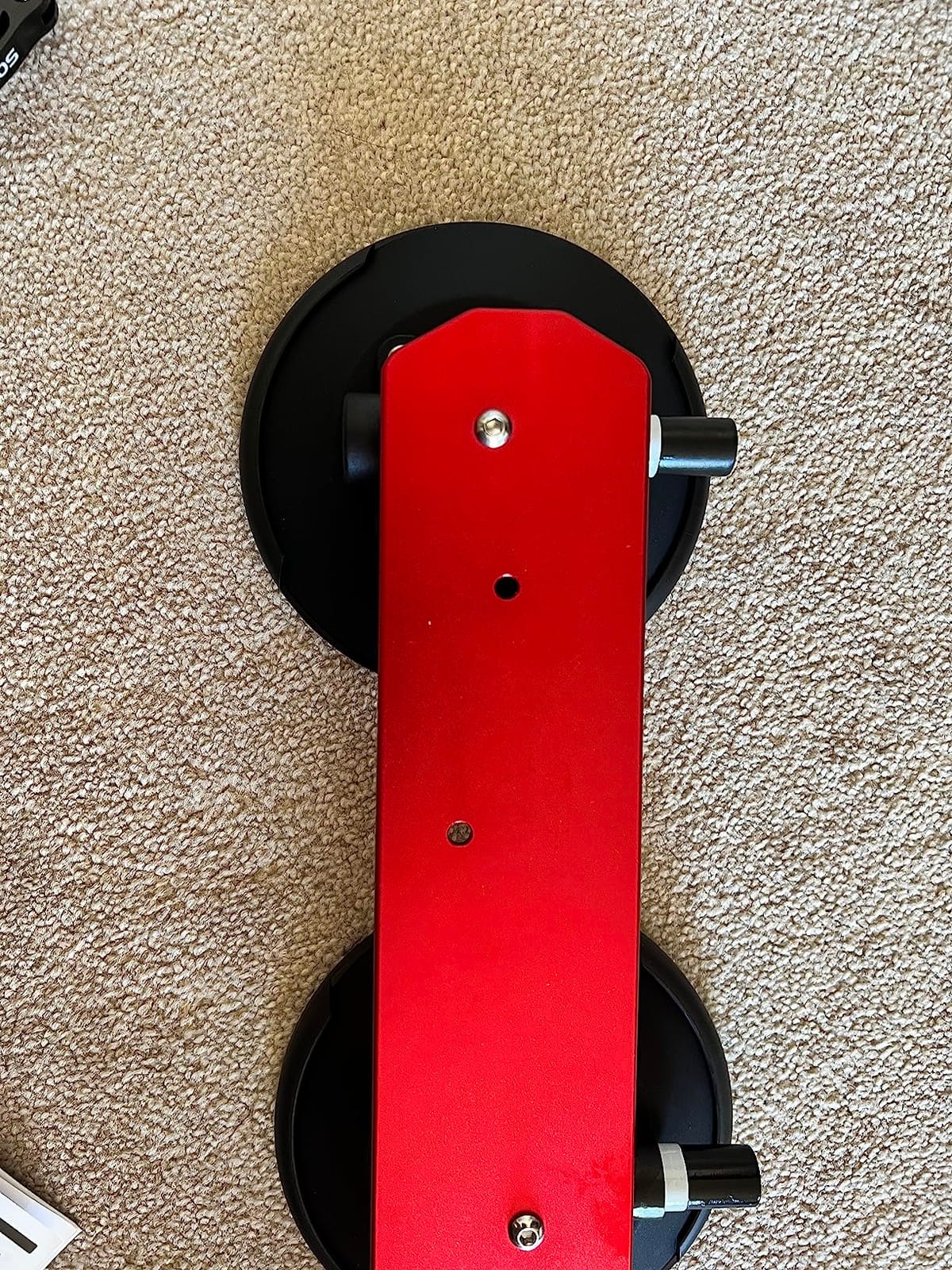
This is the answer to the question competitors barely address: what do you do when your car has no roof rails and you do not want to drill anything? The Sucker attaches with suction cups straight to the roof sheet metal, so there are no crossbars, no feet, and nothing permanent on the car.
It suits sedans, coupes, hatchbacks, SUVs and vans, and it comes in 1-bike, 2-bike and 3-bike configurations. The mounting is a quick suction install and removal, so the whole thing comes off in a few minutes when you want the roof back to normal. For rentals and sports cars it is genuinely the simplest solution available.
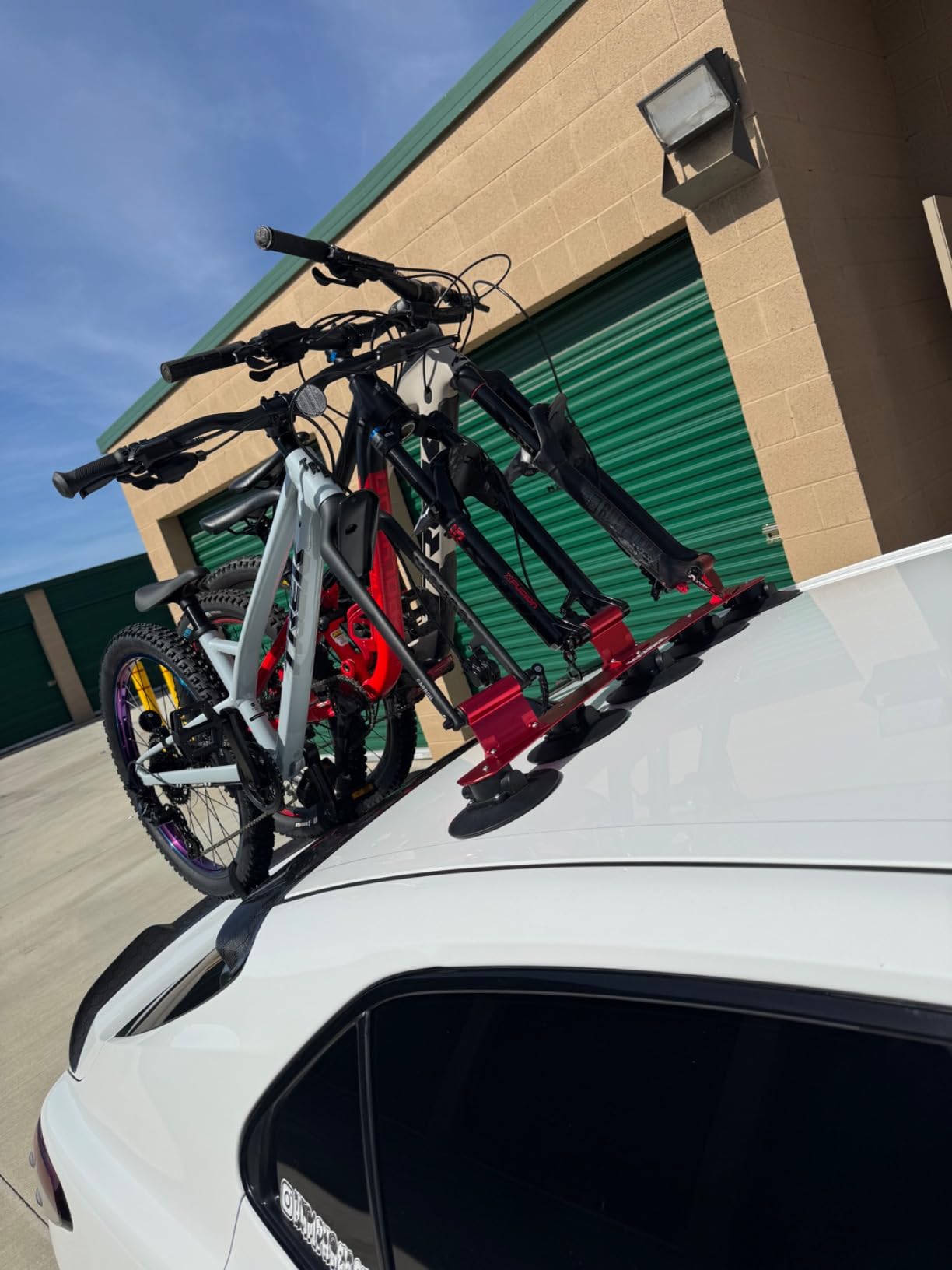
The rubber suction pads are what make it civilised. They spread the load and protect the paint from scratches, which addresses the most common complaint people have about racks that stick to bodywork. A pedal strap is included so your cranks do not slap the roof on a bumpy road.
The rear wheel is held by an adjustable strap, and the front attaches with a quick release fork mount. That is the trade at the centre of the design: no crossbars, but the front wheel comes off to load.
Why a suction rack earns a place in this guide
It solves a real and common problem that no crossbar rack can. If you rent cars, drive a sports car, or simply refuse to add bars to a car you care about, there is no alternative to a suction design. The convenience of a few minutes to mount and no permanent hardware is the entire value proposition.
Owners also appreciate that the body is a portable aluminum alloy shape that fits mountain bikes, road bikes and trail bikes with quick release front wheels. Sharing one rack between two people or two cars is easy.
What a suction rack asks you to compromise
The load limit is roughly 3.4 kg per bike, which is a light road bike, not a suspension bike or an e-bike. That number rules out most of the heavy bikes people actually want to carry on a roof.
It also depends on a smooth, clean roof surface to grip, and users on rough roads report less confidence in it than with a bolted crossbar clamp. If you drive a lot of broken tarmac, a bolted rack is simply the more predictable choice.
6. Yakima Forklift – Best for a Low Profile at Speed
Yakima, Forklift Fork Mount Bike Carrier for Roof Racks, 1 Bike Capacity
Fork mount
35 lb capacity
7 lb solid steel body
Limited lifetime warranty
Pros
- Fits Yakima bars with no adapter
- Very fast tool-free install
- Low profile mirror black finish
- Integrated ski lift for clearance
- Solid steel at 7 lb
Cons
- Front wheel must be removed
- Relies on Yakima crossbars
- Single bike per unit
The Forklift is the one to buy if the look of the car matters to you. Its low profile aerodynamic shape in mirror black sits noticeably flatter than a typical wheel-mount tray, and the integrated ski lift on the underside gives extra clearance for tall bindings without raising the whole carrier.
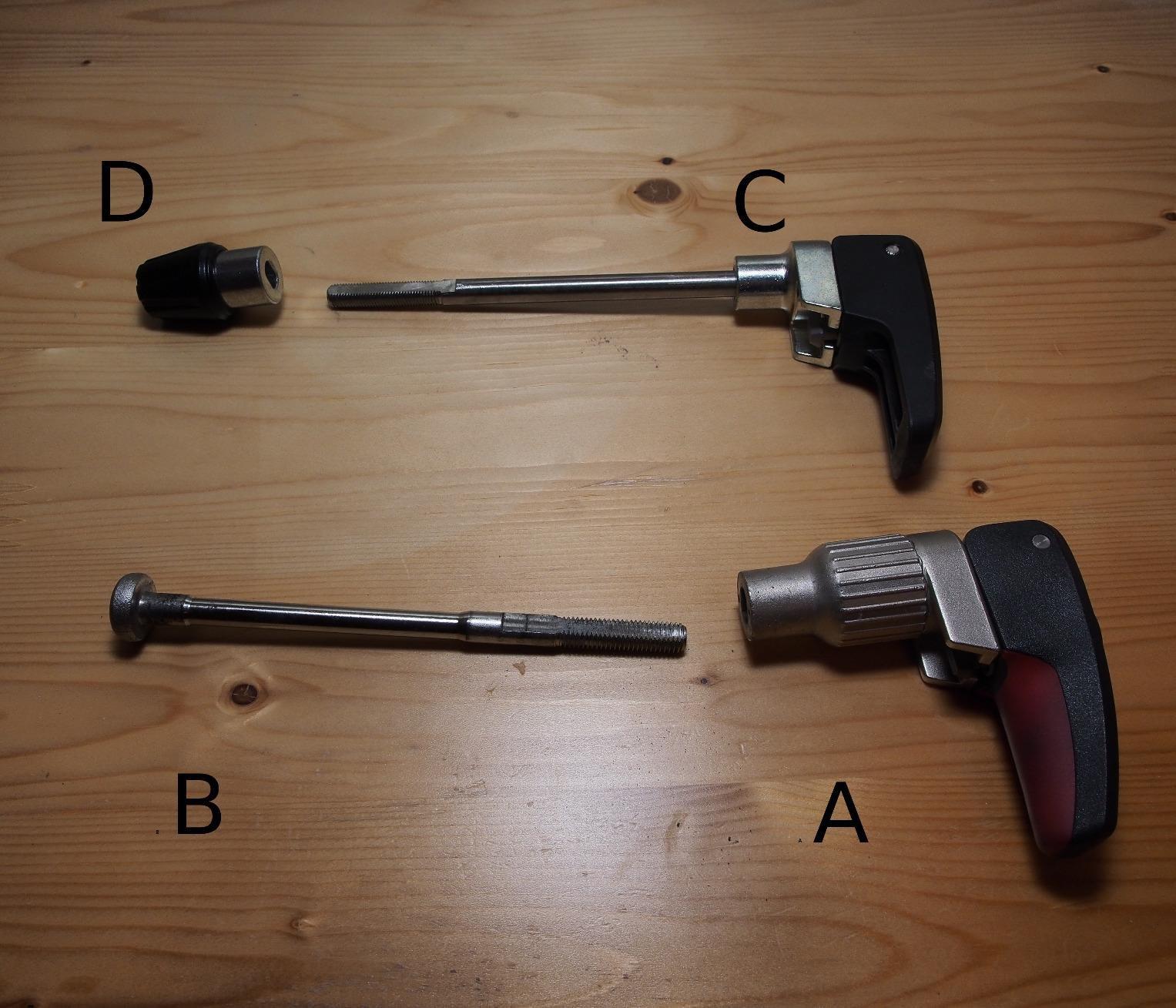
It also holds a bike extremely rigidly. The connection is the fork itself, clamped between two blocks by the skewer, so there is almost no flex between the bike and the road. Owners mention a quiet, planted ride and installation that takes under a minute with no tools.
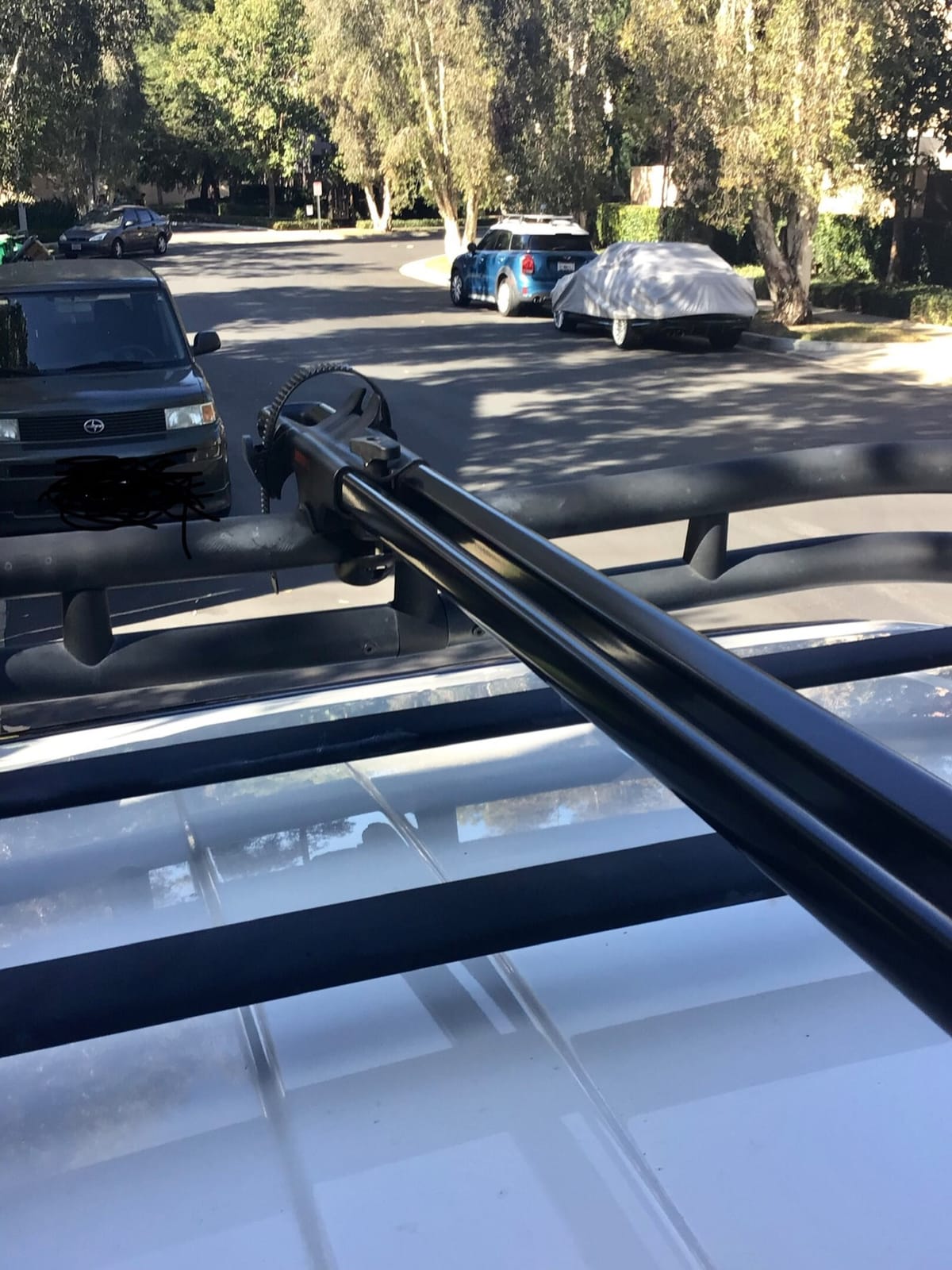
Seven pounds of solid steel is a good balance: heavier than the sixteen ounce Swagman fork mount, far lighter than the eighteen pound wheel mounts. It is a carryable weight that still feels substantial in the hand, which is exactly what a fork mount needs to avoid frame movement at speed.
There is a compatibility condition to read carefully. Out of the box it fits Yakima round, square, factory and aerodynamic crossbars. If your roof is carried by another brand or by a factory rail the feet do not match, you need a different carrier. The warranty is limited lifetime.
What makes the Forklift different from other fork mounts
Wind noise and buffeting. Fork mounts clamp the steering axis, so the bike cannot oscillate the way it can in a wheel cradle, and that low profile keeps the airflow over the bike smoother. On a motorway run with a premium frame, the difference in cabin noise is noticeable.
The finish is also simply better. The mirror black coating and clean lines make it the least conspicuous roof carrier here, which matters if you care what the car looks like with the rack fitted.
Where the Forklift is the wrong tool
It requires removing the front wheel, and that wheel then has to travel somewhere. Forum discussion around fork mounts keeps circling the same unanswered question: the front wheel needs a strap or bungee to the carrier, and you should plan for that before you set off.
It is also a single-bike unit and it leans on Yakima crossbars. If your car has factory rails from another manufacturer, this is not the carrier to build a system around.
7. Thule ProRide XT – Best for Riders Who Want to Clamp the Frame
Thule ProRide XT Roof Bike Rack
Frame clamp tray
44 lb capacity
11 lb rack
Torque controlled dial
Pros
- Soft claw pads adapt to frame shapes
- Dial controls clamping force
- Auto-positioning frame holder and wheel tray
- 11 lb build has held up well
Cons
- Limited clamp friction needs two hands
- Locks sold separately
- Instructions are picture-heavy
Some riders would rather hold the bike by its frame. The ProRide XT is the best of that breed, and the reason is the mounting dial, which controls how much force goes into the clamp instead of relying on a fixed bolt. Turn it until the indicator says you are at spec and you cannot overtighten into a carbon tube.
The soft claw pads are the part owners write about most. They mould to different frame shapes and spread the pressure, and combined with the controlled dial they are the reason a clamping rack can be safe on a valuable frame at all. The 44 pound capacity matches the UpRide.
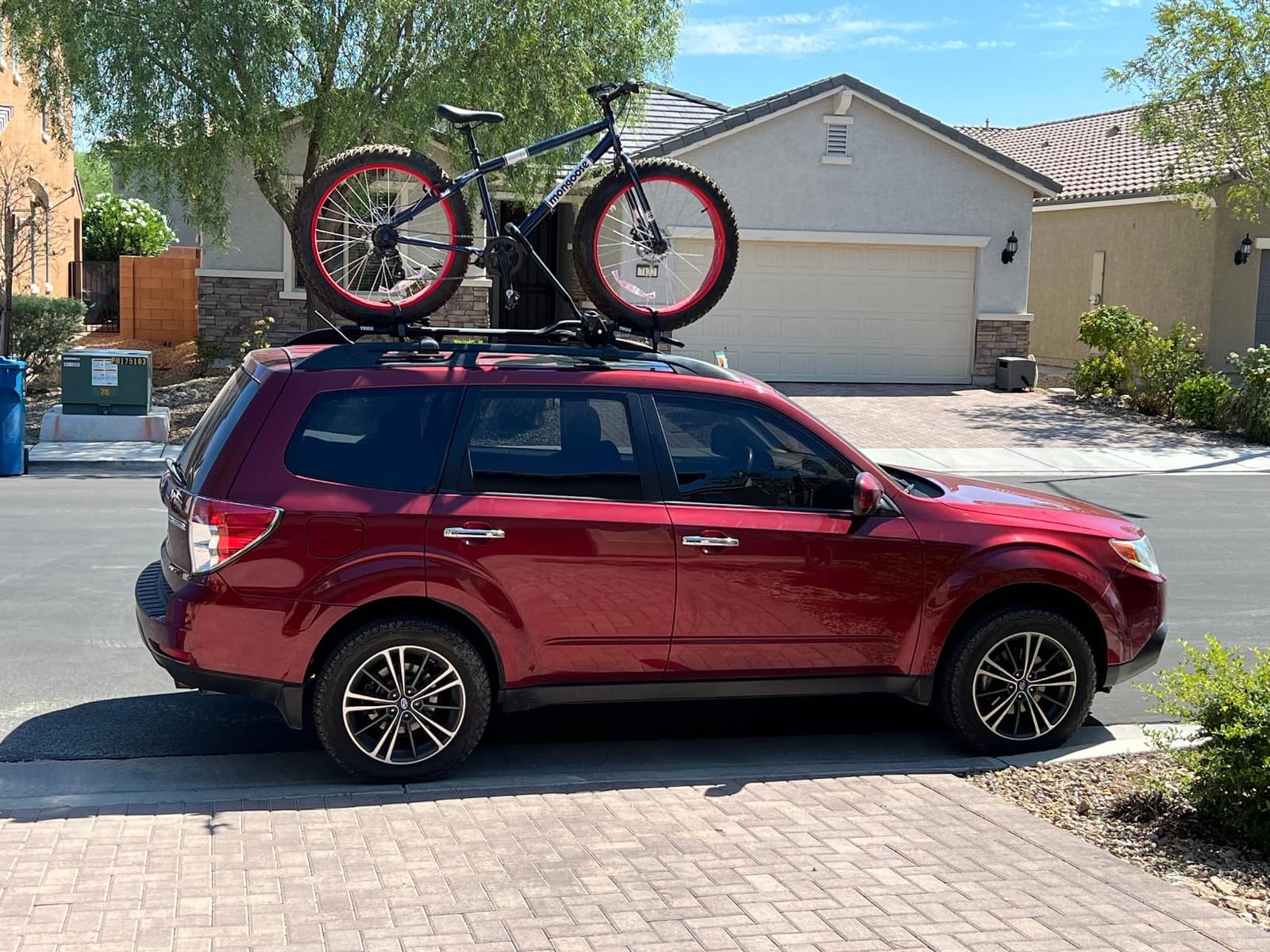
Loading is assisted by a frame holder and wheel tray that position the bike for you as you secure it, and diagonal quick release straps stabilise the wheel holders. It weighs 11 pounds, which sits in the middle of the field and is manageable on a sedan, and it mounts to all Thule rack systems and most factory racks.
Thule also backs it with a limited lifetime warranty, and owner reports mention customer service replacing a broken strap part quickly. That kind of parts support is a real difference in year three, not year one.
Who should deliberately choose a frame clamp
Riders who regularly carry suspension bikes and hardtails benefit, because a frame clamp keeps the bike flatter and steadier than a wheel cradle with a loose tire in it. Anyone with a bike that has a bulky down tube or an unusual profile also gets more of the frame actually supported.
It is also a rational choice when your bike is not delicate. On a hard-wearing aluminum mountain bike the case for never touching the frame is much weaker, and the added rigidity of a clamped frame is a benefit.
What to watch with the ProRide XT
Clamp friction is limited by design, so lining the bike up in the clamp takes two hands and a moment of patience. Anyone loading alone on a tall vehicle will feel that, and shorter riders in particular report it as awkward.
Some owners also report front wheel wobble on wide tires at highway speeds, which is worth taking seriously because repeated flex can wear wheel bearings. If you run wide tires at motorway pace all the time, a frame-free wheel mount removes that risk entirely.
8. RockyMounts Tomahawk – Best for Fat Tires and Wide Bikes
RockyMounts Tomahawk upright roof bike rack
Frame-free wheel hold
35 lb capacity
18 lb rack
Fat tires to 5 inch
Pros
- Fat bike ready out of the box
- Works with thru-axle bikes
- Quiet and firm at speed
- Mounts to round square factory and aero bars
Cons
- Front fenders not supported
- Picture-based instructions
- Lock cores sold separately
The Tomahawk is the value alternative to the premium wheel mounts, and the fat tire support is what separates it. It is ready for tires up to 5 inch wide straight out of the box, and two wheel strap extensions are included, so a wide bike needs no extra hardware. Most racks in this roundup need a separate adapter for that job.
Because it holds the bike by the wheels with a ratcheted hook over the front wheel, it never touches the frame, and that makes it compatible with thru-axle bikes where a fork mount would need an adapter. It accepts 20 to 29 inch wheels across road, gravel and mountain styles.
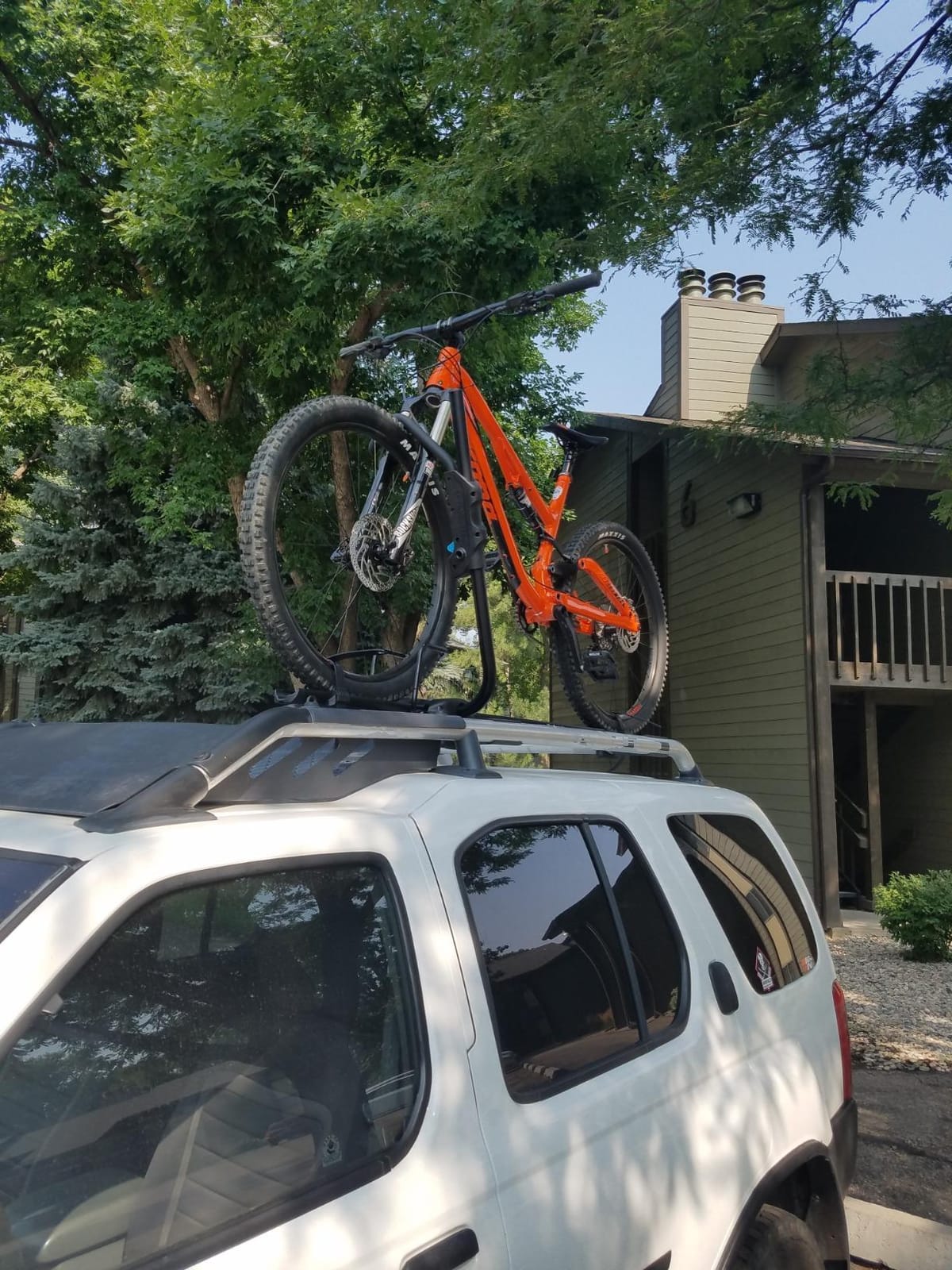
Owners report it holding firm over potholes and through fast cornering, and describe it as quiet at highway speed. A swingarm adjusts the carrier to the driver side or the passenger side, which helps you offset a single bike from the center of the roof, and it mounts to round, square, factory and aerodynamic crossbars.
There is a limited lifetime warranty behind it, and the brand has been reported to ship replacement parts free when something has worn out. Rated at 35 pounds per bike, it matches the mainstream wheel-mount figure rather than leading it.
Where the Tomahawk separates from the field
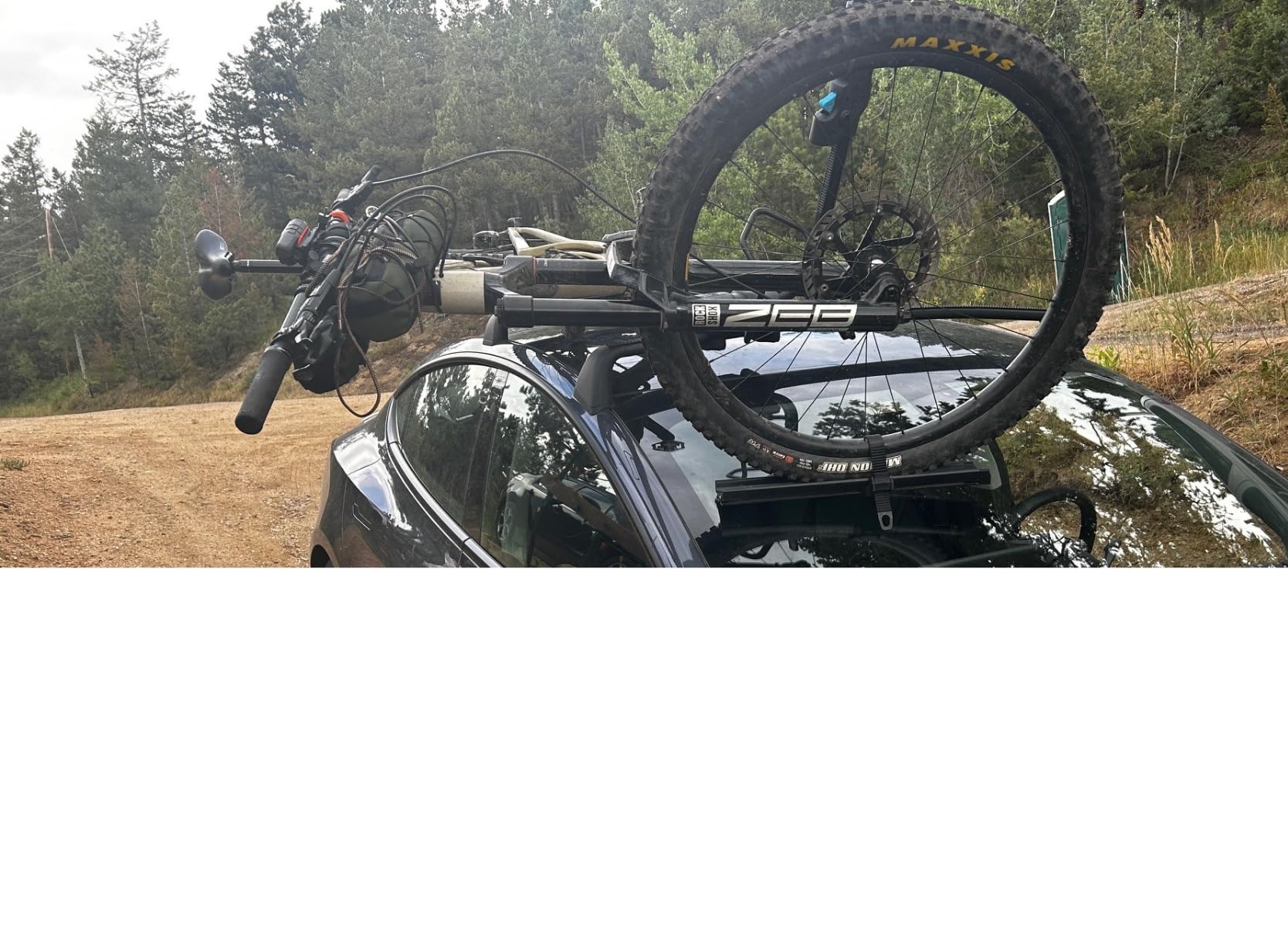
Fat tires and thru-axles, together, without an adapter. That combination is the reason to buy it over a premium wheel mount, and the included strap extensions mean the wide tire support costs nothing extra. Riders running full suspension bikes with a rear fender will appreciate the wheel-only approach too.
It also folds flat and loads easily, which is more than some premium carriers manage, and the Easy-Load wheel straps make getting a bike on and off noticeably quicker once the muscle memory is there.
What to check before you commit
Bikes with front fenders are not supported by the wheel hold, and that is a genuine limitation for anyone riding in the wet with a full mudguard on the front wheel. Check your bike before you order, because no strap adjustment solves it.
Assembly instructions are picture-based and confusing for first-time users, and the swingarm release is stiff enough that care is needed to stop the bike tipping. Lock cores are separate purchases, and at this tier they are a deterrent rather than a serious security measure.
Wheel Mount vs Fork Mount vs Suction: Which Style Do You Need?
Almost every roof rack decision reduces to one question: does the rack hold your bike by the wheels or by the fork? Suction designs are a third category that skips crossbars entirely. Here is the short version of each.
Wheel mount holds the bike by the wheels only. The front wheel sits in a cradle or behind a hook, the rear sits in a tray, and straps do the rest. Nothing touches the frame, so this is the safest option for a carbon frame, and no wheel removal is needed. The trade-offs are a taller profile, more wind noise at speed, and a front wheel that can move slightly inside the cradle.
Fork mount clamps the steering axis. You take the front wheel off, seat the fork in two blocks, and clamp with a skewer or an axle adapter. The result is the most rigid connection available and the lowest, quietest profile. The trade-offs are wheel removal, the need to carry the front wheel, and strict compatibility with your fork standard.
Suction cups skip the crossbars. The rack holds directly to the roof with rubber vacuum cups. It is the only option for a car with no rails and no desire to add bars, and it installs in minutes with no permanent hardware. The trade-offs are the lowest weight rating, dependence on a clean smooth roof, and less confidence over rough roads.
A tray or platform design is the fourth option, and it is rarer than it was. The bike stands upright on a flat tray and is strapped to the bar, with no frame clamp and no wheel cradle. It is simple, it works with heavy bikes, and it is bulky. The ProRide XT in this roundup sits at the boundary between a frame clamp and a platform, which is why it is the most versatile of the clamp designs here.
Our rule of thumb after testing all of them: if your frame or paint is valuable, use a wheel mount. If your bikes are heavy and your trips are long, use a fork mount with the correct adapter. If your car has no roof rails, a suction design is your only realistic option.
Can an E-Bike Go on a Roof Rack? Static vs Dynamic Load
Yes, an e-bike can go on a roof rack, but the rack rating and the car roof rating are two different numbers and people confuse them constantly. Your rack is rated per bike, typically 35 or 44 pounds in this roundup, while your car roof carries a total across the whole vehicle. Check both, and check the second one in your manual rather than assuming.
The more important number is the dynamic roof load limit. A car roof is rated for a static load, meaning weight sitting still on the roof with the car parked. Drive at speed and the load becomes dynamic, and the car is effectively an airfoil generating lift and drag. A heavy bike on the roof raises the vehicle centre of gravity, increases crosswind sensitivity, and can reach the dynamic limit well before the static one.
Treat the roof as a total-load budget rather than a per-bike rule. Roof camper owners on rpod-owners.com describe it exactly that way: they check the combined weight of everything up there, not each item, and treat the limit as a ceiling they stay under rather than a target. That is the correct approach.
For a heavy e-bike, remove the battery before loading if your model allows it. It is the single heaviest removable part on the bike, it is valuable, and it is the one component you never want strapped to a roof. Keep it inside the cabin with you.
If the two bikes and the bars push your setup past what you are comfortable with, a roof rack is the wrong answer rather than a cheaper one. Riders with tow bar fitted vehicles overwhelmingly prefer hitch racks for heavy e-bikes, and that preference exists for a reason.
Carbon Frames and Carbon Wheels: Choosing a Frame-Free Rack
A carbon frame is fine on a bike rack, as long as nothing clamps it. Compressed carbon is strong, but a metal clamp can mark the finish, dent a thin wall, or leave a lasting impression after a hot day on the roof. The safest answer is a rack that holds the bike by the wheels only.
That makes the wheel-mount shortlist clear: the Swagman Upright, the Yakima FrontLoader, the Thule UpRide and the RockyMounts Tomahawk. All four avoid frame contact entirely, and the Thule UpRide is explicitly listed by the manufacturer as suitable for carbon frames, non-traditional frame designs, rear suspension and bottle cages.
Carbon rims need a different kind of care. A wheel-mounted rack traps a wheel in a cradle for hours, and a bare carbon rim wall in a plastic hoop for a long hot drive is where you get a scratch or a crack. Fit rim tape or rim protectors on any bare carbon wheel before it goes on the roof, and check that the cradle pads are wide enough not to pinch the brake track.
The other frame-free warning is mudguards. A full front mudguard can foul a wheel cradle or a hook, and both the Tomahawk and the general wheel-mount category require you to check clearance around the tire and arch. A bike with a full fender is usually better served by a fork mount, where the wheel comes off and the fender is no longer in the way.
One last note on load. A light carbon road bike is the easiest thing to carry on a roof. A carbon-framed e-bike is the heaviest, and it is the combination that most often ends up on a car that cannot safely take it. Measure before you commit.
Do You Need Crossbars First? The Roof Setup Checklist
Most of these racks clamp onto crossbars, which means the crossbar question comes before the rack question. If you own a car with factory roof rails that accept a clamp, you are fine. If you have a bare roof, the crossbars are a separate purchase and they are the item most people forget to plan for.
1. Check whether your car has rated roof rails. Factory rails are usually stamped with a load limit, often somewhere between 100 and 165 pounds including the rails themselves. If the rails are there and you can clamp a compatible foot, you only need the feet, not a full bar system.
2. If you need bars, check bar width compatibility. Thule and Yakima sell a genuinely wide range of feet, and the fit depends on the shape and width of your bar. Do not assume a clamp fits a square bar because the picture looks right.
3. Check the bar width against the rack. Every carrier in this roundup except the suction design accepts square, round and oval bars up to around 3 inch wide, so most modern aero bars will work. Confirm it anyway before you order.
4. Add the bar weight to your total. A pair of aero bars plus feet is rarely trivial, and that weight is carried on the same roof as your bikes. Subtract it from your roof budget.
5. Measure your garage clearance with the rack fitted. Load a bike onto the roof, park in the garage, and look. This is the check that prevents the single most embarrassing and expensive roof-rack story there is, and a wheel mount adds real height above a fork mount.
Forgetting the bike is on the roof is the other half of that problem. A remote left in a cycling glove in the door pocket is a cheap and effective reminder, and a stripe of tape on the rack arms makes the empty rack obvious in a mirror.
Thule vs Yakima vs RockyMounts: Brand Reality Check
Long-term owners on bikeforums.net report near-identical durability across the major crossbar brands, and the thread names Thule Aero Blade load bars and Yakima racks inside the same system without a clear winner. The practical conclusion is that brand choice is mostly about local pricing, fitment and parts availability rather than build quality.
That is equally true of the carriers. Thule and Yakima both ship limited lifetime warranties on the racks in this roundup, both use tool-free mounts, and both offer the same core job: hold one bike to your bar. The difference is in the details, and the details are what should drive the decision.
Thule leans toward refinement and fit. The ProRide XT has a controlled clamping dial and adaptive pads, and the UpRide has the most capacity in the group at 44 pounds with the broadest compatibility list. Thule products fit all Thule rack systems and most factory racks, which makes sense if you plan to build a full Thule roof over time.
Yakima leans toward low profile and fast installation. The Forklift sits flatter than most and goes on in under a minute, and the FrontLoader is a genuinely well-executed wheel mount at 40 pounds. Both carry a limited lifetime warranty, and both work best when the rest of your roof is Yakima.
RockyMounts is the value answer. The Tomahawk matches the premium wheel mounts on fat tire support, adds thru-axle compatibility that many racks omit, and holds a limited lifetime warranty at a lower tier. You give up some refinement in the hardware and the instructions, and you buy lock cores separately.
So: if your roof is already one brand, stay on that brand. If you are starting from nothing, judge each carrier on fit, weight and warranty, and treat the badge as the last consideration rather than the first.
How to Choose a Roof Bike Rack: 7 Checks Before You Buy
1. Does your roof take the weight? Find the roof load limit in your manual, add the bar weight, and check the total against the dynamic limit rather than the static number. This is the check people skip and the one that matters most.
2. Will the bike fit the rack? Check wheel base, tire width and wheel size before anything else. The Swagman Upright caps wheel base at 54 inch and tires at 3 inch. The Thule UpRide and the Tomahawk take much wider tires, with the Tomahawk reaching 5 inch out of the box.
3. What is your fork standard? A 9mm quick release fork works with the Swagman Standard Fork Mount. Thru-axle and 15mm forks need an adapter or a different carrier, and finding that out after delivery is the most common purchasing mistake in this category.
4. Can you lift it? Rack weight ranges from 16 ounces to 18.5 pounds here, and that difference is the difference between a one-handed lift and a two-person job. Test the height of your loading position against the weight of the rack before you buy.
5. Front fenders or no front fenders? Wheel mounts generally need clearance around a full mudguard, and the Tomahawk does not support bikes with front fenders at all. Check your bike against the rack before the rack against the car.
6. How will you secure it? Some racks include tie-down straps and a lock, some sell lock cores separately, and both Thule racks here list locks as a separate item. Decide whether you are securing against a casual thief or a determined one, then budget accordingly.
7. How often will the bikes come off? Frequent daily use argues for tool-free mounts and light weight. Occasional holiday use argues for durability and a lock you are not paying for twice.
One more consideration that has nothing to do with hardware: the roof rack penalty for fuel economy. A tall rack adds aerodynamic drag, and riders report wind noise and buffeting on wheel mounts at speed. If your driving is mostly motorway, factor the noise and the fuel cost into how much you actually value the roof over a hitch rack.
Installation, Loading Order and the Garage Clearance Check
Install the rack on the car first, then load the bike. It is much harder to fit a skewer or tighten a strap with a bike already in the way, and nearly every owner complaint about awkward loading traces back to doing it in the wrong order.
On a wheel mount, clip the front wheel into the cradle first, set the rear into the tray, then pull the ratchet or tighten the straps and pull the front wheel firmly into the hook until it seats. On a fork mount, seat the fork in the blocks, fit the skewer or adapter, and tighten in stages with a proper torque check.
Tools are minimal. A torque wrench or a 4mm and 5mm hex key covers most of the fitting work, and a ratchet strap for the front wheel of a fork-mounted bike. Countersink the loose end of any strap so it cannot flap into a wheel.
Re-check the hardware after the first 50 to 100 miles. This is the single most repeated item in owner feedback: mounting hardware loosening on the highway, requiring a re-tighten. It is normal for a new fit-up to settle, and it costs five minutes to fix before it becomes a real problem.
Then park in the garage with the bikes loaded and look. Measure the height of your door opening, your garage, and any drive-throughs on your regular route before the first long trip rather than during it. If a wheel mount does not clear, a fork mount will be shorter, and a fold-flat design like the Tomahawk helps when the garage is tight.
For an all-in-one view of your other roof-carrying options, our picks for the best roof cargo boxes and the best ski racks for cars cover the winter half of the same roof system.
Frequently Asked Questions
What is the best roof bike rack?
The best roof bike rack depends on your bike and your car. The Swagman Upright is the safest all-round choice for most riders because it holds the bike by the wheels, weighs five pounds and needs no tools. Riders with a valuable carbon frame should look at a wheel-mount design such as the Thule UpRide, and a low-weight road bike on a Yakima bar suits a fork mount.
Is Thule or Yakima roof rack better?
Both brands report similar long-term durability, and the practical difference is fitment and price. Thule carriers fit all Thule rack systems and most factory racks and add controlled clamping force on the ProRide XT. Yakima carriers are lower profile and install faster, and the Forklift fits Yakima bars out of the box. If your roof is already one brand, stay on it.
What is the best roof bike rack for bikes with carbon frames?
Choose a frame-free wheel mount, because nothing then touches the frame. The Thule UpRide, the Swagman Upright, the Yakima FrontLoader and the RockyMounts Tomahawk all hold the bike by the wheels only. Add rim tape to bare carbon rims, and check that a full front mudguard clears the wheel cradle.
Can an ebike go on a roof rack?
Yes, but you must check the car roof limit as a total load across all bikes, bars and accessories, and you must check the dynamic limit rather than the static one. Remove the battery before loading if your model allows it. If the total is too close to your roof budget, a hitch rack is the safer answer for a heavy e-bike.
Do I need crossbars for a roof bike rack?
Usually yes, unless your car already has rated factory roof rails that accept compatible feet, or you choose a suction-mounted rack that clamps straight to the roof. Every carrier in this roundup except the suction design clamps onto crossbars, so check bar shape and width against the rack feet before you buy either.
Will a roof bike rack fit in my garage?
It often will, but you must measure. Wheel mounts sit higher than fork mounts, and a loaded rack adds the height of the bars plus the bike. Load a bike, park in the garage and check the clearance before your first long trip. A fold-flat carrier or a lower fork mount helps when the opening is tight.
The Verdict: Which Roof Bike Rack Should You Buy in 2026
The best roof bike racks for cars are not one product, they are four answers to four different situations. For most people the Swagman Upright Roof Mount is the pick: the most reviewed carrier here, the lightest at five pounds, frame-free, and it needs no tools.
Buy the Thule UpRide if your bike is worth protecting and you have someone to help lift. Buy the Thule ProRide XT if you prefer a controlled frame clamp and want the bike held flat. Buy the RockyMounts Tomahawk if you ride fat tires or thru-axle bikes and do not want to buy an adapter. Buy the ROCKBROS Sucker if your car has no roof rails and you will not add them.
And if your bikes are heavy, count the total against your roof dynamic limit before anything else. Pack light for panniers, and check out our bike pannier picks for the trips where the roof is the wrong tool.